
75% of Developers Prefer Claude Code Over Codex: What the ZDNet Survey Reveals About AI Coding Tool Preferences in 2026
The Survey That Shook the AI Coding Tool Landscape
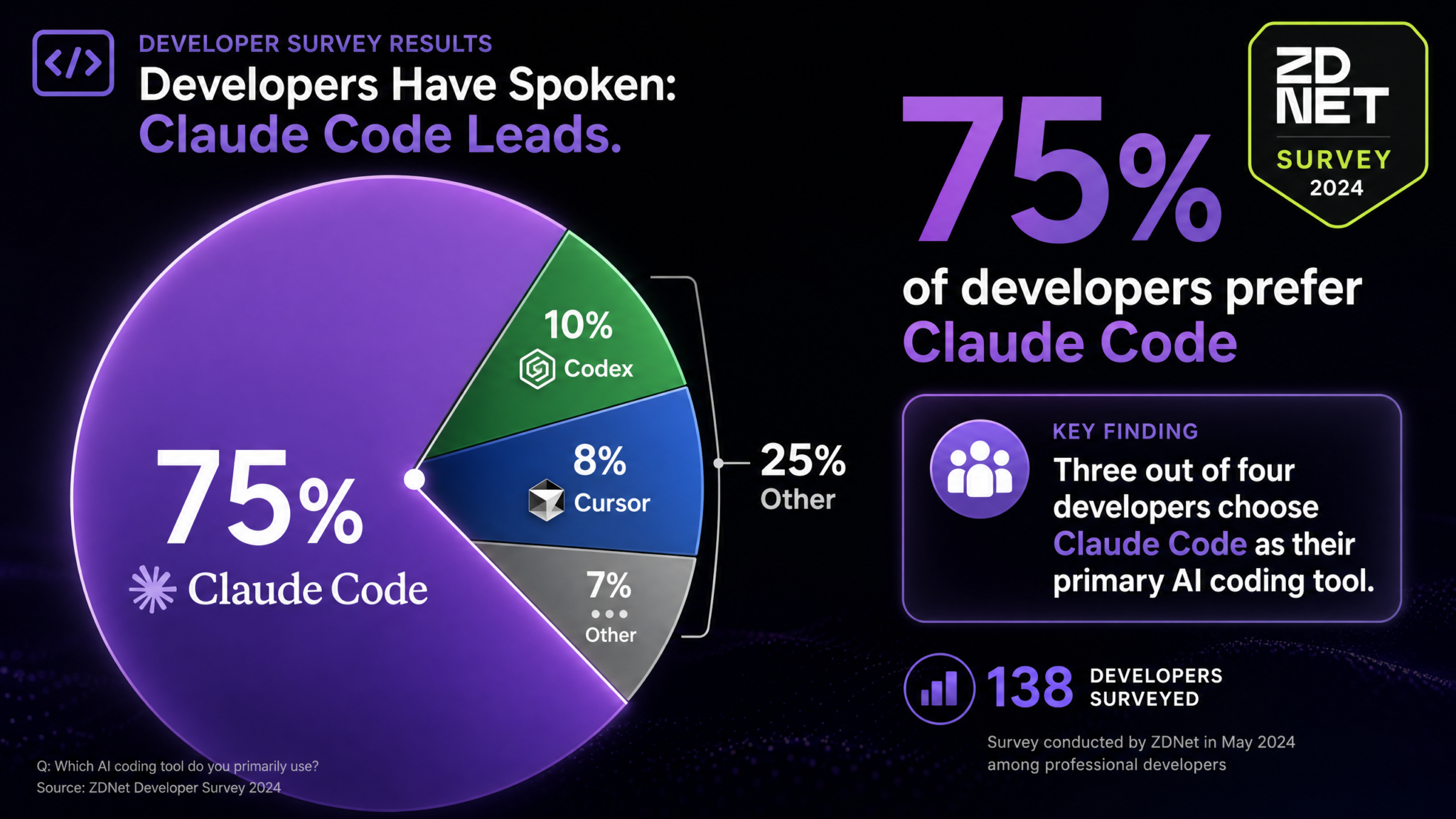
When ZDNet published its 2026 AI Developer Tooling Survey in late spring of this year, the results triggered a wave of commentary across Hacker News, developer Twitter, and engineering Slack communities that few industry reports manage to sustain for more than a news cycle. The finding was blunt, statistically significant given the sample, and directionally consistent with months of anecdotal developer conversations: three out of every four developers surveyed identified Claude Code as their primary AI coding tool, placing Anthropic’s terminal-native assistant in a position of clear dominance over OpenAI’s Codex and every other AI coding product currently on the market. In a segment that did not exist in any meaningful commercial form just three years ago, a 75-percent preference share represents something closer to a rout than a competitive race.
But raw preference numbers rarely tell the full story, and this survey is no exception. The ZDNet findings reward careful reading. The 75-percent figure obscures meaningful variation across developer types, company sizes, and use cases. Codex retains genuine strengths in enterprise governance and background task automation that Claude Code has not meaningfully addressed. The survey’s sample size of 138 developers is large enough to be directionally informative but small enough that its confidence intervals deserve respect. And the third-party tools ecosystem — Cursor, Windsurf, GitHub Copilot — occupies a separate and strategically important layer of the market that the headline number does not capture at all.
This article unpacks every layer of the ZDNet survey: what the methodology actually supports, why the preference gap exists in such pronounced form, what it reveals about the strategic positioning of both Anthropic and OpenAI, and what the AI coding tool landscape is likely to look like twelve months from now. For developers choosing between tools, for engineering leaders evaluating team-wide deployments, and for anyone tracking the competitive dynamics of applied AI, the ZDNet data provides the most structured public snapshot of developer preference available in 2026.
ZDNet Survey Methodology: Who Was Surveyed and How
Sample Composition and Recruitment
The survey was fielded between February 14 and March 31, 2026, producing 138 completed responses from developers who self-identified as regular users of at least one AI-assisted coding tool. ZDNet recruited participants through a combination of its own registered reader base, targeted outreach to developer communities on GitHub Discussions, and a smaller segment sourced through LinkedIn’s professional network targeting software engineering job titles. Respondents were not compensated for participation, a methodological choice ZDNet explicitly defended on the grounds that financial incentives introduce response quality degradation in technical surveys — a position with reasonable empirical support but which also limits sample size.
The recruitment approach skews the sample in ways that matter enormously for interpretation. ZDNet’s reader base in 2026 trends toward experienced practitioners with professional development backgrounds rather than students, bootcamp graduates, or casual hobbyist coders. The GitHub Discussions recruitment channel similarly favors developers who are already engaged with open source tooling conversations and therefore likely more opinionated and more experimental in their tool choices. The LinkedIn channel introduced somewhat more enterprise-oriented respondents, partially counterbalancing the open-source tilt of the GitHub cohort. ZDNet acknowledges these recruitment characteristics directly in the survey’s methodology appendix, which is more intellectual honesty than many industry surveys produce.
Experience Levels and Demographics
Of the 138 respondents, ZDNet’s published breakdown shows the following experience distribution:
| Experience Level | Definition Used | Respondent Count | Percentage |
|---|---|---|---|
| Junior | 0–2 years professional experience | 14 | 10.1% |
| Mid-level | 3–6 years professional experience | 41 | 29.7% |
| Senior | 7–12 years professional experience | 52 | 37.7% |
| Staff / Principal | 13+ years, architectural scope | 31 | 22.5% |
The experience skew toward senior and staff-level developers is significant. These are the practitioners who work across large, complex codebases — precisely the environment where Claude Code’s whole-codebase context awareness provides the most dramatic productivity differential over tools with narrower context windows or less sophisticated project-level memory. A survey that sampled primarily junior developers working on fresh greenfield projects might show meaningfully different preference distributions, because the features that drive Claude Code’s dominance in the ZDNet results are features that matter most at scale and complexity.
Company Size Distribution
Company size distribution among respondents broke down as follows: 31 percent worked at companies with fewer than 10 employees (solo practitioners and small startups), 24 percent at companies with 10 to 99 employees, 28 percent at companies with 100 to 999 employees, and 17 percent at companies with more than 1,000 employees. The relative underrepresentation of large enterprise respondents is the single most important limitation on how broadly the survey’s headline findings should be generalized. Enterprise developers operate under procurement constraints, security requirements, and team coordination dynamics that shift the relative value of different tools in ways the ZDNet sample cannot fully capture.
Geographic Distribution
Geographic data was not disaggregated in the published survey, though ZDNet noted that approximately 68 percent of respondents identified the United States as their primary work location, with the remaining 32 percent distributed across Canada, the United Kingdom, Germany, India, Australia, and several smaller markets. The heavy US weighting matters because Claude Code’s availability, pricing, and feature rollout has historically prioritized US users. Developers in markets where Anthropic’s infrastructure or pricing creates friction may have different preference profiles than this survey can detect.
Primary Survey Instrument Design
The core preference question asked respondents to identify their primary AI coding tool — the tool they would use first when sitting down to work on a coding problem. This is a more demanding and more informative framing than asking about tools used at all, because it forces respondents to reveal hierarchy rather than just breadth of adoption. Secondary questions asked about specific use cases, satisfaction drivers, areas of dissatisfaction, and likelihood of switching tools in the next 12 months. The switching intention data is arguably as important as the primary preference data for understanding where the market is heading.
The Headline Finding: 75% of Developers Choose Claude Code
Breaking Down the 75-Percent Number
Of the 138 respondents, 103 identified Claude Code as their primary AI coding tool — a figure that rounds to 74.6 percent and is reported throughout the ZDNet piece as “approximately 75 percent” or “three in four developers.” The remaining 35 respondents split their primary tool preference as follows:
| Primary AI Coding Tool | Respondent Count | Percentage of Total | Percentage Excluding Claude Code |
|---|---|---|---|
| Claude Code (Anthropic) | 103 | 74.6% | — |
| Codex (OpenAI) | 17 | 12.3% | 48.6% |
| GitHub Copilot | 8 | 5.8% | 22.9% |
| Cursor | 6 | 4.3% | 17.1% |
| Windsurf | 3 | 2.2% | 8.6% |
| Other / Multiple | 1 | 0.7% | 2.9% |
The spread among non-Claude-Code tools reveals that OpenAI’s Codex, while holding second place with 12.3 percent primary preference, faces competition not just from Anthropic but from multiple fronts. GitHub Copilot’s 5.8 percent primary preference share is striking given that Copilot has far greater installed base through its integration with VS Code and GitHub’s enterprise contracts. The fact that only 8 of 138 active AI tool users identify it as their primary tool suggests widespread use as a supplementary tool rather than a primary workflow anchor — a distinction with significant implications for how Microsoft should think about Copilot’s positioning.
Switching Behavior and Tool Recency
One of the more revealing secondary findings concerns how recently respondents had switched to their current primary tool. Among Claude Code primary users, 47 percent had adopted it within the past 12 months, and an additional 31 percent within the past 6 months. This means 78 percent of Claude Code’s current primary user base made their adoption decision in the 18 months preceding the survey. The tool is not simply retaining longtime users — it is actively capturing market share from competing tools with notable velocity.
Among former tool identities for Claude Code users, 34 percent reported switching from GitHub Copilot, 22 percent from Cursor, 19 percent from an earlier version of Codex or ChatGPT code mode, and the remaining 25 percent described themselves as first-time serious AI coding tool users who adopted Claude Code as their entry point. That last cohort is particularly important: for roughly one in four Claude Code primary users, the product did not displace a competitor so much as define the category in that developer’s experience.
Claude Code Terminal Setup and Configuration Guide
Satisfaction and Net Promoter Indicators
ZDNet also collected satisfaction ratings on a 1–10 scale. Claude Code primary users reported a mean satisfaction score of 8.4 out of 10. Codex primary users reported 7.1. GitHub Copilot primary users reported 6.8. The satisfaction gap between Claude Code and Codex is 1.3 points on a 10-point scale — meaningful but not catastrophic for Codex. The gap between Claude Code and Copilot at 1.6 points is more concerning for Microsoft given Copilot’s significantly larger installed base investment.
Why Developers Prefer Claude Code: The Five Core Reasons
ZDNet asked respondents to select and rank their top reasons for preferring their chosen primary tool. Among Claude Code users, the responses clustered around five dominant themes with notable consistency across experience levels and company sizes. Understanding these reasons in technical depth is essential to understanding both why the preference gap exists and how durable it is likely to be.
1. Context Awareness Across the Entire Codebase
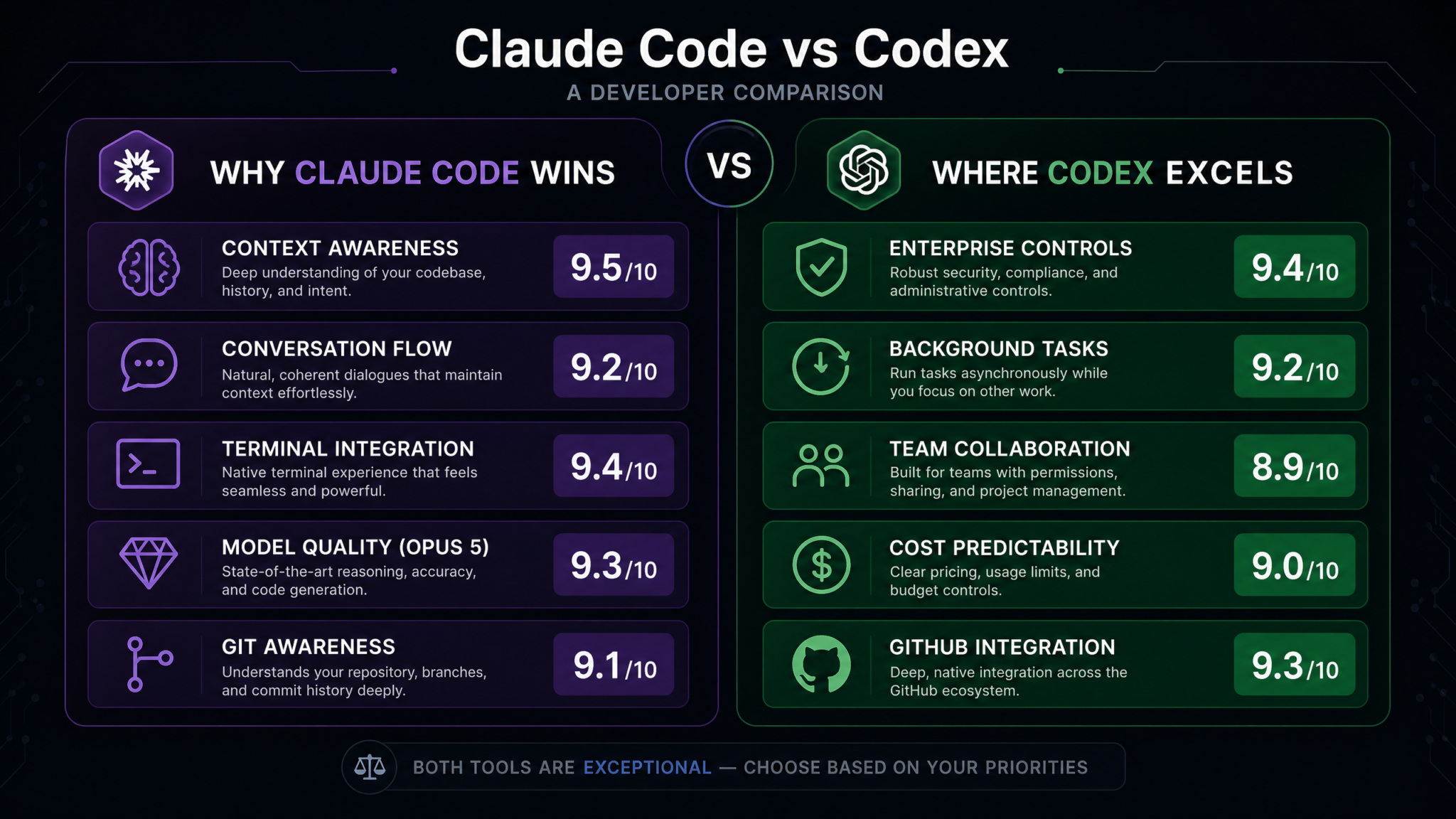
The single most cited reason — mentioned by 71 percent of Claude Code primary users in their top three preference factors — was context awareness at codebase scale. Claude Code’s ability to ingest, reason about, and maintain coherent understanding across entire project directories, including deeply nested dependency structures and cross-file function relationships, represents a fundamental architectural advantage over tools that operate primarily at the file or snippet level.
Senior developers were particularly emphatic about this dimension. In qualitative responses, engineers working on monorepo structures described Claude Code as the first AI tool capable of answering questions like “why does this API handler behave differently in the test environment than in production staging?” with responses that demonstrated genuine understanding of the configuration files, environment variable handling, middleware stack, and test fixture setup simultaneously — not just the isolated function in question. That kind of multi-file, systems-level reasoning is what distinguishes an AI coding assistant from an AI autocomplete tool, and Claude Code’s implementation of it received consistently high marks.
Claude Code achieves this partly through the Opus 5 model’s extended context window and reasoning architecture, and partly through intelligent project indexing that prioritizes recently modified files, import chains connected to the current working context, and configuration files with broad project-wide effect. The result is that developers spend significantly less time providing context in prompts because Claude Code has already assembled much of that context autonomously.
2. Natural Conversation Flow and Iterative Refinement
The second most cited reason, mentioned by 64 percent of Claude Code primary users, was the quality and naturalness of multi-turn conversation for iterative code development. This is a more subtle dimension than context breadth, but developers were highly articulate about why it matters in practice.
When a developer asks Claude Code to implement a feature, receives an initial implementation, and then says something like “this approach is going to create problems if the API rate limit gets hit during a batch job — can we make it resilient to that?” — Claude Code interprets that request within the full context of what was built, what the surrounding system architecture looks like, and what “resilient” implies in that specific context. It does not require the developer to re-explain the codebase, re-paste the relevant files, or re-establish the conversational context. This persistence of context through iterative refinement loops dramatically reduces the cognitive overhead of working with the tool, allowing developers to maintain focus on the problem rather than on managing the AI’s understanding of the problem.
Developers contrasted this favorably with Codex’s behavior in background task mode, where the autonomous execution model trades conversational fluidity for independence — a tradeoff that serves certain use cases well but fails developers who want a collaborative back-and-forth refinement process rather than a “describe it and wait” workflow.
3. Terminal-Native Workflow Integration
Claude Code’s decision to operate as a terminal-native tool rather than a GUI application or IDE plugin earned explicit praise from 58 percent of Claude Code primary users. This design philosophy aligns with how senior developers actually work: in the terminal, across multiple files simultaneously, with direct access to git history, test runners, build systems, and deployment scripts.
A terminal-native tool means developers do not need to switch context between an editor, a chat window, and a terminal — the AI lives in the same environment where the actual work happens. Claude Code can run tests directly, inspect git diffs, read build output, and iterate on implementation based on actual execution results rather than static code analysis alone. Developers described workflows like asking Claude Code to “make the integration tests pass” and watching it run the tests, read the failure output, diagnose the root cause, modify the relevant files, and rerun tests — all without leaving the terminal session.
This kind of agentic loop — not fully autonomous like Codex’s background task model, but responsive and iterative within a developer-supervised session — represents a design point that ZDNet’s respondents found highly productive. It preserves human oversight while dramatically reducing the mechanical overhead of the debug-modify-test cycle.
4. CLAUDE.md Project Files and Persistent Project Context
Forty-nine percent of Claude Code primary users specifically mentioned CLAUDE.md project files as a preference driver — a finding that surprised some industry observers given how recently this feature was introduced. CLAUDE.md files allow developers to encode persistent project-level context: architecture decisions, coding conventions, API patterns specific to the project, known edge cases, and domain-specific context that would otherwise need to be re-explained in every session.
For teams or individual developers working on long-lived projects, CLAUDE.md transforms Claude Code from a context-free assistant into a tool that understands the project’s specific history and constraints. Developers described maintaining CLAUDE.md files that document things like “this service communicates with a legacy SOAP API that has non-standard error codes — see the error mapping in src/adapters/legacy-soap.ts” or “we are intentionally not using TypeScript strict mode in the /migrations directory due to the Sequelize version pinning requirement.” Claude Code reads these files at session start and incorporates their content into every subsequent interaction, dramatically reducing the repetitive context-establishment overhead that makes AI coding tools frustrating on complex real-world projects.
Complete Guide to Writing Effective CLAUDE.md Files for Complex Projects
5. Git-Aware Operations and Version Control Intelligence
The fifth major preference driver, cited by 44 percent of Claude Code primary users, was the tool’s awareness of git history and version control context. Claude Code can inspect commit history, understand branch structure, read staged changes, and reason about code evolution over time in ways that inform its suggestions and explanations.
When a developer asks “why was this validation logic added here?” Claude Code can inspect the git blame, read the commit message, identify the associated files changed in that commit, and provide an explanation grounded in the actual change history — not just static analysis of the current code. This temporal awareness of codebase evolution represents a meaningful intelligence layer that pure autocomplete tools and context-window-only tools cannot replicate.
What Codex Does Better: Enterprise Features That Matter
Characterizing the ZDNet survey as an unqualified endorsement of Claude Code over Codex misreads the data. The 17 developers who identified Codex as their primary tool articulated clear, defensible reasons for their preference, and the qualitative data from enterprise-segment respondents reveals genuine competitive strengths that Anthropic has not yet meaningfully addressed. Understanding what Codex does well is as important for the market analysis as understanding why Claude Code leads overall.
Enterprise Security Compliance: SOC 2 and Beyond
For developers at companies with formal security compliance requirements, OpenAI’s Codex offers SOC 2 Type II certification, enterprise data processing agreements, and audit logging capabilities that satisfy procurement and legal review processes at organizations where AI tool adoption requires security team sign-off. Anthropic has made progress on enterprise compliance for Claude, but the depth and completeness of Codex’s enterprise security documentation has historically been a differentiator in procurement processes at regulated industries — financial services, healthcare, defense contractors, and publicly traded companies with stringent data handling policies.
Among the 17 Codex primary users in the survey, 12 cited compliance or procurement requirements as a significant factor in their organization’s tool selection. This is not a preference in the sense of “I enjoy using Codex more” — it is a constraint-driven adoption pattern that the preference headline number does not adequately capture. When regulatory or contractual requirements narrow the field, developer experience preferences become secondary factors.
Admin Controls and Team Management
Codex’s admin control layer — usage monitoring, cost allocation by team or project, policy enforcement for prompt patterns, and centralized access management — gives engineering managers and IT administrators visibility and control over AI tool usage that Claude Code’s current architecture does not match at the organizational level. For engineering leaders responsible for AI governance at scale, the ability to enforce usage policies, identify unusual patterns, and allocate costs accurately across teams is not a nice-to-have — it is a basic operational requirement.
Survey respondents who identified Codex as primary specifically praised the ability to set per-team token budgets, review anonymized usage summaries by department, and enforce prompt templates that comply with internal IP protection policies. These are features that individual developers may never notice or care about, but that make deployment decisions much easier for the infrastructure and security teams whose sign-off is required for enterprise-wide adoption.
Deep GitHub Integration and Repository-Native Workflows
OpenAI’s partnership with GitHub has produced integration depth between Codex and GitHub’s platform that Claude Code simply does not match today. Codex can operate on GitHub repositories directly — reading issues, creating branches, submitting pull requests, and responding to review comments — in ways that are native to GitHub’s own infrastructure rather than requiring terminal-level access to a local repository clone.
For development workflows that are heavily GitHub-centric — particularly open source projects and organizations that have standardized on GitHub Actions for CI/CD — this native integration reduces friction in specific automated workflows. Creating a pull request from a Codex-assisted change that includes an auto-generated description, linked issues, and appropriate labels, without leaving the GitHub interface, represents a workflow integration that Claude Code’s terminal-native design does not currently replicate.
Background Autonomous Task Execution
Codex’s asynchronous task execution model allows developers to assign coding tasks that run in the background while the developer works on something else, delivering completed results — whether a function implementation, a test suite, a documentation draft, or a refactoring pass — to a review queue. For certain classes of tasks, particularly well-specified, self-contained implementation requests, this autonomous execution model offers a meaningful productivity model that differs categorically from Claude Code’s synchronous interactive model.
Developers who work on tasks with clear acceptance criteria and who want to parallelize their own attention across multiple concurrent work items reported genuine satisfaction with Codex’s background task architecture. The tradeoff is that the autonomous model degrades significantly for ambiguous, exploratory, or architecturally complex tasks where the human developer’s judgment needs to be engaged continuously throughout the implementation process — which represents the majority of the interesting and difficult coding work that senior developers actually spend their time on.
Cost Predictability Through Included Usage Models
OpenAI’s enterprise Codex packaging, which bundles usage within a fixed subscription tier, provides cost predictability that usage-based billing models make difficult to achieve. For finance teams and procurement offices that require fixed-cost commitments for software tools, predictable monthly or annual pricing regardless of usage volume simplifies budgeting in ways that matter to procurement decisions even when they do not matter to individual developer preference.
The Preference Gap by Developer Type
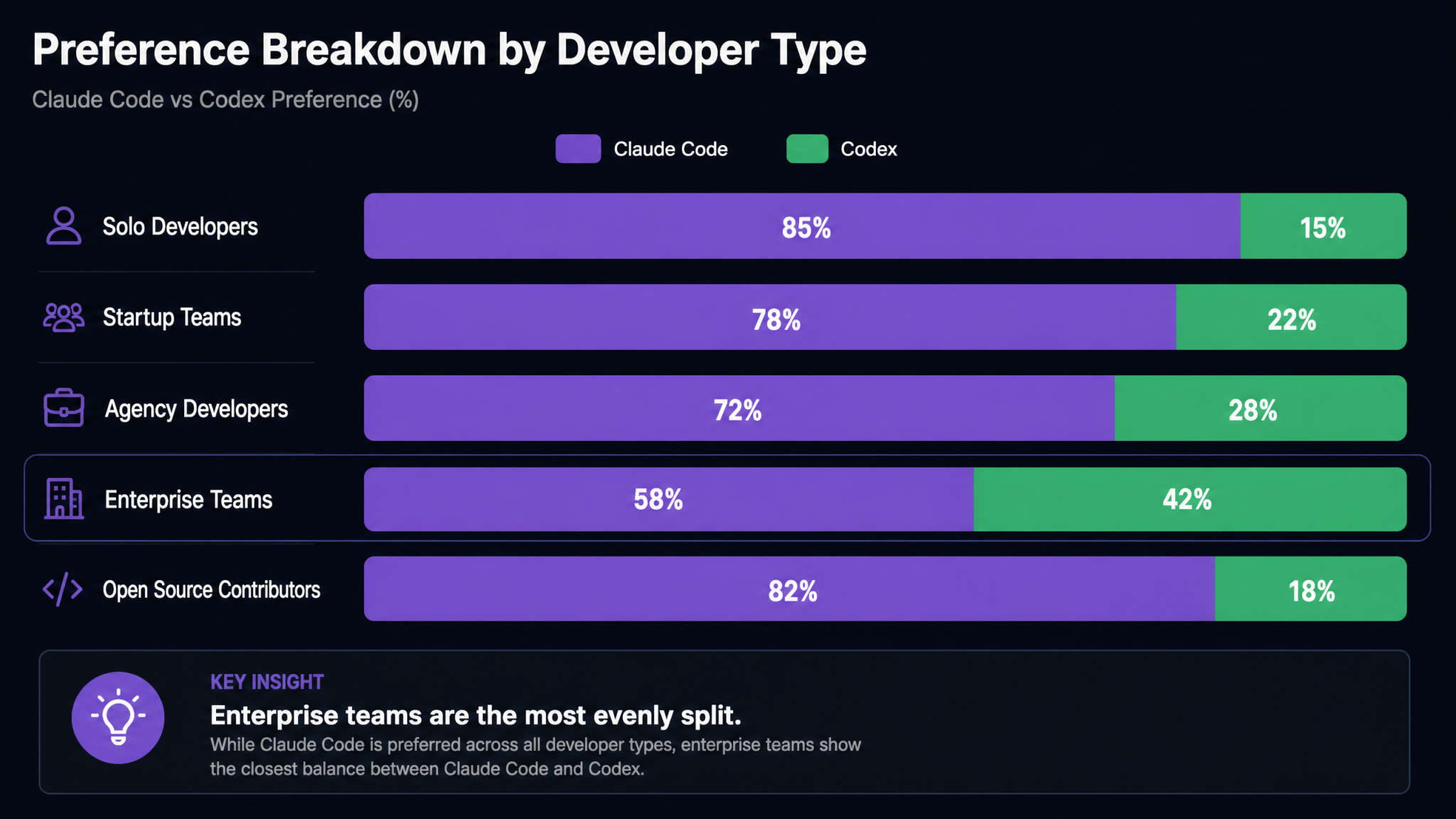
The aggregate 75-percent preference figure for Claude Code masks substantial variation across developer categories. Breaking the data down by developer type reveals a more nuanced competitive landscape with genuine implications for how each company should prioritize product investment.
Solo Developers and Freelancers
Among the 43 respondents who identified as solo developers, freelancers, or independent contractors, Claude Code’s preference share climbs to 88 percent — 38 of 43 respondents. This cohort has no organizational constraints, no compliance requirements imposed by procurement, and no need for team-level administrative features. Their tool selection is driven entirely by productivity and developer experience. In this unconstrained environment, Claude Code’s superiority on the dimensions developers actually care about — context awareness, conversational quality, workflow integration — produces a near-dominant preference share.
| Developer Category | Respondents | Claude Code Primary % | Codex Primary % | Other Primary % |
|---|---|---|---|---|
| Solo / Freelance | 43 | 88.4% | 4.7% | 7.0% |
| Small Team (2–10 devs) | 31 | 80.6% | 9.7% | 9.7% |
| Mid-Size Company (11–200 devs) | 37 | 70.3% | 16.2% | 13.5% |
| Large Enterprise (200+ devs) | 27 | 51.9% | 25.9% | 22.2% |
Open Source Contributors
Among respondents who identified significant open source contribution as part of their work, Claude Code preference was 82 percent — the second highest cohort preference share after solo developers. Open source contributors share several characteristics with solo developers in terms of AI tool selection: they work independently on complex, long-lived codebases, have high technical sophistication, and face no organizational procurement constraints. The CLAUDE.md project file feature proved particularly valued among open source contributors, who cited using it to document project history, contribution guidelines, and architecture patterns that new contributors would otherwise need to learn through code review feedback.
Enterprise Development Teams
The large enterprise cohort — 27 respondents at companies with more than 200 developers — shows the most balanced distribution: 51.9 percent Claude Code primary, 25.9 percent Codex primary, and 22.2 percent using other tools primarily. This is the competitive battleground where the outcome of the AI coding tools market is most genuinely uncertain. Enterprise developers represent disproportionate spending power, and their organizations’ procurement processes create structural advantages for tools with mature compliance documentation, regardless of developer experience quality.
Within the enterprise cohort, the 14 developers who chose Claude Code as primary despite working in enterprise environments described either having obtained explicit security team approval for Claude Code after formal review, or working in teams where individual developer tool selection remains discretionary rather than centrally mandated. The 7 who chose Codex cited compliance requirements, GitHub integration depth, and organizational standardization as their primary reasons — a pattern consistent with the constraint-driven adoption dynamic described earlier.
Developer Experience Level Breakdown
Preference also varied meaningfully by experience level. Junior developers showed the least skew toward Claude Code at 64 percent — reflecting both greater GitHub Copilot familiarity from educational contexts and less exposure to the complex, multi-file codebases where Claude Code’s context advantages are most visible. Senior and staff-level developers showed 79 and 81 percent Claude Code preference respectively — the most experienced practitioners being those most capable of evaluating the tool on the dimensions that matter most in professional-grade development work.
Third-Party Tools in the Survey: Cursor, Windsurf, and GitHub Copilot
The ZDNet survey’s value extends beyond the Claude Code vs. Codex comparison. The data on Cursor, Windsurf, and GitHub Copilot reveals important dynamics about the broader AI coding tools market that deserve independent analysis.
GitHub Copilot’s Disconnect Between Installed Base and Primary Preference
GitHub Copilot’s 5.8 percent primary preference share stands in stark contrast to its likely installed base leadership — Microsoft has reported tens of millions of Copilot users across its GitHub subscription tiers, and enterprise Copilot deployments are standard components of Microsoft 365 and GitHub Enterprise contracts at large organizations. Yet only 8 of 138 active AI tool users in this survey identify it as their primary tool.
This disconnect suggests that Copilot occupies a ubiquitous but secondary role in many developers’ workflows: installed because it comes with existing subscriptions, useful for simple autocomplete and inline suggestions, but not the tool developers turn to first when facing genuine complexity. This is a strategically precarious position — high penetration but low primacy — because it means Copilot’s installed base does not translate into competitive moat if a superior primary tool is available. Developers who use Copilot for autocomplete while using Claude Code for complex tasks represent a usage pattern that could shift entirely to Claude Code if Anthropic’s IDE integration capabilities mature further.
Cursor’s Niche but Loyal Audience
Cursor’s 4.3 percent primary preference share, representing 6 respondents, comes almost entirely from developers who specifically value its IDE-native experience with AI capabilities deeply integrated into a fork of VS Code. Cursor users in the survey were consistently satisfied — reporting a mean satisfaction score of 8.1 out of 10, the second highest behind Claude Code — but the tool’s primary audience is a specific segment of developers for whom the IDE-native AI experience is strongly preferred over a terminal-based or browser-based interaction model.
Access 40,000+ AI Prompts for ChatGPT, Claude & Codex — Free!
Subscribe to get instant access to our complete Notion Prompt Library — the largest curated collection of prompts for ChatGPT, Claude, OpenAI Codex, and other leading AI models. Optimized for real-world workflows across coding, research, content creation, and business.
Cursor’s challenge in the current market is that its core differentiation — AI deeply integrated into the editor — is a differentiation that Microsoft can replicate through Copilot’s continued development and that Claude Code can partially address through IDE plugins. The tool’s reliance on underlying models from third parties (primarily Anthropic’s Claude models and OpenAI models accessed via API) means it competes on interface design and workflow integration rather than model quality, a competitive axis that is harder to defend long-term than model capability differentiation.
Windsurf: A Specialized Challenger
Windsurf’s 2.2 percent primary share — 3 respondents — is too small to support detailed analysis from this sample, but all three Windsurf primary users were mid-level developers at companies in the 10–100 employee range, suggesting the tool may have particular resonance in a specific company size and experience level band. All three cited “Cascade” workflow features as their primary satisfaction driver, indicating that Windsurf’s agentic multi-step task execution capabilities had found genuine advocates among this small cohort. Larger sample sizes would be needed to characterize Windsurf’s competitive position with confidence.
Cursor vs Windsurf vs Claude Code Comparison for Professional Developers
Honest Methodology Critique: Limitations of the Data
Any analyst or developer relying on the ZDNet survey findings to make tool decisions or form strategic views should engage seriously with the survey’s methodological limitations. Not as a reason to dismiss the findings — they are directionally informative and consistent with observable market dynamics — but as a necessary constraint on how confidently and broadly those findings should be applied.
Sample Size and Statistical Power
138 respondents is a genuinely small sample for a market that contains millions of active AI coding tool users globally. At this sample size, the 75-percent finding for Claude Code has a margin of error of approximately ±7.4 percentage points at 95 percent confidence — meaning the true population preference share could plausibly range from 67.6 percent to 82.4 percent. This is still a large preference share at either end of the confidence interval, but the imprecision matters when interpreting subcategory breakdowns. The enterprise developer breakdown (27 respondents) and the Windsurf analysis (3 respondents) are operating with confidence intervals so wide that they should be treated as directional hypothesis generators rather than reliable population estimates.
Self-Selection Bias
Respondents who choose to complete a voluntary survey about AI coding tools are not a random sample of AI coding tool users. They are likely more engaged, more opinionated, and more experimental in their tool adoption than the average AI tool user. This selection effect may specifically inflate Claude Code’s apparent preference share, because Claude Code’s current user base skews toward early adopters and power users — exactly the profile most likely to respond to a ZDNet reader survey. Developers who use whatever AI tool their company provisioned without strong personal investment in the tool selection question are underrepresented in a voluntary response survey of this kind.
Time Period Considerations
The survey was fielded in the first quarter of 2026. Codex had undergone significant architectural changes in late 2025, and some of the enterprise features that represent Codex’s current competitive strengths were still being rolled out during the survey window. A survey conducted in the second half of 2026, after Codex’s enterprise feature set has had time to mature and diffuse through the market, might show meaningfully different results in the enterprise segment specifically.
Definition of “Primary Tool”
The survey’s framing of “primary AI coding tool” may interact with Claude Code’s design in ways that inflate its apparent share. Because Claude Code is a terminal-native tool used for substantive, complex coding tasks, developers who use it naturally tend to use it as their primary tool — it is not the kind of tool that slots naturally into a secondary, supplementary role. Copilot and Cursor, which integrate as IDE plugins, more naturally occupy a “secondary layer” role even for developers who use them frequently and value them highly. The question design may therefore undercount how frequently secondary tools are used relative to primary tools, artificially deflating the apparent market position of IDE-integrated assistants.
Geographic and Demographic Underrepresentation
The 68 percent US concentration in the sample leaves the survey unable to characterize developer preferences in markets like India (where price sensitivity and data locality concerns create different tool selection dynamics), the European Union (where GDPR compliance requirements create distinct procurement constraints), and China (where access to both Claude and Codex is limited by regulatory factors). A globally representative sample might show substantially different competitive dynamics in each of these major developer markets.
What This Means for OpenAI’s Strategic Direction
The ZDNet survey results, read alongside OpenAI’s observable product decisions throughout 2025 and early 2026, suggest that OpenAI has largely accepted a bifurcation of the AI coding tools market — and is executing a strategy designed to win the half where Codex’s structural advantages are strongest rather than competing head-to-head with Claude Code on developer experience.
Codex Is Pivoting Toward Enterprise Autonomy, Not Developer Experience
The clearest signal of OpenAI’s strategic repositioning is the product investment trajectory visible in Codex’s recent feature releases. Rather than investing in conversational quality improvements, context window expansion for codebase-level understanding, or terminal-native workflow integration — the dimensions where Claude Code dominates the developer experience comparison — Codex’s most significant recent investments have been in background task execution, multi-agent coordination, enterprise governance tooling, and GitHub workflow integration. These are investments in the enterprise automation layer, not the individual developer productivity layer.
This is a rational strategic response to competitive reality. Anthropic has demonstrated a sustainable advantage in conversational AI quality through its Constitutional AI training methodology and the Opus 5 model’s architectural characteristics. Competing directly on conversational quality against a company with Anthropic’s demonstrated capability in this dimension would require OpenAI to out-invest Anthropic in a direction where Anthropic has a head start, a committed research program, and what appears to be a fundamental architectural advantage. Instead, OpenAI is competing on the dimensions where its structural assets — its relationship with Microsoft, its early dominance in enterprise AI procurement, and its background task execution architecture — create defensible competitive advantages.
The Enterprise Automation Bet
OpenAI’s long-term bet, visible in both Codex’s product direction and in CEO statements throughout 2025, is that the AI coding tools market will increasingly be defined not by tools that help individual developers write code faster, but by autonomous systems that execute complete engineering tasks without continuous human supervision. In this vision of the market, the relevant competitive benchmark is not “which tool feels better to work with interactively” but “which system can reliably complete a well-specified engineering task end-to-end with minimal human touchpoints.”
Codex’s background task model, its GitHub integration, and its enterprise workflow features are all oriented toward this autonomous execution vision. If that vision proves correct — if the AI coding tools market’s center of gravity moves from interactive assistant to autonomous agent — then Codex’s current architecture is better positioned for the future than the current survey results suggest. Claude Code is designed for a human-in-the-loop interactive model; Codex is designed for a specify-and-supervise autonomous model. Which design philosophy better serves developers in 2027 will depend significantly on how rapidly AI reliability improves to the point where autonomous execution is trustworthy on complex, ambiguous tasks.
The Microsoft Factor
Any analysis of OpenAI’s strategic position in the developer tools market must acknowledge that OpenAI does not compete in enterprise AI purely on product merit — it competes through its deep integration with Microsoft’s enterprise sales channel, Azure infrastructure, and GitHub platform. Many enterprise Codex deployments happen not because engineering managers compared Codex to Claude Code and chose Codex, but because Codex came as part of an Azure AI services bundle that was already in the procurement pipeline for other reasons. This distribution advantage is invisible to developer preference surveys but enormously powerful in actual enterprise adoption dynamics.
How the Gap Might Close: What Codex Needs to Fix
The ZDNet survey documents a preference gap, not an uncloseable chasm. The history of developer tool preferences is a history of rapid reversals — tools that seemed entrenched have been displaced with surprising speed when a superior alternative gained sufficient momentum, distribution, and ecosystem integration. If OpenAI or the competitive dynamics of the market create conditions for the preference gap to narrow, the changes required are fairly clearly specified by the ZDNet data itself.
Context Management at Codebase Scale
The most cited preference driver for Claude Code — codebase-level context awareness — is an engineering problem with a known solution space. It requires large context windows, intelligent file prioritization, and the model training sophistication to reason coherently across large amounts of simultaneously presented code context. OpenAI has demonstrated world-class capability at each of these engineering challenges in other contexts; the question is whether the architectural and training investments required to match Claude Code’s codebase context performance are prioritized within Codex’s product roadmap or deprioritized in favor of the autonomous task execution direction described above.
If OpenAI invested heavily in matching Claude Code’s codebase context awareness, it would directly address the primary preference driver for the 75 percent of developers who currently choose Claude Code. This seems like an obvious investment from the developer preference data — but it potentially conflicts with the enterprise automation strategy that Codex’s recent feature trajectory suggests is OpenAI’s actual priority.
More Natural Conversation and Iterative Refinement
The quality of multi-turn conversation in Codex’s interactive mode — distinct from its background task mode — was cited as a specific dissatisfaction point by the 17 Codex primary users in the survey. Several described Codex as “forgetting” context within long sessions, requiring frequent re-explanation of constraints that should have been retained from earlier in the conversation, and producing responses that failed to account for implementation decisions made earlier in the same session.
This is a solvable problem that is ultimately about context window management within conversations and the model’s training on long-context coherence. Improvements to conversational persistence would not require a fundamental architectural change to Codex — they would require targeted investment in the interactive conversation quality layer that currently appears to be deprioritized relative to autonomous task features.
A Terminal-Native Option
Codex currently offers a web interface, an API, and GitHub integration — but not a terminal-native experience equivalent to Claude Code’s command-line interface. For the significant cohort of developers who prefer terminal-native workflows, this is simply a gap. Building a Codex CLI that matches Claude Code’s terminal integration depth would not require abandoning any existing Codex features — it would add a new interaction layer that serves a clear, demonstrated demand from the developer preference data.
Project Memory Features Equivalent to CLAUDE.md
CLAUDE.md’s ability to encode persistent project context was cited by 49 percent of Claude Code users as a preference driver — yet Codex has no direct equivalent. Implementing a project context file standard — whether named similarly or differently — would be a relatively low-complexity feature investment that directly addresses a documented preference gap. The concept of a developer-maintained context file that the AI reads at session start is straightforwardly replicable; the question is whether Codex’s product team treats it as a priority.
AI Coding Tool Context Management Strategies for Large Codebases
Predictions for 2027: Where the Market Goes From Here
Extrapolating from the ZDNet survey data, current product trajectories, and the broader dynamics of the AI tools market, several predictions for 2027 emerge with enough support from current evidence to be worth stating explicitly — not as certainties, but as the most probable outcomes given what is currently observable.
Prediction 1: Claude Code Maintains Preference Leadership Among Individual Developers
The structural advantages that drive Claude Code’s current preference share — context awareness, conversational quality, terminal-native workflow, CLAUDE.md — are not accidental features. They reflect deliberate product philosophy at Anthropic: building an AI tool for professional developers working on real-world complexity. These advantages will not disappear, and the preference gap among individual developers and small teams is likely to persist at broadly similar levels through 2027 unless Codex makes the specific investments described above, which current product trajectory does not suggest is the priority.
Prediction 2: Codex Gains Enterprise Share Through Non-Preference Channels
Despite Claude Code’s developer experience leadership, Codex’s enterprise revenue and enterprise user count are likely to grow faster than Claude Code’s over the next 12 months, driven primarily by Microsoft distribution advantages, enterprise compliance documentation, and the continued maturation of Codex’s autonomous task execution capabilities. A developer preference survey in 2027 may show similar or even slightly wider preference gaps favoring Claude Code while simultaneously showing Codex gaining revenue share — a paradox explained by enterprise procurement dynamics that operate largely independent of individual developer preferences.
Prediction 3: The IDE-Native Layer Consolidates Around Fewer Players
The third-party IDE-native tool layer — Cursor, Windsurf, and similar products — faces increasing pressure as both Anthropic and OpenAI invest in their own IDE integration capabilities, and as the underlying model providers whose APIs these tools depend on could theoretically restrict access or adjust pricing in ways that erode third-party margins. One or more of these tools is likely to be acquired by a larger player (the obvious acquirers being Microsoft, Anthropic, OpenAI, or a large cloud provider) or to undergo significant feature pivots to find a sustainable differentiated position.
Prediction 4: A New Entrant Disrupts on a Dimension Not Yet Competitive
The AI tools market has proven remarkably susceptible to disruption by entrants that compete on unexpected dimensions. Claude Code itself was not the obvious heir to GitHub Copilot’s early market leadership — its success came from competing on depth of reasoning and context rather than IDE integration convenience. In 2027, a tool competing on multi-developer collaborative AI sessions, real-time pair programming with AI, or deep integration with formal verification tools could capture a segment of developer preference that is not being served by any current tool’s design philosophy. The ZDNet survey data, valuable as it is, represents a snapshot of preferences formed around the capabilities of current tools — it cannot capture demand for capabilities that do not yet exist.
Prediction 5: The “Primary Tool” Concept Itself May Evolve
The ZDNet survey’s framing of “primary AI coding tool” assumes a tool selection dynamic that may be less stable in 2027 as AI capabilities expand. If AI coding tools become sufficiently capable at autonomous task execution, the relevant question may shift from “which tool do you prefer using interactively?” to “which AI system do you trust to execute tasks autonomously?” These are different products serving different needs, and the competitive dynamics around autonomous trust may favor different attributes — reliability, auditability, predictability — than the interactive preference dynamics that Claude Code currently dominates. Anthropic is clearly aware of this evolution, but Claude Code’s current design is optimized for interactive collaboration rather than autonomous trust, suggesting the company has product evolution work ahead to compete in the autonomous execution paradigm that Codex is racing toward.
| Market Dimension | Current Leader (2026) | Likely 2027 Position | Key Variable |
|---|---|---|---|
| Individual Developer Preference | Claude Code (75%) | Claude Code (70–80%) | Codex conversational improvements |
| Enterprise Revenue Share | Codex / Copilot | Codex / Copilot (strengthening) | Microsoft distribution, compliance depth |
| Autonomous Task Execution | Codex (emerging) | Contested (Claude, Codex, others) | AI reliability thresholds |
| Open Source Developer Adoption | Claude Code (82%) | Claude Code (stable) | CLAUDE.md ecosystem growth |
| IDE-Native Experience | Cursor / Copilot | Contested (consolidating) | M&A activity, first-party investment |
| Junior Developer Adoption | Claude Code (64%) | Potentially contested | GitHub Copilot educational initiatives |
Conclusion: A Market in Rapid Transition
The ZDNet 2026 AI Developer Tooling Survey produces a clear and credible finding: among active AI coding tool users with enough engagement to participate in a developer survey, Claude Code has achieved a dominant primary preference share that reflects genuine product superiority on the dimensions developers most consistently value — context depth, conversational quality, workflow integration, and project memory. The 75-percent figure deserves to be taken seriously as a directional indicator even while the methodological caveats surrounding sample size, self-selection, geographic distribution, and developer type composition are kept firmly in view.
The more interesting story beneath the headline number is the strategic divergence it reveals between Anthropic and OpenAI. Anthropic is building a tool for the way senior developers actually work today — in terminals, across complex codebases, through iterative collaborative conversations with an AI that understands the full scope of a project. OpenAI is building a tool for the way it believes developers will increasingly work in the near future — specifying tasks, supervising autonomous execution, and reviewing results rather than writing every line interactively. Both bets have internal coherence. Which bet the market rewards in 2027 and beyond will depend on how rapidly AI reliability scales to the point where autonomous execution is trustworthy on the kinds of complex, ambiguous tasks that currently require continuous human judgment.
For individual developers making tool decisions today, the ZDNet data offers straightforward guidance: if you work on complex, long-lived codebases and value deep contextual understanding and natural iterative refinement, the preference data strongly supports Claude Code as the current leading choice. If you work in an enterprise environment with formal compliance requirements, need deep GitHub integration, or are exploring autonomous task execution for well-specified engineering work, Codex’s enterprise features create genuine value that the overall preference numbers do not capture.
The AI coding tools market in 2026 is not a market with a settled winner — it is a market in rapid transition with genuine competition across multiple strategic dimensions. The ZDNet survey provides the clearest current snapshot of where individual developer preferences sit in that transition. What it cannot tell us — what no survey can tell us — is where the transition leads. That answer will be written in product releases, model capability improvements, enterprise procurement decisions, and the lived experience of millions of developers working on real projects in the months ahead. The tools that earn those developers’ primary preference in 2027 will have earned it by solving the problems that the current generation of tools, impressive as they are, still leave on the table.
The ZDNet survey is a data point, not a verdict. Read it as such, and it is genuinely informative about a market that deserves careful, evidence-grounded attention from every developer and engineering leader navigating the AI coding tools landscape right now.
