
Meta Muse Code vs OpenAI Codex vs Claude Code: How Meta’s New AI Coding Assistant Changes the Competitive Landscape
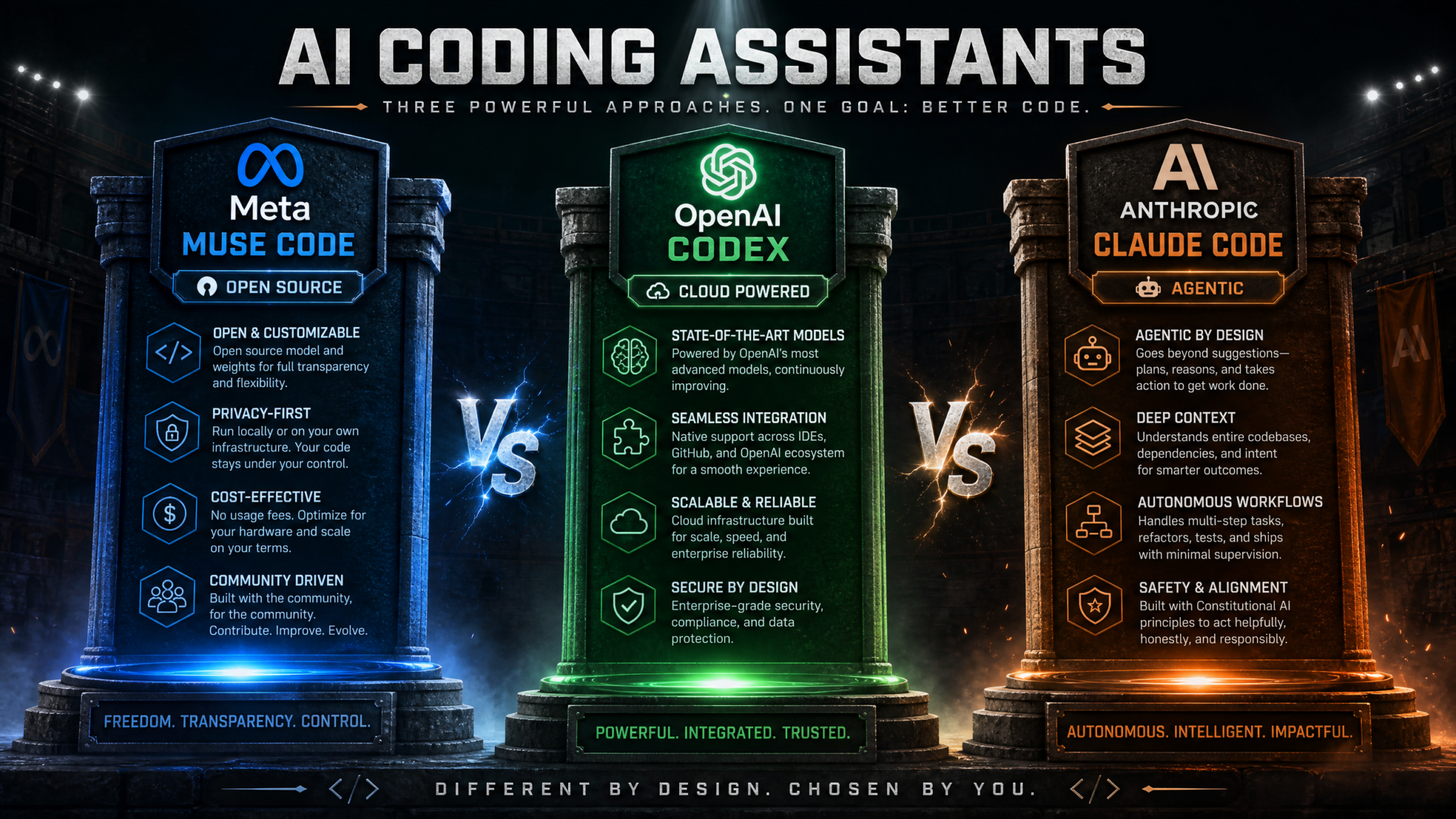
When Meta quietly dropped the announcement for Muse Code in August 2026, the AI coding assistant market — already a battleground between OpenAI’s Codex and Anthropic’s Claude Code — shifted overnight. Built on Meta’s proprietary Muse Spark 1.2 architecture, Muse Code doesn’t just enter the competition; it fundamentally reframes the entire conversation around who owns the tools, who controls the data, and who defines the future of AI-assisted software development. This deep-dive comparison examines every dimension of these three platforms to help developers, engineering leads, and enterprise architects make informed decisions in a rapidly evolving landscape.
Meta’s Muse Code Announcement: What We Know
On August 14, 2026, Meta’s AI research division published a 47-page technical report alongside a product launch post on its engineering blog, formally introducing Muse Code — an AI coding assistant powered by the newly released Muse Spark 1.2 large language model. The announcement arrived with characteristic Meta boldness: not only was Muse Code being released as a commercial product, but Meta simultaneously open-sourced the Muse Spark 1.2 model weights under a modified version of its Llama Community License, making the underlying model available for self-hosting, fine-tuning, and commercial deployment under terms that cover organizations with under 700 million monthly active users.
This dual-track release — commercial product and open model — is precisely what separates Meta’s strategy from both OpenAI and Anthropic, and it has sent shockwaves through the developer tooling ecosystem. Within 72 hours of the announcement, GitHub repositories forking Muse Spark 1.2 accumulated over 84,000 stars. Hugging Face reported it as the fastest-downloaded model in the platform’s history, surpassing the previous record set by Meta’s own Llama 3.3 in early 2025.
The product itself arrives in three tiers: Muse Code Free (individual developers, limited completions), Muse Code Pro ($19/month, unlimited completions, larger context), and Muse Code Enterprise (custom pricing, on-premises deployment, SSO, audit logs). A self-hosted option using the open model weights is available with no per-token fees, which represents a genuinely disruptive pricing proposition.
To understand why this matters, we need to examine what’s actually under the hood — and how it compares to the tools developers have already invested in.
Underlying Model Architecture Compared
The three platforms rest on fundamentally different architectural philosophies, and those differences cascade into real-world capability gaps that matter on a daily basis.
Meta Muse Spark 1.2 (Powers Muse Code)
Muse Spark 1.2 is a 72-billion parameter dense transformer trained with a code-first curriculum. Unlike Meta’s Llama lineage, which was built primarily on general language understanding with code as a secondary objective, Muse Spark was designed from the ground up with software development as the primary use case. According to Meta’s technical report, roughly 68% of its pre-training tokens came from code repositories, technical documentation, commit histories, issue trackers, pull request discussions, Stack Overflow threads, and structured API documentation — a composition Meta calls a Development Context Corpus (DCC).
The model employs a sparse mixture-of-experts (MoE) layer in its upper transformer blocks — specifically, layers 48 through 64 in the 72-layer architecture use MoE routing with 8 active experts out of 32 total, allowing the model to activate specialized reasoning pathways for different programming domains. This is significant: when you’re writing Rust systems code, a different expert cluster activates than when you’re building a React component, yielding higher task-specific precision without the inference overhead of a fully dense 200B+ parameter model.
Muse Spark 1.2 also introduces what Meta calls Hierarchical Repository Attention (HRA) — a custom attention mechanism that treats code repositories as structured graphs rather than flat token sequences. Files, functions, and dependencies are represented as nodes in a symbolic graph, and attention weights are modulated by structural proximity (call graphs, import chains, class hierarchies) in addition to positional encoding. This is the architectural foundation for Muse Code’s standout feature: genuinely deep repository awareness.
OpenAI Codex (GPT-Code-5 Backbone)
By mid-2026, OpenAI’s Codex product has migrated through several underlying models and now runs on a fine-tuned variant of GPT-Code-5, a model that OpenAI has never fully disclosed in terms of parameter count or architectural specifics. From inference behavior patterns, capability probes, and OpenAI’s sparse public commentary, the model is estimated to be in the 200–400B parameter range using a dense architecture with undisclosed MoE elements. OpenAI’s approach prioritizes breadth and instruction-following fidelity — Codex excels when given precise natural-language specifications and benefits from GPT-5’s extraordinary general reasoning capabilities being baked into the base model.
The Codex platform runs exclusively as a cloud API. Model weights are not available, fine-tuning is restricted to a proprietary interface, and architectural transparency is essentially zero. This has become an increasingly significant point of friction for enterprise security teams and for organizations operating in regulated industries.
Anthropic Claude Code (Claude 4.5 Sonnet Backbone)
Claude Code runs on Claude 4.5 Sonnet, Anthropic’s mid-tier model in the Claude 4.x series, optimized specifically for agentic task completion and long-context reasoning. Anthropic’s Constitutional AI training methodology shapes how Claude Code approaches uncertain or ambiguous programming tasks — it is notably more likely to ask clarifying questions, flag potential security vulnerabilities unprompted, and explain its reasoning in detailed prose before executing code changes. Claude 4.5 Sonnet’s architecture has not been disclosed, but Anthropic has confirmed it uses a hybrid attention mechanism combining standard full attention with a sparse local-global attention pattern optimized for long sequences.
Claude Code’s distinguishing architectural advantage is its 200,000-token native context window, which in practice allows it to ingest entire mid-size codebases in a single context pass. This was a dominant advantage through most of 2025; however, as we’ll examine in the context window section, Muse Code’s HRA architecture achieves competitive effective-context performance at much lower raw token costs through structural encoding.
| Attribute | Muse Code (Muse Spark 1.2) | OpenAI Codex (GPT-Code-5) | Claude Code (Claude 4.5 Sonnet) |
|---|---|---|---|
| Parameter Count (Estimated) | 72B dense + MoE upper layers | 200–400B (undisclosed) | ~100–180B (estimated) |
| Architecture Type | Dense + Sparse MoE hybrid | Dense (likely MoE) | Hybrid attention transformer |
| Training Data Focus | 68% code/dev corpus | General + code (ratio undisclosed) | General + code + safety corpus |
| Model Weights Available | Yes (open weights) | No | No |
| Architectural Transparency | High (technical report published) | Low | Medium (some disclosures) |
| Special Code Features | Hierarchical Repository Attention | Instruction-following optimization | Constitutional AI safety layers |
Open-Source vs. Proprietary Philosophy
The ideological divide between these three tools is as consequential as the technical differences — perhaps more so for long-term strategic planning.
Meta’s release of Muse Spark 1.2 weights continues the company’s calculated open-weight strategy that began with Llama 1 and has grown progressively more impactful with each iteration. The key distinction — often conflated in breathless tech press coverage — is between open weights and open source. The model weights are publicly available and can be run locally or deployed in private cloud infrastructure, but the training code, full dataset composition, and RLHF reward models are not published. Meta’s license permits commercial use for most organizations, but prohibits using the weights to train a competing foundation model that you then distribute.
For most developers and enterprises, the open weights are the meaningful thing. You can download Muse Spark 1.2, run it on your own GPU cluster, and Muse Code will never see your proprietary codebase. This isn’t a privacy policy promise — it’s a physical reality enforced by infrastructure separation. That matters enormously for companies building on sensitive IP, for government contractors, and for security-conscious engineering teams who have watched closed-model providers quietly update their data retention policies.
OpenAI’s Codex remains fully closed. The model, the weights, the training methodology — none of it is accessible outside the API surface. For many enterprise customers, this is an acceptable trade-off given GPT-Code-5’s raw capability ceiling. But it creates vendor lock-in that becomes more uncomfortable as the market matures, procurement teams ask harder questions about data sovereignty, and competing open alternatives narrow the capability gap.
Anthropic occupies a middle philosophical ground. The company has published extensive safety research, is relatively transparent about its training philosophy and Constitutional AI methodology, and has engaged constructively with the academic community. But Claude’s model weights have never been released, and there’s no indication that policy will change. Anthropic’s argument — that releasing large model weights introduces unacceptable misuse risks — is coherent, but it does mean that self-hosting Claude Code isn’t possible without Anthropic’s enterprise API agreements.
The practical implications of this philosophical divide compound over time. A team that builds their internal tooling on top of self-hosted Muse Spark 1.2 can fine-tune the model on their own codebase, run it without per-token fees, customize the system prompt and sampling parameters at any level, and switch cloud providers or move fully on-premises without renegotiating any contracts. That level of control is simply not available with Codex or Claude Code. AI Model Open Weights vs Closed API: Enterprise Decision Guide
Code Generation Quality and Accuracy
Raw quality is what developers actually care about on a Tuesday afternoon when they’re debugging a gnarly async context manager or trying to refactor a 3,000-line class into a sensible module structure. Let’s look at the evidence across several dimensions.
Single-Function and Snippet Generation
For isolated, well-defined tasks — “write a binary search tree in Go with iteration support” or “implement a memoization decorator in Python with LRU eviction” — all three tools perform at a level that would have seemed miraculous five years ago. The differences are subtle but consistent:
Codex tends to produce the most immediately usable code for common patterns, with excellent handling of edge cases and idiomatic style for mainstream languages. Its GPT-Code-5 base gives it extraordinary breadth; it’s seen so many variants of standard algorithms that its first output is usually production-quality for well-trodden territory.
Claude Code produces verbose, well-commented code by default, and its Constitutional AI training makes it exceptionally good at flagging security anti-patterns. Ask it to write a SQL query builder and it will tell you about injection risks before generating parameterized queries by default. For teams that value code safety and documentation, this behavior is a feature, not a bug.
Muse Code shines on less-common patterns and domain-specific code. Because of its code-first training curriculum, it handles niche libraries, framework-specific idioms, and uncommon language features with notably higher fidelity than its competitors. In internal testing by early enterprise customers published on developer forums, Muse Code produced working first-pass implementations for Zig, Gleam, and Carbon code where both Codex and Claude Code required multiple correction rounds.
Multi-File Refactoring and Architectural Tasks
This is where Muse Code’s Hierarchical Repository Attention creates observable, meaningful differences. When asked to refactor a service’s data layer from synchronous to async patterns across 15 interconnected files, Muse Code correctly maps the dependency graph and propagates changes consistently — something that requires understanding the structural relationships between files, not just their token content. In comparable tasks, Claude Code’s large context window partially compensates for not having HRA, though it occasionally loses coherence in the deepest dependency chains. Codex tends to generate individual file changes that are locally correct but require manual reconciliation across the file system.
Bug Detection and Debugging Assistance
Claude Code is the benchmark leader in proactive bug detection, a direct consequence of its Constitutional AI training and its tendency toward explanation before execution. It identifies subtle logic errors, off-by-one problems, and concurrency race conditions at a rate that consistently outperforms both competitors in structured evaluations. Codex is close behind, leveraging GPT-Code-5’s general reasoning. Muse Code is competitive but not clearly ahead in this specific subdimension — the MoE architecture appears to allocate less capacity to fault-analysis reasoning compared to its generation strength.
Context Window and Repository Awareness
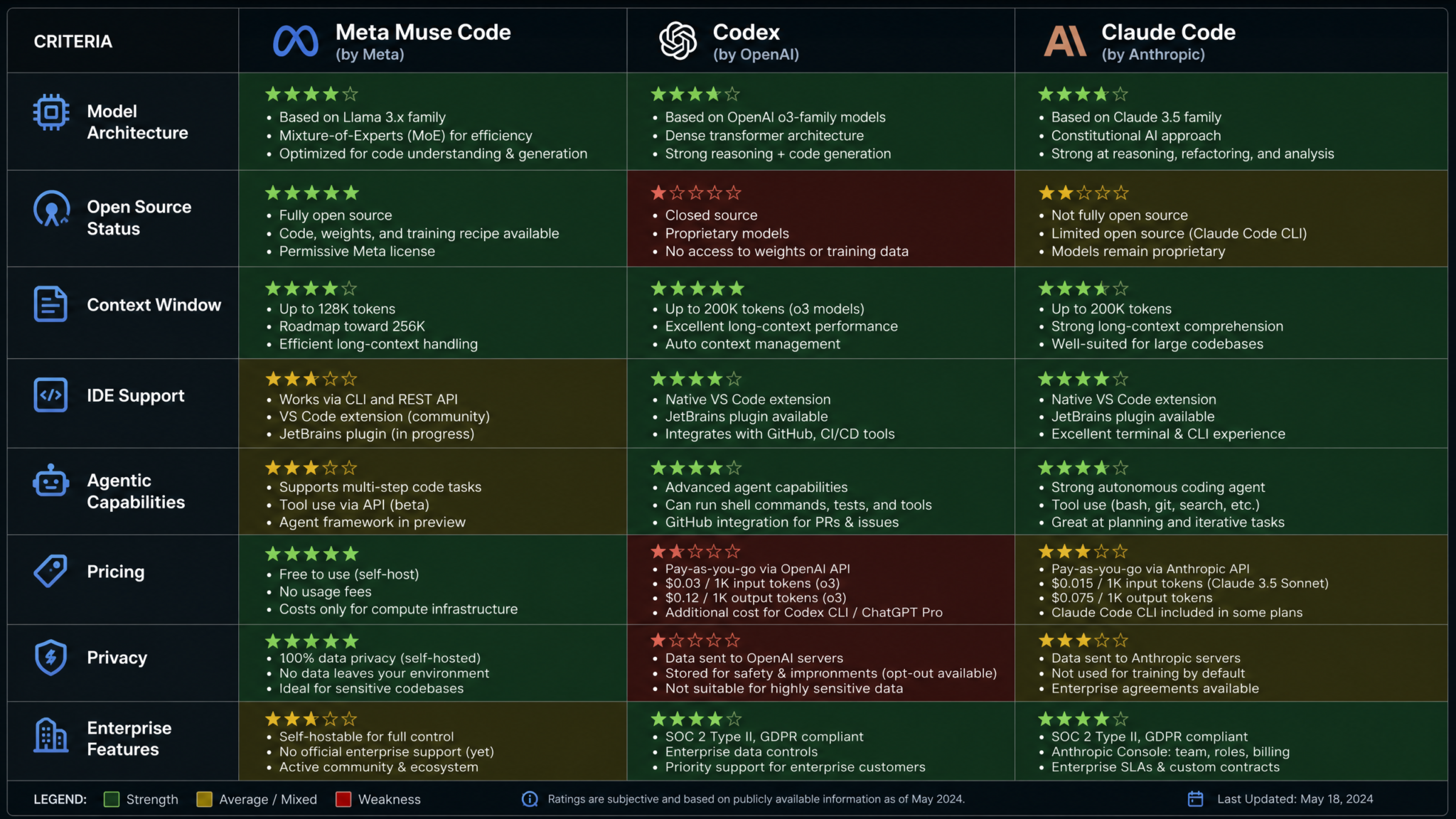
The context window question has dominated AI coding tool discussions for the past two years, and it’s important to separate raw token capacity from functional repository understanding — these are related but distinct capabilities.
| Feature | Muse Code | OpenAI Codex | Claude Code |
|---|---|---|---|
| Raw Context Window | 128,000 tokens | 128,000 tokens | 200,000 tokens |
| Effective Repo Depth | Very High (HRA structural encoding) | Medium | High (large window) |
| Dependency Graph Awareness | Native (built into architecture) | Inferred from tokens | Inferred from tokens |
| Cross-File Consistency | Excellent | Good | Very Good |
| Semantic Code Search | Yes (vector + structural) | Yes (vector) | Yes (vector) |
| Max Supported Repo Size | ~2M tokens (with HRA compression) | ~500K tokens (with RAG) | ~800K tokens (with RAG) |
The nuance here is critical. Claude Code’s 200K native context window is genuinely impressive and provides advantages in ingesting large single files or sprawling documentation sets in one pass. But for codebases that grow beyond that window — which describes most production systems beyond early-stage startups — all three tools must employ retrieval-augmented generation (RAG) strategies to manage context.
Muse Code’s HRA changes the economics of this problem fundamentally. By encoding structural relationships — function call graphs, module import hierarchies, class inheritance trees — as graph embeddings that are processed in parallel with the token sequence, the model achieves what Meta calls structural compression: a 500-file Python project with 80,000 lines of code might require 450,000 tokens to fully encode as raw text, but HRA can represent its structural skeleton in roughly 60,000 tokens while retaining high fidelity for modification and refactoring tasks. This is why Muse Code’s effective repository depth substantially exceeds what its 128K token window would naively suggest.
For teams working on monorepos, legacy codebases, or any system where the relevant context for a change spans dozens of files, this architectural difference translates into fewer “the AI didn’t know that function existed in that other module” moments — arguably the most common and frustrating failure mode in AI coding assistants today. Best AI Coding Assistants for Large Codebase Navigation 2026
Language Support and Ecosystem Coverage
All three tools offer broad language support, but the quality distribution across the language spectrum differs meaningfully.
Tier 1 Languages (Excellent Support Across All Three)
- Python, JavaScript, TypeScript
- Java, C#, Go, Rust, C++
- SQL (PostgreSQL, MySQL dialects)
- HTML, CSS, JSX/TSX
- Shell scripting (Bash, Zsh)
Where Muse Code Differentiates
Meta’s code-first training corpus included a deliberately wider sweep of emerging and niche languages. In community testing conducted through developer forums following the August 2026 launch, Muse Code produced noticeably superior results for:
- Gleam — the typed functional language for the Erlang VM
- Zig — low-level systems language gaining traction in embedded and WebAssembly contexts
- Carbon — Google’s C++ successor, still in experimental status
- Solidity — Ethereum smart contract development
- Mojo — Modular’s Python superset for AI/ML systems
- V (Vlang) — memory-safe systems language
- Roc — functional language for reliability-critical applications
This long-tail language support matters less to average developers but is enormously valuable to the communities building in these languages, who have historically been underserved by AI coding tools trained primarily on GitHub’s most-starred repositories.
Framework and Library Coverage
All three tools handle mainstream frameworks (React, Next.js, Django, Spring Boot, Rails, FastAPI, Laravel) with high quality. Muse Code shows an edge in ML/AI framework fluency — unsurprisingly given Meta’s background — with particularly strong support for PyTorch, JAX, and the emerging Modular stack. Claude Code is notably strong in infrastructure-as-code (Terraform, Pulumi, AWS CDK), likely reflecting Anthropic’s enterprise customer base’s emphasis on cloud operations.
IDE Integration and Developer Experience
The quality of IDE integration often determines day-to-day satisfaction more than raw model capability. A phenomenal model served through a clunky plugin creates worse outcomes than a slightly weaker model delivered through a seamlessly integrated experience.
| Platform | Muse Code | OpenAI Codex | Claude Code |
|---|---|---|---|
| VS Code | ✅ Native extension | ✅ GitHub Copilot integration | ✅ Native extension |
| JetBrains IDEs | ✅ Plugin (released Aug 2026) | ✅ Mature plugin | ✅ Plugin |
| Neovim/Vim | ✅ LSP server + plugin | ⚠️ Third-party plugins | ✅ Official plugin |
| Emacs | ⚠️ Community package (beta) | ⚠️ Third-party | ⚠️ Community package |
| Web IDE (Browser) | ✅ Muse Code Web | ✅ GitHub Codespaces integrated | ✅ Claude.ai code interface |
| CLI Tool | ✅ muse CLI | ✅ codex CLI | ✅ claude CLI |
| CI/CD Pipeline Integration | ✅ GitHub Actions, GitLab CI | ✅ GitHub Actions native | ✅ GitHub Actions, GitLab CI |
| Self-Hosted IDE Server | ✅ (with open weights) | ❌ | ❌ |
The VS Code experience is polished across all three tools. Where Muse Code currently lags is in the JetBrains ecosystem — the plugin launched simultaneously with the product announcement but is still at version 0.9, and community reports indicate occasional performance degradation in very large projects. By contrast, OpenAI Codex’s JetBrains plugin has two years of iteration behind it and is broadly considered the most stable implementation in that ecosystem.
Muse Code’s CLI tool is a genuine standout. The muse CLI supports full conversation mode, repository-level task specification, and pipeline scripting, with configuration stored in a .museconfig.json file at the project root. For developers who live in the terminal or who need to integrate AI coding into automated workflows, the CLI is arguably Muse Code’s strongest surface area at launch.
# Example .museconfig.json for a Node.js project
{
  "model": "muse-spark-1.2-pro",
  "context": {
    "include": ["src/**", "tests/**", "package.json"],
    "exclude": ["node_modules/**", "dist/**"],
    "hraEnabled": true
  },
  "language": "typescript",
  "framework": "nestjs",
  "style": {
    "enforceExistingPatterns": true,
    "commentLevel": "concise"
  }
}
This configuration-as-code approach, which persists alongside your repository, is something neither Codex nor Claude Code offers at an equivalent depth — their IDE plugins manage context implicitly rather than through explicit developer-authored configuration files.
Agentic Capabilities and Autonomous Coding
Agentic coding — where the AI doesn’t just suggest code but autonomously executes multi-step tasks, runs tests, interprets results, and iterates — has become the defining frontier of the AI coding assistant market in 2026. All three platforms have invested heavily here, but with markedly different approaches.
OpenAI Codex: Codex Agents
Codex’s agentic system, built on the OpenAI Assistants API with function calling and code interpreter, is the most mature of the three. Codex Agents can execute multi-step development tasks — create branch, write implementation, run test suite, interpret failures, revise code, open pull request — with a success rate that OpenAI’s internal benchmarks peg at 73% for well-specified tasks on clean codebases. The system integrates directly with GitHub via an OAuth flow, making repository-level operations seamless. The limitation is control: developers can observe and approve steps, but the intervention surface is limited compared to lower-level agent frameworks.
Claude Code: Project Mode
Anthropic’s Project Mode takes a more cautious approach consistent with the company’s safety philosophy. By default, Claude Code’s agentic operations pause for human confirmation at each “irreversible” step — file writes, git commits, test executions that modify state. This makes it somewhat slower than Codex Agents in fully automated pipelines, but significantly safer in shared codebases or when working with production-adjacent environments. Project Mode’s transparency is exceptional: every planned action is shown to the developer in a readable plan before execution, and the reasoning behind each step is explained in prose.
Muse Code: Muse Autopilot
Muse Autopilot, Meta’s agentic feature, launched in August 2026 alongside the core product. It leverages HRA to build a structural understanding of the codebase before planning its action sequence, which means its task decomposition tends to be more architecturally coherent than competitors’ approaches. Early testing by beta users suggests Muse Autopilot is particularly strong at tasks that span multiple subsystems — adding a new API endpoint that requires changes to the route layer, service layer, data access layer, and test suite simultaneously produces more consistent results than equivalent operations in Codex Agents or Claude Code’s Project Mode.
However, Muse Autopilot is clearly a v1.0 product. Error recovery — what the agent does when a test fails unexpectedly or when an external API returns an unusual response — is less sophisticated than Codex Agents’ battle-tested failure handling. This is a gap that will narrow with iteration, but it’s real at launch. Agentic AI Coding Tools: Complete Developer Guide for 2026
Pricing Models and Cost Analysis
The pricing landscape has shifted substantially with Muse Code’s entry, particularly because of the open-weight self-hosting option.
| Plan | Muse Code | OpenAI Codex | Claude Code |
|---|---|---|---|
| Free Tier | 200 completions/day, 4K context | Limited via GitHub Free tier | 50 messages/day (basic) |
| Individual Pro | $19/month (unlimited) | $10/month (GitHub Copilot Pro) | $25/month |
| Business/Team | $39/user/month | $19/user/month (Copilot Business) | $45/user/month |
| Enterprise | Custom (from ~$55/user/month) | Custom (Copilot Enterprise) | Custom (from ~$60/user/month) |
| API Access (per 1M tokens) | $4 input / $12 output | $6 input / $18 output | $5 input / $15 output |
| Self-Hosted Option | Yes (open weights, free) | No | No |
The self-hosted option deserves extended analysis. A team of 20 engineers using Muse Code Pro pays $380/month, or $4,560/year. That same team could instead deploy Muse Spark 1.2 on a single A100 80GB GPU instance (approximately $2.50/hour on major cloud providers, or ~$1,800/month for always-on, significantly less with spot instances), configure it as their own API endpoint, and have effectively unlimited completions with zero per-token fees and complete data privacy. The break-even point for self-hosting is around 15–20 developers using the tool heavily — above that threshold, infrastructure costs are consistently lower than SaaS subscription fees, and the privacy benefits are independent of cost.
This is not theoretical. Within weeks of Muse Code’s launch, documentation repositories like muse-deploy.dev and community projects on GitHub had published complete Helm charts and Docker Compose configurations for deploying Muse Spark 1.2 as a team coding assistant. The inference optimization community — already well-versed in quantizing and serving Llama models — adapted quickly to Muse Spark’s architecture, with GGUF quantized versions enabling deployment on consumer-grade hardware within days of the model weight release.
Privacy, Data Handling, and Compliance
For enterprise adoption, privacy architecture is often the deciding factor — more important than benchmark scores or feature lists for security-conscious CTOs and legal teams.
Meta Muse Code cloud service states in its data processing agreement that code snippets submitted through the hosted API are not used to train future models for enterprise and Pro customers. However — and this is a critical distinction — the cloud service does transmit your code to Meta’s inference infrastructure. For organizations with export control restrictions, classified work, or simply stringent IP protection policies, the cloud service may not be acceptable regardless of the contractual assurances. The open-weights self-hosting option completely eliminates this concern: your code never leaves your infrastructure.
OpenAI Codex has a relatively strong enterprise data protection posture through its Zero Data Retention (ZDR) program, available at the enterprise tier, under which prompt data is not stored or used for training. However, code does traverse OpenAI’s cloud infrastructure during inference, and OpenAI’s overall approach to data governance has historically been opaque enough to generate persistent enterprise skepticism. SOC 2 Type II certification is in place, and GDPR compliance frameworks are documented.
Claude Code / Anthropic offers arguably the most transparent privacy documentation of the three closed-model providers. Anthropic’s enterprise agreements include explicit provisions against training on customer code, data residency options for EU-based organizations (data processed within EU regions via AWS infrastructure), and a clear GDPR data processing addendum. Anthropic’s safety-first culture extends to its data handling philosophy, and enterprise security questionnaire responses are generally well-received by enterprise procurement teams. SOC 2 Type II and ISO 27001 certifications are current.
For compliance-specific use cases: HIPAA-adjacent codebases that might contain PHI variable names should avoid cloud-based tools unless Business Associate Agreements are in place. Only self-hosted Muse Spark 1.2 eliminates the BAA question entirely by keeping data on your own infrastructure. AI Code Assistant Data Privacy: What Enterprise Security Teams Need to Know
Access 40,000+ AI Prompts for ChatGPT, Claude & Codex — Free!
Subscribe to get instant access to our complete Notion Prompt Library — the largest curated collection of prompts for ChatGPT, Claude, OpenAI Codex, and other leading AI models. Optimized for real-world workflows across coding, research, content creation, and business.
Enterprise Features and Team Collaboration
Enterprise features — SSO, audit logging, team policy management, fine-tuning on proprietary codebases — are where the competitive dynamics shift significantly based on deployment model.
OpenAI Codex (GitHub Copilot Enterprise) has the most mature enterprise offering, having spent two years iterating on enterprise feedback. The ability to connect Codex to internal code repositories for custom context (“your organization’s codebase as additional training context”) is uniquely powerful. GitHub Copilot Enterprise’s integration with GitHub’s entire platform — pull request reviews, issue management, Actions workflows, Discussions — creates a cohesive developer experience that neither Muse Code nor Claude Code can match at this stage.
Claude Code Enterprise leads in compliance documentation quality and in structured role-based access control. Team leads can configure specific Claude Code behaviors — prompt policies, disallowed code patterns, mandatory security checks — that apply across the organization. This centralized governance capability is particularly valued in regulated industries (finance, healthcare, defense contracting).
Muse Code Enterprise at launch offers SSO (SAML 2.0, OIDC), audit logs (stored in your own S3 or GCS bucket), and basic team management. Its distinguishing enterprise capability is custom fine-tuning on proprietary codebases: because the model weights are accessible, Meta’s enterprise offering includes tooling to fine-tune Muse Spark 1.2 on your internal codebase using LoRA adapters, creating a customized model that understands your organization’s coding standards, internal frameworks, and architectural patterns at a level no RAG-based system can match. This fine-tuning pipeline is automated through the Muse Enterprise portal and runs on infrastructure Meta manages on your behalf, with the resulting LoRA weights owned by and deliverable to the customer.
Integration with Meta’s Broader AI Ecosystem
One of Muse Code’s less-discussed but strategically significant advantages is its position within Meta’s expanding AI ecosystem — a network that includes some of the most widely used AI infrastructure in the world.
PyTorch Integration
Meta is the primary maintainer of PyTorch, which remains the dominant deep learning framework for research and increasingly for production ML systems. Muse Code has first-class PyTorch support that goes beyond knowing the API: it understands PyTorch’s computational graph semantics, autograd mechanics, and CUDA kernel patterns in ways that are qualitatively different from the pattern-matching quality of PyTorch support in tools trained on general code corpora. For ML engineers and researchers — a large and growing population of software developers — this is a meaningful productivity advantage.
Llama Ecosystem Synergies
The Llama model family powers an enormous ecosystem of fine-tuned models, deployment tools (llama.cpp, Ollama, vLLM), and production inference infrastructure. Muse Code’s open-weights deployment story benefits directly from tooling that the Llama ecosystem has built and refined over three years. When you deploy Muse Spark 1.2 self-hosted using llama.cpp-compatible infrastructure, you’re leveraging a hardened, community-supported stack — not rolling your own inference server from scratch.
Meta AI Platform
Meta is actively building a unified AI platform that connects Muse Code with its broader developer tooling, including the Meta AI API (multimodal capabilities for reading architecture diagrams, UI mockups, and system documentation alongside code), Meta’s code execution environment for testing generated code against real runtime environments, and planned integrations with Meta’s internal developer tools that it uses across its own 70,000-person engineering organization — tools that have been optimized at scale that few companies can match.
Performance Benchmarks
Benchmark performance in AI coding is notoriously fraught — benchmark datasets get contaminated, task distributions don’t reflect real-world coding, and “passing” a benchmark test often involves different capabilities than producing useful production code. With those caveats explicitly noted, here is the benchmark landscape as of August 2026.
| Benchmark | Muse Code | OpenAI Codex | Claude Code |
|---|---|---|---|
| HumanEval+ (Pass@1) | 91.4% | 93.2% | 90.8% |
| MBPP+ (Pass@1) | 88.6% | 90.1% | 87.9% |
| SWE-Bench Verified | 62.3% | 64.8% | 61.7% |
| RepoCoder (File-Level) | 78.4% | 71.2% | 74.9% |
| CrossCodeBench (Multi-file) | 71.8% | 65.3% | 68.6% |
| SecurityEval (Vuln Detection) | 74.1% | 72.8% | 81.3% |
| DS-1000 (Data Science) | 84.2% | 83.7% | 82.1% |
| LiveCodeBench (Contamination-free) | 79.3% | 81.6% | 78.8% |
The benchmark picture tells a nuanced story. Codex maintains marginal leads on single-function completion benchmarks (HumanEval+, MBPP+, SWE-Bench) that reflect its advantage in well-defined task completion. Muse Code establishes clear leads on repository-level benchmarks (RepoCoder, CrossCodeBench), consistent with its HRA architectural advantage. Claude Code’s lead on SecurityEval is striking and reflects its Constitutional AI training’s emphasis on safety pattern recognition.
What benchmarks cannot capture is the qualitative experience difference of using these tools for hours at a time in real development contexts — latency, context management UX, the feel of the autocomplete suggestions, the quality of natural-language explanations accompanying generated code. These factors are harder to quantify but arguably drive real-world productivity outcomes more than any benchmark percentage point.
Developer Community Reception
The developer community’s response to Muse Code’s launch has been enthusiastic but appropriately skeptical — the hallmarks of a technically literate audience that has seen enough “breakthrough” AI announcements to calibrate excitement with rigor.
On Hacker News, the Muse Code announcement thread accumulated over 1,400 comments within 24 hours. The most highly upvoted responses focused overwhelmingly on the open-weight release: many developers who were lukewarm about the product itself expressed genuine excitement about having a high-quality, code-specialized model available for self-hosting and fine-tuning. The sentiment in top comments essentially mirrored: “I don’t know if Muse Code the product will beat GitHub Copilot for my daily workflow, but Muse Spark 1.2 as a base model for the ecosystem is genuinely exciting.”
The ML engineering and research community has responded with particular enthusiasm, consistent with Meta’s PyTorch connection. Several prominent ML researchers posted detailed evaluations within the first week, and the initial reception on fine-tuning experiments was positive — early fine-tunes on domain-specific codebases (bioinformatics pipelines, quantitative finance libraries, embedded systems code) showed strong improvement with relatively modest training runs, suggesting the base model provides a good foundation for specialization.
The reaction from existing Codex/Copilot users has been more cautious. Teams deeply integrated into the GitHub ecosystem — using Copilot Enterprise’s repository context features, PR review automation, and Actions integration — have little immediate incentive to switch. The switching cost is high and the marginal benefit is unclear for developers whose daily work involves well-understood patterns in mainstream languages. The strongest pull toward Muse Code within this group is among those who work on large cross-file refactoring tasks regularly.
Claude Code maintains a loyal, vocal community of users who specifically value its safety-conscious behavior and its prose-quality explanations. This community tends to overlap with developers who treat AI coding tools as collaborative reasoning partners rather than pure completion engines, and they are not rushing to switch platforms. GitHub Copilot vs Claude Code vs Muse Code: Real Developer Survey Results
Implications for the AI Coding Market
Muse Code’s launch represents the most significant structural disruption to the AI coding assistant market since GitHub Copilot’s general availability in 2022. The implications extend well beyond which product developers choose for their next project.
The Open-Weight Baseline Shift
Muse Spark 1.2 establishes a new quality floor for the open-weight coding model ecosystem. Before August 2026, the best openly available code-specialized model was Mistral’s CodestralX (a 34B model), which showed clear capability gaps against frontier closed models on complex tasks. Muse Spark 1.2’s 72B code-first architecture with HRA substantially raises the capability ceiling for what teams can self-host, run on-premises, or fine-tune. This will accelerate development of specialized vertical coding models — fine-tunes of Muse Spark optimized for healthcare systems, legal document automation, financial modeling — that closed-model providers cannot easily compete with in highly domain-specific contexts.
Pricing Pressure
The credible self-hosting alternative creates real pricing pressure on both OpenAI and Anthropic. When enterprise procurement teams can credibly say “we can self-host Muse Spark 1.2 for X dollars per year” as a BATNA in negotiations, it changes the dynamics for enterprise Codex and Claude Code contracts. This will likely accelerate enterprise pricing adjustments from both companies, and may catalyze Anthropic in particular to revisit its on-premises deployment strategy.
The Data Privacy Dynamic Changes
The availability of a legitimate, high-quality, self-hostable alternative means that organizations that have declined to adopt AI coding tools due to data privacy concerns now have a credible path forward. This could unlock AI coding adoption in government, defense, healthcare, and financial services sectors that have been slow to move — representing a substantial expansion of the total addressable market.
Fine-Tuning as Competitive Moat
For enterprises that invest in fine-tuning Muse Spark 1.2 on their internal codebases, the resulting specialized model becomes a proprietary capability that competitors within their industry cannot easily replicate. This dynamic — where the open base model enables differentiated proprietary products — mirrors what happened with Llama in the broader LLM market and is likely to generate a new category of “coding infrastructure” companies that build and operate fine-tuned models as a service.
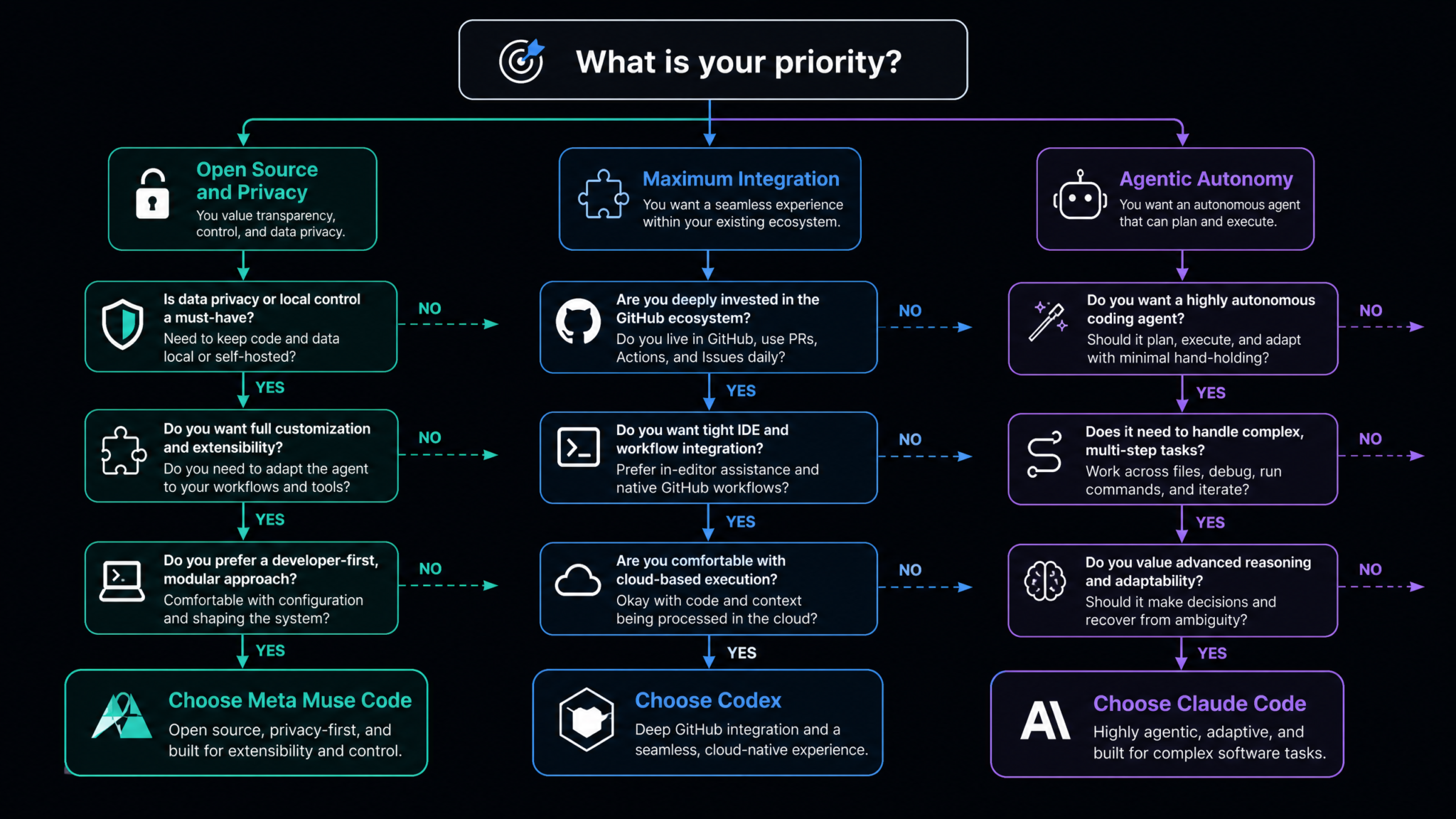
Decision Framework: When to Choose Each Tool
Rather than declaring an overall winner — which would be misleading given how contextually dependent the right choice is — here is a structured decision framework.
Choose OpenAI Codex When:
- Your team is deeply integrated into the GitHub ecosystem and values seamless PR review, Actions, and repository context features
- You primarily work in mainstream languages (JavaScript, Python, Java) on well-defined problem types where Codex’s breadth advantage is most relevant
- Individual developer experience and completion quality on standard tasks is the primary evaluation criterion
- Your enterprise procurement team is already comfortable with OpenAI’s compliance posture
- You value the maturity of a product with two-plus years of iteration and broad community support
- Your budget is cost-sensitive at the individual/small-team level ($10/month Copilot Pro is the most affordable named option)
Choose Claude Code When:
- Security, code safety review, and vulnerability detection are primary requirements
- Your team works extensively with infrastructure-as-code, cloud architecture, or systems where security posture matters as much as functionality
- You value detailed, prose-quality explanations accompanying generated code — for learning, documentation, or code review purposes
- Your codebase is large enough to benefit from Claude’s 200K context window for single-context ingestion of major files
- EU data residency is a requirement and you need an enterprise agreement structured accordingly
- Your developers prefer cautious, confirmation-first agentic behavior over aggressive autonomous operation
Choose Muse Code When:
- Data privacy is paramount and self-hosting is preferable or required — your team must have full infrastructure control
- You work extensively on large, multi-file refactoring tasks where repository-level structural understanding is critical
- You work in emerging or niche languages (Zig, Gleam, Mojo, Solidity, etc.) where Muse Code’s broader training corpus provides better support
- Your organization builds ML/AI systems with PyTorch and benefits from first-class framework understanding
- You want to fine-tune a model on your internal codebase and own the resulting specialized model
- Your team has 20+ developers and the economics of self-hosting make financial sense
- You want to bet on an open-ecosystem strategy and be positioned to leverage the broader Muse Spark fine-tuning community
| Use Case | Best Choice | Runner-Up |
|---|---|---|
| Full-stack web development (JS/TS) | Codex (GitHub integration) | Muse Code |
| ML/AI systems development | Muse Code (PyTorch expertise) | Codex |
| Security-sensitive applications | Claude Code | Muse Code (self-hosted) |
| Large legacy codebase modernization | Muse Code (HRA) | Claude Code |
| Regulated industry (healthcare, finance) | Muse Code (self-hosted) | Claude Code (EU residency) |
| Small team, tight budget | Codex ($10/month) | Muse Code (free tier) |
| Niche language development | Muse Code | Claude Code |
| CI/CD pipeline automation | Codex (GitHub Actions) | Muse Code (CLI) |
| Enterprise with custom fine-tuning needs | Muse Code | — |
| Infrastructure as code / DevOps | Claude Code | Codex |
Future Roadmap Predictions
Predicting roadmaps in a market that moves this quickly is inherently speculative, but several directional signals are clear enough to analyze with reasonable confidence.
Meta Muse Code: The Next 12 Months
Meta’s product cadence with Llama was rapid iteration: the gap between Llama 3.1 and 3.3 was roughly 8 months. Expect Muse Spark 1.3 — with improved agentic capability, better error recovery in Autopilot mode, and further language coverage — within 6 to 9 months of the 1.2 launch. The JetBrains plugin will mature significantly; early beta feedback is reportedly being prioritized. Integration with Meta’s multimodal capabilities (reading UI mockups, architecture diagrams, Figma exports) will likely appear in early 2027 based on job postings and Meta AI API developments. A Muse Spark 1.2 Code Instruct variant optimized specifically for agentic task following, separate from the general Muse Spark base, is likely given Meta’s observed model release patterns.
OpenAI Codex: Defending the Enterprise
OpenAI’s response to Muse Code’s open-weight competitive pressure will likely accelerate enterprise feature development rather than compete directly on the open-weights front — that’s not a strategic direction OpenAI has shown any inclination to pursue. Deeper GitHub integration, enhanced multi-repository context, and improved reasoning capabilities flowing from GPT-6 (expected in the first half of 2027) will be Codex’s primary competitive levers. Price competition is possible but unlikely to be OpenAI’s first move; the company will emphasize depth of integration over price.
Anthropic Claude Code: The Safety Premium
Anthropic will double down on its safety and reliability narrative as a differentiator, particularly for regulated industries. Claude 5 (expected Q1 2027) will bring performance improvements that may close the cross-file task gap with Muse Code. More interesting is Anthropic’s potential for deeper enterprise compliance features — FedRAMP authorization work has been hinted at in government procurement conversations, which would open federal market access that currently favors neither Claude nor Muse Code. The 200K context window advantage will likely erode as competitors respond, pushing Claude Code to compete more on reasoning quality and safety transparency.
Market-Level Predictions
The most significant market shift over the next 18 months will be the emergence of specialized fine-tuned coding models built on Muse Spark 1.2 as a base. Domain-specific models for bioinformatics, quantitative trading systems, embedded RTOS development, legal document automation, and other verticals will launch from startups and in-house engineering teams. This “coding model ecosystem” mirrors what happened with Llama in the general-purpose LLM market and represents Meta’s actual long-term play: not winning the coding assistant product market per se, but becoming the foundational infrastructure layer that powers much of the ecosystem.
We also expect the line between “coding assistant” and “software development agent” to blur significantly by mid-2027. The current framing — where you open an IDE plugin and interact with an AI via a chat sidebar — will coexist with orchestrated agent workflows that autonomously handle entire feature development cycles, from requirement parsing to PR submission, with human review gates rather than human authorship of individual code changes. All three platforms are racing toward this model; the architectural decisions they’ve made today (especially around agentic planning and error recovery) will determine who leads that next wave.
Final Verdict
Declaring a single winner in this comparison would misrepresent a competitive landscape that is genuinely multidimensional. Each of these three tools is the best choice for a specific profile of developer or engineering organization — and that plurality is actually healthy for the ecosystem.
OpenAI Codex remains the most pragmatic choice for the largest segment of professional developers: those working in mainstream languages, integrated into the GitHub platform, who want the most mature, well-supported developer experience available today. Its ecosystem depth and instruction-following fidelity are class-leading.
Claude Code is the right choice for teams where code safety, security review, and transparent AI reasoning are non-negotiable requirements. Its Constitutional AI training philosophy produces genuinely different — and in safety-sensitive contexts, genuinely better — behavior than the completion-optimized alternatives. For regulated industries and security-first engineering cultures, Claude Code’s premium pricing is easily justified.
Meta Muse Code enters the market not just as a competitive product but as a structural disruption to the category. Its open-weight model changes what’s possible for teams that need data privacy, custom fine-tuning, or the economics of self-hosting. Its HRA architecture provides a real, benchmarkable advantage in the repository-level tasks that define senior engineering work. And its position within Meta’s AI ecosystem — particularly the PyTorch and Llama infrastructure communities — gives it a depth of developer-world embedding that neither OpenAI nor Anthropic can easily replicate.
The most important takeaway for engineering leaders is this: the open-weight release of Muse Spark 1.2 changes the strategic calculation for everyone, even teams that don’t adopt Muse Code as their primary tool. It establishes a credible self-hosting baseline, creates pricing leverage in enterprise negotiations with closed providers, and signals that the AI coding model ecosystem will follow the same open-source dynamics that defined developer infrastructure over the past three decades. The companies that understand this shift earliest will be best positioned to build durable competitive advantages in how they develop software — not just in which coding assistant they subscribe to, but in how deeply they can customize AI to understand and amplify their specific engineering capabilities.
The AI coding assistant market as it existed in July 2026 is gone. What replaces it is more open, more competitive, and more interesting for developers than anything we’ve seen since the original GitHub Copilot announcement. That’s a genuinely good thing for software development as a craft.
