
OpenAI Drops GPT-5.6 Luna Price by 80%: What the Biggest API Price Cut in AI History Means for Developers and Startups
Published: | By: ChatGPT AI Hub Editorial Team | Category: AI News, Developer Tools, OpenAI
The Announcement That Shook the AI Industry
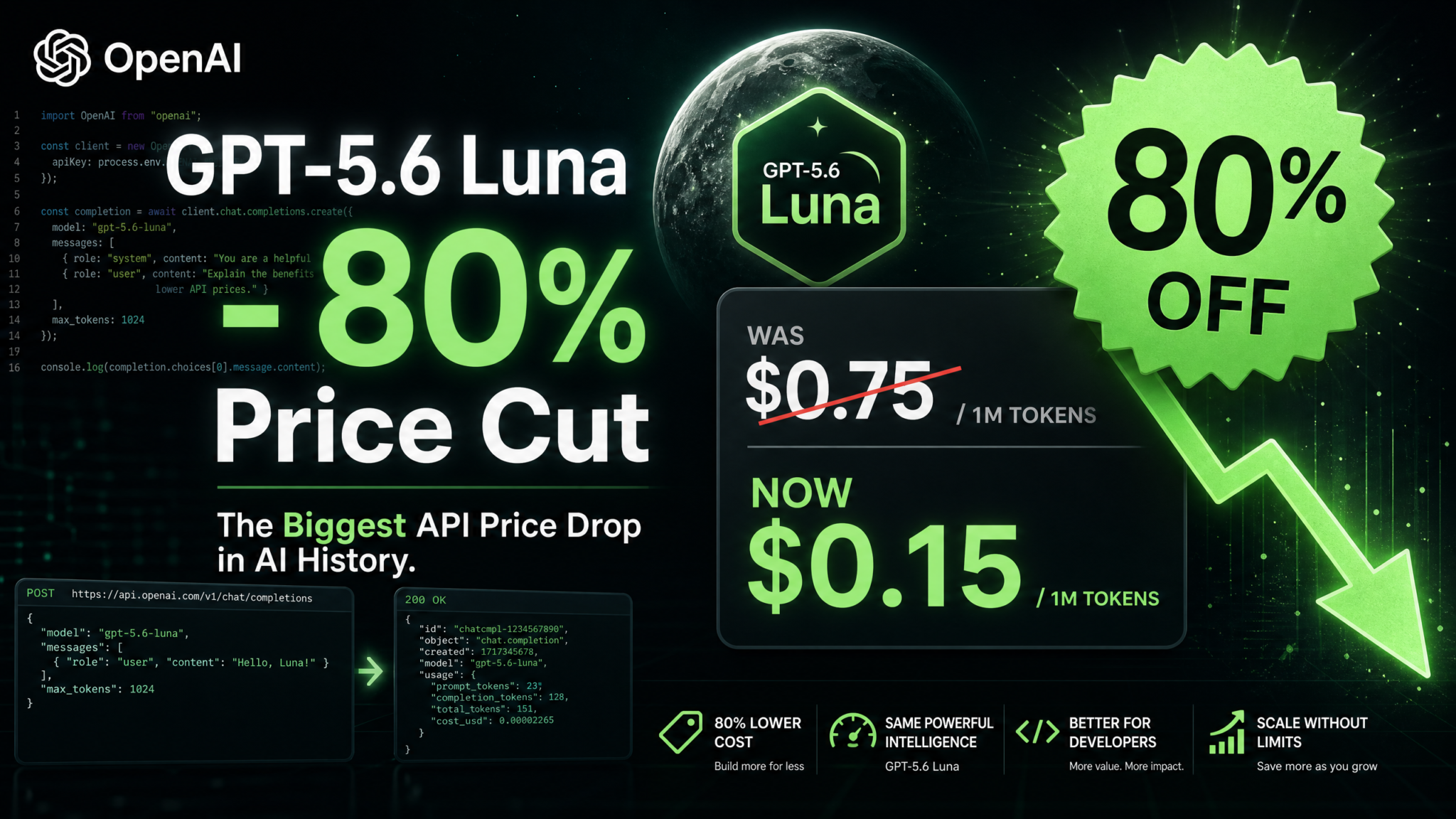
On the morning of August 12, 2026, OpenAI dropped what industry observers are already calling the most consequential pricing announcement in the history of artificial intelligence. In a post published simultaneously on the OpenAI blog and developer portal, the company announced an 80 percent reduction in API pricing for GPT-5.6 Luna — its widely used, mid-tier intelligence model — effective immediately. No waiting period, no graduated rollout. Developers worldwide woke up to find that the AI they had been building on overnight became dramatically cheaper to run. Token prices for GPT-5.6 Luna fell from $0.75 per million input tokens and $3.00 per million output tokens to a staggering $0.15 per million input tokens and $0.60 per million output tokens. In a single announcement, OpenAI had handed startups, solo developers, and enterprise engineers an 80 percent discount on one of the most capable frontier models available through a public API. The ripple effects will be felt for years.
The announcement came with characteristic OpenAI flair — a crisp blog post, a developer X/Twitter thread from CTO Mira Murati, and a quietly updated pricing page that left many developers doing double-takes when they refreshed their dashboards. By mid-morning Pacific time, the post had accumulated over 140,000 reposts across platforms. Developer communities on Reddit, Hacker News, and Discord lit up with a mixture of celebration, disbelief, and immediate back-of-the-napkin recalculations of project economics. Startups that had shelved product roadmap features due to prohibitive API costs were suddenly dusting them off and spinning up new staging environments. This is that kind of moment — a before-and-after line in the timeline of AI commercialization.
To fully understand why this matters, you need to understand not just the price cut itself but the strategic logic behind it, the companies it threatens, the developers it empowers, and the entirely new category of AI applications it makes possible for the first time. This article breaks down every dimension of the GPT-5.6 Luna price reduction — and what every developer, startup founder, and AI architect needs to know right now.
New Pricing Breakdown: The Numbers Explained
Before diving into the implications, let’s establish the raw numbers with precision. The GPT-5.6 Luna API pricing change applies to the standard API access tier and affects both the synchronous and batch endpoints, though the batch endpoint carries its own additional discount on top of the new base rate — more on that shortly.
Core Pricing Changes
| Pricing Dimension | Previous Price | New Price | Reduction |
|---|---|---|---|
| Input Tokens (per 1M) | $0.75 | $0.15 | 80% |
| Output Tokens (per 1M) | $3.00 | $0.60 | 80% |
| Batch API — Input (per 1M) | $0.375 | $0.075 | 80% |
| Batch API — Output (per 1M) | $1.50 | $0.30 | 80% |
| Context Cache Read (per 1M) | $0.094 | $0.019 | 80% |
| Context Cache Write (per 1M) | $0.75 | $0.15 | 80% |
The uniformity of the 80 percent reduction across all dimensions is notable. OpenAI did not selectively cut only the most competitive metrics or apply graduated discounts that would obscure the real-world impact. Every pricing lever moved by the same factor. This signals that the cost reduction is structural — driven by genuine improvements in inference efficiency, hardware utilization, and scale — rather than a promotional pricing gimmick with hidden trade-offs.
Real-World Cost Calculator: What You Actually Pay Now
To make this concrete, consider a few archetypal applications and what their monthly API spend looks like under the new pricing. These calculations assume average token distributions based on publicly available benchmarks from application developers who shared telemetry data in community forums:
| Application Type | Monthly Token Volume | Old Monthly Cost | New Monthly Cost | Annual Savings |
|---|---|---|---|---|
| Customer Support Chatbot (SMB) | 50M input / 20M output | $97.50 | $19.50 | $936 |
| Legal Document Summarizer | 200M input / 50M output | $300.00 | $60.00 | $2,880 |
| Real-Time Translation API | 1B input / 800M output | $3,150.00 | $630.00 | $30,240 |
| AI Coding Assistant (SaaS) | 500M input / 300M output | $1,275.00 | $255.00 | $12,240 |
| Enterprise Knowledge Base (5,000 users) | 2B input / 600M output | $3,300.00 | $660.00 | $31,680 |
For a real-time translation startup processing a billion input tokens monthly — a realistic figure for a moderately successful consumer application — the annual savings exceed $30,000. For an enterprise knowledge management platform serving five thousand users, the savings cross $31,000 per year. These are not trivial figures for early-stage companies operating on tight runways.
The Batch API Multiplier Effect
Developers who adopt the Batch API endpoint — which processes requests asynchronously with up to 24-hour turnaround — now pay just $0.075 per million input tokens and $0.30 per million output tokens. For workloads that tolerate latency — overnight document analysis, scheduled report generation, training data enrichment, content moderation pipelines — these prices represent a staggering democratization of large-scale AI processing. At these rates, processing a million documents of average length costs less than a typical developer’s daily coffee budget.
Why OpenAI Made This Move Now
OpenAI’s decision to cut prices by 80 percent did not emerge from altruism or arbitrary corporate generosity. It is the product of at least four converging pressures that had been building throughout 2025 and into 2026, each one tightening the competitive vice around OpenAI’s historically premium pricing position.
1. The DeepSeek Threat Has Not Gone Away
When DeepSeek first shook the industry in early 2025 with its V3 and R1 models — demonstrating frontier-tier capabilities at a fraction of Western infrastructure costs — many dismissed it as a one-time disruption. By mid-2026, that dismissal had aged poorly. DeepSeek’s V4 Ultra, released in March 2026, achieved performance benchmarks within 4 percent of GPT-5.6 Luna on the majority of standard evaluation suites, while pricing its API at rates that made even the pre-cut Luna pricing look expensive. More critically, developers who had been using DeepSeek’s API were reporting substantial production cost savings without meaningful capability degradation for their specific use cases. OpenAI’s enterprise sales team reportedly flagged this substitution pattern as accelerating in Q2 2026, particularly among price-sensitive segments like startups and individual developers.
2. Google’s Gemini Flash Strategy Proved the Playbook
Google’s aggressive pricing of Gemini Flash — its own speed-optimized, cost-efficient frontier model — demonstrated empirically that sub-dollar-per-million-token pricing could drive massive adoption volume. Internal Google data, partially shared at Google I/O 2026, indicated that Gemini Flash API calls had grown by over 900 percent year-over-year following each successive price reduction. The lesson was not lost on OpenAI’s business team: in AI infrastructure, the network effects of developer adoption compound rapidly, and the price point that captures developers early tends to capture their architectures and downstream businesses permanently. Luna needed to be price-competitive at the tier where volume lives.
3. Open-Source Models Are Closing the Gap Faster Than Expected
Meta’s Llama 4 family, Mistral’s Magistral series, and a proliferation of fine-tuned community models have placed genuinely capable open-source alternatives within reach of any developer with access to modest GPU infrastructure. The calculus for many developers had shifted from “OpenAI API vs. competitor API” to “hosted API vs. self-hosted open source.” At the previous pricing, the self-hosted option was increasingly attractive for developers processing more than a few hundred million tokens monthly. OpenAI’s price cut effectively resets this comparison, making the managed API value proposition — reliability, uptime guarantees, no DevOps overhead, continuous model improvements — economically defensible again for a much larger portion of the developer population.
4. Inference Costs Have Actually Fallen Dramatically
It would be incomplete to analyze this solely as a competitive response without acknowledging the underlying economics. OpenAI’s inference costs have fallen dramatically. The combination of custom silicon (OpenAI’s partnership with custom ASIC manufacturers was confirmed in late 2025), dramatically improved model quantization techniques, and the sheer scale of their infrastructure means that the marginal cost to serve a million tokens is a small fraction of what it was eighteen months ago. OpenAI can cut prices by 80 percent and still operate these workloads profitably because the cost side of the equation has moved nearly as dramatically as the price side. GPT-5.6 Luna vs Sol vs Terra Model Comparison Guide
5. The Adoption-at-Scale Strategy
Sam Altman’s long-stated vision for OpenAI has always centered on making powerful AI universally accessible. The price cut represents a strategic pivot from maximizing per-unit revenue to maximizing total volume and ecosystem lock-in. If Luna becomes the default choice for developers globally — embedded in tens of thousands of production applications — OpenAI’s aggregate revenue position actually strengthens even as per-token prices fall. The playbook mirrors what Amazon Web Services executed with cloud computing in the 2010s: price aggressively to become infrastructure, then capture value through adjacent services, enterprise contracts, and the compounding switching costs of deep integration.
The Startup Economics Revolution
The most immediate and visceral impact of the GPT-5.6 Luna price cut lands squarely on the startup ecosystem. For the past two years, a recurring pattern has appeared in startup pitch decks and post-mortems alike: “The product worked technically. The unit economics didn’t.” API costs were frequently the invisible ceiling that prevented AI-native startups from achieving sustainable gross margins at consumer-accessible price points.
The Unit Economics Before vs. After
Consider a hypothetical but representative consumer application: an AI-powered writing coach that provides real-time feedback on user-submitted paragraphs. Under the previous Luna pricing, a meaningful user session might consume approximately 8,000 input tokens (the user’s document plus conversation history) and generate 2,000 output tokens (detailed feedback). At $0.75/$3.00 pricing, that session cost roughly $0.012 in API costs alone. That sounds trivial, but multiply it by a hundred sessions per user per month — a modest usage figure for an engaged writing tool — and you’re spending $1.20 per user per month in raw API costs before accounting for infrastructure, storage, engineering, or support.
For a product priced at $9.99 per month (a standard consumer SaaS price point), $1.20 in API costs representing 12 percent of gross revenue was manageable but pressure-filled. At scale, with heavier users, the math often broke. Under the new pricing — $0.15/$0.60 — that same hundred sessions now costs $0.24 per user per month. API costs drop from 12 percent to 2.4 percent of gross revenue. Suddenly, the business model not only survives but thrives, with margin headroom to invest in acquisition, retention, and product expansion. How to Build Profitable AI SaaS Products With OpenAI API
The Viability Threshold Shift
The price cut effectively shifts the viability threshold for AI-native products in a way that opens up entirely new market segments. Previously, sustainable AI products needed either:
- High ticket prices (enterprise-focused, limiting total addressable market)
- Extremely low token consumption per user session (limiting product richness)
- Massive scale to absorb thin margins (requiring substantial venture funding to survive)
- Aggressive prompt compression and caching strategies (adding engineering complexity and often degrading user experience)
Under the new pricing, consumer products with modest average revenue per user become viable. Freemium models with more generous free tiers become sustainable. Solo developers building useful tools can actually run them without subsidizing users from their own pockets. The democratization is real and it is immediate.
Runway Extension for Existing Startups
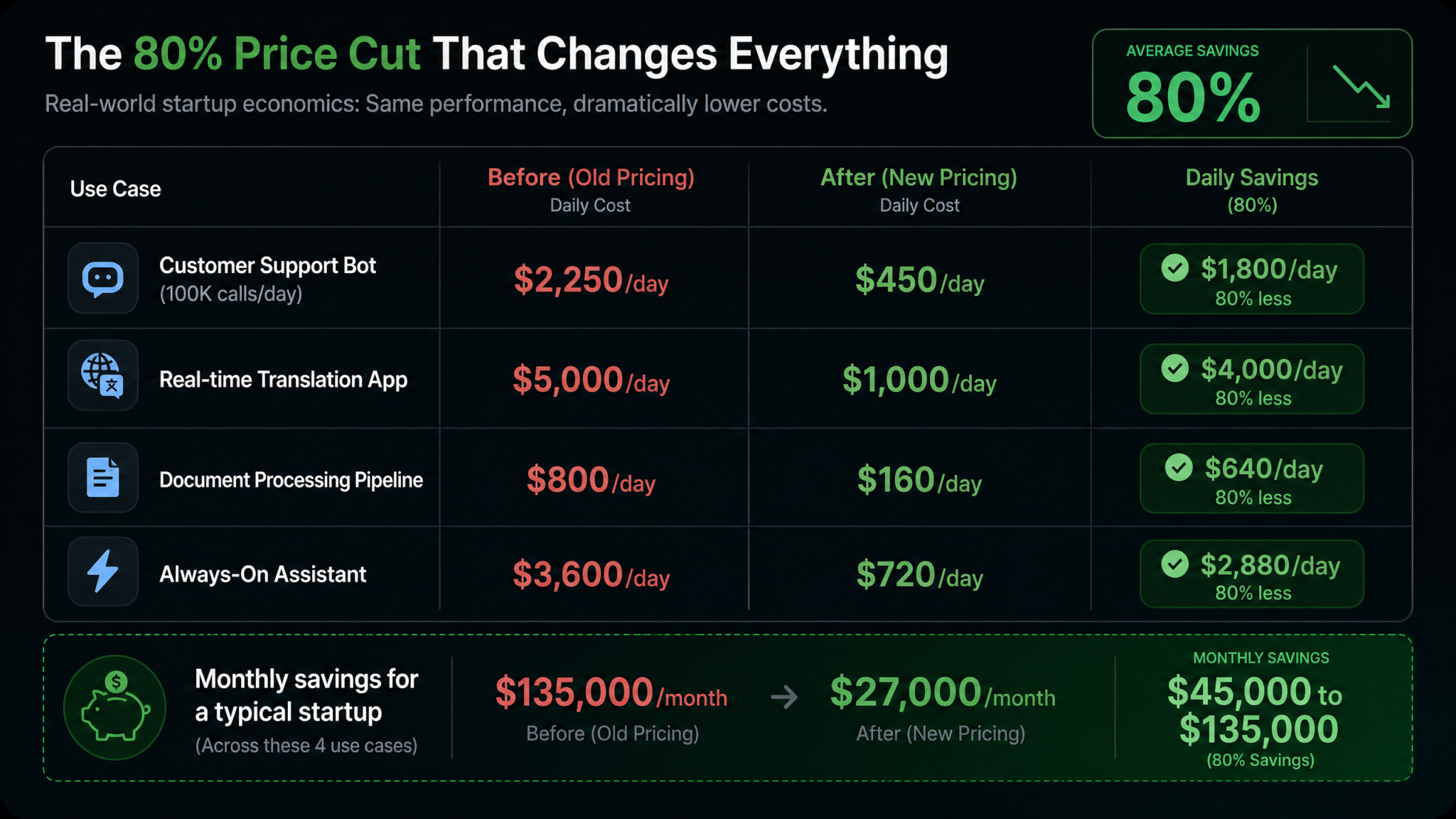
For startups already in production, the overnight cost reduction translates directly into extended runway. A company burning $15,000 monthly on Luna API costs — a realistic figure for a series A-stage company with meaningful user traction — will see that line item fall to $3,000. Over twelve months, that’s $144,000 in freed capital that can be redirected toward engineering hires, marketing experiments, or simply extending runway in a still-challenging fundraising environment. Several founders took to social media within hours of the announcement to describe recalculating their cash position projections and finding anywhere from three to eight additional months of runway built into the new numbers.
New Use Cases That Are Now Economically Viable
Perhaps the most exciting dimension of the price cut is not what it does for existing applications but what it makes possible for the first time. Several categories of AI application that were technically achievable but economically absurd at previous pricing are now firmly in “let’s build this” territory.
Real-Time Multilingual Translation at Consumer Scale
Real-time neural translation using a frontier model like Luna had been largely impractical for consumer applications due to the token volume involved. A live meeting transcription and translation service for a one-hour meeting might consume 50,000 input tokens and generate 40,000 output tokens — costing roughly $0.16 per meeting at old pricing. While that sounds small, multiply it by thousands of concurrent users and the economics collapse. At new pricing, that same meeting costs $0.031 — a 5x reduction that transforms the business model for real-time translation tools. Startups building multilingual meeting assistants, real-time caption services, and cross-language customer support platforms should be spinning up demos today.
Always-On Conversational Assistants
The concept of a truly always-on AI companion — an assistant that maintains persistent context and engages in ongoing conversational threads throughout a user’s day — previously ran into brutal API economics. If a user exchanges thirty messages with an assistant daily, with growing context windows, daily token consumption could easily exceed 100,000 tokens. At old pricing, that represented $0.37 per user per day, or $135 annually, in API costs alone before any other operational expenses. Charging users $200/year for such a service was possible but left microscopic margins. At new pricing, the same usage pattern costs $0.027 per day — $9.85 annually — making the service viable at mainstream consumer price points or even as part of a freemium offering.
Bulk Document Processing at Enterprise Scale
Enterprise document intelligence — automated processing, summarization, classification, and extraction across millions of documents — is one of the highest-value applications in AI but has traditionally been constrained to well-funded enterprise contracts with custom pricing. At $0.075/$0.30 (Batch API), processing a million pages of insurance claims, legal contracts, or medical records now costs a fraction of its previous price. A healthcare technology company processing patient intake documents at a rate of ten million pages monthly — fully plausible for a national platform — can now do so at a dramatically reduced cost, making the service viable for smaller health networks that couldn’t previously justify the investment. OpenAI Batch API Guide for Enterprise Document Processing
AI-Augmented Education at Scale
Personalized AI tutoring — where each student receives individualized explanations, feedback, and practice problems in real time — has long been the promised land of edtech. Previous pricing made it difficult to provide this at consumer-accessible prices, particularly in K-12 contexts where families are price-sensitive and school district budgets are constrained. At $0.15/$0.60, an hour of intensive tutoring with rich conversational exchange might consume 150,000 tokens — costing $0.052 at input/output proportions typical for educational dialogues. The price cut makes AI tutoring platforms economically viable at subscription prices families actually pay.
Sentiment Analysis and Customer Intelligence Pipelines
Marketing technology platforms that want to run LLM-grade sentiment analysis and thematic extraction across every customer review, support ticket, and social mention have previously had to choose between sampling (losing statistical completeness) and paying prohibitive costs. At batch pricing of $0.075 input / $0.30 output, processing a million customer reviews costs roughly $7.50 in input tokens. For an enterprise analytics platform, that cost is negligible relative to the value of complete, unsampled customer intelligence.
What This Means for the Free Tier and Consumer Products
One important contextual note for those who have been following OpenAI’s product evolution: GPT-5.6 Luna has already been available to free-tier ChatGPT users on an effectively unlimited basis since its launch in April 2026. OpenAI made the strategic decision to position Luna as the “always available” model for free users — accessible without rate limits for standard conversational tasks — while reserving Sol and Terra for the paid subscription tiers. The API price cut does not directly change the consumer free tier experience, but it carries significant indirect implications.
Developer Free Tier Alignment
OpenAI has simultaneously announced an expansion of the API free tier for developers. New API accounts will receive $25 in monthly Luna credits — up from $5 — renewable for the first six months of account activity. At the new pricing, $25 in Luna credits enables developers to process approximately 100 million input tokens or 40 million output tokens before hitting the paid tier. For a developer building a personal project or validating a startup concept, this is a genuinely meaningful free allocation that allows substantial product development and early user testing without spending a dollar.
The Consumer-to-Developer Pipeline
OpenAI’s decision to make Luna free for consumers and now dramatically cheaper for developers creates a coherent product narrative. Users fall in love with Luna’s capabilities in ChatGPT. Developers — many of whom are also consumers — build products powered by Luna knowing their users have a reference experience to anchor their expectations. The flywheel effect is intentional: consumer adoption informs developer adoption informs consumer adoption. At $0.15/$0.60, the API version of the model users already love is cheap enough that developers can build compelling businesses on top of it.
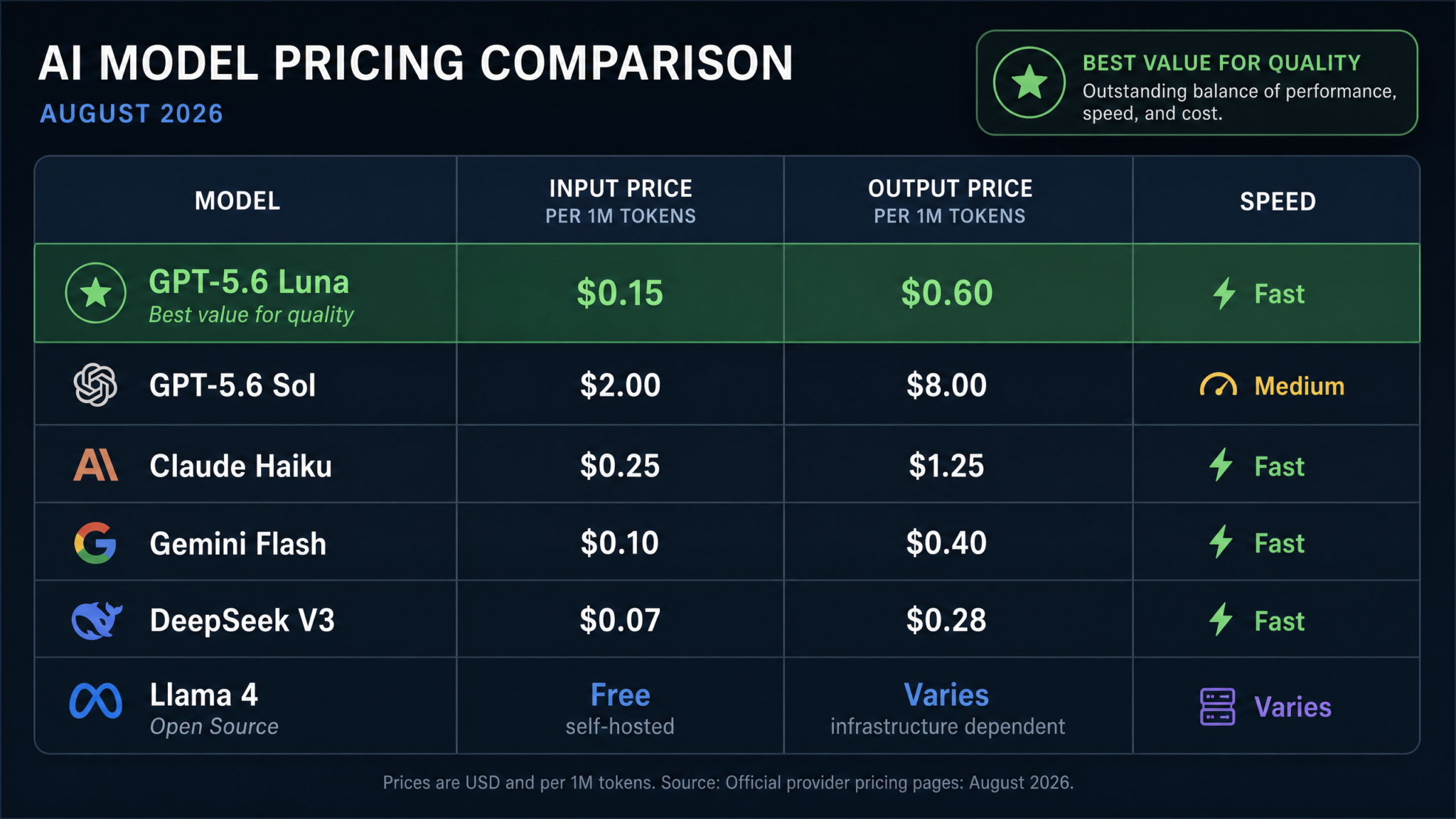
The Competitive Landscape After the Price Cut
The GPT-5.6 Luna price cut does not exist in isolation. It lands in a market already characterized by aggressive competitive pricing from multiple directions. Understanding the post-announcement competitive landscape requires examining each major player’s current position.
The Full Competitive Pricing Map
| Model | Provider | Input ($/1M tokens) | Output ($/1M tokens) | Notes |
|---|---|---|---|---|
| GPT-5.6 Luna (new) | OpenAI | $0.15 | $0.60 | Effective Aug 12, 2026 |
| Gemini 2.5 Flash | $0.10 | $0.40 | With Google One AI tier | |
| Gemini 2.5 Flash (standard) | $0.19 | $0.75 | Standard API pricing | |
| Claude Haiku 4 | Anthropic | $0.20 | $0.80 | Last updated May 2026 |
| DeepSeek V4 Ultra | DeepSeek | $0.09 | $0.28 | Peak hour surcharges apply |
| Mistral Magistral Small | Mistral AI | $0.08 | $0.24 | European data residency available |
| Meta Llama 4 Scout | Self-hosted / Partners | $0 (weights free) | $0 (weights free) | Infrastructure costs apply |
| Llama 4 Scout (hosted, Together AI) | Together AI | $0.06 | $0.18 | SLA not enterprise-grade |
The Anthropic Response Problem
Anthropic is now in an uncomfortable position. Claude Haiku 4, previously the undisputed value leader among branded frontier model APIs, is now more expensive than Luna across both input and output dimensions. Anthropic’s strength has always been positioned around safety, reliability, and nuanced instruction following — and Claude’s dedicated user base will not disappear overnight. But for developers who are token-volume-sensitive and less wedded to any specific model’s personality or safety profile, the comparative calculus has shifted against Anthropic. Industry observers expect Anthropic to respond with a Haiku 4 price cut within 90 days, possibly as early as September 2026.
Google’s Position
Google’s competitive situation is more nuanced. Gemini 2.5 Flash at standard pricing is actually now more expensive than Luna — $0.19/$0.75 versus $0.15/$0.60. Google’s preferred-tier pricing of $0.10/$0.40 undercuts Luna, but that rate requires Google One AI subscription bundling that not all enterprise developers will opt into. For pure API consumers, Luna has become the better value proposition. Google also faces internal headwinds: the Gemini 2.5 series has faced mixed developer reviews regarding consistency of instruction following in production environments, a vulnerability OpenAI has actively amplified in developer community discussions.
The Open-Source Calculus
Meta Llama 4 Scout remains technically “free” in that the model weights are openly distributed and deployable without licensing fees. But free weights are not free infrastructure. A developer or startup that wants Llama 4 Scout in production needs GPU compute, inference optimization, scaling infrastructure, monitoring, and engineering time to manage it. At realistic cloud GPU pricing for well-utilized inference infrastructure, self-hosting Llama 4 Scout costs approximately $0.04–$0.08 per million tokens — cheaper than Luna even at the new pricing, but only if you can fully utilize the hardware. For most startups and individual developers, the operational overhead and capital requirement of self-hosting makes the Luna API more economically rational despite the higher per-token cost. Self-Hosted Llama 4 vs OpenAI API: Total Cost of Ownership Analysis
How Developers Should Rethink Their Architecture
An 80 percent price reduction is not just a financial event — it is an architectural event. Optimization decisions that were rational at previous pricing levels may now be engineering overhead that adds complexity without delivering proportionate economic benefit. Here is how the design calculus changes:
Prompt Compression: Now Often Not Worth It
Many developers have invested significant engineering effort in aggressive prompt compression — stripping whitespace, abbreviating instructions, truncating system prompts, and compressing conversation history to reduce token count. At $0.75 per million input tokens, reducing a prompt from 2,000 tokens to 1,500 tokens saved $0.000375 per call. Across millions of calls, those savings were meaningful. At $0.15 per million tokens, the same compression saves $0.000075 per call. Unless your compression logic is trivially cheap to execute, the engineering amortization cost often exceeds the token savings. Clearer, more verbose prompts often produce better model outputs, and the quality improvement may now be worth more than the marginal token cost.
Context Caching Strategy Has Changed
Context caching — storing commonly repeated prefix tokens to avoid re-processing them on each request — was a significant cost optimization at previous pricing. At new rates, the economics shift. Cache write costs are $0.15/1M (same as standard input), and cache read costs are $0.019/1M. Caching still offers a roughly 8x reduction on repeated context reads, but the absolute dollar savings per million tokens are so small that caching complexity is only warranted for very high-volume applications with highly repetitive contexts. For most applications, the engineering overhead of cache management now exceeds the cost benefit.
Longer Contexts Are Now Affordable by Default
Luna supports up to 256,000-token context windows. Previously, using long contexts routinely was expensive enough that developers frequently implemented chunking and retrieval-augmented generation pipelines to avoid passing large contexts directly. RAG pipelines add latency, architectural complexity, and retrieval quality risk. With input tokens at $0.15/1M, a 100,000-token context costs $0.015 — roughly 1.5 cents. For many applications, directly passing full document context produces better results than RAG, and the cost difference is now negligible. Developers should reconsider whether their RAG implementations are still economically justified or whether simpler full-context approaches now dominate both on cost and quality.
Access 40,000+ AI Prompts for ChatGPT, Claude & Codex — Free!
Subscribe to get instant access to our complete Notion Prompt Library — the largest curated collection of prompts for ChatGPT, Claude, OpenAI Codex, and other leading AI models. Optimized for real-world workflows across coding, research, content creation, and business.
Batch Processing as Default
The Batch API, previously an optimization for highly cost-sensitive workloads, should now be the default architecture for any application that can tolerate asynchronous processing. At $0.075/$0.30, the batch discount is substantial enough to justify asynchronous design for document analysis, content generation pipelines, data enrichment, and reporting workflows. Here’s a simplified example of how a batch processing pipeline might look in production:
// Example batch document processing with OpenAI Batch API
const { OpenAI } = require('openai');
const client = new OpenAI({ apiKey: process.env.OPENAI_API_KEY });

async function processBatchDocuments(documents) {
  const batchRequests = documents.map((doc, index) => ({
    custom_id: `doc-${index}-${Date.now()}`,
    method: 'POST',
    url: '/v1/chat/completions',
    body: {
      model: 'gpt-5.6-luna',
      messages: [
        {
          role: 'system',
          content: 'Extract key entities, sentiment, and summary. Return structured JSON.'
        },
        {
          role: 'user',
          content: doc.text
        }
      ],
      max_tokens: 500,
      response_format: { type: 'json_object' }
    }
  }));

  // Submit batch — costs $0.075/1M input, $0.30/1M output
  const batch = await client.batches.create({
    input_file_id: await uploadBatchFile(batchRequests),
    endpoint: '/v1/chat/completions',
    completion_window: '24h'
  });

  console.log(`Batch submitted: ${batch.id} — Status: ${batch.status}`);
  return batch.id;
}
AI Agent Economics: The 100-Call Problem Is Solved
Among all the implications of the Luna price cut, the impact on AI agent economics may be the most transformative in the medium term. Autonomous AI agents — systems that decompose complex tasks into subtasks, call tools, reason over intermediate results, and iterate toward goals without constant human intervention — are token-intensive by nature. An agent solving a moderately complex task might make 50 to 150 separate LLM calls, with each call potentially consuming 5,000 to 20,000 tokens as context accumulates.
The Pre-Cut Economics of Agents
At previous Luna pricing, an agent task involving 100 API calls, each consuming an average of 10,000 input tokens and producing 1,500 output tokens, cost approximately:
- Input: 100 calls × 10,000 tokens = 1,000,000 tokens × $0.75/1M = $0.75
- Output: 100 calls × 1,500 tokens = 150,000 tokens × $3.00/1M = $0.45
- Total per task: $1.20
For an agent platform charging $9.99/month with a usage-included model, users could complete roughly eight complex tasks per month before the API cost exceeded the subscription revenue. Overage-sensitive users constrained themselves. Product teams rationed agent invocations. The agent paradigm was technically functional but economically constrained at scale.
Post-Cut Agent Economics
At new Luna pricing, the same 100-call agent task costs:
- Input: 1,000,000 tokens × $0.15/1M = $0.15
- Output: 150,000 tokens × $0.60/1M = $0.09
- Total per task: $0.24
Cost per complex agent task has fallen from $1.20 to $0.24 — an 80 percent reduction, matching the base pricing cut. The implications are profound. At $0.24 per task, agent platforms can offer generous usage allowances at consumer subscription prices, or build unlimited-usage models that remain economically sustainable. Enterprise platforms can run agents autonomously on background tasks without metering every invocation. The friction that previously made agent usage feel “expensive and risky” from a cost management perspective largely disappears.
Multi-Agent Orchestration Now Viable
Multi-agent systems — where a coordinating agent spawns and directs multiple specialized subagents — multiply call volumes further. A sophisticated multi-agent research pipeline might involve a planner agent, four to six specialist agents, and a synthesis agent, collectively making 500 or more LLM calls for a deep research task. At old pricing, such a task could cost $5–$8, making it viable only for premium enterprise tiers. At new pricing, the same orchestration costs $1–$1.50, which falls comfortably within consumer-grade pricing structures. The multi-agent future that AI researchers have been describing theoretically is now within economic reach for practical deployment.
Sol and Terra Pricing: Unchanged and Widening the Gap
OpenAI’s announcement was explicit on one point: the price cut applies exclusively to GPT-5.6 Luna. Pricing for GPT-5.6 Sol and GPT-5.6 Terra — the higher-capability models in the current generation — remains unchanged. This decision is both strategically sensible and revealing about how OpenAI conceptualizes its model tier structure.
Current Model Tier Pricing (August 2026)
| Model | Capability Tier | Input ($/1M) | Output ($/1M) | Best For |
|---|---|---|---|---|
| GPT-5.6 Luna | Standard (fast) | $0.15 | $0.60 | High-volume, latency-sensitive, cost-driven |
| GPT-5.6 Sol | Advanced (balanced) | $2.50 | $10.00 | Complex reasoning, nuanced tasks |
| GPT-5.6 Terra | Premium (frontier) | $15.00 | $60.00 | Research, frontier reasoning, highest fidelity |
The price gap between Luna and Sol has now widened dramatically — Sol costs 16.7x more per input token and 16.7x more per output token than Luna. Previously, the Sol-to-Luna premium was roughly 3.3x on input and output. This widening gap is intentional and has significant architectural implications.
The Routing Imperative
With a 16.7x pricing differential between Luna and Sol, intelligent model routing — sending queries to the cheapest model capable of handling them adequately — becomes a first-class architectural concern rather than an optional optimization. Developers should be building evaluation pipelines that classify incoming requests by required capability level and route accordingly. A customer service chatbot handling simple FAQ queries should almost never invoke Sol; a legal analysis tool performing jurisdiction-specific contract interpretation might frequently need it. The cost difference now makes imprecise routing expensive in a way it previously was not.
Will Sol and Terra See Cuts Soon?
The community is already speculating about when Sol and Terra pricing might follow Luna’s trajectory. Based on the pattern of previous OpenAI pricing cycles and the stated reasoning around inference cost improvements and competitive dynamics, most analysts expect Sol pricing to see a 50–70 percent reduction within 12 to 18 months, with Terra following 6 to 12 months after Sol. The structural drivers — improving inference efficiency, custom hardware, scale — apply equally to the higher-tier models; the primary reason for holding Sol and Terra pricing steady is to maintain price differentiation between tiers and protect the premium model revenue that subsidizes research and development.
Community Reaction: Euphoria, Skepticism, and Everything In Between
Few announcements in recent AI history have generated such immediate and sustained community response. Within 24 hours of the announcement, the developer and startup community had coalesced around several distinct reactions, ranging from pure celebration to carefully calibrated caution.
The Celebration Cohort
The loudest voices in the immediate aftermath were those for whom the price cut removes a direct obstacle to building. Solo developers who had been running passion projects at personal cost shared token usage graphs showing monthly bills dropping from hundreds to tens of dollars. YC-backed founders posted revised unit economics spreadsheets showing the path to profitability suddenly clearing. One widely circulated post from a founder building an AI-powered accessibility tool for deaf users described how the price cut transformed their product from “economically aspirational” to “fundable with real metrics.” The emotional authenticity of these responses was impossible to manufacture and underscored that this announcement had touched something real.
The Strategic Skeptics
A more measured cohort — typically experienced platform engineers and technical investors — offered cautionary observations alongside the celebration. Their concerns clustered around two themes: vendor lock-in deepening as prices fall, and pricing sustainability. The lock-in argument is substantive: at $0.15/$0.60, developers will build more aggressively against Luna’s specific capabilities, quirks, and API design, making future migration to alternatives more expensive even if alternative models become cheaper. The sustainability question focuses on whether OpenAI can maintain these prices if the competitive dynamics shift — specifically, whether a future where OpenAI achieves greater market dominance might see prices creep upward again once developers are fully committed.
The “What About Rate Limits?” Thread
A surprisingly prominent community concern following the announcement centered on whether rate limits would be adjusted alongside pricing. Several developers pointed out that if prices fall 80 percent but rate limits remain constant, the real-world benefit is constrained for applications that run near the limit ceiling. OpenAI’s documentation update acknowledged this concern and confirmed that rate limits for Luna will be increased proportionally across all tiers — a detail that was initially buried in the technical documentation but became a major talking point after developer advocates surfaced it.
Anthropic Developers Weighing Their Options
A significant contingent of Claude users — particularly those using Claude Haiku for cost-sensitive applications — spent much of August 12 openly deliberating whether to migrate workloads to Luna. The discussion was nuanced: Claude maintains specific advantages in instruction adherence, refusal calibration, and output formatting consistency that matter in specific production contexts. But for developers whose primary constraint was cost rather than these qualitative differences, the Luna price cut created a compelling reason to at least run a comparative evaluation. Anthropic’s community Slack channels reportedly saw their highest-ever message volume in the 24 hours following the announcement.
Predictions: How Far Can Prices Fall?
The GPT-5.6 Luna price cut invites a question that is simultaneously exciting and vertiginous: if prices have already fallen this far, how much further can they realistically go?
The Structural Drivers of Further Decline
Several forces continue to push inference costs downward. Custom AI silicon — both OpenAI’s proprietary ASICs and the next generation of AI-optimized chips from Nvidia, AMD, and emerging competitors — will continue improving price-per-FLOP at rates that make 2024 GPU economics look primitive. Quantization techniques that reduce model precision from FP16 to INT8 or INT4 without proportional quality degradation are becoming increasingly sophisticated. Speculative decoding architectures that use smaller draft models to accelerate larger model inference are being refined continuously. Each of these technology vectors contributes to lower marginal inference costs that eventually translate into lower API prices.
A Plausible 18-Month Pricing Projection
| Timeframe | Projected Input ($/1M) | Projected Output ($/1M) | Cumulative Reduction from Peak |
|---|---|---|---|
| August 2026 (Current) | $0.15 | $0.60 | 80% |
| Q1 2027 | $0.08 | $0.30 | 90% |
| Q3 2027 | $0.03 | $0.12 | 96% |
| Q1 2028 | $0.01 | $0.04 | 98.7% |
These projections are speculative extrapolations based on the observed rate of AI inference cost reduction since 2022 — a trajectory that has consistently outpaced analyst expectations. If token prices reach $0.01/$0.04 per million by early 2028, the economics of AI-powered applications become essentially trivial to model: the cost of AI reasoning at that price point is comparable to the cost of a database query in today’s application architectures. That scenario implies a world where AI capability is embedded as freely as text rendering or image compression — a genuine commodity layer of the software stack.
The Freemium API Horizon
An increasing number of analysts are positing that the endpoint of current pricing trajectories is some form of free or near-free API access, supported by alternative monetization models — advertising on AI-mediated surfaces, premium feature tiers, data partnership arrangements, or enterprise-grade SLA premiums on top of free baseline access. OpenAI has not signaled any movement in this direction, and Luna’s current $0.15/$0.60 pricing still represents a meaningful revenue stream at scale. But the directional pressure toward zero is real and consistent with the history of all information technology infrastructure costs over time.
The Verdict: A Turning Point for AI Accessibility
Strip away the competitive maneuvering, the strategic calculations, and the community drama, and what the GPT-5.6 Luna price cut represents at its core is an acceleration of AI’s transition from premium novelty to essential infrastructure. The developers who will look back on August 12, 2026 as a turning point are not those who were already building expensive enterprise AI applications — they had the budgets to build regardless. The real beneficiaries are the solo developer in Nairobi building a legal aid tool, the two-person startup in São Paulo building an accessibility service, the student in Seoul building a language learning app, the nonprofit in Jakarta building a healthcare information platform. These are the builders for whom $0.75 per million tokens was the invisible fence and $0.15 per million tokens is the gate swinging open.
OpenAI’s price cut is simultaneously a competitive response, a bet on volume economics, and — intentionally or not — an act of democratization. The three forces are not in tension with each other; they are mutually reinforcing. Making Luna accessible at near-marginal-cost pricing expands the developer base, deepens the ecosystem, generates more aggregate revenue at scale, and builds the kind of developer loyalty that sustains platform dominance through the inevitable cycles of competitive disruption that lie ahead.
For developers and startups reading this analysis with one hand on their API key dashboard, the advice is straightforward: recalculate everything. The unit economics you modeled six months ago are wrong — meaningfully wrong, in your favor. Use cases you dismissed are worth reexamining. Product features you rationed are worth restoring. Architectures you simplified are worth revisiting. The floor of what is economically buildable with AI has dropped dramatically, and the builders who move quickly to occupy the newly viable territory will establish positions that are difficult to displace.
The biggest API price cut in AI history is not the end of a story. It is the prologue to a generation of applications that we have not yet imagined.
Complete OpenAI API Pricing Guide 2026 — All Models and Tiers Compared
This article reflects information available as of August 14, 2026. API pricing is subject to change. Developers should verify current pricing directly at platform.openai.com/pricing before making architectural or financial decisions based on this analysis. Projected future pricing figures are speculative and should not be treated as commitments or forecasts from OpenAI or ChatGPT AI Hub.
