
Stripe Acquires OpenRouter: What the AI Model Marketplace Deal Means for Developers and the API Economy
Stripe Acquires OpenRouter: What the AI Model Marketplace Deal Means for Developers and the API Economy
Published: August 19, 2026 | By ChatGPT AI Hub Editorial Team | Category: AI Industry News, Developer Tools, API Economy
Breaking: Stripe Confirms OpenRouter Acquisition
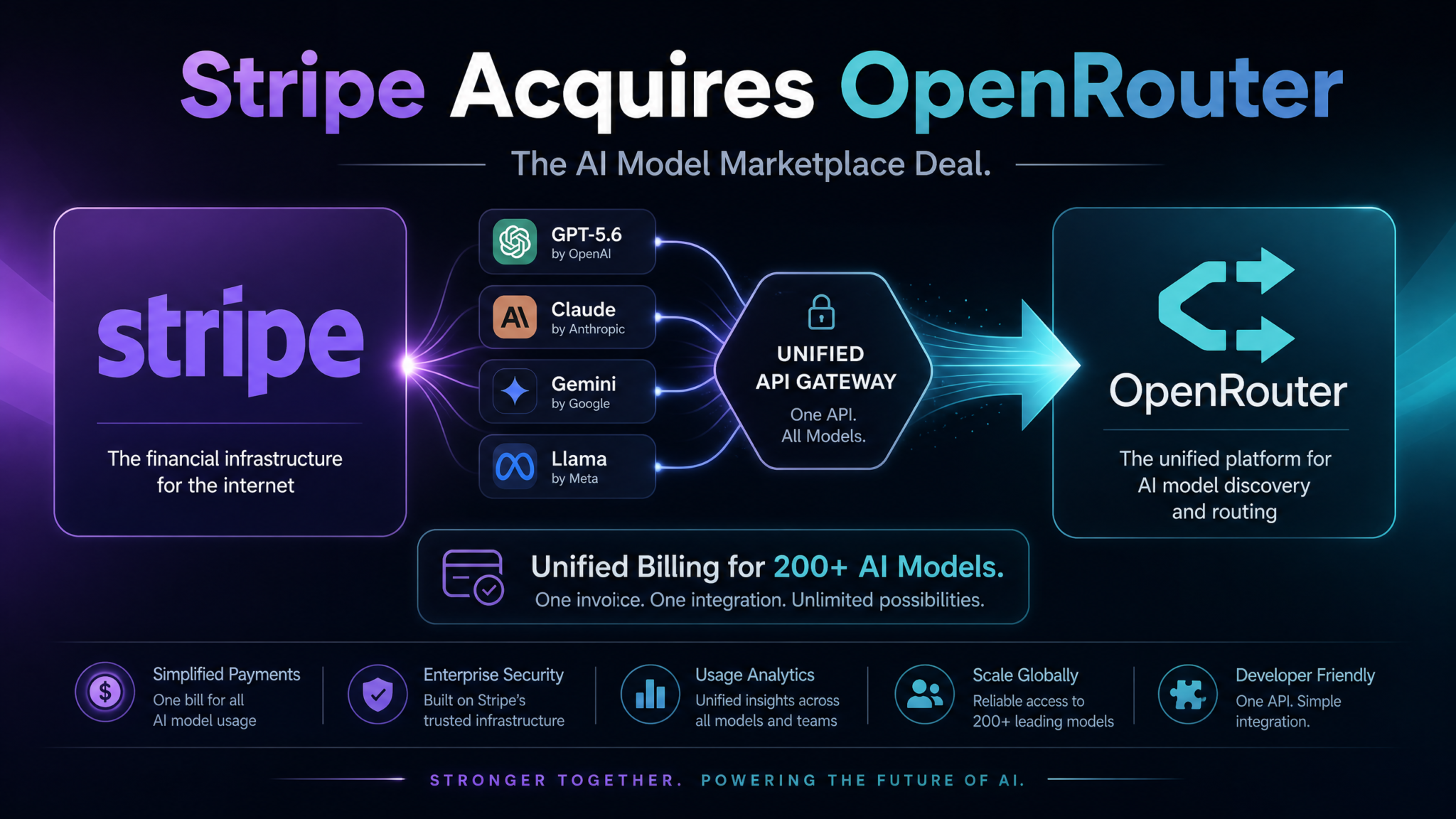
In what analysts are already calling one of the most strategically significant technology acquisitions of 2026, Stripe — the private payments infrastructure giant valued at over $70 billion — has confirmed it is acquiring OpenRouter, the developer-beloved AI model marketplace that allows engineers to access more than 200 large language models through a single unified API. The deal, first reported by CNBC on August 19, 2026, is estimated to be valued at more than $200 million, and signals a dramatic pivot for Stripe from pure payments infrastructure into the rapidly consolidating world of AI API infrastructure. The announcement sent shockwaves through developer communities on Hacker News, X, and Discord servers, with reactions ranging from enthusiastic optimism to genuine concern about the long-term independence of one of the most indispensable tools in the modern AI development stack.
The acquisition, which is expected to close in Q4 2026 pending regulatory review, will see the entire OpenRouter team fold into Stripe’s developer platform division. In a joint blog post published Tuesday morning, Stripe CEO Patrick Collison and OpenRouter co-founder wrote that the “combination of OpenRouter’s model routing intelligence and Stripe’s billing infrastructure represents a natural union that will make building AI-powered products dramatically simpler for developers everywhere.” The post emphasized that OpenRouter’s API will remain fully compatible and operational throughout any integration process — a direct response to the immediate concerns flooding social media within hours of the announcement.
To understand why this deal matters so profoundly — not just to the hundreds of thousands of developers who use OpenRouter daily, but to anyone who cares about how artificial intelligence gets built, billed, and distributed at scale — we need to examine each layer of what’s happening here. This is not simply a payment company buying a software tool. This is a calculated move to own the financial and routing infrastructure layer of the AI economy at the precise moment that layer is becoming the most valuable real estate on the internet.
What Is OpenRouter and Why Does It Matter?
If you’ve spent any meaningful time building AI-powered applications over the last two years, you’ve almost certainly either used OpenRouter or seriously considered it. For the uninitiated: OpenRouter is a model-agnostic API gateway and marketplace that lets developers send a single API request and access virtually any frontier AI model available on the market — GPT-5.6 from OpenAI, Claude 4 Sonnet and Opus from Anthropic, Gemini Ultra 2.0 from Google DeepMind, Meta’s Llama 4 family, Mistral, Cohere Command R+, DeepSeek V3, and over 200 additional models from providers ranging from established labs to emerging open-source communities.
The core value proposition is elegant in its simplicity: instead of maintaining five different API keys, five different billing relationships, five different rate limit management systems, and five different error handling pipelines, a developer writes code against OpenRouter’s OpenAI-compatible API endpoint once, and can then swap between any model in the catalog by changing a single parameter — the model name string. The billing is unified: everything flows through a single OpenRouter account, denominated in credits that developers purchase in advance or via subscription.
OpenRouter’s Key Technical Features
- Unified API endpoint: A single REST endpoint compatible with the OpenAI Chat Completions format, meaning most existing code requires zero modification to switch to OpenRouter
- Model fallback routing: Automatically routes to a backup model if a primary model is unavailable or rate-limited, dramatically improving application reliability
- Cost-optimized routing: Developers can specify routing preferences that balance cost, speed, and quality — OpenRouter selects the optimal provider for each request
- Provider redundancy: For popular models like Claude 4, OpenRouter maintains relationships with multiple hosting providers, reducing single-provider risk
- Streaming support: Full server-sent events streaming across all supported models
- Usage analytics: Per-model, per-application token usage tracking with exportable data
- Prompt caching: Where supported by underlying models, OpenRouter transparently handles prompt caching to reduce costs
- Free tier access: Select open-source models available with no-cost API access, subsidized by the platform’s paid model margins
The platform grew from a niche developer tool in 2023 to what multiple sources estimate is now processing over 15 billion tokens per day across its network — a volume that rivals some of the direct API offerings from major labs. According to data published by OpenRouter on its public status page in July 2026, the platform serves requests from applications in 142 countries, with the highest traffic volumes coming from SaaS development shops, individual developers building consumer apps, and increasingly, enterprise engineering teams that want model-agnostic AI infrastructure without the operational overhead of managing multiple vendor relationships.
The Models Available Through OpenRouter (As of August 2026)
| Provider | Models Available | Typical Input Cost (per 1M tokens) | Primary Use Case Strength |
|---|---|---|---|
| OpenAI | GPT-5.6, GPT-5.6 Mini, GPT-4o, o3 | $2.50 – $15.00 | General reasoning, coding, multimodal |
| Anthropic | Claude 4 Opus, Sonnet, Haiku | $3.00 – $15.00 | Long-context analysis, safety-critical apps |
| Google DeepMind | Gemini Ultra 2.0, Pro 2.0, Flash | $0.70 – $10.00 | Multimodal, code generation, search-augmented |
| Meta | Llama 4 Scout, Maverick, 405B | $0.10 – $2.00 | Cost-efficient, self-hostable, open weights |
| Mistral AI | Mistral Large 3, Medium, Nemo | $0.30 – $3.00 | European data residency, code, multilingual |
| DeepSeek | DeepSeek V3, R2 | $0.07 – $0.55 | Cost-optimized reasoning, math |
| Cohere | Command R+, Command Light | $0.50 – $3.00 | RAG pipelines, enterprise search |
| 200+ others | Various open-source and specialized models | $0.00 – $5.00 | Specialized domains, research, fine-tuned |
The marketplace dynamic that OpenRouter created is genuinely novel: by aggregating demand across hundreds of thousands of developers, it gained meaningful negotiating leverage with AI providers. This allowed OpenRouter to pass through competitive pricing — and in many cases, offer pricing that undercut direct API access from the labs themselves by securing volume discounts. That leverage, combined with the platform’s billing infrastructure and routing intelligence, is precisely what Stripe saw as worth more than $200 million.
OpenRouter API Integration Guide for Production Applications
Deal Structure and Financial Details
According to sources familiar with the matter who spoke to CNBC ahead of Tuesday’s announcement, the deal is structured as an all-cash acquisition in the range of $200 million to $240 million, with performance-based earnout provisions tied to API transaction volume growth over the 24 months following close. The earnout structure could push the total deal value beyond $300 million if OpenRouter’s user base and transaction volume continue their current growth trajectory under Stripe’s infrastructure.
OpenRouter had raised a total of approximately $12 million in venture funding across two seed rounds, meaning early investors including several prominent angel investors from the developer tools ecosystem are set to see exceptional returns. The company had been growing largely capital-efficiently, with its credit-based business model generating positive unit economics at scale — a fact that made it an attractive acquisition target rather than requiring a turnaround.
The entire OpenRouter team, understood to be approximately 35 full-time employees, will join Stripe under the existing OpenRouter leadership. The team will operate initially as a semi-autonomous unit within Stripe’s developer platform division, reporting to Stripe’s head of developer infrastructure. This structure mirrors how Stripe handled its acquisition of Radar (fraud prevention) and how it successfully integrated financial infrastructure tooling into its broader developer platform without disrupting product continuity.
Timeline and Regulatory Path
The acquisition is not expected to face significant antitrust scrutiny. Neither Stripe nor OpenRouter holds a dominant market position in a clearly defined relevant market by traditional regulatory standards — Stripe’s core business remains payment processing, and OpenRouter operates in the nascent AI API aggregation space where no single player commands monopoly-level share. Regulatory review is expected to be straightforward in both the United States and European Union, with deal close targeted for October or November 2026.
Stripe has committed publicly — in its blog post and in Patrick Collison’s statements to CNBC — to maintaining OpenRouter’s existing pricing structure for a minimum of 12 months post-close. This commitment is clearly designed to prevent the kind of immediate developer migration that has historically followed acquisitions of popular developer tools, and its credibility will be tested the moment the integration clock starts ticking.
Why Stripe Bought OpenRouter: Strategic Rationale
On the surface, this looks like a payments company making an unusual move into AI infrastructure. Beneath the surface, however, the strategic logic is exceptionally clear — and in hindsight, it may look inevitable.
Owning the Billing Layer of the AI Economy
Stripe’s entire business is built on one foundational insight that Patrick Collison articulated in the company’s earliest days: whoever controls the billing infrastructure for a new category of economic activity controls an enormously valuable position in that category’s value chain. In the 2010s, that meant owning the payment processing rails for e-commerce. In the 2020s, Stripe correctly identified that SaaS subscription billing, marketplace payments, and usage-based pricing were the next frontier — and built Stripe Billing, Stripe Connect, and Stripe Metered Billing accordingly.
The AI API economy is the next major category of economic activity being created. Developers and companies are spending — and will spend — hundreds of billions of dollars annually on AI model inference. OpenAI alone was reported to be processing over $5 billion in annualized API revenue in early 2026. Anthropic, Google, and Meta’s collective API revenues add substantial additional volume. The total addressable market for AI API infrastructure billing is projected by Gartner to reach $180 billion annually by 2028.
OpenRouter processes all of that spending — at least for the developer segment — through a single billing system. By acquiring OpenRouter, Stripe doesn’t just add a product; it acquires an established position at the billing layer of the AI API economy, with existing developer relationships, transaction data, and technical infrastructure already in place.
The Natural Extension of Stripe’s Developer-First Platform
Stripe has spent fifteen years building the world’s most developer-loved payments infrastructure. Its documentation is legendary, its API design is the gold standard against which other developer APIs are judged, and its brand equity with software engineers is unparalleled in the fintech world. OpenRouter was built with an explicitly developer-first ethos that maps almost perfectly onto Stripe’s own product philosophy: clean APIs, excellent documentation, transparent pricing, and infrastructure that stays out of the developer’s way while handling enormous complexity behind the scenes.
The cultural and philosophical alignment between the two companies is not incidental to the deal — it’s likely central to why Stripe chose OpenRouter over building its own equivalent product. Developer trust is extraordinarily hard to earn and catastrophically easy to lose. Acquiring a product that already commands genuine developer affection is worth a substantial premium over attempting to build a competing product from scratch.
Usage-Based Billing as a Core Competency
AI API consumption is by its nature usage-based: you pay per token, per request, per second of inference compute. Usage-based billing (UBB) is also one of Stripe’s fastest-growing product areas. Stripe Metered Billing, which allows SaaS companies to charge customers based on actual consumption rather than flat subscription tiers, has seen adoption grow over 400% since 2023 as more software companies shift to consumption pricing models. The combination of OpenRouter’s model consumption data with Stripe’s metered billing infrastructure creates a product flywheel: Stripe can now offer the world’s most sophisticated usage-based AI billing infrastructure to any company building AI products, using OpenRouter’s transaction data to power cost optimization features that no competitor can match.
Controlling the Data Layer
This is the strategic element that is getting the least coverage in early reporting, but may be the most significant long-term. OpenRouter sits on an extraordinary dataset: billions of API calls with metadata about which models developers choose, how they route between models, what use cases drive model selection, and how price sensitivity varies across different developer segments. This data is invaluable for understanding the AI market — and Stripe, which already holds sensitive financial transaction data for millions of businesses, knows better than almost anyone how to extract strategic value from aggregate transaction intelligence without compromising individual privacy.
What This Means for Developers Right Now
For the hundreds of thousands of developers currently using OpenRouter in production, the immediate practical implications deserve careful examination. Let’s separate signal from noise.
Unified AI Billing Through Stripe
The most immediately exciting prospect for developers is the potential for truly unified AI model billing through Stripe. Today, even OpenRouter users still need to manage a separate billing relationship with OpenRouter (purchasing credits) on top of their existing Stripe relationship for their own product’s payment processing. The integration of OpenRouter’s billing into Stripe’s infrastructure could mean that AI model costs appear as a line item in the same dashboard where developers manage their Stripe payments, subscriptions, and payouts — creating a single pane of glass for all financial infrastructure.
For development agencies and SaaS companies that pass AI costs through to customers, this opens the door to dramatically simplified usage-based billing. A developer building a document analysis SaaS could configure Stripe to automatically meter their customers based on actual AI token consumption routed through OpenRouter, with no additional billing infrastructure required. The cost tracking, invoice generation, and payment collection all happen within the same platform already handling the rest of the business’s financial operations.
Cost Management and Optimization Dashboards
Stripe is known for the quality of its analytics and financial reporting tools. Developers currently using OpenRouter have access to basic usage analytics, but Stripe’s data visualization capabilities and financial reporting infrastructure could dramatically elevate the cost management tooling available for AI spending. Imagine granular breakdowns of AI model costs by customer segment, by feature within your application, by time of day — the kind of FinOps sophistication that cloud infrastructure spending has had for years but that AI API spending currently largely lacks.
Model Routing Optimization Tied to Business Metrics
Perhaps the most technically exciting future feature enabled by the acquisition: routing decisions tied to business-level financial data. OpenRouter currently routes based on technical parameters — model availability, response latency, raw token cost. Once integrated with Stripe, routing logic could potentially be informed by customer lifetime value, subscription tier, or revenue attribution. A developer could configure their application to use Claude 4 Opus for requests from enterprise customers on $500/month plans while routing requests from free tier users to Llama 4 Scout — and have that routing logic live natively in the same infrastructure managing subscription management and payment processing.
Potential Risks and Developer Concerns
Not all developer sentiment about the acquisition is positive, and the concerns being raised in technical communities are legitimate and deserve honest examination.
- Pricing changes after the 12-month commitment window: Stripe is not a nonprofit. Once the initial commitment period expires, pricing changes are plausible. Stripe’s own payment processing fees have historically been competitive but not the cheapest option — developers accept the premium for reliability and developer experience.
- Data usage and privacy: The combination of Stripe’s financial data and OpenRouter’s model usage data creates a uniquely powerful dataset. Developers building sensitive applications will need clarity on how aggregate usage data is or is not used for commercial intelligence purposes.
- Dependency risk concentration: Using OpenRouter already means accepting a dependency on a third-party gateway. Using an OpenRouter now owned by Stripe means the same dependency on a company with a broader range of financial relationships with your business — which could feel uncomfortable for some teams.
- Impact on open-source model access: OpenRouter’s current free tier, which provides access to select open-source models at no cost, has been enormously valuable to independent developers and researchers. Whether Stripe will maintain that free tier long-term is an open question that the company has not yet addressed.
What OpenRouter Users Need to Know
If your production application currently depends on OpenRouter, here is the practical situation as of August 19, 2026:
API Compatibility: The Commitment and Its Limits
Stripe has committed to full API compatibility throughout the integration process. Your existing OpenRouter API keys will continue to work. Your existing base URL configuration pointing to https://openrouter.ai/api/v1 will continue to function. No code changes are required and none will be forced during the initial integration period.
What this commitment does not cover: any new features or endpoints introduced post-acquisition may launch under Stripe’s API conventions rather than OpenRouter’s. Over time, it is reasonable to expect that OpenRouter’s API will evolve to adopt Stripe’s authentication patterns, SDK conventions, and versioning strategy. The migration will almost certainly be gradual and well-documented, given Stripe’s reputation for developer-friendly API evolution — but developers should plan for eventual migration rather than assuming the current interface will be static forever.
Your OpenRouter Credits and Balance
Existing OpenRouter credit balances will be honored fully. Stripe has confirmed that current credit system will remain operational and that credits purchased before close will be usable post-acquisition on the same terms. The longer-term fate of the credit-based billing system — versus migration to a pure pay-as-you-go model within Stripe’s billing infrastructure — has not been announced.
Expected Feature Timeline
Based on Stripe’s historical integration patterns with acquisitions, developers should expect:
- Months 1–6 post-close: No changes to existing OpenRouter product. Team focuses on internal systems integration and architectural planning.
- Months 6–12: New Stripe-native features begin to appear as optional additions — likely a Stripe Dashboard integration for OpenRouter usage visibility and the ability to authenticate using Stripe API keys as an alternative to OpenRouter keys.
- Months 12–24: Deeper integration with Stripe Billing for usage-based billing pass-through. Legacy OpenRouter billing system transitioned to Stripe’s infrastructure. Potential consolidation of OpenRouter billing into Stripe credits or pay-as-you-go invoicing.
- 24+ months: Full product integration. OpenRouter likely becomes “Stripe AI Gateway” or similar branded product within the Stripe product suite, though the brand transition has not been announced.
Impact on the Broader AI API Ecosystem
The Stripe-OpenRouter deal does not exist in isolation. It is the most dramatic data point yet in a clear trend: consolidation of AI API infrastructure into the hands of well-capitalized platform companies, with the middleware and aggregation layer becoming the highest-value real estate in the AI stack.
The Competitive Landscape: AI Model Gateways and Marketplaces
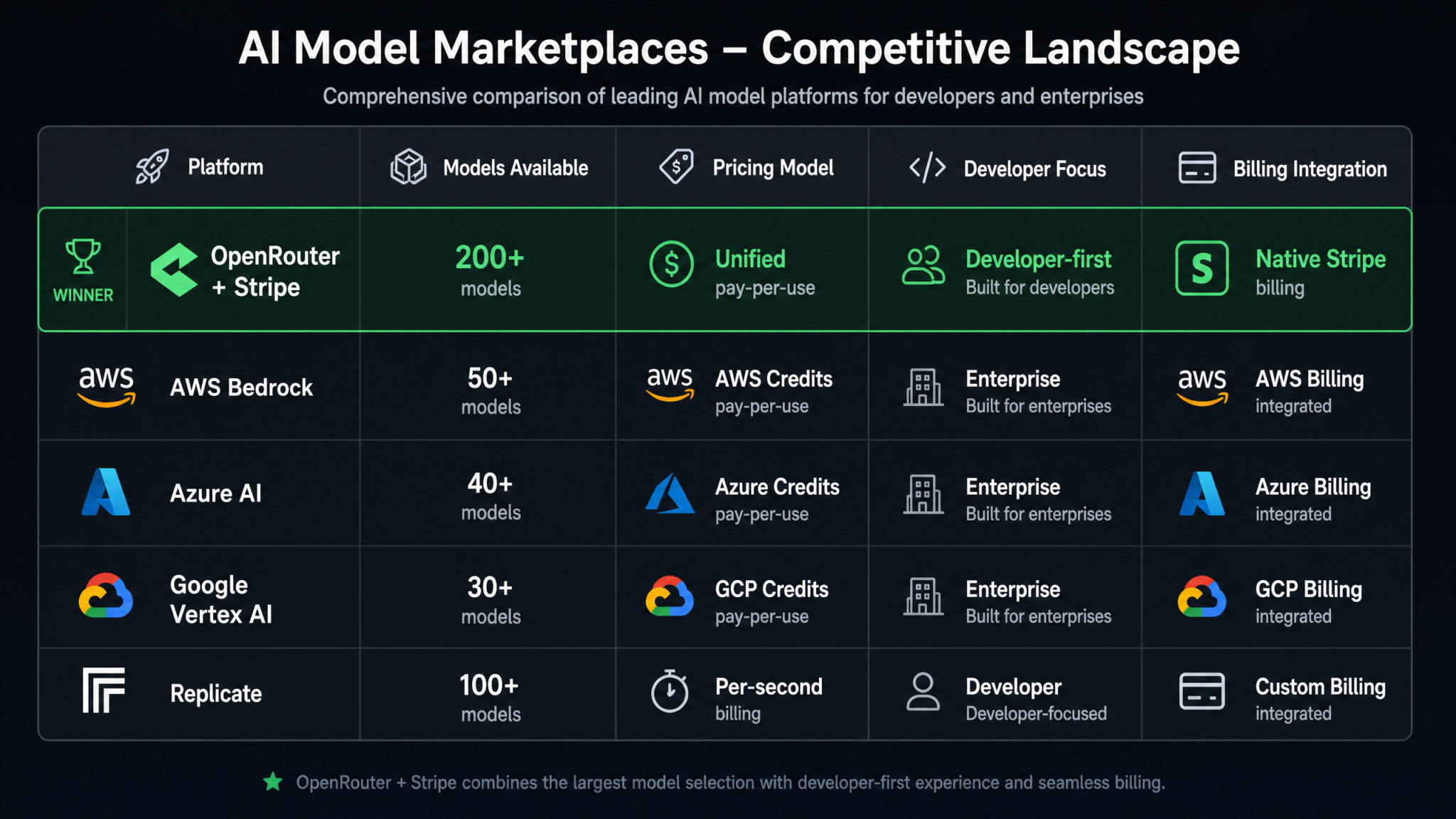
| Platform | Owner | Models Available | Primary Customer | Estimated Monthly Volume | Key Differentiator |
|---|---|---|---|---|---|
| OpenRouter (acquired) | Stripe | 200+ | Developers, indie hackers, SaaS | ~450B tokens | Model-agnostic, dev-friendly, unified billing |
| AWS Bedrock | Amazon | 50+ | Enterprise, AWS-native teams | >2T tokens | AWS IAM, VPC, compliance, private deployment |
| Azure AI Foundry | Microsoft | 60+ | Enterprise, Microsoft 365 orgs | >1.5T tokens | Azure RBAC, Copilot integration, enterprise SLAs |
| Google Vertex AI | 40+ | GCP users, enterprise | >1T tokens | Gemini-native, multimodal, TPU access | |
| Hugging Face Inference | Hugging Face | 150,000+ | Researchers, open-source devs | Variable | Open-source focus, community models |
| Together AI | Independent | 80+ | Developers, enterprise | ~200B tokens | Open-source model performance, fine-tuning |
| Groq Cloud | Independent | 20+ | Latency-sensitive apps | ~100B tokens | Fastest inference (LPU architecture) |
The striking reality revealed by this competitive landscape table is that Stripe-OpenRouter now occupies a unique position: the only major AI model gateway that is neither a cloud hyperscaler nor an AI lab, and which explicitly serves the developer and independent builder segment that the big cloud platforms nominally address but frequently underserve with pricing complexity, IAM overhead, and enterprise-first product design decisions.
Consolidation Accelerating Across the Stack
The Stripe-OpenRouter deal follows a series of acquisitions and partnerships that signal rapid consolidation of AI infrastructure middleware. Earlier in 2026, Cloudflare expanded its AI Gateway product (originally launched in 2024) into a full model marketplace, positioning itself as an alternative aggregation layer. Vercel has deeply integrated AI SDK tooling with model routing capabilities into its deployment platform. Databricks, following its acquisition of Mosaic AI, now offers model serving infrastructure that competes with the gateway layer from the enterprise side.
The pattern is clear: companies that own developer workflow touchpoints — deployment, edge networks, payments, data platforms — are all racing to insert themselves into the AI model consumption layer. The rationale is identical in each case: the model consumption layer is where developer attention, transaction volume, and data flow intersect, making it the most valuable infrastructure position to occupy as AI moves from experimental to indispensable.
Stripe’s Full AI Strategy Comes Into Focus
The OpenRouter acquisition is not Stripe’s first move in AI — it’s the move that makes the full picture legible. To understand where Stripe is going with AI, it’s worth assembling the timeline of its investments and product decisions over the last three years.
Stripe’s AI Infrastructure Timeline
2023: Stripe launches its first AI-powered features within its existing product suite — AI-assisted fraud detection enhancements in Stripe Radar, AI-generated financial summary reports in Stripe Dashboard, and AI-powered dispute management recommendations. These are consumer-facing AI features, not infrastructure plays.
2024: Stripe begins internal experimentation with LLM-powered developer support, replacing significant portions of its documentation search with a Claude-powered assistant. The company also quietly invests in Anthropic through its corporate development arm, joining a group of strategic investors that includes Google and Amazon. This investment, worth an undisclosed amount, gives Stripe commercial terms with Anthropic that would prove valuable in later infrastructure planning.
2025: Stripe launches Stripe AI Billing Intelligence, a product that uses machine learning to optimize subscription pricing recommendations, predict churn before it occurs, and suggest billing model changes for SaaS companies based on their Stripe transaction data. This product, while receiving modest press coverage, is strategically important as the first signal of Stripe applying AI to financial decision-making rather than purely to fraud and support automation.
Early 2026: Stripe hires a new VP of AI Infrastructure from a major cloud provider, assembles an internal AI platform team, and files multiple patents related to AI model cost allocation, usage-based billing for inference workloads, and intelligent request routing. In retrospect, these hires and filings were preparation for the OpenRouter acquisition.
August 2026: OpenRouter acquisition announced. The strategy becomes visible in its totality.
What Stripe Is Building Toward
Reading across these data points, Stripe’s AI strategy appears to be oriented around a specific thesis: that the financial infrastructure layer of the AI economy — the systems that meter consumption, allocate costs, generate invoices, and process payments for AI services — will be as valuable as the models themselves, and that no existing player is positioned to own that layer as naturally as a company that has spent fifteen years building financial infrastructure for developers.
The end state Stripe appears to be building toward: a platform where any company building an AI product can manage the entire financial stack of that product — paying for model inference, billing customers based on AI consumption, optimizing model selection for cost efficiency, and accessing credit and financing for AI infrastructure — all within Stripe. This would represent a genuine expansion of Stripe’s addressable market from payment processing (a large but bounded market) into AI financial infrastructure (a market with no visible ceiling given the current pace of AI adoption).
How AWS, Google, and Microsoft Will React
The cloud hyperscalers will not sit quietly as Stripe establishes itself as the preferred financial infrastructure layer for AI API consumption. Each has both the motive and the capability to respond aggressively — and understanding how they might respond helps developers anticipate where the competitive dynamics will settle over the next 12 to 24 months.
Amazon Web Services
AWS’s response will almost certainly be accelerated investment in Bedrock’s billing and aggregation features, combined with pricing moves designed to make Bedrock’s multi-model marketplace more attractive to the developer segment that OpenRouter currently serves so effectively. AWS has historically been reluctant to prioritize developer experience over enterprise capability, but the OpenRouter acquisition may force a recalibration. Expect AWS to introduce simplified pay-as-you-go billing for Bedrock that doesn’t require navigating AWS Cost Explorer’s complexity, and potentially a free tier for Bedrock access that mirrors OpenRouter’s current approach.
Access 40,000+ AI Prompts for ChatGPT, Claude & Codex — Free!
Subscribe to get instant access to our complete Notion Prompt Library — the largest curated collection of prompts for ChatGPT, Claude, OpenAI Codex, and other leading AI models. Optimized for real-world workflows across coding, research, content creation, and business.
AWS may also respond through partnership: deepening integrations with developer-focused platforms like Vercel, Railway, and Render to offer Bedrock access with simplified billing through those platforms’ existing developer relationships. This would be a distribution response rather than a product response, acknowledging that AWS’s developer experience weakness can be addressed through partnerships with companies that already have developer trust.
Google is in the most complicated position. It is both a direct competitor to Stripe-OpenRouter (via Vertex AI’s model marketplace) and a strategic partner (Gemini models are among OpenRouter’s most popular offerings, and Google has financial and strategic interest in broad Gemini distribution). Google’s most likely response is to strengthen Vertex AI’s developer-facing features and pricing transparency while simultaneously ensuring that Gemini models remain available through Stripe-OpenRouter — because Gemini’s broad adoption matters more to Google than any competitive positioning against Stripe in the infrastructure layer.
Longer term, Google may consider acquisitions in the API gateway and developer tooling space to shore up the developer segment of Vertex AI, which has historically been overshadowed by Vertex’s enterprise positioning.
Microsoft
Microsoft’s response may be the most direct, given that Azure AI Foundry already represents the most complete corporate response to OpenRouter’s value proposition — a multi-model marketplace within a broader developer platform (Azure) that includes comprehensive billing and cost management tools. Microsoft will likely accelerate Azure AI Foundry’s development, prioritizing features that appeal to developers without existing Azure relationships: improving the developer experience for new Azure accounts, simplifying the billing setup process, and potentially offering a migration incentive for OpenRouter users who are now considering their options given the Stripe acquisition.
Microsoft also has a relationship card to play: as OpenAI’s primary cloud partner, Microsoft can offer GPT-5.6 access through Azure AI Foundry with latency and capacity guarantees that a third-party gateway like OpenRouter-Stripe cannot match. This is a genuine competitive advantage that Microsoft has not fully exploited in the developer market to date.
Azure AI Foundry vs AWS Bedrock for Enterprise AI Development
The Bigger Picture: When Fintech Meets AI Infrastructure
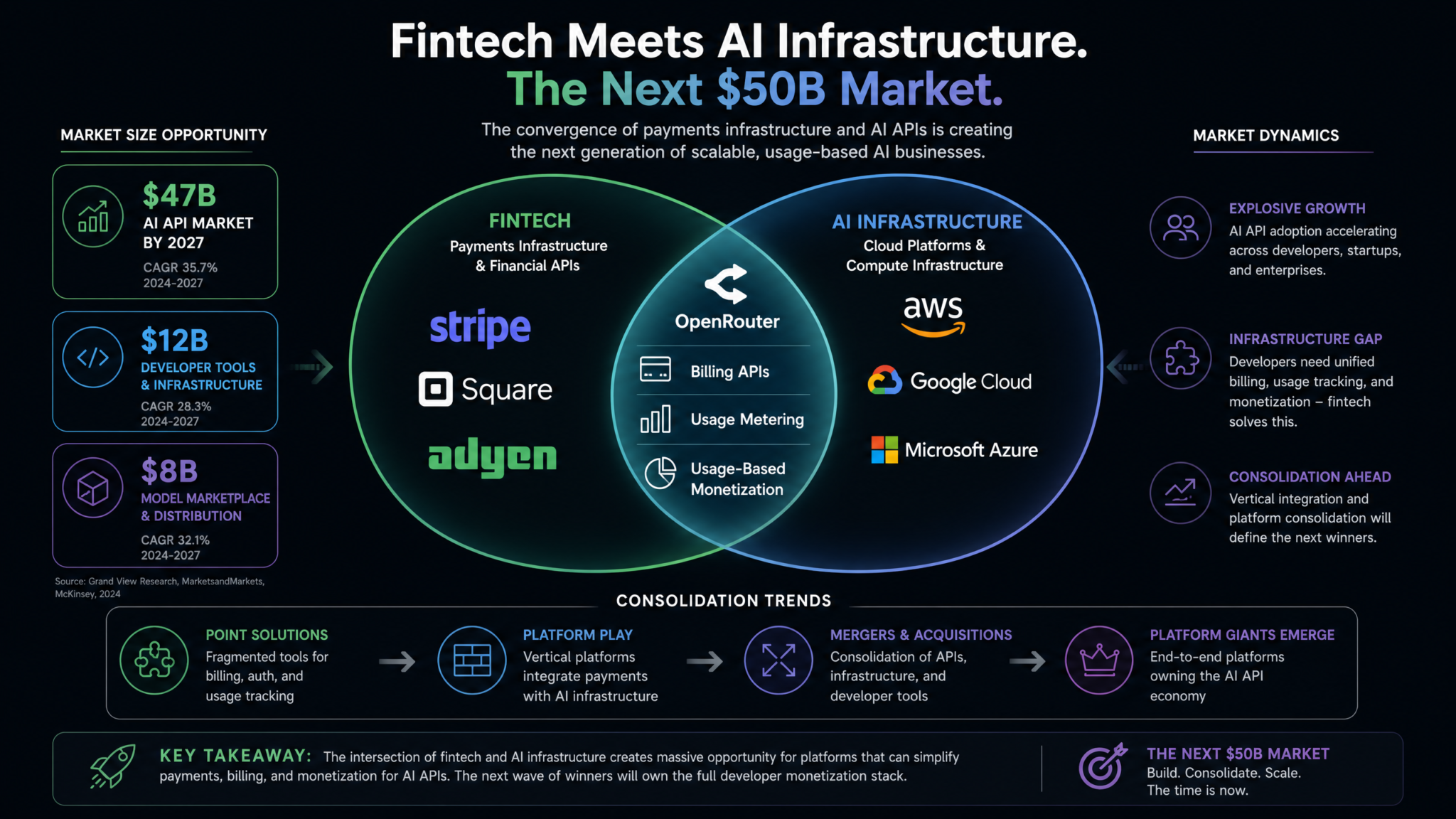
The Stripe-OpenRouter deal is not an isolated corporate transaction. It represents the clearest articulation yet of a structural shift that has been developing for 18 months: the convergence of financial infrastructure companies and AI infrastructure companies, as both categories recognize that the commercial layer of the AI economy is the highest-value position to occupy.
Consider the parallel developments happening simultaneously across the fintech-AI intersection:
- Brex and Ramp, the corporate card platforms, have both launched AI spending analytics products that classify and optimize AI API spending as a distinct expense category, recognizing it as one of the fastest-growing line items in startup operating budgets
- Plaid has been developing API products specifically designed to enable AI companies to verify and monitor their customers’ financial capacity for usage-based AI consumption billing
- Mercury, the banking platform popular with tech startups, launched “Mercury AI Credits” — a product that provides pre-approved credit lines specifically collateralized against projected AI API revenue
- Moody’s and S&P have both published new credit rating frameworks for AI-native companies that weight AI API cost structure and model dependency risk as significant credit factors
What all of these developments have in common is a recognition that AI API costs are now a critical financial infrastructure element for technology companies — as important to track, optimize, and finance as cloud compute was in the 2010s. And just as the cloud era created massive financial infrastructure businesses around AWS billing, cloud cost optimization (Cloudability, CloudHealth), and cloud-native finance tools, the AI era is creating an entirely parallel ecosystem of financial infrastructure built around AI consumption.
Stripe, by acquiring OpenRouter, is positioning itself as the AWS of this AI financial infrastructure ecosystem — not just processing the payments, but owning the metering, the cost optimization, the analytics, and eventually the credit products that enable companies to grow their AI spending before their revenue fully catches up. This is the playbook Stripe has already proven with Stripe Capital (lending to Stripe merchants based on transaction data) applied to the AI economy.
The Market Size Opportunity
To appreciate why this strategic positioning is worth fighting over, consider the market scale projections from major research firms:
| Metric | 2024 Actual | 2026 Estimated | 2028 Projected | Source |
|---|---|---|---|---|
| Global AI API spending | $12.4B | $47.2B | $182B | Gartner |
| AI API transactions per day (global) | ~800B | ~8T | ~85T | IDC estimate |
| Number of apps with AI API integration | ~2.1M | ~12M | ~45M | Andreessen Horowitz |
| AI infrastructure middleware market | $0.8B | $4.3B | $22B | Forrester |
| AI billing and financial infra market | $0.3B | $2.1B | $15B | Morgan Stanley |
Even capturing a modest single-digit percentage of the AI API billing infrastructure market at its projected 2028 scale represents a multi-billion dollar business — one that could meaningfully expand Stripe’s total addressable market beyond its current payments-centric foundation.
Market Predictions for AI Infrastructure Through 2027
With the Stripe-OpenRouter acquisition as the defining inflection point for AI infrastructure consolidation in 2026, what should developers, investors, and technology leaders expect from the market through the end of 2027?
Prediction 1: At Least Two More Major API Gateway Acquisitions by Q2 2027
The Stripe-OpenRouter deal has validated the value of the AI model aggregation layer in terms that acquirers understand: a nine-figure acquisition price. This validation will trigger a competitive rush among well-capitalized platform companies to acquire the remaining independent AI gateway and aggregation platforms before prices climb further. The most likely acquisition targets include Together AI (for its combination of model hosting and gateway capabilities), Portkey.ai (for its enterprise-focused gateway with strong prompt management features), and LiteLLM’s commercial offering (for its open-source-adjacent positioning in the developer community).
Prediction 2: OpenAI Will Launch a Native Developer Marketplace That Competes Directly with Stripe-OpenRouter
OpenAI has been systematically building toward controlling more of its own distribution and billing infrastructure. The Stripe acquisition of OpenRouter removes one of OpenAI’s indirect distribution channels from the neutral-platform category and places it under the ownership of a company with its own commercial interests. Expect OpenAI to respond by accelerating its own developer platform ambitions — likely launching a multi-model access product (potentially including curated third-party models) that keeps developers within OpenAI’s billing ecosystem rather than routing through aggregators.
Prediction 3: Stripe Will Introduce AI-Specific Credit Products Within 18 Months
Following the Stripe Capital playbook, within 18 months of the OpenRouter acquisition close, expect Stripe to offer pre-approved AI API spending credit to developers and startups whose consumption patterns through OpenRouter-Stripe demonstrate sufficient volume and reliability. This product — essentially a short-term credit facility for AI model costs, repaid from revenue collected through Stripe Payments — would be a natural extension of Stripe Capital and would create a powerful flywheel: the more a company uses Stripe’s AI infrastructure, the better its credit terms for continued AI spending.
Prediction 4: Model-Level Cost Transparency Will Become a Regulatory Issue
As AI API spending crosses from experimental to mission-critical for thousands of companies, regulatory bodies in the EU and US will begin scrutinizing the transparency and fairness of AI model pricing, routing decisions, and billing practices. The EU AI Act’s provision on transparency will be interpreted by regulators to include economic transparency — requiring that developers understand not just how routing decisions are made technically, but whether routing decisions are influenced by commercial relationships between gateway operators and model providers. Stripe-OpenRouter, given its combination of financial infrastructure and model routing, will face this scrutiny directly and will need to develop clear disclosure standards.
Prediction 5: The Open-Source Alternative Ecosystem Will Mature Rapidly
Every major acquisition of a developer-beloved open product triggers a wave of investment in open-source alternatives. LiteLLM, which provides open-source model gateway functionality, will see dramatically accelerated adoption and funding following the Stripe-OpenRouter deal. Expect at least one well-funded commercial entity to emerge around LiteLLM’s open-source core within 12 months, targeting the segment of developers who explicitly do not want their AI infrastructure owned by a payments company.
Expert Analysis and Industry Reactions
The developer and analyst community’s reaction to the Stripe-OpenRouter acquisition has been characteristically multidimensional — reflecting the genuine complexity of a deal that touches on developer autonomy, market consolidation, competitive dynamics, and the fundamental question of who controls the economic infrastructure of AI.
“This is Stripe doing what Stripe has always done: identifying the billing layer of a new economic category and building the infrastructure to own it. The timing is perfect — OpenRouter has achieved the critical mass of developer adoption that makes it a genuine infrastructure asset, but the AI API market is still early enough that Stripe can shape the norms of how AI consumption gets billed. In five years, this acquisition will look as obvious as Stripe’s early bet on API-first payments.”
— Partner at a major venture capital firm specializing in developer infrastructure (speaking on background)
“I’m cautiously optimistic but watching carefully. OpenRouter has succeeded because it was genuinely independent and developer-aligned. The moment developers suspect that routing decisions are influenced by Stripe’s commercial relationships with model providers — rather than pure cost and performance optimization — trust will evaporate quickly. Stripe knows this, which is why they’ve been so emphatic about compatibility commitments. But commitments last 12 months. Business incentives last forever.”
— Principal engineer at a Series B AI startup, posting on Hacker News
“From a purely competitive strategy standpoint, Stripe has made a bold and correct move. The AI API billing layer is going to be worth tens of billions of dollars annually within three years, and it was going to be controlled by someone. Better for developers that it’s controlled by Stripe — which has fifteen years of evidence that developer trust is its most valuable asset — than by AWS, which views developer experience as a feature rather than a core philosophy.”
— Technology analyst, Redpoint Ventures research team
Not all reactions have been sanguine. The open-source and self-hosting communities — particularly those who rely on OpenRouter’s free tier for research and experimentation — have expressed concern that Stripe’s commercial orientation may erode the platform’s commitment to free and open model access. Several prominent developers announced immediately following the acquisition news that they were migrating production workloads to self-hosted LiteLLM instances, citing a desire to reduce dependency on any single commercial entity controlling their AI infrastructure.
The reaction from AI labs has been strategically muted. OpenAI, Anthropic, and Google DeepMind all declined to comment specifically on the acquisition. This restraint is notable: each of these labs has an ambivalent relationship with OpenRouter. The platform drives meaningful adoption of their models among developers who might not otherwise access them, contributing to ecosystem growth. But it also abstracts the lab from the developer relationship, placing Stripe between the model provider and the developer in a way that shifts commercial negotiating power. The acquisition of that intermediary layer by a well-capitalized financial infrastructure company makes that dynamic more permanent and more consequential than it was when OpenRouter was an independent startup.
The Bottom Line for the Developer Community
For developers building AI applications today, the Stripe-OpenRouter acquisition is not a crisis — but it is a significant market event that warrants strategic reflection. The immediate practical situation is stable: the API works, pricing is committed for 12 months, and Stripe’s track record with developer tools gives reason for measured optimism about the product’s future. The longer-term situation requires some proactive thinking: How dependent is your application on OpenRouter-specific features? What is your fallback if pricing or routing behavior changes materially? Have you explored self-hosting options for your most critical inference workloads?
The developers who will navigate this transition most successfully are those who treat it as a prompt to audit their AI infrastructure dependencies more broadly — not just their OpenRouter usage, but their entire AI vendor stack. The Stripe-OpenRouter deal is a reminder that the AI infrastructure layer is being consolidated and commercialized rapidly, and that the infrastructure choices developers make today are increasingly choices about whose commercial incentives they are aligning with for the long term.
That is not inherently bad news. Stripe is a good steward of developer tools by any historical measure. But it is news worth taking seriously — and the developers who thrive in the next chapter of AI infrastructure will be those who engage with these strategic questions thoughtfully rather than ignoring them until they become urgent problems.
The AI economy is maturing faster than almost anyone predicted. The billing infrastructure of that economy is now, in significant part, owned by Stripe. How that shapes the tools available to developers, the competitive dynamics of the AI market, and the economics of building AI-powered products will be one of the defining stories of the next two years in technology. ChatGPT AI Hub will continue to track the integration timeline, pricing developments, and competitive responses as this story develops through the end of 2026 and into 2027.
