
AI-Generated Code Is Creating a New Software Bottleneck: Complete Guide to Validation, Testing, and Quality Assurance for AI-Assisted Development
AI-Generated Code Is Creating a New Software Bottleneck: Complete Guide to Validation, Testing, and Quality Assurance for AI-Assisted Development
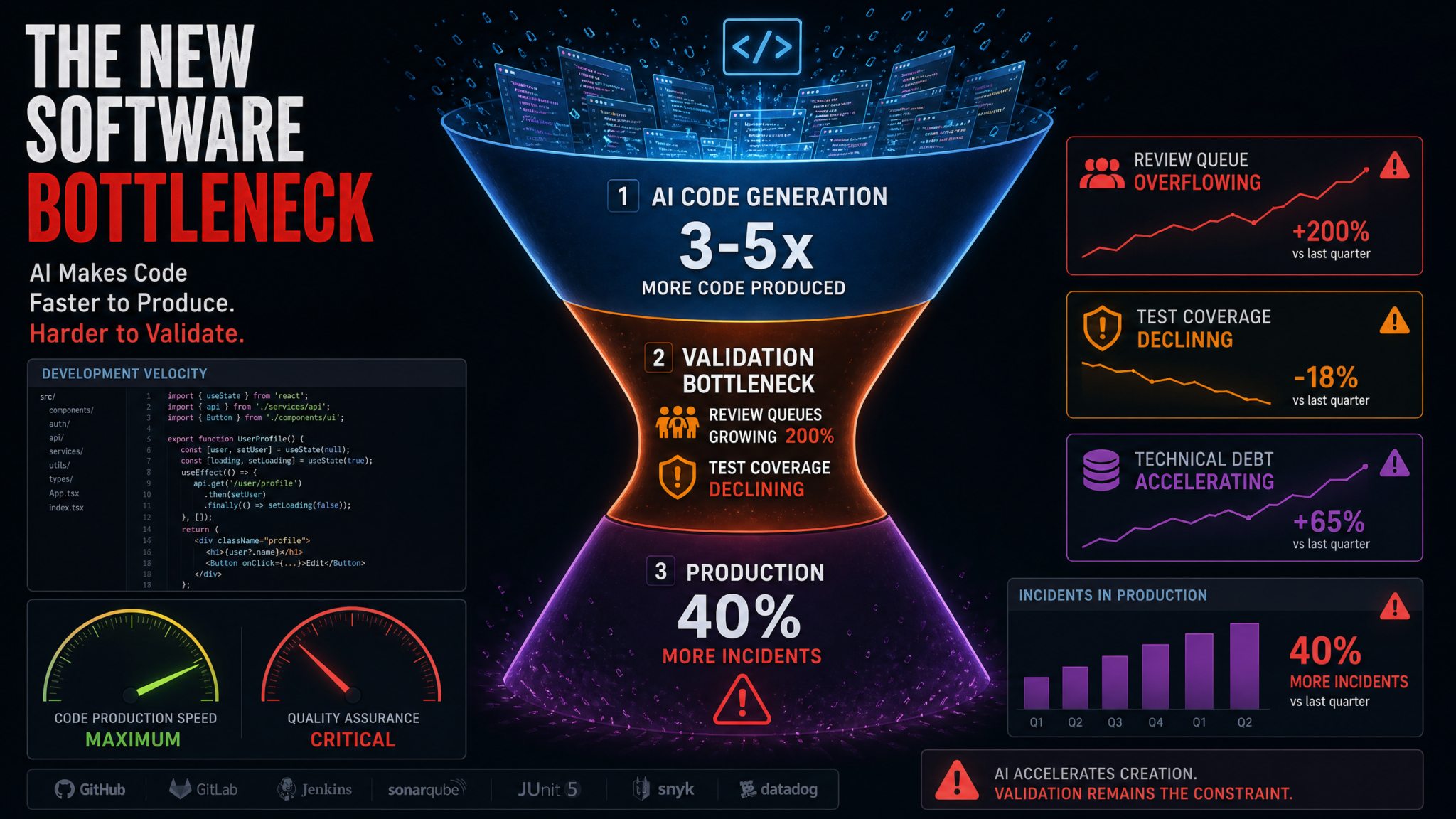
The promise was irresistible: AI coding assistants would make software teams dramatically more productive. And in one narrow sense, they delivered. Code is being produced at a pace that would have seemed impossible just three years ago. But across engineering organizations of every size, a troubling pattern is emerging. The bottleneck has not been eliminated — it has simply moved. What was once a generation problem is now a validation crisis, and it is reshaping how serious engineering teams think about quality assurance, technical debt, and the very nature of software craftsmanship in the age of AI.
According to an InformationWeek August 2026 report, AI makes code faster to produce but measurably harder to validate, creating what researchers are now calling the validation gap — a structural mismatch between code production velocity and the human capacity to review, test, and trust that code before it reaches production. This guide is a complete, engineering-level treatment of that gap: what causes it, how to measure it, and how leading teams are building the processes, pipelines, and cultures needed to close it without sacrificing the speed benefits that made AI-assisted development attractive in the first place.
The New Bottleneck: From Generation Gap to Validation Gap
For most of software engineering history, the constraint was writing code. Developers could only type so fast, reason through problems so quickly, and translate requirements into working implementations at a natural human pace. Tools, frameworks, and methodologies evolved across decades with this fundamental constraint in mind. Agile sprints were sized around it. Code review workflows assumed it. Hiring pipelines were built to address it. Then generative AI arrived and snapped that constraint like a dry twig.
What replaced it is more insidious because it is less visible. The validation gap does not announce itself with a deployment failure or a blocked ticket. It accumulates quietly in the form of rushed reviews, declining test coverage, unexamined dependencies, and subtle bugs that only surface weeks after a feature has shipped. By the time an organization recognizes the pattern, the technical debt has compounded, the production incidents are multiplying, and the team is exhausted from trying to keep pace with an output velocity that their review processes were never designed to handle.
Understanding the validation gap requires revisiting what code review and testing actually do. They are not bureaucratic checkpoints. They are the mechanisms by which a team builds shared understanding of a codebase, enforces architectural decisions, catches security vulnerabilities, and maintains the structural integrity that allows software to be extended and modified over time. When those mechanisms are overwhelmed, every downstream activity — debugging, refactoring, onboarding new engineers, responding to incidents — becomes harder and slower. The speed gained at the generation stage is consumed, and then some, at every subsequent stage.
The InformationWeek validation gap framework identifies three distinct phases through which AI-heavy teams typically pass. In the acceleration phase, output velocity climbs and leadership celebrates. In the accumulation phase, technical debt and review backlogs grow but remain manageable, often masked by continued feature velocity. In the reckoning phase, production incidents spike, developer morale drops, and the organization recognizes that it has been trading future capacity for present output. Most organizations surveyed in the August 2026 report were somewhere in the accumulation phase — still benefiting from AI productivity gains while quietly building toward a reckoning they had not yet been forced to confront.
“The teams that are struggling are not struggling because AI writes bad code. They are struggling because they never redesigned their quality systems to match AI’s production velocity. The bottleneck moved and they didn’t.”
— Principal Engineer, Fortune 500 Financial Services Platform (InformationWeek, August 2026)
This guide is for the teams that want to redesign those systems before the reckoning arrives — and for those already in it who need a structured path out.
The Numbers Behind the Crisis
Abstract descriptions of a bottleneck are easy to dismiss. Concrete numbers are harder to ignore. The data emerging from AI-heavy engineering teams in 2025 and 2026 paints a consistent and concerning picture across multiple dimensions of software quality and team health.
Code Volume and Review Capacity
Teams actively using AI coding assistants — tools like GitHub Copilot, Cursor, Amazon Q Developer, and the newer generation of autonomous coding agents — are generating 3 to 5 times more code per developer per sprint compared to baseline measurements taken before AI tool adoption. This is not marginal improvement. It represents a fundamental change in the volume of material that needs to pass through quality gates before reaching production.
The problem is that review capacity has not scaled to match. Human code reviewers operate at roughly the same pace they always have. Attention, comprehension, and critical analysis are not parallelizable activities. A senior engineer reviewing a pull request still needs to read the code, understand its intent, reason about edge cases, consider security implications, and evaluate architectural fit — regardless of whether that code was written by a human junior developer or an AI assistant. If anything, AI-generated code can require more cognitive load per line, not less, for reasons explored in the next section.
The result is predictable: code review queues have grown by 200% in organizations that adopted AI-assisted development without redesigning their review processes. Pull requests are sitting in queue longer. Reviewers are approving changes with less scrutiny simply to prevent backlogs from becoming completely paralyzing. The review process, which was already the slowest part of most development pipelines, has become a genuine organizational emergency.
Test Coverage Collapse
Perhaps the most alarming single metric from recent industry data is the decline in test coverage across AI-heavy teams. Historically, mature engineering organizations targeted and often achieved 80% or higher unit and integration test coverage. This figure, while imperfect as a quality proxy, has long served as a reasonable indicator of how thoroughly behavior has been specified and verified.
In AI-heavy teams measured over 12-month periods following significant AI tool adoption, test coverage has declined from approximately 80% to 60%. That 20-percentage-point drop represents not a small regression but a structural shift in how thoroughly code is being verified before it ships. The causes are layered: developers are writing more implementation code and less test code because AI generates implementations faster than tests; AI-generated code often comes with AI-generated tests that are superficially complete but fail to cover meaningful edge cases; and the sheer volume of new code makes achieving coverage targets mathematically harder even when individual effort is maintained.
Production Incidents and Defect Rates
The downstream consequences of reduced validation rigor are becoming measurable. Engineering teams reporting high AI code generation volumes are experiencing 40% more production incidents compared to periods before AI adoption, even as they ship features faster. Mean time to detect bugs has lengthened. Mean time to resolve incidents has grown because unfamiliar code patterns require more debugging time. The net result is that on-call rotations are more demanding, customer-facing reliability metrics are degrading, and engineering organizations are spending an increasing proportion of their capacity on reactive incident response rather than proactive feature development.
Technical Debt Velocity
Technical debt — the cost of deferred refactoring, suboptimal architectural decisions, and accumulated workarounds — is accumulating at three times the historical rate in AI-heavy teams. This matters because technical debt is not a static number. It is a multiplier that makes every future development task more expensive. Teams that accumulate debt three times faster will, absent intervention, reach the point where debt servicing consumes the majority of development capacity three times sooner than previous planning models would have predicted.
| Metric | Pre-AI Baseline | Post-AI (12 months) | Change |
|---|---|---|---|
| Code volume per developer/sprint | 1x (baseline) | 3–5x | +200–400% |
| Code review queue length | 1x (baseline) | 3x | +200% |
| Test coverage | ~80% | ~60% | –25% |
| Production incidents per release | 1x (baseline) | 1.4x | +40% |
| Technical debt velocity | 1x (baseline) | 3x | +200% |
| Developer-reported burnout (review overload) | 22% | 51% | +29 pts |
Why AI-Generated Code Is Harder to Validate
Accepting that AI-generated code is harder to validate requires understanding the specific mechanisms that make it so. This is not a vague quality concern or a technophobic reaction. There are concrete, engineering-level reasons why AI output places higher cognitive demands on reviewers than human-written code, even when the output is superficially correct and functional.
Unfamiliar and Inconsistent Patterns
Human developers working within a codebase develop shared conventions. These emerge through code reviews, architecture discussions, onboarding documents, and the gradual accumulation of team norms. A reviewer reading code written by a colleague can often predict the approach taken before reading it, because they share a mental model of how the team solves certain classes of problems. That predictability reduces cognitive load and makes review faster without sacrificing depth.
AI assistants have no knowledge of or loyalty to those conventions. They generate code using patterns from their training data, which represents a vast cross-section of public repositories with wildly varying styles, idioms, and architectural philosophies. An AI assistant might generate Python code using class-based patterns in one file and functional patterns in another, apply two different error-handling strategies within the same module, or choose a library that the team has explicitly avoided in favor of an internal alternative. Each of these deviations requires a reviewer to stop, contextualize the unfamiliar approach, and determine whether it represents a genuine improvement or a violation of team standards. That cognitive overhead adds up rapidly across hundreds of AI-generated lines.
Hidden Bugs in Seemingly Correct Code
AI models are optimized to produce code that looks correct. They are trained on code that passed code review, that was committed to public repositories, that compiled and ran. This training signal creates a powerful ability to generate code that is syntactically valid, semantically coherent, and structurally plausible — and a corresponding weakness in catching subtle logical errors that require deep domain understanding or knowledge of runtime behavior under specific conditions.
The danger this creates for reviewers is precisely the plausibility of AI output. A human reviewer’s defenses are calibrated by experience. They have learned to slow down and scrutinize certain code patterns — complex concurrency logic, authentication flows, financial calculations, database transactions — because they have seen those areas produce bugs. AI-generated code can trigger those heuristics less reliably because it may handle the obvious cases correctly while failing subtly on edge cases, or implement a security-sensitive operation in a way that looks standard but omits a critical validation step that experienced developers would include automatically.
Dependency and Integration Issues
AI coding assistants frequently introduce dependencies without considering the broader context of a project’s dependency graph, licensing requirements, or security posture. A model generating a utility function might import a library that solves the immediate problem elegantly while introducing a transitive dependency with a known vulnerability, a license incompatible with the project’s commercial terms, or a maintenance status that makes it inappropriate for production use.
These issues are invisible at the line-by-line level of code review. They require dedicated dependency auditing tooling and processes — which many teams had in place for human-written code but have not scaled to handle the higher volume and more varied dependency choices that AI generation produces. The result is codebases that are growing more vulnerable and legally exposed even as their feature sets expand.
Security Vulnerabilities That Look Normal
Security is where the stakes of AI-specific validation failures are highest. AI models can and do generate code containing SQL injection vectors, improper input sanitization, insecure cryptographic implementations, path traversal vulnerabilities, and authentication bypass conditions. What makes these particularly dangerous is that they are embedded in code that otherwise follows current best practices. A function that correctly structures a database query but builds one parameter through string concatenation rather than parameterized queries presents as mostly secure, with a single, easily missed vulnerability buried in otherwise exemplary code.
Security researchers examining AI-generated code samples in 2025 found that approximately 30% of AI-generated code in security-sensitive contexts contained at least one vulnerability that would not have been obvious to a reviewer performing a standard review without security-specific attention. Traditional security scanning tools, tuned for patterns common in human-written code, flagged only about 60% of these AI-specific vulnerabilities, suggesting that existing tooling needs to be extended with AI-specific security rules.
Prompt Context Leakage and Data Handling
A less-discussed but increasingly documented failure mode involves AI-generated code that handles sensitive data inappropriately because the model inferred incorrect assumptions from the prompt context. This can manifest as logging statements that capture sensitive fields, temporary files that contain personal data and are not properly cleaned up, or caching layers that inadvertently store authentication tokens beyond their intended scope. These bugs are particularly difficult to catch because they often involve correct business logic paired with incorrect data handling — the code does what it was asked to do in the prompt, but the prompt did not fully specify the data governance requirements that an experienced developer would have applied automatically.
Enterprise Impact: Speed Gains and Quality Losses
The business-level consequences of the validation gap extend well beyond engineering metrics. They affect product reliability, security posture, regulatory compliance, developer retention, and the organization’s ability to make rational build-versus-buy decisions about AI tooling investments.
The Productivity Illusion
Many organizations measuring AI coding tool ROI focus on a single metric: features delivered per sprint. By this measure, AI-assisted teams look dramatically more productive, and the tooling appears to justify its cost many times over. This metric is not wrong, but it is incomplete in ways that become dangerous over time.
A more complete productivity measure would account for post-release defect remediation time, incident response capacity consumed, review queue delays that block releases, and the compounding cost of technical debt. When these factors are incorporated, the net productivity gain from AI-assisted development — without corresponding investment in validation infrastructure — is substantially smaller than the gross generation velocity improvement suggests. In some documented cases, teams with very high AI generation rates and very poor validation processes showed negative net productivity on an 18-month horizon compared to their pre-AI baseline.
Developer Burnout from Review Overload
Code review is cognitively demanding work. Experienced engineers performing thorough reviews are engaging in one of the most mentally intensive activities in software development — they must hold a mental model of the system, track the reviewer’s intent, reason about correctness and security simultaneously, and communicate feedback clearly. This is sustainable at human code generation rates. It becomes unsustainable when review queues grow by 200% while reviewer headcount stays flat.
Survey data from AI-heavy engineering organizations shows developer-reported burnout related specifically to review overload has risen from approximately 22% to 51% following significant AI tool adoption. Engineers in these organizations describe feeling pressured to approve pull requests they have not fully reviewed, experiencing anxiety about production consequences of under-reviewed code they approved, and losing the sense of craftsmanship and ownership that makes software development professionally rewarding. This burnout has measurable attrition consequences — experienced engineers are the hardest to retain and replace, and they are disproportionately bearing the review burden in AI-heavy teams.
Technical Debt Compounding
Technical debt accumulating three times faster than historical rates is not a gradual inconvenience. It is an exponential threat. Debt compounds: each piece of suboptimal code makes the surrounding code harder to work with, which increases the cognitive cost of all future development in that area, which increases the likelihood that future AI-generated code in the same area will make further suboptimal choices because the context it is working within is itself degraded. Organizations that do not implement structural responses to AI-driven debt accumulation within the first 12–18 months of significant AI adoption are setting themselves up for refactoring projects of a scale that can consume engineering teams for quarters or years.
Technical Debt Management Strategies for AI-Assisted Engineering Teams
Building a Validation Pipeline for AI-Generated Code
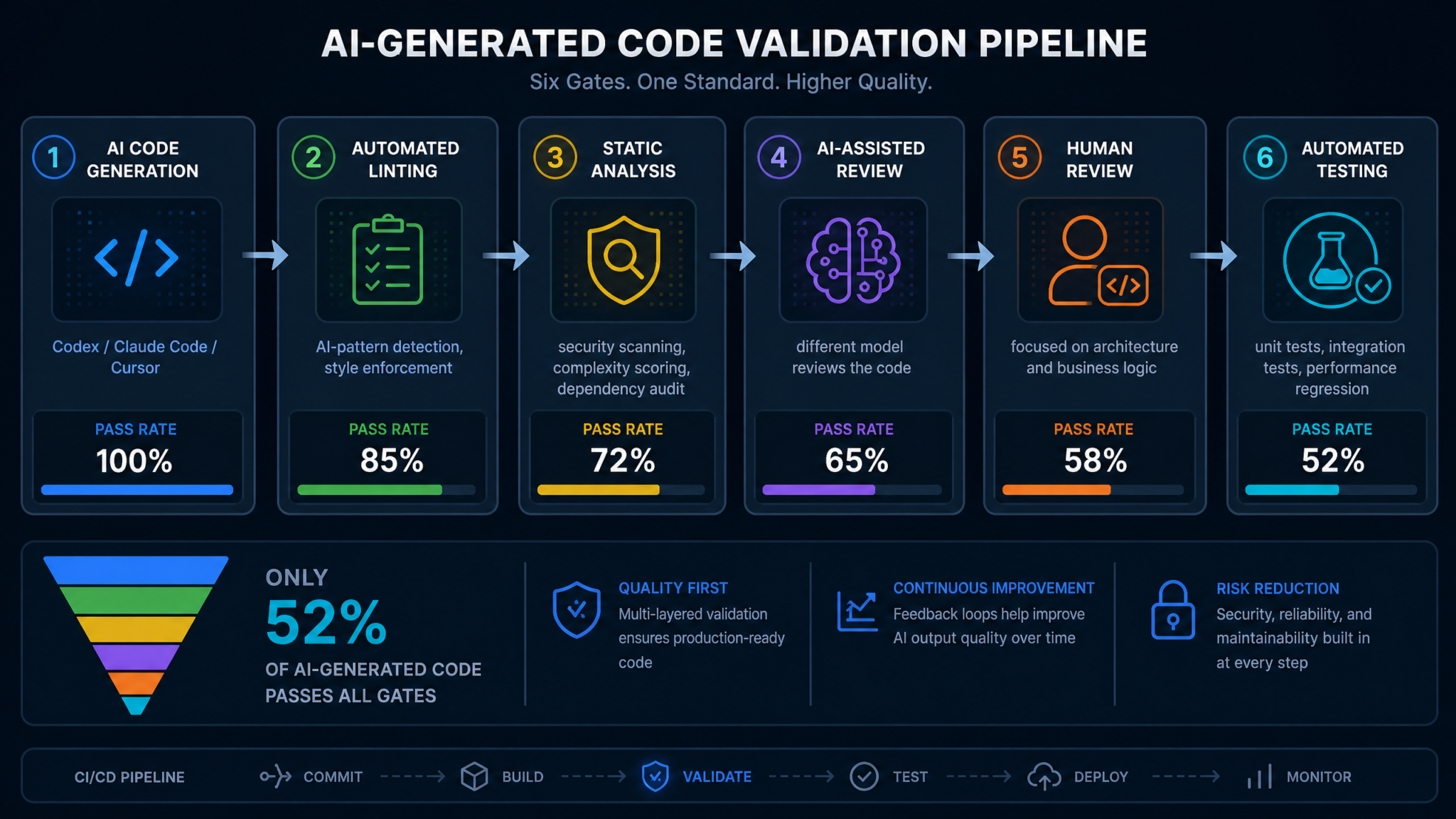
The solution to the validation gap is not to slow down AI code generation. It is to build validation infrastructure that can operate at AI-generation velocity. This requires automating the portions of validation that are automatable, augmenting human reviewers with AI-powered review tools, and structuring the validation workflow so that human attention is reserved for the decisions that genuinely require it.
Stage 1: AI-Pattern Linting
Standard linters enforce style rules and catch common syntactic issues. For AI-generated code, this baseline needs to be extended with rules specifically designed to catch patterns that AI models produce frequently but that violate team or language community best practices. These AI-pattern linters should be configured to flag:
- Imports of packages not on the project’s approved dependency list
- Code complexity scores above configurable thresholds (cyclomatic complexity, cognitive complexity)
- Inconsistent error handling patterns within a file or module
- Magic numbers and inline string constants that should be named constants or configuration values
- Duplicate logic that appears to have been generated independently in separate functions
- Comment-to-code ratio anomalies (AI often generates either very sparse or very verbose comments that don’t match team norms)
Tools like ESLint, Pylint, and RuboCop all support custom rule plugins. Teams should invest engineering time in building an AI-specific rule set that reflects the specific failure modes they observe in their AI-generated code. This is not a one-time configuration task — it should be an evolving set of rules updated as the team learns more about where their AI tools create systematic problems.
Stage 2: Static Analysis Tuned for AI Output
Static analysis goes deeper than linting, examining control flow, data flow, and potential runtime behavior without executing the code. For AI-generated code, the most valuable static analysis configurations focus on:
- Null and undefined reference analysis: AI models frequently generate code that assumes the success path without fully handling null or undefined return values from called functions.
- Concurrency hazard detection: Race conditions, deadlock risks, and improper lock usage in concurrent code are a known AI generation weakness.
- Data flow analysis for sensitive fields: Tracking where user-provided data flows through the system can surface injection vectors and improper sanitization.
- Dead code and unreachable branch detection: AI models sometimes generate defensive code paths that are structurally unreachable, adding noise and maintenance burden.
Commercial tools like Sonar, Coverity, and Semgrep can be configured with AI-specific rule sets. The Semgrep registry, in particular, has seen active community contribution of rules targeting common AI generation antipatterns. Semgrep Configuration Guide for AI-Generated Code Security Scanning
Stage 3: AI-Assisted Code Review Using a Different Model
One of the most powerful emerging practices in AI-generated code validation is using a different AI model to review the output of the primary generation model. This sounds circular but reflects a genuine engineering insight: different models have different biases, training data emphases, and failure modes. A review model that was not responsible for generating the code will not have the same blind spots as the generation model, and it can surface issues that human reviewers, fatigued by volume, might miss.
In practice, this means integrating a code review AI into the pull request workflow that:
- Receives the complete diff of changes along with the relevant repository context
- Produces a structured review identifying potential bugs, security concerns, and quality issues
- Flags sections that require mandatory human review based on sensitivity rules
- Suggests specific improvements with explanations that help human reviewers understand the concern
The AI review should not replace human review. It should pre-process and prioritize it, ensuring that human attention flows to the highest-risk portions of each change rather than being diluted evenly across all changed lines. Teams implementing this approach report that reviewer throughput improves significantly without a corresponding reduction in defect detection rates — the combination of AI pre-screening and targeted human review outperforms either in isolation.
Stage 4: Continuous Testing with AI-Generated Test Cases
The test coverage crisis requires a supply-side response. If AI is generating implementation code faster than humans can write tests, the answer is to use AI to generate tests as well — but with careful quality controls applied to the tests themselves. AI-generated tests are not automatically valuable. Tests that only cover the happy path, that use mocked dependencies in ways that don’t reflect production behavior, or that assert on implementation details rather than observable behavior can produce misleadingly high coverage numbers while providing little actual quality assurance.
A well-structured AI-assisted testing workflow:
- Uses AI to generate an initial test suite as part of implementation, not as an afterthought
- Applies mutation testing tools (Pitest for Java, mutmut for Python, Stryker for JavaScript) to verify that tests actually fail when code behavior changes
- Requires human review of test design for any tests covering security-sensitive or financially critical paths
- Tracks not just coverage percentage but coverage of branch paths, edge cases, and error conditions
- Integrates property-based testing generation where the domain supports it
Stage 5: Security Scanning with AI-Specific Rules
Existing SAST (Static Application Security Testing) tools need augmentation with rules targeting AI-specific vulnerability patterns. Leading security teams are building rule sets that specifically target:
- String concatenation in SQL, LDAP, and command execution contexts
- Hardcoded credentials and API keys (AI models occasionally reproduce credential patterns from training data)
- Insecure deserialization patterns common in AI-generated serialization code
- Missing authorization checks in AI-generated API endpoint handlers
- Cryptographic weaknesses including MD5/SHA1 usage, ECB mode selection, and improper IV/nonce handling
- Server-side request forgery vectors in AI-generated HTTP client code
The validation pipeline should run security scanning on every commit, with results surfaced directly in the pull request interface. Security findings should block merge unless explicitly reviewed and acknowledged by a qualified team member — not just any approver.
Pipeline Architecture Overview
A complete validation pipeline for AI-generated code operates as a series of gates, each of which can block or flag for human attention without necessarily blocking all subsequent stages. The architecture, described as a text diagram:
  [Code Push / PR Open]
         |
  [AI-Pattern Lint]  ──fail──>  [Block + Report]
         |
  [Static Analysis]  ──high severity──>  [Flag for Priority Human Review]
         |
  [AI Code Review (Different Model)]  ──>  [Annotated PR + Risk Score]
         |
  [Security Scan (AI-Specific Rules)]  ──critical──>  [Block + Security Team Alert]
         |
  [Automated Test Suite + Mutation Testing]  ──coverage below gate──>  [Block]
         |
  [Dependency Audit]  ──license/vulnerability fail──>  [Block + Legal/Security Review]
         |
  [Complexity + Debt Scoring]  ──>  [Dashboard Update + Tech Debt Log]
         |
  [Human Review Queue]  ──>  [AI-Prioritized Review Assignment]
         |
  [Approved + Merged]
CI/CD Pipeline Configuration for AI-Assisted Development Teams
Quality Gates Designed for AI Output
Quality gates are the specific thresholds and rules that determine whether code can proceed through the pipeline. For AI-generated code, these gates need to be both more numerous and more precisely calibrated than traditional gates, because the failure modes are more varied and the volume is higher.
AI Content Threshold Gate
Teams should implement tooling that estimates the proportion of AI-generated content in each file or pull request. GitHub Copilot, Cursor, and similar tools expose telemetry about accepted suggestions. Some teams use heuristic detectors based on code structure patterns. When a file or PR exceeds 50% estimated AI-generated content, it should trigger a mandatory enhanced review process that includes:
- Assignment to a senior reviewer with explicit AI review training
- Mandatory AI-powered pre-review before human review begins
- Longer minimum review time expectations
- Explicit sign-off on security implications
Automated Complexity Scoring Gate
Cyclomatic complexity and cognitive complexity scores should be computed at the function, file, and module level, with configurable thresholds that trigger review escalation. For AI-generated code specifically, the thresholds should be tighter than for human-written code, because AI models tend to generate locally optimal solutions that can be globally complex — solving an immediate problem with a function that is technically correct but structurally convoluted in ways that will burden future maintainers.
Recommended initial thresholds: cyclomatic complexity above 10 per function triggers warning; above 20 blocks merge pending architectural review. These numbers should be calibrated to the team’s specific codebase and adjusted over time based on defect correlation analysis.
Dependency Audit Gate
Every dependency introduced by AI-generated code should be automatically checked against:
- The project’s approved dependency registry
- Known vulnerability databases (CVE, OSV, GitHub Advisory Database)
- License compatibility requirements
- Package maintenance status and last release date
- Download volume and community health indicators
Any new dependency not on the approved list should require explicit human approval from an architect or technical lead — not just from the PR author. This gate alone can dramatically reduce the supply-chain risk introduced by AI-generated import statements.
Performance Regression Gate
AI-generated code that is functionally correct can introduce significant performance regressions because AI models optimize for correctness and readability over efficiency. Automated performance benchmarks should run on every PR that touches performance-sensitive paths, with baseline comparisons that flag regressions above configurable thresholds — typically 5–10% on key benchmarks for latency-sensitive systems, or 15–20% for throughput-oriented systems.
Access 40,000+ AI Prompts for ChatGPT, Claude & Codex — Free!
Subscribe to get instant access to our complete Notion Prompt Library — the largest curated collection of prompts for ChatGPT, Claude, OpenAI Codex, and other leading AI models. Optimized for real-world workflows across coding, research, content creation, and business.
Metrics That Actually Matter
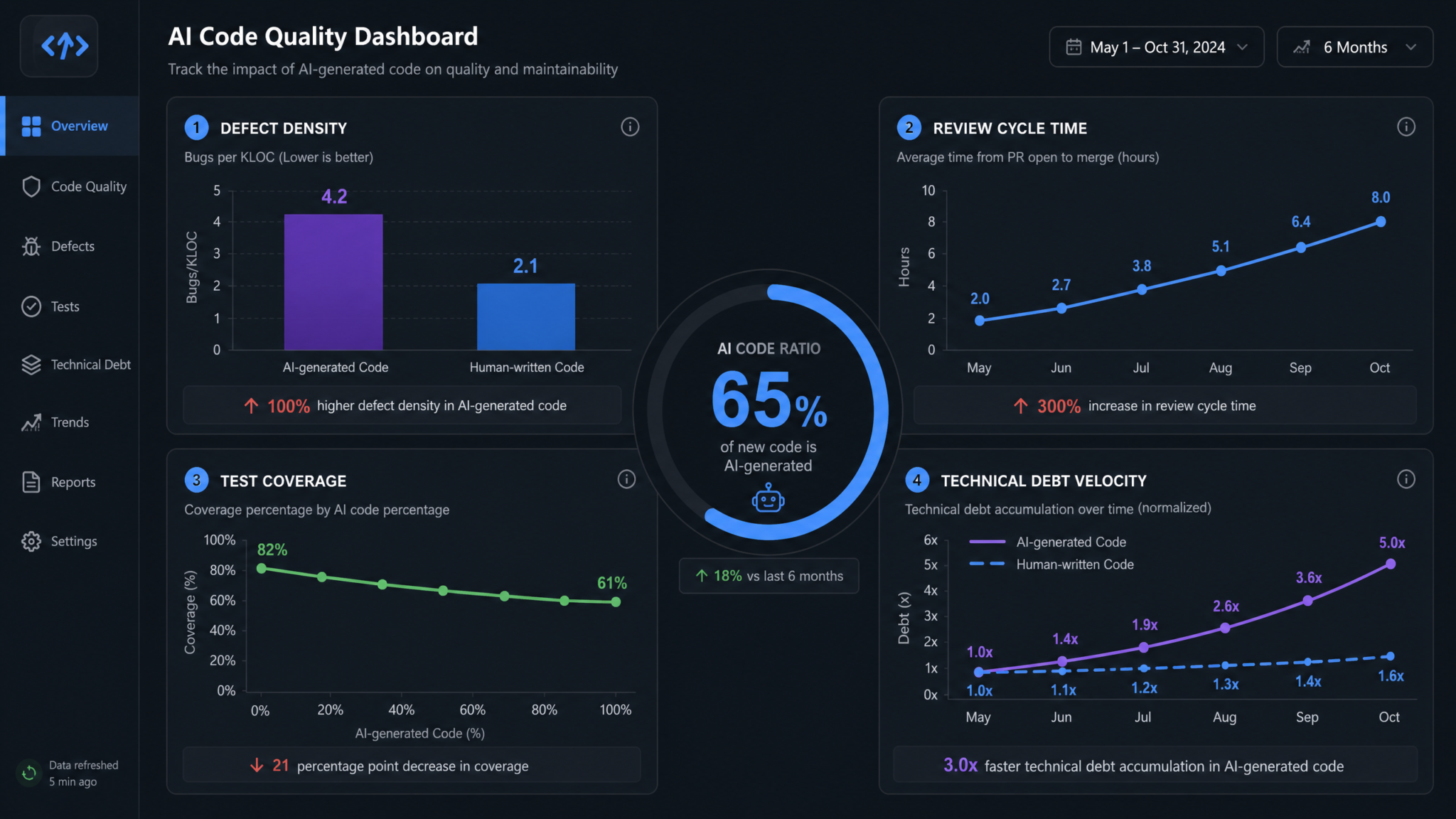
Managing the validation gap requires measuring it. Teams that attempt to improve AI code quality without rigorous measurement are navigating blind. The following metrics dashboard provides a structured framework for tracking the health of AI-assisted development programs.
Core Quality Metrics
Defect Density: AI vs. Human-Written Code. Track bugs per thousand lines of code separately for AI-generated and human-written code. This comparison is the most direct measure of relative AI code quality and will evolve as your tooling, review processes, and developer training improve. Most teams starting this measurement find AI defect density is 1.3–1.8x higher than human-written defect density. The goal is to bring this ratio to parity or better through improved validation.
Review Cycle Time by Code Origin. Measure the time from PR open to merge for AI-heavy PRs versus human-written PRs. If AI PRs take significantly longer to review despite containing more code, this signals review process inefficiency. If they take the same or less time, it may signal insufficiently thorough review. Neither extreme is necessarily right; the goal is efficient AND thorough review.
Test Coverage Ratio. Track not just absolute coverage percentage but the ratio of test code to implementation code, broken down by AI versus human origin. A healthy ratio ensures that AI-generated implementations are accompanied by proportionate test investment.
Mean Time to Detect AI-Introduced Bugs (MTTD-AI). How long does it take from when an AI-generated bug is introduced until it is detected — in review, in testing, or in production? This metric measures the effectiveness of your entire validation pipeline. A decreasing MTTD-AI indicates your validation is catching bugs earlier. An increasing MTTD-AI is a warning signal that bugs are escaping earlier stages.
Technical Debt Velocity. Using automated debt measurement tools (SonarQube’s debt calculation, CodeClimate’s technical debt rating), track how quickly technical debt is accumulating in AI-generated versus human-written portions of the codebase. This should be reported as a trend metric, not a point-in-time measurement, to make the accumulation rate visible.
Pipeline Health Metrics
Gate Pass Rate by Stage. For each stage of your validation pipeline, track what percentage of submissions pass without manual escalation. Sudden changes in gate pass rates often signal changes in AI tool behavior, prompt practice changes among developers, or emerging problem areas in the codebase.
Security Finding Frequency. Track security findings per AI-generated PR, categorized by severity and vulnerability type. This metric should be analyzed for trends and patterns — if injection vulnerabilities are appearing in every PR touching database code, that points to a specific intervention needed in developer prompting practice or reviewer focus.
False Positive Rate for Automated Checks. Automated tools that flag too many false positives will be ignored or disabled by frustrated developers. Track the rate at which automated findings are dismissed by human reviewers and use this to tune your tooling.
Team Health Metrics
Review Load Distribution. Measure how review burden is distributed across the team. High concentrations of review load on specific individuals are both a burnout risk and a quality risk — tired reviewers approve code they haven’t fully examined. Aim for load distribution that keeps individual review burden within sustainable limits.
Reviewer Confidence Score. Survey reviewers periodically with a simple question: “How confident are you that the code you approved this week is correct and safe?” Declining confidence scores are a leading indicator of burnout and quality risk before either manifests in production metrics.
| Metric | Measurement Frequency | Target Direction | Alert Threshold |
|---|---|---|---|
| Defect density ratio (AI/human) | Weekly | Decreasing toward 1.0 | >2.0 triggers review process audit |
| Test coverage (AI code paths) | Per PR + Weekly trend | Increasing toward 80% | <60% blocks merge |
| MTTD-AI (bug detection time) | Monthly | Decreasing | +20% month-over-month triggers pipeline review |
| Technical debt velocity | Sprint-level | Stable or decreasing | +50% vs. baseline triggers debt sprint |
| Review cycle time | Weekly | Stable with volume growth | +40% triggers process intervention |
| Security findings per AI PR | Per PR + Weekly trend | Decreasing | Critical findings always block merge |
Building a Sustainable Workflow
Pipelines and metrics are necessary but not sufficient. The validation gap is ultimately a human problem — it manifests in the behaviors, habits, and culture of engineering teams. Building a sustainable workflow means addressing the human dimension as rigorously as the technical one.
Training Developers to Review AI Code Effectively
Reviewing AI-generated code requires a different mental model than reviewing human-written code. Human code review heuristics evolved to catch human cognitive errors — forgetting edge cases, misunderstanding requirements, making logic errors in complex conditions. AI code review requires additional heuristics specifically calibrated to AI failure modes: plausible but subtly incorrect logic, missing domain context, inappropriate pattern application, and security vulnerabilities embedded in otherwise clean code.
Effective training programs for AI code review should include:
- Bug hunting exercises using real examples of AI-generated code with known issues, where reviewers practice spotting problems before seeing the answers
- Pattern recognition training that teaches developers to identify specific AI generation antipatterns in their team’s technology stack
- Security-focused review sessions specifically covering the OWASP Top 10 as they manifest in AI-generated code
- Calibration sessions where multiple reviewers independently review the same AI-generated code and compare findings
- Regular retrospectives on production incidents that originated in AI-generated code that passed review
Establishing AI Coding Standards
The same way teams maintain human coding standards through style guides, architecture decision records, and design patterns documentation, they need AI coding standards that govern how developers interact with AI tools. These standards should specify:
- Which types of code can be AI-generated with minimal review (boilerplate, simple utilities) versus which require enhanced scrutiny (authentication, payment processing, data access)
- Required prompt elements for generating code in security-sensitive contexts
- Standards for reviewing and cleaning AI-generated code before committing
- Rules about AI-generated test quality — what makes an AI-generated test acceptable
- Documentation requirements for AI-generated code — what the developer needs to add that AI did not provide
AI Coding Standards Template for Enterprise Software Teams
Creating Feedback Loops to Improve AI Output Quality
Most teams treat AI output quality as a fixed input — they use whatever the model generates and review it. A more sophisticated approach treats AI output quality as a variable that can be improved through systematic feedback loops. This means:
- Tracking which types of prompts produce code that passes review easily versus requires significant revision
- Building a prompt library of high-quality prompt templates for common development tasks, refined based on review outcomes
- Creating a team-level knowledge base of AI failure patterns and their corrections, updated continuously as new patterns emerge
- Using fine-tuned models or retrieval-augmented generation with team-specific context to improve output alignment with team standards
- Establishing prompt review as part of the code review process — not just reviewing the code, but reviewing the prompt that produced it and improving it for future use
Balancing Speed with Quality: The Senior Engineer Model
The most successful framework for sustainable AI-assisted development treats the AI as a very capable but junior developer and the human as a senior engineer providing oversight. Under this model, AI handles implementation velocity while humans provide architectural judgment, security awareness, domain context, and quality standards. This division of labor is not about limiting AI — it is about deploying human expertise where it delivers the highest leverage.
The senior engineer model requires that organizations invest in developing and retaining senior engineering talent even as they adopt AI tools that increase junior-level code output velocity. The temptation to reduce senior headcount because AI tools make individual developers more productive is one of the most dangerous organizational mistakes in the current AI adoption wave. Senior engineers are the review capacity constraint. Reducing them worsens the bottleneck, not improves it.
Case Studies: Who Solved It and Who Didn’t
Case Study 1: FinOps Platform at Scale — A Successful Intervention
A mid-sized financial operations platform serving enterprise clients had adopted AI coding assistants aggressively in late 2024, seeing immediate productivity gains that delighted leadership. By Q2 2025, they were experiencing the accumulation phase in full force: review queues averaging 4.5 days, test coverage declining from 78% to 63%, and three production incidents in a single month that traced back to AI-generated code that had passed review without adequate scrutiny.
The engineering leadership convened a validation task force and spent four weeks building a complete validation pipeline and quality gate system. Key decisions included: mandatory AI pre-review for all PRs using a dedicated Anthropic Claude instance configured with their internal coding standards; a two-tier review system where AI-heavy PRs above 50% AI content required a senior reviewer specifically assigned from a rotating pool; and a “test before merge” policy that used mutation testing to verify coverage quality rather than just coverage quantity.
Six months after implementation, defect density in AI-generated code had fallen 35%. Test coverage had recovered to 71% and was trending toward their 80% target. Review queue time had dropped from 4.5 days to 1.8 days, despite higher code volume, because the AI pre-review was routing human attention more efficiently. Production incidents returned to pre-AI baseline levels. Developer-reported review burnout declined from 58% to 31%.
The critical factor in their success was treating validation infrastructure as a product, with engineering investment and dedicated maintenance, rather than as a process overhead to be minimized.
Case Study 2: E-Commerce Startup — The Reckoning
A venture-backed e-commerce startup had fully embraced AI-generated code from their founding in early 2025. Moving fast was a survival requirement, and AI tools let their team of 12 engineers ship at the pace of a team of 40. For the first 18 months, this strategy appeared vindicated. Feature velocity was extraordinary, investors were pleased, and the product was expanding rapidly.
By month 20, the accumulation had reached critical mass. A security audit ahead of a Series B revealed 23 significant vulnerabilities in AI-generated authentication and payment handling code, several of which had been in production for over a year. Test coverage had fallen below 40%. Technical debt had accumulated to the point where adding new features to the checkout flow — their core revenue driver — required weeks of untangling for every sprint of progress. Two senior engineers resigned citing frustration with the codebase quality. The Series B closed at a significantly reduced valuation, with investors requiring a six-month “quality remediation sprint” before additional development investment.
The remediation sprint consumed 14 weeks and required bringing in two external senior engineers as contractors. The total cost — including delayed revenue, contractor fees, and the reduced Series B valuation — exceeded what a proper validation infrastructure investment would have cost by a factor of approximately 12.
Their retrospective identified three pivotal failures: no security scanning beyond basic dependency checking, no quality gates that could block a PR, and a culture where flagging AI code quality issues was implicitly discouraged because velocity was celebrated above all else.
Case Study 3: Healthcare SaaS — Regulatory Compliance as the Driver
A healthcare SaaS company found an unexpected advantage in their regulatory environment. Operating under HIPAA requirements with regular third-party audits, they could not adopt AI-generated code without explicit validation processes — their auditors required evidence of review for any code handling protected health information. This constraint, initially viewed as a handicap, forced them to build validation infrastructure from the start of AI adoption rather than retroactively.
Their compliance-driven approach produced a validation pipeline that other industry verticals would benefit from voluntarily adopting. Every file touching patient data was tagged in the repository metadata. AI-generated code in tagged files required documented security review, automated PII data flow analysis, and explicit sign-off from their HIPAA compliance officer. They built a custom Semgrep ruleset specifically targeting HIPAA-relevant data handling patterns in AI-generated code.
The result was that two years into AI adoption, they had the lowest defect density of any team benchmarked in their peer group, maintained 82% test coverage, and had experienced zero HIPAA-reportable incidents. Their compliance overhead was real but modest compared to the quality benefits it had indirectly created.
HIPAA Compliance Requirements for AI-Assisted Healthcare Software Development
Key Differentiators Between Success and Failure
| Factor | Teams That Solved It | Teams That Didn’t |
|---|---|---|
| Validation infrastructure investment | Treated as product development, with dedicated engineering time | Treated as overhead, minimized or deferred |
| Senior engineer investment | Maintained or grew senior headcount as AI adoption increased | Reduced senior headcount citing AI productivity gains |
| Metrics and measurement | Tracked AI vs. human defect density from day one | Measured only feature velocity |
| Security scanning | AI-specific security rules, blocking gates | Generic scanning, non-blocking or absent |
| Culture and incentives | Celebrated quality metrics alongside velocity | Velocity celebrated exclusively |
| Training | Structured AI code review training for all reviewers | No specific training for AI code review |
Conclusion: Quality as the Competitive Differentiator
The software industry is in the middle of a productivity transformation that is genuinely unprecedented. AI coding assistants have demonstrated real, measurable gains in development velocity that are not going to disappear. The teams and organizations that capture the full value of those gains — rather than trading future reliability for present speed — are the ones that treat validation and quality assurance as core competencies requiring the same investment and attention as the AI tools themselves.
The validation gap is not inevitable. It is a predictable consequence of adopting a capability that changes the production side of the development equation without making corresponding changes to the quality assurance side. The teams that recognize this — that build validation pipelines capable of operating at AI velocity, that invest in training reviewers to understand AI-specific failure modes, that measure the right things and use those measurements to continuously improve — are demonstrating that AI-assisted development can deliver its promised productivity gains without the reliability and debt penalties that are currently plaguing unprepared adopters.
The InformationWeek August 2026 report’s central finding deserves to be read as a challenge, not just a warning: AI makes code faster to produce but harder to validate. The harder-to-validate part is not a fixed constraint. It is an engineering problem. And engineering problems, given sufficient attention, rigor, and investment, get solved.
The organizations building systematic responses to the validation gap today are not just protecting themselves from near-term production incidents. They are building the institutional knowledge, tooling infrastructure, and engineering culture that will make them more capable of leveraging whatever AI capabilities emerge next — because they will already have the quality systems in place to use those capabilities responsibly. In a landscape where every competitor has access to the same AI generation tools, the ability to validate, trust, and ship AI-generated code confidently is becoming the genuine competitive differentiator.
That differentiator is built now, in the choices engineering leaders make about how to respond to the bottleneck that has already arrived — not in a future where the bottleneck becomes a crisis that can no longer be ignored.
