
GPT-5.6 Sol Ultra vs Max Reasoning: Subagent Architecture, Cost, Latency, and Workload Selection
Introduction
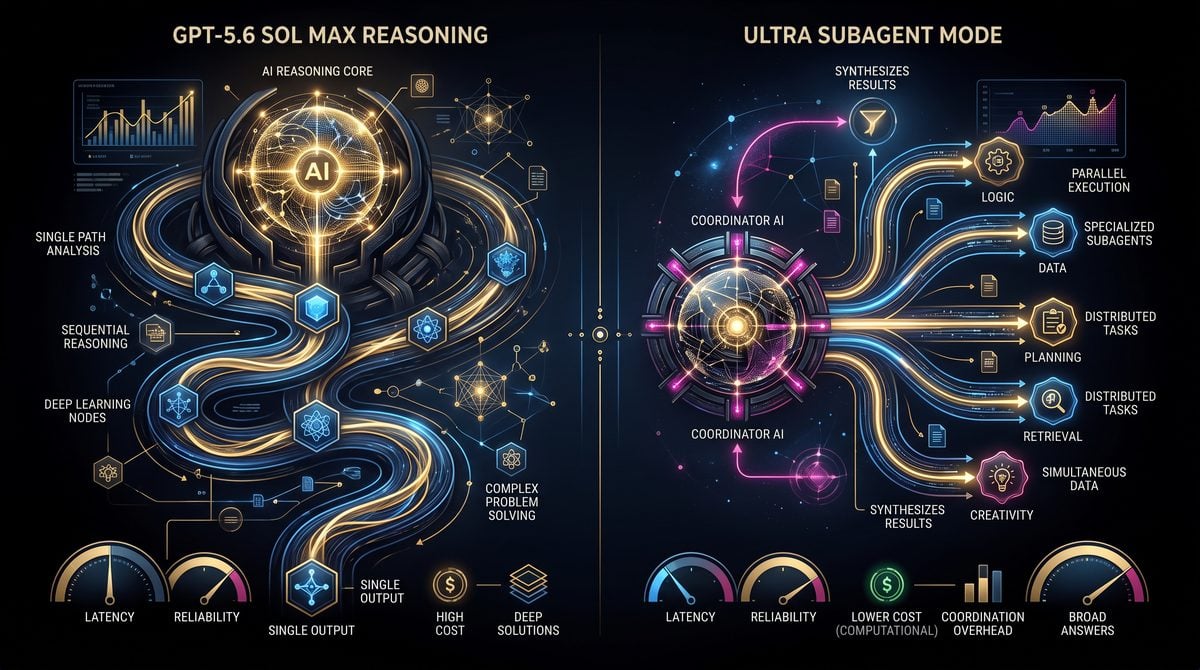
GPT-5.6 Sol introduces two distinct reasoning topologies intended to address different classes of difficult tasks: a “max” reasoning setting that deepens a single-agent chain-of-thought, and an “ultra” subagent mode that composes multiple specialized or parallel subagents under an orchestrator. This section establishes the conceptual distinction between those topologies and gives an executive-level verdict so system architects can quickly choose a topology based on mission constraints such as latency sensitivity, cost budgets, and failure-mode tolerance. The analysis draws on OpenAI’s GPT-5.6 Sol preview materials, which document the new max reasoning effort, ultra subagent coordination, Terminal-Bench improvements, layered misuse safeguards, and over 700,000 A100-equivalent GPU hours of automated red teaming used during development.
The focus here is reasoning topology rather than high-level Sol/Terra/Luna tier selection: we compare a deeper single-agent reasoning flow (max) against a coordinated multi-agent workflow (ultra). Readers will find a concise executive verdict for quick decisions, a clear Table of Contents for navigation, and a concept-level comparison that covers latency, token usage, orchestration overhead, reliability and failure modes, cost drivers, and routing heuristics by workload class. Implementation examples are presented as architecture patterns rather than product APIs, and safety context references Terminal-Bench and layered misuse safeguards where they alter design choices or operational risk.
Executive verdict
The max reasoning topology is the default choice when a single, coherent chain-of-thought with minimal external coordination is most likely to produce correct results: tasks that require deep sequential inference, tightly interdependent reasoning steps, or minimal ambient parallelism. Max trades increased single-call compute depth for simpler failure modes and lower orchestration overhead.
The ultra subagent topology is preferable when a task decomposes naturally into semi-independent subproblems, when parallel execution or specialized reasoning is likely to reduce total wall-clock time, or when you want modular redundancy and specialized expertise (for example, a numeric verifier plus a natural-language explainer). Ultra adds orchestration and coordination costs and introduces multi-agent consistency issues, but it can improve throughput, enable specialist tuning per subagent, and increase resilience via redundancy and disagreement resolution.
Table of Contents
- Section 1 — Introduction, executive verdict, and conceptual comparison of max vs ultra (this section)
- Section 2 — Latency, token economics, and coordination overhead analysis
- Section 3 — Reliability, failure modes, and safety mitigations (Terminal-Bench & layered safeguards)
- Section 4 — Workload routing, deployment patterns, and operational recommendations
Conceptual comparison: max reasoning versus ultra subagent mode
Core topology and control flow
The two topologies differ fundamentally in how they partition reasoning work and where control is centralized.
- Max (deeper single-agent): A single reasoning agent receives the problem statement and performs a deeper, often iterative internal reasoning process. The agent may internally expand chain-of-thought steps, maintain a mental model, and perform multi-step refinement before emitting a final answer. From an orchestration perspective, a single high-latency compute operation encapsulates most of the work.
- Ultra (subagent orchestration): A lightweight orchestrator decomposes the problem and dispatches units of work to multiple subagents. Subagents can run in parallel, specialize on subtasks (parsers, verifiers, synthesis modules), or run variants for redundancy. The orchestrator merges and reconciles outputs, possibly invoking tie-breakers or additional subagent queries to resolve inconsistencies.
Latency and parallelism
Max concentrates latency into one or a few long-running calls. Because the reasoning is internal and sequential, wall-clock latency maps closely to single-call compute duration and any internal iterative passes. There is minimal network round-trip overhead beyond the initial request and final response, which simplifies latency predictability.
Ultra trades single-call depth for potential parallelism. When subproblems are independent, wall-clock latency can decrease because multiple subagents execute concurrently. However, ultra adds orchestration latency: the time to decompose the task, dispatch subagents (which often requires separate request/response cycles), and perform aggregation and conflict resolution. For workloads that parallelize poorly or where the aggregation step is complex, ultra’s orchestration latency can exceed max’s single-call latency.
Token usage and internal compute accounting
Max often uses more internal tokens per reasoning path because deep chain-of-thought or iterative refinement expands internal state representation. Those internal tokens are billed as model compute and can increase per-request cost metrics. Ultra redistributes token consumption across several subagents; total token volume may increase due to repeated context sent to each subagent and coordination metadata, but per-subagent token counts are often smaller. Ultra can be more token-efficient when subagents operate on small focused contexts and avoid redoing entire chains of thought.
Coordination overhead and orchestration complexity
Ultra introduces explicit coordination tasks: problem decomposition, context partitioning, result aggregation, and disagreement resolution. Each of these steps creates operational complexity:
- Decomposition heuristics must preserve problem semantics without losing cross-cutting dependencies.
- Context partitioning may duplicate shared context across subagents, increasing token usage.
- Aggregation needs conflict-resolution logic — majority voting, weighted trust, or verifier subagents — which itself can require additional compute and tokens.
By contrast, max’s orchestration is minimal: the application submits a single problem and the model internally handles sequencing. That simplicity translates into fewer moving parts and a smaller operational surface area.
Reliability, failure modes, and multi-agent inconsistencies
Both topologies have distinct reliability characteristics and failure modes.
| Dimension | Max (single-agent) | Ultra (subagent) |
|---|---|---|
| Primary failure modes | Timeouts, hallucination or incorrect chain-of-thought, insufficient depth for certain problems | Subagent disagreement, partial failures (one subagent times out), orchestration deadlocks, inconsistent consolidation |
| Recoverability | Retry with greater reasoning depth or adjustable temperature; single point of retry | Selective retry of failed subagents, re-run aggregation with redundancy, fallback to max-style single-agent attempt |
| Observability | Harder to introspect internal reasoning steps without explicit chain-of-thought output | Higher observability: each subagent output is a traceable artifact useful for debugging |
Ultra can be more resilient because it enables redundancy and targeted retries; however, it creates new failure classes associated with coordination logic. For example, two subagents might provide plausible but contradictory answers; resolving such disagreement requires explicit arbitration strategies. Max may fail silently with a plausible but incorrect final answer unless the model is instrumented to produce traceable reasoning steps.
Cost drivers without absolute pricing
Cost is driven by compute time, token volume, and orchestration overhead rather than an inherent property of either topology. Relevant qualitative drivers include:
- Compute intensity per call: max concentrates compute into deeper passes; ultra breaks compute into many smaller calls whose overhead may sum to a higher total compute budget if redundancy is used.
- Token duplication: ultra often duplicates shared context across subagents, increasing billed tokens unless context compression or retrieval-based context is used.
- Orchestration compute: the orchestrator may run verification or aggregation logic, which can be implemented in-model (additional subagent calls) or in deterministic code (application-side compute).
- Safety and red-teaming margins: improved Terminal-Bench performance and layered misuse safeguards documented in the preview reduce operational risk and may change the effective cost of mitigation activities, but they do not eliminate the need for design-time safeguards in ultra topologies where the attack surface grows.
Routing by workload: heuristics and archetypes
Architectural choice should be guided by workload decomposition characteristics and operational constraints. The following routing heuristics summarize practical selection patterns:
- Deep, sequential inference (choose max). Mathematical proofs, causal chain reconstruction, or problems where each inference step depends on the previous one are natural for a deep single-agent reasoning flow. Where explaining every step is important, configure the model to surface internal chains-of-thought for auditing.
- Modular or parallelizable problems (choose ultra). Large-scale document synthesis where each chapter can be drafted independently, multi-part code generation with separate test generation and verifier agents, or pipelines that combine factual extraction, normalization, and templated rendering map well to subagent decomposition.
- Latency-sensitive but partitionable (choose ultra with care). If wall-clock latency is paramount and subtasks parallelize, ultra can reduce elapsed time even if total compute rises. Ensure orchestration latency does not dominate and that aggregation logic runs deterministically.
- High-assurance outputs (hybrid strategies). Use ultra for initial parallel exploration and a final max-style verifier to consolidate and deeply validate the leading candidate. This hybrid reduces chance of inconsistent outputs while leveraging parallelism.
Illustrative orchestration patterns (conceptual)
// Max (conceptual)
// Single request; model performs deep sequential reasoning then returns an answer.
submitProblem(problem)
-> singleDeepAgent(problem)
-> answer

// Ultra (conceptual)
// Orchestrator decomposes and runs parallel subagents, then aggregates.
submitProblem(problem)
-> orchestrator.decompose(problem) -> [subtasks]
-> parallelExecute(subagents, subtasks) -> [results]
-> orchestrator.aggregate(results) -> finalAnswer
Within GPT-5.6 Sol Ultra vs Max Reasoning: Subagent Architecture, Cost, Latency, and Workload Selection, the Ultra Subagent Patterns decision connects directly to The Complete Guide to Codex Multi-Agent Orchestration — Sub-Agents, Collaboration, and Concurrency. That linked article specifically examines codex Multi-Agent Orchestration — Sub-Agents, Collaboration, and Concurrency, giving teams concrete background for applying the present article’s Ultra Subagent Patterns recommendations without duplicating this workflow’s scope.
Safety considerations intertwined with topology
OpenAI’s preview materials highlight substantial automated red-teaming efforts and Terminal-Bench improvements and document layered misuse safeguards. From a topology perspective, ultra increases the operational attack surface because multiple subagents and the orchestrator each need appropriate safeguards; however, ultra also enables in-band mitigations such as specialized safety subagents or consensus-based rejection of safety-sensitive outputs. Max simplifies the safety surface but requires careful internal prompting or auditing to ensure deep internal chains-of-thought do not produce unsafe outputs. Both topologies benefit from Terminal-Bench-guided evaluation to identify edge-case behaviors discovered during automated red-teaming.
Architecture deep dive: single-agent deliberation and subagent decomposition
Within GPT-5.6 Sol Ultra vs Max Reasoning: Subagent Architecture, Cost, Latency, and Workload Selection, the Executive Verdict decision connects directly to GPT-5.6 Complete Review August 2026: Sol vs Luna vs Terra Benchmarks, Pricing, and Real-World Performance Across Every Use Case. That linked article specifically examines gPT-5.6 Complete Review August 2026: Sol vs Luna vs Terra Benchmarks, Pricing, and Real-World Performance Across Every Use Case, giving teams concrete background for applying the present article’s Executive Verdict recommendations without duplicating this workflow’s scope.
Below we explore implementation patterns, common failure modes, and practical mitigations that apply when you architect systems around either topology. The goal is not to prescribe SDK calls or exact parameters, but to provide operational guidance for integrating these modes into production pipelines and for constructing hybrid strategies where tasks are routed dynamically between them.
Single-agent deliberation (max): iterative depth inside one reasoning trace
Max reasoning behaves like a single, deeper agent performing longer internal deliberation cycles. Architecturally, a max-run is typically organized as a sequence of internal passes within one context window: hypothesis generation, evidence extraction, internal critique, hypothesis revision, and final synthesis. Those passes can be explicit—implemented as distinct prompt phases—or implicit, with the model instructed to reason step-by-step within one extended response.
Primary benefits include reduced inter-agent coordination and a unified internal state that avoids inconsistencies introduced by multi-party communication. Because the entire chain of thought lives in one trace, verification and corrective steps operate against the same working memory, which simplifies rollback and iterative refinement. In practice, this is advantageous for tasks requiring tight, stateful reasoning where intermediate assumptions must be mutated and reconsidered (for example, embedded arithmetic proofs, long legal argumentation, or tightly-coupled sequential planning).
However, the single-agent approach concentrates latency and token cost inside one session. Deeper deliberation usually implies longer responses or multiple back-and-forth prompt phases. The dominant operational issues are:
- Token inflation: iterative internal reasoning increases the total tokens consumed in a single session, which affects compute cost and can approach context-window limits.
- Latent failure persistence: if the agent adopts an incorrect premise early, that incorrect premise can cascade through later steps unless explicit critique and constraint-checking are enforced.
- Wall-clock latency: deeper reasoning often increases per-request latency because the model runs longer without parallelism.
Common engineering mitigations include instrumenting internal verification checkpoints (ask the model to produce a concise verification summary after each reasoning stage), breaking long reasoning into bounded micro-phases with explicit termination criteria, and layering lightweight correctness checks (syntactic validators, unit tests, or deterministic calculators) that run between phases.
Subagent decomposition (ultra): parallelism, specialization, and orchestration
Ultra subagent mode organizes reasoning as an ecosystem of smaller, focused subagents coordinated by a manager or controller. Each subagent handles a specialized facet of the problem (e.g., retrieval, numerical verification, domain-specific heuristics, creative drafting), and the manager is responsible for distributing tasks, collecting results, and adjudicating conflicts. Architecturally this looks like a scheduler + worker topology where workers may run in parallel and the manager performs synthesis and consistency checks.
The principal benefits are modularity, reduced per-subagent context size, and the ability to run smaller subagents that are cheaper or faster than a single, monolithic pass. Ultra shines on decomposable workloads—document pipelines, multi-step synthesis where independent subtasks can be solved concurrently, and ensemble-style reliability setups where multiple subagents provide overlapping answers for cross-checking.
Costs and challenges include:
- Coordination overhead: spawning subagents requires context distribution, result collection, and orchestration logic, which adds nontrivial latency and token duplication.
- Context duplication and token amplification: each subagent needs enough context to solve its facet; naively sending full context to all workers increases aggregate token usage.
- Consistency and assumption management: subagents may make incompatible local assumptions, producing divergent outputs that the manager must reconcile.
Typical mitigations comprise a canonical shared-context layer (compressed summaries or indexed references rather than full-text replication), capability-aware dispatch (send full context only to workers that require it), and standardized output schemas so the manager can efficiently parse and merge results.
Shared context, context compression, and state management
Both topologies depend on effective context management, but the challenges differ. In max, context is centralized and evolves inside the trace; the main concern is staying inside the active window while preserving sufficient history for robust reasoning. With ultra, context becomes a distributed resource that must be versioned, canonicalized, and possibly referenced rather than duplicated.
Practical techniques to control token use and reduce latency include:
- Summarization pipelines that compress prior exchanges into concise, canonical summaries that preserve critical facts and constraints.
- Reference-based context where long documents are converted into embeddings and the manager supplies retrieval pointers or short excerpts to subagents instead of full documents.
- Incremental context updates and version management so subagents can request only the delta since their last run, preventing repeated transmission of unchanged material.
Designing a shared-context API within your orchestration layer reduces ambiguity: define canonical keys for facts, timestamps for freshness, and a small set of immutable anchors (for example, the authoritative dataset snapshot or the agreed list of business rules) that all subagents consult rather than regenerate.
Result synthesis and adjudication patterns
Synthesizing outputs from multiple reasoning traces is the defining responsibility of the ultra manager. There are several common adjudication patterns, chosen based on task type and reliability targets:
- Voting and ensemble aggregation: for categorical decisions, apply plurality, quorum, or weighted voting based on subagent confidence scores and historical reliability.
- Constraint-based synthesis: apply hard constraints and discard any subagent outputs that violate invariant checks. This is useful where safety or correctness properties are absolute.
- Meta-reasoning fusion: run a synthesis agent that treats subagent outputs as evidence, reconciles contradictions, and produces a combined narrative with provenance tagging.
Engineers can reduce synthesis cost by tiering the synthesis step: for many tasks, a light-weight deterministic filter can reject obvious outliers before invoking an expensive synthesis agent. For high-assurance use cases, include programmatic validators (calculators, schema validators, regression tests) as part of the synthesis stage so the final output is accompanied by verifiable artifacts.
Example orchestration sketch (illustrative pattern): manager dispatches N subagents with task-specific prompts → subagents return structured outputs with a confidence score and provenance → manager runs deterministic validators → manager synthesizes final result using a meta-agent or rule-based merger.
Coordination overhead, latency composition, and token accounting
When evaluating latency and cost, decompose both topologies into component phases and account for parallelism and serial bottlenecks. Consider the following conceptual breakdown:
| Component | Max (single-agent) | Ultra (subagents + manager) |
|---|---|---|
| Initial context transmission | Single transmission; larger payload | Multiple transmissions or reference pointers; may be smaller per worker but repeated |
| Parallel compute | Limited (internal sequential passes) | Available; reduces wall-clock with concurrency |
| Coordination & synthesis | Implicit within trace; lower orchestration cost | Explicit synth step adds serial latency |
| Token duplication | Low to moderate (single trace) | Potentially high unless references/compression used |
In practice, ultra can reduce wall-clock latency for large, decomposable tasks if the communication overhead is small relative to subagent runtime. Conversely, for tasks that require tight sequential reasoning with strong internal state dependencies, max usually yields better latency-to-quality trade-offs because it avoids multiple synchronization barriers.
Reliability, failure modes, and practical defenses
Both topologies have distinct failure modes and monitoring requirements. Common failure classes and mitigations are:
- Cascading hallucination (max): an early incorrect assumption propagates through iterations. Mitigate with intermediate constraint checks, explicit contradiction detection, and automatic rollback triggers.
- Subagent divergence (ultra): workers produce incompatible outputs due to differing local assumptions. Mitigate by enforcing a canonical fact store and requiring subagents to declare assumptions as structured metadata that the manager checks automatically.
- Consensus failure (ultra): no quorum or no clear winner emerges. Implement fallback policies such as deterministic tie-breakers, escalation to a stronger single-agent synthesis run, or human-in-the-loop escalation.
- Soft deadlock (both): the system repeatedly requests clarification. Enforce bounded retries, backoff strategies, and a final fallback strategy that returns a conservative answer with explicit uncertainty statements.
Operational observability is critical: log subagent outputs with provenance, track confidence distributions, detect semantic contradictions automatically, and surface these signals to monitoring dashboards. Improvements to the underlying platform—such as Terminal-Bench enhancements and extensive automated red-teaming during GPT-5.6 Sol’s development—help identify systemic vulnerabilities, but production systems must still enforce layered safeguards and runtime validators tuned to the application domain.
Access 40,000+ AI Prompts for ChatGPT, Claude & Codex — Free!
Subscribe to get instant access to our complete Notion Prompt Library — the largest curated collection of prompts for ChatGPT, Claude, OpenAI Codex, and other leading AI models. Optimized for real-world workflows across coding, research, content creation, and business.
Routing heuristics between max and ultra
Within GPT-5.6 Sol Ultra vs Max Reasoning: Subagent Architecture, Cost, Latency, and Workload Selection, the Workload Routing Guidelines decision connects directly to The Complete Guide to GPT-5.6 Luna for High-Volume Production — Classification, Routing, Summarization, and Cost Optimization at Scale. That linked article specifically examines gPT-5.6 Luna for High-Volume Production — Classification, Routing, Summarization, and Cost Optimization at Scale, giving teams concrete background for applying the present article’s Workload Routing Guidelines recommendations without duplicating this workflow’s scope.
Cost and latency economics, workload matrix, failure modes, evaluation methodology, governance, and routing heuristics
This section translates the architectural distinctions of max reasoning (a deeper single-agent deliberation path) and ultra subagent mode (coordinated parallel or specialized subagents) into operational decisions: how each mode consumes compute and tokens, how latency behaves under different topologies, where coordination overhead appears, and how to route real workloads. The objective is practical: provide measurable metrics, an experimental plan to evaluate tradeoffs, and governance patterns to control cost, safety, and failure surface.
Because OpenAI’s GPT-5.6 Sol preview documents both the new max reasoning effort and ultra subagent mode, plus substantial automated red-teaming effort, the recommendations below build on those design patterns without inventing precise pricing or benchmark numbers. The discussion focuses on qualitative and measurable dimensions—wall-clock latency, compute-seconds, token accounting (including internal coordination tokens), and failure taxonomy—so engineering teams can design controlled experiments and make production routing decisions.
Cost vs latency: qualitative economics and where overhead appears
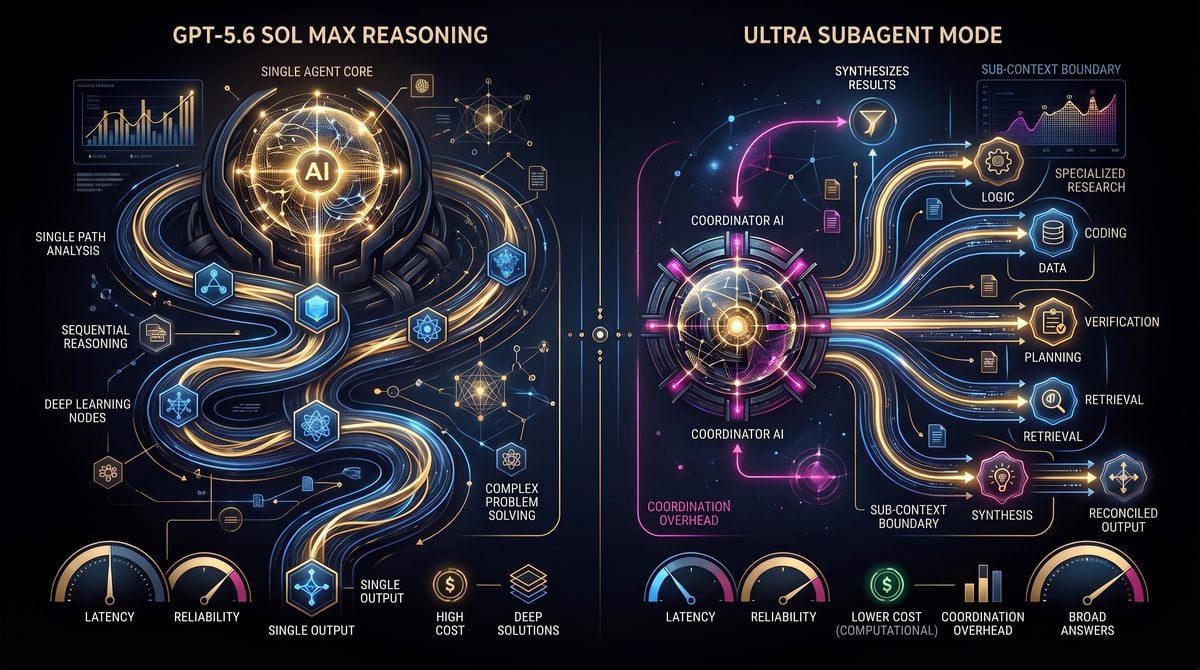
Cost and latency split into two related but distinct accounting domains: wall-clock latency experienced by a request, and the underlying compute cost (compute-seconds or GPU-hours) plus token-related billing. Max reasoning concentrates computation into a single agent that may run multiple internal deliberative passes; ultra distributes work across subagents and a coordinator, which changes the distribution of compute, parallelism, and token exchange.
Key budget and latency drivers to measure for each topology:
- Sequential depth: number of serial reasoning iterations performed by the model in a single-agent max run. Greater depth increases wall-clock latency linearly with iteration time, and increases compute-seconds and token use per request.
- Parallel breadth: number of subagents run concurrently in ultra mode. Breadth can reduce wall-clock latency through parallelism but increases aggregate compute-seconds and may increase token overhead for context replication and synthesis.
- Coordination tokens: messages sent from coordinator to subagents and back, plus any shared-context replication. These tokens count toward token consumption and often dominate cost for fine-grained decompositions.
- Result synthesis passes: the final aggregation step in ultra that consolidates subagent outputs; this can be repeated for verification and therefore adds to both latency and cost.
- Cold-starts and model switching: latency and cost from loading different specialized subagents or changing model precision/size per request.
| Dimension | Max reasoning (single agent) | Ultra subagent (coordinated) |
|---|---|---|
| Wall-clock latency | Higher for long serial deliberations; predictable because single pipeline | Lower if subagents run in parallel; coordinator adds synthesis latency |
| Compute-seconds per request | Concentrated in one model instance; proportional to deliberation depth | Typically higher aggregate compute due to multiple instances running |
| Token consumption | Tokenized internal chain-of-thought counts once per pass | Higher due to replicated context across subagents and coordinator messages |
| Predictability | More predictable latency distribution | Variance due to synchronization and stragglers among subagents |
Workload routing matrix — which topology fits which problem
Within GPT-5.6 Sol Ultra vs Max Reasoning: Subagent Architecture, Cost, Latency, and Workload Selection, the Architecture deep dive decision connects directly to How OpenAI Tripled GPT-5.6 Scores on ARC-AGI-3 with Two Simple API Settings: A Technical Deep Dive. That linked article specifically examines how OpenAI Tripled GPT-5.6 Scores on ARC-AGI-3 with Two Simple API Settings: A Technical Deep Dive, giving teams concrete background for applying the present article’s Architecture deep dive recommendations without duplicating this workflow’s scope.
| Workload characteristic | Preferred topology | Why | Routing heuristic (qualitative) |
|---|---|---|---|
| Long, linear chain-of-thought reasoning (one coherent internal state) | Max reasoning | Single-agent state preserves continuity without context replication | Prefer max when reasoning depth > medium and decomposition adds overhead |
| Natural decomposition into independent subproblems (map-reduce style) | Ultra subagent | Subagents can run in parallel and results can be synthesized | Prefer ultra when task splits cleanly into N independent subtasks |
| Ensemble verification, error checking, or cross-checking | Ultra subagent (parallel specialized verifiers) | Multiple subagents with different priors improve coverage and calibration | Route to ultra when verification budget > minimal and correctness critical |
| Latency-sensitive single-response (low token footprint) | Max reasoning (shallow) or a single specialized ultra subagent | Avoid coordination overhead; use minimal work | Prefer lowest round-trips and smallest context replication |
| High-throughput batch tasks with similar prompts | Ultra with batch subagents or optimized max runs | Parallelism and batching amortize overhead; reuse warm instances | Batch requests and reuse warmed subagents for lower cost per item |
Failure modes and reliability considerations
Both topologies expose failure surfaces, though their shapes differ. Ultra mode adds coordination and synchronization failure modes on top of those present in max reasoning. Reliability engineering must treat these as first-class concerns.
- Coordination failure: messages between coordinator and subagents may time out, be delayed, or return inconsistent state. In ultra this can manifest as partial outputs, missing subagent contributions, or stalled synthesis. Implement exponential backoff, idempotent subagent calls, and timeouts tuned to expected subagent latencies.
- Straggler effects: ultra systems can have a long tail where one slow subagent delays completion. Techniques include speculative execution, early synthesis with partial results, or assigning redundancy to expected slow roles.
- Divergence and contradiction: subagents may produce contradictory answers; the synthesis stage must reason about disagreement, apply voting or confidence-weighted aggregation, and surface ambiguity instead of returning a single inconsistent result.
- State staleness and context mismatch: in ultra, context replication to subagents can diverge if the coordinator updates state mid-run; use versioned contexts and ensure atomic snapshot semantics for each coordinated run.
- Compute exhaustion: launching many subagents can saturate GPU pools and increase queuing latency; implement admission control and dynamic throttling based on current cluster utilization.
- Hallucination and misalignment: both modes are susceptible to hallucination, but ultra offers an architectural advantage—specialized verification subagents can be invoked to reduce misreports. Governance must require such verification for high-stakes outputs.
Evaluation methodology: measurements and experiments you should run
Within GPT-5.6 Sol Ultra vs Max Reasoning: Subagent Architecture, Cost, Latency, and Workload Selection, the Terminal-Bench improvements decision connects directly to GPT-5.6 Sol vs Terra vs Luna: Complete Pricing and Performance Guide for Developers. That linked article specifically examines gPT-5.6 Sol vs Terra vs Luna: Complete Pricing and Performance Guide for Developers, giving teams concrete background for applying the present article’s Terminal-Bench improvements recommendations without duplicating this workflow’s scope.
Essential metrics and how to capture them:
- Wall-clock latency (p95, p99): measure end-to-end request time from client to final response, including any coordinator synthesis time.
- Compute consumption: measure compute-seconds per request and GPU utilization; attribute aggregate compute to subagents and synthesis steps.
- Token accounting: record total tokens consumed across initial prompt, inter-subagent messages, and final synthesis. Distinguish billable tokens from internal ephemeral tokens if your platform exposes such accounting.
- Success/failure rate and correctness: use ground-truth test sets and measure accuracy, precision, recall, and calibration-related metrics.
- Disagreement rate: for ultra ensembles, measure how often subagents disagree beyond an acceptable confidence threshold.
- Resource variance: track queuing times and variance introduced by cold starts or model-switching.
Suggested experimental matrix:
- Single-task baseline: run the same prompt through max with shallow vs deep settings to measure the marginal latency and token cost of additional deliberation depth.
- Decomposable task sweep: vary the number of subagents in ultra mode and measure wall-clock latency, aggregate compute, and token overhead. Introduce artificial straggler subagents to observe tail effects.
- Ensemble verification: run multiple verification subagents with different priors and measure how voting rules affect correctness and cost. Evaluate confidence calibration before and after synthesis.
- Adversarial robustness: apply automated red-teaming-style inputs to stress-test misuse safeguards, using a similar scale and methodology as the preview’s automated red-teaming, and capture failure modes for governance remediation.
- Operational load test: run throughput tests that mimic production arrival patterns and measure how routing decisions interact with admission control and cluster utilization.
The GPT-5.6 Sol preview documents more than 700,000 A100-equivalent GPU hours of automated red-teaming used to exercise the system’s layered misuse safeguards; use this level of adversarial testing as a model when validating topology-specific risks.
Governance controls and routing heuristics
Governance must be layered and topology-aware: operational policies should include cost caps, safety checks, human-in-the-loop escalation, and logging that captures not only final outputs but subagent interactions and decision provenance. Below are practical governance controls and routing heuristics you can implement.
- Cost governance: implement per-request compute budgets and token budgets. If a request is budgeted for max-deep reasoning, allow a bounded number of deliberation iterations. For ultra, cap the maximum number of parallel subagents and total coordinator synthesis passes.
- Safety gates: require verification subagents for outputs that exceed a predefined risk threshold. The verification step can be a lightweight ensemble run or a specialized safety subagent that checks policy constraints.
- Routing rules: use a decision function that considers task decomposability, latency sensitivity, correctness requirement, and current cluster load. Example pseudocode follows to show the decision flow.
// Pseudocode decision flow (illustrative)
// inputs: task_metadata {decomposable:boolean, latency_sensitivity:low/med/high, criticality:low/med/high}
// outputs: topology selection and configuration
if (task_metadata.criticality == 'high') {
  select ultra;
  configure: include verification_subagents = true;
  set max_parallel = constrained_by_budget;
} else if (!task_metadata.decomposable && task_metadata.latency_sensitivity == 'low') {
  select max_reasoning;
  configure: allow deeper iterations up to configured depth;
} else if (task_metadata.decomposable && system_load < load_threshold) {
  select ultra;
  configure: parallelism = min(desired_parallelism, budget_limit);
} else {
  select max_reasoning (shallow) or ultra with single subagent to balance cost and latency;
}
Practical heuristics to encode into your router:
- Favor max reasoning for tasks where internal state must be preserved across many small steps (legal reasoning, long proofs, sequential planning).
- Favor ultra when tasks partition naturally, when independent specialist knowledge is required, or when you can exploit parallel hardware for throughput.
- Rate-limit ultra breadth when cluster utilization is high to avoid queueing-induced latency spikes.
- Default to conservative verification for outputs that touch privacy, safety, or financial domains.
- Expose a per-request explainability artifact that records which topology was used, subagent outputs, and the final synthesis rationale for auditing.
Finally, maintain a feedback loop where production telemetry feeds the evaluation suite. Periodically run the experimental matrix under current load patterns to recalibrate routing thresholds and safety gate triggers. Doing so operationalizes the topology tradeoffs into measurable SLOs for cost, latency, and correctness.
Detailed scenarios: Coding, research, security, planning, incident response, and enterprise deployments
This section applies the reasoning-topology comparison (max single-agent vs ultra subagent mode) to concrete operational scenarios. Each scenario highlights why topology choice matters for latency, token use, coordination overhead, reliability, and cost. The intent is practical guidance that helps architects select or combine modes based on workload shape and failure impact.
Within GPT-5.6 Sol Ultra vs Max Reasoning: Subagent Architecture, Cost, Latency, and Workload Selection, the Architecture deep dive decision connects directly to GPT-5.6 Sol, Terra, and Luna: OpenAI’s Three-Model Architecture Explained — Capabilities, Pricing Tiers, and What Government-Gated Access Means for Enterprise Adoption. That linked article specifically examines gPT-5.6 Sol, Terra, and Luna: OpenAI’s Three-Model Architecture Explained — Capabilities, Pricing Tiers, and What Government-Gated Access Means for Enterprise Adoption, giving teams concrete background for applying the present article's Architecture deep dive recommendations without duplicating this workflow's scope.
Coding and developer tooling
Workloads: synthesis from high-level specs, multi-file refactors, large-scale debugging, automated test generation, and vulnerable-code detection.
- Recommendation pattern: Prefer max for tight sequential reasoning tasks where a single context and deep chain-of-thought across many lines of code matters (for example, complex refactors or multi-step bug hunts). Choose ultra when you can decompose work into independent subproblems that can be solved in parallel (for example, per-file synthesis, concurrent linting plus unit-test generation, or running specialized subagents for static analysis, type inference, and test-case generation).
- Latency and token profile: max avoids inter-agent coordination tokens but consumes more internal context and may perform more internal passes, increasing compute time but reducing inter-agent messaging overhead. ultra will add coordination tokens and synthesis steps; however, parallel subagents can lower wall-clock time for embarrassingly parallel tasks if orchestration latency and bandwidth are managed.
- Failure modes and mitigation: max failures tend to be monolithic (the single chain misses a critical corner case). Use reproducible prompts and deterministic seeds/configuration where possible, or add constrained re-evaluation passes. For ultra, failures are often localized to specific subagents; design an orchestration layer that validates subagent outputs and retries only failing subagents rather than the whole workflow.
Research and literature synthesis
Workloads: survey synthesis, multiperspective hypothesizing, citation-aware summarization, exploratory question answering across heterogeneous sources.
- Recommendation pattern: Start with ultra for breadth-first exploration—assign subagents to different domains, corpora, or methodological lenses. Use a max-style synthesis agent as a final stage for deep integration and critical evaluation of subagents' findings.
- Coordination and reliability: Use structured shared context formats (annotated summaries or compact embeddings) to bound token growth and make synthesis deterministic. Because research tolerates iterative exploration, orchestration can schedule progressive deepening: initial parallel retrieval/synthesis, then progressive max-style deliberation on top results.
- Auditability: Preserve per-subagent provenance. Ultra naturally creates a decomposition that maps to an audit trail; this aids reproducibility and critique in research settings.
Security analysis and threat hunting
Workloads: dynamic threat triage, automated vulnerability testing, adversarial input generation, and exploitation scenario planning. Security demands both breadth of exploration and high reliability with explicit guardrails.
- Recommendation pattern: Use ultra to parallelize specialized subagents (e.g., static analysis, network-protocol modeling, exploit-scenario generation) while centralizing policy checks in a separate verification subagent that enforces layered safeguards. For high-risk actions, require that outputs pass a hardened max-style verification pass before being used or surfaced.
- Governance and safeguards: Leverage the layered misuse safeguards documented in the preview: implement an orchestration layer that enforces policy gates and logs all high-privilege outputs. Treat any automation that could produce exploit code as requiring additional human-in-the-loop approval and recordkeeping.
- Cost and latency trade-offs: Parallel subagents accelerate detection and provide resilience to individual agent misjudgments but increase cost due to duplicated context ingestion. Mitigate with targeted retrieval and incremental context passing to subagents.
Planning, decision support, and program design
Workloads: multi-actor planning, scenario modeling, resource allocation with constraints, and policy drafting.
- Recommendation pattern: Hybrid approaches are common. Use ultra to represent and explore multiple stakeholders or scenario branches concurrently; then use max-like internal deliberation in a final decision coordinator that reconciles trade-offs and generates policy-ready outputs.
- Coordination overhead: The planner must handle state-space explosion; prune branches early using inexpensive heuristics or a lightweight subagent that filters low-value scenarios. This lowers token cost and reduces coordination traffic between subagents and the synthesizer.
- Reliability: Prefer deterministic synthesis stages for final outputs to support traceability. Save intermediate branch evaluations for audit but avoid recomputing them on every user query unless required by policy.
Incident response and forensic triage
Workloads: rapid triage, evidence correlation, timeline reconstruction, suggested containment steps, and playbook adaptation.
- Recommendation pattern: Choose ultra for rapid parallel triage—assign subagents to ingest logs, network traces, and host data in parallel, extracting candidate indicators. Combine with a max-style adjudicator that ranks actions and generates an incident report with explicit confidence scores and action rationales.
- Latency sensitivity: Incident response is latency-sensitive but cannot afford incorrect actions. Use fast, inexpensive subagents for initial triage and isolate high-sensitivity decisions to slower, deeper max processing or human review.
- Fallbacks: Implement hard fallbacks: if subagent outputs disagree or confidence is low, escalate to human operators or run redundant verification subagents. Orchestration should include timeouts and graceful degradation (e.g., provide partial results labeled as preliminary).
Enterprise deployments and production services
Workloads: customer-facing assistants, internal knowledge retrieval, automated operational playbooks, large-scale document processing.
- Recommendation pattern: Enterprises often need both modes. Use ultra when workloads can be partitioned across teams, document collections, or functionality (e.g., a legal subagent, a compliance subagent, and a product-context subagent). Use max for tasks requiring coherent, deeply integrated responses that must account for many subtle dependencies.
- Routing and autoscaling: Implement routing policies based on workload characteristics—latency tolerance, expected size of context, need for parallelism, and cost budgets. Autoscale subagents independently to align with demand patterns, but centralize billing and monitoring to control cost.
- Governance: Maintain centralized audit logs that record subagent inputs/outputs, orchestration decisions, and policy checks. Leverage the automated red-teaming investment documented in the preview (>700,000 A100-equivalent GPU hours) as part of a risk assessment narrative for stakeholders.
Decision framework: selecting max, ultra, or hybrid
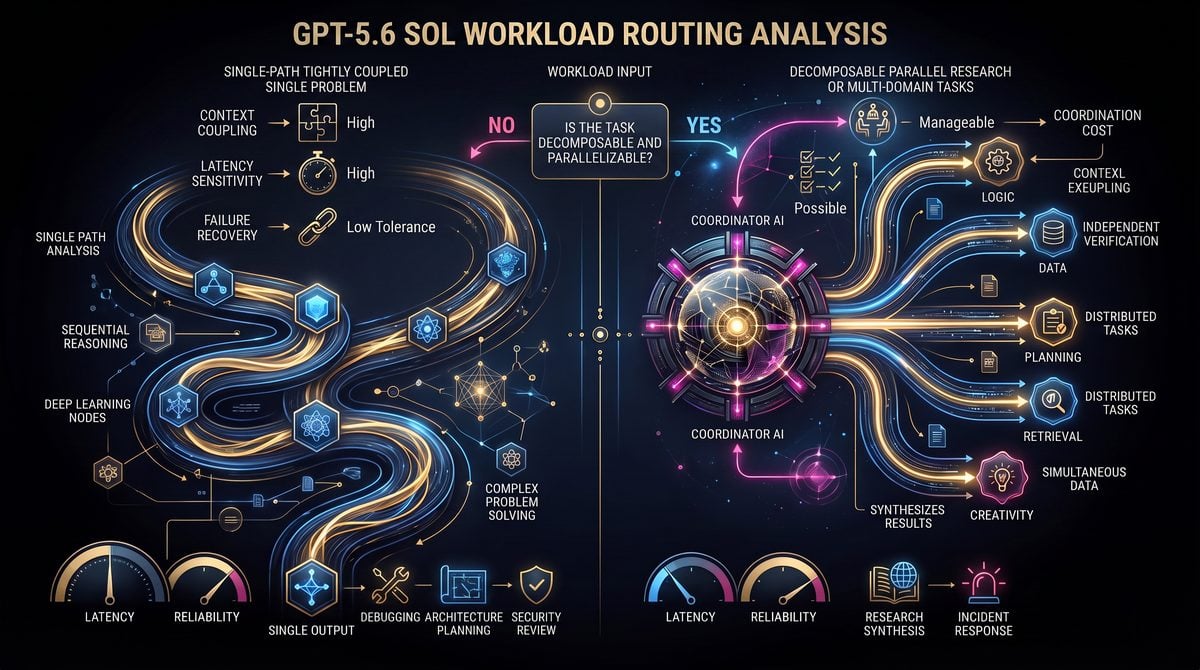
Use the following decision framework as a pragmatic checklist. Each step maps to a topology preference and suggests practical controls.
- Characterize correctness criticality: If an incorrect output has significant risk (legal, security, safety), prefer a hybrid with mandatory verification by a max-style adjudicator and human-in-the-loop gates.
- Measure latency requirements: For strict real-time constraints, employ ultra only if parallel subagents materially reduce wall-clock time after accounting for orchestration overhead; otherwise prefer tuned max configurations for predictable latency.
- Decomposability: If the task decomposes cleanly into independent subproblems, favor ultra to parallelize; if not, favor max for holistic reasoning.
- Audit and provenance needs: Ultra provides natural provenance; choose it when traceability is required. Ensure every subagent produces structured outputs and identifiers for lineage.
- Cost sensitivity: If budget constraints dominate and parallelization does not reduce wall-clock time appreciably, prefer max to avoid redundant context processing and coordination costs.
- Operational maturity: For early-stage prototypes, start with max to simplify orchestration. Move to ultra incrementally as use cases and failure modes are better understood.
Rollout checklist: staging, monitoring, and governance
Use this checklist when deploying either mode in production. The list emphasizes reproducibility, safety, and observability.
- Define acceptance criteria: Specify precision/recall thresholds, latency SLAs, and allowable cost per transaction. Include guardrail requirements for security-sensitive outputs.
- Simulate workloads: Run replay-based tests and use Terminal-Bench-style scenarios to exercise long chains of reasoning and multi-agent interactions under load. Simulations should include adversarial or malformed inputs.
- Implement layered safeguards: Apply the previewed layered misuse safeguards at multiple touchpoints—input sanitizers, policy-checking subagents, and final-output validators.
- Establish observability: Instrument per-subagent metrics (latency, token consumption, error rates), orchestration metrics (queue times, retries), and business metrics (task success rate). Log structured provenance for every output.
- Define fallback and retry strategies: For ultra, prepare targeted retries; for max, prepare re-evaluation passes or constrained regeneration. Establish timeouts, and ensure the orchestration layer can fall back to a simpler policy or human operator.
- Run adversarial/red-team exercises: Leverage automated red-teaming and human review to validate guardrails. Incorporate findings into prompt and orchestration updates. Record iterations and residual risks for compliance.
- Start with canaries: Deploy to a small subset of users with detailed telemetry. Enable rapid rollback paths and ensure monitoring alerts for anomalous model behavior or cost spikes.
- Operationalize cost controls: Apply rate-limiting, throttling, and budget-aware routing policies. Add per-subagent caps and a central quota manager to prevent runaway parallelism.
- Train users and operators: Provide runbooks for interpreting confidence, handling conflicting subagent recommendations, and managing escalations. Maintain a change log for prompts, orchestration logic, and guardrails.
Conclusion
Max reasoning and ultra subagent modes present complementary solutions: max concentrates compute and depth inside a single agent to produce tightly integrated, deeply deliberated outputs; ultra distributes expertise and parallelism across specialized subagents at the cost of coordination overhead and potentially higher aggregate token use. For many real-world workloads, hybrid architectures—parallel exploration with an adjudicating synthesis pass—capture the advantages of both. Determine topology by weighing decomposability, latency tolerance, correctness criticality, and cost constraints, and follow the recommended rollout checklist to mitigate operational and safety risks.
Adopt a staged approach: prototype with max for simplicity; move to ultra incrementally where parallelism provides measurable benefits; and build orchestration primitives that log provenance, enforce layered safeguards, and allow targeted retries. This approach balances the new capabilities in GPT-5.6 Sol (including Terminal-Bench improvements and enhanced misuse safeguards) with enterprise operational realities and the extensive automated red-teaming evidence base shared in the preview.
