
AI Is Hollowing Out Mid-Level Software Engineering: Complete Guide to Surviving the 2026 Developer Career Shift
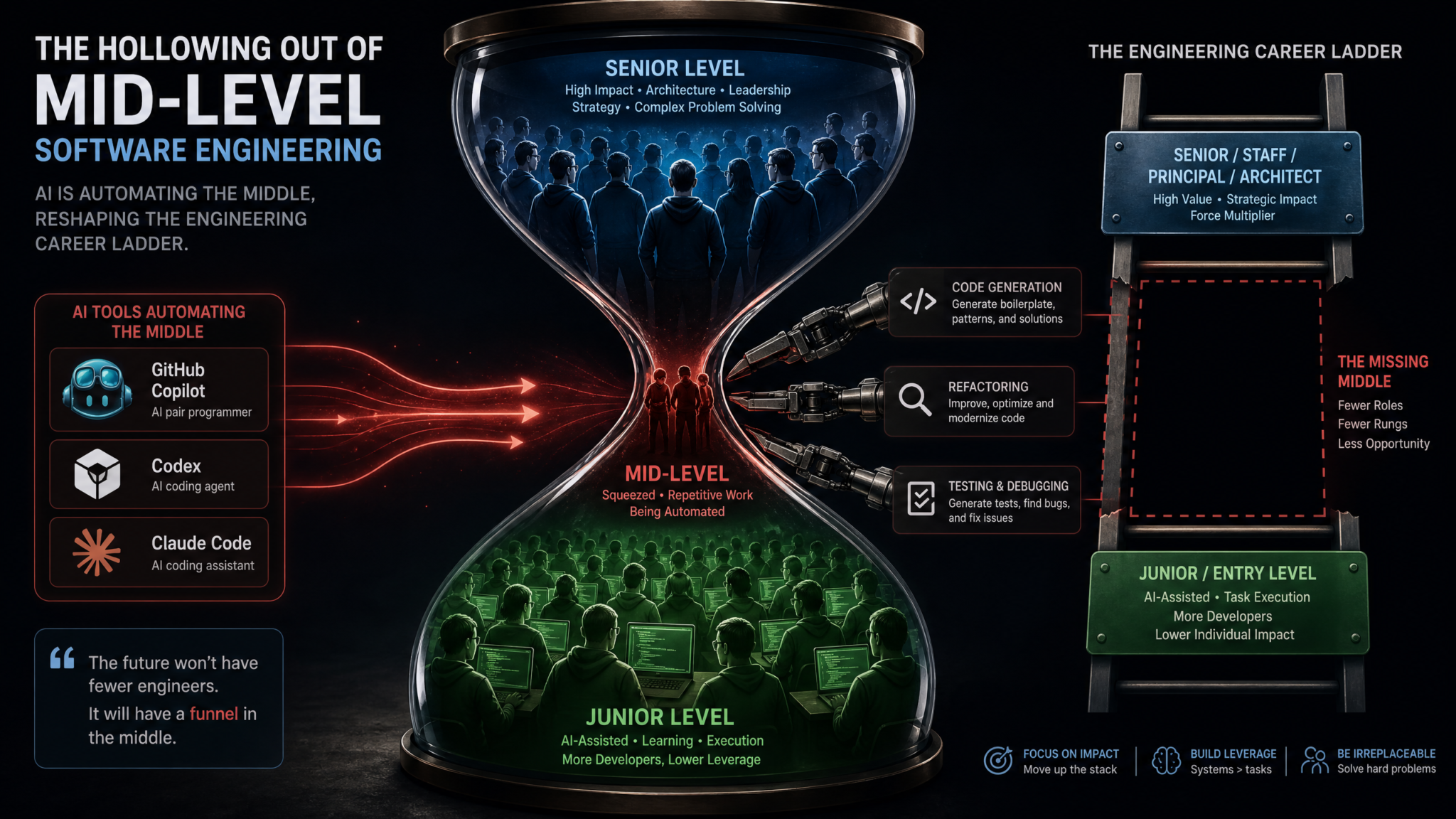
The software engineering career ladder is breaking. Not at the top, not at the bottom — in the middle. AI coding tools have quietly begun compressing the most populated tier of the developer workforce, and most mid-level engineers have no idea how close they are to the edge. This guide is your comprehensive playbook for understanding what’s happening, why it’s accelerating, and exactly how to reposition yourself before the structural shift becomes irreversible.
The Hollowing Pattern: What the Data Actually Shows
In economics, there’s a well-documented concept called labor market polarization — where automation gradually eliminates the routine middle of any workforce while leaving the most complex and the most basic roles intact. Manufacturing experienced this in the 1980s. Administrative work experienced it in the 2000s. Software engineering is experiencing it right now, and the timeline is compressed in ways that would have seemed alarmist even two years ago.
The numbers are not ambiguous. According to JetBrains’ 2024 Developer Ecosystem Survey, 85% of professional software engineers now use AI-assisted coding tools regularly, with 42% describing those tools as “essential” to their daily workflow. GitHub’s own internal research suggests that developers using Copilot complete coding tasks up to 55% faster — a productivity multiplier that has enormous structural implications for team sizing. When one developer can output the work of 1.5 developers, companies don’t need as many developers.
But here’s the critical insight that most career advice misses: the productivity gains are not evenly distributed across the career ladder. They’re concentrated at the implementation layer — the layer that mid-level engineers overwhelmingly occupy. A McKinsey analysis of software development workflows published in late 2024 found that the tasks most heavily augmented by AI — feature implementation, boilerplate generation, documentation, unit test writing, and routine bug fixes — account for approximately 68% of a typical mid-level software engineer’s daily work.
Meanwhile, Stack Overflow’s 2024 Developer Survey revealed that while overall developer hiring held relatively steady in 2023, mid-level-specific roles (those requiring 3–6 years of experience) saw a 23% decline in open job postings year-over-year, even as senior-level and entry-level positions grew modestly. The middle is contracting in real time.
“We’re not replacing engineers. We’re replacing layers of engineering. The judgment layers are safe. The implementation layers are not.” — Anonymous VP of Engineering at a Series C fintech, quoted in a 2024 Pragmatic Engineer survey
What makes this shift particularly difficult to navigate is that it’s happening gradually, then suddenly. Companies aren’t issuing press releases announcing “we’re eliminating our mid-level engineering tier.” They’re simply not backfilling mid-level roles when engineers leave. They’re restructuring teams around AI-augmented senior engineers leading smaller clusters of junior developers. They’re redefining what a “mid-level” engineer even means. And by the time most engineers in the 3–6 year experience range notice the pattern, the structural shift will already be well underway.
This guide exists to help you see it coming — and move before you have to react.
Why Mid-Level Is the Bullseye: The Career Ladder Compression Thesis
Understanding the Three-Layer Model
To understand why mid-level engineers are being squeezed, you need to understand what each layer of the traditional software engineering career ladder actually contributes — and which contributions AI can replicate.
The traditional ladder looks roughly like this:
- Junior engineers (0–2 years): Execute well-defined tasks with close supervision. Write CRUD endpoints, implement UI components from designs, fix clearly scoped bugs, write tests with guidance.
- Mid-level engineers (3–6 years): Work independently on features. Translate product requirements into technical implementation. Conduct code reviews. Debug complex issues. Write technical documentation. Own modules or services with moderate complexity.
- Senior engineers (7+ years): Define technical direction. Make architectural decisions with long-term consequences. Mentor junior engineers. Translate business goals into system design. Navigate tradeoffs involving scalability, maintainability, and team velocity.
Now apply AI coding tools to each layer, and the picture comes into focus immediately.
Junior-level tasks — the CRUD endpoints, boilerplate components, test scaffolding — are exactly what tools like GitHub Copilot, Cursor, and Amazon CodeWhisperer were built to handle. A junior engineer with strong AI tool literacy can complete these tasks faster, but the fundamental task set doesn’t disappear. The demand for someone to prompt, review, and integrate AI-generated code persists. Junior engineers become AI operators rather than disappearing entirely.
Senior-level work — architectural judgment, system design, stakeholder communication, technical strategy — remains stubbornly human for reasons that go beyond current AI capability limitations. These tasks require organizational context, political judgment, accumulated pattern-matching from hard-won production failures, and the kind of responsibility and accountability that companies are not prepared to delegate to models. AI can assist in system design, but it cannot own the outcome.
Mid-level work sits precisely at the intersection of what AI does best: independent implementation, feature-level coding, debugging, documentation, and code review. The tasks that define the mid-level role are not just AI-assistable — they are AI’s primary strength zone.
The Compression Dynamic in Practice
Consider how a typical mid-sized engineering team might restructure over the next 24–36 months. Previously, a product team building a new authentication service might deploy: one senior engineer defining the architecture, two mid-level engineers implementing it, and one junior engineer handling tests and documentation. Total: four engineers.
With modern AI tooling, the same team could plausibly become: one senior engineer defining the architecture and conducting final review, one highly AI-proficient junior-to-mid engineer implementing with Cursor or Copilot as a near-constant coding partner, and automated tooling handling documentation and test generation. Total: two engineers — or three at most, with the junior role elevated to something that looks more like a mid-level role but compensated significantly below traditional mid-level rates.
This isn’t speculation. Stripe’s engineering blog, Shopify’s public statements about AI tooling productivity, and multiple anonymous engineering leadership surveys from 2024 all point toward exactly this kind of team compression happening in practice. The question isn’t whether it’s happening — it’s whether your specific role is in the path of it.
The Skills Gap That Widens the Bullseye
There’s a compounding factor that makes mid-level engineers particularly vulnerable: many of them built their competency precisely through the slow accumulation of implementation experience. Junior engineers now entering the workforce have grown up alongside AI tools. They don’t experience AI as an add-on — they experience it as a native part of the development environment. A 2024 study from MIT found that junior engineers who learned to code alongside AI tools showed significantly stronger AI collaboration skills than engineers who learned without them and adopted AI tools later.
Mid-level engineers in the 3–6 year experience bracket learned their craft before these tools dominated the workflow. Many of them have adopted AI tools reactively rather than natively, using them to speed up the work they were already doing rather than fundamentally rethinking how that work gets done. That distinction matters enormously for long-term career resilience.
Mid-Level Tasks Most at Risk from AI Automation
Not all mid-level work is equally at risk. Understanding the threat landscape with precision is essential for knowing where to direct your development energy. Here’s a breakdown of the specific task categories, their automation risk level, and the reasoning behind the assessment.
Feature Implementation (Risk Level: Very High)
Standard feature implementation — taking a product requirement, translating it into code across the stack, and integrating it into an existing codebase — has become AI’s most demonstrated capability. Tools like Cursor with Claude 3.5 Sonnet, Copilot with GPT-4o, and Devin (Cognition AI’s autonomous agent) can take a well-specified feature request and produce working implementation code with remarkable accuracy when the requirements are clear and the codebase context is available.
A 2024 benchmark study from Princeton found that large language models could successfully implement 72% of isolated feature tickets drawn from real production repositories when given sufficient codebase context. That number drops significantly for features requiring deep cross-system understanding, but it’s high enough to fundamentally change staffing math.
Routine Bug Fixing (Risk Level: High)
Bug fixing has two flavors: the routine kind (null pointer exceptions, off-by-one errors, incorrect API contract assumptions, missing validation logic) and the architectural kind (race conditions in distributed systems, memory leaks in complex lifecycle management, data consistency issues across microservices). AI tools have become genuinely impressive at the former and nearly useless at the latter.
The problem for mid-level engineers is that routine bug fixing represents a significant portion of their billable time. If you’ve been building your career on resolving GitHub issues labeled “good first bug” and “regression,” you are directly competing with increasingly capable AI debugging tools.
Code Review (Risk Level: Moderate-High)
AI-assisted code review tools — GitHub Copilot for Pull Requests, CodeRabbit, Sourcery, and Graphite’s AI review features — have moved from novelty to genuine utility. They catch style inconsistencies, identify common security vulnerabilities, flag performance anti-patterns, and generate detailed review comments at a level that was considered strong mid-level review quality just two years ago.
What they cannot do well is evaluate architectural appropriateness, assess whether a change aligns with unwritten team norms, or understand the political and organizational context of a pull request. The human judgment layer of code review remains valuable. The mechanical correctness layer is rapidly being commoditized.
Technical Documentation (Risk Level: Very High)
If you’ve been building your mid-level value proposition around writing good documentation, this is the area requiring the most urgent recalibration. AI tools write documentation extraordinarily well. Given a codebase and a prompt, modern LLMs produce accurate, well-structured API documentation, README files, architectural decision records, and onboarding guides that match or exceed the quality of what most engineers produce manually. Companies like Swimm, Mintlify, and Docusaurus have all integrated AI generation deeply into their documentation workflows.
Unit and Integration Test Writing (Risk Level: High)
Test generation has been one of AI’s earliest and most consistent wins in the development workflow. Tools can generate comprehensive unit test suites from function signatures and docstrings, produce integration test scaffolding from API specifications, and even perform mutation testing analysis. The mid-level engineer who built their reputation on “writes really thorough tests” is facing direct and capable competition.
What AI Cannot Yet Replace
The tasks where AI tools consistently struggle — and where developing genuine expertise provides real career protection — include:
- System design with organizational constraints: Designing systems that account for team capabilities, existing technical debt, budget constraints, and political feasibility
- Incident response and production debugging at scale: Diagnosing novel failure modes in complex distributed systems under time pressure
- Technical leadership and mentorship: Building team capability, navigating interpersonal dynamics, coaching junior engineers
- Cross-functional stakeholder translation: Translating between product, business, and engineering contexts in real time
- Novel algorithm design: Creating new solutions to genuinely novel computational problems
- Security architecture and threat modeling: Anticipating adversarial behavior in complex system designs
What Companies Are Actually Doing Right Now
Flattening Engineering Ladders
One of the clearest structural signals is the ongoing flattening of engineering career ladders at companies that have adopted AI tooling deeply. The traditional progression — Junior → Mid → Senior → Staff → Principal — is being compressed at several companies into a simplified structure: Engineer → Senior Engineer → Staff/Principal, with the middle band essentially absorbed by expanding expectations at both ends.
Shopify CEO Tobias Lütke’s 2024 memo explicitly stated that AI proficiency would be treated as a baseline job requirement, not an optional skill. The memo’s implication for headcount — that teams should be able to accomplish more with fewer people — directly signals mid-level role compression. Shopify publicly froze most new hiring while simultaneously investing in AI tooling infrastructure throughout 2024.
Duolingo’s April 2024 announcement that it was reducing contractor headcount specifically in content creation and implementation roles — and citing AI capabilities as the reason — was one of the first public acknowledgments of exactly this dynamic. Similar quiet reorganizations have been reported at Klarna, Dropbox, and several Series B and C startups, though most companies have been careful not to publicly frame these as AI-driven workforce reductions.
Creating AI-Augmented Roles
Some companies are not eliminating mid-level roles so much as redefining them around AI orchestration. These are roles with titles like “AI-Augmented Software Engineer,” “ML-Integrated Developer,” or simply mid-level roles with dramatically expanded expectations that implicitly assume heavy AI tool usage.
The practical effect: companies are expecting mid-level output from engineers with less experience by pairing them with AI tools, or expecting senior-level output from mid-level engineers by augmenting with AI tools. In either case, the traditional value proposition of the mid-level engineer — “I can implement features independently without the architectural judgment of a senior” — becomes significantly less valuable.
Redefining Mid-Level in Job Descriptions
A survey of software engineering job descriptions from Q1 2024 compared to Q1 2023 reveals a striking pattern: mid-level job postings increasingly include requirements that would have been considered senior-level as recently as two years ago. System design interview requirements, expectations of “ownership” of entire service domains, and requirements for “cross-functional leadership” are appearing in roles advertised as mid-level with commensurate mid-level salaries.
What companies are doing, in effect, is paying mid-level salaries for senior-level skills by betting that AI tools will cover the implementation gap. For employers, this is financially rational. For mid-level engineers without strong senior-level competencies, it creates a growing qualification gap that’s extremely difficult to bridge while also maintaining current employment performance.
Salary Implications: The Bifurcation of Developer Compensation
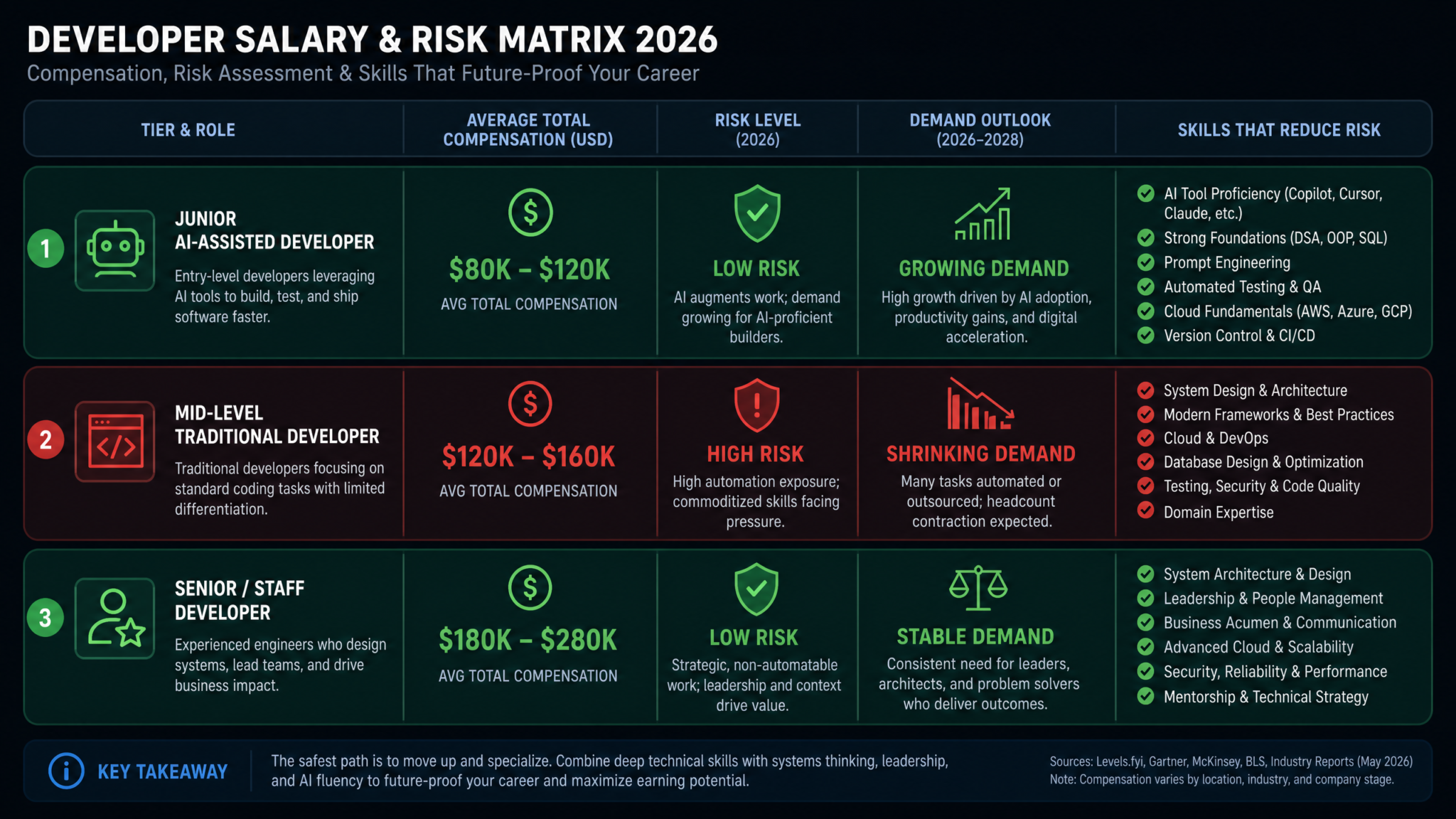
The compensation data emerging from 2024 hiring activity suggests a clear bifurcation developing. The following table represents aggregated data from Levels.fyi, Glassdoor, and Blind for US-based software engineering roles as of Q4 2024, with projections based on current trends.
| Role Level | Experience Range | 2024 Median TC (Big Tech) | 2024 Median TC (Mid-Market) | 2026 Projected TC Change | Job Availability Trend |
|---|---|---|---|---|---|
| Junior / L3 | 0–2 years | $142,000 | $78,000 | +5% to +8% | Stable to slight growth |
| Mid-Level / L4 | 3–5 years | $198,000 | $112,000 | -8% to -15% | Declining (-20 to -30% openings) |
| Mid-Level / L5 | 4–7 years | $248,000 | $138,000 | -5% to -10% | Declining (-15 to -25% openings) |
| Senior / L6 | 7–10 years | $340,000 | $175,000 | +10% to +15% | Growing (+10 to +20% openings) |
| Staff / L7 | 10+ years | $450,000 | $210,000 | +20% to +30% | Strong growth (+25 to +40%) |
| AI-Specialized Engineer | 3–8 years (ML/AI focus) | $320,000 | $165,000 | +25% to +40% | Explosive growth |
The projection for mid-level compensation compression is driven by a combination of factors: reduced scarcity (more supply relative to demand as teams shrink), expanded role expectations without commensurate pay increases, and the increased productivity of remaining mid-level engineers reducing the need for headcount growth.
The premium for senior and staff engineers, by contrast, is likely to increase substantially. When AI tools amplify the output of strong engineers, the value of architectural judgment and technical leadership compounds. A staff engineer with strong AI tool proficiency and deep system design expertise will be able to execute work that previously required entire mid-level teams, making their compensation increasingly justifiable at rates that would have seemed extraordinary just a few years ago.
The AI Specialization Premium
Perhaps the most significant salary opportunity visible in current data is the emerging premium for engineers who specialize at the intersection of software engineering and AI systems. This isn’t the same as becoming a machine learning researcher — it’s about becoming the engineer who builds AI-integrated applications, manages AI infrastructure, and implements the pipelines that connect LLMs to production systems.
Engineers working on retrieval-augmented generation (RAG) systems, fine-tuning pipelines, AI evaluation frameworks, and AI-native application architectures are commanding salaries 30–50% above equivalent-experience engineers working on traditional software development. This premium is expected to persist for at least 3–5 years as the supply of genuinely skilled AI-systems engineers significantly lags demand.
Building Production-Ready RAG Systems: Complete Implementation Guide
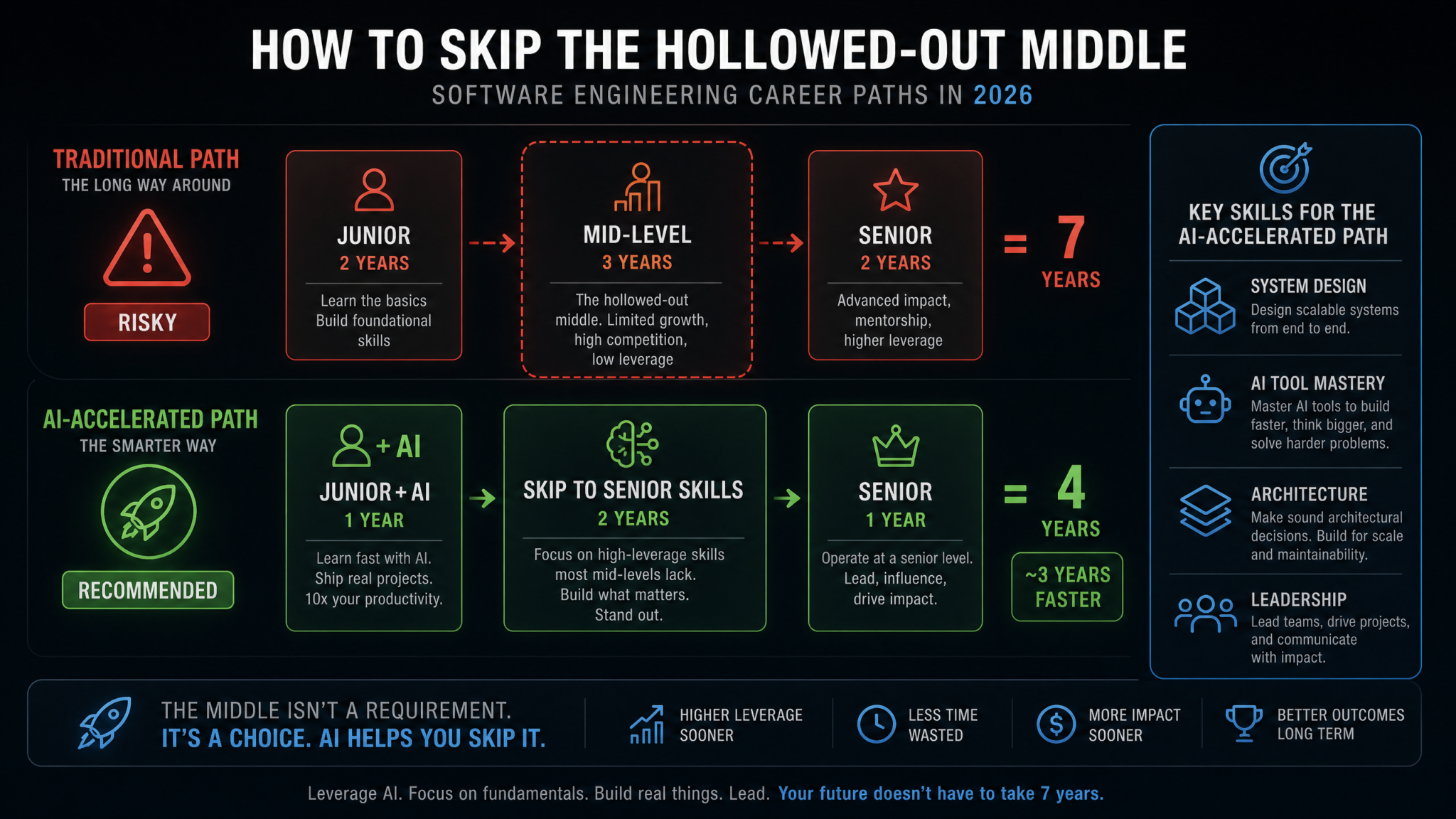
Strategies to Skip the Middle and Survive the Shift
Strategy 1: Aggressively Develop System Design Skills Ahead of Schedule
The most direct path out of the vulnerable mid-level zone is to accelerate your acquisition of senior-level skills — specifically system design, which remains the most AI-resistant competency in the engineering skill stack. This means deliberately seeking out experiences that most mid-level engineers don’t prioritize until they’re gunning for a senior promotion.
Concrete actions include:
- Own an architectural decision record (ADR). Propose and document a significant architectural change at your current company, including the tradeoffs you evaluated and rejected. The act of writing this document builds the mental model that makes system design interviews and real system design work much more accessible.
- Study production postmortems systematically. Resources like the Google SRE book’s postmortems, Netflix’s tech blog, Cloudflare’s incident reports, and the AWS re:Post incident archive are rich sources of the kind of complex systems thinking that distinguishes senior from mid-level engineers.
- Take on infrastructure and reliability work voluntarily. Many mid-level engineers avoid on-call rotations and infrastructure work because it’s uncomfortable and unglamorous. This is precisely why it builds differentiated competency. Volunteer for incident response. Ask to shadow senior engineers during production incidents.
- Complete system design mock interviews with a senior engineer, not just peers. Platforms like Interviewing.io connect you with senior engineers at top companies for realistic system design interview practice. The feedback gap between a peer practice session and an expert-reviewed session is enormous.
Strategy 2: Achieve Genuine AI Tool Mastery — Not Just Familiarity
There is a critical difference between using AI tools and mastering AI tools — and it’s the difference between being threatened by the shift and being positioned to benefit from it. Most engineers who “use AI tools regularly” are using them at 20–30% of their potential capability. Genuine mastery looks very different.
AI tool mastery for a software engineer means:
- Advanced prompt engineering for code generation: Understanding how to provide codebase context, specify constraints, iterate on generated code, and chain prompts to build complex features. This is a learnable skill that most engineers never systematically develop.
- Agent workflow configuration: Building and configuring multi-step AI agent workflows using tools like Cursor’s composer mode, GitHub Copilot Workspace, or custom agent implementations with the OpenAI Assistants API. Engineers who can build AI agent workflows are building something junior engineers cannot replicate.
- AI tool integration in development pipelines: Integrating AI tools into CI/CD pipelines, code review workflows, and testing infrastructure. This is infrastructure-level AI deployment, and it sits firmly in protected territory.
- Critical evaluation of AI-generated code: Understanding the failure modes of AI code generation — the subtle security vulnerabilities, the inappropriate dependency choices, the scalability assumptions that break in production — is a genuinely senior skill. The engineer who knows when to trust AI output and when to scrutinize it is more valuable than the one who simply uses it faster.
Strategy 3: Build a T-Shaped Expertise Profile
The T-shaped engineer — someone with broad familiarity across the stack and deep expertise in one or two specific domains — is significantly more resilient than the generalist mid-level engineer. The depth dimension of the T is where you become difficult to replace, both by AI tools and by other engineers.
Access 40,000+ AI Prompts for ChatGPT, Claude & Codex — Free!
Subscribe to get instant access to our complete Notion Prompt Library — the largest curated collection of prompts for ChatGPT, Claude, OpenAI Codex, and other leading AI models. Optimized for real-world workflows across coding, research, content creation, and business.
The most defensible depth specializations in the current landscape include:
- Security engineering: Application security, threat modeling, secure architecture design. This domain is deeply human-judgment-intensive and increasingly critical as AI-generated code introduces new vulnerability patterns.
- Distributed systems and reliability engineering: Deep expertise in consistency models, distributed consensus, observability, and reliability engineering remains hard to acquire and harder to automate.
- AI/ML systems engineering: Building the infrastructure that trains, serves, evaluates, and monitors ML models. This is the hottest depth specialization in engineering right now by a significant margin.
- Developer experience and platform engineering: Building the internal tooling, developer platforms, and infrastructure that other engineers use. Ironically, the engineers building AI tooling infrastructure are the ones least threatened by AI tooling.
- Domain expertise combination: Being a software engineer with genuine expertise in a specific industry domain — healthcare, fintech, cybersecurity, embedded systems — creates a combined value that pure AI tools cannot replicate because they lack the regulatory context, edge case knowledge, and stakeholder relationship understanding.
Strategy 4: Develop the Communication and Leadership Surface Area of Senior Engineers
One of the most consistent findings from engineering leadership surveys is that the promotion bottleneck from mid-level to senior is less often technical skill and more often the ability to operate at senior scope: influencing without authority, communicating technical tradeoffs to non-technical stakeholders, and demonstrating ownership of outcomes rather than just outputs.
These are skills that AI tools cannot replicate and that distinguish engineers who will be compressed out of the market from those who will grow through it. Deliberately developing these skills — even before your current role requires them — is one of the highest-leverage investments a mid-level engineer can make.
Practical methods: volunteer to present your team’s technical work at company all-hands meetings, write internal engineering blog posts about architectural decisions, take ownership of technical communications with cross-functional partners, and actively mentor engineers with less experience than you.
Portfolio Strategies and Career Positioning for 2026
Building a Portfolio That Signals Senior-Level Thinking
The traditional software engineering portfolio — a GitHub full of side projects demonstrating implementation ability — is losing signal value as AI tools make implementation trivially demonstrable. The portfolio that stands out in 2026 demonstrates judgment, architecture, and the kind of thinking that requires genuine expertise.
Consider building and publicly documenting:
- An AI-integrated application with a detailed architectural write-up: Build something that uses LLMs as a core component, deploy it to a service like yourproject.io, and write a comprehensive architectural decision record explaining why you made the design choices you did. The technical writing demonstrates senior-level thinking in ways that a GitHub repository cannot.
- A public postmortem of a technical failure you caused or resolved: Engineers who can publicly analyze their own failures with intellectual honesty and demonstrate systematic thinking about prevention are rare, credible, and compelling to senior engineering hiring managers.
- An open-source contribution with real complexity: Not a documentation fix or a typo correction, but a meaningful contribution to a widely-used project that required understanding an existing complex codebase and navigating contributor relationships. The process demonstrates exactly the skills that matter in senior roles.
- A conference talk or detailed technical blog post: Publishing detailed technical analysis — not tutorials, but genuine research and analysis of complex topics — builds a public record of senior-level thinking that no portfolio repository can match.
Networking Strategy for the AI Era
The engineering labor market is becoming increasingly bifurcated between engineers who have strong professional networks and those who rely entirely on job boards. As mid-level roles become scarcer, the competition for available positions intensifies significantly, and the edge of a warm introduction from a respected engineer compounds accordingly.
Effective networking in the current environment focuses on:
- Becoming known in a specific technical community — contributing consistently to a specific Slack group, Discord server, or forum around a technology stack you’re specializing in
- Building relationships with senior engineers at companies you want to work for through genuine technical engagement (thoughtful comments on their technical posts, contributing to their open-source projects, asking substantive questions at meetups)
- Positioning yourself as a resource, not a job seeker — engineers who share useful technical insights consistently, help others solve problems, and demonstrate expertise organically build much stronger networks than those who only engage when actively job searching
System Design Interview Preparation: Complete Guide for Senior Engineering Roles
Tailored Advice for Every Career Stage
If You Have 2–3 Years of Experience
You are in the most precarious position and, paradoxically, the most advantageous one. Your career is young enough to be redirected with relatively low switching costs, and you’ve been in the workforce long enough to have real production experience to build on.
Your immediate priority: Do not spend the next 2–3 years deepening your mid-level implementation skills. Spend them aggressively developing senior-level skills, with a particular focus on system design, AI tool mastery, and one deep specialization. You want to compress the typical 5–7 year path to senior into 3–4 years by developing the right skills deliberately rather than waiting for them to accumulate naturally.
Concretely, this means:
- Starting system design interview preparation now, even if you’re not job searching. The mental models you build through this preparation will make you a better engineer and accelerate your real-world development.
- Choosing a depth specialization and pursuing it with genuine intensity — not as a side project but as a deliberate career investment with a 12–18 month timeline.
- Identifying a senior engineer mentor and explicitly asking for guidance on the skills and experiences you need to develop to reach senior level within a compressed timeline.
- Evaluating your current role for senior-skill growth opportunities. If you’re spending more than 60% of your time on pure implementation work with no exposure to architectural decisions, system design, or technical leadership, consider whether a different role or company would accelerate your development.
If You Have 4–6 Years of Experience
You are in the zone of maximum vulnerability. You’re likely compensated at genuine mid-level rates, your role is likely heavily implementation-focused, and you’re far enough into your career that a lateral move feels like backsliding but not senior enough to have naturally acquired the most protected senior-level skills.
Your immediate priority: Close the gap to senior as fast as possible — ideally within 12–18 months. This may require difficult conversations with your current manager about growth opportunities, or it may require changing roles to one that offers more direct exposure to senior-level work.
The engineers at this experience level who are thriving in the current environment share several common characteristics: they have a genuine technical specialty that isn’t pure implementation, they’ve developed a reputation within their company or technical community beyond just “good coder,” and they’ve begun thinking about and contributing to architectural decisions even if those contributions aren’t yet their primary job function.
If your company is in the middle of AI-driven restructuring right now, consider whether you’re on the right side of it. Engineers who are helping lead the AI integration — helping the team adopt tools, building the infrastructure around AI tooling, setting standards for AI-generated code review — are positioning themselves as architects of the new reality rather than victims of it.
If You Have 7+ Years of Experience
If you’ve reached seven or more years of experience, you are likely at or near senior level, which means the immediate existential threat is lower — but complacency is the real danger. Senior engineers who built their identity around implementation speed and feature delivery rather than system design, technical leadership, and architectural judgment may find themselves compressed in unexpected ways.
Your immediate priority: Ensure your value proposition is anchored in the skills that AI genuinely cannot replicate. If you’re at 7+ years but still mostly doing individual implementation work without significant architectural or leadership responsibility, this is the time to actively seek that exposure.
For engineers at this level, the AI era represents an opportunity rather than a threat — but only if you proactively position yourself to lead AI adoption rather than adapt to it reactively. Becoming the person at your company who sets standards for AI-assisted development, evaluates AI tools for team adoption, and designs the workflows around AI tooling is one of the highest-leverage career moves available to senior engineers right now.
Staff Engineer Career Path: How to Navigate the Promotion from Senior to Staff
Predictions for 2027–2028: Where the Career Ladder Goes Next
The Autonomous Coding Agent Inflection Point
The current generation of AI coding tools are copilots — they assist human engineers but require continuous human direction. The next generation, represented by early-stage products like Devin, SWE-agent, and OpenAI’s Codex CLI agent, are moving toward greater autonomy — agents that can take a ticket, explore a codebase, implement a solution, write tests, and submit a pull request with minimal human intervention.
The current state of these autonomous agents (as of 2025) shows impressive performance on isolated, well-specified tasks but significant limitations on complex, multi-component features requiring deep codebase understanding. By 2027, based on the current capability improvement trajectory, these limitations are likely to narrow substantially. Industry estimates suggest autonomous agents may be capable of handling 40–60% of typical mid-level feature tickets by 2027 with acceptable quality, up from approximately 15–20% today.
The Emergence of AI Engineering Orchestration as a Distinct Role
A new role archetype is becoming visible in engineering org charts: the engineer who designs, manages, and optimizes networks of AI agents and tools rather than writing the underlying code themselves. This role — sometimes called an AI engineering lead, systems orchestration engineer, or AI-augmented software architect — represents a kind of meta-engineering that sits above traditional implementation work.
By 2027–2028, this role type is likely to be well-established at larger technology companies and increasingly prevalent at mid-sized companies. Engineers who have developed both the technical depth to understand what AI agents are doing and the systems thinking to design effective agent workflows will be extraordinarily valuable in this world.
Compensation Polarization Accelerates
The salary gap between the top and middle of engineering compensation is likely to widen significantly by 2027–2028. The scarcity of truly senior engineers — those with deep technical judgment, strong system design ability, and the experience to architect systems that survive contact with production scale — will drive continued compensation premiums at that level.
Meanwhile, the supply of AI-assisted implementation-level capability will continue to increase, putting sustained downward pressure on mid-level compensation. The engineers who maintain mid-level compensation at current levels will be those who have either moved up the skill stack (toward senior) or right on the specialization axis (toward deep domain expertise).
Career Ladder Prediction: What Engineering Teams Look Like in 2028
Based on current trajectory, the typical engineering team structure in 2028 at a well-resourced technology company is likely to look significantly different from today:
- Fewer total engineers per product area, with AI tools handling the implementation output that previously required larger teams
- A compressed ladder with two main human tiers: AI-proficient implementation engineers (roughly equivalent to today’s strong junior/early-mid) and senior architects/technical leads
- An AI operations layer: a new category of engineer focused on managing, evaluating, and improving the AI tooling infrastructure itself
- Higher average quality expectations at every level because AI-generated code raises the floor, meaning acceptable output has to be genuinely good rather than merely functional
- A premium on product sense at the engineering level: engineers who can translate between technical and product thinking will be disproportionately valued as teams get smaller and the gap between engineers and stakeholders narrows
Machine Learning Engineer vs Software Engineer: Career Path Comparison for 2026
Your 90-Day Action Plan
Understanding the structural shift is valuable. Acting on it is the only thing that matters for your career. Here is a concrete 90-day action plan for each career stage, designed to produce measurable progress toward a more resilient career position.
Days 1–30: Assessment and Foundation
- Conduct an honest skill audit. For each task category in your current role, rate your reliance on AI-assistable versus judgment-dependent skills. If more than 60% of your day-to-day work falls into AI-assistable categories, that’s your signal to accelerate the transition.
- Identify your specialization target. Choose one depth specialization area from the list above and research what genuine expertise in that area requires. Create a learning roadmap with specific resources, projects, and milestones.
- Evaluate your AI tool proficiency honestly. Can you use Cursor or Copilot to implement a complete feature from a specification? Can you evaluate AI-generated code for security vulnerabilities? Can you build a basic AI agent workflow? If the answer to any of these is no, that’s a concrete skill gap with a clear path to closure.
- Have a direct conversation with your manager about senior-level growth opportunities. Ask specifically what skills and experiences the company looks for in senior engineers, what gaps they see in your current profile, and what opportunities exist to develop those skills in your current role.
Days 31–60: Skill Development Acceleration
- Begin active system design practice. Aim for two system design sessions per week — one solo using structured resources like Designing Data-Intensive Applications or the system design primer, and one with a senior engineer or through a platform like Interviewing.io.
- Start building your AI-integrated portfolio project. Commit to a project that uses AI as a core component and that will produce a substantive architectural write-up. Register a domain (like myapp.dev) for it — public deployment signals commitment.
- Engage in one technical community. Choose a specific Slack group, Discord, or forum in your specialization area and participate consistently — not just lurking, but contributing answers, sharing analysis, and building visibility.
- Volunteer for one senior-scope responsibility at your current company: an architectural proposal, a technical lead role on a cross-team initiative, or ownership of a significant technical decision.
Days 61–90: Positioning and Momentum
- Write and publish a detailed technical post. Choose a topic from your specialization area where you have genuine insight — a pattern you’ve learned, a failure you’ve diagnosed, a tradeoff you’ve navigated — and write a thorough analysis. Publish it on a personal site at yourproject.io or on a platform like Substack or the ACM Queue.
- Update your professional materials. Reframe your resume and LinkedIn around architectural contributions, technical leadership, and system-level thinking rather than implementation tasks and technology buzzwords. The language should reflect senior-level scope even if your title hasn’t changed yet.
- Conduct at least two informational interviews with senior engineers at companies you’d like to work for. Approach these as genuine learning conversations, not networking theater — ask specifically about what they look for in senior hires and what distinguishes engineers who advance from those who plateau.
- Reassess your current role trajectory. After 90 days of deliberate development, evaluate honestly whether your current role provides the growth path you need. If the answer is no, beginning an active job search for a role with more senior-scope exposure is a reasonable and urgent conclusion — not a failure.
The Bottom Line: Move Before You Have To
The engineers who navigate the 2026 developer career shift successfully will share one common characteristic: they saw the structural change coming and moved deliberately before market forces compelled them to react. The engineers who struggle will be those who waited for an obvious signal — a layoff, a rejected promotion, a market that no longer values their specific implementation skills — and then scrambled to adapt under adverse conditions.
The hollowing of mid-level software engineering is not a prediction. It’s a process already underway. The available data on AI tool productivity multipliers, team size restructuring trends, and mid-level job posting declines all point toward a labor market that will look substantially different in 24–36 months than it does today. What varies is how individual engineers will be positioned relative to that change.
The good news — and it is genuinely good news — is that software engineering remains one of the highest-value professions in the global economy, and the engineers who reach genuine senior level will be compensated more highly, have more interesting work, and have more career optionality than at any previous point in the industry’s history. AI doesn’t make software engineering less valuable. It makes the implementation layer less scarce and the judgment layer more valuable.
Your goal is to be on the right side of that distinction. You have roughly 12–24 months to position yourself deliberately. The time to start is now.
