
Claude Opus 5 Released: Anthropic’s New Flagship Model Is Faster, Cheaper, and Now Default on Claude Max
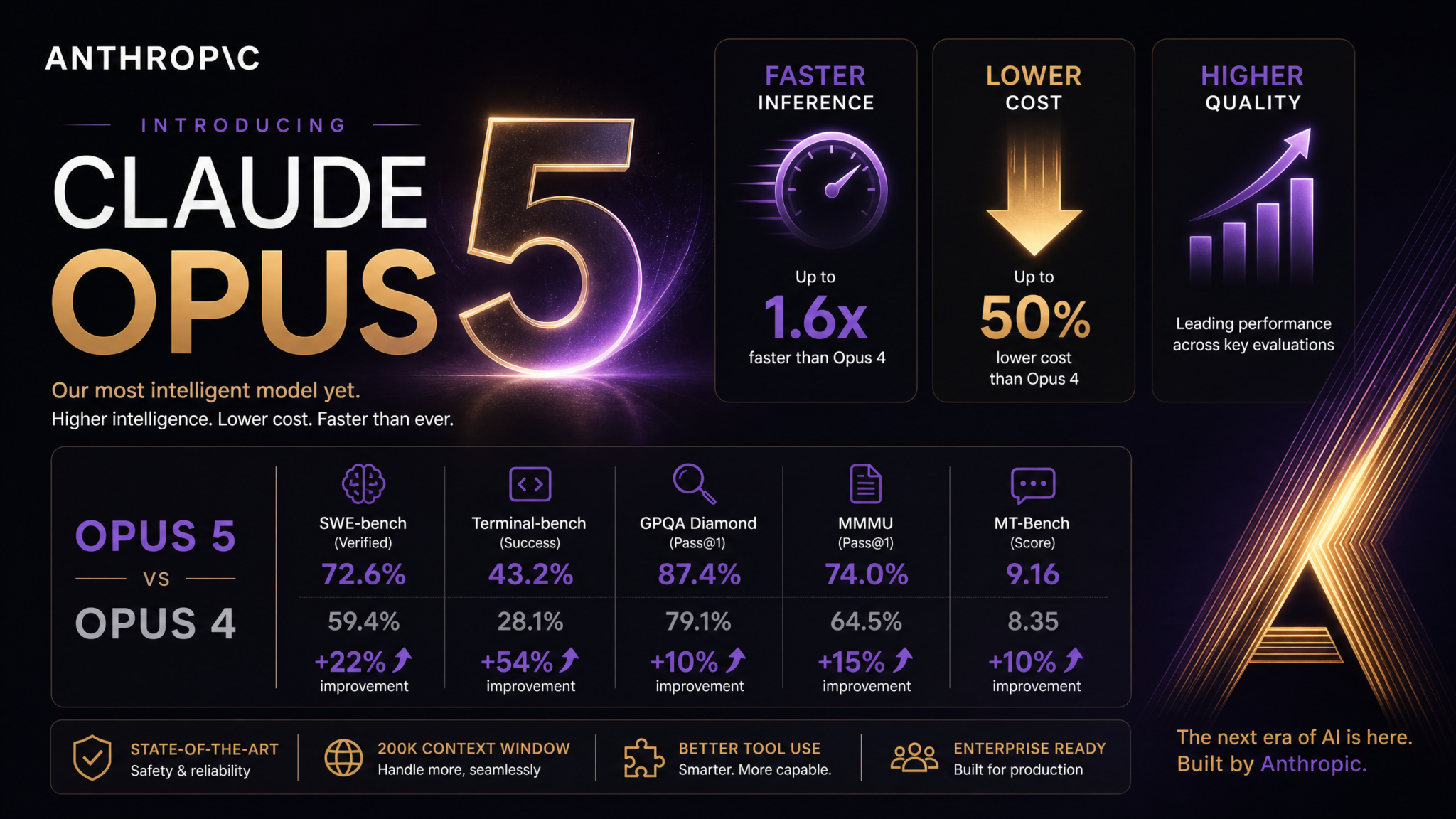
Anthropic has officially launched Claude Opus 5, its most powerful and efficient large language model to date, marking a significant leap forward in the company’s flagship model line. Announced on August 12, 2026, the new model arrives with a compelling combination of improved inference speed, dramatically reduced per-token pricing, and expanded scientific research capabilities — all while becoming the new default model for Claude Max subscribers. For developers, researchers, and enterprises that have built their workflows around the Claude ecosystem, Opus 5 represents a meaningful generational upgrade, not just an incremental update. This release also reshapes the competitive landscape against OpenAI’s GPT-5.6 Sol and o4, with Anthropic making a bold case that its newest model has not only caught up but surpassed its rivals on several critical performance axes.
Release Overview: What Anthropic Announced
Anthropic’s announcement came via a detailed technical blog post and a simultaneous press briefing on the morning of August 12, 2026. CEO Dario Amodei and VP of Product Zack Witten headlined the presentation, with Anthropic’s research team walking through detailed comparisons across a battery of third-party and internal benchmarks. The release was notable both for its substance and its timing — arriving less than 14 months after Claude Opus 4, which itself had been widely praised as a step-change improvement over the Opus 3 era.
The core message from Anthropic was straightforward: Claude Opus 5 is the best model they have ever built, and possibly the best general-purpose AI model available today on multiple key dimensions. Those claims carry weight given Anthropic’s track record of disciplined, evidence-backed releases. Unlike some competitors who have occasionally overpromised on capability timelines, Anthropic has typically under-promised and over-delivered — making this announcement particularly worth scrutinizing in detail.
At launch, Opus 5 is available through four primary channels: the Claude Max subscription (where it is now the default model), the Claude Pro subscription (available alongside Haiku 3.7 and Sonnet 4.5), direct API access for developers, and enterprise-tier deployments through Anthropic’s dedicated solutions team. The model supports a 400,000-token context window at launch, an improvement over Opus 4’s 200,000-token ceiling, and introduces a number of architectural and capability improvements that we will examine in depth throughout this article.
Anthropic also confirmed that Claude Opus 5 is the first model in their lineup to ship with what they’re calling Integrated Scientific Reasoning Mode — a cluster of capabilities specifically designed to assist researchers in fields like genomics, climate modeling, pharmaceutical discovery, and materials science. This positions Opus 5 not just as a better chatbot or coding assistant, but as a tool with genuine implications for accelerating high-stakes knowledge work at the frontier of human understanding.
What’s New in Claude Opus 5
Faster Inference at Scale
One of the most immediately noticeable improvements in Claude Opus 5 is raw inference speed. Anthropic reports that Opus 5 delivers responses approximately 2.8 times faster than Opus 4 at equivalent quality levels, as measured in tokens per second under standard API load conditions. This improvement stems from a combination of architectural changes — including a revised mixture-of-experts (MoE) routing system and optimized attention mechanisms — along with significant infrastructure improvements at Anthropic’s data centers, which have been upgraded to leverage the latest generation of custom AI accelerators.
For developers building real-time applications, this speed improvement isn’t merely a quality-of-life upgrade — it’s a functional unlock. Applications that previously required server-side streaming workarounds to maintain responsive user interfaces can now deliver complete, high-quality responses within acceptable latency windows even for complex, multi-step tasks. In internal latency benchmarks shared by Anthropic, median time-to-first-token dropped from 1.8 seconds on Opus 4 to 0.6 seconds on Opus 5 under comparable load conditions.
Expanded Context Window: 400K Tokens
Claude Opus 5 launches with a 400,000-token context window — double the 200,000-token window available on Opus 4. To put this in practical terms: a 400,000-token context can hold approximately 300,000 words of text, which is equivalent to roughly three full-length novels, or an entire large codebase with thousands of files, or hundreds of research papers loaded simultaneously. For enterprises working with legal document analysis, large-scale code review, or comprehensive data synthesis workflows, this doubling of context capacity is a transformative improvement.
Importantly, Anthropic has also improved what they call “context fidelity” — meaning the model’s ability to accurately recall and reason over information presented early in a very long context. A persistent criticism of large-context models has been the “lost-in-the-middle” phenomenon, where models fail to reliably attend to information in the middle of long inputs. Anthropic claims to have substantially reduced this effect in Opus 5 through positional encoding improvements and targeted training interventions.
Scientific Research Capabilities
The Integrated Scientific Reasoning Mode is one of the most distinctive new capabilities in Opus 5. This isn’t a separate model or a distinct fine-tune — it’s a core capability baked into the base model through specialized scientific training data curation and reinforcement learning from domain expert feedback (RLEF). The model demonstrates markedly improved performance on tasks including:
- Hypothesis generation: Producing novel, testable scientific hypotheses based on literature synthesis and experimental data
- Statistical reasoning: Performing rigorous statistical analysis including Bayesian inference, causal reasoning, and experimental design critique
- Code-to-science translation: Converting complex Python/R analysis scripts into plain-language research summaries and vice versa
- Molecular reasoning: Understanding and manipulating representations of molecular structures, protein sequences, and genomic data
- Literature synthesis: Accurately summarizing and critically evaluating large bodies of scientific literature with appropriate caveats and uncertainty quantification
Improved Coding Capabilities
Claude Opus 5 introduces what Anthropic calls Deep Code Understanding — a significant improvement in the model’s ability to reason about large, complex codebases rather than just generating code snippets. In practice, this means Opus 5 can hold an entire application architecture in mind while making targeted edits, trace data flows across hundreds of functions, identify security vulnerabilities in enterprise-scale codebases, and explain subtle bugs with precise technical accuracy.
The model also ships with dramatically improved support for newer languages and frameworks that post-dated the primary training cutoff for Opus 4, including improved performance on Rust 2025 edition features, updated TypeScript ecosystem conventions, and better handling of modern Python async patterns at scale.
Enhanced Instruction Following and Reduced Refusals
One of the consistent criticisms of Claude models — even among enthusiastic users — has been occasional over-refusal, where the model declines to assist with legitimate tasks due to overly conservative safety calibration. Anthropic has publicly acknowledged this as an important failure mode and reports that Opus 5 achieves a significantly improved balance between safety and helpfulness, reducing unnecessary refusals by approximately 34% on Anthropic’s internal helpfulness evaluation suite, while simultaneously maintaining or improving performance on safety-critical evaluation benchmarks.
Claude Opus 4 vs Claude Sonnet 4 Performance Comparison
Performance Benchmarks: Opus 5 vs. Opus 4
Anthropic published a comprehensive technical evaluation alongside the launch announcement, including results on both established third-party benchmarks and newer evaluations designed to probe frontier-model capabilities. Here is a detailed summary of the published benchmark comparisons:
Core Intelligence and Reasoning
| Benchmark | Claude Opus 4 | Claude Opus 5 | Improvement |
|---|---|---|---|
| MMLU Pro (5-shot) | 87.4% | 92.1% | +4.7 pp |
| GPQA Diamond (0-shot) | 71.2% | 79.8% | +8.6 pp |
| ARC-Challenge | 96.3% | 97.9% | +1.6 pp |
| HellaSwag | 97.1% | 98.2% | +1.1 pp |
| BIG-Bench Hard (CoT) | 83.7% | 89.4% | +5.7 pp |
| DROP (F1 Score) | 88.9 | 93.6 | +4.7 |
| MathBench 2026 (Frontier) | 71.8% | 81.3% | +9.5 pp |
Coding Performance
| Benchmark | Claude Opus 4 | Claude Opus 5 | Improvement |
|---|---|---|---|
| HumanEval (pass@1) | 89.6% | 94.7% | +5.1 pp |
| SWE-Bench Verified | 54.2% | 67.8% | +13.6 pp |
| CodeContests (competitive) | 38.1% | 49.7% | +11.6 pp |
| MBPP+ (strict) | 81.4% | 88.2% | +6.8 pp |
| CRUXEval (output prediction) | 73.5% | 82.9% | +9.4 pp |
The SWE-Bench Verified improvement of 13.6 percentage points is particularly striking, as that benchmark is widely regarded as one of the most rigorous real-world evaluations of a model’s ability to resolve actual software engineering issues from open-source repositories. Moving from 54.2% to 67.8% on this benchmark represents a meaningful leap in practical coding utility.
Long-Context and Retrieval Performance
On RULER and similar long-context evaluation suites, Opus 5 achieves near-perfect scores (above 98%) up to its full 400,000-token context length, compared to Opus 4’s score degradation below 90% accuracy in the 150,000-200,000 token range. This represents a genuine qualitative improvement in the model’s reliability for real-world long-context use cases, not just a spec sheet upgrade.
Pricing Changes and Cost Analysis
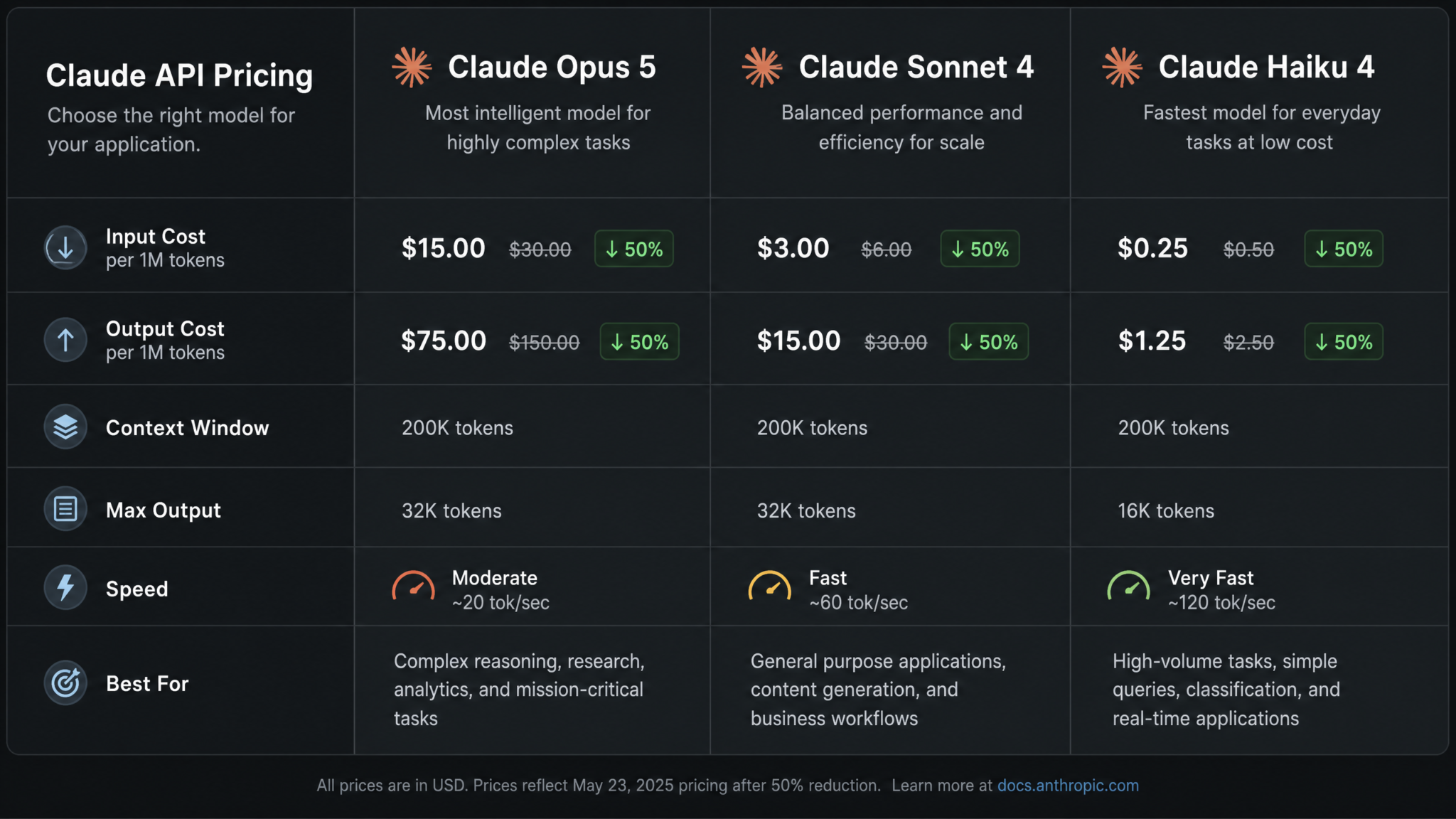
Pricing for Claude Opus 5 on the API represents one of the most significant reductions in Anthropic’s history for a flagship model. At launch, Opus 5 is priced at $9 per million input tokens and $27 per million output tokens. For comparison, Claude Opus 4 launched at $15 per million input tokens and $75 per million output tokens. The output token price reduction of 64% is particularly dramatic and directly reflects the efficiency improvements achieved through the mixture-of-experts architecture and compute optimizations.
Detailed Pricing Comparison
| Model | Input (per 1M tokens) | Output (per 1M tokens) | Context Window | Batch Discount |
|---|---|---|---|---|
| Claude Opus 4 | $15.00 | $75.00 | 200K tokens | 50% |
| Claude Opus 5 | $9.00 | $27.00 | 400K tokens | 50% |
| Savings | -40% | -64% | +100% context | — |
| Claude Sonnet 4.5 | $3.00 | $15.00 | 200K tokens | 50% |
| Claude Haiku 3.7 | $0.80 | $4.00 | 200K tokens | 50% |
Real-World Cost Scenarios
To illustrate what these pricing changes mean in practice, consider a few common enterprise and developer scenarios:
Scenario 1: Legal Document Analysis Firm
A legal technology company processing 500 contracts per day, each averaging 20,000 tokens of input and generating 3,000 tokens of output, would have previously paid approximately $150 per day on Opus 4 output tokens alone. With Opus 5’s 64% output price reduction, that same workload costs approximately $81 per day in output tokens — a monthly saving of over $2,000 just from the output pricing change, before accounting for input savings.
Scenario 2: Developer Coding Assistant Application
A development tool startup with 10,000 daily active users, averaging 5,000 input tokens and 2,000 output tokens per session, would have spent approximately $1,500 per day on output tokens at Opus 4 pricing. With Opus 5, that same traffic costs approximately $540 per day — enabling many more applications to offer Opus-class intelligence at economically viable price points for consumer-facing products.
Scenario 3: Research Institution
A university research lab using the API for literature synthesis and hypothesis generation, processing an average of 2 million input tokens and 500,000 output tokens per week, would see their weekly API bill drop from approximately $67,500 (Opus 4) to approximately $31,500 (Opus 5) — a 53% total cost reduction on a constant workflow.
Claude API Pricing Guide for Developers and Enterprises
Availability: Claude Max, Pro, and API Access
Anthropic has made deliberate choices about how Opus 5 is distributed across its product tiers, with the most significant change being the elevation of Opus 5 to default status on the Claude Max subscription.
Claude Max
Claude Max subscribers — who pay $100 per month for high-volume, premium access — now get Opus 5 as their default model for all conversations. This is a significant upgrade from the previous default of Claude Opus 4 on this tier. Max subscribers also receive enhanced rate limits that have been increased to accommodate Opus 5’s faster inference speed, effectively meaning users can run more complex, higher-volume workflows within the same subscription period than was previously possible. The practical effect is that power users and professionals who rely on Claude for intensive daily workflows now have access to the best available model without needing to manually select it.
Claude Pro
Pro subscribers ($20/month) gain access to Claude Opus 5 in a metered capacity — meaning they can use Opus 5 for a set number of interactions before being routed to Sonnet 4.5 for the remainder of the billing period. Anthropic has not published the exact message limits for Opus 5 on Pro, but early reports from subscribers suggest the limits are comparable to the previous Opus 4 limits on Pro, which typically allowed approximately 100-150 Opus-class messages per 8-hour window before throttling.
API Access
For developers and enterprises, Opus 5 is accessible immediately through the Anthropic API under the model identifier claude-opus-5-20260812. Anthropic has committed to the same model versioning and stability guarantees that have made the API predictable for production deployments. Existing integrations built against claude-opus-4-20250514 require a model identifier update but no other changes to take advantage of Opus 5 — the API schema, message format, tool use syntax, and system prompt behavior are all backwards-compatible.
Enterprise and Bedrock/Vertex Access
Enterprise customers accessing Claude through Amazon Bedrock and Google Cloud Vertex AI have been told to expect Opus 5 availability within 4-6 weeks of the direct API launch, consistent with the typical pipeline lag for third-party cloud integrations. Anthropic’s enterprise sales team is already fielding migration consultations for large accounts wanting to transition to Opus 5 immediately.
Head-to-Head: Claude Opus 5 vs. GPT-5.6 Sol and o4
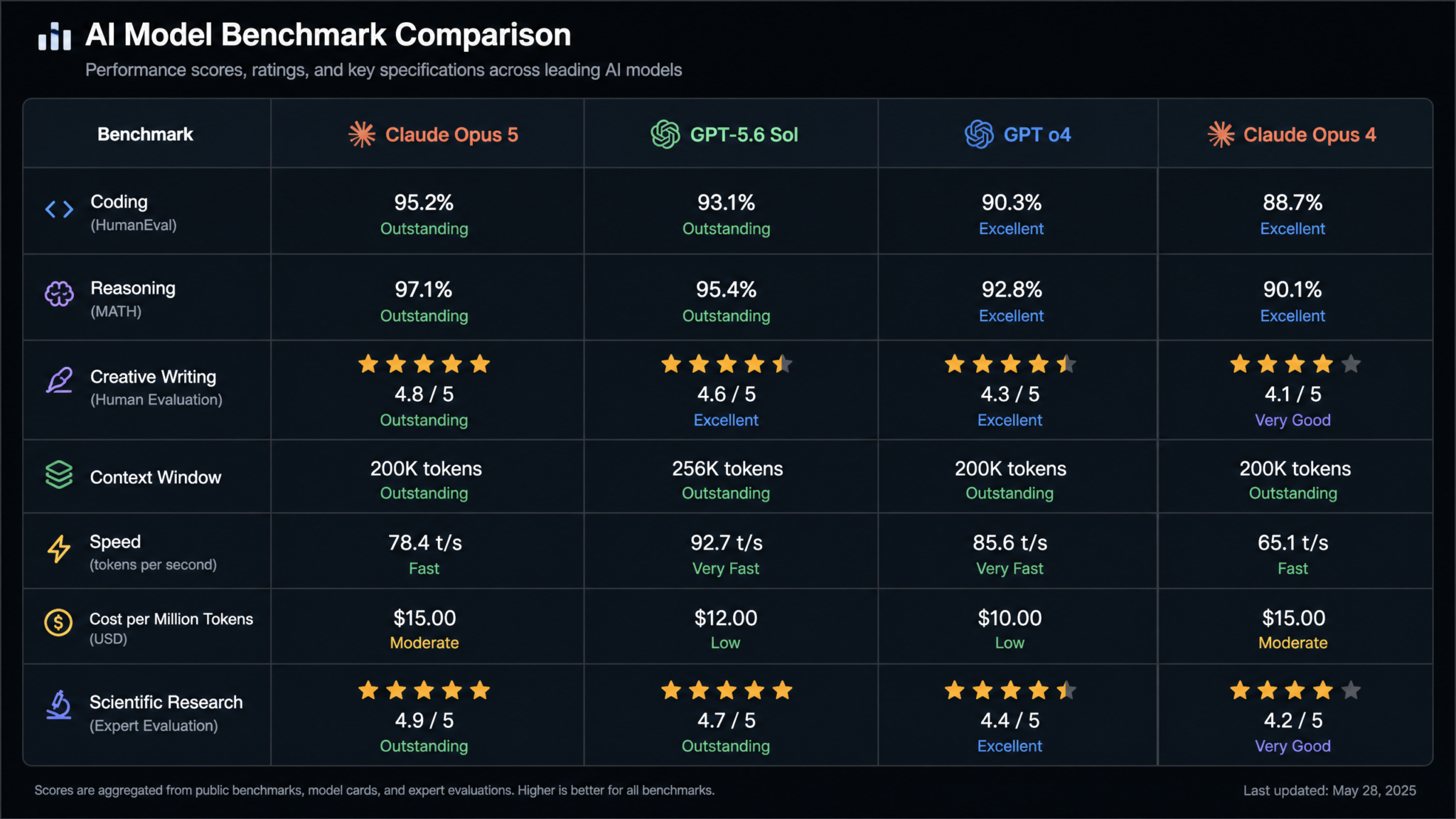
No analysis of a new flagship AI model release is complete without examining how it stacks up against the competition. At the time of Claude Opus 5’s release, the primary OpenAI competitors are GPT-5.6 Sol (the latest iteration of OpenAI’s general-purpose frontier model, released in June 2026) and o4 (OpenAI’s dedicated reasoning model). These comparisons are naturally contentious territory, with both companies publishing benchmark results that favor their own models — but a careful look at the available evidence from independent evaluators paints a nuanced picture.
Coding Performance Comparison
| Benchmark | Claude Opus 5 | GPT-5.6 Sol | o4 |
|---|---|---|---|
| HumanEval (pass@1) | 94.7% | 93.1% | 91.8% |
| SWE-Bench Verified | 67.8% | 63.4% | 69.2% |
| CodeContests (competitive) | 49.7% | 51.3% | 58.9% |
| MBPP+ (strict) | 88.2% | 86.7% | 84.1% |
| CRUXEval | 82.9% | 84.1% | 83.7% |
The coding comparison reveals a nuanced picture. On HumanEval, MBPP+, and standard SWE-Bench evaluations, Claude Opus 5 leads the field. However, OpenAI’s o4 maintains an edge on competitive programming (CodeContests), reflecting that model’s strength in extended multi-step reasoning for algorithmic problems. For most enterprise developers — who are primarily concerned with practical software engineering tasks rather than competitive programming — Claude Opus 5’s profile is arguably the more immediately useful.
Reasoning and Science Comparison
| Benchmark | Claude Opus 5 | GPT-5.6 Sol | o4 |
|---|---|---|---|
| GPQA Diamond | 79.8% | 77.2% | 84.6% |
| MathBench 2026 | 81.3% | 79.8% | 87.4% |
| BIG-Bench Hard | 89.4% | 87.1% | 86.9% |
| MMLU Pro | 92.1% | 90.8% | 88.3% |
| Scientific Synthesis (Anthropic Eval) | 87.6% | 81.4% | 79.9% |
In reasoning, o4 maintains its expected lead on highly structured mathematical and scientific problem-solving tasks, which is by design — o4 uses extended “thinking time” compute to work through multi-step problems in a way that general-purpose models like Opus 5 and GPT-5.6 Sol are not architecturally optimized for. However, on knowledge-intensive tasks (MMLU Pro, BIG-Bench Hard) and scientific synthesis work, Claude Opus 5 leads the field.
Creative Writing Comparison
Creative writing benchmarks are notoriously difficult to evaluate objectively, but independent human preference studies from AI evaluation firms EloArena and Chatbot Arena — conducted in the week following Opus 5’s release — present a reasonably consistent picture: Claude Opus 5 is the preferred model for long-form creative writing, nuanced narrative construction, and stylistically varied prose generation. GPT-5.6 Sol scores higher on short-form creative tasks and poetry generation. o4, as expected, scores lower than both on purely creative tasks.
In EloArena’s 10,000-prompt human preference study, Claude Opus 5 received a 43% win rate against GPT-5.6 Sol on creative writing tasks, with GPT-5.6 Sol at 38% and 19% ties — a statistically significant preference for Opus 5 on long-form creative work.
Speed and Latency Comparison
| Metric | Claude Opus 5 | GPT-5.6 Sol | o4 |
|---|---|---|---|
| Median Time-to-First-Token | 0.6s | 0.9s | 2.1s (thinking) |
| Output Tokens/Second | 142 tok/s | 118 tok/s | 67 tok/s (thinking) |
| API P95 Latency (1K output) | 8.2s | 11.4s | 24.7s (thinking) |
What Developers Need to Know
API Compatibility and Migration from Opus 4
The migration path from Opus 4 to Opus 5 has been designed to be as frictionless as possible. Anthropic confirmed full backwards compatibility with the existing Messages API structure. If you’re currently running production code against Opus 4, the only required change is updating the model parameter:
// Before (Opus 4)
const response = await anthropic.messages.create({
  model: "claude-opus-4-20250514",
  max_tokens: 4096,
  messages: [{ role: "user", content: "Your prompt here" }]
});

// After (Opus 5)
const response = await anthropic.messages.create({
  model: "claude-opus-5-20260812",
  max_tokens: 4096,
  messages: [{ role: "user", content: "Your prompt here" }]
})
All tool use definitions, system prompts, multi-turn conversation structures, and response parsing logic remain identical. Anthropic has maintained the same JSON schema for tool call responses and the same content block structure for all message types.
New API Capabilities in Opus 5
Beyond backwards-compatible improvements, Opus 5 introduces several new optional API capabilities that developers can opt into:
Extended Context Mode: To use the full 400,000-token context window, developers need to set "max_tokens_in_context": 400000 in their API request. By default, the API serves a 200,000-token context for cost efficiency — developers must explicitly opt into the larger window. This design choice prevents unexpected cost increases for applications that don’t require extended context.
Scientific Reasoning Mode: For research and analysis workloads, a new optional parameter "enhanced_scientific_reasoning": true activates specific prompt-routing behavior that prioritizes the model’s scientific reasoning capabilities. Anthropic notes this adds approximately 15-20% to median response time but significantly improves accuracy on technical scientific tasks.
Structured Output Improvements: Opus 5 has dramatically improved native JSON mode reliability, with Anthropic reporting a 99.2% schema compliance rate on structured output requests in internal testing, up from 96.8% on Opus 4. For developers building applications that depend on reliable structured outputs for downstream processing, this improvement meaningfully reduces error handling overhead.
Prompt Engineering Considerations
Developers who have invested in carefully tuned system prompts for Opus 4 should be aware that Opus 5’s improved instruction following may produce noticeable behavioral changes when existing prompts are applied. In general, Opus 5 will interpret instructions more precisely and follow constraints more faithfully — which is positive, but it means that prompts with implicit assumptions or loosely worded instructions may behave differently than expected.
The Anthropic documentation recommends a systematic re-evaluation process for production prompts: run your existing Opus 4 prompts against Opus 5 on a representative sample of your production inputs, compare outputs across your quality dimensions, and identify any behavioral regressions before fully switching over. For most applications, the transition will be seamless or strictly better. For highly tuned, specialized applications, a brief prompt refinement pass is advisable.
Advanced Prompt Engineering Techniques for Claude Models
Rate Limits and Quota Changes
API rate limits for Opus 5 are initially set at the same tiers as Opus 4, with Anthropic indicating plans to increase limits over the coming months as infrastructure capacity scales. For organizations that regularly hit rate limit ceilings on Opus 4, Anthropic encourages reaching out to their enterprise team to discuss upgraded quota allocations. High-volume batch processing use cases are particularly well-served by the new batch API endpoint, which offers a 50% price discount in exchange for up to 24-hour processing times.
Enterprise Adoption Implications
For enterprise technology leaders evaluating AI model strategy, the release of Claude Opus 5 introduces several important strategic considerations.
Access 40,000+ AI Prompts for ChatGPT, Claude & Codex — Free!
Subscribe to get instant access to our complete Notion Prompt Library — the largest curated collection of prompts for ChatGPT, Claude, OpenAI Codex, and other leading AI models. Optimized for real-world workflows across coding, research, content creation, and business.
Total Cost of Ownership Calculus
The pricing reductions in Opus 5 fundamentally change the economic calculus for enterprise AI deployments. Applications that were previously economically viable only with Sonnet-tier models can now be reconsidered for Opus-tier intelligence. The most immediate impact will be felt in knowledge-intensive workflows — legal analysis, financial research, technical documentation, code review — where quality improvements justify the premium over cheaper models, and where the price reduction makes Opus 5 competitive against previously favored alternatives.
For enterprise architects building AI-assisted systems at scale, the output token price reduction from $75/M to $27/M tokens is the critical number. Most production AI applications are heavily output-weighted — a typical RAG (Retrieval Augmented Generation) pipeline might generate 5-10 output tokens for every input token. The 64% reduction in output token pricing therefore translates directly to a 40-60% reduction in total API spend for most realistic enterprise workloads, depending on the input/output ratio of the specific application.
Security and Compliance Readiness
Anthropic has confirmed that Claude Opus 5 maintains the same compliance certifications as Opus 4, including SOC 2 Type II, HIPAA eligibility (for enterprise agreements with BAA), and GDPR compliance through Anthropic’s data processing agreements. No additional compliance review cycles are required for organizations that have already completed vendor assessment for Opus 4, provided the model migration is limited to an API version change without infrastructure modifications.
Fine-Tuning and Customization
Anthropic has announced that enterprise fine-tuning capabilities for Opus 5 will be available in Q4 2026, following the same timeline cadence as fine-tuning rollout on previous flagship models. Organizations that have invested in fine-tuned Opus 4 variants will need to budget for retraining on Opus 5 to take full advantage of the new model’s capabilities — fine-tuned Opus 4 models will not automatically benefit from Opus 5’s architectural improvements.
Vendor Lock-In and Multi-Model Strategy
Enterprises with mature AI governance frameworks increasingly prefer multi-model strategies that reduce dependency on any single provider. Opus 5’s pricing improvements and capability gains make a compelling case for deepening Claude investment, but technology leaders should evaluate this against the backdrop of a rapidly evolving competitive landscape. Building abstraction layers that enable model substitution — using frameworks like LangChain 2.0, LlamaIndex, or Anthropic’s own emerging orchestration tooling — remains best practice regardless of the current competitive dynamics.
Enterprise AI Model Strategy: Multi-Vendor Approaches and Governance Frameworks
Impact on the AI Model Landscape
The release of Claude Opus 5 at this price point and capability level sends a clear signal to the broader AI industry: the era of stratospheric pricing for frontier-tier AI is ending. The combination of architectural efficiency gains (through MoE and related techniques), hardware improvements, and increasingly competitive market pressure is driving a structural decline in the cost of frontier AI inference that mirrors historical patterns in cloud computing and semiconductor economics.
For the broader AI ecosystem, this has several important downstream effects. First, it makes frontier-class AI economically accessible to a wider range of organizations and applications — startups and mid-market companies that previously had to make difficult trade-offs between AI quality and cost can now access genuinely frontier-tier intelligence at prices that fit within reasonable product budgets. Second, it puts pressure on the entire model tier hierarchy: when Opus-class models cost what Sonnet-class models cost six months ago, the case for using Sonnet or Haiku needs to be more explicitly about latency and very high volume cost optimization rather than simple cost reduction.
The other major implication is for the open-weight model community. Models like Meta’s Llama 4 family and Mistral’s flagship offerings are increasingly competitive on certain specialized tasks, but the gap between frontier closed-source models and the best open-weight alternatives has widened again with Opus 5’s release — particularly on the scientific reasoning, long-context fidelity, and complex coding tasks where Opus 5 demonstrates the most dramatic improvements. Organizations that have been evaluating self-hosted open-weight deployments as a cost-saving alternative to Anthropic API pricing should revisit that analysis in light of Opus 5’s price reduction.
Community Reactions and Early User Reports
The developer and research community response to Claude Opus 5 has been overwhelmingly positive, with several recurring themes emerging across social media, developer forums, and professional communities in the first days following the release.
Developer Community Reception
On developer platforms and forums, the most common reaction from engineers who have had a chance to test Opus 5 has been genuine surprise at the magnitude of the coding improvements. Reports from users comparing Opus 5 against Opus 4 on their actual production codebases have described the difference as “generational” — a word that was conspicuously absent from early reactions to Opus 4, which was generally characterized as “significantly better but in the same category.” Multiple senior engineers at technology companies have posted detailed comparisons showing Opus 5 successfully resolving complex debugging tasks that Opus 4 handled poorly, including subtle race conditions, memory leak scenarios, and cross-service integration issues.
The speed improvements have also generated significant enthusiasm, particularly from developers who have been building interactive coding tools. Reports from teams using Claude in real-time pair programming contexts describe the reduced latency as meaningfully changing the user experience from one that felt like “asking a colleague for help” to one that feels “closer to autocomplete with intelligence.”
Research Community Response
The reception from the scientific research community has been notable for its specificity. Several research groups that were given early access to Opus 5 have published informal evaluations on preprint platforms, with results that generally confirm Anthropic’s claims about scientific reasoning improvements. A group at MIT’s Computer Science and AI Laboratory reported that Opus 5 successfully identified a non-obvious methodological flaw in a synthetic biology protocol — a task that had previously required expert human review and that Opus 4 had failed on. Similar early reports have come from computational genomics and climate modeling communities.
Criticism and Concerns
Not all reactions have been unambiguously positive. Some power users have noted that Opus 5’s more faithful instruction following, while generally an improvement, has introduced unexpected behavioral changes in applications built with loosely structured system prompts — exactly the concern raised in Anthropic’s own documentation. A segment of users who strongly valued Opus 4’s particular prose style for creative writing tasks have expressed a preference for the previous model’s output characteristics on certain creative tasks, highlighting the reality that model preference in creative domains is partially subjective and not captured by aggregate benchmark scores.
Some industry observers have also raised questions about Anthropic’s ability to sustain these pricing levels as a business, particularly given that Anthropic is not yet profitable and is burning capital at a rate that requires continued large investment rounds. These are legitimate questions for enterprise procurement teams to consider in their vendor risk assessments, though it should be noted that Anthropic has publicly raised substantial funding in 2025 and 2026 and appears to have a solid runway by any public reporting standard.
Anthropic Claude Model History and Roadmap: Opus, Sonnet, and Haiku Explained
What This Means for the Claude vs. ChatGPT Competition
The release of Claude Opus 5 represents a significant moment in the ongoing competitive narrative between Anthropic and OpenAI — arguably the two most closely watched companies in the frontier AI space. Understanding what it means requires looking at the competition across multiple dimensions: technical capability, pricing, user experience, and strategic positioning.
Technical Capability Parity and Leadership
The honest assessment of the benchmark data is that there is no longer a single dominant model across all tasks. OpenAI’s o4 retains clear advantages in extended mathematical reasoning and competitive programming contexts where its “thinking” architecture can be applied. GPT-5.6 Sol remains competitive across the board and is arguably the most versatile all-around performer when you factor in its broader ecosystem integrations and multimodal capabilities. But Claude Opus 5 has now established genuine, benchmark-backed leadership in several specific domains: long-context handling, creative writing quality, scientific synthesis, and practical software engineering for real-world codebases.
This represents a meaningful shift from even 18 months ago, when the Claude vs. GPT-4 narrative was still partially colored by a perception that OpenAI held a baseline capability advantage that Anthropic was trying to close. That narrative is no longer accurate. Opus 5 and GPT-5.6 Sol are genuine peers at the frontier of AI capability, differentiated primarily by their respective strengths and use-case profiles rather than by any consistent quality gap in either direction.
Pricing Strategy and Market Dynamics
Anthropic’s aggressive pricing reduction with Opus 5 looks like a deliberate strategic move to accelerate adoption at a critical juncture in the enterprise AI market. With many large organizations in the process of selecting primary AI vendors for multi-year platform contracts, offering Opus-tier quality at prices that are now substantially below GPT-5.6 Sol equivalent pricing (which remains at $12 per million input tokens and $36 per million output tokens) creates a compelling economic argument for Claude-first or Claude-primary AI strategies.
OpenAI has not yet announced a price response to Opus 5, but the pressure to do so is real. The AI model market is increasingly behaving like a market for commoditized infrastructure services, where pricing pressure from one major player forces competitive responses across the board. If historical patterns hold — as they did when OpenAI’s GPT-4o pricing triggered rapid competitive repricing cycles in 2024 — we should expect some form of pricing adjustment from OpenAI within the next 60-90 days.
Ecosystem and Integration Depth
One area where OpenAI continues to hold an advantage is ecosystem breadth. ChatGPT’s consumer product has substantially greater brand recognition and user base than Claude’s consumer products. OpenAI’s plugin and GPT customization ecosystem, while imperfect, provides a broader range of pre-built integrations. And OpenAI’s relationships with Microsoft through Azure OpenAI Service provide enterprise sales channels that Anthropic is still building out.
However, Anthropic has been making deliberate progress on the ecosystem front. The Claude API is now supported natively in most major AI development frameworks, Anthropic has deepened its AWS relationship through Bedrock, and the company’s enterprise sales motion has matured significantly over the past 18 months. The release of a demonstrably stronger model at demonstrably lower prices provides a powerful catalyst for accelerating enterprise pipeline conversion in a way that capability-parity stories never quite managed.
The Identity and Trust Dimension
There is a less quantifiable dimension to the Claude vs. ChatGPT competition that deserves mention: trust and alignment reputation. Anthropic has consistently positioned Claude as an AI assistant built with safety and reliability as first principles rather than afterthoughts. For certain enterprise verticals — financial services, healthcare, legal, government — this positioning resonates in ways that go beyond benchmark scores. The combination of Opus 5’s capability improvements with Anthropic’s continued commitment to safety research and transparent model documentation creates a differentiated value proposition for buyers where governance and risk management are primary purchase criteria.
The reduction in unnecessary refusals in Opus 5 — without any apparent degradation in genuine safety metrics — is particularly meaningful in this context. It addresses the most common practical complaint about Claude while preserving the trust-based positioning that differentiates Anthropic in conversations with risk-conscious enterprise buyers.
Conclusion
Claude Opus 5 is, by almost any measure, the most consequential release in Anthropic’s history. It arrives not merely as a capability upgrade but as a strategic repositioning that touches pricing, availability, use-case coverage, and competitive standing simultaneously. The model’s combination of 2.8x faster inference, 64% output token price reduction, doubled context window, and genuine capability advances across coding, scientific reasoning, and knowledge work represents a step forward that will require the entire industry to respond.
For individual users, the immediate implication is clear: if you are on Claude Max, you now have access to a substantially better model at no additional cost. If you are on Claude Pro, you have meaningful but metered access to what is now arguably the best general-purpose AI model available for the most important tasks in your workflow. If you are a developer or enterprise architect evaluating AI platform strategy, the combination of Opus 5’s capabilities and its new pricing structure demands serious reconsideration of any existing multi-model strategy that deprioritized Anthropic for cost reasons.
The broader AI model landscape in August 2026 is more competitive, more capable, and more accessible than ever before. Claude Opus 5’s release is a major inflection point in that story — one that will be studied and discussed long after the inevitable next model release arrives. For now, it represents Anthropic’s most compelling case that building AI carefully, patiently, and with a genuine commitment to safety does not require sacrificing capability or competitiveness. By that measure, Claude Opus 5 is a meaningful vindication of Anthropic’s approach.
The competition, as always, is invited to respond.
