
Codex Security Scanner: How to Use OpenAI’s Built-In Threat Modeling and Vulnerability Detection for Enterprise Repositories
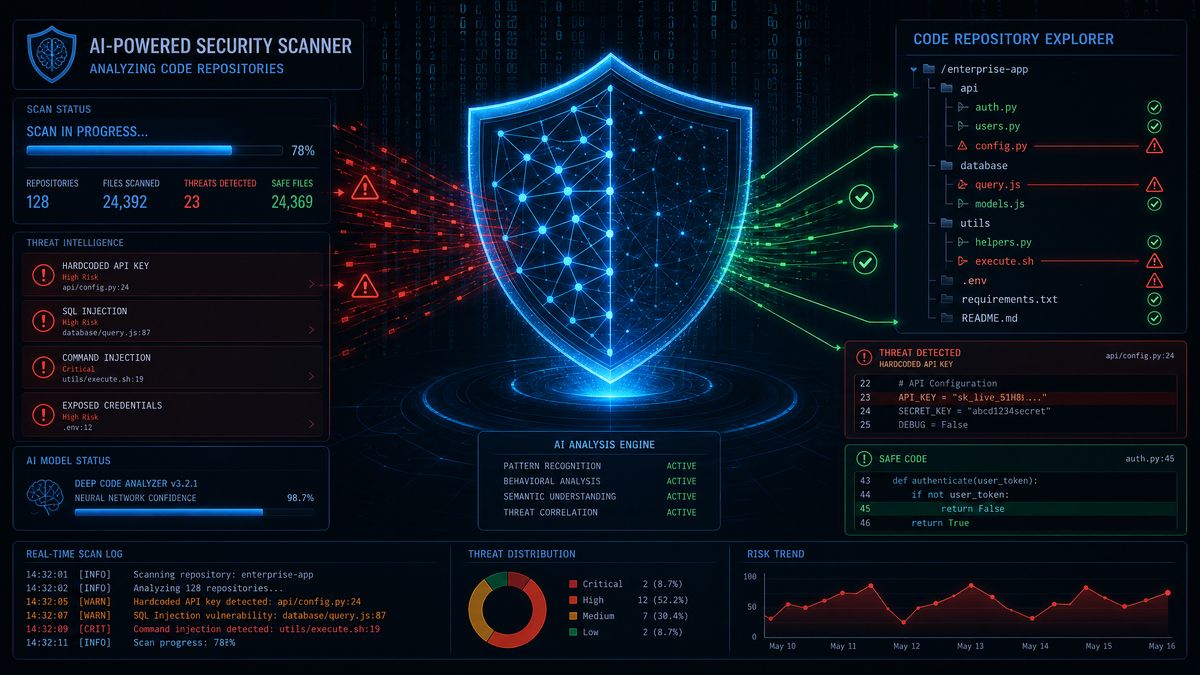
Codex Security Scanner: How to Use OpenAI’s Built-In Threat Modeling and Vulnerability Detection for Enterprise Repositories
Enterprise security teams are drowning in vulnerabilities. The average Fortune 500 company maintains hundreds of repositories, millions of lines of code, and a constant influx of new dependencies — all of which expand the attack surface faster than traditional static analysis tools can keep pace. OpenAI’s Codex Security Scanner changes the calculus entirely. By embedding threat intelligence directly into the code comprehension layer, Codex doesn’t just flag known patterns — it reasons about intent, context, and architectural risk in ways that legacy SAST tools cannot. This guide provides a comprehensive, practitioner-level walkthrough of every major feature: threat modeling, repository history scanning, vulnerability detection, and full SDLC integration for enterprise security teams ready to modernize their AppSec pipeline.
Table of Contents
- What Is the Codex Security Scanner?
- Core Architecture and How It Differs from SAST/DAST
- Built-In Threat Modeling Capabilities
- Repository History Scanning and Git Archaeology
- Vulnerability Detection: Classes, Severity, and Context
- Enterprise SDLC Integration
- CI/CD Pipeline Configuration
- Compliance Reporting and Audit Trails
- Real-World Enterprise Scenarios
- Best Practices and Tuning the Scanner
- Known Limitations and Mitigations
- Future Roadmap and Enterprise Considerations
What Is the Codex Security Scanner?
The Codex Security Scanner is an enterprise-grade, AI-powered static and contextual analysis capability built on top of OpenAI’s Codex model family. Unlike conventional security scanners that rely on rule-based pattern matching or signature databases, the Codex Security Scanner uses large language model reasoning to understand code semantics, data flow, trust boundaries, and developer intent across entire repository graphs.
At its core, the scanner operates through three primary mechanisms: contextual vulnerability detection, which evaluates code in the context of surrounding logic rather than in isolation; threat model generation, which automatically constructs STRIDE-aligned threat models from repository structure and code analysis; and historical risk analysis, which traverses Git commit history to identify when vulnerabilities were introduced, by whom, and how they propagated across branches.
The scanner is available through the OpenAI API under the codex-security capability flag, as a GitHub App for direct repository integration, and as a CLI tool (codex-scan) suitable for local developer workflows and CI/CD pipelines. Enterprise customers on the OpenAI Enterprise tier gain access to on-premises deployment options via the Codex Enterprise Security Gateway, which allows all code analysis to occur within a customer-controlled VPC without source code leaving the organizational boundary.
Key Differentiators at a Glance
| Feature | Traditional SAST | Codex Security Scanner |
|---|---|---|
| Analysis Method | Pattern/signature matching | Semantic reasoning + pattern detection |
| False Positive Rate | High (30–60% in complex codebases) | Significantly reduced through context awareness |
| Threat Modeling | Manual or template-based | Automated, architecture-aware, STRIDE-aligned |
| Historical Analysis | Current snapshot only | Full Git history traversal |
| Language Support | Limited, language-specific rules | 70+ languages with cross-language dataflow |
| Remediation Guidance | Generic CWE references | Context-specific, inline fix suggestions |
| Compliance Mapping | Manual mapping required | Automatic OWASP, NIST, SOC2, PCI-DSS mapping |
| Developer Experience | Batch reports, late feedback | IDE integration, PR-level inline comments |
Core Architecture and How It Differs from SAST/DAST
Understanding how the Codex Security Scanner works under the hood is essential for security architects evaluating its fit within an enterprise environment. The scanner operates on a three-layer analysis model that combines classical program analysis with LLM reasoning.
Layer 1: Syntactic and Structural Parsing
The first layer performs language-specific parsing using tree-sitter grammars to construct abstract syntax trees (ASTs) for every file in the repository. This layer handles tokenization, scope resolution, and import graph construction. It operates similarly to traditional static analysis at this stage — fast, deterministic, and language-aware. The output is a normalized code representation that feeds into Layer 2.
Layer 2: Semantic Dataflow Analysis
Layer 2 performs taint analysis and dataflow tracking across functions, modules, and service boundaries. This is where Codex begins to diverge meaningfully from traditional tools. Rather than relying solely on predefined source/sink definitions, the Codex model reasons about which variables carry user-controlled input, which functions constitute security-sensitive sinks, and how sanitization or validation logic intervenes in the data path. The model has internalized patterns from millions of real-world codebases, enabling it to recognize novel taint propagation patterns that evade rule-based detectors.
Cross-service analysis is particularly powerful here. In a microservices architecture, Codex can trace data from an API endpoint in a Node.js service through a message queue consumer in Python to a database write in Go — identifying SQL injection risk that spans three different technology stacks.
Layer 3: Contextual Risk Reasoning
The third layer applies LLM reasoning to generate human-readable vulnerability assessments, threat model components, and remediation suggestions. This layer consumes the structured output of Layers 1 and 2 plus repository metadata — including README content, CI/CD configuration, infrastructure-as-code files, and historical commit data — to produce contextually relevant security assessments. A SQL query that would be flagged as a critical injection risk in a public-facing API might be assessed as medium severity in an internal analytics service protected by network segmentation, with the scanner noting both the technical finding and the contextual risk reduction.
Comparison with DAST Approaches
Dynamic Application Security Testing (DAST) tools like OWASP ZAP or Burp Suite operate by sending HTTP requests to running applications and observing responses. They excel at identifying runtime vulnerabilities but require a deployed application, produce no results until late in the SDLC, and cannot identify the root cause in source code. The Codex Security Scanner is fundamentally a pre-runtime tool — it operates on source code before deployment — but its semantic understanding of application behavior allows it to identify many classes of vulnerability that DAST tools find through runtime probing. For enterprise teams, the ideal configuration uses Codex for developer-stage and CI/CD-stage scanning, with DAST tools complementing the workflow in staging environments.
Built-In Threat Modeling Capabilities
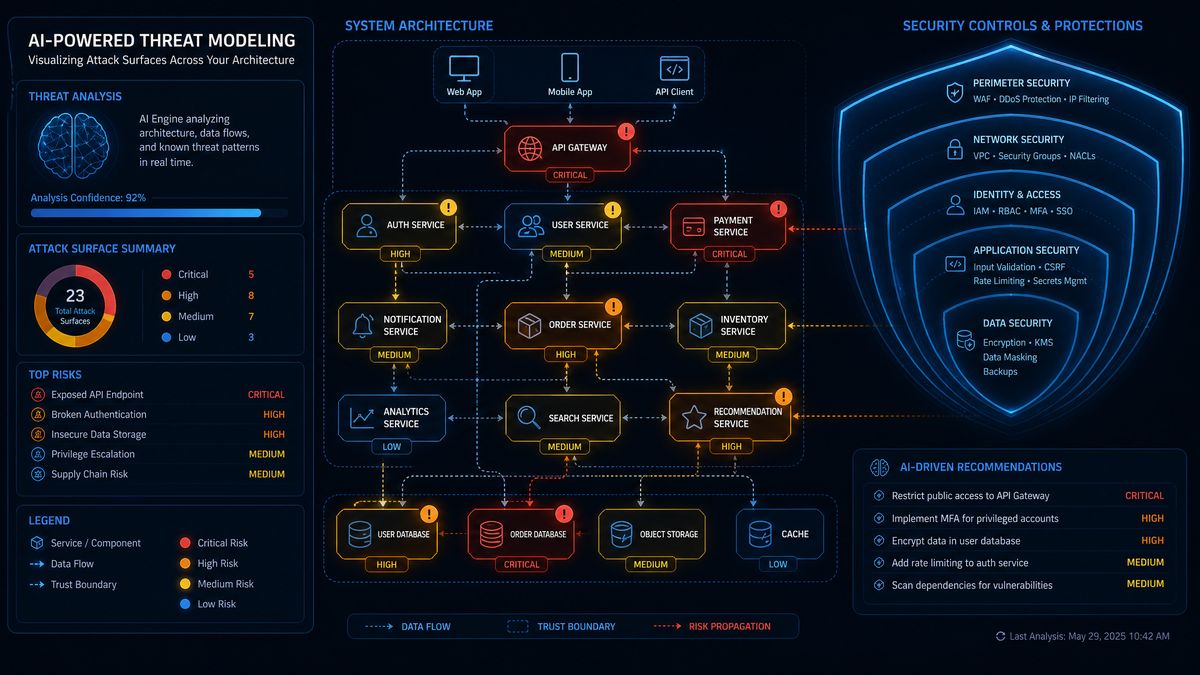
One of the Codex Security Scanner’s most differentiated capabilities is its ability to automatically generate structured threat models from repository content. Manual threat modeling is notoriously time-intensive — STRIDE analysis for a moderately complex microservices application can take a security architect several days to complete. Codex can produce an initial threat model in minutes, with the quality and depth that previously required significant human expertise.
How Threat Model Generation Works
When you invoke the threat modeling capability, Codex performs the following analysis sequence:
- Architecture Reconstruction: Codex parses configuration files (docker-compose.yml, Kubernetes manifests, Terraform/CDK files), API definitions (OpenAPI/Swagger, gRPC proto files, GraphQL schemas), and service-to-service call patterns in the application code to reconstruct an architectural diagram of the system’s components and communication paths.
- Trust Boundary Identification: Based on network configuration, authentication middleware, and data serialization patterns, Codex identifies trust boundaries — the points where data crosses between different privilege levels or security domains.
- STRIDE Enumeration: For each component and each trust boundary crossing, Codex generates STRIDE threat entries (Spoofing, Tampering, Repudiation, Information Disclosure, Denial of Service, Elevation of Privilege) with specific, code-referenced evidence for each threat.
- Attack Surface Mapping: Codex enumerates all entry points into the system — HTTP endpoints, message queue consumers, file watchers, scheduled jobs, webhook handlers — and maps them to their corresponding code locations.
- Risk Scoring: Each threat is scored using a DREAD-like model (Damage, Reproducibility, Exploitability, Affected Users, Discoverability) weighted by contextual factors like external exposure, data sensitivity indicators in the code, and existing control implementations.
Invoking Threat Modeling via CLI
# Basic threat model generation
codex-scan threat-model --repo ./my-enterprise-app --output threat-model.json

# STRIDE-specific analysis with custom trust boundary definitions
codex-scan threat-model \
  --repo ./my-enterprise-app \
  --trust-boundaries trust-boundaries.yaml \
  --framework stride \
  --output-format html \
  --output threat-model-report.html

# Threat modeling for a specific service within a monorepo
codex-scan threat-model \
  --repo ./monorepo \
  --scope services/payment-processor \
  --include-dependencies \
  --output payment-service-threats.json
The Trust Boundaries Configuration File
For complex enterprise applications, you can provide explicit trust boundary definitions to supplement Codex’s automated detection:
# trust-boundaries.yaml
trust_boundaries:
  - name: "Internet-DMZ"
    description: "Traffic entering from public internet to DMZ"
    ingress_components:
      - service: "api-gateway"
        ports: [443, 80]
    egress_components:
      - service: "auth-service"
      - service: "public-api"
    risk_multiplier: 2.0

  - name: "DMZ-Internal"
    description: "Traffic from DMZ to internal services"
    ingress_components:
      - service: "auth-service"
      - service: "public-api"
    egress_components:
      - service: "user-service"
      - service: "product-catalog"
      - service: "order-service"
    risk_multiplier: 1.5

  - name: "Internal-DataStore"
    description: "Application tier to data persistence"
    ingress_components:
      - service: "user-service"
      - service: "order-service"
    egress_components:
      - service: "postgres-primary"
      - service: "redis-cluster"
      - service: "elasticsearch"
    risk_multiplier: 1.8
Sample Threat Model Output Structure
The generated threat model follows a structured JSON schema that can be consumed by downstream tools, ticketing systems, or security dashboards:
{
  "threat_model": {
    "generated_at": "2024-11-15T14:32:00Z",
    "repository": "github.com/enterprise/payment-platform",
    "commit": "a3f7c891",
    "architecture_summary": {
      "components": 12,
      "trust_boundaries": 4,
      "entry_points": 47,
      "data_stores": 5
    },
    "threats": [
      {
        "id": "T-001",
        "category": "STRIDE-T",
        "title": "JWT Token Tampering via Algorithm Confusion",
        "description": "The authentication middleware in auth-service/middleware/jwt.js accepts the 'alg' header from the token itself without validation. An attacker can change the algorithm to 'none' to forge tokens without a valid signature.",
        "affected_component": "auth-service",
        "affected_files": ["auth-service/middleware/jwt.js:42"],
        "trust_boundary": "Internet-DMZ",
        "cvss_score": 9.1,
        "cvss_vector": "CVSS:3.1/AV:N/AC:L/PR:N/UI:N/S:U/C:H/I:H/A:N",
        "cwe": "CWE-347",
        "owasp_category": "A02:2021 Cryptographic Failures",
        "evidence": {
          "code_snippet": "const decoded = jwt.verify(token, secret, { algorithms: token.header.alg });",
          "line": 42,
          "explanation": "The algorithms option derives from attacker-controlled input"
        },
        "remediation": {
          "short": "Hardcode accepted algorithms: { algorithms: ['RS256'] }",
          "detailed": "Replace the dynamic algorithm selection with a hardcoded list of approved algorithms. For RS256: jwt.verify(token, publicKey, { algorithms: ['RS256'] }). Also validate the token structure before calling verify().",
          "references": ["https://auth0.com/blog/critical-vulnerabilities-in-json-web-token-libraries/"]
        }
      }
    ]
  }
}
Threat Model Differencing
One of the most valuable enterprise workflows is threat model differencing — running threat modeling on two different commits or branches to understand how a proposed change modifies the threat landscape. This is particularly valuable for security review of major architectural changes:
# Compare threat models between main branch and a feature branch
codex-scan threat-model diff \
  --baseline main \
  --compare feature/add-oauth-provider \
  --repo . \
  --output threat-diff-report.html
The diff report highlights new threats introduced, threats that were mitigated, and threats whose severity changed as a result of the code changes. This transforms threat modeling from a periodic activity into a continuous process embedded in the code review workflow.
Repository History Scanning and Git Archaeology
Most security scanners operate on the current state of a codebase. The Codex Security Scanner’s repository history scanning capability goes further, treating the Git history as a rich data source for understanding vulnerability provenance, credential exposure timelines, and the evolution of security-critical code paths.
Why Historical Scanning Matters
Consider these common enterprise scenarios where history scanning provides value that snapshot analysis cannot:
- Secret Exposure Detection: A developer accidentally committed an AWS access key, then deleted it in the next commit. The secret is gone from the current codebase but remains exposed in Git history — still accessible to anyone with repository access and potentially cached by GitHub’s own systems.
- Vulnerability Introduction Attribution: Understanding exactly which commit introduced a critical vulnerability, and by which developer, is essential for post-incident analysis and for identifying systemic patterns in security-relevant code changes.
- Regression Detection: A security fix was applied three months ago but was accidentally reverted during a large merge. Historical scanning can identify this regression by comparing current code against the known-fixed state.
- Dependency Backdating: Understanding when a vulnerable dependency version was introduced and whether any exploitation-relevant code paths were active at that time.
Running Repository History Scans
# Full history scan (all commits)
codex-scan history \
  --repo . \
  --full-history \
  --output history-scan-results.json

# Scan commits within a date range
codex-scan history \
  --repo . \
  --since "2024-01-01" \
  --until "2024-11-15" \
  --output history-2024.json

# Scan for secrets and credentials in history only
codex-scan history \
  --repo . \
  --full-history \
  --scan-types secrets,credentials,pii \
  --output credential-exposure.json

# Trace the history of a specific vulnerability class
codex-scan history \
  --repo . \
  --track-vulnerability CWE-89 \
  --full-history \
  --output sqli-history.json
Secret and Credential Detection in History
The history scanner uses a combination of entropy analysis, pattern matching, and semantic understanding to identify exposed secrets across commit history. Codex goes beyond simple regex patterns — it understands context well enough to distinguish a test fixture with a hardcoded “password123” from a real production credential, significantly reducing the noise that plagues tools like truffleHog or git-secrets in their default configurations.
Detected credential types include:
| Credential Type | Detection Method | Confidence Levels |
|---|---|---|
| AWS Access Keys/Secret Keys | Pattern + entropy | High (verified format) |
| GitHub Personal Access Tokens | Pattern match (ghp_, gho_, ghs_ prefixes) | High |
| Google Cloud Service Account Keys | JSON structure + key indicators | High |
| Database Connection Strings | Semantic + pattern | Medium-High |
| Private Keys (RSA, EC, PGP) | PEM header detection | High |
| JWT Signing Secrets | Semantic context analysis | Medium |
| API Keys (Generic) | Entropy + variable naming | Medium |
| Slack/Webhook Tokens | Pattern match | High |
| Stripe/Payment Keys | Pattern match (sk_live_, pk_live_) | High |
| Hardcoded Passwords | Semantic context | Low-Medium (context-dependent) |
Vulnerability Provenance Reporting
For each vulnerability detected in the current codebase, the history scanner can produce a provenance report showing the commit that introduced the vulnerable code, the developer who made the change, the PR/ticket context if available from commit messages, and how the vulnerability evolved through subsequent modifications:
# Generate vulnerability provenance for all current findings
codex-scan history provenance \
  --repo . \
  --findings current-scan-results.json \
  --output provenance-report.json \
  --include-blame
This capability is invaluable for both security investigations and developer education programs, as it allows security teams to understand not just where vulnerabilities exist but how they were introduced — enabling targeted training and process improvements rather than generic security awareness campaigns.
Vulnerability Detection: Classes, Severity, and Context
The vulnerability detection engine is the operational heart of the Codex Security Scanner. It covers the full spectrum of OWASP Top 10 and extends well beyond into CWE categories that traditional tools handle poorly or not at all.
Supported Vulnerability Categories
The scanner covers the following primary vulnerability categories with enterprise-grade depth:
Injection Vulnerabilities
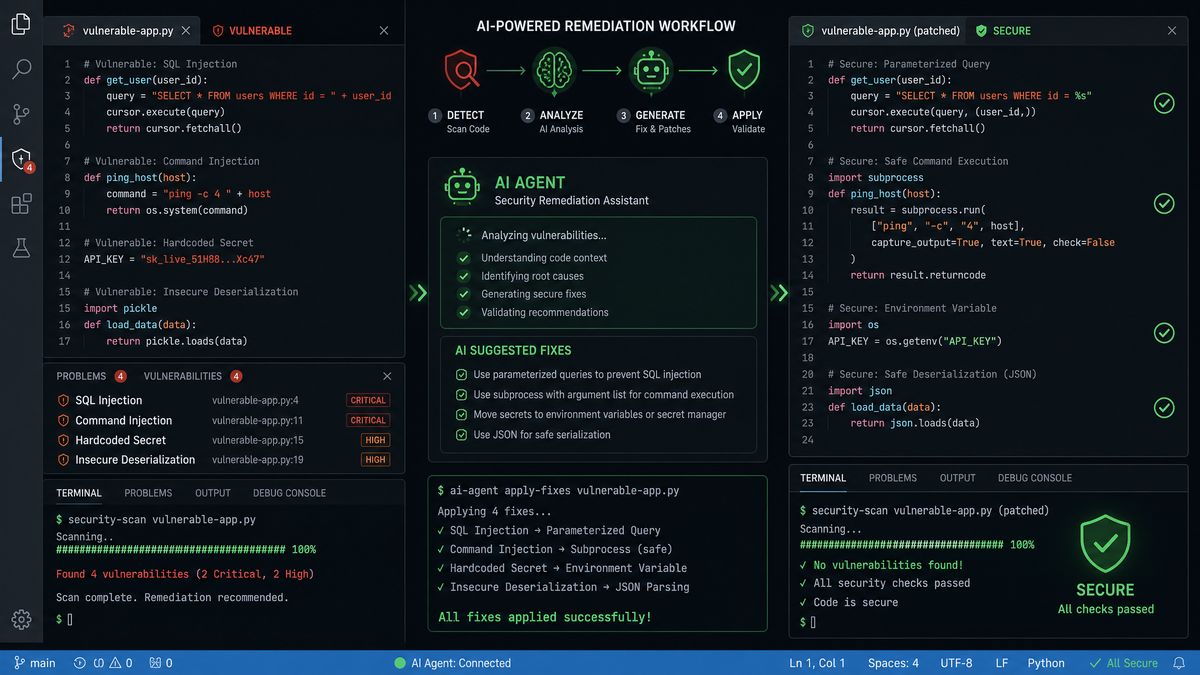
SQL injection, NoSQL injection, command injection, LDAP injection, XPath injection, template injection, and OS command injection. Codex’s taint analysis tracks user-controlled data through parameterization, escaping, and ORM layers to identify true positives while understanding legitimate sanitization patterns that legacy tools often miss, dramatically reducing false positives in modern frameworks using prepared statements and ORMs.
# Example: Codex identifies this as high-confidence SQL injection despite
# the string formatting being indirect

# Python example - flagged as CWE-89 High Confidence
def get_user_orders(user_id, status_filter):
    # status_filter comes from request query parameter
    base_query = "SELECT * FROM orders WHERE user_id = %s"
    if status_filter:
        # Codex identifies that status_filter is user-controlled
        # and that this string concatenation bypasses parameterization
        filter_clause = " AND status = '{}'".format(status_filter)
        base_query += filter_clause
    return db.execute(base_query, (user_id,))
Authentication and Session Management
Weak password hashing (MD5, SHA1, unsalted hashes), insecure session token generation, missing authentication on sensitive endpoints, JWT vulnerabilities (algorithm confusion, none algorithm, weak secrets), OAuth implementation flaws, and insecure remember-me implementations.
Cryptographic Failures
Use of deprecated algorithms (DES, 3DES, RC4, MD5 for security purposes), insufficient key lengths, ECB mode usage, hardcoded encryption keys, insecure random number generation for security-sensitive purposes, and improper certificate validation.
// JavaScript example - Codex flags ECB mode and hardcoded key
// Finding: CWE-327 (Use of Broken Algorithm) + CWE-798 (Hardcoded Credentials)

const crypto = require('crypto');

const ENCRYPTION_KEY = 'mySecretKey12345'; // Flagged: hardcoded key

function encryptData(plaintext) {
    // Flagged: AES-ECB mode leaks plaintext patterns
    const cipher = crypto.createCipheriv('aes-128-ecb', ENCRYPTION_KEY, null);
    return cipher.update(plaintext, 'utf8', 'hex') + cipher.final('hex');
}
Access Control Vulnerabilities
Insecure Direct Object References (IDOR), missing function-level access control, privilege escalation paths, path traversal, SSRF (Server-Side Request Forgery), and missing authorization checks on state-changing operations.
Security Misconfiguration
Hardcoded debug settings in production code, permissive CORS configurations, missing security headers, exposed stack traces, verbose error messages containing sensitive information, and insecure default configurations.
Cross-Site Scripting (XSS)
Reflected, stored, and DOM-based XSS. Codex’s semantic understanding of template engines, React/Angular/Vue rendering patterns, and sanitization libraries allows it to distinguish true XSS risks from safely rendered content with high accuracy.
Deserialization Vulnerabilities
Insecure deserialization in Java (ObjectInputStream), Python (pickle), PHP (unserialize), and Ruby (Marshal), as well as JSON deserialization issues in type-confused languages.
Dependency Vulnerabilities
Integration with the GitHub Advisory Database, NVD, and Snyk vulnerability databases allows Codex to identify vulnerable dependency versions and, crucially, assess whether the vulnerable code path is actually reachable from the application’s entry points — eliminating the alert fatigue from theoretical vulnerabilities in unused transitive dependencies.
Severity Scoring and Contextual Risk Adjustment
Each finding receives a base CVSS score derived from the vulnerability characteristics, which is then adjusted by contextual factors to produce an Effective Risk Score:
| Contextual Factor | Risk Adjustment | Example |
|---|---|---|
| External exposure (public internet) | +0.5 to +1.5 | Endpoint reachable without authentication |
| Data sensitivity indicators | +0.5 to +2.0 | Code handling PII, financial, or health data |
| Existing controls | -0.5 to -2.0 | WAF rules, rate limiting, input validation detected |
| Network segmentation | -0.5 to -1.0 | Service only accessible from internal VPC |
| Authentication requirement | -0.5 to -1.5 | Vulnerability requires authenticated user session |
| Code reachability | -1.0 to -3.0 | Vulnerable code in dead code path |
| Exploit availability (public PoC) | +0.5 to +1.0 | CVE with public exploit code available |
Enterprise SDLC Integration
For enterprise security teams, scanner adoption is only valuable if it integrates seamlessly into existing workflows. The Codex Security Scanner was designed with enterprise SDLC integration as a first-class concern, providing integration points at every stage of the development lifecycle.
When implementing the Codex Security Scanner as part of a broader enterprise security strategy, security architects should consider how it complements existing investments in tools like SonarQube, Veracode, or Checkmarx.
Implementing Codex Security Scanner effectively requires complementary data loss prevention policies that ensure sensitive code patterns, API keys, and proprietary algorithms are protected during automated scanning workflows. For a comprehensive deep dive, see our guide on How to Build Enterprise DLP Policies for ChatGPT and Codex.
provides detailed guidance on where Codex adds the most incremental value in a mature AppSec program and how to avoid redundant scanning that increases costs without improving coverage.
IDE Integration: Shift-Left Security
The shift-left principle — catching vulnerabilities as early as possible in the development process — reaches its logical conclusion with IDE integration. The Codex Security Scanner provides extensions for:
- VS Code: The
codex-securityextension provides real-time vulnerability highlighting as developers type, inline remediation suggestions, and on-demand threat model generation for the current file or workspace. - JetBrains IDEs (IntelliJ IDEA, PyCharm, GoLand, WebStorm): Available through the JetBrains Marketplace, providing the same real-time analysis capabilities with deep IDE framework integration.
- GitHub Copilot Integration: When Codex Security is enabled alongside GitHub Copilot, code suggestions are automatically screened and flagged if they contain security vulnerabilities before being presented to the developer.
Pull Request Integration
PR-level scanning is the highest-value integration point for most enterprise teams. When a developer opens a pull request, Codex Security Scanner runs automatically and posts results as PR comments with the following characteristics:
- Inline comments attached to the specific lines of changed code where vulnerabilities exist
- A PR-level summary comment with aggregate finding counts, severity distribution, and threat model changes
- Automated PR labels (
security-review-required,security-approved,critical-security-finding) based on configurable severity thresholds - Branch protection rules integration to block merges when critical findings are present
- Links to detailed remediation guidance in the security portal
GitHub App configuration for PR integration:
# .github/codex-security.yml
version: 1
scanning:
  on_pull_request: true
  on_push:
    branches: [main, develop, release/*]
  full_history_scan: false

thresholds:
  block_merge_on:
    - severity: critical
    - severity: high
      confidence: high
  require_security_review_on:
    - severity: high
    - severity: medium
      category: [injection, authentication, cryptography]

notifications:
  slack:
    webhook: ${SLACK_SECURITY_WEBHOOK}
    channel: "#security-alerts"
    on: [critical, high]
  email:
    recipients:
      - [email protected]
    on: [critical]

suppressions:
  - id: "SUP-001"
    finding_id: "CWE-798"
    file_pattern: "tests/**/*.py"
    reason: "Test fixtures with non-production credentials"
    approved_by: "[email protected]"
    expires: "2025-06-01"

compliance:
  frameworks: [owasp-top10, nist-800-53, pci-dss, soc2]
  generate_report: true
  report_destination: s3://enterprise-security-reports/
Security Review Workflow Integration
For high-risk changes — modifications to authentication systems, cryptographic implementations, or data access layers — Codex Security Scanner can trigger an enhanced security review workflow:
- Codex detects that changes touch security-sensitive code (configurable via path patterns and code pattern analysis)
- The PR is automatically assigned to a security reviewer from the enterprise security team
- A detailed security review package is generated, including the relevant threat model sections, all findings, and a pre-populated security review checklist
- The security reviewer can mark findings as accepted risk, false positive, or requiring remediation directly within the PR interface
- All decisions are logged to the audit trail with timestamp, reviewer identity, and justification
CI/CD Pipeline Configuration
CI/CD integration ensures that security scanning occurs consistently on every build, regardless of IDE configuration or developer practices. The following examples cover the major CI/CD platforms used in enterprise environments.
GitHub Actions
name: Codex Security Scan

on:
  push:
    branches: [ main, develop ]
  pull_request:
    branches: [ main, develop ]
  schedule:
    # Full history scan every Sunday at midnight
    - cron: '0 0 * * 0'

jobs:
  security-scan:
    runs-on: ubuntu-latest
    permissions:
      contents: read
      security-events: write
      pull-requests: write

    steps:
      - name: Checkout repository
        uses: actions/checkout@v4
        with:
          fetch-depth: 0  # Required for history scanning

      - name: Run Codex Security Scanner
        uses: openai/codex-security-action@v2
        with:
          api-key: ${{ secrets.OPENAI_API_KEY }}
          scan-type: ${{ github.event_name == 'schedule' && 'full-history' || 'incremental' }}
          severity-threshold: medium
          fail-on-severity: high
          output-format: sarif
          generate-threat-model: ${{ github.ref == 'refs/heads/main' }}
          compliance-frameworks: 'owasp-top10,pci-dss'

      - name: Upload SARIF results
        uses: github/codeql-action/upload-sarif@v3
        if: always()
        with:
          sarif_file: codex-security-results.sarif
          category: codex-security

      - name: Upload Security Artifacts
        uses: actions/upload-artifact@v4
        if: always()
        with:
          name: security-reports
          path: |
            codex-security-results.sarif
            threat-model.json
            compliance-report.html
          retention-days: 90
Jenkins Pipeline
pipeline {
    agent any

    environment {
        OPENAI_API_KEY = credentials('openai-api-key')
        SECURITY_REPORTS_S3 = 's3://enterprise-security/jenkins/'
    }

    stages {
        stage('Checkout') {
            steps {
                checkout scm
                sh 'git fetch --unshallow || true'
            }
        }

        stage('Security Scan') {
            parallel {
                stage('Vulnerability Scan') {
                    steps {
                        sh '''
                            codex-scan scan \
                                --repo . \
                                --api-key $OPENAI_API_KEY \
                                --output-format json \
                                --output vuln-results.json \
                                --severity-threshold low \
                                --confidence-threshold medium
                        '''
                    }
                }

                stage('Secret Detection') {
                    steps {
                        sh '''
                            codex-scan history \
                                --repo . \
                                --scan-types secrets \
                                --since $(git log --format=%H | tail -1) \
                                --output secrets-results.json
                        '''
                    }
                }

                stage('Dependency Audit') {
                    steps {
                        sh '''
                            codex-scan dependencies \
                                --repo . \
                                --check-reachability \
                                --output dependency-results.json
                        '''
                    }
                }
            }
        }

        stage('Threat Model Update') {
            when {
                branch 'main'
            }
            steps {
                sh '''
                    codex-scan threat-model \
                        --repo . \
                        --output threat-model.json \
                        --output-format html \
                        --output-html threat-model.html
                '''
            }
        }

        stage('Quality Gate') {
            steps {
                script {
                    def results = readJSON file: 'vuln-results.json'
                    def criticalCount = results.findings.count { it.severity == 'critical' }
                    def highCount = results.findings.count { it.severity == 'high' && it.confidence == 'high' }

                    if (criticalCount > 0) {
                        error("Build failed: ${criticalCount} critical vulnerabilities found")
                    }
                    if (highCount > env.HIGH_VULN_THRESHOLD.toInteger()) {
                        unstable("Build unstable: ${highCount} high-confidence high-severity findings")
                    }
                }
            }
        }

        stage('Upload Reports') {
            steps {
                sh '''
                    aws s3 cp vuln-results.json ${SECURITY_REPORTS_S3}${BUILD_NUMBER}/
                    aws s3 cp threat-model.json ${SECURITY_REPORTS_S3}${BUILD_NUMBER}/
                '''
            }
        }
    }

    post {
        always {
            archiveArtifacts artifacts: '*.json, *.html', fingerprint: true
            publishHTML([
                reportDir: '.',
                reportFiles: 'threat-model.html',
                reportName: 'Threat Model Report',
                keepAll: true
            ])
        }
        failure {
            slackSend(
                channel: '#security-alerts',
                color: 'danger',
                message: "Security gate failure: ${env.JOB_NAME} #${env.BUILD_NUMBER} - Critical vulnerabilities detected"
            )
        }
    }
}
GitLab CI/CD
include:
  - template: Security/SAST.gitlab-ci.yml

variables:
  OPENAI_API_KEY: $OPENAI_API_KEY

codex-security-scan:
  stage: test
  image: openai/codex-scan:latest
  script:
    - codex-scan scan --repo . --output-format gitlab-sast --output gl-sast-report.json
    - codex-scan threat-model --repo . --output threat-model.json
  artifacts:
    reports:
      sast: gl-sast-report.json
    paths:
      - gl-sast-report.json
      - threat-model.json
    expire_in: 30 days
  rules:
    - if: $CI_PIPELINE_SOURCE == 'merge_request_event'
    - if: $CI_COMMIT_BRANCH == $CI_DEFAULT_BRANCH
Compliance Reporting and Audit Trails
For regulated industries — financial services, healthcare, retail with payment card data — compliance reporting is not optional. The Codex Security Scanner generates compliance-mapped reports for major regulatory frameworks automatically, transforming raw vulnerability data into the structured evidence required for audits.
Understanding how Codex Security Scanner findings map to specific regulatory requirements is critical for compliance teams managing multiple frameworks simultaneously.
Security teams using Codex Security Scanner can amplify their threat modeling with 50 specialized GPT-5.5 prompts designed for threat analysis, incident response, and vulnerability assessment across enterprise environments. For a comprehensive deep dive, see our guide on 50 GPT-5.5 Prompts for Cybersecurity Professionals.
Access 40,000+ AI Prompts for ChatGPT, Claude & Codex — Free!
Subscribe to get instant access to our complete Notion Prompt Library — the largest curated collection of prompts for ChatGPT, Claude, OpenAI Codex, and other leading AI models. Optimized for real-world workflows across coding, research, content creation, and business.
offers comprehensive guidance on mapping vulnerability management programs to SOC 2 Type II, PCI DSS 4.0, and HIPAA security requirements using AI-powered tooling.
Supported Compliance Frameworks
| Framework | Version Supported | Report Types | Key Sections Covered |
|---|---|---|---|
| OWASP Top 10 | 2021 | HTML, PDF, JSON | All 10 categories |
| NIST SP 800-53 | Rev 5 | HTML, PDF, OSCAL JSON | SA, SI, SC, AC controls |
| PCI DSS | 4.0 | HTML, PDF | Req 6 (Secure Systems), Req 8 (Access) |
| SOC 2 | TSC 2017 | HTML, PDF | CC6, CC7, CC8 criteria |
| ISO 27001 | 2022 | HTML, PDF | A.8 Technology controls |
| HIPAA | Current | HTML, PDF | Technical Safeguards |
| CIS Benchmarks | v8 | HTML, JSON | IG1, IG2, IG3 |
| DORA (EU) | 2023 | HTML, PDF | ICT Risk Management |
Generating Compliance Reports
# Generate PCI DSS 4.0 compliance report
codex-scan report compliance \
  --framework pci-dss-4.0 \
  --findings scan-results.json \
  --output-format pdf \
  --output pci-dss-compliance-report.pdf \
  --include-evidence \
  --include-remediation-plan \
  --organization "Enterprise Corp" \
  --assessment-period "Q4 2024"

# Generate multi-framework compliance dashboard
codex-scan report compliance \
  --framework owasp-top10,nist-800-53,soc2 \
  --findings scan-results.json \
  --output-format html \
  --output compliance-dashboard.html
Audit Trail and Evidence Management
The Codex Security Scanner maintains a tamper-evident audit log of all scanning activities, findings, suppressions, and remediation status changes. This audit trail is essential for demonstrating due diligence to auditors and regulators:
# Query the audit trail
codex-scan audit \
  --start-date "2024-10-01" \
  --end-date "2024-11-15" \
  --event-types [scan_completed, finding_suppressed, remediation_verified] \
  --output-format json \
  --output audit-trail-q4-2024.json

# Generate an evidence package for a specific finding
codex-scan audit evidence \
  --finding-id "CSEC-20241101-0042" \
  --include-history \
  --include-remediation \
  --output evidence-package.zip
Real-World Enterprise Scenarios
Scenario 1: Financial Services — Pre-Merger Code Acquisition
A large financial institution is acquiring a fintech startup. As part of due diligence, the security team needs to assess the security posture of the target’s entire codebase — 47 repositories, 1.2 million lines of code, 6 years of commit history — within a two-week timeline. Previously, this would have required a team of application security engineers conducting manual code review supplemented by tool-assisted scanning, followed by weeks of triage and report preparation.
Using Codex Security Scanner:
- All 47 repositories are configured in a bulk scan manifest and processed in parallel over 18 hours
- Full Git history is scanned for credential exposure, identifying 3 historical AWS key exposures and 1 still-valid database connection string in an archived branch
- Threat models are generated for all 47 services, with cross-repository dataflow analysis identifying 2 critical trust boundary violations in the payment processing flow
- A consolidated executive report is generated showing aggregate risk scores, top 20 critical findings, and a remediation roadmap with effort estimates
- PCI DSS and SOC 2 gap analysis reports are generated for the due diligence team
Total timeline: 72 hours from configuration to final report, compared to an estimated 8 weeks for a traditional manual assessment.
Scenario 2: Healthcare — HIPAA-Compliant CI/CD Pipeline
A healthcare SaaS company processing Protected Health Information (PHI) needs to maintain continuous evidence of security controls for HIPAA compliance. They implement Codex Security Scanner as the cornerstone of their secure SDLC:
- Every commit to repositories containing PHI-processing code triggers an automated scan
- Findings related to data exposure (logging of PHI, insecure transmission, improper access controls) are escalated immediately to the security officer
- Monthly compliance reports are auto-generated and archived to an immutable S3 bucket with WORM (Write Once Read Many) policy
- The scanner’s contextual analysis is configured with healthcare-specific sensitivity indicators (ICD codes, SSNs, insurance IDs) to provide elevated risk scoring for vulnerabilities near PHI handling code
- Developer training is targeted based on the types of findings introduced by each team, turning scanner output into a personalized learning signal
Scenario 3: E-Commerce — Black Friday Security Readiness
An e-commerce platform preparing for its highest-traffic period of the year uses Codex Security Scanner for a comprehensive pre-event security assessment:
- Threat modeling is run across the payment, checkout, and fraud detection services to identify any new attack surfaces introduced during the preceding development sprint
- Dependency vulnerability scanning identifies a critical deserialization vulnerability in a payment library updated three weeks prior
- Historical scanning reveals that a security-critical input validation function was accidentally simplified during a recent refactor, removing protection against price manipulation attacks
- The scanner generates a risk-prioritized remediation plan with 10 days until the event, enabling the engineering team to focus exclusively on the highest-impact fixes
Best Practices and Tuning the Scanner
Getting maximum value from the Codex Security Scanner in an enterprise environment requires thoughtful configuration and ongoing tuning. The following best practices are derived from enterprise deployment experiences across multiple industry verticals.
1. Define a Repository Classification Scheme
Not all repositories warrant the same level of scanning intensity. Establish a classification scheme and configure scan profiles accordingly:
| Tier | Repository Types | Scan Profile | CI Gate |
|---|---|---|---|
| Critical | Payment processing, authentication, PHI/PII handling | Full scan + threat model + history | Block on High+Critical |
| High | Customer-facing APIs, user data services | Full vulnerability scan | Block on Critical only |
| Medium | Internal tools, admin interfaces | Standard scan | Warn on High |
| Low | Documentation, tooling, scripts | Secret detection + basic scan | No gate |
2. Establish a Suppression Governance Process
False positives and accepted risks must be managed carefully. An uncontrolled suppression process undermines the scanner’s value. Implement a governance workflow where suppressions require:
- Security team approval for any High or Critical finding suppression
- Mandatory expiration dates (typically 90 days maximum)
- Business justification and compensating control documentation
- Automated expiration notifications to the approving security engineer
3. Integrate with Vulnerability Management Platforms
Scanner findings become most valuable when integrated with vulnerability management platforms like Archer, ServiceNow Security Operations, or Jira for tracking remediation across teams. The Codex Security Scanner provides native integrations with these platforms, enabling automatic ticket creation with finding context, SLA tracking based on severity, and automatic closure when re-scan confirms remediation.
4. Tune Confidence Thresholds by Category
Different vulnerability categories have different false positive rates in different codebases. Spend time in the first 30 days analyzing false positives and tuning confidence thresholds by category. For example, you might accept medium-confidence injection findings but only act on high-confidence cryptographic findings to maintain a manageable finding volume.
5. Run Regular Baseline Assessments
Monthly full-history scans of Tier 1 repositories provide early warning of accumulating technical security debt and are required for demonstrating continuous monitoring to most compliance frameworks. Schedule these as separate pipeline jobs from the incremental CI scans to avoid performance impacts on build times.
Known Limitations and Mitigations
No security tool is without limitations, and honest assessment of where the Codex Security Scanner falls short is important for enterprise teams building a complete security program.
Limitation 1: Dynamic and Runtime Vulnerabilities
Issue: Like all SAST tools, Codex cannot identify vulnerabilities that only manifest at runtime — race conditions in multi-threaded code, environment-specific misconfigurations, or vulnerabilities that depend on runtime-loaded plugins.
Mitigation: Complement with DAST scanning in staging environments and runtime application self-protection (RASP) tools in production.
Limitation 2: Novel/Zero-Day Vulnerability Patterns
Issue: While Codex’s semantic understanding makes it more resilient to novel patterns than rule-based tools, it may not recognize entirely new vulnerability classes that emerged after its training data cutoff.
Mitigation: Monitor OpenAI’s Codex Security Scanner rule update releases and supplement with threat intelligence feeds for emerging vulnerability patterns.
Limitation 3: Performance on Extremely Large Repositories
Issue: Repositories exceeding 5 million lines of code may experience extended scan times for full analysis, particularly for cross-service dataflow analysis.
Mitigation: Use the --scope flag to limit analysis to changed modules for incremental CI scans. Reserve full-repository analysis for scheduled weekly or monthly scans.
Limitation 4: Infrastructure-as-Code Completeness
Issue: While Codex analyzes IaC files for security context, it does not provide the depth of analysis available from dedicated cloud security posture management (CSPM) tools or IaC-specific scanners like Checkov or Bridgecrew.
Mitigation: Use a dedicated IaC security scanner in parallel, particularly for Terraform, CloudFormation, and Kubernetes manifests.
Limitation 5: Binary and Obfuscated Dependencies
Issue: Analysis of compiled binary dependencies or heavily obfuscated JavaScript bundles is limited to known vulnerability database lookups without the full semantic analysis available for source code.
Mitigation: Ensure Software Bill of Materials (SBOM) generation is part of the build process to maximize vulnerability database coverage for binary dependencies.
Future Roadmap and Enterprise Considerations
OpenAI has published a public roadmap for the Codex Security Scanner that includes several capabilities with significant enterprise implications:
Agentic Remediation (In Development)
The next major release introduces Codex Security Agent, an autonomous remediation mode where Codex can propose and, with appropriate approvals, implement fixes for detected vulnerabilities as pull requests. The agent can handle straightforward remediation cases — parameterizing SQL queries, replacing deprecated cryptographic algorithms, updating vulnerable dependency versions — without human coding intervention. For enterprise teams, this capability includes an approval workflow with security team sign-off before any automated PR is opened.
Cross-Repository Attack Path Analysis
Planned functionality that analyzes entire organization-level repository graphs to identify multi-hop attack paths — for example, a vulnerability in a shared authentication library that, when exploited, enables access to sensitive data stores across 14 downstream services that all depend on it.
AI-Powered Security Chaos Engineering
Integration with chaos engineering frameworks (Chaos Monkey, LitmusChaos) to automatically generate security-focused chaos experiments derived from the threat model. This closes the loop between threat identification and resilience validation.
Supply Chain Security Enhancements
Enhanced analysis of software supply chain risks, including detection of typosquatting attacks on package names, analysis of package maintainer reputation signals, and detection of dependency confusion attack vectors in multi-registry configurations.
Enterprise Deployment Considerations
For enterprises evaluating the Codex Security Scanner, key deployment considerations include:
- Data Sovereignty: Enterprise customers in the EU, healthcare sector, or defense industrial base should evaluate the Codex Enterprise Security Gateway for on-premises deployment, ensuring source code never leaves organizational control during analysis.
- Model Versioning: Enterprise subscriptions allow pinning to specific model versions to ensure consistent scan results between assessments and avoid unexpected behavior changes from model updates. This is important for compliance frameworks that require consistent methodology across audit periods.
- Rate Limits and Performance SLAs: Enterprise tier provides dedicated capacity with guaranteed scan completion times and SLA-backed performance commitments suitable for integration into time-sensitive release pipelines.
- Team Training: The value realization from the Codex Security Scanner is significantly higher when development teams receive training on interpreting findings and implementing suggested remediations. OpenAI offers structured developer security training programs aligned with the tool’s output format.
Conclusion
The Codex Security Scanner represents a meaningful advancement in enterprise application security tooling. By combining the pattern recognition of traditional SAST tools with the semantic understanding of large language models, it addresses the most persistent pain points of enterprise AppSec programs: the high false positive rates that cause developer alert fatigue, the absence of meaningful threat modeling at scale, the inability to learn from security history in the codebase, and the disconnect between vulnerability discovery and practical remediation guidance.
For security teams beginning their evaluation, the recommended starting point is integrating the scanner at the PR level in a single Tier 1 repository, running it in observation mode (no CI gates) for two weeks to understand finding volume and quality, then progressively enabling gates and expanding coverage. The configuration flexibility of the platform — from confidence thresholds and suppression workflows to compliance framework selection and notification routing — means that enterprises can tune it to match their risk tolerance and team capacity rather than being forced to accept one-size-fits-all defaults.
The threat modeling, historical scanning, and vulnerability detection capabilities covered in this guide represent the current state of the platform, but the roadmap toward agentic remediation and cross-repository attack path analysis suggests that the most impactful capabilities are still ahead. Enterprises that invest now in building the operational foundations — repository classification, suppression governance, SDLC integration, and compliance reporting workflows — will be best positioned to leverage those capabilities as they mature.
Application security is ultimately a continuous process, not a point-in-time assessment. The Codex Security Scanner, properly integrated into the SDLC, transforms security from a periodic gate into a continuous signal that enables developers to build securely from the first line of code to production deployment and beyond.
