
Falcon Guardian vs Codex Managed Configuration: Runtime Detection vs Preventive Agent Controls
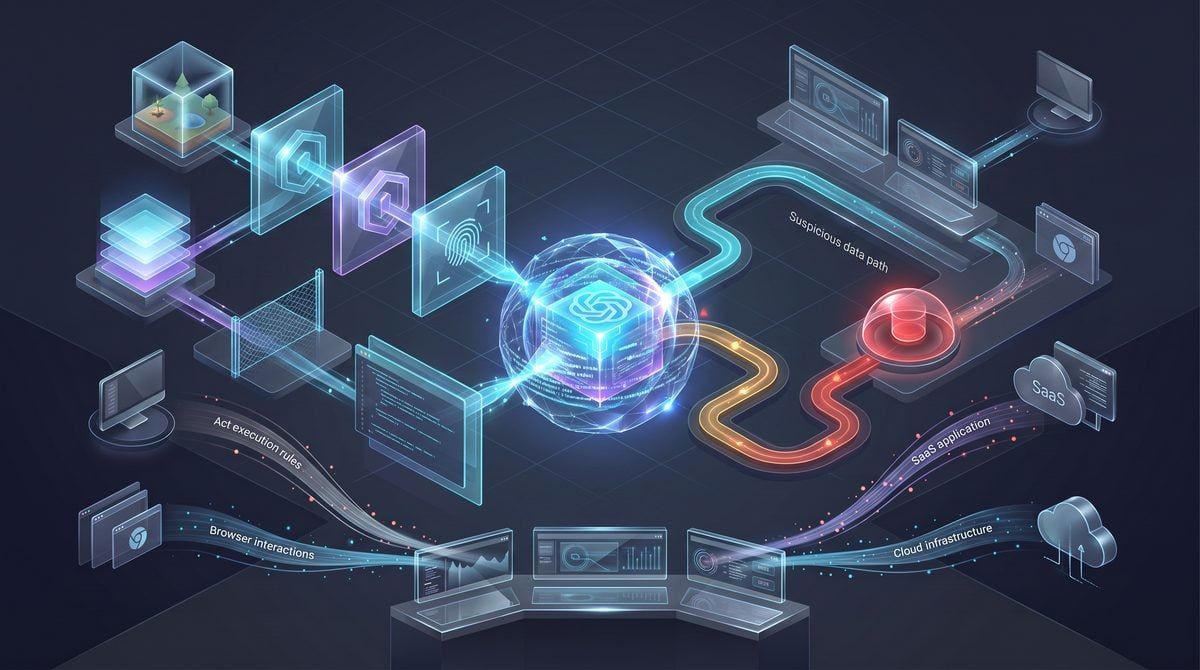

Why “detecting agent behavior” and “configuring agent boundaries” are different jobs
Security teams evaluating Codex in enterprise environments now have to separate two categories that are often collapsed into one conversation: preventive controls that shape what an agent is allowed to attempt, and runtime detection-and-response systems that observe what agents actually do during execution. OpenAI’s Codex safety documentation describes preventive mechanisms such as sandboxing, approval policies, managed network access, protected identity and credentials, command rules, managed configuration, OpenTelemetry export, and Enterprise/Edu compliance logs. CrowdStrike’s September 2, 2026 announcement says Falcon Guardian will extend runtime AI detection and response to supported Codex agents by discovering agents, mapping who deployed them and what they access, correlating agent actions with Falcon telemetry, detecting compromised or unauthorized behavior, and responding before activity spreads.
The practical distinction matters because a denied configuration and a detected incident answer different questions. A managed Codex policy can say, for example, that browser uploads are denied, persistent approvals are disabled, a specific site is blocked, or only approved native applications may be used. That is a pre-execution boundary. A runtime detection product, as described in CrowdStrike’s announcement, is meant to watch activity as it occurs, correlate it with endpoint and security telemetry, identify behavior that looks compromised or unauthorized, and support response. One reduces the number of risky actions an agent can perform; the other helps find and contain risky behavior that still occurs because of misconfiguration, stolen identity, malicious prompts, compromised tools, excessive permissions, or gaps outside the agent’s local policy.
For Codex Enterprise Deployment Security, Running Codex Safely in Enterprise Environments: A Practical Guide for Engineering Leaders and Security Teams is the most relevant adjacent resource. The enterprise Codex safety guide covers identity, sandboxing, credentials, permissions, and operational controls that form the preventive half of the comparison.
The two source models: OpenAI preventive controls and CrowdStrike runtime defense
OpenAI’s published Codex safety approach is built around bounded execution. The stated objective is to make low-risk actions frictionless inside controlled environments while stopping higher-risk actions for review. In practice, that model includes sandbox boundaries, command rules, managed network access, approval prompts, managed configuration, protected credentials, and telemetry exports. OpenAI’s managed-configuration documentation further distinguishes administrator-enforced requirements from managed defaults: requirements constrain security-sensitive settings and cannot be weakened by users, while managed defaults are initial values that users may change during a run and that the client reapplies at restart.
That distinction is operationally important. An administrator-enforced requirement is suitable for non-negotiable policy, such as denying a class of browser capability or restricting native computer use to approved applications. A managed default is suitable when the organization wants a preferred starting posture but accepts that a user may adjust the value during a run. OpenAI also documents policy precedence across sources such as system requirements, cloud-managed requirements, legacy managed configuration, and macOS managed preferences, with higher-precedence sources taking priority according to documented merge behavior. That means administrators need to test effective policy rather than assume a single file or console setting is the final authority.
CrowdStrike’s announcement describes a different layer. According to CrowdStrike, Falcon Guardian will extend runtime AI detection and response to supported Codex agents. The announced functions include discovering supported Codex agents across an organization, mapping who deployed them, identifying what they access, assessing security status, correlating agent actions with Falcon telemetry, detecting compromised or unauthorized behavior, responding before activity spreads, and translating governance policy into enforceable runtime controls. Those are runtime security claims, not a restatement of Codex’s local sandbox or OpenAI’s managed browser and computer-use settings.
The safest way to read the announcement is as a complementary integration, not a universal replacement for endpoint, identity, network, or Codex configuration controls. CrowdStrike’s language refers to supported Codex agents and to Falcon Guardian capabilities as announced; it does not mean every Codex deployment is automatically covered, that every remediation action is autonomous, or that local Codex policies can be ignored. It also does not remove the need for workspace administrators to set appropriate roles, approvals, model and product access, repository permissions, operating-system controls, secrets handling, and audit exports.
Decision rule: use Codex managed configuration to define what should be allowed before an agent acts; use runtime AI detection and response to discover, correlate, detect, and respond when agent activity creates security signals during execution.
The four-layer control model for agentic development environments
A practical security architecture for Codex agents can be organized into four layers: identity, preventive policy, runtime behavior, and evidence/response. Each layer answers a different operational question. Identity asks who or what is acting. Preventive policy asks what the agent is allowed to attempt. Runtime behavior asks what the agent actually did in context. Evidence and response ask how the organization proves, investigates, and contains the event. Treating these as separate layers prevents two common errors: overloading an agent policy file with responsibilities it cannot satisfy, and expecting a runtime detector to compensate for avoidable over-permissioning.
| Layer | Primary question | Relevant controls from the sources | Operational failure if ignored |
|---|---|---|---|
| Identity | Who deployed the agent, what account is it using, and what resources can that identity reach? | Workspace identity, protected credentials, repository and app permissions, and CrowdStrike’s announced mapping of who deployed supported agents and what they access. | An agent may inherit broad access, making a benign task capable of touching sensitive repositories, SaaS data, or cloud resources. |
| Preventive policy | What can the agent attempt before execution is allowed? | OpenAI sandbox boundaries, approval policies, command rules, managed network access, managed configuration requirements, browser and native-app restrictions. | High-risk actions may be available by default, or users may weaken defaults that should have been enforced as requirements. |
| Runtime behavior | What is the agent doing now, and does that behavior look unauthorized or compromised? | CrowdStrike’s announced runtime telemetry correlation, behavior detection, and runtime enforcement for supported Codex agents. | Security teams may only discover misuse after code, credentials, browser data, or external systems have already been affected. |
| Evidence and response | Can the organization reconstruct the event and respond with enough context? | OpenAI OpenTelemetry export, Enterprise/Edu compliance logs, Falcon telemetry correlation, investigation workflows, and incident response processes. | Teams may know something happened but lack sufficient context to determine scope, root cause, or remediation priority. |
Layer 1: Identity is the blast-radius boundary
Identity comes first because every other control inherits its risk from what the acting principal can reach. A Codex agent working under a developer’s repository permissions, local environment, connected tools, or browser context can only be evaluated safely if administrators understand the permissions behind that session. OpenAI’s safety model refers to protected identity and credentials as part of running Codex safely, while CrowdStrike says Falcon Guardian will map who deployed supported Codex agents and what they access. These are complementary facts: one side is about safeguarding identity use inside the agent workflow, and the other is about discovering and correlating identity-linked agent activity at runtime.
For enterprise administrators, the identity layer should be treated as an access-design problem, not just an audit label. A developer account with write access to production repositories, a browser profile with authenticated SaaS sessions, or a local machine with cloud credentials can expand what an agent task can affect. Preventive agent policy can reduce available actions, but it does not erase the underlying privileges of the human, machine, browser, repository, or application context. That is why least privilege, role design, credential isolation, and approval requirements remain necessary even when runtime detection is deployed.
Layer 2: Preventive policy is the “before action” boundary
Preventive policy is where OpenAI’s managed configuration is most directly relevant. OpenAI documents controls for browser use such as default and per-origin access policies, upload denial, download allowance, browser-history access, persistent approval, full Chrome DevTools Protocol access, automatic review, and approval lifetimes. For native computer use, administrators can deny applications by default and allow approved macOS bundle identifiers or verified Windows application identities. OpenAI also documents feature pins for browser use, in-app browser, external browser use, full CDP access, and computer use.
The key implementation warning is that allow rules are not magic grants. OpenAI’s managed-configuration documentation states that allow rules do not install software, grant operating-system permissions, or bypass separate review requirements. The September 2026 release notes also state that allowing a site or application does not override other policies or approval prompts. This means a security team should not interpret “allowed” as “fully executable without friction.” It means the item is permitted by that policy layer, subject to other requirements, approvals, operating-system constraints, and product behavior documented by OpenAI.
A strong preventive baseline usually starts with default-deny logic for higher-risk surfaces, then adds narrow exceptions for known development workflows. For example, a team may permit a specific internal documentation origin for browser reference, deny uploads to prevent accidental data transfer, disable persistent approvals to force recurring human review, and restrict native app access to a small set of verified development tools. The exact keys and supported behavior must come from OpenAI’s managed-configuration documentation and should be validated against the deployed client version before rollout.
Layer 3: Runtime behavior is where intent meets execution
For AI Detection and Response, OpenAI Launches Dedicated Cybersecurity AI Model: How the New Cyber Defense System Changes Enterprise Threat Detection is the most relevant adjacent resource. The dedicated cyber-defense model analysis explains threat detection and response workflows, providing context for how runtime telemetry can support investigation and containment.
This layer is especially important because agent workflows are multi-step. A single prompt can lead to repository inspection, command execution, dependency review, browser research, file edits, test runs, and proposed commits. Preventive settings can constrain those steps, but runtime monitoring helps determine whether the observed chain makes sense for the user, task, endpoint, and environment. A command that is acceptable in a test repository may be suspicious on a production endpoint; a browser destination that is normal for package documentation may be inappropriate during a confidential incident response task.
Layer 4: Evidence and response turn signals into accountable security action
Evidence and response determine whether a security team can move from “something looked wrong” to “we know what happened and what to do next.” OpenAI’s safety documentation refers to OpenTelemetry export and Enterprise/Edu compliance logs as part of the Codex safety approach. CrowdStrike’s announcement emphasizes correlating agent actions with Falcon telemetry and responding before activity spreads. These evidence streams serve different but related purposes: agent-side logs can help reconstruct Codex activity and policy context, while security-platform telemetry can connect agent activity to endpoint, identity, and broader threat signals.
Security teams should plan the evidence layer before the first serious incident. That means documenting which logs are available, who can access them, how long they are retained under the organization’s policies, how agent activity is correlated with human identity, and what triggers escalation. It also means defining response playbooks that do not assume a single product has complete context. A Codex policy violation, a Falcon detection, a repository anomaly, and a cloud alert may each show only part of the sequence. The incident process should combine them into a timeline before deciding whether to revoke credentials, isolate an endpoint, roll back code, disable a workflow, or change managed requirements.
How to frame the comparison for a real deployment
The most useful comparison is not “Falcon Guardian versus Codex managed configuration” as competing choices. The correct comparison is “which layer is responsible for which control outcome?” OpenAI’s documented controls are closest to prevention and bounded execution: sandboxing, approvals, network requirements, browser restrictions, native-app allow lists, command rules, and telemetry export. CrowdStrike’s announced Falcon Guardian capabilities are closest to runtime discovery, correlation, behavior detection, response, and runtime policy enforcement for supported Codex agents. Both can be necessary in the same environment because they reduce different classes of risk.
A development endpoint illustrates the distinction. Codex managed configuration can restrict browser origins, deny uploads, disable persistent approvals, and limit native app use before the agent acts. Runtime detection can then monitor whether the supported agent’s behavior, endpoint activity, and access pattern look consistent with the expected development task. If the agent attempts unusual access, if the endpoint shows correlated suspicious behavior, or if activity spreads beyond the expected scope, the runtime layer is positioned to help detect and respond. The preventive layer did not fail merely because runtime monitoring found something; the layers are designed to catch different failure modes.
The same logic applies to SaaS, browser, and cloud workflows. A browser allow list can reduce exposure to unapproved origins, but it does not prove that every allowed site interaction is safe. A repository permission can enable useful code work, but it also defines the maximum damage if an identity is misused. A telemetry export can preserve evidence, but it is not the same as real-time detection. A runtime detector can surface suspicious activity, but it cannot retroactively make an overbroad identity least-privileged. Mature deployments assign responsibility to each layer and test the seams between them.
The rest of this analysis uses that four-layer model to compare controls without overstating either source. The goal is to help security architects, platform teams, and engineering leaders decide where to place policy, where to monitor behavior, and where to collect evidence. The boundary is important: OpenAI’s documentation defines preventive Codex controls and logging options, while CrowdStrike’s announcement defines an external runtime detection-and-response direction for supported Codex agents. Treating those as complementary layers is the starting point for a defensible agentic security architecture.
Control-by-control comparison: what each layer can stop, see, and prove

The practical comparison starts with timing. OpenAI’s Codex controls are primarily preventive: they shape the environment, identity, network reachability, commands, browser access, native-app access, and approval requirements before an agent action completes. CrowdStrike’s Falcon Guardian, as announced by CrowdStrike, adds an external runtime layer: discovery of supported Codex agents, live inventory, telemetry correlation, unauthorized-behavior detection, response before spread, and governance policies translated into enforceable runtime controls. Those are not substitutes for each other; they answer different operational questions.
A useful decision rule is simple: if the question is “should this Codex session be allowed to attempt the action at all?”, start with Codex sandboxing, managed configuration, approval policies, command rules, MCP allowlists, network rules, workspace identity, and feature pins. If the question is “is this deployed agent behaving abnormally or violating policy during execution across the estate?”, Falcon Guardian is the layer CrowdStrike says is designed for runtime discovery, telemetry correlation, detection, response, and enforcement. Mature deployments need both because preventive controls reduce the set of possible actions, while runtime detection addresses actions that are allowed, misconfigured, compromised, or unexpected in context.
For Codex Managed Configuration, The Codex Enterprise Deployment Playbook: 12 Prompts for Team Onboarding, Access Control, and Usage Governance is the most relevant adjacent resource. The Codex enterprise deployment playbook covers onboarding, access control, and usage governance, showing how centrally managed configuration becomes an operational control plane.
| Control area | Codex preventive control | Falcon Guardian runtime layer | Operational interpretation |
|---|---|---|---|
| Agent discovery | Codex workspace controls and local policy can define who may use features, but they are not described by OpenAI as an enterprise-wide discovery system for every supported agent instance. | CrowdStrike announced discovery of supported Codex agents across an organization. | Use Codex policy to govern authorized use; use Falcon Guardian, where available and configured, to help security teams identify supported agents operating in the environment. |
| Live inventory | Workspace identity and policy settings establish authorized users, sessions, and configured capabilities, but inventory completeness depends on the administered Codex surfaces and clients. | CrowdStrike says Falcon Guardian will map who deployed supported Codex agents, what they access, and their security status. | Inventory answers “what exists now?” Codex configuration answers “what should be permitted?” Security teams should reconcile the two rather than assuming policy equals deployment reality. |
| Sandbox modes | OpenAI describes sandbox boundaries as a core Codex safety mechanism, intended to allow lower-risk work inside bounded environments and stop higher-risk actions for review. | Falcon Guardian is not described as replacing Codex sandbox boundaries; it observes and enforces at runtime according to the announced partnership model. | Keep the sandbox as the first technical boundary. Runtime detection should be layered on top for behavior that occurs inside or attempts to move beyond those boundaries. |
| Approval policies | OpenAI’s safety approach uses approvals so higher-risk actions are stopped for review. Managed configuration can also restrict persistent approvals and set approval durations for supported browser use. | CrowdStrike’s announcement focuses on detecting compromised or unauthorized behavior and responding before activity spreads, not on replacing user or administrator approval prompts. | Approval prompts are human gates before sensitive action. Runtime detection is a compensating layer when approvals are misused, overly broad, stale, or insufficient for the observed behavior. |
| Permission profiles | Administrators can use requirements, managed defaults, workspace controls, and feature pins to define practical profiles such as restricted browser use, approved computer use, or development-only workflows. | Falcon Guardian’s announced policy enforcement can translate governance policy into enforceable runtime controls for supported agents, according to CrowdStrike. | Profiles should define intended permissions; runtime controls should verify behavior aligns with the profile during execution. Do not depend on naming conventions alone. |
| Network rules | OpenAI describes managed network access as part of running Codex safely. Managed browser policies can set website defaults and per-origin exceptions; allow rules do not override other policies or approval prompts. | Falcon Guardian’s telemetry correlation can help identify access patterns that deviate from expected behavior, according to the partnership announcement. | Use network policy to narrow reachable destinations. Use runtime correlation to catch suspicious access patterns among destinations that remain reachable. |
| MCP allowlists | Where Model Context Protocol tools are used, allowlisting trusted MCP servers and tools is a preventive control that limits what tool surfaces an agent may call. | Falcon Guardian is positioned as a runtime layer for supported Codex agents; the announcement does not specify replacing MCP allowlists. | MCP allowlists reduce tool exposure. Runtime monitoring is still needed because an allowed tool can be used in an unauthorized sequence or against an unexpected resource. |
| Workspace identity | OpenAI’s Codex safety model includes protected identity and credentials. Workspace identity should scope repositories, connected resources, and approval responsibility to accountable users or service contexts. | CrowdStrike says Falcon Guardian will map who deployed agents and what they access. | Identity determines blast radius. Runtime inventory and access mapping help validate whether the real deployment matches the intended identity model. |
| Command rules | OpenAI lists command rules among Codex safety controls. These rules can constrain or review commands before execution depending on the organization’s policy design. | Falcon Guardian’s announced detection of compromised or unauthorized behavior operates during execution rather than as a local command pre-check. | Command rules are most effective against known-dangerous commands and repeatable patterns. Runtime detection is needed for context-dependent abuse that may use ordinary commands in abnormal ways. |
| Browser controls | Managed configuration can define browser website defaults and exceptions; restrict uploads, downloads, browser history, developer access, automatic review, saved approvals, approval duration, and browser-data imports. | Falcon Guardian can correlate agent actions with Falcon telemetry, according to CrowdStrike, but the announcement does not enumerate browser-policy replacement features. | Browser policy controls the web actions Codex can attempt. Telemetry correlation helps security teams investigate whether browser activity fits the user, host, repository, and task context. |
| Native-app controls | OpenAI’s managed configuration supports denying applications by default and allowing approved macOS bundle identifiers or verified Windows application identities for supported computer use. | CrowdStrike positions Falcon Guardian as runtime AI detection and response for supported Codex agents, with correlated telemetry across the environment. | Application allowlists prevent broad desktop reach. Runtime telemetry helps detect misuse when an allowed application becomes part of an abnormal agent workflow. |
| Feature pins | OpenAI supports feature pins for browser use, in-app browser, external browser use, full Chrome DevTools Protocol access, and computer use. | Falcon Guardian is not described as managing Codex feature pins. | Use feature pins to keep sensitive capabilities from drifting. Treat runtime enforcement as a separate control plane, not as a replacement for pinning dangerous features off. |
| Telemetry and audit | OpenAI describes OpenTelemetry export and Enterprise/Edu compliance logs as part of the Codex safety and evidence model. | CrowdStrike announced correlation of agent actions with Falcon telemetry. | OpenAI telemetry helps explain Codex-side actions and policy decisions. Falcon correlation can place those actions beside endpoint, identity, and security telemetry for incident investigation. |
| Response | Codex preventive controls can stop or require review before selected actions proceed, but OpenAI’s safety documentation should not be read as a full enterprise incident-response platform. | CrowdStrike says Falcon Guardian can respond before activity spreads. | Response belongs in a security operations workflow with escalation, evidence preservation, and rollback procedures. The exact response actions remain implementation-dependent. |
Discovery and inventory: why “who deployed it?” is not the same as “who is allowed to use it?”
OpenAI workspace controls establish authorization: who can access Codex, which features are pinned, which browser or computer-use policies apply, and which approvals are required. That is the expected-state model. CrowdStrike’s announced discovery and live inventory address the observed-state model: supported Codex agents present across the organization, who deployed them, what they access, and their security status. The gap between those two states is where shadow deployment, stale clients, unmanaged endpoints, and overbroad local permissions become security problems.
A concrete example is a developer endpoint that has a restrictive managed configuration but also retains an older local workflow with broader repository access. Codex policy can restrict browser uploads, deny native applications by default, and require approvals for sensitive actions, but security teams still need a way to know which supported agents are actually running and what resources they touched. CrowdStrike’s announcement positions Falcon Guardian as the runtime inventory and mapping layer for that supported-agent visibility, while OpenAI’s controls remain the first line for defining permitted behavior.
Sandboxing, approvals, and command rules: controls that work before execution completes
OpenAI’s “running Codex safely” model is built around bounded execution: low-risk actions should proceed inside a controlled environment, while higher-risk actions are stopped for review. Sandbox boundaries, approval policies, command rules, managed network access, protected identity, and managed configuration all support that objective. In practice, an administrator should treat these as pre-execution or in-execution gates that reduce the probability of a harmful action completing without explicit policy permission.
Command rules are especially important because many agent risks do not require exotic tools. A normal shell command can exfiltrate a file, rewrite a configuration, create a persistence mechanism, or call an internal service if the environment permits it. Preventive command rules should therefore focus on categories such as credential access, destructive file operations, package-manager side effects, network transfer, and privilege escalation. Falcon Guardian’s role, based on CrowdStrike’s announcement, is not to make those command rules unnecessary; it is to help detect and respond when behavior appears compromised, unauthorized, or inconsistent with expected operation.
Approval policies should be designed for the action’s consequence, not for the agent’s confidence. A download from an internal artifact repository, a browser upload to an external origin, an attempt to use full Chrome DevTools Protocol access, or a native-app launch may all deserve different approval treatment. OpenAI’s managed configuration can restrict saved approvals and approval duration for supported browser use, which reduces the risk that a one-time approval becomes a standing authorization. Runtime detection remains valuable because an approved action can still be suspicious when correlated with endpoint events, unusual destination access, or abnormal sequencing.
Network rules, browser policy, and native-app controls: reducing reachable attack surface
Network reachability determines what an agent can contact, but website and application policy determine what it can use productively. OpenAI’s managed browser controls allow administrators to define default and per-origin access policies and restrict uploads, downloads, browser history access, developer access, automatic review, saved approvals, approval duration, and browser-data imports. OpenAI also notes that allowing a site or application does not override other policies or approval prompts, which prevents administrators from mistaking an allow rule for a universal bypass.
For native computer use, OpenAI’s managed configuration supports denying applications by default and allowing approved macOS bundle identifiers or verified Windows application identities. That is a stronger administrative pattern than allowing applications by display name, because display names are ambiguous and easier to misread operationally. The security objective is not merely to block “bad apps”; it is to keep the agent’s tool surface narrow enough that investigations remain explainable and blast radius remains bounded.
Falcon Guardian’s announced telemetry correlation becomes relevant when allowed destinations and allowed applications are used in unexpected ways. For example, a browser session that reaches an approved documentation site may be routine, while the same session followed by unusual file-access events, suspicious command execution, or unexplained outbound activity may require investigation. Preventive controls reduce the possible paths; telemetry correlation helps security teams identify which path was actually taken and whether it matches the task.
MCP allowlists and workspace identity: prevent tool sprawl before runtime monitoring begins
MCP allowlists should be handled as a supply-chain and least-privilege control, not as a convenience setting. If a Codex workflow can call external tools through MCP, administrators should restrict the approved server and tool set to those required for the task family. An allowlisted tool can still be misused if it has broad credentials, reaches sensitive systems, or returns data the agent should not process, so allowlisting must be paired with workspace identity controls and credential scoping.
Workspace identity is the practical blast-radius boundary because it determines which repositories, connected systems, credentials, and approvals are attributable to a user or managed context. OpenAI’s safety notes include protected identity and credentials, and that should translate into operational rules: avoid shared high-privilege identities for routine agent work, separate development and production access, and require approvals that identify the accountable human for risky operations. CrowdStrike’s announced mapping of who deployed supported agents and what they access can help validate whether those identity assumptions hold at runtime.
Feature pins and managed defaults: prevent configuration drift from becoming security drift
Feature pins are useful because the riskiest capabilities are often optional until a task demands them. OpenAI’s managed-configuration documentation supports pins for browser use, in-app browser, external browser use, full Chrome DevTools Protocol access, and computer use. An enterprise baseline should pin off capabilities that are not required for a role, especially full developer access and broad computer use, then create narrower exceptions for teams that can justify the additional risk and evidence requirements.
The distinction between requirements and managed defaults is critical in audits. If a setting is a requirement, users cannot weaken it; if it is only a managed default, users may be able to change it during a run, with the client reapplying the value at restart. Security teams should label each policy decision as either “must not be weakened” or “recommended starting state,” then verify the effective policy on representative clients. A runtime detection layer should not be used to compensate for a default that should have been an enforced requirement.
Where Falcon Guardian adds value after preventive controls are correctly configured
Falcon Guardian’s announced value is strongest where static policy alone cannot determine intent. A command may be permitted, a website may be allowed, an application may be approved, and an MCP tool may be on the allowlist, yet the sequence can still be abnormal. CrowdStrike’s announcement specifically cites correlating agent actions with Falcon telemetry and detecting compromised or unauthorized behavior. That kind of correlation is most useful when security teams have already defined what normal Codex work looks like for each role, repository, endpoint class, and data sensitivity level.
Response is the final difference. Codex approvals can stop selected actions before they proceed, and managed requirements can prevent users from weakening sensitive settings. Falcon Guardian is described by CrowdStrike as responding before activity spreads and translating governance policy into enforceable runtime controls. The responsible interpretation is that response should be integrated into incident handling: preserve evidence, identify the user and agent context, determine whether credentials or repositories were exposed, rotate affected secrets if needed, and document which preventive rule or runtime policy should change afterward.
Recommended operating model: configure Codex to make unsafe actions difficult or impossible by default, then use Falcon Guardian runtime visibility and response to detect supported-agent behavior that is unauthorized, compromised, or inconsistent with the approved task context.
Implementation-dependent areas to avoid overclaiming
Several parts of this comparison depend on product availability, client support, enterprise configuration, and the exact deployment architecture. CrowdStrike announced Falcon Guardian capabilities for supported Codex agents, but the announcement should not be read as universal coverage of every local script, every AI coding workflow, or every unmanaged endpoint. OpenAI’s managed-configuration controls likewise depend on supported clients, documented policy precedence, and the correct use of requirements rather than weaker defaults.
The safest implementation path is layered verification. First, confirm Codex effective policy on managed endpoints, including sandbox posture, browser settings, native-app rules, network access, approvals, command rules, MCP allowlists, workspace identity, and feature pins. Second, confirm what telemetry is exported through OpenAI-supported mechanisms such as OpenTelemetry export and Enterprise or Edu compliance logs where applicable. Third, validate Falcon Guardian’s supported-agent discovery, inventory, telemetry correlation, detection, response, and enforcement behavior in the organization’s own environment rather than assuming the announcement maps automatically to every workflow.
Reference architectures for layered Codex security

The safest way to compare Falcon Guardian and Codex managed configuration is to place each control at the point where it can actually act. OpenAI’s Codex controls shape the agent’s local execution boundary before or during a run: sandboxing, approval prompts, command rules, managed network access, workspace identity, managed configuration, OpenTelemetry export, and Enterprise or Edu compliance logs. CrowdStrike’s announcement positions Falcon Guardian as the runtime security layer for supported Codex agents: discovery, telemetry correlation, compromised or unauthorized behavior detection, response before activity spreads, and translation of governance policy into enforceable runtime controls.
These reference architectures are intentionally conservative. They do not assume that Falcon Guardian reads every Codex policy field, that Codex compliance logs automatically become CrowdStrike incidents, or that OpenTelemetry spans include security decisions unless the deployed configuration actually emits that evidence. Treat the handoffs below as design patterns that security architects should validate against product documentation, tenant settings, endpoint coverage, and contract-specific availability.
Architecture 1: single developer laptop with local Codex controls and endpoint visibility
The developer-laptop architecture is the minimum credible design for an individual engineer using Codex on a managed workstation. It is appropriate for small teams, pilot deployments, and security teams that want to prove the boundary between preventive configuration and runtime monitoring before scaling to a fleet. The key decision is to keep identity, local policy, runtime telemetry, and audit evidence separate enough that a failure in one layer does not silently disable the others.
| Control point | Primary job | Operational handoff | What not to assume |
|---|---|---|---|
| Workspace RBAC | Defines who may use Codex, which workspace identity they operate under, and what administrative settings apply. | Security team maps workspace roles to device ownership and developer groups. | RBAC does not install endpoint sensors, grant OS permissions, or prove what happened on the laptop. |
requirements.toml managed configuration |
Constrains security-sensitive Codex behavior such as browser access, native-app access, approvals, and managed defaults. | Endpoint management distributes the file or managed preferences, then the Codex client evaluates the effective policy. | An allow rule does not override separate approval prompts, network restrictions, or operating-system permissions. |
| Endpoint and browser telemetry | Records process, file, network, browser, and application activity that can reveal suspicious execution. | EDR or browser telemetry is correlated with the developer identity, device identity, and Codex execution window. | Telemetry does not automatically know why a Codex action was approved unless that evidence is exported or joined. |
| OpenTelemetry | Exports application-level traces and events where configured by the Codex environment. | Engineering or platform teams send traces to an observability backend for debugging, audit enrichment, or security review. | OpenTelemetry is not a substitute for endpoint detection and does not itself enforce policy. |
In this model, workspace RBAC is the first gate because it determines whether the developer should have access to Codex in the workspace at all. The device policy then enforces local restrictions through managed configuration. OpenAI’s managed-configuration documentation distinguishes administrator-enforced requirements from managed defaults: requirements cannot be weakened by users, while managed defaults can initialize a setting that may later be changed during a run and reapplied at restart. That distinction matters on a laptop because a user-controlled default is useful for consistency, but it is not equivalent to an administrator-enforced boundary.
A conservative laptop baseline starts by denying unnecessary browser and native computer-use surfaces, then adding narrow exceptions only for repositories, issue trackers, documentation sites, or approved development tools needed for the pilot. OpenAI’s documentation states that administrators can define default and per-origin browser access policies; restrict uploads, downloads, browser history, developer access, automatic review, saved approvals, approval duration, and browser-data imports; and allow or block specific macOS and Windows applications. The practical rule is simple: if the agent does not need a browser origin or native app to complete the assigned engineering task, do not make it reachable by default.
# Example policy-design sketch, not a copy-paste OpenAI schema.
# Use the current managed-configuration documentation for exact keys and precedence.

[workspace]
decision = "Only approved developer roles receive Codex access."

[local_requirements]
browser_default = "deny"
browser_exceptions = ["approved source control", "approved docs", "approved issue tracker"]
uploads = "deny unless task requires an approved destination"
downloads = "deny or require approval for untrusted origins"
native_apps = "deny by default; allow only verified development tools"

[telemetry]
endpoint_sensor = "collect process, file, network, and browser-relevant events"
opentelemetry = "export Codex run context where configured"
compliance_logs = "retain workspace audit evidence where available"
The handoff to runtime detection begins when Codex attempts actions on the workstation. Codex policy may stop the action outright, require approval, or allow the action inside the configured boundary. Endpoint telemetry can then observe the resulting process tree, file writes, network connections, browser events, or native-app launches. CrowdStrike says Falcon Guardian will correlate supported Codex agent actions with Falcon telemetry and detect compromised or unauthorized behavior, but the exact data fields, supported platforms, and join logic are implementation-dependent and should be verified during deployment.
For incident response on a laptop, the SOC needs a small evidence bundle rather than a vague alert. A usable triage packet includes the developer account, device identifier, Codex run timestamp, repository or working directory, effective managed-configuration profile, relevant endpoint events, and any compliance-log or OpenTelemetry records that describe approvals or tool use. The response action may be as narrow as revoking a stale approval, tightening an origin exception, or quarantining a suspicious binary; it may also require disabling the user’s Codex access through workspace administration while the endpoint investigation continues.
Architecture 2: managed development fleet with policy precedence, telemetry normalization, and SOC routing
The managed-fleet architecture applies when dozens or thousands of developers use Codex across corporate laptops, virtual desktops, or standardized engineering workstations. The architecture goal is consistency: the same role should receive the same workspace permissions, the same managed requirements, the same endpoint coverage, and the same response workflow. Without that consistency, the SOC cannot tell whether a risky event reflects an intentional exception, a policy drift, or an unauthorized agent action.
The fleet design starts with a policy source-of-truth. Workspace administrators define Codex availability and role-level controls in the OpenAI workspace. Endpoint-management administrators deploy managed configuration, including administrator-enforced requirements and managed defaults. OpenAI documents a policy stack that can include system requirements, cloud-managed requirements, legacy managed configuration, and macOS managed preferences, with higher-precedence sources taking priority according to merge behavior. Fleet operators should test the effective policy on representative devices because an intended requirement can be weakened operationally if the wrong source wins precedence or if an older client does not support a newer policy field.
- Define role groups first. Map developers, repository maintainers, build engineers, security reviewers, and contractors to workspace roles before writing endpoint rules, because local policy cannot compensate for excessive workspace access.
- Create policy profiles by task risk. Use a stricter profile for untrusted repositories, contractor machines, or production-adjacent code, and a more permissive profile only where browser or native-app access is justified by the development workflow.
- Validate effective configuration. Confirm that administrator-enforced requirements cannot be weakened by users and that managed defaults are correctly reapplied at restart.
- Normalize telemetry identifiers. Ensure user identity, device identity, repository context, and Codex run timing can be joined across endpoint telemetry, compliance logs, and observability data.
- Route alerts by ownership. Send suspected compromise to the SOC, policy drift to endpoint engineering, suspicious repository behavior to AppSec, and excessive access requests to workspace administrators.
For OpenTelemetry for AI Agents, How to Embed Codex in an Internal Operations Dashboard with App-Server, MCP Tools, Streaming, and Human Approvals is the most relevant adjacent resource. The Codex operations-dashboard tutorial demonstrates streaming event and approval visibility that teams can extend into agent-aware telemetry and security operations.
Compliance logs play a different role from runtime telemetry. Enterprise or Edu compliance logs are audit evidence about workspace activity, while endpoint telemetry is evidence about what the machine actually executed. A compliance log may help prove which user initiated a run or which workspace setting applied; an endpoint event may prove that a process wrote to a sensitive directory or connected to an unusual host. A mature SOC workflow joins both sources, but it should not treat either source as complete on its own.
| Signal | Typical owner | Primary use | Escalation trigger |
|---|---|---|---|
| Workspace role and Codex access state | Workspace administrator | Entitlement review and access revocation | User has Codex access without a business-approved role or active device assignment. |
Effective requirements.toml policy |
Endpoint engineering or platform security | Preventive control verification | Device policy differs from the approved profile or uses unsupported policy keys. |
| Endpoint or browser telemetry | SOC and endpoint security | Runtime detection and investigation | Codex-associated activity touches restricted applications, unusual network destinations, or suspicious process chains. |
| OpenTelemetry traces | Engineering platform and observability | Run reconstruction, debugging, and security enrichment | Trace context shows unexpected tool paths, repeated approval failures, or anomalous task sequences. |
| Compliance logs | Security governance and audit | Evidence retention and administrative review | Activity conflicts with documented workspace policy or incident timeline. |
CrowdStrike’s announced Falcon Guardian role is strongest in this fleet model because consistent endpoint coverage gives runtime detection enough context to compare normal and abnormal activity. The announcement says Falcon Guardian will discover supported Codex agents, map who deployed them, identify what they access, assess security status, correlate actions with Falcon telemetry, detect compromised or unauthorized behavior, and respond before activity spreads. Those are runtime and operational claims from CrowdStrike; they should be tested as part of a fleet rollout with representative Codex tasks, approved exceptions, and simulated misuse cases.
The most important unknown in the fleet architecture is not whether detection is useful; it is exactly how the runtime layer receives or infers Codex context. Security teams should ask which Codex agents and client versions are supported, which operating systems and browser surfaces are covered, whether policy violations are detected from endpoint behavior or from a direct policy integration, how user identity is mapped, and which response actions are available. Until those answers are confirmed, design the fleet so preventive controls remain enforceable even if runtime correlation is partial.
Architecture 3: enterprise multi-surface environment across endpoints, SaaS, cloud, and browser activity
The enterprise multi-surface architecture applies when Codex activity intersects with source control, cloud consoles, SaaS apps, browsers, local development tools, CI/CD systems, and enterprise incident response. This is where teams are most tempted to overstate a single control layer. A browser allowlist cannot govern every cloud-side action, an endpoint sensor cannot see every SaaS permission decision, and a workspace compliance log cannot prove every local process behavior. The architecture must assign each control to the surface it can observe or enforce.
At the top of the architecture, workspace RBAC controls who can initiate Codex work and which administrative defaults apply. At the endpoint layer, managed configuration constrains local browser and computer-use behavior. At the network and SaaS layer, existing enterprise controls govern identity provider access, repository permissions, cloud roles, data-loss-prevention policy, and approval workflows. At the detection layer, endpoint and browser telemetry, OpenTelemetry, and compliance logs feed SOC workflows. Falcon Guardian, as described by CrowdStrike, belongs in the runtime detection-and-response layer for supported Codex agents rather than replacing the identity, SaaS, cloud, or local policy layers beneath it.
Architecture rule: give each layer an enforceable decision. Workspace RBAC decides who may use Codex; managed configuration decides which local surfaces Codex may reach; SaaS and cloud IAM decide what the user or service identity may access; telemetry decides what evidence is available; SOC workflows decide containment and recovery.
A practical enterprise flow begins with a developer asking Codex to modify a repository and verify behavior in a browser. Workspace RBAC permits the developer to use Codex. The managed configuration permits only approved browser origins and blocks unnecessary uploads, downloads, browser-history access, full developer access, persistent approvals, or native applications according to the organization’s policy. Source-control permissions still decide whether the developer can read or write the repository. If Codex launches commands or browser actions, endpoint and browser telemetry record execution behavior. OpenTelemetry may export run context where configured, and compliance logs may retain workspace evidence for review.
For Enterprise Security Operations for AI, How AI Coding Agents Are Triggering Enterprise Security Alerts: What IT Teams Need to Know About Claude Code, Codex, and Cursor is the most relevant adjacent resource. The security-alert analysis documents how coding-agent activity appears to enterprise security tools and why SOC teams need agent-specific context before escalating an incident.
Incident response must also account for credential and identity boundaries. OpenAI’s Codex safety guidance highlights protected identity and credentials as part of its preventive approach. In practice, responders should assume that an agent operating under a developer’s identity may interact with whatever that identity can reach unless other controls deny the action. The containment checklist should therefore include developer session review, repository token review, connected application audit, cloud role inspection, browser session exposure, and confirmation that no saved approval or exception remains active beyond its intended duration.
| Incident question | Best evidence source | Immediate response decision |
|---|---|---|
| Was the user entitled to use Codex? | Workspace RBAC and administrative settings | Keep access, suspend access, or move the user to a stricter role. |
| Was the attempted action allowed by local policy? | Effective managed requirements and client policy state | Fix policy drift, remove an exception, or validate the approved profile. |
| What actually executed? | Endpoint, process, file, network, and browser telemetry | Isolate device, kill process, collect forensic image, or continue monitoring. |
| What did the Codex run appear to be doing? | OpenTelemetry traces and available run metadata | Reconstruct sequence, identify tool paths, and compare against the user’s stated task. |
| What audit evidence must be retained? | Enterprise or Edu compliance logs plus SOC case notes | Preserve logs, link evidence to ticket, and document administrative actions. |
The largest enterprise unknown is how policy enforcement language maps across products. CrowdStrike says Falcon Guardian will translate governance policy into enforceable runtime controls, while OpenAI documents managed configuration as the preventive mechanism for supported Codex browser and native-app behavior. Those statements are complementary, not identical. Security leaders should ask whether a governance rule is enforced locally by Codex, enforced at runtime by Falcon Guardian, enforced by an endpoint control, or merely detected and escalated to a human workflow.
A defensible enterprise deployment therefore documents control ownership before launch. Workspace administrators own entitlements and role policy. Endpoint engineers own managed configuration distribution and effective-policy validation. Observability teams own OpenTelemetry pipelines and retention boundaries. Security governance owns compliance-log review and audit evidence. The SOC owns triage, containment, and recovery. CrowdStrike Falcon Guardian, where supported and deployed, becomes part of the SOC’s runtime detection-and-response fabric; Codex managed configuration remains the preventive boundary that reduces the number and severity of actions reaching that runtime layer.
Decision framework: when to prioritize preventive Codex controls, Falcon Guardian runtime defense, or both
The practical decision is not “Falcon Guardian or Codex managed configuration.” The decision is which control must own each failure mode. OpenAI’s Codex safety materials describe preventive boundaries such as sandboxing, approval policies, managed network access, protected identity and credentials, command rules, managed configuration, OpenTelemetry export, and Enterprise/Edu compliance logs. CrowdStrike’s announcement describes Falcon Guardian as extending runtime AI detection and response to supported Codex agents, including discovery, telemetry correlation, detection of compromised or unauthorized behavior, response before activity spreads, and translating governance policy into enforceable runtime controls. Those are complementary layers: one narrows what an agent can do before or during a task, and the other helps the security organization observe, correlate, and respond when agent activity becomes risky.
Recommended decision rule: start with Codex managed configuration when the main risk is preventable access, such as browser origins, uploads, downloads, native application reach, approval persistence, browser history, or developer access. Add Falcon Guardian when the main risk is runtime behavior that must be discovered, correlated with endpoint telemetry, investigated by a SOC, or stopped as part of an incident response workflow. In regulated or high-change engineering environments, the answer will usually be both, but the proof burden should remain separate: preventive controls must show they deny or require approval for specific actions, while runtime controls must show they identify agent activity and route actionable evidence to defenders.
Deployment surface: local workstation, managed fleet, cloud gateway, or mixed environment
The deployment surface is the first branch in the decision tree because agent behavior spans local files, shell commands, browsers, repositories, networks, and sometimes enterprise applications. A small engineering team using Codex on a few laptops can often gain immediate risk reduction from OpenAI’s local and workspace controls: sandbox boundaries, approvals, command rules, and managed browser or native-app policy. A larger enterprise with thousands of managed endpoints must also answer inventory and incident-response questions that local policy alone does not solve: which supported agents exist, who deployed them, what they accessed, and how their actions correlate with endpoint or identity events.
If Codex activity is concentrated on managed endpoints, Falcon Guardian’s value is strongest where CrowdStrike telemetry is already part of the organization’s detection program. If Codex access is mediated through a model gateway, such as the AWS reference pattern for routing Codex Responses API traffic through a customer-operated LiteLLM gateway, gateway logs can help govern model access, keys, budgets, routing, and usage. That gateway evidence does not replace endpoint or agent runtime detection; it answers a different question: which model requests were routed and billed under which key or team policy. Treat gateway governance, Codex preventive controls, and runtime security telemetry as separate evidence streams that must be reconciled during a review.
Telemetry maturity and SOC ownership
Falcon Guardian should be prioritized when the security team already has an operating model for triage, containment, escalation, and evidence retention. CrowdStrike describes runtime correlation and response capabilities, but any detection product still needs ownership: who receives alerts, what severity model is used, what constitutes unauthorized agent behavior, and what containment action is permitted during business hours or release freezes. Without that operating model, runtime signals can become another alert queue instead of an accountable control.
Codex managed configuration should be prioritized when the organization lacks mature SOC capacity but can centrally enforce safer defaults. OpenAI’s managed-configuration documentation distinguishes administrator-enforced requirements from managed defaults. Requirements constrain security-sensitive runtime settings and cannot be weakened by users; managed defaults are initial values users may change during a run and that the client reapplies at restart. That distinction matters operationally: use requirements for controls that must not drift, such as upload denial, application restrictions, approval lifetimes, or browser access boundaries; use defaults for productivity settings where developer judgment is acceptable.
| Decision dimension | Favor Codex managed configuration first | Favor Falcon Guardian addition | Evidence to collect |
|---|---|---|---|
| Deployment surface | Known developer machines, narrow repositories, limited browser use | Large managed endpoint fleet, multiple teams, unclear agent inventory | Effective policy, endpoint inventory, agent presence, user mapping |
| Telemetry maturity | Admins can test denials and approvals but SOC routing is immature | SOC already uses CrowdStrike workflows and escalation paths | Alert routing test, policy-denial logs, response runbook |
| Endpoint coverage | Codex is used only on devices with enforceable local policy | Codex may appear across a broad managed estate that needs discovery | Managed-device list, unsupported-device exceptions, deployment records |
| Regulatory needs | Primary need is demonstrable preventive restriction | Primary need includes incident evidence, correlation, and response history | Compliance logs, OpenTelemetry export, incident tickets, audit retention plan |
| Developer friction | Goal is to reduce risky actions while preserving low-risk autonomy | Goal is to monitor anomalous actions without overblocking normal work | Approval frequency, denied-action examples, developer feedback |
| Response authority | Engineering owns policy updates and task approvals | Security owns containment, investigation, and escalation | RACI matrix, containment thresholds, exception approval records |
Endpoint coverage and unmanaged-device risk
Preventive Codex policies are strongest when the organization can reliably manage the client environment. OpenAI documents policy precedence across sources such as system requirements, cloud-managed requirements, legacy managed configuration, and macOS managed preferences, with higher-precedence sources taking priority according to documented merge behavior. That model helps administrators reduce configuration drift on managed systems, but it does not by itself prove that every developer device is enrolled, patched, or in scope for enterprise monitoring.
For enterprises with contractor devices, bring-your-own-device exceptions, acquisition environments, or regional IT autonomy, Falcon Guardian’s announced discovery and mapping capabilities become part of the decision. CrowdStrike frames the runtime layer as identifying supported Codex agents across an organization and mapping who deployed them, what they access, and their security status. Do not convert that announcement into an assumption of universal coverage; instead, use it as a design requirement for a proof of concept: confirm which endpoints and agent types are visible, which are not, and what compensating controls are required for gaps.
Regulatory, audit, and evidence requirements
Regulated organizations should separate three evidence categories: preventive configuration evidence, activity telemetry, and incident-response evidence. Preventive evidence includes the managed requirements that enforce browser defaults, per-origin exceptions, upload or download restrictions, approval lifetimes, browser-history access, full Chrome DevTools Protocol access, automatic review, and native application allow or deny rules. Activity telemetry can include OpenTelemetry export and Enterprise/Edu compliance logs where available under OpenAI’s documented safety approach. Incident-response evidence belongs to the security operations layer and should show how a runtime detection was triaged, enriched, assigned, contained, and closed.
A useful audit test is to ask whether the organization can explain a single agent task from policy to outcome. For example, if a developer asks Codex to update a repository and inspect a web application, the file-system boundary, network access, browser-origin policy, approval prompts, command rules, identity used, telemetry export, and any endpoint detection events should tell a consistent story. If those records cannot be joined, the control design may still reduce risk, but it will be harder to prove during a compliance review or post-incident investigation.
Developer friction and exception handling
Security teams should avoid measuring success by the number of prompts or denials alone. OpenAI’s safety model emphasizes frictionless low-risk actions inside bounded environments while higher-risk actions are stopped for review. Excessive blocking can push developers into unmanaged workarounds, while excessive approval persistence can normalize risky authorization. The design target is not maximum friction; it is predictable friction at the point where the action crosses a boundary, such as leaving an allowed origin, uploading data, downloading unreviewed artifacts, invoking a sensitive native application, or using broader browser capabilities.
Exception handling needs a written path before rollout. A practical model is to classify exceptions by duration and blast radius: one-time task approval, time-limited approval, team-level origin exception, or enterprise-wide policy change. OpenAI’s managed-configuration documentation notes that allowing a site or application does not override other policies or approval prompts, and allow rules do not install software, grant operating-system permissions, or bypass separate review requirements. That constraint is useful: it lets administrators grant narrow reachability without silently granting every downstream permission.
Response authority: who can stop the agent, the user, or the endpoint?
Runtime detection is only valuable if the organization has preapproved response authority. Engineering managers may be comfortable with Codex asking for an approval before a command runs, but incident responders need a different mandate: whether they can isolate a device, suspend a user session, revoke a token, disable an integration, or require repository credential rotation. CrowdStrike’s announcement uses response-oriented language, but the enterprise must define which actions are allowed automatically, which require human approval, and which must be coordinated with legal, privacy, or business continuity teams.
Use a RACI matrix for agent security incidents. Engineering should own safe task design, repository permissions, and developer exceptions. IT should own endpoint enrollment and managed policy delivery. Security should own detection logic, triage, containment criteria, and incident documentation. Compliance should own retention and evidence sufficiency. Procurement or platform teams should verify that support scope and contractual terms match the intended deployment, especially where an announced capability applies to “supported Codex agents” rather than every possible agent workflow.
Proof-of-concept design: what to test before committing
A credible proof of concept should test both failure prevention and runtime detection without relying on simulated marketing outcomes. Start with a small group of representative developers, repositories, device types, and tasks. Include normal work such as code search, test execution, dependency updates, and documentation generation. Include controlled boundary tests such as attempting access to a denied browser origin, trying an upload when uploads are disabled, invoking a native application that is not allowed, extending an approval beyond the configured lifetime, and running a command that should require review.
- Define the protected assets. Identify repositories, secrets, internal web apps, production credentials, local directories, and external domains that Codex should not access without approval or should not access at all.
- Apply administrator-enforced requirements first. Use requirements, not user-changeable defaults, for non-negotiable browser, network, approval, and native-app restrictions.
- Record expected outcomes. For each test action, document whether the expected result is allow, deny, require approval, log only, alert, or incident escalation.
- Validate effective policy on the client. Confirm that precedence and merge behavior produce the intended result on macOS, Windows, and any managed environment in scope.
- Exercise runtime detection paths. Where Falcon Guardian is evaluated, confirm which supported Codex activity is discovered, how it is correlated with Falcon telemetry, and how alerts reach the SOC.
- Run a joinability review. Verify that policy records, Codex telemetry, endpoint events, identity records, and incident tickets can be connected to the same user, device, repository, and time window.
- Measure developer impact qualitatively. Collect examples of blocked legitimate work, unnecessary approvals, confusing prompts, and risky workarounds rather than relying only on counts.
The proof of concept should produce a go/no-go decision for each control layer. A preventive-control go decision means administrators can prove that the configured requirements actually constrain high-risk actions without breaking ordinary development. A runtime-security go decision means the SOC can see supported agent activity, understand what happened, and execute an approved response. A combined go decision means the organization can explain how preventive boundaries reduce the likelihood of bad actions and how runtime detection reduces dwell time or blast radius when behavior is compromised, unauthorized, or unexpected.
For AI Agent Security Architecture, The Ultimate Guide to AI Agent Infrastructure in 2026: Architecture, Tools, and Best Practices is the most relevant adjacent resource. The AI agent infrastructure guide maps orchestration, tools, memory, permissions, and production boundaries, supplying the architectural frame for combining prevention with runtime defense.
Layered rollout plan
Phase 1: establish the minimum safe baseline
Begin with inventory, ownership, and non-negotiable policy. Identify who may use Codex, which workspaces and devices are in scope, which repositories and applications are permitted, and which activities require approval. Configure administrator-enforced requirements for the most sensitive settings rather than relying on managed defaults. At this stage, the goal is not broad autonomy; it is to prevent obvious boundary violations while giving developers a supported path for routine tasks.
Phase 2: add telemetry and audit joinability
After the baseline is stable, verify that Codex activity can be reconstructed. Use OpenAI-documented telemetry and compliance-log options where available, and normalize records around user, device, workspace, repository, command, browser origin, approval decision, and timestamp. If Falcon Guardian is part of the architecture, validate CrowdStrike’s announced runtime-discovery and telemetry-correlation capabilities against the organization’s actual supported Codex deployment rather than assuming coverage from the announcement alone.
Phase 3: introduce runtime detection and response playbooks
Runtime controls should be introduced with written playbooks. Define what constitutes unauthorized agent deployment, suspicious browser activity, unexpected file access, compromised credentials, or agent behavior inconsistent with the user’s role. Map each scenario to a response: notify user, open engineering review, escalate to SOC, isolate endpoint, revoke credentials, or preserve evidence. The playbook should specify when human approval is required, because not every suspicious agent action should trigger the same containment level.
Phase 4: expand by risk tier, not by enthusiasm
Expand from low-risk repositories and non-production systems to higher-risk environments only after evidence shows that policy, telemetry, and response workflows hold together. Production credentials, regulated data, privileged administrative tools, and sensitive customer systems should remain in stricter tiers until the organization can prove least privilege, approval discipline, auditability, and response authority. This tiered approach reduces the chance that developer demand for automation outruns the controls needed to govern it.
Bottom line
Codex managed configuration and Falcon Guardian answer different security questions. OpenAI’s controls help define what Codex may do, when it must ask, which browser or native-app surfaces are reachable, and how administrators can reduce drift through enforced requirements. CrowdStrike’s announced Falcon Guardian capabilities address runtime discovery, telemetry correlation, detection, response, and enforcement for supported Codex agents. Enterprises should not collapse those functions into a single checkbox. The safer architecture is layered: prevent risky actions where policy can be precise, observe behavior where execution risk remains, and give the SOC enough authority and evidence to respond when agent activity crosses a boundary.
Access 40,000+ AI Prompts for ChatGPT, Claude & Codex — Free!
Subscribe to get instant access to our complete Notion Prompt Library — the largest curated collection of prompts for ChatGPT, Claude, OpenAI Codex, and other leading AI models. Optimized for real-world workflows across coding, research, content creation, and business.
Useful Links
- CrowdStrike announcement: CrowdStrike and OpenAI expand partnership to secure the agentic era
- OpenAI: Running Codex safely
- OpenAI Enterprise documentation: Managed configuration
