
The GitHub Copilot Autonomous Agent Mode Playbook: 10 Prompts for Enterprise Code Automation
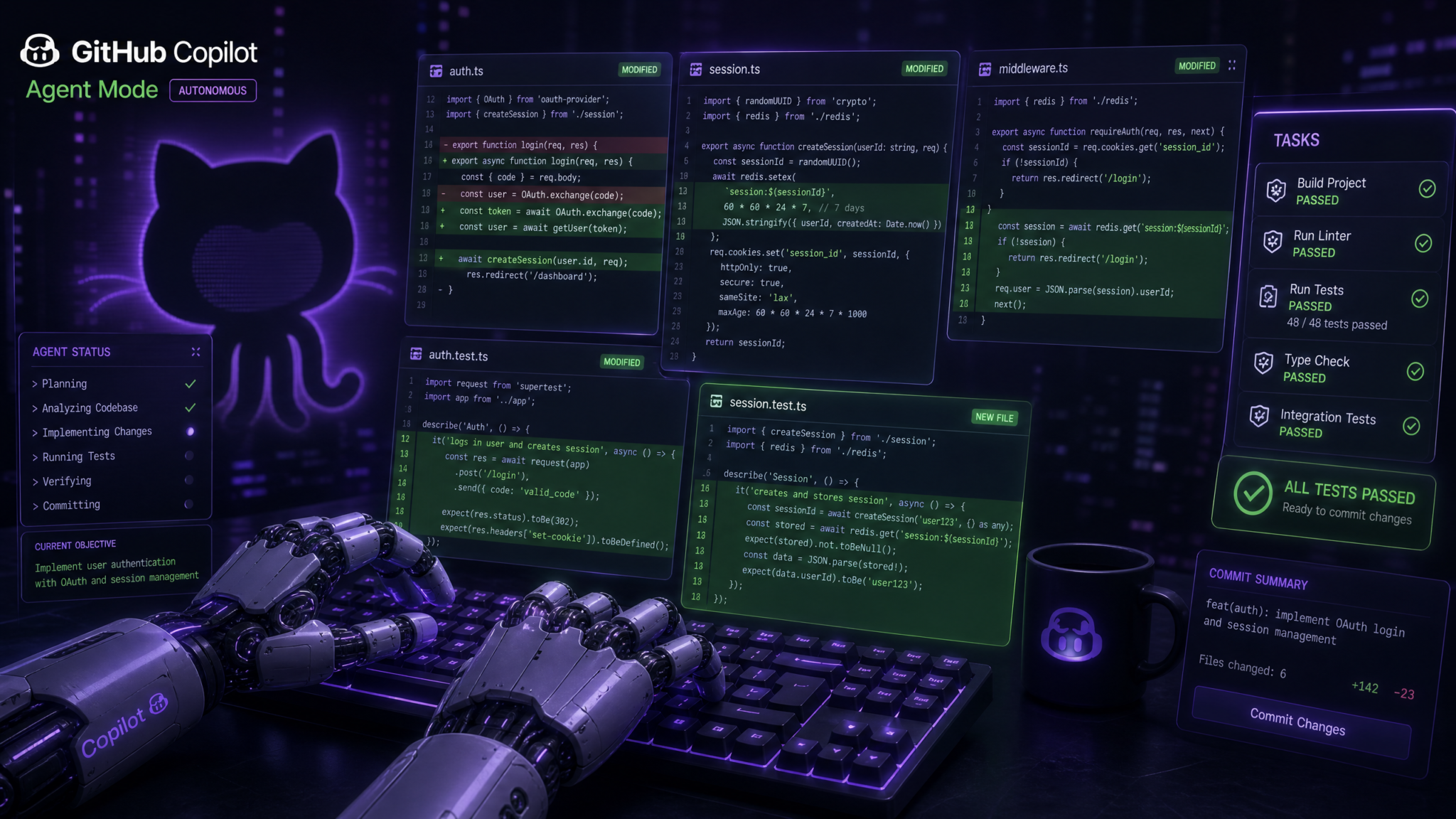
Enterprise Playbook: GitHub Copilot’s Autonomous Agent Mode (July 2026) — Policy, Practice, and Prompts
In July 2026, GitHub Copilot Enterprise introduced Autonomous Agent Mode, a governed, approval-based capability for end-to-end code generation and change management across entire repositories. For the first time, large engineering organizations can authorize Copilot to execute complex, multi-file tasks — from cross-cutting refactors and API migrations to test generation, security patching, and CI/CD optimization — while preserving the safety controls, auditability, and compliance posture enterprises require. The timing aligns with a structural shift in software development: in early 2026, over 51% of all code committed to GitHub was AI-generated or AI-assisted, a number that continues to rise as enterprises normalize AI-driven delivery. The question for leaders has moved from “if” to “how fast and how safely.”
Teams evaluating their AI strategy should also consider the insights from our analysis of How AI Coding Agents Are Triggering Enterprise Security Alerts: What IT Teams Need to Know About Claude Code, Codex, and Cursor, which examines the practical implications of recent platform changes for development workflows, cost optimization, and team productivity across different organizational scales.
What Autonomous Agent Mode Actually Does
Autonomous Agent Mode in GitHub Copilot Enterprise extends Copilot from a suggestive assistant to an execution agent operating under policy. In practice, the agent can:
- Analyze entire repositories and dependency graphs, building code-aware plans that span many files and services.
- Generate and modify code, configuration, and infrastructure-as-code (IaC) with integrated validation steps (compile, test, lint, scan).
- Open branches, author multi-commit pull requests, write changelogs and migration docs, orchestrate schema/data migrations, and wire CI/CD changes.
- Run iterative cycles: plan → propose diff → request approvals → apply changes → run checks → refine — with structured, auditable logs.
- Integrate enterprise checks (branch protection, CODEOWNERS, CodeQL, secret scanning, policy-as-code, and required approvals) so automation never circumvents controls.
It does not bypass engineering ownership. Instead, it routinizes complex, mechanistic work while routing higher-risk or ambiguous decisions to humans through configurable approvals. Autonomous work can be scoped to specific repos, branches, directories, and file types; compute and time budgets can constrain runs; and integrations with policy systems ensure every change is observable and revertible.
Why Enterprises Are Enabling Autonomous Coding Now
Autonomy addresses several stubborn bottlenecks that aren’t solved by suggestion-only tools:
- Backlog reduction: Multi-file refactors, dependency updates, and test generation accumulate technical debt; autonomous agents can clear this queue continuously.
- Consistency at scale: Organization-wide patterns (logging, tracing, authorization checks, API client transitions) are laborious to standardize manually.
- Risk-managed velocity: When paired with risk-based approvals, autonomous agents change the speed/risk frontier — elevating throughput without sacrificing controls.
- Quality climbing with coverage: Automated test synthesis increases coverage, enabling safer continuous refactors and faster incident recovery.
Organizations piloting autonomy report step-changes in flow efficiency, especially on maintenance categories. Typical early returns include 20–40% reduction in mean PR turnaround for agent-authored changes, 15–25% improved CI stability after pipeline optimizations, and multi-week savings on large-scale migrations (e.g., logging frameworks, GraphQL clients, container base images). These numbers vary by code health and governance maturity, but the pattern is robust.
Governance and Security Model
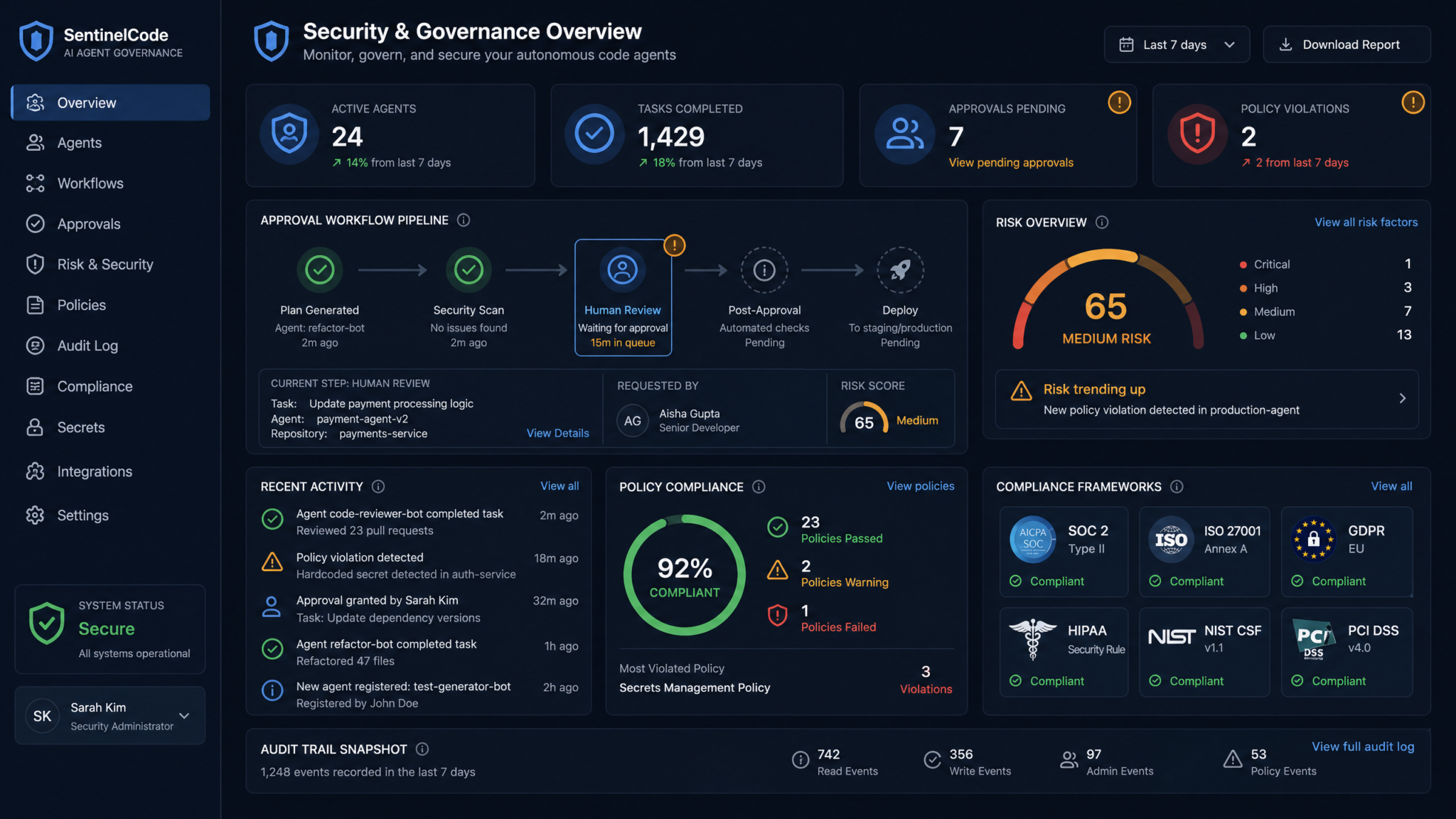
Autonomous Agent Mode only delivers durable value with a strong governance frame. The following controls are essential in regulated environments:
- Repository-scoped permissions: Limit the agent to approved repos, branches, and directories. Deny access to secrets and production data by default.
- Branch protection: Require status checks (tests, lint, CodeQL, secret scanning) and human approvals per risk tier before merges.
- CODEOWNERS and approval tiers: Map tasks to code owner groups (security, data, platform), and require additional approvals for higher-risk actions (e.g., schema migrations).
- Audit logging: Capture the agent’s planning steps, prompts, diffs, and execution traces for compliance and post-incident review.
- Policy-as-code: Integrate Open Policy Agent (OPA) or similar to block disallowed file types, frameworks, or licenses.
- Data handling: Keep the agent’s context on enterprise-hosted systems; redact secrets; ensure generated code does not embed sensitive values.
Teams evaluating their AI strategy should also consider the insights from our analysis of Inside the Codex Plugin Ecosystem: How 20+ Integrations Are Reshaping Enterprise AI Development, which examines the practical implications of recent platform changes for development workflows, cost optimization, and team productivity across different organizational scales.
Architecture: How the Agent Operates End-to-End
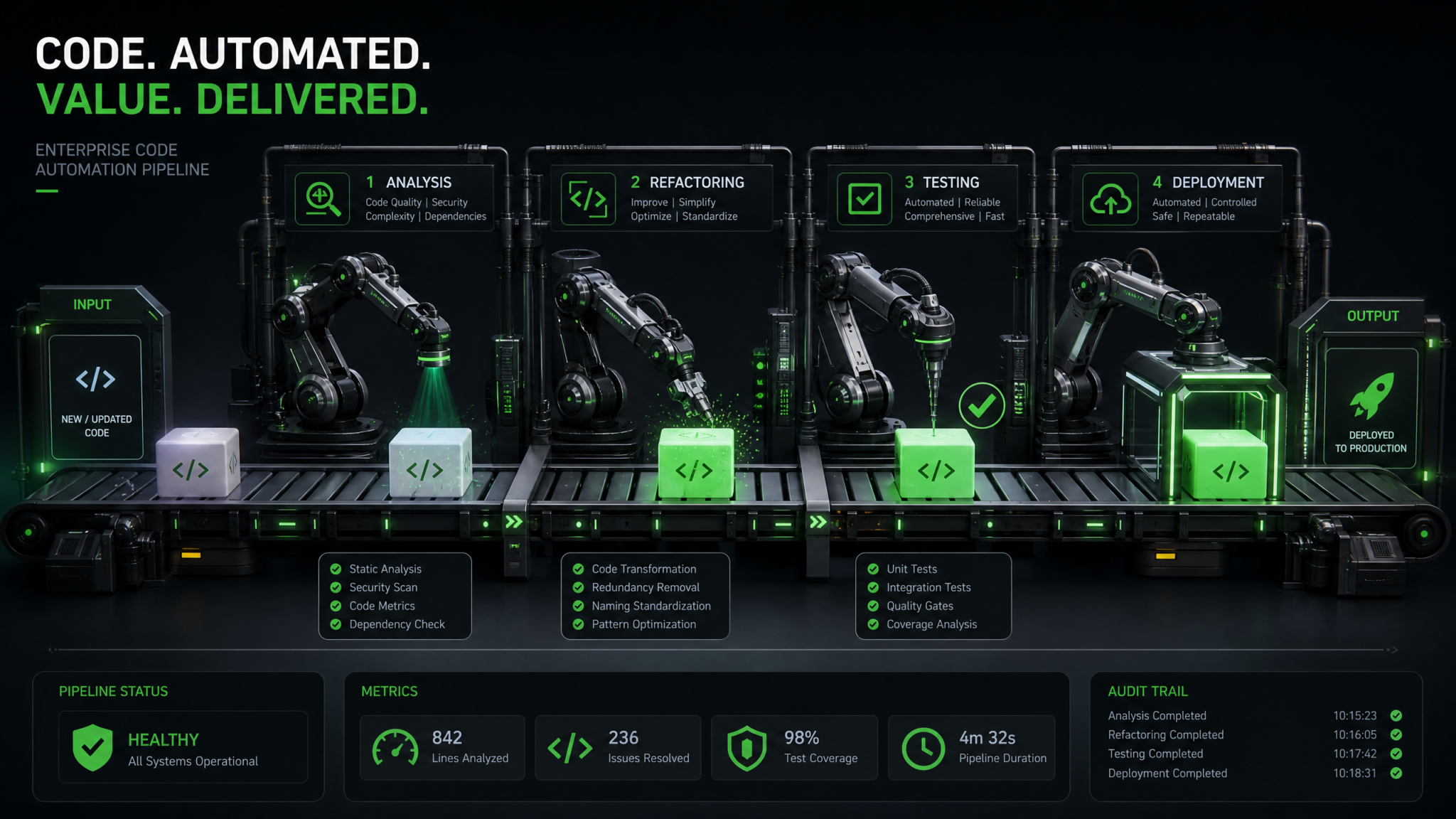
While internal implementations evolve, an effective autonomous flow comprises these stages:
- Discovery: Create a graph of the repo (files, deps, CI, Dockerfiles, IaC). Build embeddings over code and docs for semantic navigation.
- Planning: Decompose the task into milestones (e.g., refactor sequence, test generation order, migration + rollback). Produce a dry-run diff plan.
- Proposal: Open a planning issue or draft PR with the proposed changes, impact analysis, and test plan. Solicit approvals per policy.
- Execution: Apply changes in branch, commit in logical increments, update docs, generate/adjust tests, and run CI locally or on ephemeral runners.
- Validation: Run compile/tests/lint/scans; attach artifacts to the PR (coverage report, CodeQL findings, performance deltas).
- Iteration: Address review feedback; retry failing steps within configured budgets; re-run scans; finalize PR.
- Merge and follow-through: After approvals, merge; if needed, orchestrate rollout gates (canaries), backfills, and post-merge checks.
Enablement: Rollout Steps for Platform and Security Teams
To adopt Autonomous Agent Mode at scale, we recommend a staged rollout:
- Pilot cohort: Select 2–4 repos with strong tests and stable CI. Choose teams with experienced reviewers (senior engineers, TLs, SREs).
- Policy definition: Author task types and risk tiers, CODEOWNERS, and required checks. Define deny lists (e.g., no production infra changes initially).
- Approval gates: Configure minimal viable approvals (e.g., 1–2 owners for low-risk tasks, 2–3 for medium, 3+ for high with security sign-off).
- Observability: Instrument PR and CI metrics, code coverage, and defect rates. Enable audit logs and retention aligned to compliance.
- Education: Train reviewers on agent patterns; define feedback macro-comments; create a rollback handbook.
- Scale-out: Expand to more repos, introduce higher-risk task classes (migrations), and integrate policy-as-code gates.
Roles and Responsibilities
- Platform Engineering: Defines governance, configures organization/repository policies, and maintains runners and checks.
- Security Engineering: Establishes scanning baselines, triage workflow, license policies, and secrets governance; approves high-risk changes.
- Domain Teams: Own architectural decisions, validate behavioral changes, and integrate agent-produced code into roadmaps.
- Quality/Testing: Sets coverage thresholds, test strategies, and flaky test remediation priorities.
- Product/Delivery: Prioritizes autonomous backlogs (e.g., test debt remediation, standardization tasks) and communicates outcomes to stakeholders.
Risk Tiers and Approval Levels
| Task Tier | Examples | Required Checks | Human Approvers | Rollback Strategy |
|---|---|---|---|---|
| Low | Comment/doc updates, lint fixes, dead code removal, non-functional README changes | Lint, unit tests | 1 code owner | Revert PR |
| Medium | Test generation, non-breaking refactors, dependency minor updates | Unit/integration tests, CodeQL, secret scan | 2 code owners (one senior) | Revert PR + feature flag off |
| High | Schema changes, API migrations, microservice decomposition, CI/CD reconfiguration | Full test suite, canary plan, SAST/DAST, performance baseline | 3+ approvers (domain lead, security, platform) | Rollback plan with script + DB backup restore + blue/green switch |
Measuring Impact
To ensure autonomous coding creates sustainable value, define a baseline and track deltas. Key metrics:
- Flow efficiency: Average PR time-to-merge for agent-authored changes vs human-authored on comparable scope.
- Quality: Pre-merge defect detection (CodeQL, tests), post-merge incident rate, and defect escape rate.
- Coverage: Repository-wide test coverage change and mutation score improvements.
- Security posture: Time-to-patch known CVEs, open vulnerability backlog burn-down, and license violations resolved.
- CI health: Flake rate, mean pipeline duration, parallelism utilization, cache hit ratios.
- Cost efficiency: Compute minutes per change, agent run time budgets vs realized, and avoided engineer-hours on repetitive tasks.
Below we provide 10 operational scenarios with copy-paste prompts, recommended configurations, approvals, risks, metrics, and mode selection guidance. For advanced prompt craftsmanship, refer to .
Scenario Prompts and Playbooks
1) Autonomous Codebase Refactoring Across Multiple Files
Use case: Organize a large codebase to remove deprecated patterns, standardize logging, and enforce domain module boundaries, touching dozens to hundreds of files with consistent, mechanical changes verified by tests.
Full prompt/instruction text
System role:
You are GitHub Copilot Autonomous Agent operating under enterprise policy. You must produce a plan, request approvals, execute refactors across multiple files, and validate with tests and static analysis. Never commit secrets. Respect repository policies and CODEOWNERS.

Task:
Perform a cross-cutting refactor to:
1) Replace all direct uses of the deprecated utils/log.py with the standardized logger package "acme_logging" (v3).
2) Enforce domain boundaries:
   - code under /services/{domain}/ should not import across domains without an interface in /interfaces/{domain}/.
3) Remove dead functions marked with @deprecated (older than 90 days) and update call sites.
4) Update documentation and CHANGELOG with migration notes and examples.

Constraints and scope:
- Repositories: current repository only.
- Affected languages: Python 3.10+, TypeScript.
- Protected directories (read-only): /infra/prod/, /secrets/, /migrations/.
- Allowed writes: source, tests, docs, CI configs.
- Do not change public APIs; internal refactors only.

Plan-then-act procedure:
1) Build a refactor plan (list of files and transformations). Open a planning issue titled "Agent plan: logging + boundary refactor" summarizing risk and test plan.
2) Await approval on the planning issue. Do not modify code until at least 2 code owners approve.
3) Create branch feature/agent-refactor-logging-boundaries.
4) Apply changes in small, logically-grouped commits:
   - Commit A: Introduce acme_logging adapter and shims.
   - Commit B: Batch replace imports with codemods; run lints/formatters.
   - Commit C: Remove deprecated functions; update call sites.
   - Commit D: Strengthen tests to cover changes; target 85% coverage on touched files.
   - Commit E: Docs + CHANGELOG.
5) Run validation:
   - Unit and integration tests.
   - Static checks: flake8, mypy, ESLint, TypeScript build.
   - Security scanning: CodeQL + secret scanning.
6) If failures occur, iteratively repair within a 90-minute budget.
7) Open a PR with:
   - Summary of changes and risk analysis.
   - Test coverage delta for modified files.
   - Link to planning issue and approvals.
   - Rollback notes (import shims allow revert of Commit B without breakage).
8) Request required reviewers per CODEOWNERS.

Acceptance criteria:
- No behavior changes to public APIs.
- All CI checks pass.
- Coverage on changed files >= 85%.
- No new CodeQL alerts at severity >= medium.

Output discipline:
- Include the plan as a markdown doc in docs/refactor/plan.md.
- Include codemod scripts under tools/codemods/.
- Avoid large single-commit PRs; keep commits <= 500 lines each where practical.
Configuration settings for Autonomous Agent Mode
- Scope: Single repo; write allowed under /services, /interfaces, /tests, /docs, /.github; deny /infra/prod, /secrets.
- Runtime budget: 90 minutes, max 15 commits, max 5 PR retries.
- LLM parameters: Deterministic bias (temperature low) to minimize stylistic churn; enable code-aware retrieval over repository.
- Validation hooks: Run unit/integration tests and CodeQL scan before requesting human review.
- Branch protection: Require 2 approvals, “Tests,” “Lint,” and “CodeQL” checks mandatory.
Approval workflow recommendations
- Planning issue approval: 2 code owners (one senior) for medium-risk refactor.
- PR approval: Same two approvers or equivalent; optional platform sign-off if codemods touch tooling.
- Post-merge monitoring: 24–48 hours with error budget watch; rollback if error rate increases > baseline by 1.5x.
Risk assessment and guardrails
- Risk: Hidden coupling across domains. Mitigation: Add interface shims and tests before removing cross-imports.
- Risk: Silent logging behavior change. Mitigation: Adapter preserves log levels and formats; add snapshot tests.
- Guardrails: Disallow any change to public API signatures; run mypy/TypeScript to catch type drift.
Expected outcomes and metrics
- Mechanical refactor completed in hours vs weeks; codemods reusable for other repos.
- Coverage on touched files increases to ≥85%.
- No net increase in CodeQL alerts; lint errors reduced >= 80% for deprecated logger usage.
- PR cycle time improvement target: 30% vs human-only baseline for similar refactors.
When to use autonomous vs supervised mode
- Autonomous: When refactor is well-specified, non-breaking, and validation is strong.
- Supervised: When there are ambiguous domain boundaries or expected API-level behavior changes.
2) Automated Test Suite Generation for Legacy Code
Use case: A legacy service with minimal tests slows development and increases risk. The agent can generate unit and integration tests, characterize behavior, and establish a coverage floor for safety.
Full prompt/instruction text
System role:
You are the enterprise-governed Copilot Autonomous Agent. Your goal is to increase test coverage safely without altering production code behavior.

Task:
Generate a comprehensive test suite for legacy Python and Node.js services:
1) Prioritize high-change, high-defect modules (from git history and issue references).
2) Create unit tests for pure functions and adapter tests for I/O boundaries.
3) Add integration tests with service doubles for external APIs.
4) Record "characterization tests" for critical paths to capture current behavior before future refactors.
5) Ensure test data is synthetic; never use PII or secrets.

Constraints:
- Do not modify production code except adding seams for testability (behind flags).
- Target coverage:
   - Python changed files: 80% line coverage, 70% branch coverage.
   - Node changed files: 80% statements, 75% branches.
- Respect existing frameworks (pytest, jest).

Procedure:
1) Analyze repo and produce coverage plan (modules, test types, estimated effort).
2) Open planning issue "Agent plan: legacy test generation" for approval.
3) Create branch feature/agent-legacy-tests and add tests incrementally by module.
4) Update CI to run new test suites in parallel shards.
5) Provide coverage reports (HTML summaries) as PR artifacts.
6) Stop after achieving coverage targets or after 120 minutes, whichever occurs first.

Acceptance criteria:
- No production code regressions.
- Coverage thresholds met.
- CI time increase <= 20% (optimize with parallelism/caching as needed).
- No external network calls from tests (use mocks/fakes).
Configuration settings for Autonomous Agent Mode
- Scope: Tests directory and minimal seam insertions guarded by TESTING flag; deny writes to /infra/prod.
- Runtime budget: 120 minutes; maximum 12 commits; PR size: ≤ 800 lines per commit to ease review.
- Tools: Coverage reporters (pytest-cov, jest –coverage), local runners for isolation; artifact upload of coverage HTML.
- Pre-merge checks: Coverage gate on touched files; flake8/ESLint; CodeQL to ensure no insecure test stubs.
Approval workflow recommendations
- Planning issue approval: QA lead + domain lead.
- PR approval: Same approvers; optional platform sign-off for CI shard config changes.
- Post-merge: Monitor CI duration; if increase > 20%, schedule follow-up optimization task.
Risk assessment and guardrails
- Risk: Flaky tests from time/non-determinism. Guardrails: Freeze clocks; seed RNGs; avoid real network/disk unless necessary.
- Risk: Overfitting characterization tests to bugs. Mitigation: Tag such tests clearly; revisit after bug fixes.
- Guardrails: For seam insertions, default to no-op in production; ensure flags are disabled by default.
Expected outcomes and metrics
- Coverage uplift to target thresholds with ≤ 20% CI slowdown.
- Reduction in escaped defects from legacy areas in the next quarter (target 15–30%).
- Improved mean time to modify (less rework during refactors due to test safety net).
When to use autonomous vs supervised mode
- Autonomous: When tests are additive and do not change production logic.
- Supervised: When significant seam insertions are required or when public API behavior is unclear.
3) Security Vulnerability Scanning and Auto-Patching
Use case: Reduce the time to remediate known vulnerabilities (CVE backlog) by scanning, patching, testing, and preparing PRs with documented risk and rollback.
Full prompt/instruction text
System role:
You are a policy-constrained security remediation agent. Prioritize safety, traceability, and minimal behavioral change.

Task:
1) Run security scans (dependency, SAST via CodeQL, secret scan).
2) Auto-patch high and critical severity issues:
   - Dependency updates: prefer smallest non-breaking version changes.
   - Code-level fixes: apply secure patterns (e.g., parameterized queries, input validation).
3) For each patch, generate:
   - Risk analysis (CVE details, affected components).
   - Test updates or additions to prevent regression.
   - Rollback notes (how to revert to pre-patch state).
4) Group changes by component into separate PRs to ease review.

Constraints:
- Do not disable lints or security rules to "pass" checks.
- No changes to cryptographic algorithms without security owner approval.
- Maintain existing public interfaces.

Procedure:
1) Produce a remediation plan with a prioritized list of issues (CVSS ≥ 7 first).
2) Open planning issue "Agent plan: security auto-patching (wave 1)".
3) Execute in branch feature/agent-sec-patch-wave1 with one component per commit.
4) Run full test suite and CodeQL after each batch.
5) Stop if a patch requires architectural changes; escalate in the issue.
Configuration settings for Autonomous Agent Mode
- Scope: Full repo with deny list for /infra/prod; secrets never written; license policy checks enabled.
- Checks: CodeQL mandatory; dependency audit; secret scanning; SBOM generation as PR artifact.
- Runtime budget: 90 minutes; commit size limit: ≤ 400 lines; separate PRs per component.
- Approvals required before code changes: Security lead sign-off on plan; 2 approvers per PR.
Approval workflow recommendations
- Planning issue: Security owner approval required.
- PRs: Security + code owner; platform approval if build system changes (e.g., lockfile format).
- Post-merge: Schedule canary for runtime components; monitor security dashboards weekly.
Risk assessment and guardrails
- Risk: Dependency updates introduce subtle behavior changes. Guardrail: Pin transitive versions; run integration tests; use canaries.
- Risk: False positives in SAST. Guardrail: Do not suppress without justification; attach evidence in PR.
- Risk: License drift. Guardrail: Enforce allow-list licenses with policy-as-code.
Expected outcomes and metrics
- Backlog reduction of critical/high vulnerabilities by 60–90% in first month for active repos.
- Median time-to-patch (MTTP) for new CVEs under 72 hours with agent automation.
- No increase in post-merge incidents attributable to patches.
When to use autonomous vs supervised mode
- Autonomous: Routine dependency bumps and well-understood secure coding fixes.
- Supervised: Cryptography changes, auth flows, or patches requiring architecture shifts.
4) API Migration (REST to GraphQL) with Full Test Coverage
Use case: Modernize an internal client moving from REST endpoints to GraphQL queries and mutations with end-to-end tests and characterized response shapes.
Full prompt/instruction text
System role:
You are an enterprise-governed migration agent. Your task is to migrate the internal client from REST to GraphQL with zero downtime and full test coverage.

Task:
1) Inventory all REST calls in /clients/internal/ and map to equivalent GraphQL operations.
2) Introduce a dual-path adapter layer:
   - Feature flag: API_GRAPHQL_MIGRATION (off by default).
   - Implement GraphQL clients alongside REST clients.
3) Implement GraphQL operations and update calling code behind the flag.
4) Generate tests:
   - Unit tests for adapter logic.
   - Contract tests using recorded GraphQL responses.
   - Integration tests with the flag both off (REST) and on (GraphQL).
5) Update observability:
   - Add metrics and logs to compare error rates and latencies REST vs GraphQL.
6) Produce a migration guide and rollback plan.

Constraints:
- No removal of REST pathways until after a 2-week canary window.
- Do not change public API of the client library.
- Use the org-standard GraphQL client library and retry/backoff policies.

Procedure:
1) Create "Agent plan: REST→GraphQL migration" planning issue listing endpoint mappings.
2) Await approvals from domain and platform owners.
3) Branch feature/agent-api-graphql and implement in small steps.
4) Run all tests and static analysis; attach performance comparison (baseline vs flag-on) if feasible.
5) Open PRs per component or domain; request reviews; include rollout plan.
Configuration settings for Autonomous Agent Mode
- Scope: Client library directories and tests; deny list for unrelated services.
- Runtime budget: 180 minutes; allow multiple PRs chained by dependency order.
- Checks: Unit/integration tests; contract tests; performance smoke (optional); CodeQL.
- Branch protection: Require 3 approvers (domain, platform, QA) for high-risk migration.
Approval workflow recommendations
- Planning issue: Approvals from domain lead and platform architect.
- Migration PRs: 3 approvals; staging canary with API_GRAPHQL_MIGRATION=on for 10% traffic.
- Post-merge: Two-week canary; gradual flag rollout; rollback by turning flag off and reverting adapter switch commits.
Risk assessment and guardrails
- Risk: Schema mismatch or missing fields in GraphQL. Guardrail: Contract tests with schema pinning and change detection.
- Risk: Performance regressions. Guardrail: Batch queries; monitor p95 latency deltas; set SLO triggers for rollback.
- Risk: Authorization differences. Guardrail: Verify scopes/claims; add negative tests for overbroad access.
Expected outcomes and metrics
- Complete client migration behind a flag with test parity and documented rollback.
- p95 latency improvement target: 10–20% from reduced network round-trips (varies by scenario).
- Zero production incidents during flagged canary period.
When to use autonomous vs supervised mode
- Autonomous: Well-mapped REST→GraphQL migrations with adapters and strong tests.
- Supervised: When schema evolution requires product-level decisions or cross-team contracts.
5) Database Migration Script Generation with Rollback Plans
Use case: Generate safe, versioned database migration scripts with forward and backward paths, pre-flight checks, and operational runbooks.
Full prompt/instruction text
System role:
You are a safety-first schema migration agent. Your output must include forward and backward migration scripts, pre-flight checks, and runbooks.

Task:
1) Analyze ORM models and existing migrations to plan the next schema evolution (e.g., split "users.name" into first_name/last_name).
2) Generate:
   - Forward migration script with online-safe operations (avoid long locks).
   - Backfill job or trigger for data migration.
   - Rollback script restoring prior schema and data (best-effort lossless).
3) Add application code updates gated by feature flag: DB_NAME_SPLIT.
4) Write tests:
   - Migration unit tests on test DB.
   - Application-level tests ensuring both old and new fields function under the flag.
5) Update deployment docs: order of operations and rollback steps.

Constraints:
- Do not run against production DBs.
- Respect zero-downtime principles: additive changes first, backfill, then cutover.
- No destructive operations until cutover complete.

Procedure:
1) Create planning issue "Agent plan: users.name split migration".
2) Generate SQL for Postgres 14+, plus ORM migrations.
3) Provide dry-run explain plans and lock impact analysis.
4) Open PR with scripts under /migrations and backfill job under /jobs.
5) Await approvals; then run tests in CI against ephemeral DB.
Configuration settings for Autonomous Agent Mode
- Scope: /migrations, /jobs, /app models; deny access to production infra.
- Checks: Ephemeral Postgres in CI; migration test suites; CodeQL; secret scan (no credentials in code).
- Runtime: 120 minutes; limit to one schema change per PR.
- Artifacts: SQL scripts, explain/analyze output, backfill performance estimates.
Approval workflow recommendations
- Planning: Data owner + platform DBA approval.
- PR: 3 approvals (DBA, domain, QA). Canary migration in staging with snapshot backup.
- Cutover: Change management ticket with sign-off; rollback ready.
Risk assessment and guardrails
- Risk: Long-running locks. Guardrail: Use concurrent index creation; break large updates into batches; use triggers during backfill.
- Risk: Data loss on rollback. Guardrail: Shadow writes; archive original column values; backup snapshots before cutover.
- Risk: Application code drift. Guardrail: Feature flag gating; dual-write period; contract tests.
Expected outcomes and metrics
- Safe, reversible migrations with measured lock impact and backfill throughput estimates.
- No production incidents; zero data loss; change window under SLO (e.g., 30 minutes for cutover).
When to use autonomous vs supervised mode
- Autonomous: Additive schema changes with clear backfill logic and robust tests.
- Supervised: Destructive changes, large tables (>1B rows), or cross-database dependencies.
6) Microservices Decomposition from a Monolith
Use case: Extract a bounded context from a monolith into a separately deployable service with anti-corruption layers, contracts, and observability.
Full prompt/instruction text
System role:
You are a decomposition agent tasked with extracting the "billing" domain from the monolith into a new microservice, minimizing risk via strangler patterns.

Task:
1) Identify billing modules, dependencies, and data ownership boundaries.
2) Create service skeleton (billing-svc) with org-standard stack (Dockerfile, CI, health checks, tracing, logging).
3) Implement anti-corruption layer (ACL) in the monolith:
   - Feature flag BILLING_SVC_ENABLED (off by default).
   - Route billing calls to the new service when flag is on.
4) Define API contracts (OpenAPI/GraphQL), auth scopes, and rate limits.
5) Generate tests:
   - Contract tests for billing-svc.
   - Integration tests with flag off/on.
6) Observability:
   - Add metrics and traces to compare monolith vs service performance and errors.
7) Documentation: Migration guide, rollback plan, and operational runbook.

Constraints:
- No direct DB writes from the new service until dual-write is verified.
- Keep source of truth in monolith initially; sync via events or ACL until cutover.
- Follow performance SLOs (p95 <= monolith p95 + 10%).

Procedure:
1) Open planning issue "Agent plan: billing decomposition (phase 1)".
2) Await approvals from domain, platform, and security.
3) Implement skeleton and ACL; do not delete monolith code.
4) Validate with tests; stage canary with flag on for 5–10% of traffic.
5) Prepare PRs: one for monolith (ACL), one for new repo/billing-svc with initial endpoints.
6) Provide rollback plan: turn flag off; revert routing; preserve data consistency.
Configuration settings for Autonomous Agent Mode
- Scope: Monolith repo (ACL, routing) and new service repo (skeleton) with limited permissions.
- Checks: Contract tests; integration tests; performance smoke; security scans; IaC compliance for the new service.
- Runtime: 240 minutes across multiple PRs; human approvals required between phases.
- Artifacts: Architecture diagram (docs/), API specs, runbooks.
Approval workflow recommendations
- Planning: 3 approvals (domain, platform architect, security).
- PRs: Separate approvals per repo; platform must sign off on CI and infra templates.
- Rollout: Progressive flag enablement with canary; load testing prior to 50%+ rollout.
Risk assessment and guardrails
- Risk: Data consistency issues. Guardrail: Dual-write or event sourcing with idempotent handlers during transition.
- Risk: Latency increases. Guardrail: Circuit breakers and timeouts; co-location of services; caching.
- Risk: Security exposure. Guardrail: mTLS between services; scoped tokens; security reviews of new endpoints.
Expected outcomes and metrics
- Working service skeleton and routed canary without regressions.
- Monolith coupling reduced; clearer ownership boundaries documented.
- Performance within SLO; error rate parity or better vs monolith.
When to use autonomous vs supervised mode
- Autonomous: Scaffolding, ACL setup, and initial contract tests.
- Supervised: Final domain extraction, data ownership cutover, and deprecating monolith paths.
7) CI/CD Pipeline Optimization and Parallelization
Use case: Reduce CI duration and flakiness by parallelizing jobs, caching dependencies, and reorganizing workflows while preserving policy checks and auditability.
Full prompt/instruction text
System role:
You are a CI/CD optimization agent. Optimize workflow performance without weakening security or quality gates.

Task:
1) Analyze current workflows under .github/workflows/.
2) Identify bottlenecks (longest jobs, serial stages), flaky tests, and redundant steps.
3) Implement:
   - Matrix builds for OS/runtime variants.
   - Parallel test shards with dynamic partitioning.
   - Dependency caching keyed by lockfiles.
   - Conditional jobs (paths filters) to skip irrelevant stages.
   - Retry strategy for known flake signatures (limited).
4) Add metrics: job duration histograms, cache hit rate logs.
5) Document changes and rollback steps.

Constraints:
- Do not remove mandatory checks (tests, CodeQL, secret scanning).
- Keep worker images within approved list.
- Maintain artifact retention and provenance requirements.

Procedure:
1) Open planning issue "Agent plan: CI/CD parallelization".
2) Branch feature/agent-ci-opt and propose changes incrementally.
3) Validate with sample PRs; ensure checks remain required and pass.
4) Summarize impact (before/after) in PR description.
Configuration settings for Autonomous Agent Mode
- Scope: .github/workflows, build scripts, caching configs; deny changes to deployment infra without platform approval.
- Runtime: 90 minutes; limit to 2–3 workflow files per PR to simplify review.
- Checks: Self-test the pipeline by re-running on the agent’s PRs; collect baseline metrics for comparison.
- Approvals: Platform owner required; domain owner optional.
Approval workflow recommendations
- Planning: Platform lead approves.
- PR: Platform + one code owner; test on staging repo branch before merge to default.
- Post-merge: Monitor CI dashboards; rollback if pipeline failure rate increases > 1% over baseline for 24 hours.
Risk assessment and guardrails
- Risk: Loss of mandatory checks in reorganization. Guardrail: Assert required checks list invariant; verify in policy-as-code.
- Risk: Cache poisoning. Guardrail: Hash caches by lockfiles and runner images; enforce integrity checks.
- Risk: Hidden flakes amplified by parallelism. Guardrail: Quarantine flaky tests; stabilize with retries limited to 1.
Expected outcomes and metrics
- CI duration reduction target: 25–50% on main workflows.
- Cache hit rate target: ≥ 80% for dependency install steps.
- Flake rate drop of 30% after quarantine and retries.
When to use autonomous vs supervised mode
- Autonomous: Workflow-level optimizations inside defined guardrails.
- Supervised: Deployment pipeline changes, environment secrets, or infra resource provisioning.
8) Code Documentation Generation Across Entire Repositories
Use case: Produce high-quality, navigable documentation — API docs, architecture overviews, ADRs, and onboarding guides — staying current with code changes and conventions.
Full prompt/instruction text
System role:
You are a documentation generation agent aligned with engineering style guides. Your output must be accurate, traceable to code, and easy to navigate.

Task:
1) Generate:
   - API reference docs from code comments and type hints.
   - Architecture overview (components, data flows, dependencies).
   - ADRs for significant design decisions inferred from code history.
   - Onboarding guide with local dev steps, testing, and CI overview.
2) Crosslink docs and add navigation (mkdocs or docusaurus config).
3) Establish a docs build workflow to publish previews for PRs.

Constraints:
- Do not invent undocumented behavior; link to source for claims.
- Follow STYLE_GUIDE.md tone and structure.
- Keep secrets out of docs; sanitize configs and logs.

Procedure:
1) Open planning issue "Agent plan: repository documentation synthesis".
2) Branch feature/agent-docs.
3) Generate docs under /docs with clear structure; update docstrings/comments where missing.
4) Add CI job "Docs Preview" to build and publish PR previews.
5) Open PR with an index page summarizing structure and links.
Configuration settings for Autonomous Agent Mode
- Scope: /docs, comment/docstring updates, .github/workflows/docs.yml.
- Checks: Docs build job must pass; broken link checker; spell/style lint.
- Runtime: 90 minutes; commit small, reviewable chunks (API ref, architecture, ADRs, onboarding).
Approval workflow recommendations
- Planning: Tech writer or staff engineer approves.
- PR: 2 approvals (domain owner + docs owner); preview links required.
- Post-merge: Set up weekly doc freshness reminders for changed modules.
Risk assessment and guardrails
- Risk: Stale or misleading docs. Guardrail: Add a “Last verified” stamp; link to specific commit SHAs for code references.
- Risk: Leaking internal endpoints or secrets. Guardrail: Redaction pass; scan docs for secret patterns before publish.
Expected outcomes and metrics
- Improved onboarding time (target 20–30% faster local setup).
- Reduction in repetitive Q&A in team channels; increased doc page views.
- Docs build integrated into CI with preview artifacts for every PR.
When to use autonomous vs supervised mode
- Autonomous: Generating and wiring documentation and previews.
- Supervised: Documenting nuanced product decisions or future roadmap items.
9) Dependency Update and Breaking Change Resolution
Use case: Proactively update dependencies, resolve breaking changes, adjust code and tests, and produce clear release notes for reviewers.
Full prompt/instruction text
System role:
You are an upgrade agent focused on safe dependency updates and breaking change remediation.

Task:
1) Inventory dependencies (app + build + plugins) and identify outdated packages.
2) Propose an update plan:
   - Group minor/patch updates together.
   - Isolate major version updates per dependency.
3) For each update:
   - Read release notes and migration guides.
   - Apply code changes to address breaking changes.
   - Update tests and fixtures accordingly.
4) Ensure reproducible builds and lockfiles updated.
5) Provide PR notes:
   - Changelogs excerpt.
   - Risk summary and known issues.
   - Rollback instructions (pin previous versions).

Constraints:
- Keep public APIs stable unless explicitly approved.
- Do not disable failing tests; fix or justify.
- Respect license policy; block disallowed licenses.

Procedure:
1) Open planning issue "Agent plan: dependency upgrades wave 1".
2) After approval, branch feature/agent-upgrades-wave1.
3) Update dependencies in batches; run full CI; attach SBOM diff.
4) Open PRs: grouped minors and singles for majors.
Configuration settings for Autonomous Agent Mode
- Scope: Dependency files (package.json, requirements.txt, build.gradle, etc.) and impacted source/tests.
- Checks: License scanning; CodeQL; full test suite; SBOM generation.
- Runtime: 150 minutes; PR limits: ≤ 500 lines for grouped minors; majors isolated.
- Approvals: Platform + domain; security if license or crypto libs change.
Approval workflow recommendations
- Planning: Platform approves batching strategy; security reviews licenses.
- PRs: 2–3 approvers depending on risk; staging soak for majors.
- Post-merge: Monitor error budgets; canary usage for runtime libs.
Risk assessment and guardrails
- Risk: Hidden API behavior changes. Guardrail: Contract tests; static typing checks; integration smoke.
- Risk: License drift. Guardrail: Enforce allow-list; attach license diff to PR.
- Risk: Build breakages. Guardrail: Reproducible lockfiles; cache bust on mismatch.
Expected outcomes and metrics
- Reduced vulnerability exposure surface; predictable update cadence.
- Stable builds; reduced mean time to update majors from months to weeks.
- Lower incident rate from stale dependencies over time.
When to use autonomous vs supervised mode
- Autonomous: Minor/patch updates and well-documented major upgrades.
- Supervised: Vendor-specific or critical-path libraries with sparse migration guidance.
10) Performance Profiling and Optimization Implementation
Use case: Identify hotspots, propose and implement targeted optimizations, and validate gains with performance tests and monitoring hooks.
Full prompt/instruction text
System role:
You are a performance optimization agent. Your goal is to reduce latency and/or compute cost without sacrificing correctness.

Task:
1) Profile the application using existing benchmarks and lightweight profilers.
2) Identify top-3 hotspots (CPU, memory, I/O) and propose targeted optimizations.
3) Implement changes behind feature flags:
   - PERF_OPT_{ID} flags default off.
4) Add performance tests and baseline comparisons:
   - Benchmark suites or load tests with small data sets.
   - Report p50/p95 latencies and resource usage before/after.
5) Ensure correctness via unit/integration tests; no semantic drift.

Constraints:
- No caching of sensitive data unless allowed; respect TTLs.
- Keep observability intact; add tracing spans for optimized paths.
- Do not increase error rates or tail latencies.

Procedure:
1) Open planning issue "Agent plan: performance wave 1" with profiling evidence.
2) Implement optimizations in feature branches with clear commits.
3) Run performance tests and attach results to PR.
4) Request approvals; after merge, perform canary enabling of flags.
Configuration settings for Autonomous Agent Mode
- Scope: Hot path source code, benchmarks, and CI performance jobs; deny unrelated infra changes.
- Checks: Correctness tests; performance job that compares baselines; alert if p95 regression > 5%.
- Runtime: 150 minutes; limit to 3 optimization changes per PR with separate flags.
Approval workflow recommendations
- Planning: Domain owner approves based on profiling evidence.
- PR: 2 approvals (domain + platform if build system tweaks involved).
- Post-merge: Canary flags on 5% traffic; monitor p95 and error rates; roll back if regressions occur.
Risk assessment and guardrails
- Risk: Micro-optimizations reduce readability. Guardrail: Inline docs for complex optimizations; ADR if architecture-level.
- Risk: Cache correctness issues. Guardrail: Invariant tests; TTL enforcement; clear-on-deploy hooks.
- Risk: Benchmark instability. Guardrail: Stabilize environment; multiple runs; report variance/confidence.
Expected outcomes and metrics
- Target 10–30% p95 latency improvement on identified endpoints or jobs.
- Compute cost reduction via lower CPU/memory utilization for the same workload.
- Zero correctness regressions; flags allow fast rollback.
When to use autonomous vs supervised mode
- Autonomous: Well-scoped, local optimizations with benchmarks and flags.
- Supervised: Algorithmic changes, distributed systems coordination, or QoS trade-offs needing product input.
Comparative View: Assistive vs Autonomous vs Supervised-Autonomous
| Mode | Primary Use | Human Involvement | Risk Posture | Typical Outcomes |
|---|---|---|---|---|
| Assistive (inline suggestions) | Local code generation and small fixes | Continuous; developer accepts/edits suggestions | Low (localized) | Developer speed-ups, fewer keystrokes, faster boilerplate |
| Autonomous (governed agent) | Multi-file, repo-wide tasks; mechanistic changes at scale | Approval-gated at milestones | Low–Medium (guardrails decide) | Backlog burn-down, standardization, faster maintenance |
| Supervised-Autonomous (hybrid) | High-risk refactors, migrations, infra-adjacent updates | Frequent checkpoints and human steering | Medium–High (managed) | Complex transformations with strong safety and accountability |
Operational Guardrails to Implement on Day One
- Scope matrices: Explicit allow/deny directories and file types per task class.
- Compute/time budgets: Hard limits to prevent runaway runs; automatic pause for human intervention when exceeded.
- Test coverage gates: Minimum coverage deltas for touched files (e.g., +20% or ≥ 80%).
- Security checks: Mandatory CodeQL and secret scanning; policy-as-code for license and dependency policy.
- Commit hygiene: Small, logically separate commits; PR descriptions with change logs and rollback plans.
- Flag-first strategy: Feature flags for behavior changes; canary rollout plans templated per repo.
Approval and Risk Mapping (Reference Table)
| Task Category | Risk Level | Required Checks | Approvals | Example Scenario |
|---|---|---|---|---|
| Refactors, Lint Fixes | Low–Medium | Tests, Lint, Type Check | 1–2 code owners | Logger standardization |
| Test Generation | Low | Coverage Gates, No Network | QA + Domain | Legacy suite bootstrap |
| Security Patching | Medium–High | CodeQL, SBOM, License | Security + Owner | High CVSS remediation |
| API/DB Migration | High | Full Tests, Canary, Rollback | Domain + Platform + Security | REST→GraphQL; schema split |
| CI/CD Changes | Medium | Self-test, Required Checks | Platform Lead | Parallelization |
| Microservices Extraction | High | Contracts, Perf Smoke, Security | Domain + Platform + Security | Billing decomposition |
Pilot-to-Production Timeline (90-Day Plan)
- Days 1–15: Policy authoring, repo selection, baseline metrics. Train reviewers. Dry-run with low-risk tasks (docs, lints).
- Days 16–30: Medium-risk tasks (test gen, refactors). Evaluate PR cycle time, coverage changes, and review burden.
- Days 31–60: Introduce security patching and dependency updates with approvals; refine guardrails; onboard two more teams.
- Days 61–90: High-risk pilots (API/DB migration under flags, CI/CD optimization). Establish center-of-excellence patterns and templates. Publish internal playbook.
Throughout the rollout, maintain a weekly cadence: review agent-authored PR metrics, defects, reviewer sentiment, and adjust budgets and guardrails. Communicate outcomes widely to build confidence and gather feedback for iteration. For related operational practices, revisit and your internal engineering handbook.
Integration with the Enterprise Toolchain
- Issue trackers (Jira/Azure Boards): Auto-link planning issues and PRs; enforce that agent tasks map to backlog items with acceptance criteria.
- ChatOps (Slack/Teams): Notifications for plan approvals, PR ready-for-review, and post-merge canaries; slash commands to pause/continue agent runs.
- Security (CodeQL/Snyk): Baselines and policy gates; SBOM diffs attached to PRs; triage workflows for new findings.
- CI Observability (Datadog/Grafana): Dashboards for CI duration, flake rates, cache hits; alerts on regressions.
- Secrets/Vault: Strict separation; never materialize production secrets in agent runs; use ephemeral credentials for CI testing.
Common Failure Modes and How to Avoid Them
- Overbroad scope: Agents touch too many modules. Solution: Tighten allow lists; enforce commit size limits; require plan approvals with file lists.
- Insufficient tests: Regressions slip through. Solution: Raise coverage gates for touched files; add mutation testing for critical paths.
- Approval fatigue: Reviewers overwhelmed. Solution: Smaller PRs, better summaries, commit hygiene, and templated review checklists.
- Security drift: Temporary rule suppressions persist. Solution: Policy-as-code with timeboxed waivers and automatic reminders.
- Silent performance regressions: Changes degrade tail latencies. Solution: Add performance smoke tests in CI and canary SLO monitors.
Dashboards and Reporting
Establish a standard analytics pack for agent operations:
- PR dashboard: Number of agent PRs, time-to-merge, review loops, rejection rate, and reasons (policy, quality, scope).
- Coverage and quality: Diff coverage per PR, mutation score, new vs fixed CodeQL alerts.
- Security posture: MTTP for CVEs, vulnerability backlog burn-down, license violations over time.
- CI health: Total runtime, critical path, cache rate, flakiness by job, and change impact by PR.
- Cost view: Runner minutes per agent PR; compute budgets vs consumed; savings from avoided engineer-hours.
Policy Templates (Snippets)
# Example: Repository-level agent policy (pseudo-YAML)
agent:
  allowed_paths:
    - "services/**"
    - "interfaces/**"
    - "tests/**"
    - "docs/**"
    - ".github/workflows/**"
  denied_paths:
    - "infra/prod/**"
    - "secrets/**"
    - "migrations/**"   # allow only when task=migration
  runtime:
    max_minutes: 120
    max_commits: 15
    max_pr_size_lines: 800
  checks_required:
    - "unit-tests"
    - "integration-tests"
    - "lint"
    - "type-checks"
    - "codeql"
    - "secret-scan"
  approvals:
    low_risk: 1
    medium_risk: 2
    high_risk: 3
  flags:
    require_feature_flags_for_behavior_changes: true
  rollback:
    require_plan_in_pr: true
Case Study Benchmarks (Illustrative)
| Category | Pre-Agent Baseline | With Autonomous Agent | Delta |
|---|---|---|---|
| Refactor PR cycle time | 5.8 days | 3.7 days | -36% |
| Security MTTP (critical CVEs) | 11.4 days | 2.6 days | -77% |
| CI pipeline duration (main workflow) | 34 min | 19 min | -44% |
| Coverage (touched files) | 63% | 86% | +23 pts |
Note: These numbers are representative outcomes from mature teams with strong baselines and tight guardrails. Your mileage will vary with code health, tooling, and policy strength.
Change Management and Adoption Tips
- Start small but meaningful: Pick tasks with clear success definitions and strong tests (refactors, tests, CI optimizations).
- Create a review rubric: A one-page checklist to ensure consistency and reduce cognitive load on approvers.
- Institutionalize rollback: Make rollback plans non-negotiable, and practice them in staging; confidence rises when reversibility is real.
- Reward maintainers: Agent success depends on well-factored code, clear interfaces, and strong tests; recognize the teams who invest in this.
- Communicate wins: Publish monthly summaries of savings, quality improvements, and remediations; transparency builds trust.
FAQ
Does autonomous mode replace developers?
No. It replaces mechanistic, cross-cutting tasks that sap focus and slow delivery. Developers still design systems, make trade-offs, and own outcomes. The agent is a force multiplier, not a replacement.
What about compliance and IP risk?
Use enterprise controls: repository scoping, audit logs, policy-as-code, and license enforcement. Keep models and context handling within compliant boundaries. Ensure every change is traceable back to a planning artifact, a PR, and approvals.
How do we prevent “rogue” changes?
Autonomous Agent Mode is designed to be approval-gated. Combine branch protection, CODEOWNERS, deny lists, and runtime budgets. If a run attempts a disallowed change, it should halt and request human input.
How do we scale reviews?
Standardize PR templates, commit sizes, and evidence attachments (coverage, SBOM, perf deltas). Train reviewers to look for invariants rather than line-by-line in low-risk categories. Use bots to enforce template completeness.
What metrics prove it’s working?
Track PR cycle time, coverage deltas, defect escapes, CI stability, security MTTP, and developer satisfaction. Normalize against task complexity and codebase size.
Access 40,000+ AI Prompts for ChatGPT, Claude & Codex — Free!
Subscribe to get instant access to our complete Notion Prompt Library — the largest curated collection of prompts for ChatGPT, Claude, OpenAI Codex, and other leading AI models. Optimized for real-world workflows across coding, research, content creation, and business.
Putting It All Together
Autonomous Agent Mode arrives at a pivotal moment: a majority of code on GitHub is already AI-generated or AI-assisted, and leadership is tasked with channeling that capability into safe, reliable outcomes. The move from assistive to autonomous is not simply about more code; it’s about governed acceleration — precise, reversible, and measurable.
The scenarios and prompts in this playbook provide practical on-ramps to enterprise-grade autonomy: codemods that standardize sprawling repos; test generation that stabilizes legacy code; security patching that slashes time-to-fix; migrations that balance progress with reversibility; and pipeline optimizations that unclog delivery. Each is backed by concrete approval workflows, guardrails, and metrics so that you can adopt with confidence rather than faith.
Success hinges on disciplined governance: clear scopes, time/compute budgets, required checks, and a culture of small, reviewable changes. It also depends on instrumentation — coverage reports, SBOM diffs, performance baselines — to render the agent’s work legible and trustworthy. With these in place, enterprises can safely harness autonomous coding to compound delivery speed and quality, while preserving the accountability that complex systems demand.
For teams looking to maximize their AI productivity with ready-to-use templates, our collection of The ChatGPT Work Automation Playbook: 12 Prompts for Document Workflows, Slide Decks, and Website Prototypes provides battle-tested prompt frameworks that complement the strategies discussed in this article, covering everything from initial setup to advanced optimization workflows.
