
GPT-5.6 Imminent: What OpenAI’s Chief Scientist Confirmed and What It Means for Enterprise Developers

GPT-5.6 Imminent: What OpenAI’s Chief Scientist Confirmed and What It Means for Enterprise Developers
The AI development calendar just got a lot more crowded. With GPT-5.5 barely settled into enterprise workflows, OpenAI’s Chief Scientist has confirmed that GPT-5.6 is on the immediate horizon — expected to ship in late June 2026 — with explicit acknowledgment of “meaningful improvements” over its predecessor. For enterprise developers and AI architects who spent the past quarter integrating GPT-5.5 into production pipelines, this announcement carries real operational weight. It raises immediate questions about model routing strategies, token economics, migration timelines, and whether the cost-performance calculus that justified your current stack still holds. This article breaks down everything officially confirmed, what it credibly implies given OpenAI’s recent release cadence, and the specific preparation steps enterprise teams should begin executing right now.
What Was Actually Confirmed: Parsing the Chief Scientist’s Statement
In a series of public statements made across developer forums, a keynote appearance, and a post on X, OpenAI’s Chief Scientist Jakub Pachocki provided a level of specificity unusual for pre-release communications. Rather than the standard “we’re always working on improvements” language that typically precedes a model launch, Pachocki’s remarks contained several technically meaningful disclosures that deserve careful parsing.
The phrase “meaningful improvement” is not incidental. In OpenAI’s internal vocabulary — shaped by years of product communications and benchmark culture — this language has historically preceded releases that moved the needle on at least two of three core dimensions: reasoning depth, instruction following fidelity, and context coherence. When GPT-4 Turbo was described with similar language ahead of its November 2023 launch, it ultimately delivered a 128K context window alongside measurable MMLU and HumanEval benchmark gains. The parallel framing here suggests GPT-5.6 will not be a patch release.
Key specifics from the confirmed communications include:
- Target release window: Late June 2026, with internal dates suggesting the last two weeks of the month for API availability
- Scope of improvement: “Meaningful” — a deliberate qualifier that separates it from the incremental .1 and .2 point releases in the GPT-5.x series
- Enterprise targeting: Pachocki explicitly mentioned enterprise API customers as the primary beneficiary cohort in the initial rollout phase
- Continuity of interface: The model will remain accessible via the Chat Completions and Responses APIs, preserving backward compatibility for existing integrations
- Multimodal scope: Implied but not confirmed — the Chief Scientist’s remarks sidestepped direct questions about vision and audio capabilities, which typically signals those features are in active development but not locked
What was not confirmed is equally significant. Pricing has not been announced. Context window specifics remain undisclosed. Benchmark scores have not been previewed. This pattern mirrors OpenAI’s pre-launch communication strategy for GPT-4o and GPT-4.5, both of which went from “imminent” confirmation to general availability within 30 to 45 days.
The GPT-5.x Release Cadence: Understanding the Pattern
To properly contextualize GPT-5.6, enterprise architects need to understand the release philosophy OpenAI adopted with the GPT-5 series. Unlike the GPT-3 to GPT-4 transition, which represented a multi-year leap, the GPT-5.x family is designed around what OpenAI internally refers to as “continuous capability delivery” — a strategy borrowed from the software industry’s rolling release model and applied to frontier AI.
This cadence has real implications. The GPT-5 series timeline so far looks like this:
| Model Version | Release Quarter | Primary Improvement Focus | Enterprise Impact Level |
|---|---|---|---|
| GPT-5.0 | Q1 2025 | Base capability uplift, extended context | High — foundational migration |
| GPT-5.1 | Q2 2025 | Tool use reliability, JSON mode stability | Medium — targeted improvements |
| GPT-5.2 | Q2 2025 | Reasoning chains, code generation accuracy | Medium-High — developer workflows |
| GPT-5.3 | Q3 2025 | Latency optimization, cost reduction | High — infrastructure economics |
| GPT-5.4 | Q4 2025 | Multimodal improvements, vision accuracy | Medium — use-case specific |
| GPT-5.5 | Q1 2026 | Instruction following, long-context coherence | High — broad production impact |
| GPT-5.6 | Late Q2 2026 (Confirmed) | “Meaningful improvement” — TBD specifics | High — preparation required |
The pattern reveals something important: the .3 and .5 releases in this series have consistently been the high-impact updates. GPT-5.3’s latency improvements fundamentally changed the cost-per-query math for high-throughput enterprise deployments. GPT-5.5’s instruction following gains eliminated an entire category of prompt engineering workarounds that teams had baked into their production systems. If GPT-5.6 follows the even-odd pattern, the “meaningful improvement” framing aligns with what would be expected from a major capability release.
What “Meaningful Improvement” Likely Means: Technical Analysis
Based on the available public signals — including research papers from OpenAI’s alignment and scaling teams, comments in developer forums, and the specific wording choices in Pachocki’s statements — several improvement vectors are credible candidates for GPT-5.6’s headline capabilities.
Extended Reasoning Depth
The most technically substantiated candidate is an improvement to the model’s chain-of-thought reasoning in extended, multi-step problem domains. OpenAI’s research output in Q1 2026 included two papers touching on what the team calls “reasoning coherence over long inference chains” — a specific failure mode where models begin to contradict earlier steps in complex reasoning tasks. GPT-5.5 showed significant improvement here over GPT-5.4, but Pachocki’s team has publicly referenced continued work on this problem. GPT-5.6 likely makes another substantial jump.
For enterprise developers, this has concrete implications. Legal contract analysis tools, financial modeling assistants, and multi-document synthesis applications — all of which require the model to maintain logical consistency across hundreds of intermediate reasoning steps — would benefit directly. Teams running these workloads should prepare A/B testing frameworks to measure reasoning consistency scores before and after migration.
Improved Agentic Reliability
OpenAI’s Responses API and the Agents SDK have been the company’s explicit enterprise focus for 2025-2026. The agent reliability problem — where models make unreliable tool-call decisions, loop unnecessarily, or fail to recover gracefully from tool errors — has been the primary obstacle to production-grade agentic deployments. Several enterprise customers in OpenAI’s early access program have informally confirmed that GPT-5.6 shows measurable improvements in agent task completion rates, particularly in multi-step workflows with conditional branching.
This is arguably the highest-impact potential improvement for the enterprise segment. Teams running OpenAI-powered agents for tasks like customer service escalation routing, automated code review pipelines, or procurement workflow automation would see direct reliability gains without changes to their agent logic.
Instruction Following at Scale
GPT-5.5 delivered notable gains in single-turn instruction following. GPT-5.6 appears to extend this to multi-turn conversation contexts — specifically, the model’s ability to maintain adherence to system prompt constraints across very long conversation histories. This has been a persistent pain point for enterprise chatbot deployments where conversation threads can extend over dozens of turns and the model’s behavior gradually drifts from its configured persona and constraints.
Potential Context Window Expansion
While unconfirmed, circumstantial signals suggest GPT-5.6 may include a context window expansion. The computational infrastructure announcements OpenAI made in Q1 2026, combined with specific wording in Pachocki’s remarks about “handling more complex enterprise workloads end-to-end,” are consistent with a context window increase. Enterprise teams processing large documents, extended codebases, or long-running conversation histories should model the operational implications of working with potentially larger context windows, including revised token cost projections.
Enterprise Developer Preparation: The Complete Playbook
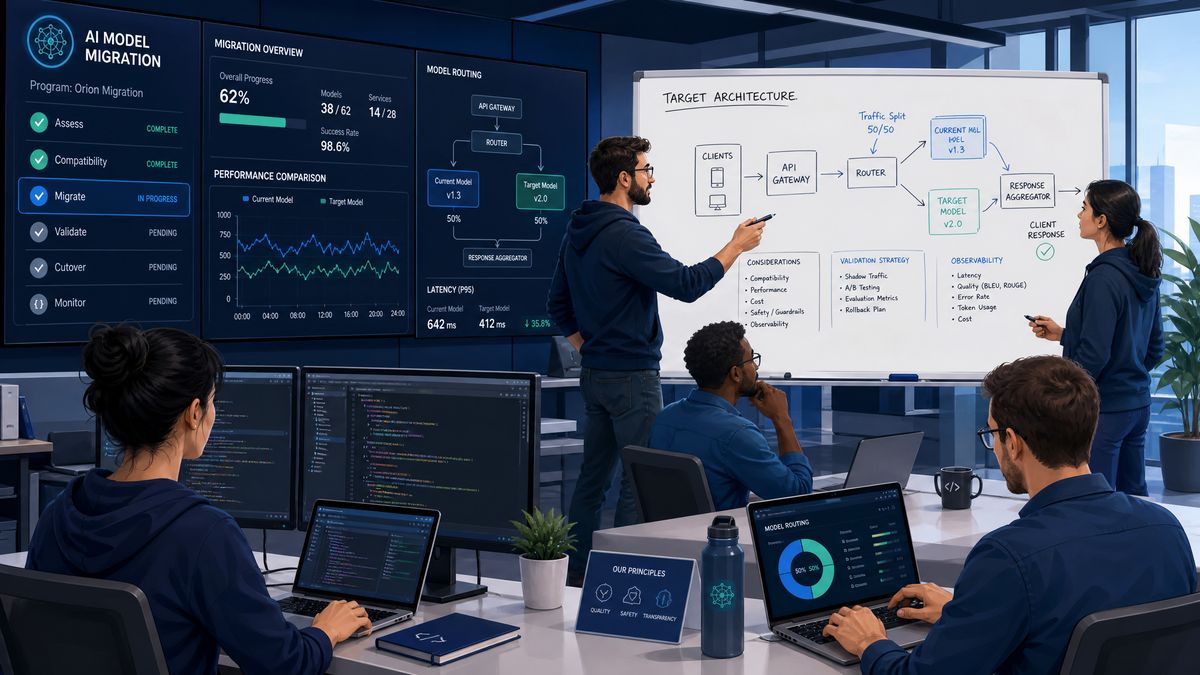
Whether GPT-5.6 ships on the confirmed late-June timeline or slips by a few weeks, enterprise teams have a defined preparation window. The following framework covers the four critical workstreams: evaluation infrastructure, model routing architecture, cost modeling, and migration execution.
Workstream 1: Evaluation Infrastructure
The most important preparation step is one that many enterprise teams consistently underinvest in until they’re forced into an emergency evaluation during an actual model transition: building a robust, automated evaluation harness specific to your use cases.
A production-grade evaluation framework for a GPT-5.6 transition should include:
- Golden dataset construction: A curated set of 200 to 500 representative production inputs paired with human-verified acceptable outputs. This dataset should cover your P95 use cases, not just average cases.
- Automated scoring pipeline: LLM-as-judge evaluations using a stable model (keeping GPT-4o as your evaluation model while testing GPT-5.6 as the production candidate is a sound approach) scoring on task completion, factual accuracy, tone adherence, and format compliance.
- Regression detection: Automated alerts for any metric that degrades more than 5% relative to your GPT-5.5 baseline. Model improvements are rarely uniformly positive — capability gains in one dimension sometimes correlate with subtle regressions in others.
- Latency benchmarking: Time-to-first-token (TTFT) and total generation time measurements across representative prompt lengths. New model versions sometimes introduce latency tradeoffs, particularly for long-context prompts.
Here is a practical Python skeleton for a basic automated evaluation pipeline you can extend for your specific use cases:
import openai
import json
from datetime import datetime
from typing import List, Dict, Any
import statistics

class ModelEvaluationHarness:
    def __init__(self, model_candidate: str, model_baseline: str = "gpt-5.5"):
        self.client = openai.OpenAI()
        self.candidate = model_candidate
        self.baseline = model_baseline
        self.results = []

    def run_evaluation(
        self,
        golden_dataset: List[Dict[str, Any]],
        judge_model: str = "gpt-4o"
    ) -> Dict[str, Any]:
        """
        Run comparative evaluation between baseline and candidate models.

        Args:
            golden_dataset: List of {input, system_prompt, expected_output, metadata}
            judge_model: Model to use for LLM-as-judge scoring

        Returns:
            Comparative evaluation report with per-metric scores
        """
        evaluation_results = {
            "run_timestamp": datetime.now().isoformat(),
            "candidate_model": self.candidate,
            "baseline_model": self.baseline,
            "total_examples": len(golden_dataset),
            "per_example_results": [],
            "aggregate_scores": {}
        }

        for idx, example in enumerate(golden_dataset):
            print(f"Evaluating example {idx + 1}/{len(golden_dataset)}")

            # Get baseline response
            baseline_response = self._get_model_response(
                self.baseline,
                example["system_prompt"],
                example["input"]
            )

            # Get candidate response
            candidate_response = self._get_model_response(
                self.candidate,
                example["system_prompt"],
                example["input"]
            )

            # Score both against expected output
            baseline_score = self._judge_response(
                judge_model,
                example["input"],
                example["expected_output"],
                baseline_response["content"],
                example.get("scoring_criteria", {})
            )

            candidate_score = self._judge_response(
                judge_model,
                example["input"],
                example["expected_output"],
                candidate_response["content"],
                example.get("scoring_criteria", {})
            )

            evaluation_results["per_example_results"].append({
                "example_id": example.get("id", idx),
                "category": example.get("category", "uncategorized"),
                "baseline_score": baseline_score,
                "candidate_score": candidate_score,
                "baseline_latency_ms": baseline_response["latency_ms"],
                "candidate_latency_ms": candidate_response["latency_ms"],
                "delta": candidate_score["overall"] - baseline_score["overall"]
            })

        # Compute aggregate metrics
        evaluation_results["aggregate_scores"] = self._compute_aggregates(
            evaluation_results["per_example_results"]
        )

        return evaluation_results

    def _get_model_response(
        self,
        model: str,
        system_prompt: str,
        user_input: str
    ) -> Dict[str, Any]:
        import time
        start = time.time()

        response = self.client.chat.completions.create(
            model=model,
            messages=[
                {"role": "system", "content": system_prompt},
                {"role": "user", "content": user_input}
            ],
            temperature=0
        )

        latency_ms = (time.time() - start) * 1000

        return {
            "content": response.choices[0].message.content,
            "latency_ms": latency_ms,
            "prompt_tokens": response.usage.prompt_tokens,
            "completion_tokens": response.usage.completion_tokens
        }

    def _judge_response(
        self,
        judge_model: str,
        original_input: str,
        expected_output: str,
        actual_output: str,
        scoring_criteria: Dict
    ) -> Dict[str, float]:

        judge_prompt = f"""You are evaluating an AI assistant's response.

Original User Request:
{original_input}

Expected/Reference Output:
{expected_output}

Actual Output to Evaluate:
{actual_output}

Score the actual output on the following dimensions (0.0 to 1.0):
1. task_completion: Did it accomplish what was asked?
2. accuracy: Is the information correct?
3. format_adherence: Does it follow the expected format?
4. instruction_following: Did it adhere to implicit/explicit constraints?

Return ONLY valid JSON with these four scores and an overall score (average).
Example: {{"task_completion": 0.9, "accuracy": 0.85, "format_adherence": 1.0, "instruction_following": 0.9, "overall": 0.9125}}"""

        response = self.client.chat.completions.create(
            model=judge_model,
            messages=[{"role": "user", "content": judge_prompt}],
            temperature=0,
            response_format={"type": "json_object"}
        )

        return json.loads(response.choices[0].message.content)

    def _compute_aggregates(self, per_example_results: List[Dict]) -> Dict:
        baseline_scores = [r["baseline_score"]["overall"] for r in per_example_results]
        candidate_scores = [r["candidate_score"]["overall"] for r in per_example_results]
        deltas = [r["delta"] for r in per_example_results]

        return {
            "baseline_mean_score": statistics.mean(baseline_scores),
            "candidate_mean_score": statistics.mean(candidate_scores),
            "mean_delta": statistics.mean(deltas),
            "regression_count": sum(1 for d in deltas if d < -0.05),
            "improvement_count": sum(1 for d in deltas if d > 0.05),
            "neutral_count": sum(1 for d in deltas if -0.05 <= d <= 0.05),
            "baseline_median_latency": statistics.median(
                [r["baseline_latency_ms"] for r in per_example_results]
            ),
            "candidate_median_latency": statistics.median(
                [r["candidate_latency_ms"] for r in per_example_results]
            )
        }

# Usage example
if __name__ == "__main__":
    harness = ModelEvaluationHarness(
        model_candidate="gpt-5.6",
        model_baseline="gpt-5.5"
    )

    # Load your golden dataset
    with open("golden_dataset.json", "r") as f:
        dataset = json.load(f)

    results = harness.run_evaluation(dataset)

    # Save results
    with open(f"eval_results_{datetime.now().strftime('%Y%m%d_%H%M%S')}.json", "w") as f:
        json.dump(results, f, indent=2)

    print(f"Evaluation complete.")
    print(f"Baseline mean score: {results['aggregate_scores']['baseline_mean_score']:.3f}")
    print(f"Candidate mean score: {results['aggregate_scores']['candidate_mean_score']:.3f}")
    print(f"Mean delta: {results['aggregate_scores']['mean_delta']:+.3f}")
    print(f"Regressions detected: {results['aggregate_scores']['regression_count']}")
Workstream 2: Model Routing Architecture
One of the most strategically important decisions enterprise teams face with each new model release is not whether to adopt the new model, but how to route different workload types across the available model portfolio. The release of GPT-5.6 will likely create a four-model decision surface for most enterprise deployments: GPT-5.6 (frontier capability), GPT-5.5 (proven production baseline), GPT-5.3 or GPT-5 Mini (cost-optimized throughput), and GPT-4o (stable evaluation and specialized use cases).
Effective model routing is not just a cost optimization exercise — it is a reliability engineering decision. The framework below provides a routing logic template that enterprise teams can adapt:
from enum import Enum
from dataclasses import dataclass
from typing import Optional
import tiktoken

class WorkloadTier(Enum):
    FRONTIER = "frontier"      # GPT-5.6 — complex reasoning, agentic tasks
    PRODUCTION = "production"  # GPT-5.5 — standard enterprise workloads
    EFFICIENT = "efficient"    # GPT-5 Mini — high-throughput, cost-sensitive
    STABLE = "stable"          # GPT-4o — evaluation, audit, specialized tasks

@dataclass
class RoutingConfig:
    max_tokens_efficient_threshold: int = 2000
    complexity_score_frontier_threshold: float = 0.75
    agent_task_always_frontier: bool = True
    cost_sensitive_workloads: list = None

    def __post_init__(self):
        if self.cost_sensitive_workloads is None:
            self.cost_sensitive_workloads = [
                "content_classification",
                "entity_extraction",
                "sentiment_analysis",
                "translation_batch"
            ]

class ModelRouter:
    """
    Intelligent model routing for enterprise OpenAI deployments.
    Routes requests to the optimal model based on workload characteristics.
    """

    MODEL_MAP = {
        WorkloadTier.FRONTIER: "gpt-5.6",
        WorkloadTier.PRODUCTION: "gpt-5.5",
        WorkloadTier.EFFICIENT: "gpt-5-mini",
        WorkloadTier.STABLE: "gpt-4o"
    }

    def __init__(self, config: RoutingConfig = None):
        self.config = config or RoutingConfig()
        self.encoder = tiktoken.get_encoding("cl100k_base")

    def route(
        self,
        messages: list,
        workload_type: str,
        requires_agent: bool = False,
        requires_audit_trail: bool = False,
        complexity_hint: Optional[float] = None
    ) -> str:
        """
        Determine the optimal model for a given request.

        Returns the model identifier string.
        """

        # Audit-required workloads always use stable model
        if requires_audit_trail:
            return self.MODEL_MAP[WorkloadTier.STABLE]

        # Agentic tasks use frontier model by config
        if requires_agent and self.config.agent_task_always_frontier:
            return self.MODEL_MAP[WorkloadTier.FRONTIER]

        # Cost-sensitive workload types use efficient model
        if workload_type in self.config.cost_sensitive_workloads:
            token_count = self._estimate_tokens(messages)
            if token_count <= self.config.max_tokens_efficient_threshold:
                return self.MODEL_MAP[WorkloadTier.EFFICIENT]

        # Complexity-based routing
        if complexity_hint is not None:
            if complexity_hint >= self.config.complexity_score_frontier_threshold:
                return self.MODEL_MAP[WorkloadTier.FRONTIER]
            else:
                return self.MODEL_MAP[WorkloadTier.PRODUCTION]

        # Auto-complexity assessment based on prompt characteristics
        auto_complexity = self._assess_complexity(messages, workload_type)

        if auto_complexity >= self.config.complexity_score_frontier_threshold:
            return self.MODEL_MAP[WorkloadTier.FRONTIER]

        return self.MODEL_MAP[WorkloadTier.PRODUCTION]

    def _estimate_tokens(self, messages: list) -> int:
        total = 0
        for message in messages:
            total += len(self.encoder.encode(message.get("content", "")))
        return total

    def _assess_complexity(self, messages: list, workload_type: str) -> float:
        """
        Heuristic complexity scoring based on observable prompt features.
        Returns score between 0.0 (simple) and 1.0 (highly complex).
        """
        score = 0.0

        # High-complexity workload types
        high_complexity_types = {
            "contract_analysis": 0.9,
            "financial_modeling": 0.85,
            "multi_document_synthesis": 0.8,
            "code_architecture_review": 0.8,
            "scientific_reasoning": 0.85,
            "legal_research": 0.9
        }

        if workload_type in high_complexity_types:
            return high_complexity_types[workload_type]

        # Token count heuristic
        token_count = self._estimate_tokens(messages)
        if token_count > 8000:
            score += 0.3
        elif token_count > 4000:
            score += 0.15

        # Keyword heuristics in system/user content
        all_content = " ".join([m.get("content", "") for m in messages]).lower()

        complexity_indicators = [
            ("step by step", 0.1),
            ("analyze", 0.05),
            ("compare and contrast", 0.15),
            ("reasoning", 0.1),
            ("multi-step", 0.15),
            ("synthesize", 0.1),
            ("evaluate tradeoffs", 0.2)
        ]

        for indicator, weight in complexity_indicators:
            if indicator in all_content:
                score += weight

        return min(score, 1.0)

# Usage in production request handler
router = ModelRouter(config=RoutingConfig(
    complexity_score_frontier_threshold=0.7,
    agent_task_always_frontier=True
))

def handle_enterprise_request(
    messages: list,
    workload_type: str,
    **kwargs
) -> dict:

    model = router.route(messages, workload_type, **kwargs)

    client = openai.OpenAI()
    response = client.chat.completions.create(
        model=model,
        messages=messages,
        temperature=0.1
    )

    return {
        "content": response.choices[0].message.content,
        "model_used": model,
        "tokens_used": response.usage.total_tokens
    }
This routing architecture becomes particularly important when GPT-5.6 ships with different pricing than GPT-5.5. Indiscriminate upgrade of all workloads to the newest model — a pattern many enterprises fall into out of operational simplicity — typically increases API costs by 20 to 40% without commensurate quality improvements across all use cases. Structured routing preserves cost discipline while ensuring frontier capabilities are available where they actually matter. For teams looking to implement this pattern within a larger orchestration framework, the principles align closely with what's explored in
OpenAI's aggressive enterprise expansion with 7 million workplace seats signals how GPT-5.6 will be positioned as an enterprise-first upgrade, with improved reasoning and tool-use capabilities designed for large-scale organizational deployment. For a comprehensive deep dive, see our guide on OpenAI's Enterprise Pivot: How 7 Million Workplace Seats Are Reshaping ChatGPT Product Strategy.
.
Workstream 3: Cost Modeling for GPT-5.6
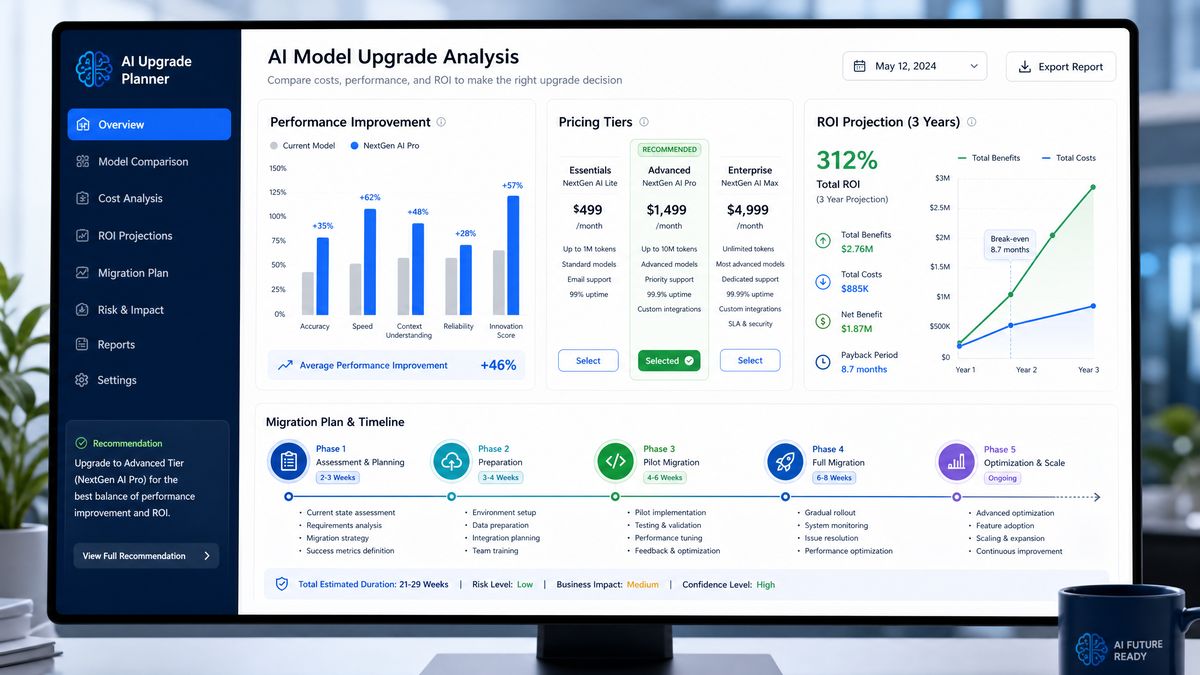
Without confirmed pricing, enterprise teams must model scenarios based on historical pricing patterns across the GPT-5.x series. The data here is informative:
| Model Version | Input Price (per 1M tokens) | Output Price (per 1M tokens) | Price Change vs. Prior Version |
|---|---|---|---|
| GPT-5.0 | $15.00 | $60.00 | Baseline |
| GPT-5.1 | $15.00 | $60.00 | No change |
| GPT-5.2 | $12.00 | $48.00 | -20% (efficiency release) |
| GPT-5.3 | $10.00 | $40.00 | -17% (latency/cost focus) |
| GPT-5.4 | $12.00 | $48.00 | +20% (multimodal uplift) |
| GPT-5.5 | $12.00 | $48.00 | No change |
| GPT-5.6 (Projected) | $13.00–$16.00 | $52.00–$64.00 | +8% to +33% (capability uplift) |
Note: Prices above represent illustrative projections based on publicly reported pricing trajectories and are provided for planning purposes. Actual GPT-5.6 pricing has not been announced as of this writing.
The historical pattern is clear: major capability releases (GPT-5.0, GPT-5.4) come with price increases, while efficiency-focused releases (GPT-5.2, GPT-5.3) bring price reductions. Given that GPT-5.6 is being framed as a capability uplift rather than an efficiency optimization, a price increase is the base-case scenario for cost modeling.
Enterprise teams should build their cost models around three scenarios:
- Conservative scenario: 10% price increase over GPT-5.5, full workload migration. Model the monthly cost delta against your current API spend to determine budget approval requirements.
- Base scenario: 20% price increase over GPT-5.5, tiered migration with routing-based cost optimization retaining 40% of volume on GPT-5.5 or Mini. Net cost increase in the 8 to 12% range after routing optimization.
- Aggressive scenario: 33% price increase, frontier workloads only on GPT-5.6, full cost routing for commodity workloads. Net cost impact may be cost-neutral or even negative if routing discipline is maintained.
Migration Planning: From Preparation to Production Cutover
Assuming GPT-5.6 ships in the last two weeks of June 2026 per the confirmed timeline, enterprise teams that begin preparation now have approximately six to eight weeks of lead time. This is a workable window if planning begins immediately. Here is the week-by-week execution plan:
Weeks 1–2: Foundation and Infrastructure
- Build or update the automated evaluation harness described in Workstream 1
- Audit your golden dataset — it should be refreshed with recent production examples from the past 60 days
- Document all production system prompts across your deployment portfolio, including any that have been modified informally without version control
- Implement the model routing architecture with GPT-5.6 as a configurable target that can be enabled without a code deployment (use feature flags or environment variable-driven model name configuration)
- Review your API error handling code — new model versions sometimes introduce new error types or change the behavior of existing ones
Weeks 3–4: Evaluation and Benchmarking
- Once API access is available (OpenAI typically provides enterprise API customers early access 1 to 2 weeks before general availability), begin running your evaluation harness immediately
- Run evaluations for all major workload categories, not just your highest-volume use case
- Pay specific attention to any workloads that had known reliability issues with GPT-5.5 — these are your highest-value candidates for GPT-5.6 migration and deserve priority evaluation
- Document any prompt adjustments needed to handle behavioral differences — new model versions sometimes require minor system prompt revisions to maintain the same output characteristics
- Run latency benchmarks across three times of day (business hours peak, off-peak, late night) to characterize the full performance envelope
Weeks 5–6: Staged Rollout
- Begin with a 5% traffic split to GPT-5.6 for your lowest-risk, highest-volume workloads (typically classification, extraction, summarization tasks)
- Monitor key production metrics: error rate, latency P50/P95/P99, output quality flags from human reviewers, and downstream business metrics if measurable
- Increase to 25% traffic after 48 hours if metrics hold within acceptable bounds
- For agentic workloads and complex reasoning pipelines, run shadow mode evaluation (GPT-5.6 generates output but GPT-5.5 output is served to users) for a minimum of 72 hours before cutover
- Have rollback procedures tested and documented, with specific rollback trigger criteria defined before the rollout begins
Post-Launch: Optimization and Learning
- Full production cutover for standard workloads after successful staged rollout
- Begin a second evaluation cycle specifically focused on prompts and system designs that were written to work around GPT-5.5 limitations — these may be simplifiable given GPT-5.6's improved capabilities
- Revisit system prompts for verbosity — improved instruction following in newer models often means that defensive prompt engineering (over-specified instructions added to compensate for model limitations) can be trimmed, reducing token costs
- Update your routing configuration to rebalance workload distribution based on actual GPT-5.6 performance data
System Prompt Considerations for GPT-5.6
One of the most practically impactful but least discussed aspects of model transitions is the system prompt audit. Enterprise teams that spent months iterating their system prompts for GPT-5.5 sometimes find that the same prompts produce suboptimal behavior on newer models — not because the new model is worse, but because the prompts were designed to compensate for specific limitations that the new model no longer has.
Common system prompt patterns that should be reviewed and potentially simplified when migrating to GPT-5.6:
Over-Specified Format Instructions
Earlier GPT-5.x versions sometimes required very explicit formatting instructions to produce consistent structured output. If your current system prompts include extensive formatting directives like "Always begin your response with..." or "You must structure your answer using exactly these headers..." evaluate whether the newer model's improved instruction following allows for lighter-touch formatting guidance that produces equally consistent results.
Defensive Negative Instructions
Prompts that include long lists of "never do X, do not do Y, avoid Z" instructions often accumulated because previous model versions required explicit prohibition of specific behaviors. GPT-5.6's improved instruction following may allow consolidation of these negative instructions. Run evaluations specifically testing whether behaviors you currently explicitly prohibit remain reliably suppressed without explicit instructions.
Reasoning Scaffolding Instructions
For complex reasoning tasks, it was common practice with earlier models to include explicit chain-of-thought scaffolding in the system prompt ("Think through this step by step before providing your final answer"). If GPT-5.6 delivers on its promised reasoning improvements, some of this scaffolding may become unnecessary or may even interfere with the model's native reasoning behavior. Test both with and without explicit reasoning instructions.
Agentic Use Cases: The High-Stakes Transition
For enterprise teams with significant investments in OpenAI-powered agent workflows, the GPT-5.6 transition warrants particularly careful attention. Agentic systems are more sensitive to model behavior changes than static prompt-response patterns because behavioral changes compound across multiple tool calls and model invocations within a single task execution.
Access 40,000+ AI Prompts for ChatGPT, Claude & Codex — Free!
Subscribe to get instant access to our complete Notion Prompt Library — the largest curated collection of prompts for ChatGPT, Claude, OpenAI Codex, and other leading AI models. Optimized for real-world workflows across coding, research, content creation, and business.
Specific agentic considerations for the GPT-5.6 transition:
Tool Call Behavior
New model versions frequently change how models approach tool selection — which tools they call, in what order, and under what circumstances they decide a tool call is unnecessary. Before migrating agentic workloads to GPT-5.6, instrument your existing agents to log detailed tool call sequences so you have a baseline to compare against. A change in tool call behavior is not inherently bad — it might reflect more efficient task execution — but it needs to be evaluated explicitly.
Error Recovery Logic
Test your agents' error recovery paths specifically. Submit tool calls that return errors and verify that GPT-5.6 handles the errors in a way compatible with your agent's recovery logic. Error handling behavior can change significantly between model versions.
Task Completion Criteria
More capable models sometimes decide tasks are "done" sooner than less capable ones — they identify shortcuts or more efficient solution paths. This is generally positive but can interact unexpectedly with agent orchestration logic designed around an expectation of specific intermediate steps. Test your agent completion detection logic explicitly.
Enterprise teams building complex agentic workflows should familiarize themselves with the nuances of tool call orchestration before the GPT-5.6 transition, particularly the patterns covered in
Understanding how GPT-5.5 currently compares against Claude Fable 5 across enterprise benchmarks provides essential baseline context for evaluating the improvements GPT-5.6 will bring to coding, reasoning, and multi-step task completion. For a comprehensive deep dive, see our guide on GPT-5.5 vs Claude Fable 5 Enterprise Benchmark Comparison.
.
Competitive Context: Why GPT-5.6's Timing Matters
The late June 2026 release window is not arbitrary. It places GPT-5.6 directly in competition with expected capability announcements from Anthropic and Google DeepMind, both of whom have signaled significant model releases in the same timeframe. Understanding the competitive dynamics helps enterprise architects make better decisions about model commitment strategy.
Anthropic's Claude Positioning
Anthropic's Claude series has made significant inroads with enterprise customers specifically on the dimensions of instruction following reliability and reduced hallucination rates in long-document analysis tasks. If GPT-5.6's improvements focus on these same dimensions, it directly contests Claude's primary enterprise differentiation. Enterprise teams that maintain a multi-vendor AI strategy — running both OpenAI and Anthropic models on different workload types — should run comparative evaluations immediately upon GPT-5.6's release rather than waiting for community benchmark results.
Google DeepMind's Gemini Trajectory
Google's Gemini Ultra series has been competitive specifically on context window size and multimodal capabilities. If GPT-5.6 includes the context window expansion that several signals suggest, it narrows the gap with Gemini on a dimension that was previously a meaningful differentiator. Enterprise teams using Gemini for long-document workloads specifically because of its context capabilities should include GPT-5.6 in their evaluation matrix.
The Multi-Model Enterprise Strategy
The increasing capability parity between frontier models is actually making the case for model-agnostic infrastructure stronger, not weaker. Enterprise teams that have built routing and evaluation infrastructure around a single provider find themselves operationally locked and unable to take advantage of competitive dynamics. The preparation work for GPT-5.6 is an excellent opportunity to also ensure your infrastructure can route to non-OpenAI endpoints, using standard interfaces that abstract the specific model provider.
Security and Compliance Considerations
Enterprise teams operating in regulated industries have additional considerations for the GPT-5.6 transition that go beyond performance evaluation. Several important compliance checkpoints apply:
Data Processing Agreement Review
When OpenAI releases a new model version, enterprise teams should verify that their existing Data Processing Agreements (DPAs) extend to the new model. Most enterprise DPAs with OpenAI are structured at the API service level rather than the specific model level, but it is worth a legal review, particularly for healthcare (HIPAA) and financial services (SOX, GLBA) environments where data handling attestations are specific.
Output Validation Layer Review
Teams that have implemented output validation layers — PII detection, toxicity filtering, business logic constraint checking — should revalidate these layers against GPT-5.6's output distribution. A more capable model generating more nuanced and complex outputs can sometimes produce edge cases that pass validation checks designed for simpler output patterns.
Red Team Evaluation
For customer-facing deployments, include a focused red team evaluation session specifically targeting your deployment's safety boundaries. New model versions can shift jailbreak resistance characteristics in either direction. Automated red-teaming tools (Garak, Promptfoo, or commercial equivalents) should be run as part of the standard pre-release evaluation pipeline.
The Broader Strategic Question: How Fast Should Enterprises Move?
Every model release raises the same fundamental strategic question for enterprise AI teams: should you be on the frontier or running one version behind? The answer depends on several factors that only your organization can weigh:
The Case for Immediate Frontier Adoption
For enterprises where AI output quality directly drives revenue outcomes — where a measurable improvement in model capability translates to measurable business value — the cost of not adopting a better model is real and calculable. Sales intelligence platforms, legal research tools, financial analysis systems, and code generation tools in high-velocity development environments are all examples where the business case for frontier model adoption is clear.
Additionally, OpenAI has a pattern of aggressively deprecating older model versions on accelerated schedules as the GPT-5.x series progresses. Teams that delay migration too long risk being forced into a rushed transition by deprecation timelines rather than executing a planned migration on their own schedule.
The Case for Deliberate Timing
For enterprises where AI is a supporting capability rather than a core value driver — internal productivity tools, document management assistants, HR chatbots — the ROI calculation for frontier model adoption is less immediate. The reliability and predictability of a proven production model often outweighs marginal capability improvements for these use cases. These organizations benefit from letting the community and early adopters surface edge cases and behavioral surprises before committing to migration.
A Practical Decision Framework
| Organizational Profile | Recommended Approach | Timeline |
|---|---|---|
| AI-native company, customer-facing AI product | Immediate evaluation, fast migration for core features | Within 2 weeks of GA |
| Enterprise with significant agentic workflows | Parallel evaluation, staged migration with shadow mode | 4–6 weeks post-GA |
| Large enterprise, AI as productivity enhancement | Evaluation during staged rollout, migrate non-critical workloads first | 6–10 weeks post-GA |
| Regulated industry (healthcare, finance) | Full evaluation + compliance review before any production migration | 8–12 weeks post-GA |
| Government / defense adjacent | Evaluation only, await security certification updates | Certification-dependent |
What to Watch for at the Official Announcement
When OpenAI makes the official GPT-5.6 announcement, enterprise developers should have a structured watching brief to capture key information immediately. Here are the specific data points to extract from the announcement:
- Benchmark disclosures: Which benchmarks improved and by how much. Look specifically for MATH-500, HumanEval, GPQA, and any enterprise-specific benchmark OpenAI has started reporting (they introduced enterprise-relevant benchmarks alongside GPT-5.5).
- Pricing structure: Input/output token prices, whether caching pricing has changed, and whether batch API pricing receives the same update.
- Context window: Confirmed context window size and whether the effective context (what the model reliably attends to) matches the technical limit.
- API availability timeline: Some models have launched with different availability schedules for ChatGPT vs. API vs. Enterprise API vs. Azure OpenAI. Know when your specific deployment path receives access.
- Deprecation schedule for GPT-5.5: OpenAI typically announces a deprecation timeline for the previous version at the time of a major new release. Know your runway for completing migration.
- System card disclosures: The safety evaluation and red team findings in the system card often contain operational information relevant to enterprise deployments, particularly regarding behavioral changes from the prior version.
- Fine-tuning availability: Whether GPT-5.6 supports fine-tuning from launch or if fine-tuning follows general availability (OpenAI has had both patterns).
Conclusion: The Preparation Window Is Now
GPT-5.6's confirmation as an imminent, meaningful capability release creates a specific and actionable preparation window for enterprise AI teams. The Chief Scientist's explicit framing, the historical pattern of the GPT-5.x series, and the competitive dynamics of the late-June 2026 window all point toward a release that will matter for production systems — not a cosmetic update that can be safely ignored until the community reports on it.
The teams that navigate this transition best will not be the ones that move fastest. They will be the ones that moved earliest in their preparation, built robust evaluation infrastructure before the model was available, designed their routing architecture to accommodate the new option without forced all-or-nothing migration choices, and established clear decision criteria for what constitutes a successful migration for each workload category in their portfolio.
The six-to-eight weeks between now and GPT-5.6's expected availability is an unusually clear preparation window. Build the evaluation harness. Audit the system prompts. Model the cost scenarios. Define the rollback triggers. When the model ships — and based on everything confirmed, it will ship on schedule — the enterprise teams that have done this preparation work will be in a fundamentally different position than those who are starting their evaluation from scratch on launch day.
OpenAI's release cadence shows no signs of slowing. Developing robust model transition discipline as an organizational capability — the ability to evaluate, route, migrate, and optimize across a changing model portfolio — is no longer optional for enterprise teams with significant AI dependencies. GPT-5.6 is the next test of that discipline. The preparation starts now.
