
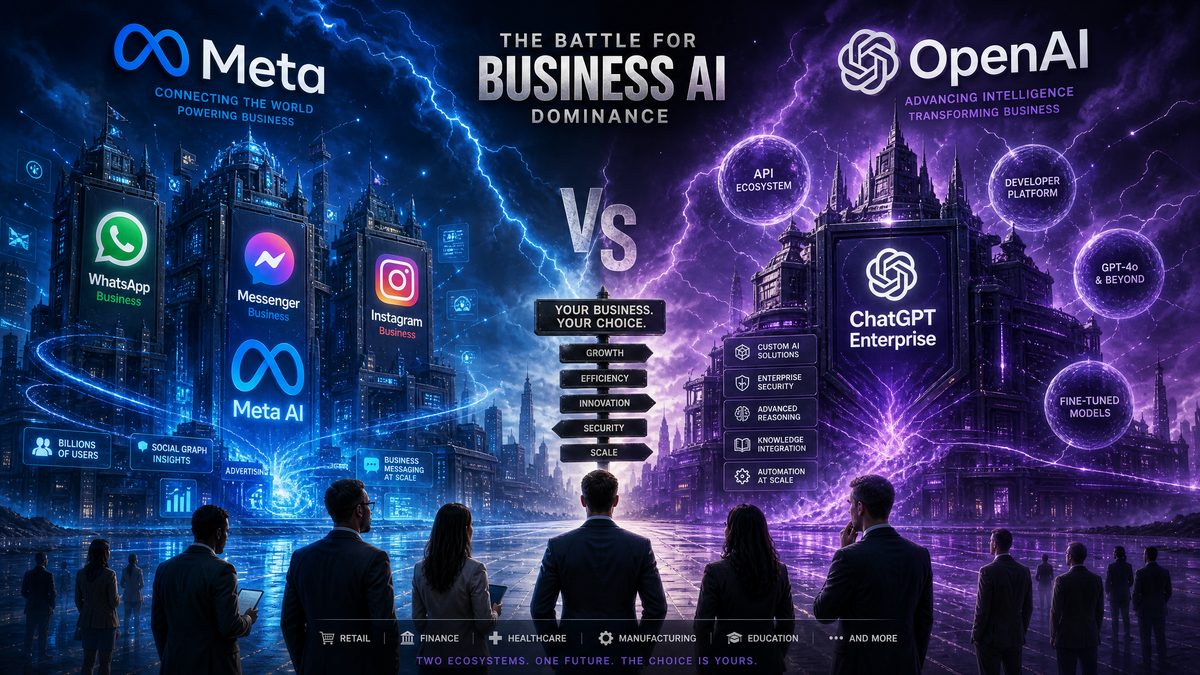
In the rapidly evolving landscape of AI-powered customer engagement, two titans have emerged as frontrunners: Meta Business Agent and ChatGPT Enterprise. Meta’s Business Agent, launched globally on June 3, 2026, across WhatsApp, Messenger, and Instagram, promises seamless integration with some of the world’s largest social platforms. Meanwhile, OpenAI’s ChatGPT Enterprise, serving over 2 million businesses and contributing to 40% of OpenAI’s revenue, continues to redefine enterprise AI interactions with its advanced natural language understanding and robust platform flexibility.
This comprehensive article delves deeply into a head-to-head comparison between these two AI customer engagement solutions. We explore their platform reach, integration capabilities, pricing models, AI functionalities, customer engagement metrics, industry adoption trends, and recommendations for which solution best fits varying business sizes and sectors.
Platform Reach and Ecosystem Integration
Effective customer engagement solutions must operate where customers already are. Both Meta Business Agent and ChatGPT Enterprise excel in this dimension but with different approaches.
Meta Business Agent: Leveraging Meta’s Social Ecosystem
Meta Business Agent is launched natively on three of Meta’s flagship platforms: WhatsApp, Messenger, and Instagram. Combined, these platforms host over 3.8 billion monthly active users worldwide as of Q1 2026, giving businesses unparalleled access to a massive, engaged audience.
- WhatsApp: Over 2 billion users globally, widely used for personal and business communication.
- Messenger: 1.3 billion users, popular in North America and Europe.
- Instagram: 1.5 billion users, heavily used for brand discovery and influencer marketing.
Meta Business Agent capitalizes on this reach by embedding AI-driven chat capabilities directly inside each platform’s native messaging experience. This integration allows businesses to engage customers without requiring app switches or additional downloads, crucial for reducing friction and increasing conversion rates.
Moreover, Meta’s Business Agent uses Contextual AI that can access users’ historical interactions across these platforms, enabling more personalized and context-aware responses. For example, a customer who previously browsed a product on Instagram Shopping can receive tailored support or offers via WhatsApp Business conversations.
One of the most compelling examples of Meta Business Agent’s integration prowess is its use during major shopping events such as Black Friday and Singles’ Day. Retailers leveraging Meta’s platforms have reported up to a 40% increase in customer engagement rates due to the seamless transition from product discovery on Instagram to real-time assistance and purchasing on WhatsApp. This frictionless journey is powered by Meta’s AI, which anticipates customer needs based on past behavior and current conversation context.
Furthermore, Meta Business Agent’s ecosystem integration extends beyond messaging. Businesses can integrate with Meta’s powerful advertising platform to trigger AI-driven conversations directly from targeted ads. For instance, a user clicking on a Facebook ad for a new smartphone can immediately initiate a chat with an AI agent to inquire about specifications, availability, or payment plans without leaving the app. This reduces drop-off rates and enhances conversion efficiency.
Meta also recently announced the incorporation of augmented reality (AR) features within Business Agent interactions. Users can, for example, try on virtual products through Instagram’s AR filters while chatting with the AI agent for personalized recommendations or support. This blend of immersive technology and AI engagement is poised to revolutionize social commerce.
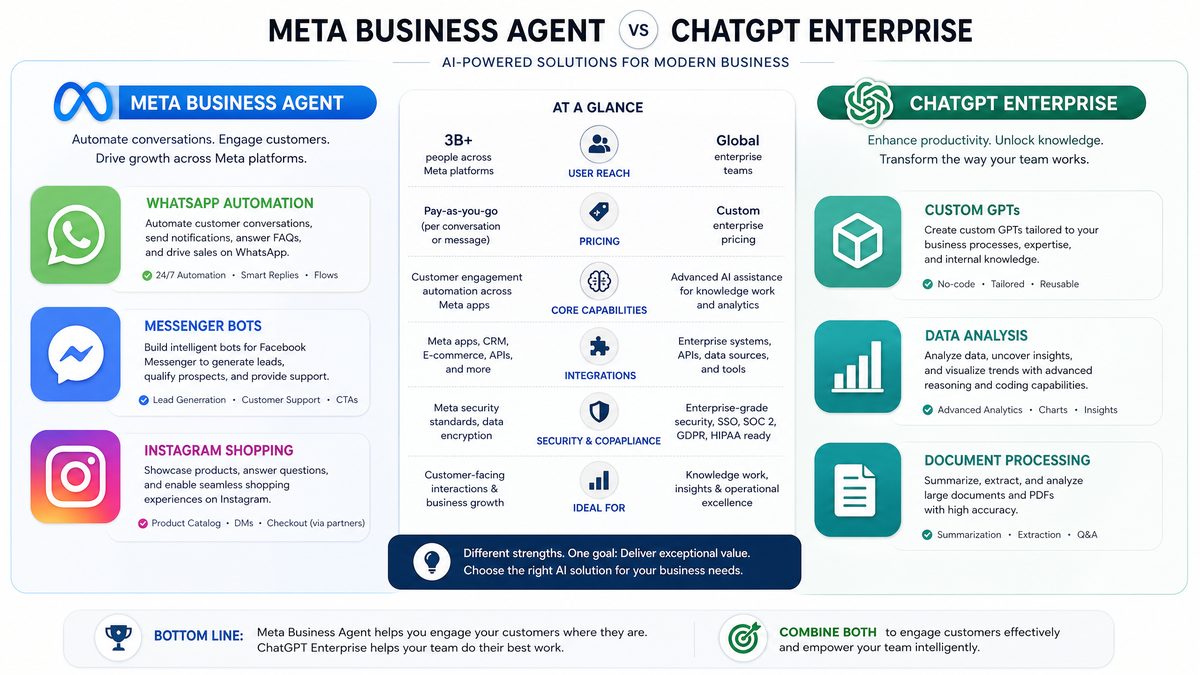
ChatGPT Enterprise: Platform-Agnostic and API-First
ChatGPT Enterprise adopts a platform-agnostic approach focused on flexibility and extensibility. Instead of being tied to a specific messaging platform, it offers:
- Robust APIs: Allowing integration into various communication channels such as websites, mobile apps, CRM systems, and third-party messengers.
- Multi-channel Support: Businesses can deploy ChatGPT-powered interfaces across email, Slack, Microsoft Teams, SMS gateways, and custom chat widgets.
- Customizable UI: Enterprises can tailor the user experience to match branding and workflows.
With over 2 million businesses currently using ChatGPT Enterprise, its reach is more distributed but extensive. It is especially prevalent in sectors where businesses operate across diverse digital touchpoints—such as financial services, SaaS, healthcare, and retail.
By leveraging OpenAI’s advanced GPT-4 architecture, ChatGPT Enterprise can be embedded in virtually any customer engagement pipeline, offering businesses the freedom to innovate without platform dependency.
An exemplary case is how leading financial institutions have integrated ChatGPT Enterprise into their omnichannel customer support strategies. For instance, a top-tier bank utilizes ChatGPT to power its chatbot on the website, mobile app, and internal call center tools, ensuring consistent and accurate information delivery regardless of the channel. This unified AI experience has reduced average handling times by 25% and improved first-contact resolution by over 15%.
ChatGPT Enterprise’s open architecture also enables the creation of bespoke AI applications. For example, a healthcare provider built a symptom triage chatbot that integrates medical knowledge bases with patient records, providing preliminary assessments and directing patients to appropriate care levels. This application operates seamlessly across the provider’s website, mobile app, and SMS, illustrating the flexible deployment options available.
Additionally, many SaaS companies have leveraged ChatGPT Enterprise to automate technical support and developer community interactions. By embedding ChatGPT into their help centers, these companies have seen a 30% reduction in support ticket volume and a notable boost in user satisfaction, as AI agents can handle nuanced technical questions and provide code snippets or debugging tips instantly.
Integration Capabilities: Technical Depth and Customization
Integration depth determines how well AI agents fit into existing business systems and workflows. Both Meta Business Agent and ChatGPT Enterprise provide strong, but distinctly different, integration options.
Meta Business Agent Integration Features
Meta Business Agent offers deep native integration with Meta’s social graph and commerce tools:
- Native SDKs and APIs: Businesses can access Meta’s Business Messaging API to embed AI-driven chatbots that interact naturally on WhatsApp, Messenger, and Instagram.
- Commerce Integration: Supports product catalogs, order tracking, and payments directly within chats using Meta’s Commerce API.
- CRM Synchronization: Partners with platforms like Salesforce and HubSpot for seamless customer data synchronization.
- Automated Workflows: Enables automation of frequently asked questions, appointment scheduling, and customer feedback collection.
For example, a retail brand can automate the entire customer journey from product discovery on Instagram Shopping to order confirmation and shipment tracking on WhatsApp, all powered by the Business Agent AI.
To illustrate, a multinational electronics retailer utilizes Meta Business Agent to connect their inventory systems with Meta’s Commerce API, enabling real-time product availability updates within customer chats. When a customer inquires about stock levels on Messenger, the AI agent fetches live data, providing accurate and timely responses that reduce customer frustration and abandoned carts.
Meta’s CRM synchronization capabilities allow businesses to maintain a unified customer profile across touchpoints. For instance, a hotel chain integrates Meta Business Agent with Salesforce to capture customer preferences and past interactions, which the AI agent uses to personalize offers and handle loyalty queries. This integration not only improves customer satisfaction but also drives repeat bookings through targeted promotions delivered via WhatsApp.
Meta Business Agent also supports advanced automation scenarios. An example is a healthcare provider automating appointment scheduling and reminders through Messenger, reducing administrative overhead by 35%. The AI can handle rescheduling requests, pre-visit instructions, and post-appointment feedback collection, streamlining patient communication.
ChatGPT Enterprise Integration Features
ChatGPT Enterprise excels in flexible, customizable integration:
- Comprehensive API Suite: Includes RESTful endpoints for chat completion, embeddings, and fine-tuning models.
- Plug & Play Connectors: Pre-built integrations for Salesforce, Zendesk, ServiceNow, and other enterprise platforms streamline deployment.
- Custom Plugins and Extensions: Enterprises can develop custom plugins to connect ChatGPT with proprietary databases, inventory systems, or analytics tools.
- Security and Compliance: Enterprise-grade security features including SSO, data encryption, and compliance with GDPR, HIPAA, and SOC 2.
Here is a code example showcasing how to integrate ChatGPT Enterprise API into a custom chatbot backend:
import openai

openai.api_key = "YOUR_ENTERPRISE_API_KEY"

response = openai.chat.completions.create(
    model="gpt-4-enterprise",
    messages=[
        {"role": "system", "content": "You are a helpful customer service assistant."},
        {"role": "user", "content": "Can you help me track my recent order #12345?"}
    ],
    temperature=0.5,
    max_tokens=250
)

print(response.choices[0].message.content)
This API-first design enables businesses to embed ChatGPT in virtually any digital customer interface, supporting bespoke workflows and complex use cases.
For instance, a global logistics company integrated ChatGPT Enterprise with their proprietary shipment tracking system via a custom plugin. Customers can ask natural language questions like “Where is my package?” or “Has my delivery been delayed?” through the company’s website chat or mobile app, and the AI responds with precise, real-time information pulled from internal databases. This seamless integration has reduced call center volumes by 22% and improved customer satisfaction scores.
Additionally, ChatGPT Enterprise’s fine-tuning capabilities allow organizations to tailor the AI’s responses to industry-specific terminology and regulatory requirements. A legal services firm, for example, fine-tuned a ChatGPT model on their internal legal documents and FAQs, enabling the AI agent to provide accurate guidance on contract clauses and compliance questions, enhancing client trust and operational efficiency.
Security is another key area where ChatGPT Enterprise shines. Enterprises operating in sensitive sectors such as finance and healthcare benefit from its compliance with industry standards like HIPAA and SOC 2. The platform supports Single Sign-On (SSO) and end-to-end data encryption, ensuring that customer data remains protected throughout AI interactions. These features are critical for organizations balancing AI innovation with stringent data governance needs.
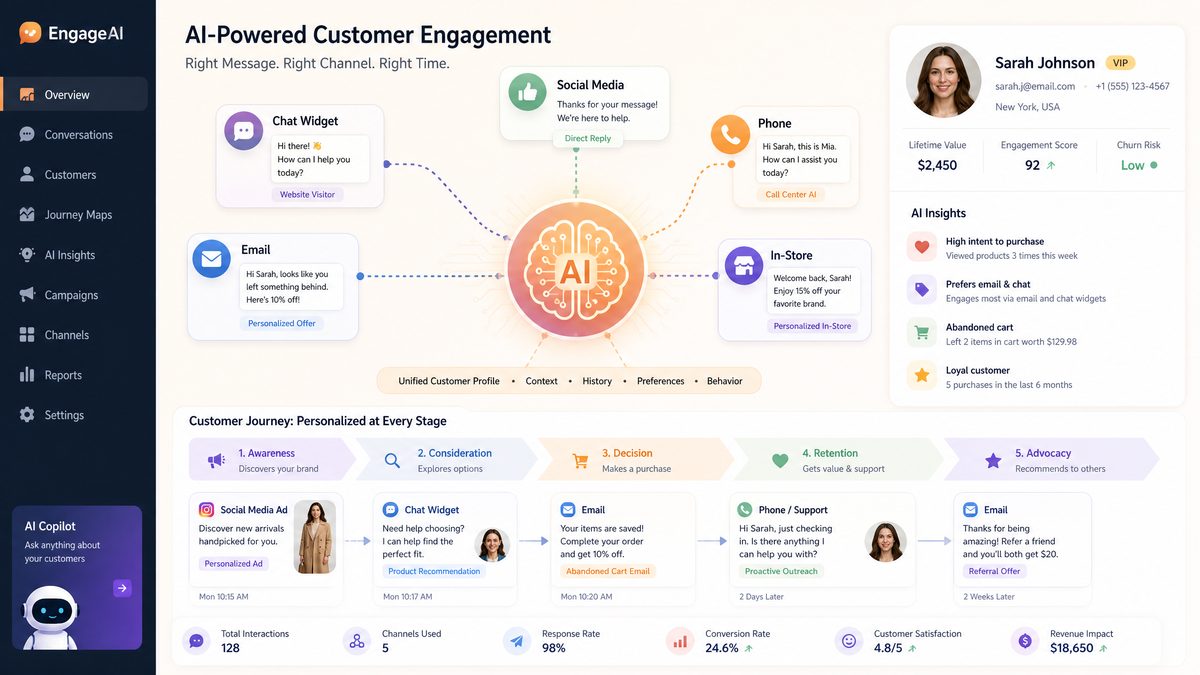
Pricing Models: Cost Structures and Value Proposition
Pricing is a critical factor in selecting a customer engagement AI. Meta Business Agent and ChatGPT Enterprise adopt different pricing strategies aligned with their market focus.
| Feature | Meta Business Agent | ChatGPT Enterprise |
|---|---|---|
| Pricing Model | Per conversation/session pricing + platform fees | Subscription-based (per user/month) + API usage fees |
| Base Cost | Starts at $0.005 per message; minimum monthly spend varies by region | Starts at $20 per user/month; volume discounts available |
| Additional Fees | Commerce transaction fees may apply | API calls billed separately based on usage tiers |
| Enterprise Support | Available with custom contracts and onboarding services | Included in enterprise plans with dedicated success managers |
| Free Tier | Limited free trial period for small businesses | Free trial with limited API calls and user seats |
Meta Business Agent’s per-message pricing aligns well with businesses that have fluctuating message volumes, such as seasonal retailers or event-driven campaigns. The integration of commerce fees means that businesses need to carefully model total costs when leveraging Meta’s shopping ecosystem.
For example, a mid-sized apparel brand running seasonal promotions on Instagram experienced a 150% message volume increase during holiday sales periods. Meta’s per-message pricing allowed them to scale AI interactions without upfront costs typical of subscription models, though commerce transaction fees added a layer of complexity in budgeting. The company leveraged Meta’s analytics tools to optimize messaging frequency and content, balancing cost and engagement.
In contrast, ChatGPT Enterprise’s subscription model provides predictable budgeting, particularly for organizations with stable or growing user bases. The API usage fees allow scaling granularly based on actual AI interactions, which is advantageous for businesses with diverse digital touchpoints.
A multinational SaaS provider with 5,000 support agents subscribes to ChatGPT Enterprise, paying a fixed monthly fee per user while incurring additional charges based on API consumption. This model facilitates precise cost forecasting and supports rapid scaling during product launches or support spikes. The provider also benefits from volume discounts, which lower the effective cost by 20% as usage grows.
Both platforms offer free trials, enabling businesses to pilot AI capabilities before committing. However, Meta Business Agent’s free tier is often limited to smaller businesses or regional markets, whereas ChatGPT Enterprise’s trial includes API access and user seats, allowing broader exploration of integration possibilities.
AI Capabilities: Natural Language Processing and Beyond
At the core of these platforms are their AI engines, which determine the quality of automated interactions and customer satisfaction.
Meta Business Agent’s AI Strengths
Meta Business Agent utilizes a proprietary AI stack combining natural language processing (NLP), computer vision (for Instagram image recognition), and contextual analytics:
- Contextual Memory: Tracks conversation history across Meta platforms to personalize responses.
- Multi-modal Understanding: Processes text, images, and stickers to interpret customer intent.
- Sentiment Analysis: Detects customer emotions to tailor tone and escalate to human agents when needed.
- Language Support: Supports over 60 languages and dialects, critical for global brands.
For example, a customer sending a photo of a damaged product through Instagram can receive immediate AI-driven troubleshooting advice or an automated replacement request.
Meta’s multi-modal AI capabilities are particularly notable in industries where visual content drives engagement. In the consumer electronics sector, customers often share images of devices to diagnose issues. Meta Business Agent’s AI can analyze these images using computer vision to identify product models, detect visible defects, and suggest tailored solutions or direct escalation to technicians. This capability reduces resolution time and improves customer satisfaction.
Furthermore, Meta’s sentiment analysis engine is continuously refined through machine learning models trained on billions of platform interactions. This enables the AI to detect subtle cues such as frustration or satisfaction, prompting dynamic response adjustments. For instance, if a customer expresses dissatisfaction, the AI can switch to a more empathetic tone or offer to connect the user to a live agent, enhancing the overall experience.
In terms of language support, Meta Business Agent’s extensive multilingual capabilities support global enterprises operating in diverse markets. Its AI can seamlessly switch languages within a conversation, accommodating users who mix dialects or languages, a common scenario in regions like India or Latin America. This linguistic flexibility boosts engagement and reduces the need for human intervention.
ChatGPT Enterprise’s AI Strengths
ChatGPT Enterprise is powered by OpenAI’s GPT-4 architecture, known for leading-edge NLP capabilities:
- Advanced Language Understanding: Excels in complex query comprehension, conversational nuance, and long-form responses.
- Custom Fine-Tuning: Enterprises can fine-tune models on proprietary datasets to align with brand voice and domain-specific knowledge.
- Knowledge Integration: Connects with internal knowledge bases via embeddings and retrieval-augmented generation (RAG) for precise answers.
- Multi-turn Dialogues: Maintains context over extended conversations, ideal for technical support and onboarding.
For instance, a SaaS company can deploy ChatGPT Enterprise to handle tier-1 and tier-2 technical support queries with answers referencing the latest product documentation stored in their internal database.
OpenAI’s GPT-4 architecture is renowned for its ability to understand and generate human-like language, enabling nuanced and contextually rich interactions. This capability is critical in sectors such as legal, finance, and healthcare, where precise language and compliance are paramount.
The fine-tuning feature allows enterprises to adapt the AI to specific jargon, regulatory language, or brand tone. A financial services firm, for example, fine-tuned their ChatGPT model on proprietary investment guidelines and compliance manuals, enabling the AI to provide accurate, regulation-compliant responses to sensitive customer queries. This reduces legal risks while enhancing customer trust.
Knowledge integration via RAG empowers ChatGPT Enterprise to pull information dynamically from vast internal databases, ensuring responses are always up-to-date. For example, a telecommunications company connects ChatGPT to their evolving product catalogs, troubleshooting guides, and network status dashboards. Customers receive real-time, precise answers, reducing support escalations.
Multi-turn dialogue management is another strength. ChatGPT Enterprise can maintain context over long sessions involving multiple topics, enabling complex workflows such as onboarding new customers, guiding them through setup, and answering follow-up questions without losing track. This capability leads to higher resolution rates and customer satisfaction.
Customer Engagement Metrics: Measuring Success
Effective AI customer engagement platforms provide detailed metrics that allow businesses to optimize interactions and ROI.
| Metric | Meta Business Agent | ChatGPT Enterprise |
|---|---|---|
| Response Time | Average < 1 second due to native platform integration | Variable; optimized via API scaling and caching |
| Resolution Rate | Up to 78% first-contact resolution in retail sectors | Up to 85% resolution in technical support environments |
| Customer Satisfaction (CSAT) | Average 4.3/5 across Meta platforms | Average 4.6/5 in enterprise deployments |
| Engagement Rate | Click-through rates improve by 30% with AI assistance | Customer retention uplift of 15-20% |
| Escalation Rate | Low escalation (~12%) due to sentiment analysis | Moderate escalation (~18%) for complex queries |
Businesses deploying Meta Business Agent report improved engagement on social commerce campaigns, while ChatGPT Enterprise’s metrics highlight strengths in customer support and knowledge-driven interactions.
Meta’s sub-second response times are a direct result of its native integration within Meta’s platforms, minimizing network latency and enabling real-time conversational flows. This speed is crucial during high-traffic periods, such as flash sales or promotional campaigns, where rapid responses drive conversions. For example, a cosmetics brand leveraging Meta Business Agent during a product launch observed a 35% increase in chat engagement and a 22% boost in sales conversions attributed to the AI’s fast, personalized responses.
ChatGPT Enterprise, while exhibiting slightly variable response times depending on deployment scale and API call optimization, excels in maintaining high-resolution rates, particularly in complex technical environments. Its 85% first-contact resolution rate in technical support is backed by its ability to understand intricate queries and access up-to-date knowledge bases. A major software company reported that ChatGPT Enterprise reduced average ticket resolution times by 30%, freeing human agents to focus on high-priority cases.
Customer satisfaction scores further illustrate both platforms’ effectiveness. Meta Business Agent’s 4.3/5 CSAT reflects strong performance in social commerce and casual interactions, while ChatGPT Enterprise’s 4.6/5 indicates higher satisfaction in enterprise-grade, detailed support scenarios. These differences align with the platforms’ core strengths and target use cases.
Engagement metrics also reveal distinct advantages. Meta Business Agent’s AI assistance drives a 30% increase in click-through rates on social ads and shopping posts, directly impacting revenue for retailers. Meanwhile, ChatGPT Enterprise contributes to a 15-20% uplift in customer retention by providing consistent, high-quality support, which is critical in subscription-based industries like SaaS.
The escalation rates highlight Meta’s sentiment analysis efficiency, keeping escalation low by resolving most queries autonomously or with empathetic AI responses. ChatGPT Enterprise’s moderate escalation rate indicates a balanced approach, where complex queries are appropriately handed off to human experts to ensure accuracy and compliance.
Access 40,000+ AI Prompts for ChatGPT, Claude & Codex — Free!
Subscribe to get instant access to our complete Notion Prompt Library — the largest curated collection of prompts for ChatGPT, Claude, OpenAI Codex, and other leading AI models. Optimized for real-world workflows across coding, research, content creation, and business.
Industry Adoption Patterns and Use Cases
Adoption trends reveal which industries benefit most from each platform’s unique capabilities.
Meta Business Agent Adoption
- Retail & E-commerce: Brands use Business Agent to automate order inquiries, returns, and personalized promotions across WhatsApp and Instagram Shopping.
- Travel & Hospitality: Airlines and hotels leverage Messenger-based AI for booking confirmations and customer assistance.
- Consumer Electronics: Companies employ image recognition to assist with warranty claims and troubleshooting.
For example, a leading fashion retailer reported a 25% increase in conversion rates by enabling WhatsApp Business Agent to handle personalized style recommendations.
In the retail sector, Meta Business Agent has become a core tool for brands aiming to enhance social commerce. A prominent shoe manufacturer integrated Business Agent with Instagram Shopping and WhatsApp, enabling customers to receive personalized size and style advice via AI chat. This initiative led to a 30% reduction in return rates and a 15% increase in average order value, as customers felt more confident in their purchases.
Travel companies have also embraced Meta’s AI capabilities. A major airline uses Messenger-based Business Agent to automate check-in reminders, flight status updates, and baggage tracking. This automation has reduced call center volumes by 40% and improved on-time notifications, enhancing overall passenger experience.
In consumer electronics, image recognition is a game-changer. A global smartphone brand leverages Instagram’s image processing AI to help customers diagnose hardware issues through photos. The AI then guides users through troubleshooting steps or initiates warranty claims seamlessly within the chat interface, accelerating resolution and reducing support costs.
ChatGPT Enterprise Adoption
- Financial Services: Banks and insurance firms use ChatGPT Enterprise for complex customer queries, fraud detection alerts, and compliance FAQs.
- Healthcare: Providers deploy AI to triage patient inquiries, schedule appointments, and deliver post-care instructions.
- SaaS & Technology: Tech companies utilize ChatGPT for onboarding, troubleshooting, and developer support.
A global SaaS provider reduced support ticket volume by 40% after implementing ChatGPT Enterprise, while increasing customer satisfaction scores significantly.
Financial institutions have been early adopters of ChatGPT Enterprise due to its compliance and customization strengths. A multinational bank uses ChatGPT to answer complex queries about loan products, fraud alerts, and regulatory disclosures. Leveraging fine-tuned models and secure data handling, the bank has improved customer trust and operational efficiency, reducing inquiry handling times by 35%.
Healthcare providers have integrated ChatGPT Enterprise into patient engagement workflows. For example, a large hospital system deployed AI-powered virtual assistants to triage symptoms, schedule appointments, and provide post-discharge care instructions. This initiative led to a 25% reduction in non-emergency calls and improved patient adherence to care plans.
In the SaaS and technology sectors, ChatGPT Enterprise supports onboarding and developer support scenarios. A cloud software company embedded ChatGPT into their developer community forums, providing instant code examples, troubleshooting tips, and product updates. This has increased community engagement by 40% and lowered support escalations.
For more insights on AI adoption in specific verticals, explore our detailed analysis on
For additional insights on this rapidly evolving landscape, our detailed analysis in How to Build a a Code Review Bot with Claude Sonnet 4.6 in 2026: Step-by-Step provides comprehensive coverage of the latest developments and practical implementation strategies.
.
Which Solution Fits Your Business Size and Sector?
Choosing between Meta Business Agent and ChatGPT Enterprise depends heavily on your business scale, digital strategy, and sector requirements.
| Business Type | Meta Business Agent | ChatGPT Enterprise |
|---|---|---|
| Small Businesses & Startups | Ideal for those focused on social commerce and direct messaging sales via WhatsApp/Instagram. | Suitable if requiring multi-channel support or advanced customization beyond social platforms. |
| Mid-sized Companies | Great for retail chains and hospitality leveraging Meta’s ecosystem for customer engagement. | Recommended for companies needing integration with CRM and internal knowledge bases. |
| Large Enterprises | Effective when integrated into large-scale social media marketing campaigns. | Preferred for complex, multi-department workflows, and regulated industries needing compliance. |
| Sector-Specific | Retail, Travel, Consumer Goods heavily favor Meta Business Agent. | Finance, Healthcare, Technology sectors benefit more from ChatGPT Enterprise’s flexibility. |
For enterprises evaluating AI customer engagement platforms, a hybrid approach is also possible—using Meta Business Agent for social channel engagement, and ChatGPT Enterprise for internal and multi-channel support.
Many global corporations already implement such hybrid strategies. For example, a multinational retail conglomerate uses Meta Business Agent to interact with customers on social platforms and ChatGPT Enterprise internally to support call center agents and process backend workflows. This dual approach maximizes both platforms’ strengths, ensuring seamless customer experiences across touchpoints.
Small and medium businesses focused on e-commerce and social sales will find Meta Business Agent’s native integration and commerce features particularly valuable, especially when budgets are tight and simplicity is key. Conversely, companies operating in regulated industries or with complex support needs should lean towards ChatGPT Enterprise’s robust customization, compliance, and multi-channel capabilities.
Learn more about hybrid AI strategies in our feature piece on
For additional insights on this rapidly evolving landscape, our detailed analysis in Deep Dive: OpenAI Codex Complete Guide — Every Feature, Benchmark, and Use Case in 2026 provides comprehensive coverage of the latest developments and practical implementation strategies.
.
Conclusion: The Future of AI-Powered Customer Engagement
The launch of Meta Business Agent globally marks a significant milestone in social commerce and conversational AI, granting businesses direct access to billions of users on Meta’s platforms. Its native integration, commerce capabilities, and multi-modal AI make it a powerful tool for brands aiming to capitalize on social interactions.
Conversely, ChatGPT Enterprise’s platform-agnostic, API-first design, combined with the cutting-edge GPT-4 architecture, offers unmatched flexibility and power for enterprises requiring sophisticated, multi-channel AI solutions. Its widespread adoption across industries underscores its versatility and robustness.
Ultimately, the choice between Meta Business Agent and ChatGPT Enterprise hinges on your business’s digital ecosystem, customer engagement goals, and industry-specific needs. Both platforms represent the future of conversational AI, each with unique strengths that can transform how businesses connect with their customers.
Technological advancements on both fronts continue at a rapid pace. Meta is investing heavily in expanding AI capabilities within its social ecosystem, including deeper AR integrations, improved multilingual support, and more intelligent commerce functionalities. Meanwhile, OpenAI is enhancing ChatGPT Enterprise with continual model improvements, expanded fine-tuning options, and stronger data privacy controls.
Businesses should stay informed and agile, considering pilot programs and phased rollouts to evaluate which platform aligns best with evolving customer expectations and operational requirements.
For a detailed implementation guide and best practices on deploying AI chatbots, visit our comprehensive resource on
For additional insights on this rapidly evolving landscape, our detailed analysis in 99+ ChatGPT Prompts for marketers provides comprehensive coverage of the latest developments and practical implementation strategies.
.
