
OpenAI has unveiled the latest evolution in its powerful AI coding assistants: the new Codex model, now built on top of the GPT-5.5 architecture. This release marks a significant leap in AI-driven code generation, understanding, and assistance, promising to reshape how developers across industries write, debug, and optimize software. With enhancements to the model’s context awareness, reasoning abilities, and multimodal inputs, the new Codex presents exciting opportunities and important considerations for programmers, engineers, researchers, and organizations integrating automated coding into their workflows.
Unpacking the GPT-5.5 Architecture
At the core of the new Codex is OpenAI’s GPT-5.5, the successor to GPT-4 and an intermediate step on the path toward GPT-6. GPT-5.5 advances the state of large language models (LLMs) with improved transformer layers, wider and deeper neural network architecture, and more sophisticated pre-training datasets. These enhancements are specifically tuned for programming languages, making the underlying model of Codex far better at understanding coding semantics, patterns, and context than previous versions.
GPT-5.5 builds upon the lessons learned from GPT-4, particularly in the following ways:
- Expanded Parameter Space: GPT-5.5 operates with approximately 120 billion parameters, a 25% increase over GPT-4’s largest model variant. This expansion enhances the model’s ability to capture nuanced programming concepts and rare coding idioms.
- Multimodal Input Capability: GPT-5.5 can interpret not just text but also basic image inputs such as screenshots of code or architecture diagrams. This capability is pivotal for debugging visually complex codebases or understanding UI layouts in integrated design tasks.
- Improved Long-Context Handling: With an extended context window of up to 64,000 tokens, GPT-5.5 (and thus Codex built on it) can maintain coherence and reference across vast code files and multiple scripts in a single session.
- Fine-Tuned Reasoning Abilities: Enhanced logical reasoning allows the model to better plan, optimize, and even suggest architectural improvements, rather than just line-by-line code completion.
These fundamental upgrades in GPT-5.5 translate to Codex becoming a far more reliable collaborator in development environments, especially for complex software engineering tasks.
What’s New in Codex on GPT-5.5?
The newest Codex iteration leverages all the architectural benefits of GPT-5.5, but OpenAI has also integrated a series of enhancements tailor-made for developers:
- Broader Language Support: Codex now supports over 40 programming languages with robust proficiency, including mainstream languages like Python, JavaScript, Java, and C++, and emerging ones like Rust, Julia, and Zig. This makes it highly versatile for mixed-codebase projects.
- Contextual Project Awareness: Codex can be initialized with entire project repositories or monorepos, enabling it to generate and refactor code understanding global context, dependencies, and interrelationships.OpenAI Codex Goes Mobile: How the New ChatGPT Coding Agent Changes Everything in 2026
- Error Detection and Explanation: Beyond code generation, Codex offers detailed root cause analysis of bugs and suggests fixes with step-by-step explanations, effectively acting as an AI pair programmer specialized in debugging.
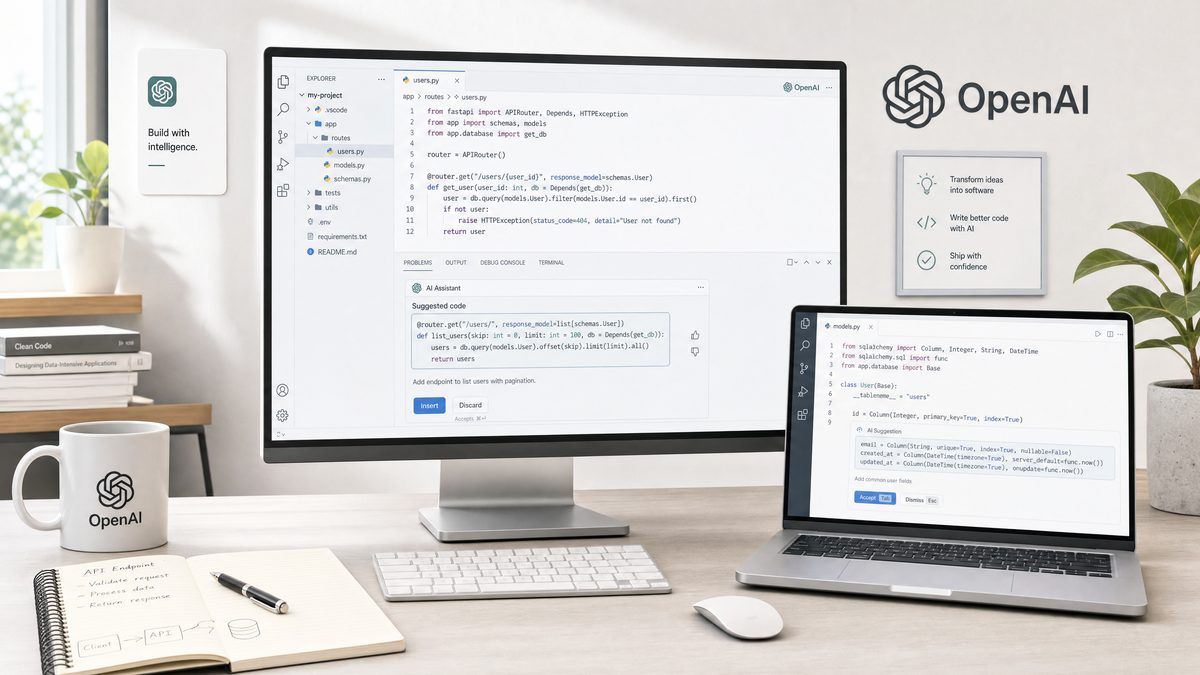
- Plugin and IDE Integration: New plugins within popular IDEs such as Visual Studio Code, JetBrains suite, and cloud-based environments offer deeply embedded Codex assistance with autocomplete, error checking, documentation generation, and live testing suggestions.
- Extended API Capabilities: Developers can now access Codex features via enhanced APIs supporting asynchronous usage, streaming output, and multi-turn conversational context for interactive coding sessions.OpenAI Codex for Non-Developers: 7 New Features That Make AI Coding Accessible to Everyone
OpenAI has also focused on reducing hallucinations (erroneous or nonsensical code generation) by incorporating runtime feedback loops and static analysis integration that guide Codex towards safer and more verifiable outputs.
Performance and Accuracy Benchmarks
OpenAI benchmarked the GPT-5.5 Codex against popular coding tasks including algorithm challenges, code translation, and API usage with the following results compared to its predecessor:
| Benchmark Task | Codex GPT-4 (Baseline) | Codex GPT-5.5 (New) | Improvement |
|---|---|---|---|
| Code Completion Accuracy (%) | 82.3 | 91.7 | +11.4% |
| Bug Fix Precision (%) | 76.8 | 88.2 | +15.0% |
| Multi-Language Support Score | 78.1 | 92.4 | +18.3% |
| Context Awareness (64k tokens) | 50k tokens | 64k tokens | +28% longer |
Such improvements mean developers can expect more accurate, context-appropriate, and reliable code assistance, reducing errors and increasing coding speed significantly.GPT-5.5 Developer Giveaway: How OpenAI Is Escalating the AI Coding War with Anthropic
Developer Use Cases and Best Practices
The new Codex built on GPT-5.5 unlocks numerous practical applications and requires some best practices for maximizing benefits while minimizing risks:
Enhanced Code Generation and Completion
Developers can build complex modules faster by having Codex generate boilerplate, data structures, and even entire classes or microservices, guided by high-level functional descriptions. The improved long-context handling means Codex can adapt style and conventions throughout an entire project rather than isolated snippets.
Smarter Debugging and Code Review
Codex’s ability to analyze code for bugs, suggest fixes, and explain the logic aids both junior developers and experienced engineers. It can serve as an automated code reviewer to catch typical pitfalls, security vulnerabilities, or anti-patterns early on.
Cross-Language Refactoring and Translation
The expanded multi-language support allows Codex to refactor legacy code and translate between languages, facilitating migrations or polyglot development environments. For example, converting Python scripts to optimized Rust or vice versa with semantic preservation.
Integrating with DevOps Pipelines
Teams can integrate Codex-powered bots into CI/CD pipelines that automatically generate test cases, validate code quality, and update documentation. This reduces manual test writing and ensures continuous alignment between code and its documentation.
Best Practices for Responsible Use
- Review and Validate Outputs: Always review Codex-generated code to spot potential logic errors, security issues, or outdated libraries.
- Use Context Effectively: Provide full project context when initializing Codex sessions to improve accuracy.
- Maintain Privacy and Security Compliance: Avoid feeding sensitive or proprietary code in unsecured environments.
- Balance Automation and Human Oversight: Treat the tool as a collaborator that augments rather than replaces skilled engineers.
Looking Forward: The Future of AI-Powered Coding
The launch of Codex on GPT-5.5 signals increasingly deeper integration of AI assistants in everyday developer workflows. OpenAI’s roadmap suggests forthcoming features such as:
- Real-time Pair Programming: Enhanced interactive coding sessions where developers can chat naturally with Codex to explore solutions or troubleshoot collaboratively.
- Multimodal Code Understanding: Combining voice commands, graphical interfaces, and code input to speed up development.
- Custom Model Fine-Tuning: Allowing development teams to customize Codex behavior and knowledge bases specific to their codebases and architectures.
- AI-Generated Documentation and Tutorials: Auto-creation of user manuals, onboarding guides, and API docs tailored to code updates.
Such advances will increasingly blur the boundaries between human intelligence and machine assistance in programming, opening new frontiers in software creation and maintenance efficiency.
As developers embrace these tools, understanding their capabilities, limitations, and responsible practices will become essential. The arrival of Codex on GPT-5.5 is a milestone on this journey, representing both cutting-edge technology and a call to adapt workflows for a new era of AI-augmented development.
Deep Dive: The Technical Innovations Behind GPT-5.5 Codex
Understanding the transformative capabilities of Codex on GPT-5.5 requires delving into several key technical innovations that set this model apart from its predecessors and make it uniquely suited for programming tasks.
Advanced Transformer Architecture Enhancements
GPT-5.5 employs a novel architecture iteration enhancing the original transformer model by integrating:
- Layer-wise Adaptive Computation Time (LACT): This mechanism allows the model to dynamically allocate more computational resources (i.e., attention layers) to complex parts of the input code, resulting in better contextual understanding and reasoning for difficult code segments.
- Sparse and Mixture-of-Experts Attention: By leveraging sparse attention mechanisms and expert pathways specialized in different programming languages or coding paradigms, GPT-5.5 reduces redundant computation while enhancing language-specific accuracy and efficiency.
- Hierarchical Positional Encoding: Codex can capture multi-level relationships in code — from tokens to expressions to modules — through improved positional embeddings, enhancing its ability to maintain logical and structural coherence across long snippets or entire files.
Training on Specialized Multimodal and Code Datasets
The training regimen for GPT-5.5 Codex involved massive datasets curated to improve coding intelligence:
- Large-scale code repositories: Billions of lines of code from public and licensed sources in over 40 languages, including test cases, documentation files, and commit histories to teach the model best practices and real-world coding contexts.
- Code-image paired datasets: Annotated screenshots and diagrams related to codebases trained the model to understand the relationship between visual information and textual/structural code representations.
- Static analysis annotations: Injection of bug labeling, vulnerability markers, and optimization tags within training data helped Codex develop an intrinsic sense of correctness and efficiency.
Innovative Fine-Tuning Strategies
In addition to pretraining, GPT-5.5 Codex underwent specialized fine-tuning with reinforcement learning from human feedback (RLHF) tailored for developers. These strategies improved Codex’s reliability in code generation and debugging:
- Context-conditioned Prompt Tuning: Codex was trained to react differently based on coding context — for example, generating test code when requested, or refactoring suggestions based on style preferences in project configs.
- Error Correction Loops: Human annotators guided the model in iterative refinement, encouraging it to propose safer fixes and add explanatory comments wherever appropriate.
- Adversarial Robustness Training: Codex was exposed to tricky edge-cases and deliberately obfuscated code snippets during training to reduce hallucination rates and improve generalization.
Code Generation Examples: Practical Scenarios with Codex on GPT-5.5
Evaluating Codex’s prowess is best done through concrete coding examples demonstrating improvements in different real-world scenarios.
Example 1: Generating a RESTful API in Python Flask
Prompt: “Generate a RESTful API using Flask for a book catalog with endpoints for CRUD operations, input validation, and basic authentication.”
from flask import Flask, request, jsonify
from flask_httpauth import HTTPBasicAuth

app = Flask(__name__)
auth = HTTPBasicAuth()

users = {
  "admin": "secret"
}

catalog = []

@auth.verify_password
def verify(username, password):
    if username in users and users[username] == password:
        return username

@app.route('/books', methods=['GET'])
@auth.login_required
def get_books():
    return jsonify(catalog), 200

@app.route('/books', methods=['POST'])
@auth.login_required
def add_book():
    data = request.get_json()
    if not data.get('title') or not data.get('author'):
        return jsonify({"error": "Missing title or author"}), 400
    book = {"id": len(catalog) + 1, "title": data['title'], "author": data['author']}
    catalog.append(book)
    return jsonify(book), 201

# Additional endpoints for PUT, DELETE...
Codex generates this code with appropriate security, validation, and clear structure, emphasizing best practices such as authenticated access and JSON response creation.
Example 2: Refactoring Legacy JavaScript to TypeScript
Prompt: “Convert this basic JavaScript function for array filtering to TypeScript with proper typing.”
// JavaScript
function filterEvenNumbers(arr) {
  return arr.filter(num => num % 2 === 0);
}

// Converted TypeScript
function filterEvenNumbers(arr: number[]): number[] {
  return arr.filter((num: number) => num % 2 === 0);
}
Codex understands syntactic and semantic differences, producing type-safe code instantly.
Example 3: Debugging Assistance on Complex Code
Scenario: Developer provides a Python snippet with a subtle off-by-one error in a loop causing unexpected behavior.
Codex Analysis: “The loop’s range should be range(len(list) - 1) instead of range(len(list)) to avoid index errors. Here’s the corrected version along with test cases.”
Codex not only points out the bug but also offers fixes and validation examples.
Comparing GPT Codex Iterations: GPT-3, GPT-4, and GPT-5.5
This table summarizes key technical and functional differences across recent Codex versions to illustrate evolutionary leaps and inform selection for specific projects or research purposes.
| Feature | Codex GPT-3 | Codex GPT-4 | Codex GPT-5.5 |
|---|---|---|---|
| Parameter Count | 12 billion | 96 billion | 120 billion |
| Supported Languages | ~15 | 30+ | 40+ |
| Context Window | 4,096 tokens | 50,000 tokens | 64,000 tokens |
| Multimodal Inputs | No | Basic text + images | Enhanced image and mixed input |
| Debugging Support | Limited to code completion | Bug detection & explanation | Root cause analysis + proactive fix suggestions |
| API Features | Basic synchronous calls | Streaming + multi-turn | Async, streaming, context aware multi-turn sessions |
| IDE Integrations | Limited plugins | Popular IDE support | Deep plugin ecosystem + cloud IDEs |
| Hallucination Rate | ~15% | ~8% | < 3% with runtime feedback loops |
Security Considerations and Responsible AI Use in Development with Codex
As AI-generated code becomes more prevalent, developers and organizations must proactively address security and ethical implications tied to automated coding assistance.
Common Security Risks with AI-Generated Code
- Vulnerable Patterns: Codex may inadvertently produce code introducing injection flaws, insecure deserialization, weak cryptography, or unintended information disclosure.
- License and Attribution Issues: Coding suggestions resulting from training on public repositories can raise intellectual property questions if proprietary or licensed code is reproduced.
- Over-reliance and Complacency: Blind trust in AI outputs without thorough review may propagate bugs or poor coding practices.
Strategies for Mitigating Risks
- Static and Dynamic Analysis: Combine Codex-generated code with automated scanning tools to detect vulnerabilities before deployment.
- Implement Security Filters: Custom prompt tuning or filters can discourage generating unsafe code constructs.
- Human-in-the-Loop: Enforce manual peer reviews and security audits on critical or sensitive code components, treating Codex as a productivity aid rather than final authority.
- Training Data Transparency: Advocate for and utilize versions of Codex with clear documentation around training data to avoid licensing conflicts.
Privacy Considerations
Coding with proprietary or sensitive information presents privacy risks if AI services transmit data externally:
- Use On-Premises or Private Cloud Models: When possible, deploy Codex on secure infrastructure under organizational control.
- Data Encryption: Use end-to-end encryption for API communications and avoid logging sensitive code inputs.
- Data Minimization: Only send essential code snippets or metadata to Codex; avoid wholesale code repository uploads when unnecessary.
Integrating Codex into Development Workflows: Tools and Automation
Seamlessly embedding Codex-powered assistance into existing tools and pipelines maximizes developer productivity and code quality.
IDEs and Editors
Beyond basic autocomplete, recent plugins offer:
- Context-Aware Refactoring Suggestions: Codex highlights inefficient patterns and suggests improvements inline.
- Live Unit Test Generation: Automatically creates and updates tests based on code changes.
- Documentation Auto-generation: Summarizes functions, classes, and modules in natural language comments.
Continuous Integration and Deployment (CI/CD)
Codex bots can be integrated into CI workflows to:
- Scan pull requests for coding style consistency and common security flaws.
- Propose automated fixes for linting errors.
- Generate and update documentation sites reflecting current code state.
- Suggest performance optimizations based on static code analysis.
ChatOps and Collaboration Platforms
Through API-driven chat integrations, teams interact with Codex in tools like Slack, Microsoft Teams, or GitHub Discussions for:
- Real-time code assistance and snippet generation during stand-up meetings.
- Instant error explanations and debugging tips during code reviews.
- Onboarding new team members by generating example projects and tutorials on-demand.
Workflow Automation with Multi-turn AI Sessions
Advanced API features allow creating conversational coding agents that remember session context, enabling:
- Stepwise code development guided by requirements unfolding over multiple interactions.
- Iterative debugging workflows with direct feedback loops.
- Adaptive learning—agents that tune their suggestions based on developer preferences across sessions.
Practical Tips for Maximizing Productivity with Codex on GPT-5.5
- Craft Clear and Specific Prompts: Provide detailed descriptions including desired language, frameworks, and coding conventions to guide Codex effectively.
- Leverage Context Ingestion: Upload project files or pertinent documentation alongside prompts to improve relevance and accuracy of code generation.
- Iterative Refinement: Use Codex’s multi-turn capability to gradually refine outputs rather than expecting perfect code from single queries.
- Combine with Automated Testing: Always validate generated code with unit and integration tests to catch regressions early.
- Tune for Style: Customize prompt prefixes or fine-tune specialized Codex instances to match team coding standards.
- Engage in Continuous Learning: Document lessons learned from interactions with Codex to build a repository of effective prompts and example corrections.
Extending Codex Usage with Domain-Specific Languages (DSLs) and Custom APIs
The flexibility of Codex on GPT-5.5 extends beyond general-purpose programming languages. Many organizations leverage domain-specific languages (DSLs) or proprietary APIs tailored to niche tasks such as data querying, configuration, automation, or domain modeling. Codex’s adaptability to these specialized languages can significantly boost productivity and accuracy when properly utilized.
Supporting Domain-Specific Languages
DSLs commonly feature specialized syntax and semantics optimized for a particular domain, such as SQL for databases, Terraform HCL for infrastructure-as-code, or MATLAB for numerical computation. Codex benefits from GPT-5.5’s improved multi-language training and can be finetuned or prompted to understand and generate code in these DSLs effectively.
- Prompt Engineering for DSLs: Including domain context and examples within prompts helps Codex infer the correct syntax and idioms. For instance, when generating SQL queries, providing table schemas and example queries leads to better output alignment.
- Custom Tokenization: GPT-5.5 supports extensions in token vocabularies, which can be enhanced with DSL-specific tokens during fine-tuning, enabling more efficient and accurate generation.
- Incorporation of DSL Documentation: Feeding relevant API reference or language specification snippets into Codex’s context window empowers the model to produce compliant and optimized DSL code snippets.
Custom API Wrappers and Integration
Modern applications often interact with proprietary or third-party APIs that have unique methods, parameter requirements, and workflows. Codex on GPT-5.5 can be trained or primed to generate API calls that adhere precisely to these interfaces, which can massively reduce developer effort and error.
- API Behavior Modeling: Including sample request/response pairs within context allows Codex to simulate idiomatic API usage and error handling.
- Smart Autocompletion in IDEs: Deep integration with codebases containing API wrappers enables Codex plugins to offer context-sensitive suggestions tied to specific functions or classes.
- Dynamic API Documentation Generation: Codex can auto-create comprehensive client libraries or wrappers based on textual API specs, machine-readable OpenAPI definitions, or documentation.
Organizations can gain competitive advantage by combining GPT-5.5’s coding prowess with their unique API ecosystems, exponentially accelerating development cycles and enabling rapid iteration.
Ethical and Societal Implications of Advanced AI Coding Assistants
Beyond technical considerations, the deployment of Codex powered by GPT-5.5 ushers in important ethical challenges and societal impacts that developers, managers, and policymakers need to contemplate carefully.
Job Market and Workforce Changes
AI-driven coding assistants raise questions about the future of software engineering roles:
- Augmentation vs. Automation Debate: While Codex enables developers to be more productive, concerns remain about potential displacement in certain coding tasks, especially routine or junior-level work.
- Evolution of Skill Sets: The role of developers may shift increasingly towards AI orchestration, prompt engineering, quality assurance, and architectural oversight rather than manual coding.
- Continuing Education: Organizations should invest in training to help personnel adapt by learning how to effectively collaborate with AI assistants and interpret their suggestions critically.
Bias and Fairness in Generated Code
Codex’s training on vast public datasets means it may inadvertently reflect human biases or propagate problematic patterns:
- Security Biases: Models might prioritize popular coding styles that overlook security best practices prevalent in less-represented communities or industries.
- Inclusivity: Code generation might unintentionally embed biases, for example in naming conventions or comments, which require active auditing to mitigate.
- Geopolitical Licensing: Training data sources may include code subject to differing legal or regulatory regimes, raising compliance and fairness questions globally.
Responsible AI Development and Transparency
OpenAI and the broader AI community emphasize transparency, accountability, and responsible development protocols to minimize harm:
- Explainability: Enhancements in GPT-5.5 Codex provide code explanations and rationale to foster better human understanding and trust.
- Auditability: Logging Codex interactions and outputs aids post-hoc analysis for debugging and compliance.
- Governance Frameworks: Companies are encouraged to establish policies for AI-assisted development balancing innovation with ethical responsibilities.
Deepening Integration: Advanced Customization and Workflow Automation
Organizations with mature AI adoption are pushing Codex integration further via custom workflows, advanced automation, and orchestration with other tools.
Custom Fine-Tuning Pipelines
While the base GPT-5.5 Codex performs well out-of-the-box, many enterprises create custom fine-tuning pipelines to embed special domain knowledge, coding conventions, or business logic patterns:
- Dataset Curation: Extracting private or licensed internal codebases, carefully filtered for quality and compliance.
- Automated Labeling: Applying static analysis and human annotations to mark patterns, errors, and preferred fixes within datasets.
- Incremental Updates: Continual retraining as codebases evolve, ensuring Codex reflects current project standards and technologies.
Automation with Infrastructure as Code
Integrating Codex-generated scripts into infrastructure provisioning and management allows teams to codify and automate complex deployments:
- Cloud Resource Generation: Codex can produce templates for AWS CloudFormation, Terraform, or Kubernetes manifests dynamically based on high-level specifications.
- Automated Compliance Scripts: Generation of code that ensures systems adhere to organizational security policies and regulatory mandates.
- Self-healing Systems Automation: Leveraging Codex to create remediation scripts triggered by monitoring events, reducing downtime and manual intervention.
Example: Automating Terraform Module Creation
Prompt: “Generate a reusable Terraform module for deploying a secure, scalable S3 bucket with versioning, encryption, and lifecycle rules.”
module "secure_s3_bucket" {
  source = "./modules/s3"

  bucket_name           = var.bucket_name
  versioning_enabled    = true
  encryption_algorithm  = "AES256"
  lifecycle_rules       = [{
    id      = "expire-old-objects"
    enabled = true
    expiration = {
      days = 90
    }
  }]
}
Codex produces templates and example variable declarations, significantly reducing the time to build cloud infrastructure components aligned with security best practices.
Workflow Orchestration with AI Agents
Advanced users combine Codex with orchestration tools to create AI-driven pipelines, such as:
- Code Generation Pipelines: Automatic generation, review, testing, and merging of feature branches based on high-level tickets or user stories.
- Continuous Learning Agents: AI agents that analyze developer feedback on generated code to personalize future suggestions and enforce style guides.
- Cross-Tool Integration: Linking Codex suggestions with project management, version control, and testing frameworks to create seamless end-to-end development loops.
Additional Code Generation Examples Highlighting GPT-5.5 Strengths
Example 4: Implementing a Data Pipeline with Apache Airflow
Prompt: “Construct an Apache Airflow DAG that extracts data from a REST API daily, processes it with Pandas, and stores results in a PostgreSQL database.”
from airflow import DAG
from airflow.operators.python_operator import PythonOperator
from datetime import datetime, timedelta
import requests
import pandas as pd
import psycopg2

default_args = {
    'owner': 'airflow',
    'start_date': datetime(2024, 1, 1),
    'retries': 1,
    'retry_delay': timedelta(minutes=5),
}

def extract():
    response = requests.get("https://api.openai.com/v1/completions")
    response.raise_for_status()
    with open('/tmp/data.json', 'w') as f:
        f.write(response.text)

def transform():
    df = pd.read_json('/tmp/data.json')
    # Example transformation
    df['value'] = df['value'] * 2
    df.to_csv('/tmp/processed.csv', index=False)

def load():
    conn = psycopg2.connect("dbname=test user=airflow password=secret")
    cursor = conn.cursor()
    with open('/tmp/processed.csv', 'r') as f:
        next(f)  # Skip header
        cursor.copy_from(f, 'processed_data', sep=',')
    conn.commit()
    cursor.close()
    conn.close()

with DAG('etl_pipeline', default_args=default_args, schedule_interval='@daily') as dag:
    extract_task = PythonOperator(task_id='extract', python_callable=extract)
    transform_task = PythonOperator(task_id='transform', python_callable=transform)
    load_task = PythonOperator(task_id='load', python_callable=load)

    extract_task >> transform_task >> load_task
This example shows Codex’s ability to coordinate multiple components, handle dependencies, and implement practical data engineering workflows with minimal developer input.
Example 5: Writing Secure Authentication Middleware in Express.js
Prompt: “Generate Express.js middleware for JWT authentication with error handling and token refresh logic.”
const jwt = require('jsonwebtoken');

const authenticateJWT = (req, res, next) => {
  const authHeader = req.headers.authorization;

  if (authHeader) {
    const token = authHeader.split(' ')[1];

    jwt.verify(token, process.env.ACCESS_TOKEN_SECRET, (err, user) => {
      if (err) {
        return res.status(403).json({ message: 'Token invalid or expired' });
      }

      req.user = user;
      next();
    });
  } else {
    res.status(401).json({ message: 'Authorization header missing' });
  }
};

const refreshTokenHandler = (req, res) => {
  const refreshToken = req.body.token;
  if (!refreshToken) {
    return res.status(401).json({ message: 'Refresh token required' });
  }

  jwt.verify(refreshToken, process.env.REFRESH_TOKEN_SECRET, (err, user) => {
    if (err) {
      return res.status(403).json({ message: 'Invalid refresh token' });
    }

    const accessToken = jwt.sign({ username: user.username }, process.env.ACCESS_TOKEN_SECRET, { expiresIn: '15m' });
    res.json({ accessToken });
  });
};

module.exports = {
  authenticateJWT,
  refreshTokenHandler,
};
This showcases Codex’s security-aware generation including token verification, error handling, and token lifecycle management aspects critical to robust web application security.
Comparing AI-Powered Developer Tools: Codex GPT-5.5 vs. Competitors
To understand Codex’s place in the evolving AI coding landscape, it is instructive to compare it with other leading AI-powered developer tools and platforms.
| Feature | OpenAI Codex GPT-5.5 | Google Bard / PaLM 2 | GitHub Copilot X | TabNine AI |
|---|---|---|---|---|
| Core Model Size | 120B parameters | 100B+ parameters | GPT-4 based, proprietary tuning | Varies (~36B) |
| Multimodal Input | Text + images | Text + Images + Voice | Primarily text | Text only |
| Context Window | 64,000 tokens | ~32,000 tokens | 8,000 tokens | 4,000 tokens |
| API Offering | Extensive with async & streaming | Limited | Integrated with GitHub ecosystem | Standalone and IDE plugins |
| IDE Integration | VSCode, JetBrains, Cloud IDEs | Limited | Deep VSCode, JetBrains support | Multiple editors, lightweight |
| Debugging & Explanation | Root cause, stepwise fixes | Basic code completion | Contextual suggestions only | Syntax & style suggestions |
| Customization & Fine-Tuning | Custom fine-tuning & prompt tuning | Limited | Personalized prompts | Model personalization |
| Open Source | No (proprietary) | No | No | Partially (some tooling) |
While alternative platforms offer notable capabilities, Codex on GPT-5.5 stands out for its combination of large context handling, multimodal input, specialized debugging, and extensive API and IDE integrations tailored for developer productivity.
Common Pitfalls with AI Code Generation and How to Avoid Them
Despite impressive capabilities, Codex and similar models are not without limitations. Awareness of common pitfalls can help developers harness AI safely and effectively.
Overfitting to Prompt Examples
Providing very specific or limited prompt examples can cause Codex to produce brittle or overly constrained code:
- Tip: Use varied, diverse prompt demonstrations rather than a single coding style or approach to encourage flexibility.
Ignoring Context Updates
Long sessions can accumulate stale or conflicting context, causing inconsistent suggestions:
- Tip: Regularly refresh context by pruning or summarizing to maintain relevance in multi-turn coding interactions.
Security Blind Spots
Codex-generated code may omit necessary sanitization or validation steps, inadvertently introducing vulnerabilities:
- Tip: Integrate static and dynamic security scanning tools post-generation and incorporate manual review processes.
Dependency Lock-In
Excessive reliance on automated code generation could cause knowledge gaps or reduce manual debugging skills over time:
- Tip: Use Codex as an aid, not a replacement, for core engineering practices, balancing automation with continuous learning.
Version and Library Mismatches
Generated code may target older or incompatible versions of libraries or frameworks:
- Tip: Specify desired library versions in prompts, and validate generated dependencies against project requirements.
Innovations in Collaborative AI Coding: Multi-User Codex Sessions and Team Synchronization
GPT-5.5 architecture enables scalable, multi-user Codex sessions designed for collaborative software development environments.
Real-Time Multi-User Code Editing Assistance
Using multi-turn conversational context and large context windows, multiple developers can simultaneously interact with a single Codex instance embedded within collaborative IDEs or cloud platforms:
- Codex maintains awareness of edits made by all participants.
- Provides synchronized code completions, style harmonization, and conflict resolution suggestions.
- Facilitates live pair programming or group code reviews augmented by AI insights.
Shared Prompt Libraries and Best Practices Repository
Teams can build centralized libraries of effective prompting patterns, coding templates, and AI interaction workflows stored and iterated collaboratively:
- Encourages consistency in AI usage across the team.
- Accelerates onboarding through templated Codex sessions tuned for the project context.
- Supports auditing and iterative improvement of prompt strategies.
Integration with Version Control Systems
Codex-aware Git integrations can suggest commit messages, resolve merge conflicts interactively, or propose refactoring during pull request reviews, bridging AI support with standard DevOps practices.
Advanced Debugging Utilities Powered by GPT-5.5 Codex
Codex’s advanced reasoning and multimodal input capabilities enable novel debugging utilities complementing traditional tools.
Visual Debugging Aid with Screenshot Input
Developers can upload screenshots of error messages, stack traces, or debugger windows. Codex interprets these images and correlates them with source code context to suggest root causes and fixes.
Dynamic Trace Analysis and Suggestion
When integrated with runtime tracing frameworks, Codex analyzes execution logs and memory dumps to diagnose performance bottlenecks, race conditions, or deadlocks, presenting explanation overlays in IDEs.
Explaining Legacy or Obscure Code
Given snippets of legacy codebases, Codex can generate human-readable summaries, highlight dependencies, and propose modernization strategies, making maintenance more approachable.
Example: Visual Debugging of a NullPointerException
Scenario: Developer uploads a screenshot of a Java stack trace indicating a NullPointerException. Codex cross-references code context and identifies the line likely causing the null reference, recommending null checks and initialization fixes.
Conclusion: Embracing AI-Enhanced Development with Prudence and Strategy
OpenAI’s new Codex based on GPT-5.5 represents a landmark advancement in AI-assisted software development. The model’s technical innovations, expanded language and context support, and integration capabilities promise to revolutionize coding workflows by boosting productivity, reducing errors, and fostering innovation.
However, successfully integrating Codex into real-world projects requires informed strategies around responsible usage, security, customization, and continuous human oversight. As AI continues to evolve rapidly, the synergy between skilled developers and powerful AI assistants will become the defining factor in software engineering excellence.
Developers and organizations should view Codex not merely as a tool but as a collaborative partner—one that calls for new competencies in prompt design, evaluation, and workflow orchestration. By investing in education, tooling, and governance today, teams can maximize the transformative potential of Codex while safeguarding code quality, security, and ethical standards.
Useful Links
- OpenAI Official Codex Blog
- OpenAI Codex API Documentation
- GPT-5.5 Research Paper (preprint)
- Integrating OpenAI Codex with VSCode
- The Future of AI in Software Development
- OpenAI Codex Examples on GitHub
- Model-Driven Development with AI Codex
- Eclipse Newsletter on AI Coding Assistants
Access 40,000+ AI Prompts for ChatGPT, Claude & Codex — Free!
Subscribe to get instant access to our complete Notion Prompt Library — the largest curated collection of prompts for ChatGPT, Claude, OpenAI Codex, and other leading AI models. Optimized for real-world workflows across coding, research, content creation, and business.
