
OpenAI Retires GPT-5.2 and GPT-5.3 on August 10: What Developers Need to Know About the Model Deprecation and Migration Path
Published: August 4, 2026 | Category: OpenAI News, Developer Updates, API Changes
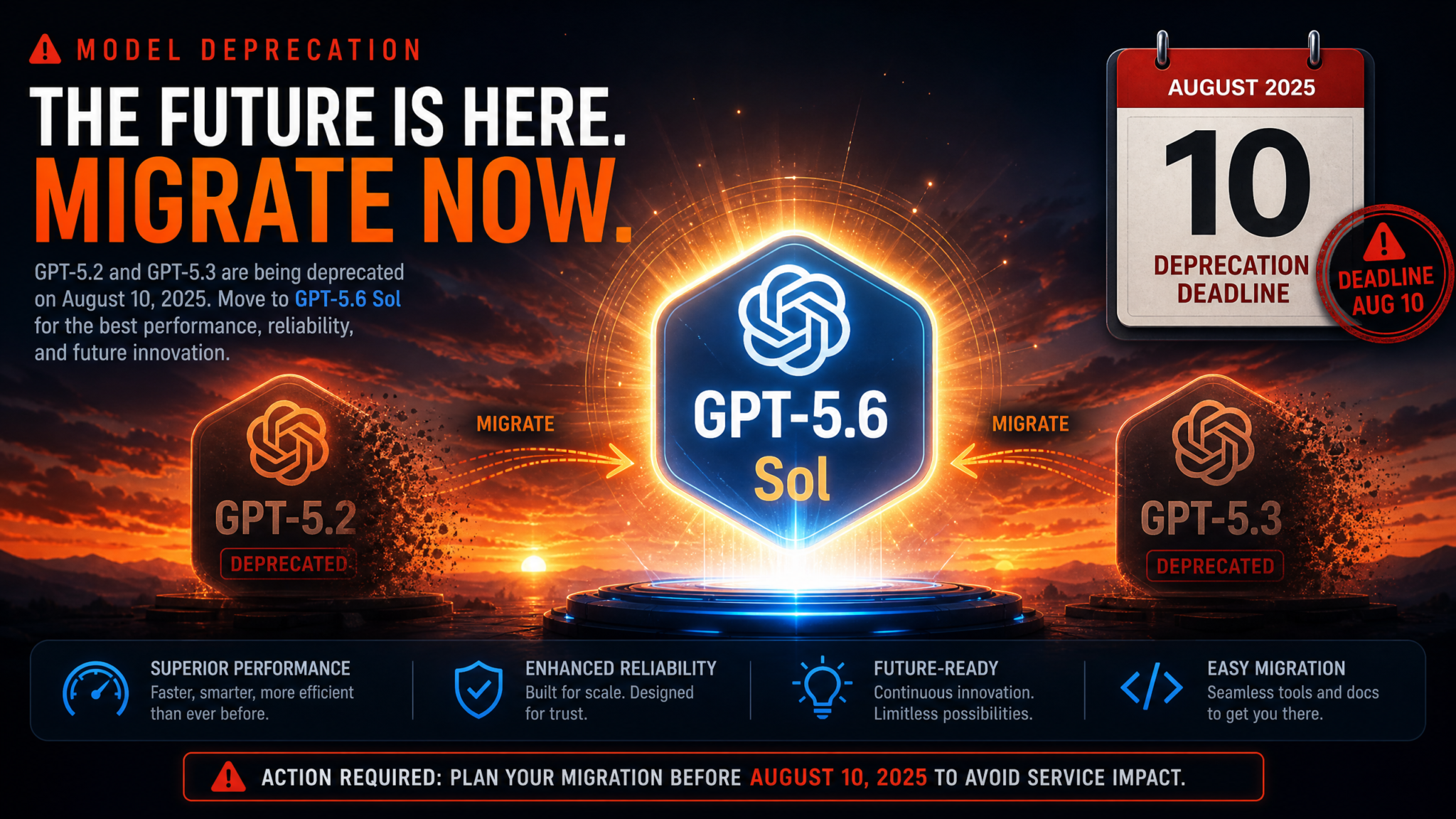
OpenAI has officially confirmed that GPT-5.2 Chat Latest and GPT-5.3 Chat Latest will be permanently retired on August 10, 2026, giving developers just days to complete their migration to the GPT-5.6 model family. The announcement, published through OpenAI’s developer platform dashboard and confirmed via email notices sent to affected API customers, marks one of the more consequential model deprecation events of the year — affecting an estimated 340,000 active API integrations worldwide according to figures cited in OpenAI’s internal developer communication. For teams still running production workloads on these models, the clock is ticking, and the consequences of inaction range from degraded fallback performance to unexpected billing changes and broken application behavior.
What Exactly Is Being Deprecated on August 10
The scope of this deprecation is narrower than some of OpenAI’s previous sunset events but carries outsized impact because GPT-5.2 and GPT-5.3 were positioned as “stable production” models when they launched in late 2025 and early 2026 respectively. Many enterprise development teams built long-lived integrations around them specifically because of that positioning.
The following model identifiers will stop accepting new API requests at 11:59 PM Pacific Time on August 10, 2026:
gpt-5.2-chat-latestgpt-5.2-chat-0115(the pinned January 2026 snapshot)gpt-5.2-chat-0301(the pinned March 2026 snapshot)gpt-5.3-chat-latestgpt-5.3-chat-0420(the pinned April 2026 snapshot)
Notably, gpt-5.2-instruct and gpt-5.3-instruct — the non-chat, completion-endpoint variants of these models — are not included in this deprecation wave. OpenAI has indicated in its developer FAQ that the instruct variants will remain available through at least Q1 2027, as those models still serve a meaningful segment of legacy text-completion workloads that have not yet transitioned to the Chat Completions API. OpenAI Chat Completions vs Instruct API Differences Explained
OpenAI’s deprecation notice also clarifies that this is a hard cutoff, not a soft redirect. Once August 10 passes, API calls referencing the deprecated model identifiers will return a 404 Model Not Found error rather than silently routing traffic to a fallback — a change in policy from the company’s earlier practice of automatically redirecting deprecated model calls to the nearest available successor. That earlier approach, while developer-friendly in the short term, caused widespread confusion when application behavior changed silently. OpenAI’s current policy of hard cutoffs is designed to force explicit migration decisions, even though it creates more urgent pressure on development teams.
“We recognize this creates urgency for some teams. The decision to move to hard-stop deprecations rather than silent redirects was deliberate — silent redirects were causing production incidents where developers had no idea their model had changed. A clean 404 is debuggable. A silently degraded prompt response is not.” — OpenAI Developer Relations, posted to the OpenAI Community Forum, July 28, 2026
Why OpenAI Is Retiring GPT-5.2 and GPT-5.3
Understanding the reasoning behind this deprecation is important not just for managing the immediate migration but for anticipating how OpenAI will handle future model lifecycles. The stated rationale centers on three interrelated factors: infrastructure consolidation, the emergence of the GPT-5.6 model family as a comprehensive replacement, and the operational cost of maintaining older model weights alongside newer ones.
Infrastructure Consolidation Around GPT-5.6
OpenAI’s compute infrastructure operates at a scale where even relatively minor efficiency gains across its server fleet translate into enormous cost savings. Maintaining multiple distinct model weight sets — each requiring dedicated GPU memory allocation, routing logic, and monitoring overhead — imposes a significant operational burden. When GPT-5.6 launched in June 2026 across three variants (Sol, Luna, and Terra), it was explicitly designed to cover the use-case range previously served by GPT-5.1 through GPT-5.4. The three-variant structure allows OpenAI to route different workload types to different optimized configurations while running on a consolidated infrastructure stack.
In its developer communication, OpenAI noted that GPT-5.2 and GPT-5.3 together account for approximately 18% of active API calls but require infrastructure maintenance equivalent to roughly 34% of the engineering overhead associated with the GPT-5.x family due to compatibility shims, separate fine-tuning pipelines, and isolated monitoring systems. Retiring these models allows OpenAI to redirect that engineering capacity toward GPT-5.6 improvements and the upcoming GPT-6 development track.
Capability Obsolescence
GPT-5.2 was released in November 2025 and GPT-5.3 followed in February 2026. In the compressed timescale of modern foundation model development, those releases are now considered at least two full generations behind in several key capability benchmarks. GPT-5.6’s Terra variant in particular demonstrates substantial improvements in multi-step reasoning, code generation accuracy, and instruction-following consistency — areas where GPT-5.2 and GPT-5.3 showed documented weaknesses that OpenAI patched only partially with subsequent system prompt updates.
Safety and Alignment Updates
A less prominently discussed but significant factor involves OpenAI’s ongoing safety and alignment work. GPT-5.6 incorporates a revised RLHF training pipeline with updated human feedback data collected through 2026, and a new Constitutional AI layer that was not retroactively applied to GPT-5.2 or GPT-5.3. Maintaining older models on production infrastructure means maintaining what OpenAI internally characterizes as “legacy safety surface” — an ongoing risk factor that the company wants to eliminate as quickly as responsibly possible.
The Replacement Models: GPT-5.6 Sol, Luna, and Terra
The GPT-5.6 family consists of three distinct variants, each optimized for a different performance-cost profile. Understanding which variant maps to your existing GPT-5.2 or GPT-5.3 use case is the first decision in any migration plan.
| Variant | Model ID | Context Window | Optimized For | Recommended Replacement For |
|---|---|---|---|---|
| GPT-5.6 Sol | gpt-5.6-sol |
64K tokens | Speed and cost efficiency; lightweight tasks | GPT-5.2 Chat Latest (standard workloads) |
| GPT-5.6 Luna | gpt-5.6-luna |
128K tokens | Balanced capability and cost; most general tasks | GPT-5.3 Chat Latest (general purpose) |
| GPT-5.6 Terra | gpt-5.6-terra |
256K tokens | Complex reasoning, long-context analysis, agentic workflows | Advanced GPT-5.3 use cases requiring deeper reasoning |
Sol is the closest functional replacement for standard GPT-5.2 workloads — customer support bots, content generation pipelines, classification tasks, and other applications where throughput and cost matter more than raw capability ceiling. Sol processes requests approximately 23% faster than GPT-5.2 Chat Latest in benchmark testing and comes in at a slightly lower token price point.
Luna is the primary successor for GPT-5.3 Chat Latest workloads. It covers the same general-purpose territory with meaningfully improved performance across reasoning tasks, code generation, and long-form writing, while maintaining a familiar API contract that minimizes the surface area of required code changes.
Terra is positioned at the high end of the family, and while it’s overkill for most applications previously running on GPT-5.2 or GPT-5.3, teams with complex agentic workflows or long-document analysis requirements should seriously evaluate it. Its 256K context window — quadruple what GPT-5.3 offered — is particularly relevant for legal tech, research, and document processing applications.
GPT-5.6 Terra vs GPT-5.6 Luna Full Benchmark Comparison
API Changes Required for Migration
For the majority of applications, the core migration change is straightforward: update the model parameter in your API calls. However, there are several secondary considerations that developers need to review carefully before treating the migration as complete.
Basic Model Parameter Update
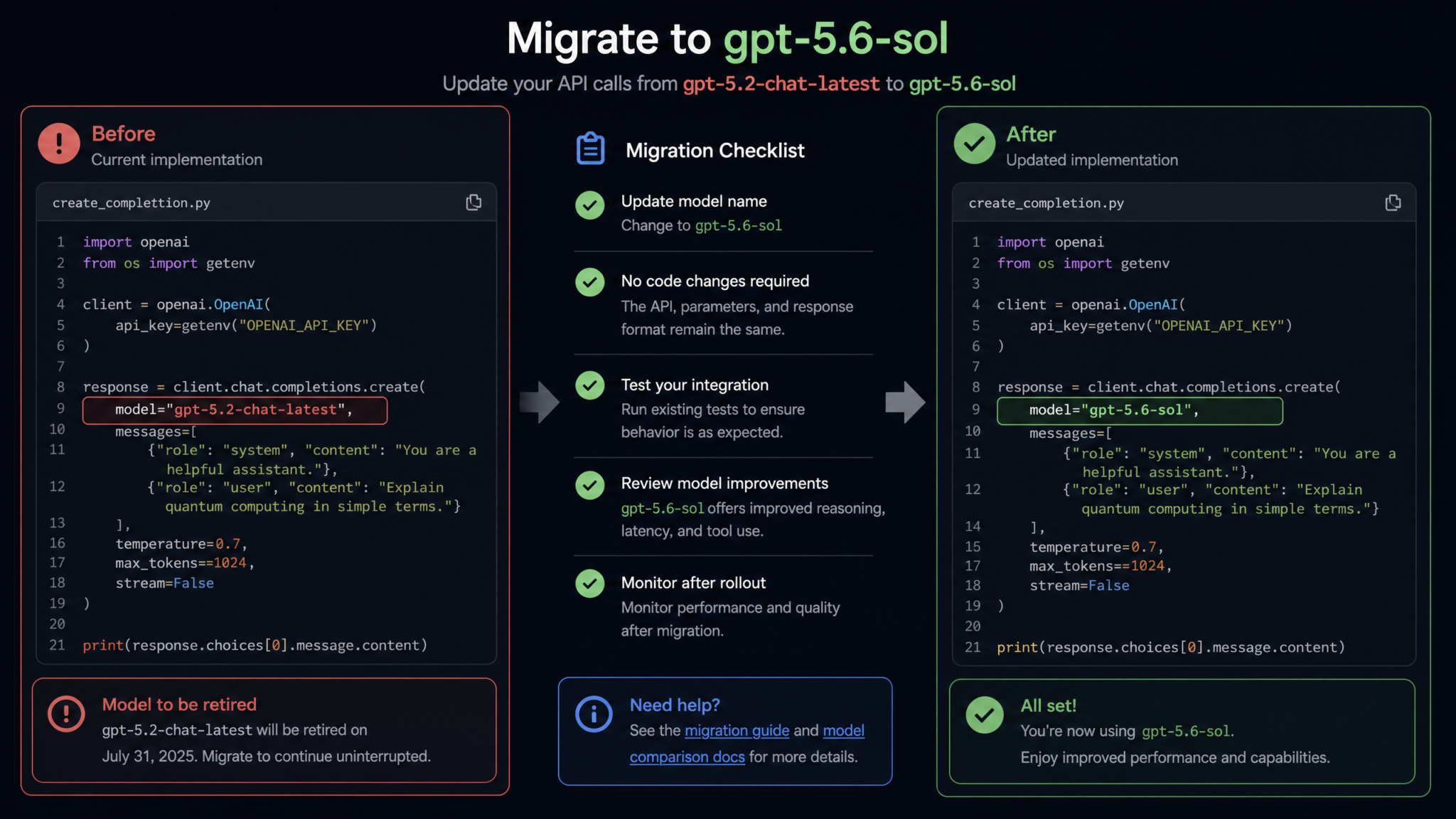
Here is a before-and-after comparison of the most common API call pattern, using Python with the OpenAI SDK:
# BEFORE: GPT-5.2 or GPT-5.3 API call
from openai import OpenAI

client = OpenAI(api_key="your-api-key")

response = client.chat.completions.create(
    model="gpt-5.2-chat-latest",  # DEPRECATED August 10, 2026
    messages=[
        {"role": "system", "content": "You are a helpful assistant."},
        {"role": "user", "content": "Summarize the following document..."}
    ],
    max_tokens=1024,
    temperature=0.7
)

print(response.choices[0].message.content)
# AFTER: GPT-5.6 Luna (recommended replacement for GPT-5.3)
from openai import OpenAI

client = OpenAI(api_key="your-api-key")

response = client.chat.completions.create(
    model="gpt-5.6-luna",  # Recommended successor
    messages=[
        {"role": "system", "content": "You are a helpful assistant."},
        {"role": "user", "content": "Summarize the following document..."}
    ],
    max_tokens=1024,
    temperature=0.7,
    # New optional parameters available in GPT-5.6
    reasoning_effort="standard",  # Options: "minimal", "standard", "thorough"
    response_format={"type": "text"}
)

print(response.choices[0].message.content)
New Parameters in the GPT-5.6 API Contract
GPT-5.6 introduces several new optional parameters that were not present in GPT-5.2 or GPT-5.3. None of these are required for basic migration, but understanding them is important for taking full advantage of the new models and for avoiding unexpected behavior:
reasoning_effort— Controls the depth of chain-of-thought reasoning the model applies before generating its response. Defaults to"standard". Setting this to"minimal"reduces latency and cost for simple tasks;"thorough"enables extended reasoning for complex problems. This parameter replaces the informal practice of using system prompt instructions to influence reasoning depth.context_persistence— A boolean that, when set totrue, enables OpenAI’s server-side conversation state caching for multi-turn applications. This was available as a beta feature in GPT-5.3 but is now generally available and officially supported in GPT-5.6.output_schema— An enhanced version of theresponse_formatparameter that accepts a full JSON Schema definition for structured output. This supersedes the earlierresponse_format: {"type": "json_object"}approach and provides stricter output conformance guarantees.tool_choice_strategy— Controls how the model decides between available tools in function-calling scenarios. Options are"conservative","balanced", and"aggressive", allowing developers to tune tool invocation frequency for their specific agentic workflow.
Response Object Differences
The response object structure has minor but important changes in GPT-5.6 that can break applications with strict response parsing:
# GPT-5.2 / GPT-5.3 response object (simplified)
{
  "id": "chatcmpl-abc123",
  "object": "chat.completion",
  "model": "gpt-5.2-chat-latest",
  "choices": [...],
  "usage": {
    "prompt_tokens": 45,
    "completion_tokens": 122,
    "total_tokens": 167
  }
}

# GPT-5.6 response object (simplified) — note new fields
{
  "id": "chatcmpl-xyz789",
  "object": "chat.completion",
  "model": "gpt-5.6-luna",
  "choices": [...],
  "usage": {
    "prompt_tokens": 45,
    "completion_tokens": 122,
    "total_tokens": 167,
    "reasoning_tokens": 18,       # NEW: tokens used in internal reasoning
    "cached_tokens": 0             # NEW: tokens served from context cache
  },
  "system_fingerprint": "fp_5d6a9c2b1e",
  "performance_tier": "standard"   # NEW: reflects compute tier used
}
If your application parses the usage object expecting exactly three keys, the additional fields will not cause errors in most SDK versions, but applications using strict schema validation or TypeScript interfaces with exhaustive property checks may throw validation exceptions. Review your response parsing logic before deploying the migration to production.
Step-by-Step Migration Path for Developers
Given the hard cutoff on August 10, here is the practical migration sequence that OpenAI’s developer relations team recommends, supplemented with additional steps based on industry best practices for API migrations under time pressure.
Step 1: Audit All Model References in Your Codebase
Before writing a single line of new code, conduct a thorough audit of everywhere a deprecated model identifier appears. This includes not just your primary application code but configuration files, environment variables, database records storing model preferences, third-party integration settings, and any infrastructure-as-code templates.
# Shell command to find all deprecated model references in a codebase
grep -rn "gpt-5\.2\|gpt-5\.3" ./src ./config ./infra --include="*.py" \
  --include="*.js" --include="*.ts" --include="*.json" \
  --include="*.yaml" --include="*.env*" \
  | grep -v ".git"
Many teams discover model identifiers hardcoded in unexpected places — database seed files, cached API response fixtures used in testing, admin dashboard configurations, or legacy scripts maintained by non-engineering team members. A thorough grep audit before beginning the migration prevents surprise failures after deployment.
Step 2: Select Your Target GPT-5.6 Variant
Use the mapping table above as a starting point, but validate your selection against your specific workload characteristics. If your application uses GPT-5.2 for a simple classification task, Sol is almost certainly the right choice. If you use GPT-5.3 for complex multi-step reasoning, evaluate Luna and Terra before committing. The one-week window between now and August 10 is enough time to run comparative evaluations if you start immediately.
Step 3: Update Model Parameters in a Feature Branch
Make all model parameter changes in a dedicated feature branch or behind a feature flag. Never migrate directly on main/production without an intermediate testing stage. If your application supports environment-variable-based model configuration (recommended practice), update the configuration value and test without touching application logic.
# Recommended pattern: environment-variable-driven model selection
# .env.production (before migration)
OPENAI_MODEL=gpt-5.2-chat-latest

# .env.production (after migration)
OPENAI_MODEL=gpt-5.6-luna

# application code (model-agnostic, no changes needed)
import os
from openai import OpenAI

client = OpenAI()
model = os.environ.get("OPENAI_MODEL", "gpt-5.6-luna")

response = client.chat.completions.create(
    model=model,
    messages=messages
)
Step 4: Update Prompt Templates if Necessary
GPT-5.6 models respond differently to some prompting patterns that were tuned for GPT-5.2 and GPT-5.3. In particular, verbose chain-of-thought instructions in system prompts (“Think step by step before answering…”) may produce redundant reasoning output in GPT-5.6 Luna and Terra because the models natively apply structured reasoning. Review your system prompts and evaluate whether they can be simplified.
Step 5: Run Your Evaluation Suite
Execute your existing evaluation suite against the new model before deploying to production. If you don’t have an evaluation suite — a situation that should itself prompt reflection — run at least a representative sample of 50-100 real prompts from production logs through both the old and new model and compare outputs qualitatively. Building an LLM Evaluation Pipeline for Production Applications
Step 6: Deploy with Observability in Place
When deploying the migrated model to production, ensure your observability stack is capturing model identifiers in API call logs. This allows you to confirm traffic is flowing to the new model and to quickly diagnose any output quality regressions through log correlation.
Impact on Existing Applications
The impact of this deprecation varies significantly depending on how an application was architected and what it was using these models for. Here is a breakdown by application type and risk level.
| Application Type | Typical Model Usage | Migration Risk Level | Primary Concern |
|---|---|---|---|
| Customer support chatbots | GPT-5.2 for standard Q&A | Low | Minor tone/response style differences |
| Content generation pipelines | GPT-5.2 or 5.3 for drafting | Low–Medium | Output format consistency with downstream parsers |
| Code generation tools | GPT-5.3 for code tasks | Medium | Syntax and style differences in generated code |
| Agentic / function-calling apps | GPT-5.3 with tools | Medium–High | Tool invocation behavior changes in 5.6 |
| Fine-tuned model deployments | 5.2/5.3 as base for fine-tune | High | Fine-tunes on deprecated base models need retraining |
| Document analysis / RAG systems | GPT-5.3 for long context | Low | GPT-5.6 context windows are larger — minimal concern |
| Structured output / JSON extraction | GPT-5.2/5.3 with json_object | Medium | New output_schema parameter offers improvements but requires testing |
The highest-risk category is fine-tuned model deployments. Teams that fine-tuned GPT-5.2 or GPT-5.3 for domain-specific tasks face the most complex migration: fine-tuning jobs on deprecated base models cannot be migrated by simply updating a model parameter. They require retraining on GPT-5.6 Sol or Luna (Terra fine-tuning support is not yet generally available as of this writing). OpenAI has extended a free fine-tuning credit of up to 500,000 training tokens for affected customers who submit a migration request through the developer dashboard before August 7. This offer applies per organization, not per fine-tuned model, so teams with multiple fine-tuned variants should prioritize accordingly.
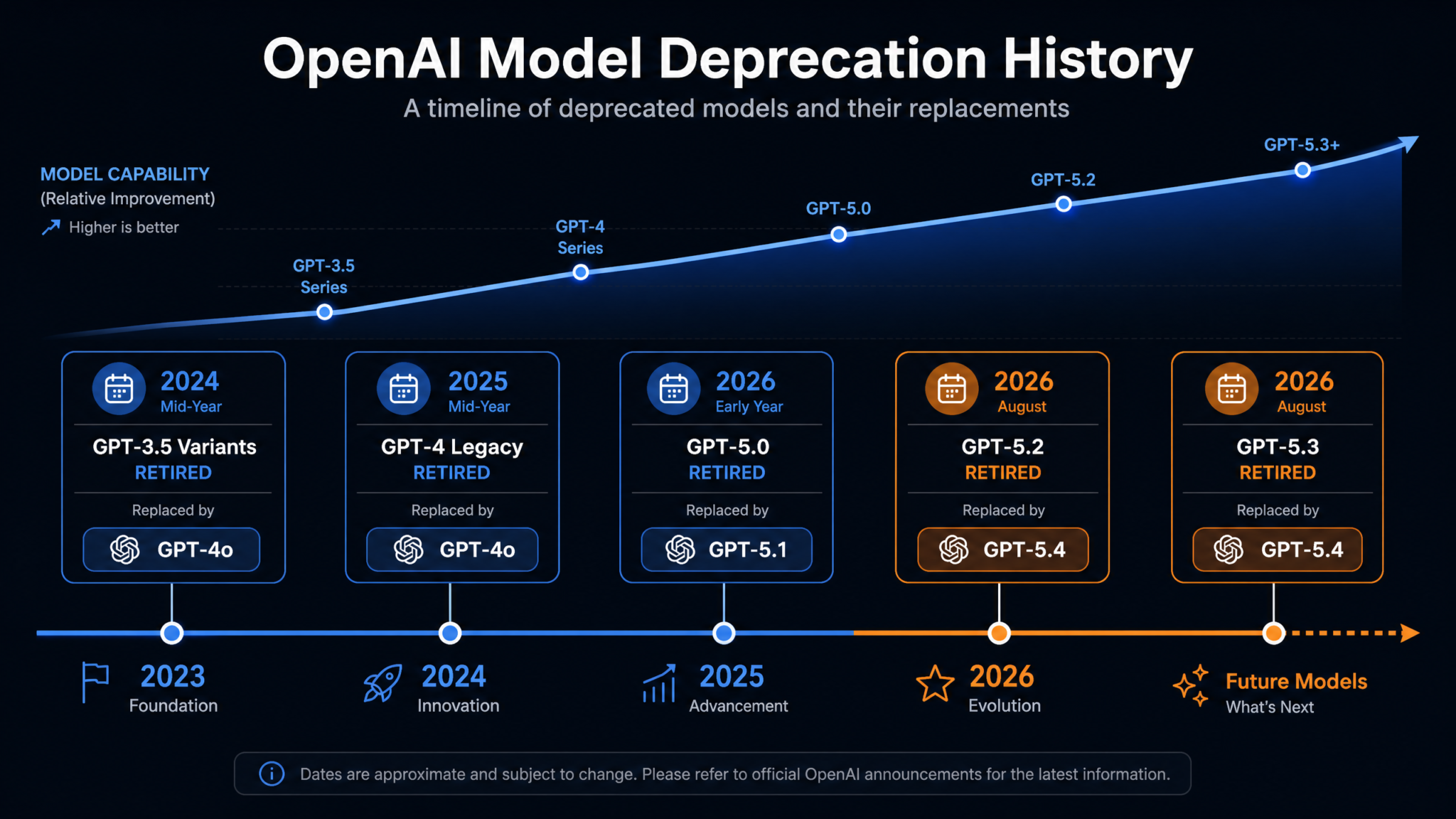
Historical Pattern of OpenAI Model Deprecations
This deprecation follows a pattern that has become familiar to developers who have worked with OpenAI’s API since its early days. Understanding the historical cadence helps teams build migration expectations into their architecture planning rather than treating deprecations as surprise events.
A condensed timeline of major OpenAI model deprecation events:
- June 2023: GPT-3.5-turbo-0301 deprecated; developers migrated to GPT-3.5-turbo-0613. Affected approximately 120,000 integrations. First instance of OpenAI sending proactive email notifications to affected API customers.
- January 2024: GPT-4-0314 and GPT-4-0613 deprecated; migration to GPT-4-turbo. First deprecation to involve a major context window change (8K to 128K), creating opportunities but also prompt engineering disruption for applications relying on the natural context limit as an implicit truncation mechanism.
- September 2024: GPT-3.5-turbo-instruct sunset. Marked the end of OpenAI’s legacy completions endpoint support for GPT-3.5 series models.
- March 2025: GPT-4-turbo-preview and GPT-4-turbo-0125 deprecated as GPT-4.5 became the new standard. Affected over 200,000 integrations and generated significant community backlash due to a compressed 45-day notice window.
- November 2025: GPT-4.5 family deprecated in favor of GPT-5.1, completing the GPT-4 to GPT-5 transition. Largest single deprecation event by affected integration count to date.
- August 10, 2026: GPT-5.2 and GPT-5.3 Chat Latest models deprecated. Current event.
Several patterns are visible across this history. Notice periods have ranged from 30 days (early deprecations) to 90 days (the current norm). OpenAI has generally maintained instruct-variant models longer than chat-variant models. And deprecations have consistently accelerated the closer OpenAI gets to releasing a new model family — the retirement of GPT-5.2 and GPT-5.3 arriving approximately 60 days after GPT-5.6’s general availability fits this pattern precisely.
The average time between model release and deprecation has also compressed. GPT-3.5-turbo had a useful life of approximately 18 months before deprecations began reshaping the landscape. GPT-5.2 will have been available for approximately 9 months when it reaches end-of-life — a compression that reflects both the accelerating pace of capability improvements and OpenAI’s growing operational motivation to consolidate its infrastructure footprint. Complete History of OpenAI API Model Deprecations and Migration Timelines
How to Test Your Migration Before the Cutoff
With less than a week until the deprecation date, testing rigorously but efficiently is the challenge. Here is a pragmatic testing approach for teams under time pressure.
Parallel Traffic Testing
If your infrastructure allows it, the most reliable pre-migration test is parallel traffic splitting: route a percentage of live traffic to the new model while the old model continues serving the remainder. Compare response quality, latency distributions, and error rates in real time. Even a 5% split over 24 hours against high-volume traffic generates statistically meaningful performance data.
import random
from openai import OpenAI

client = OpenAI()

def get_model_for_request(migration_percentage: float = 0.05) -> str:
    """
    Routes traffic to new model based on migration percentage.
    Gradually increase migration_percentage from 0.05 to 1.0
    as confidence in the migration grows.
    """
    if random.random() < migration_percentage:
        return "gpt-5.6-luna"      # New model
    else:
        return "gpt-5.2-chat-latest"  # Legacy model (until Aug 10)

def chat_completion(messages: list, migration_percentage: float = 0.05):
    model = get_model_for_request(migration_percentage)

    response = client.chat.completions.create(
        model=model,
        messages=messages
    )

    # Log model used for observability
    log_model_usage(model, response.usage)

    return response
Regression Testing with Production Prompt Samples
Export a representative sample of recent production prompts (stripping any PII in compliance with your data handling policies) and run them through both models. Automated scoring using an LLM-as-judge approach — where a separate GPT-5.6 Terra instance evaluates the quality of both responses on dimensions like accuracy, helpfulness, and adherence to instructions — can process hundreds of test cases quickly and provide quantitative comparison metrics.
Critical Path Testing
If you cannot complete comprehensive testing before August 10, prioritize testing your application's highest-stakes flows: the paths that handle the most traffic volume, generate direct revenue, or have the highest cost of failure. Document any behavioral differences observed and assess whether they represent regressions or acceptable changes before deciding whether to proceed with the migration or escalate to OpenAI support for an extension request.
OpenAI has confirmed that case-by-case extension requests will be considered for enterprise customers with documented migration blockers, submitted through the enterprise support portal before August 8. However, extensions are not guaranteed and are evaluated individually based on circumstances. Do not rely on an extension as a backup plan.
GPT-5.2/5.3 vs. GPT-5.6: Capability Differences Compared
Beyond the migration mechanics, developers evaluating this transition should understand the actual capability differences between the old and new models. In most dimensions, GPT-5.6 represents a meaningful upgrade — but the upgrade is not uniform across all task types, and in a few areas, behavioral changes may require prompt engineering adjustments.
| Capability | GPT-5.2 | GPT-5.3 | GPT-5.6 Sol | GPT-5.6 Luna | GPT-5.6 Terra |
|---|---|---|---|---|---|
| Context Window | 32K | 64K | 64K | 128K | 256K |
| Multi-step Reasoning (MATH-500) | 71.2% | 76.8% | 74.1% | 82.4% | 89.7% |
| Code Generation (HumanEval+) | 68.5% | 74.2% | 72.8% | 80.1% | 86.3% |
| Instruction Following (IFEval) | 79.3% | 83.1% | 84.6% | 88.9% | 91.2% |
| Structured Output Reliability | Medium | Medium-High | High | Very High | Very High |
| Function Calling Accuracy | 76.4% | 81.7% | 82.3% | 87.5% | 90.1% |
| Average Latency (512-token response) | 2.1s | 2.8s | 1.6s | 2.3s | 3.4s |
| Multilingual Support (languages) | 47 | 54 | 54 | 68 | 68 |
Several capability improvements deserve specific attention for developers migrating production applications:
Structured output reliability is notably improved across the GPT-5.6 family. Applications that used GPT-5.2 or GPT-5.3 with response_format: {"type": "json_object"} and experienced occasional malformed JSON output should see this issue largely eliminated with GPT-5.6's enhanced output conformance guarantees, particularly when using the new output_schema parameter.
Function calling accuracy improvements in GPT-5.6 Luna mean that agentic applications will observe a reduction in unnecessary tool calls ("over-triggering") and missed tool invocations ("under-triggering") that were documented weaknesses in GPT-5.3. This is generally a positive change but may alter application flow in ways that require testing — particularly if downstream logic assumes a specific tool invocation frequency.
Latency is improved for Sol and comparable for Luna relative to their recommended predecessors. Terra is slower than GPT-5.3, which should be factored into user experience considerations for real-time applications evaluating Terra as their migration target.
Access 40,000+ AI Prompts for ChatGPT, Claude & Codex — Free!
Subscribe to get instant access to our complete Notion Prompt Library — the largest curated collection of prompts for ChatGPT, Claude, OpenAI Codex, and other leading AI models. Optimized for real-world workflows across coding, research, content creation, and business.
Pricing Changes and Cost Implications
One of the practical questions developers and finance teams are asking is how this migration affects API costs. The answer depends on which GPT-5.6 variant you select, your current usage volumes, and whether you're leveraging the new context caching feature.
| Model | Input (per 1M tokens) | Output (per 1M tokens) | Cached Input (per 1M tokens) |
|---|---|---|---|
| GPT-5.2 Chat Latest (retiring) | $3.20 | $9.60 | $1.60 |
| GPT-5.3 Chat Latest (retiring) | $4.80 | $14.40 | $2.40 |
| GPT-5.6 Sol | $2.80 | $8.40 | $1.12 |
| GPT-5.6 Luna | $4.20 | $12.60 | $1.68 |
| GPT-5.6 Terra | $7.50 | $22.50 | $3.00 |
The headline observation is that the direct replacement paths — GPT-5.2 → Sol and GPT-5.3 → Luna — both carry lower prices than the models they replace, representing approximately a 12-14% cost reduction at equivalent token volumes. This is consistent with the historical pattern of OpenAI reducing per-token pricing with each new model generation as inference efficiency improves.
Teams migrating from GPT-5.3 to Terra (where use-case requirements justify the capability upgrade) should anticipate approximately a 56% increase in input token costs — a significant consideration for high-volume applications. However, Terra's superior performance on complex tasks often means it completes multi-step workflows in fewer API calls than GPT-5.3 required, partially offsetting the per-token price premium in well-optimized agentic architectures.
The new context caching pricing is particularly relevant for applications with repetitive system prompts or frequent re-submission of shared document content. Teams that implement context persistence through GPT-5.6's context_persistence parameter can expect to see cached input tokens billed at 40% of the standard input rate — a meaningful reduction for chatbot applications that resend long conversation histories with each turn.
What Happens If You Don't Migrate: Fallback Behavior Explained
As noted earlier, OpenAI has moved away from silent fallback behavior in favor of hard errors on deprecated model requests. This is a significant policy change from earlier deprecation cycles and deserves explicit attention.
Starting at 12:00 AM Pacific Time on August 11, 2026, any API call specifying a deprecated model identifier will receive the following error response:
{
  "error": {
    "message": "The model 'gpt-5.2-chat-latest' has been deprecated and is no longer available. Please migrate your application to use a supported model. See https://platform.openai.com/docs/deprecations for migration guidance.",
    "type": "invalid_request_error",
    "param": "model",
    "code": "model_not_found"
  }
}
This error will be returned with an HTTP 404 status code. Applications that do not handle this error gracefully will experience complete functional failure for affected API calls. There is no automatic routing, no degraded mode, and no warning period after August 10 — just an immediate 404.
The practical consequences span several dimensions:
User-facing failures: Any application that surfaces API errors to end users will show error states rather than responses. Customer support chatbots will stop responding. Content generation tools will fail silently or show error messages. The user experience impact will be immediate and highly visible.
Agentic workflow failures: Applications running automated agentic workflows — scheduled content generation, document processing pipelines, monitoring agents — will fail at the API call step, potentially leaving workflows in indeterminate states or generating error logs without automatic recovery.
Billing implications: OpenAI will not charge for failed requests due to model deprecation. However, if your application logic retries on errors, you may observe retry loop behavior generating a high volume of requests that return 404 errors. Ensure your retry logic excludes model_not_found errors from the retry-eligible error set.
from openai import OpenAI, APIError
import time

client = OpenAI()

def chat_with_retry(messages: list, max_retries: int = 3) -> str:
    """
    Retry logic that correctly excludes model_not_found errors.
    model_not_found errors are not transient and should not be retried.
    """
    non_retryable_codes = {"model_not_found", "invalid_api_key", "insufficient_quota"}

    for attempt in range(max_retries):
        try:
            response = client.chat.completions.create(
                model="gpt-5.6-luna",  # Ensure this is updated before Aug 10
                messages=messages
            )
            return response.choices[0].message.content

        except APIError as e:
            if e.code in non_retryable_codes:
                raise  # Do not retry — surface the error immediately

            if attempt < max_retries - 1:
                wait_time = 2 ** attempt  # Exponential backoff
                time.sleep(wait_time)
            else:
                raise
Best Practices for Future-Proofing Against Model Deprecations
The stress this deprecation is causing many development teams is, in large part, a symptom of architectural decisions made when integrating with OpenAI's API. Hardcoded model identifiers, tightly coupled prompt logic, and missing evaluation infrastructure all compound the difficulty of responding to deprecation events. Here are the architectural and operational practices that reduce the pain of future deprecations — and there will be future deprecations.
1. Externalize Model Configuration
Never hardcode model identifiers in application logic. Store them in environment variables, feature flag systems, or configuration databases that can be updated without code deployments. This single practice reduces migration time from days to hours for the majority of deprecation scenarios.
2. Build a Model Abstraction Layer
Introduce a thin abstraction layer between your application logic and the OpenAI API. This layer should handle model selection, error translation, retry logic, and logging in a centralized location. When a deprecation occurs, only the abstraction layer needs to change — application logic remains untouched.
3. Maintain an Evaluation Suite
Any production LLM application should have an evaluation suite: a collection of representative input-output pairs against which new model versions can be benchmarked before deployment. The evaluation suite serves both migration validation and ongoing quality monitoring. Without one, migration decisions are made on faith rather than evidence. How to Build LLM Evaluation Suites for Production Chat Applications
4. Subscribe to OpenAI Developer Notifications
OpenAI sends deprecation notices to the email address associated with the primary account for each organization. Ensure this address is actively monitored and that deprecation notices are not filtered to spam. Consider creating a dedicated [email protected] alias that routes to your engineering team's alert channel.
5. Pin Model Versions for Production, Track Latest for Development
Use gpt-5.6-luna-latest in development environments to stay current with improvements, but pin to a dated snapshot identifier (e.g., gpt-5.6-luna-0601) in production to ensure output consistency between deployments. Monitor OpenAI's deprecation announcements for snapshot-level retirement schedules, which typically provide more lead time than latest-version deprecations.
6. Implement Model-Version Logging
Log the model field from every API response object in your observability stack. This provides an audit trail of exactly which model version served each request and enables rapid diagnosis of output quality changes correlated with model updates.
Community Reaction and Developer Concerns
The developer community's response to this deprecation announcement has been notable for its blend of resignation and technical frustration. Threads on the OpenAI Community Forum, Hacker News, and Reddit's r/MachineLearning subreddit reflect a development community that has grown accustomed to deprecations but has not fully made peace with them.
The dominant technical concern raised by developers is the treatment of fine-tuned models on deprecated base models. As one developer with a 50,000-user production application wrote on the OpenAI forum:
"We spent three months and roughly $40K in training costs fine-tuning GPT-5.3 for our specific domain. Now we're looking at retraining from scratch on 5.6 Luna with 90 days of notice. The free credit covers a fraction of the training cost. The real cost is the engineering time and the evaluation time to confirm the retrained model performs equivalently. There's no shortcut for that."
This concern has generated enough volume that OpenAI's developer relations team issued a supplementary note clarifying that fine-tuning teams should contact enterprise support for individualized migration assistance, including potential access to an accelerated fine-tuning queue and extended evaluation support. That response has been characterized as insufficient by much of the affected community, with criticism focusing on the lack of a systematic policy for fine-tuned model migration support rather than case-by-case handling.
A second significant concern involves the compression of model useful lifespans. Developer sentiment analysis of forum threads shows a clear correlation between time in the industry and frustration level: developers who have been building on OpenAI's API since 2023 are significantly more vocal about the accelerating deprecation cadence than newer developers who entered the ecosystem with shorter lifecycle expectations already embedded in their mental models.
On the positive side, the community response to the actual capability improvements in GPT-5.6 has been warm. Developers who have completed early migrations report that the improvements to structured output reliability and instruction following are "immediately noticeable in production" and that the prompt engineering burden has reduced with GPT-5.6's improved instruction following capabilities. Several contributors to the OpenAI forum's migration thread noted that previously problematic prompts that required careful engineering around GPT-5.2 or GPT-5.3 limitations "just work" with GPT-5.6 Luna without modification.
There is also measured acknowledgment among experienced API users that the shift to hard-stop deprecations — while painful in the short term — represents better practice than silent redirects. The 2025 GPT-4.5 deprecation event, which used silent redirects initially before switching to hard stops, generated more production incidents than the current approach is likely to, even accounting for applications that have not yet begun migration.
Third-party AI tooling providers have been among the fastest to adapt. LangChain, LlamaIndex, and several commercial LLM orchestration platforms pushed GPT-5.6 support updates within 24 hours of the deprecation announcement. Teams using these frameworks as middleware between their application logic and the OpenAI API have a significantly lighter migration path — in many cases, a single configuration value update is sufficient.
Final Assessment and Action Items
The August 10 retirement of GPT-5.2 and GPT-5.3 Chat Latest is simultaneously one of the more disruptive deprecation events in OpenAI's history — given the scale of active integrations affected — and one of the more developer-friendly in terms of the quality of the replacement options available. GPT-5.6 Sol and Luna are genuinely better models at lower price points than their predecessors. The migration path is technically straightforward for the majority of use cases. The hard-stop policy, while creating urgency, removes ambiguity that historically caused worse outcomes through silent degradation.
The legitimate pain points — compressed fine-tuning migration windows, accelerating model lifecycles, and the operational overhead of continuous migration maintenance — are real and deserve acknowledgment. They also represent the current state of a technology field moving faster than any single vendor's policies can comfortably accommodate. The best response is the architectural one: build systems that are designed to accommodate model changes as a recurring operational reality rather than treating each deprecation as an exceptional event requiring emergency response.
For teams facing the immediate August 10 deadline, here are the prioritized action items:
- Today: Run the grep audit. Identify every reference to deprecated model identifiers in your codebase and infrastructure.
- Today–August 6: Select your GPT-5.6 target variant. Begin testing in a staging environment. Prioritize your highest-traffic and highest-stakes application flows.
- August 6–7: Deploy migration to production with observability monitoring in place. Start with low-traffic windows if possible. Confirm traffic is routing to the new model in logs.
- August 8–9: Monitor production for output quality regressions, error rate changes, and latency anomalies. If fine-tuned models are involved and migration is not complete, contact OpenAI enterprise support immediately.
- August 10: Verify 100% of traffic is routing to GPT-5.6 variants before 11:59 PM Pacific. Keep your observability dashboard active through the midnight transition window.
- Post-migration: Implement the architectural improvements described in this article to ensure future deprecations are operational events rather than emergencies.
The model is changing. The more important question is whether your architecture is ready to accommodate model changes as a normal condition of building on foundation model APIs — because this will not be the last time OpenAI retires a model you depend on. OpenAI API Integration Architecture Best Practices for Production Applications
