
Prompting AI Agents: How to Write Effective Instructions for Codex, Claude Code, and Autonomous Systems
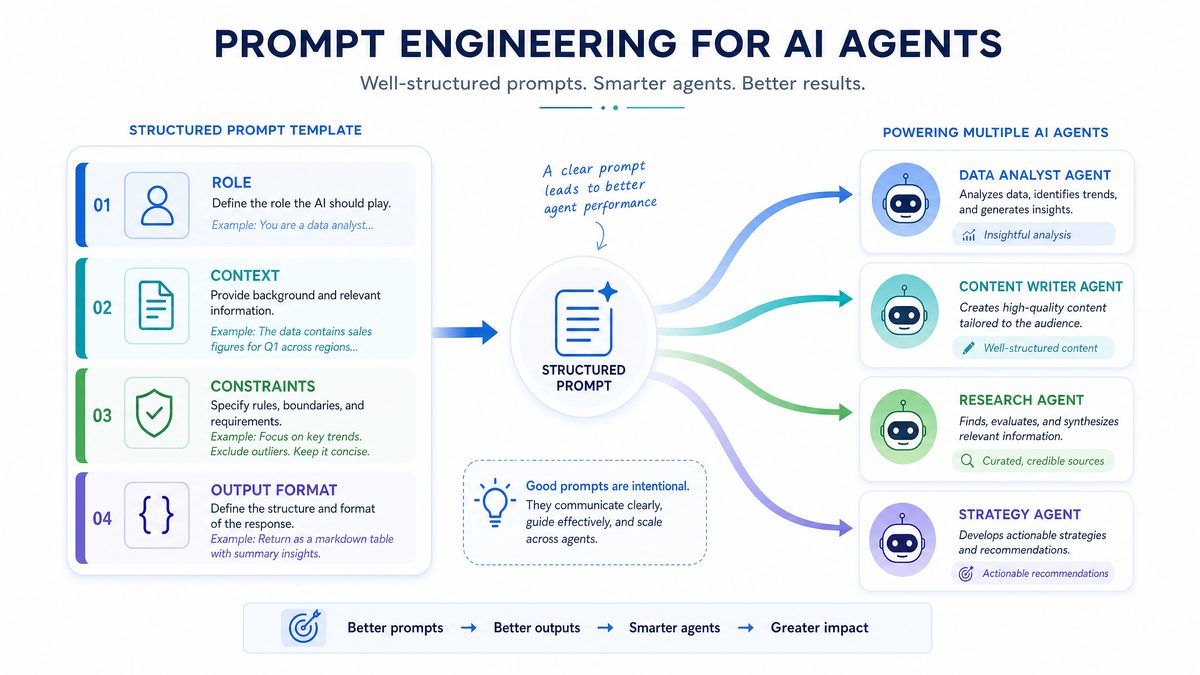
” alt=”Illustration of AI autonomous agents in action” />
As artificial intelligence technology advances, the nature of human-AI interaction is undergoing a paradigm shift. Autonomous AI agents, exemplified by models such as OpenAI Codex, Anthropic’s Claude Code, and Claude Managed Agents, represent a leap beyond traditional conversational AI. Rather than merely responding to input with conversational replies, these autonomous agents execute complex, multi-step tasks, interface directly with external tools, manage internal memory across workflows, and make decisions to fulfill user-defined goals with minimal oversight.
Writing effective prompts for such autonomous AI agents is fundamentally different from crafting prompts for conversational chatbots. The instructions need to be unambiguous, structured, and tailored to leverage the operational capabilities and architectural nuances of these systems. This comprehensive guide delves deep into the art and science of prompting autonomous AI agents. It offers practical and agent-specific techniques for task decomposition, constraint definition, output format control, nuanced memory management, and orchestrating multi-step workflows. Whether you are a developer, product manager, or AI researcher, mastering these principles empowers you to harness autonomous AI agents to their fullest potential and build robust, scalable AI-driven automation solutions.
1. Understanding the Unique Nature of Autonomous AI Agents
” alt=”Workflow diagram of autonomous AI agents versus chatbots” />
To successfully design prompts for autonomous AI agents, it is essential first to appreciate how these entities differ from traditional chatbots and why those differences compel a new prompting approach. The evolution from conversational bots to autonomous agents reflects the AI field’s shift toward AI systems that perform actionable tasks, manage workflows, and integrate with external resources automatically.
1.1 Definition and Capabilities of Autonomous AI Agents
At their core, autonomous AI agents are sophisticated software systems driven by large language models (LLMs) but enhanced with strategic planning abilities, state persistence, and external tool integration. Unlike chatbots, which primarily generate conversation-like text replies, autonomous agents serve as computerized assistants capable of:
- Task Execution: Performing complex, multi-domain operations such as writing detailed codebases, conducting multi-step research analyses, generating reports, scheduling events, or executing API calls without human intervention.
- Tool Integration: Acting as orchestrators of external computational resources, databases, code interpreters, or hardware APIs through precisely crafted instructions that direct when and how to use those tools.
- Memory and State Management: Maintaining internal state, including task progress, intermediate outputs, decision histories, and user preferences, to sustain coherence across multi-turn and recursive workflows.
- Goal-Oriented Behavior: Pursuing well-defined objectives by dynamically planning task sequences and adapting strategies without relying solely on explicit user inputs at every step.
These capabilities render autonomous agents powerful functionaries capable of complex decision-making and operational autonomy. However, extracting deterministic and reliable behaviors requires rethinking how instructions are formulated compared to casual chatbot prompts.
1.2 Key Agent Examples: Codex, Claude Code, and Claude Managed Agents
OpenAI Codex stands out as a specialized AI model trained extensively on large codebases spanning multiple programming languages. Codex supports instruction-driven code generation, debugging, modification, and explanation, and it can autonomously generate syntactically valid code snippets or larger modules. Codex’s strength lies in translating natural language prompts into executable code sequences, making it ideal for software engineering tasks that require precision and adherence to programming conventions.
Claude Code builds upon Anthropic’s Claude architecture by integrating enhanced code understanding, generation, and natural language reasoning capabilities. Claude Code is particularly adept at sophisticated problem-solving that combines logical reasoning with code generation, such as algorithm design, complex refactoring, or verification tasks. Its prompting paradigm often involves multi-modal instructions that embed rationale, ethical constraints, and code synthesis simultaneously.
Claude Managed Agents represent a class of autonomous systems designed to orchestrate workflows that span multiple tasks, tools, and APIs. They operate on declarative prompts typically formatted in JSON or YAML, specifying workflows, constraints, toolkits, and memory management schemas. This architecture allows developers or end users to define multi-step processes with rule-based conditionals, persistent memory states, and dynamic branching logic. Managed Agents excel at automating constraint-satisfaction problems, coordinating multi-tool pipelines, and executing persistent automation tasks across sessions.
1.3 Differences Compared to Traditional Chatbot Prompting
Prompting autonomous AI agents introduces unique demands that distinguish it substantially from conventional chatbot interactions.
- Instruction Specificity: Chatbot prompts often rely on conversational context and implicit understanding, whereas agent prompts must explicitly state task goals, operational constraints, and success criteria to enable autonomous decision-making.
- Structured Output Requirements: Agents frequently produce outputs that feed downstream systems or APIs; thus, prompt instructions must dictate precise output formats. Unstructured or ambiguous responses can break automated pipelines.
- Memory Utilization: Unlike ephemeral chatbot dialogs, autonomous agents use persistent memory or internal state across multiple interactions, requiring instructions on what to remember, discard, and summarize to manage token limits and maintain task continuity.
- Multi-step and Recursive Task Handling: Agents are designed to break down and recursively solve complex tasks. Prompts must therefore describe permissible decomposition strategies, recursion depth, and error correction protocols.
Mastering these differences is a prerequisite for effective autonomous agent development. For foundational concepts on AI prompting that complement this agent-focused approach, consult
While this guide focuses on agent-specific prompting, the foundational frameworks like RTF, CREATE, and Chain-of-Thought covered in our advanced prompt engineering frameworks guide provide the building blocks that agent prompts extend and adapt for autonomous execution. Advanced Prompt Engineering Frameworks for 2026.
.
2. Decomposing Complex Tasks into Manageable Subtasks
” alt=”Flowchart showing task decomposition steps for AI agents” />
Complex workflows often overwhelm both human designers and AI systems if treated as monolithic demands. Autonomous AI agents, however, thrive when given the latitude to split overarching tasks into smaller, logically ordered subtasks. This task decomposition ensures modular handling, improved accuracy, and opportunities for error detection and correction at each stage.
2.1 Why Task Decomposition Matters
Task decomposition boosts agent performance and reliability through several mechanisms:
- Reducing Ambiguity: Large high-level commands inherently contain vague or conflicting requirements. Breaking these into discrete, atomic subtasks forces clarity and allows the agent to focus effort precisely.
- Facilitating Error Detection: Smaller subtasks enable stepwise validation or interactive correction, preventing error propagation in later stages.
- Enabling Incremental Progress: Agents can checkpoint intermediate outputs, aiding in recovery from failures and working within token limits imposed by underlying LLM architectures.
2.2 Designing Prompts for Task Decomposition
Effective prompting strategies for decomposition emphasize precise guidance on the granularity, ordering, and handling of subtasks:
- Explicit Instructions: Enumerate when the agent should initiate decomposition, such as on receiving overall objectives or during multi-turn conversations. Example phrasing: “Break down the following assignment into separate, logically sequential subtasks that can be addressed individually.”
- Guiding Subtask Prioritization: Define how subtasks should be ordered, for example based on precedence relationships, critical paths, or resource constraints. Explicit clarifications prevent the agent from creating random or inefficient plans.
- Examples and Templates: Providing a structured example or template for decomposition outputs ensures consistent formatting and reduces ambiguity—for instance, a numbered list with subtask descriptions and estimated complexities.
- Recursive Task Handling: Clarify whether subtasks themselves can be further decomposed and under what conditions. Instructions may specify maximum recursion depths or fallback mechanisms to constrain infinite loops or over-fragmentation.
2.3 Agent-Specific Features for Decomposition
OpenAI Codex thrives at decomposition when prompts explicitly request modular code generation. Prompt engineers can capitalize on Codex’s ability to generate independent functions or classes for subtasks, boosting code maintainability and testing.
Claude Managed Agents come with native recursive planning modules, configured via structured inputs that define decomposition hierarchies and iterative refinement loops. Prompting these agents involves specifying the workflow structure in JSON or YAML schemas, simplifying complex recursive task executions.
Claude Code uniquely benefits from integrating reasoning instructions that justify why and how subtasks are broken down, adding interpretability layers and guiding the prompt towards logical, disciplined subtask enumeration.
2.4 Example: Prompt Template for Task Decomposition
You are an autonomous agent tasked with completing [TASK DESCRIPTION]. To ensure effectiveness:

1. Break the task into sequential subtasks.
2. Prioritize subtasks based on dependencies.
3. Provide a brief explanation for the order.
4. Output the subtasks as a numbered list.
Applying this pattern helps agents produce actionable work plans that downstream modules or human supervisors can easily validate. For detailed decomposition methodologies and examples, refer to
Organizations implementing agent prompting at scale can reference real-world enterprise AI automation case studies that demonstrate how well-crafted agent instructions translate into measurable business outcomes across different industries. Enterprise AI Automation Case Studies 2026.
.
3. Specifying Constraints and Controlling Output Formats
Precise constraint specification and output format control are cornerstones in ensuring that autonomous AI agents produce outputs compatible with downstream automated systems or APIs. Without such rigour, even the most advanced agent can generate results that are syntactically invalid, semantically off-target, or unprocessable.
3.1 Importance of Constraint Specification
Constraints carve operational boundaries for the agent, limiting behavior and outputs to ensure safety, efficiency, and consistency. Common categories include:
- Resource Limitations: Instructions may specify memory usage caps, execution time limits, or API call quotas to prevent system overload or performance degradation.
- Data Format Constraints: Required output structures such as JSON, XML, CSV, or domain-specific languages must be clearly articulated with syntactic rules and valid key sets.
- Security and Ethical Restrictions: Agents must be directed to avoid sensitive data exposure, unauthorized access, or behaviors violating governance policies.
- Functional Behavior Rules: Explicit directives can prevent unintended behaviors, e.g., forbidding network calls without prior authentication or restricting commands to read-only queries.
3.2 Techniques for Defining Constraints Effectively
- Clear Scope Statement: Define what the agent can and cannot do in unambiguous language, avoiding open-ended instructions that invite differentiable interpretations.
- Explicit Formatting Rules: For example, instruct: “Output your response exclusively as valid JSON objects with keys ‘step’, ‘action’, and ‘parameters’ strictly adhered to.” Constrain allowable data types and nesting levels if needed.
- Constraint Examples: Providing both positive and negative examples of correctly and incorrectly formatted outputs can enhance the agent’s pattern recognition and error avoidance.
- Reinforcement Prompts: Reiterate constraints at multiple points during the workflow, especially before critical output generation steps, to reduce drift or accidental violations.
3.3 Output Format Control for Tool-Using Agents
Autonomous agents interfacing with ecosystems—APIs, databases, or software toolchains—require deterministic and machine-parseable output structures. For instance:
- OpenAI Codex excels at generating syntactically correct code snippets or structured API calls when prompted with explicit format templates and comment-based instruction embedding.
- Claude Managed Agents rely on JSON/YAML specifications for task orchestration. Prompts define workflow steps, tool invocations, and branching logic via declarative blocks that the agent interprets and executes.
- Claude Code balances code generation with reasoning outputs, often requesting intermediate explanation clauses preceding structured code outputs to enhance interpretability and verification.
3.4 Example: Output Format Prompt for a Data Extraction Task
Please extract all relevant customer information from the input text. Return the results as a JSON array with objects containing keys:
- "name" (string)
- "email" (string)
- "phone" (string)
Do not include any other information.
This prompt precisely defines the output schema, effectively reducing post-processing requirements and improving integration robustness.
3.5 Comparative Constraint and Output Control Capabilities
| Feature | OpenAI Codex | Claude Code | Claude Managed Agents |
|---|---|---|---|
| Explicit Output Format Enforcement | Strong for code and JSON formats | Moderate; reliant on reasoning prompt | Very strong; native support for structured JSON/YAML workflows |
| Constraint Specification Granularity | High for function and API call restrictions | High for logic and reasoning constraints | Very high; supports real-time constraint application |
| Tool Integration Output | Generates code snippets and function calls | Supports reasoning about tool usage with code | Orchestrates multi-tool workflows with JSON commands |
| Memory and State Impact on Constraints | Requires careful prompt engineering | Supports dynamic adjustments based on previous steps | Built-in state and persistent memory schemas |
Expanding your understanding of output formatting and constraint management techniques is essential. For further reading, visit
For hands-on practice with agent prompting, the OpenAI Codex Chrome DevTools integration guide walks through specific prompt structures that effectively direct the Codex agent to perform debugging, testing, and refactoring tasks. How to Use OpenAI Codex with Chrome DevTools.
.
4. Managing Memory and Context in Autonomous Agent Prompts
The memory and context management mechanisms within autonomous agents undergird their capacity to maintain coherent, goal-driven operations that span multiple iterative steps or recursive subtask layers. Without effective memory management practices embedded in prompts, agents risk forgetting critical information, duplicating effort, or drifting into irrelevant tangents.
4.1 The Role of Memory in AI Agents
Memory extends the agent’s operational window from isolated, single-step interactions to multi-turn, contextually aware workflows. Specific roles include:
- Recall of Previous Steps and Decisions: Accessing prior conclusions or user inputs avoids redundant queries and enables logical progression.
- Task State Maintenance: Agents track progress, such as which subtasks have been completed, the status of data processing, or partial results generated.
- Learning and Adaptation: By remembering user preferences or environmental constraints, the agent can adjust its behavior to improve efficiency or align better with operational policies.
4.2 Prompting Techniques for Context Management
- Explicit Memory Instructions: Direct the agent on what information to store, highlight, or discard. For example: “Remember the following user preferences through all steps: concise output, no inclusion of personal data.”
- Summarization Requests: Task the agent with generating periodic concise summaries of past activity to compress and integrate information, preserving essential context while economizing token usage.
- Memory Window Optimization: Instruct agents to prioritize recently critical information or data related to unresolved subtasks as the context window nears capacity.
- Memory Refresh or Reset Cues: Specify points where memory should be pruned or archived to prevent bias or contamination of long workflows. For instance: “After completing module generation, clear intermediate variables from memory to avoid conflicts.”
4.3 Examples of Memory Management Prompts
"For subsequent steps, remember the user's preferences for output verbosity and data privacy. Summarize key findings every three steps to maintain context clarity."
In sophisticated systems like Claude Managed Agents, memory schemas can be explicitly defined in prompts, specifying persistence strategies, retrieval priorities, and archival procedures, thereby enabling developers to finely control memory lifecycle and state transitions.
4.4 Challenges and Best Practices
- Mitigating Hallucinations: Reinforce memory validation steps to avoid the agent fabricating or forgetting previous outputs by having it periodically confirm stored facts or outputs.
- Balancing Detail Retention vs. Token Limits: Leverage summarization combined with pruning strategies to retain essential context without exceeding model input size constraints.
- Modular Prompt Designs: Separate memory management instructions from core task directives to improve readability, reusability, and debugging during prompt iteration.
5. Orchestrating Multi-step Workflows with Autonomous Agents
The hallmark of autonomous AI agents is their ability to manage complex, multi-step workflows that require conditional logic, branching, and interfacing with diverse tools or APIs throughout the task lifecycle. Designing prompts that guide workflow orchestration is critical for deploying these agents effectively in real-world applications.
5.1 Defining Workflow Objectives and Steps
Begin by explicitly stating the end goal of the workflow, coupled with intermediate milestones or checkpoints. Clear, goal-driven instructions keep the agent task-focused and reduce unnecessary exploration. For example:
- “Complete the following software project by designing modules, testing functionality, and generating documentation. Intermediate milestones include interface definition, unit testing, and integration validation.”
5.2 Prompting for Conditional and Parallel Task Handling
Autonomous agents often need to evaluate conditions to choose execution paths or handle multiple tasks concurrently. Prompt strategies include:
- Conditional Logic: Instruct the agent on criteria for branching workflows. For example: “If a test case fails, attempt automated debugging; if debugging exceeds five iterations, notify the user.”
- Parallel Execution: Define subtasks eligible for parallel processing to accelerate workflow completion. Use explicit instructions such as: “Tasks 2 and 3 can be run concurrently as they have no dependencies.”
5.3 Example: Multi-step Workflow for Automated Bug Fixing
1. Review the provided code snippet and identify bugs.
2. Classify bugs by severity.
3. Prioritize fixing high-severity bugs.
4. Generate patches respecting project style guidelines.
5. Validate patches against test cases.
6. Output a summary report in JSON format.
Such clear, stepwise instructions allow the agent to autonomously transition from problem discovery through resolution and validation, producing machine-readable outputs suitable for integration in continuous delivery pipelines.
5.4 Monitoring and Error Handling via Prompts
Robust prompts will embed monitoring cues, error detection rules, and fallback procedures to maintain workflow integrity:
- Define what constitutes an error or failure condition.
- Specify how the agent should react, such as retry attempts, graceful degradation, or escalating to human oversight.
- Prompt agents to log diagnostic information for auditing or debugging purposes.
5.5 Leveraging Agent Capabilities for Workflow Management
Claude Managed Agents specialize in such orchestrated execution. They support declarative workflow descriptions in JSON or YAML, allowing prompt-based definition of toolkits, memory schemas, constraint blocks, and complex branching. This flexibility makes them ideal for enterprise-grade automation workflows involving multiple APIs, persistent memory use, and real-time constraint enforcement.
6. Agent-Specific Prompt Engineering Techniques
6.1 Prompt Patterns for OpenAI Codex
- Language-Specific Instructions: Use unambiguous prompts that specify target programming language and style preferences to guide accurate code generation.
- Input-Output Examples: Include commented sample code blocks showcasing desired input-output mappings to bootstrap the agent’s generation.
- In-line Constraints and Error Handling: Embed requirements as code comments, instructing the agent on error detection, boundary cases, or exception handling inline.
6.2 Prompt Patterns for Claude Code
- Combined Reasoning and Code Generation: Structure prompts to request logical explanations or planning steps before code synthesis to capitalize on Claude Code’s reasoning prowess.
- System-Level Ethical Constraints: Include overarching instructions governing agent behavior to respect security, fairness, and accuracy throughout execution.
- Step-wise Explanation Requests: Request detailed reasoning summaries for complex decisions to improve human interpretability and debugging ease.
6.3 Prompt Patterns for Claude Managed Agents
- Structured Prompt Inputs: Utilize JSON or YAML schemas defining workflows, task dependencies, toolkits, and constraints declaratively.
- Explicit Memory Schema Definitions: Specify how agent memory persists, what data to persist or discard, and retrieval policies.
- Constraint Blocks: Embed specific operational limits or permission settings inside prompt sections to enforce run-time governance rigorously.
7. Evaluation and Iterative Improvement of Prompts
7.1 Metrics for Assessing Prompt Effectiveness
- Accuracy: Measure whether the agent’s output fulfills the task requirements and adheres to all constraints.
- Efficiency: Assess time, computational resources, or tokens used to produce results.
- Reliability: Evaluate consistency over multiple runs, including error rates and constraint adherence frequency.
- Human Interpretability: Determine the ease with which outputs can be validated, corrected, or integrated into workflows by human users.
7.2 Strategies for Iteratively Refining Prompts
- Analyze failure or edge cases to pinpoint ambiguous or missing instructions and revise accordingly.
- Solicit user feedback to incorporate diverse scenarios and improve prompt robustness.
- Conduct A/B testing to compare different prompt phrasings or structures for yield improvements.
- Maintain prompt version control and detailed documentation to track improvements and rollback if necessary.
7.3 Automation Tools for Prompt Testing
Emerging frameworks simulate autonomous agent behaviors, enabling batch execution and scaled validation of prompt variants. These tools help accelerate refinement cycles, detect drift, and establish production readiness benchmarks for AI-driven automation.
8. Future Directions and Best Practices in Prompting Autonomous AI Agents
8.1 Trends in Autonomous Agent Development
The horizon for autonomous agents promises enhanced natural language understanding, evolving memory architectures with lifelong learning, seamless multi-agent collaboration, and deeper real-world tool integrations. Expect agents capable of continuous self-optimization, contextual adaptation, and handling multi-modal inputs—a fusion of language, vision, and action-oriented signals driving complex, integrated automation.
8.2 Emerging Prompting Paradigms
- Multi-agent Collaboration: Prompts specifying negotiation roles, competing objectives, or cooperative problem solving among several agents.
- Self-optimizing Prompts: Agents suggesting improvements to their own prompts to refine task performance autonomously.
- Incorporation of Multimodal Inputs: Combining text, images, video, or sensor data in prompting to enrich task context and flexibility.
8.3 Established Best Practices Summary
- Maintain clarity and specificity in all instructions to reduce interpretive variability.
- Control expected agent outputs explicitly through examples, constraints, and formatting guidelines.
- Leverage agent memory abilities proactively, utilizing summarization, prioritization, and refresh tactics.
- Design prompts modularly to facilitate iterative development and systematic evaluation.
To stay abreast of the latest advances and emerging techniques in autonomous agent prompting, bookmark and explore our continually updated repository of best practices and case studies.
By mastering these detailed prompting strategies tailored specifically for autonomous AI agents such as OpenAI Codex, Claude Code, and Claude Managed Agents, practitioners can unlock the remarkable potential of AI-driven task automation. Through precise, structured, and iterative prompt engineering, organizations and individuals alike can architect innovative, efficient, and highly dependable AI-augmented workflows that expand the boundaries of what AI agents can accomplish autonomously.
Access 40,000+ AI Prompts for ChatGPT, Claude & Codex — Free!
Subscribe to get instant access to our complete Notion Prompt Library — the largest curated collection of prompts for ChatGPT, Claude, OpenAI Codex, and other leading AI models. Optimized for real-world workflows across coding, research, content creation, and business.
