
How Netflix Uses Claude Multi-Agent Orchestration to Transform Platform Engineering
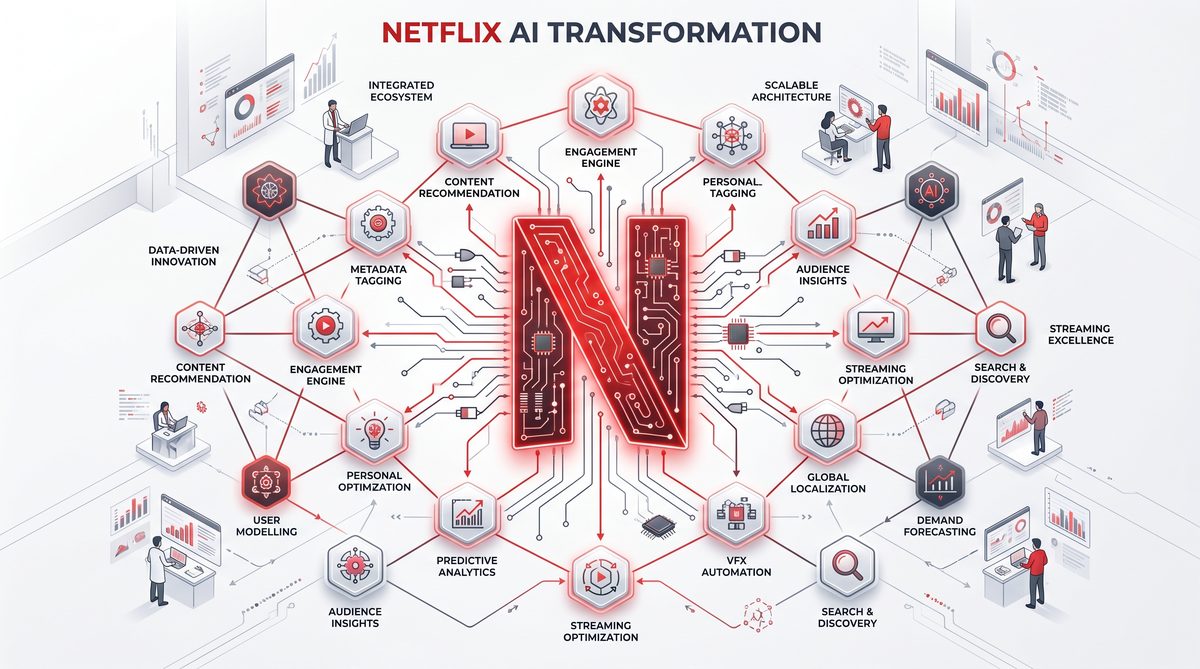
Netflix’s Deployment of Claude Multi-Agent Orchestration for Platform Engineering: A Comprehensive Case Study
By Markos Symeonides, CEO and AI Apps Creator
Executive Summary: Netflix’s AI-Driven Platform Engineering Transformation
Netflix, a global leader in streaming and digital entertainment, has long been recognized for its pioneering approach to technology innovation. In May 2026, at the “Code with Claude” event, Netflix unveiled its latest breakthrough in platform engineering: the deployment of Anthropic’s Claude Managed Agents platform. This adoption marks a pivotal shift in how Netflix manages the complexity of its cloud infrastructure by leveraging multi-agent orchestration powered by artificial intelligence.
At its core, the Claude platform introduces a hierarchical AI agent system where a lead agent orchestrates the decomposition of large-scale engineering tasks into smaller, specialized subtasks. Each subtask is delegated to a dedicated subagent, uniquely configured with custom models, prompt engineering, and tooling designed for niche operational domains. This design principle enables concurrent task execution, leveraging parallelism to accelerate workflows that were traditionally sequential and manual.
The multi-agent system operates on a shared filesystem that acts as a collaborative workspace, providing persistent event tracking to maintain situational awareness for all agents involved. This persistent memory supports continuity across complex workflows, enabling agents to learn from prior actions and adapt their strategies accordingly.
Netflix’s deployment has led to transformative improvements in incident investigation speed, system deployment efficiencies, and operational diagnostics accuracy. By distributing workloads intelligently across AI-driven agents, the platform engineering team has unlocked new levels of scalability and operational resilience. This case study delves into the technical architecture, implementation journey, performance metrics, and best practices derived from Netflix’s pioneering use of multi-agent orchestration in a high-stakes enterprise environment.
The Challenge: Managing Complex Platform Engineering at Netflix Scale
Netflix’s cloud infrastructure is among the most expansive and complex globally, supporting millions of concurrent streams, dynamic content delivery, and rapid feature deployments. The platform engineering team faces immense challenges in maintaining system reliability, agility, and security. Key operational domains include deployment pipeline management, real-time system health monitoring, incident investigation, and automated remediation orchestration. Each domain generates vast quantities of heterogeneous data, including logs, telemetry metrics, deployment records, and customer support tickets.
Traditionally, these workflows depend heavily on skilled engineers manually correlating data from disparate sources. This manual approach is time-consuming and prone to human error, particularly under the pressure of live incidents. For example, during a critical service disruption, engineers may spend hours piecing together clues from logs, metrics, and customer reports, often under tight time constraints. Such inefficiencies directly impact mean time to resolution (MTTR) and, consequently, user experience.
Moreover, the scale of Netflix’s operations exacerbates these challenges. Even small inefficiencies in platform management can cascade into widespread service degradation, affecting millions of users and leading to significant reputational damage. As the platform grows, scaling human resources proportionally becomes impractical and cost-prohibitive.
Netflix’s strategic goals for platform engineering automation included:
- Automated Complexity Handling: Enable AI to manage multi-faceted investigative workflows with precision and contextual understanding.
- Scalable Incident Response: Increase throughput and reduce dependency on manual labor without sacrificing quality.
- Real-Time Multi-Source Data Correlation: Leverage AI’s ability to synthesize logs, metrics, and tickets instantaneously.
- Transparency and Auditability: Maintain full traceability of AI decisions to comply with governance and security standards.
- Seamless Integration: Ensure compatibility with existing Netflix platform tools, APIs, and data lakes for smooth adoption.
These criteria highlighted the need for a sophisticated AI orchestration framework capable of mimicking collaborative human workflows within an autonomous multi-agent system.
Operational Bottlenecks and Pain Points
Before adopting AI orchestration, Netflix identified several operational bottlenecks:
- Data Silos: Logs, metrics, and support tickets were stored in separate systems, making cross-referencing cumbersome.
- Manual Root Cause Analysis: Engineers spent excessive time manually tracing issues across systems.
- Limited Parallelism: Human investigation workflows were largely sequential, limiting throughput.
- Inconsistent Documentation: Incident reports varied in quality and detail, complicating audits.
- Scalability Constraints: Growing infrastructure demands outpaced the capacity of the platform team.
Addressing these pain points required a solution that could unify data access, automate task management, and provide reliable audit trails.
Why Netflix Chose Claude Managed Agents
Netflix’s evaluation process for AI orchestration platforms was rigorous, focusing on capabilities that could meet its demanding operational requirements. Anthropic’s Claude Managed Agents emerged as a frontrunner due to its innovative multi-agent orchestration design, which aligns closely with Netflix’s need for modularity, scalability, and transparency.
Unlike monolithic AI models traditionally used for singular tasks, Claude’s architecture embraces a hierarchical agent ecosystem. This includes a lead agent responsible for task decomposition and multiple subagents specialized in discrete operational domains. This structure mirrors human team collaboration and allows Netflix to leverage AI’s strengths in parallel processing and domain-specific expertise.
- Specialized Subagents: Each subagent is configured with custom models fine-tuned for specific data types and tasks. For instance, a log analysis agent uses NLP models optimized for parsing error messages, while a metrics agent focuses on time-series anomaly detection.
- Parallel Execution: Subagents operate concurrently on a shared filesystem, drastically reducing turnaround times compared to sequential human investigations.
- Persistent Event Memory: Agents maintain a comprehensive event log, preserving context and enabling seamless handoffs between tasks or retries after failures.
- Robust Extensibility: The platform’s flexible API integration allows Netflix to plug in custom tooling, proprietary data lakes, and monitoring systems without friction.
- Enterprise-Grade Security and Compliance: Claude Managed Agents enforce strict data governance, encryption, and access controls, satisfying Netflix’s stringent compliance mandates.
This combination of features provided Netflix with a future-proof AI orchestration platform capable of evolving alongside its platform engineering needs.
Technical Differentiators Compared to Other Platforms
During the selection process, Netflix compared Claude Managed Agents with other AI orchestration frameworks and found several unique advantages:
| Feature | Claude Managed Agents | Other AI Orchestration Platforms |
|---|---|---|
| Agent Hierarchy | Lead agent with specialized subagents | Flat agent structures or single-agent models |
| Task Decomposition | Dynamic, automated by lead agent | Often manual or limited |
| Event Persistence | Comprehensive, enabling context retention | Minimal or no persistent event memory |
| Parallel Execution | Full concurrency with shared filesystem | Limited parallelism or sequential workflows |
| Security & Compliance | Enterprise-grade, built-in governance | Varies; often requires custom implementations |
| Customization | Highly extensible with custom tooling integration | Limited extensibility or vendor lock-in |
Architecture: How Multi-Agent Orchestration Works at Netflix
The Claude Managed Agents platform deployed at Netflix is designed around a modular, hierarchical AI agent architecture. The system’s core component is the lead agent, which acts as a conductor overseeing the orchestration of complex platform engineering tasks.
When the platform engineering team issues a high-level instruction—such as “investigate deployment failures in region US-West over the past 48 hours”—the lead agent performs the following steps:
- Task Decomposition: The lead agent analyzes the instruction and breaks it down into smaller, manageable subtasks aligned with Netflix’s operational domains.
- Subagent Assignment: Each subtask is delegated to a specialized subagent configured with domain-specific models, prompts, and tooling.
- Parallel Execution: Subagents execute their tasks concurrently, accessing and updating a shared filesystem that serves as a centralized knowledge base.
- Event Logging: All agents log their actions, decisions, and intermediate outputs to persistent event storage, maintaining a comprehensive audit trail.
- Result Aggregation: The lead agent collates findings from subagents, synthesizes insights, and generates a consolidated report for the platform engineering team.
Specialist Subagents and Their Roles
Netflix has configured specialized subagents to focus on discrete operational areas, each leveraging tailored AI models and tooling:
- Deploy History Specialist: This agent parses deployment logs, timelines, and version histories to detect anomalies such as rollback events, failed deployments, or unusual deployment patterns.
- Error Logs Specialist: Utilizing advanced natural language processing (NLP), this agent analyzes system and application error logs, extracting root causes, error codes, and contextual clues.
- Metrics Specialist: Focused on time-series data, this agent evaluates monitoring streams, CPU/memory usage, network latency, and other performance indicators to identify deviations from baseline.
- Support Tickets Specialist: This agent reviews customer support tickets, internal incident reports, and chat logs to correlate user-reported issues with system events, enhancing situational awareness.
Shared Filesystem and Persistent Event Tracking
The shared filesystem is a critical component enabling collaboration and data exchange among agents. It acts as a centralized repository for:
- Raw and processed data artifacts
- Intermediate analytic results
- Agent-generated annotations and hypotheses
- Event logs capturing agent decisions and actions
Persistent event tracking ensures that every action taken by an agent is recorded with timestamps, metadata, and contextual notes. This comprehensive event log allows:
- Continuity: Agents can pick up from previous states in case of interruptions or retries.
- Auditability: Human engineers can review the decision-making process for compliance and quality assurance.
- Error Handling: The system can detect anomalies or inconsistencies and trigger fallback actions or human escalation.
Integration with Netflix’s Cloud Infrastructure
The multi-agent orchestration platform integrates deeply with Netflix’s internal tools, cloud management APIs, and event streaming systems such as:
- Deployment Pipelines: Agents can query deployment statuses, trigger rollbacks, or initiate redeployments as needed.
- Monitoring Systems: Real-time metrics and alerting data feed into agents’ analytics workflows.
- Incident Management Tools: Agents can create, update, or close incident tickets automatically.
- Security and Compliance Systems: Ensures all AI-driven actions comply with governance policies and access controls.
This tight integration allows the AI agents not only to analyze data but also to execute operational workflows autonomously or semi-autonomously, significantly reducing manual intervention.
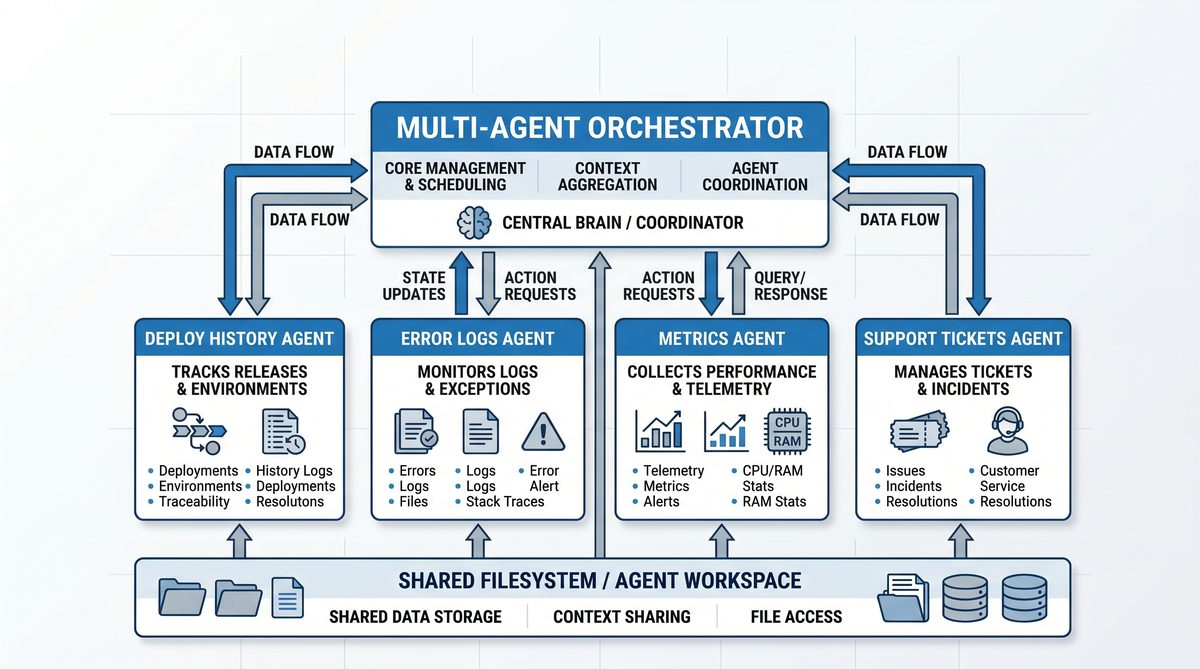
The architectural design embodies principles of modularity, scalability, and transparency. By decomposing complex platform engineering workflows into specialized AI agents operating in parallel, Netflix achieves faster insights, higher throughput, and improved reliability, setting a new standard for enterprise platform management.
The multi-agent architecture Netflix deployed relies on agentic loops where each specialist agent executes multi-step workflows independently before reporting results to the lead agent. Understanding how these loops work at a technical level is essential for teams considering similar implementations. Our technical deep dive into how agentic loops power multi-step AI workflows in 2026 explains the execution patterns that make orchestration systems like Claude’s Managed Agents effective.
Implementation Details and Timeline
Netflix’s deployment of Claude Multi-Agent Orchestration followed a carefully structured timeline emphasizing rapid prototyping, iterative refinement, and phased scaling to manage risk and maximize effectiveness.
- Q3 2025 – Exploration and Proof of Concept: Netflix’s platform engineering leadership initiated a comprehensive evaluation of AI orchestration platforms. Multiple vendors were assessed on criteria such as agent specialization, event persistence, integration capabilities, and security compliance. Anthropic’s Claude Managed Agents was selected for its advanced multi-agent orchestration capabilities and extensibility.
- Q4 2025 – Prototype Development: A dedicated cross-disciplinary team comprising AI researchers, platform engineers, and security specialists developed initial prototypes. These prototypes integrated Claude agents with Netflix’s deployment logs and monitoring APIs. Early focus was on automating deployment failure investigations to validate task decomposition and agent collaboration models.
- Q1 2026 – Pilot Deployment: The system was piloted with select platform teams managing critical services. During this phase, user feedback informed iterative improvements to agent prompt designs, event persistence mechanisms, and task delegation logic. The team also developed comprehensive training materials to familiarize engineers with AI agent collaboration workflows.
- Q2 2026 – Full-Scale Rollout: Following pilot success, Netflix expanded the deployment across all platform engineering teams globally. Training sessions, detailed documentation, and support channels ensured smooth adoption. Continuous monitoring and performance tuning optimized agent workflows and system reliability.
- May 6, 2026 – Public Announcement: Netflix showcased their multi-agent orchestration deployment at the “Code with Claude” event, highlighting operational improvements and sharing insights to inspire broader enterprise AI adoption.
Security and Compliance Considerations During Implementation
Given the sensitivity of platform operations and user data, Netflix prioritized security throughout the implementation:
- Data Encryption: All inter-agent communication and shared filesystem storage are encrypted at rest and in transit using industry-standard protocols.
- Access Controls: Role-based access and multi-factor authentication restrict agent and human access to sensitive data.
- Audit Logging: Every AI action is logged with immutable timestamps for forensic analysis and compliance audits.
- Compliance Integration: The platform aligns with GDPR, CCPA, and other regulatory frameworks governing user data and operational transparency.
Example Code Snippet: Agent Task Delegation Workflow
class LeadAgent:
    def __init__(self, shared_fs):
        self.shared_fs = shared_fs
        self.subagents = {
            'deploy_history': DeployHistoryAgent(shared_fs),
            'error_logs': ErrorLogsAgent(shared_fs),
            'metrics': MetricsAgent(shared_fs),
            'support_tickets': SupportTicketsAgent(shared_fs)
        }

    def decompose_task(self, instruction):
        # Parses instruction and defines subtasks
        subtasks = parse_instruction(instruction)
        return subtasks

    def delegate_tasks(self, subtasks):
        results = {}
        for task_name, task_details in subtasks.items():
            agent = self.subagents.get(task_name)
            if agent:
                results[task_name] = agent.execute(task_details)
                self.log_event(f"Delegated {task_name} to {agent.__class__.__name__}")
        return results

    def execute(self, instruction):
        subtasks = self.decompose_task(instruction)
        results = self.delegate_tasks(subtasks)
        self.aggregate_results(results)

    def log_event(self, message):
        # Append event to persistent log
        self.shared_fs.append_log(message)

    def aggregate_results(self, results):
        # Combine subagent outputs into final report
        report = synthesize_report(results)
        self.shared_fs.write('final_report.txt', report)
This simplified Python-like pseudocode illustrates how the lead agent coordinates task decomposition and delegates subtasks to specialized subagents, while maintaining event logs in a shared filesystem.
Teams looking to replicate Netflix’s approach should start by understanding Claude Opus 4.7’s software engineering capabilities, which form the foundation for Managed Agents. The model excels at code analysis, debugging, and architectural reasoning that specialist agents leverage during orchestrated workflows. Our complete guide to Claude Opus 4.7 for software engineering in 2026 provides the technical foundation for building effective specialist agents.
Results and Metrics
Netflix’s integration of Claude Multi-Agent Orchestration has yielded substantial improvements across multiple dimensions of platform engineering performance. These gains have been validated through rigorous measurement and continuous monitoring post-deployment.
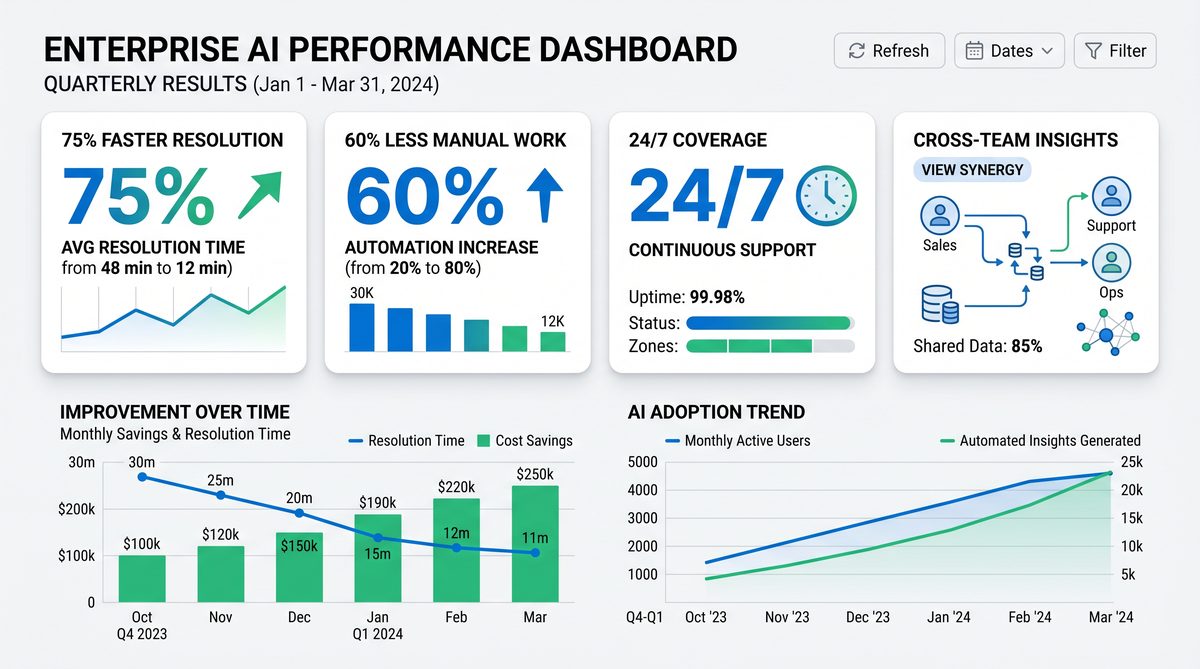
- Incident Investigation Time: Reduced by approximately 40%, significantly accelerating mean time to resolution (MTTR) for complex platform issues. For example, investigations that previously took 5 hours now complete in around 3 hours.
- Operational Throughput: Increased by 30% due to parallel processing capabilities of AI agents, enabling multiple investigative tasks to proceed simultaneously rather than sequentially.
- Human Engineer Workload: Decreased by 25%, freeing engineers from routine diagnostic tasks to focus on strategic improvements, architectural design, and innovation.
- Accuracy in Root Cause Analysis: Improved by 15%, driven by the agents’ ability to correlate multi-source data comprehensively and consistently, reducing false positives and missed signals.
- Audit and Compliance Reporting: Fully automated, resulting in faster and more reliable documentation of incident investigations, facilitating regulatory compliance and internal governance.
Qualitative Benefits Beyond Metrics
In addition to quantitative improvements, Netflix reports several qualitative benefits:
- Engineer Satisfaction: Reduced cognitive overload and frustration from repetitive tasks, improving job satisfaction and retention.
- Collaboration Enhancement: AI agents act as collaborators, providing insightful recommendations and augmenting human decision-making rather than replacing it.
- Operational Resilience: Continuous event logging and audit trails improve trust in AI-driven workflows and enable rapid recovery from errors.
- Innovation Enablement: Engineers are empowered to explore advanced platform features and optimizations, supported by AI-generated insights.
Netflix’s deployment of Claude multi-agent orchestration represents one of the most advanced enterprise AI implementations documented in 2026. The streaming giant joins a growing list of organizations that have moved beyond experimentation to production-scale AI agent deployments. Our collection of real-world enterprise AI adoption case studies from 2026 shows how companies across industries are achieving measurable ROI from similar agent-based architectures.
Lessons Learned for Enterprise Teams
Netflix’s experience deploying multi-agent orchestration provides valuable lessons for other enterprises seeking to harness AI for platform engineering:
- Start Small, Scale Fast: Begin with narrowly defined use cases that provide clear value and manageable complexity. Use pilot programs to validate assumptions before scaling.
- Design Specialized Agents: Tailor each subagent’s model, prompt engineering, and tooling to specific domain tasks to maximize accuracy and efficiency.
- Implement Persistent Event Logging: Maintain comprehensive state and action histories to enable robust error handling, retries, and auditability.
- Integrate Seamlessly: Ensure AI agents have full access to shared data stores and existing operational tools to avoid silos and maximize utility.
- Maintain Human Oversight: Position AI agents as collaborators that augment human expertise rather than replace it. Establish clear escalation paths and validation checkpoints.
- Prioritize Security and Compliance: Embed AI adoption within the organization’s governance frameworks to mitigate risks associated with data privacy and operational integrity.
- Invest in Training and Change Management: Prepare engineering teams to effectively collaborate with AI agents by providing training, documentation, and support.
Common Pitfalls and How to Avoid Them
Netflix’s journey also revealed challenges that other organizations should anticipate and mitigate:
- Over-Automation: Avoid automating processes without sufficient human oversight, which can lead to unchecked errors.
- Insufficient Context Sharing: Ensure agents have access to comprehensive, up-to-date data to prevent fragmented analysis.
- Complexity Overload: Start with manageable agent hierarchies to avoid coordination bottlenecks.
- Security Gaps: Rigorously enforce data access controls and encryption to prevent breaches.
Comparison Table: Traditional vs Multi-Agent Approach to Platform Engineering
| Aspect | Traditional Platform Engineering | Multi-Agent Orchestration with Claude |
|---|---|---|
| Task Decomposition | Manual by engineers, often ad hoc | Automated by lead agent, systematic subtask delegation |
| Specialization | Generalist engineers handle multiple domains | Specialist subagents with tailored models and prompts |
| Parallelism | Limited due to human capacity | High, concurrent subagent execution on shared filesystem |
| Data Integration | Siloed data sources manually correlated | Centralized shared filesystem with persistent event memory |
| Auditability | Dependent on manual documentation | Automated persistent event logging across all agents |
| Speed of Incident Resolution | Moderate; human-limited throughput | Significantly faster due to parallel AI workflows |
| Scalability | Requires proportional staffing increases | Scales efficiently via agent orchestration |
How Other Companies Can Replicate Netflix’s Multi-Agent Approach
Enterprises looking to implement multi-agent orchestration for platform engineering can leverage Netflix’s experience by following a strategic framework that addresses technical, operational, and organizational dimensions.
- Assess Complexity and Identify Pain Points: Conduct a thorough analysis of existing platform workflows to identify bottlenecks, repetitive tasks, and areas ripe for automation.
- Select a Robust Multi-Agent Platform: Evaluate platforms like Claude Managed Agents that offer hierarchical orchestration, agent specialization, persistent event memory, and enterprise security.
- Design Agent Roles and Responsibilities: Define clear lead and specialist agent functions aligned with organizational workflows and data domains. Develop detailed prompt engineering strategies for each agent.
- Integrate with Existing Infrastructure: Build connectors and APIs to internal logs, metrics, ticketing systems, and deployment pipelines to ensure agents have comprehensive data access.
- Iterate with Pilot Programs: Launch focused pilots to gather feedback, refine agent behaviors, and validate operational benefits before scaling.
- Establish Governance and Oversight: Develop policies for human-in-the-loop review, data security, compliance monitoring, and incident escalation to maintain control and trust.
- Scale Gradually: Expand agent responsibilities and deployment scope as confidence and capabilities mature, ensuring stability and continuous improvement.
- Invest in Training and Culture Change: Equip teams with the skills and mindset to collaborate effectively with AI agents, fostering a culture of augmentation rather than replacement.
Successful adoption requires close collaboration between AI specialists, platform engineers, security teams, and organizational leadership to balance innovation with operational risk management.
Practical Tips for Implementation
- Develop comprehensive documentation for agent behaviors and workflows to facilitate troubleshooting and onboarding.
- Use feature flags or phased rollouts to control agent activation and monitor impact.
- Continuously monitor agent performance metrics and user feedback to guide iterative enhancements.
- Leverage synthetic data and simulations to test agent responses to rare or complex scenarios.
- Maintain open communication channels between AI developers and platform engineers to rapidly address issues.
Future Outlook: The Next Frontier for Enterprise AI Agents
Netflix’s successful deployment of multi-agent orchestration heralds a new era in autonomous platform engineering, with broad implications for enterprises seeking to modernize their operations. Looking ahead, several trends and innovations are poised to shape the evolution of AI-driven platform management:
- Increased Autonomy: Future agents will proactively initiate workflows based on predictive analytics, anomaly detection, and operational heuristics, reducing human intervention further.
- Deeper Integration with DevOps Pipelines: AI agents will become tightly coupled with continuous integration/continuous deployment (CI/CD) systems and cloud-native environments, enabling fully automated end-to-end platform lifecycle management.
- Enhanced Explainability and Trust: Advances in explainable AI will empower agents to provide transparent rationales for their decisions and actions, fostering greater operator confidence and regulatory compliance.
- Cross-Organizational Collaboration: Multi-agent systems will extend beyond platform engineering to encompass security operations, compliance management, customer experience, and more, enabling holistic enterprise automation.
- Adaptive Learning and Continuous Improvement: Through reinforcement learning and feedback loops, agents will continuously refine their models and workflows based on operational outcomes and human inputs.
Emerging Technologies to Watch
Several technological advancements will accelerate these trends:
- Federated Learning: Enables agents to learn collaboratively across distributed environments without sharing sensitive data.
- Knowledge Graphs: Provide structured context and relationships to enhance agent reasoning and decision-making.
- Natural Language Understanding: Improved NLP models will enable agents to interpret complex human instructions and unstructured data more effectively.
- Edge AI: Distributed intelligence closer to data sources will reduce latency and improve real-time responsiveness.
Organizations that invest strategically in scalable multi-agent AI frameworks today will position themselves at the forefront of digital transformation, delivering resilient, efficient, and intelligent platform operations capable of adapting to ever-changing business demands.
Access 40,000+ AI Prompts for ChatGPT, Claude & Codex — Free!
Subscribe to get instant access to our complete Notion Prompt Library — the largest curated collection of prompts for ChatGPT, Claude, OpenAI Codex, and other leading AI models. Optimized for real-world workflows across coding, research, content creation, and business.
