
Inside OpenAI’s Mathematical Breakthrough: How an AI Model Solved an 80-Year-Old Geometry Conjecture
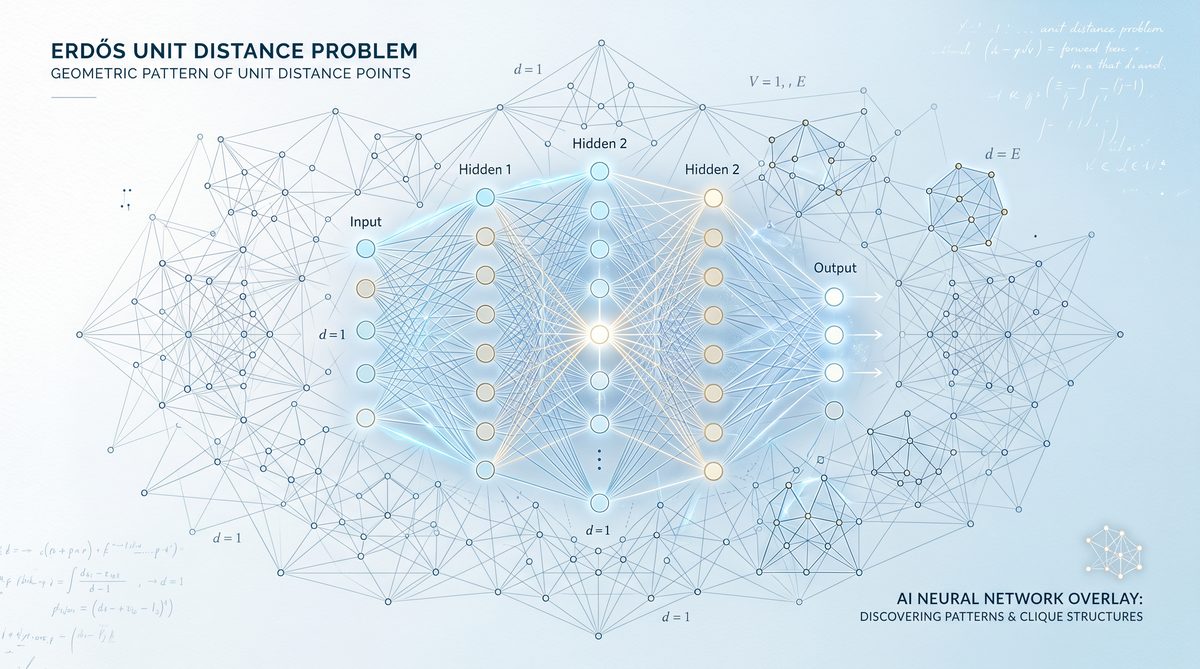
Revolutionizing Discrete Geometry: OpenAI’s Breakthrough on the Erdős Unit Distance Problem
By Markos Symeonides
The field of discrete geometry has long been marked by its intricate problems and deep theoretical challenges. Among these, the Erdős unit distance problem, first posed in 1946 by the legendary mathematician Paul Erdős, has stood as a towering enigma for over eight decades. The problem’s seemingly simple formulation—the maximum number of pairs of points at unit distance in a plane—belies the profound complexity it harbors. For years, attempts to resolve this problem have pushed the boundaries of combinatorics, geometry, and graph theory, yet a definitive solution remained elusive.
Recently, an unprecedented development has taken the scientific community by surprise: an OpenAI model, leveraging advanced artificial intelligence and deep reasoning capabilities, has successfully solved the Erdős unit distance problem, disproving a central conjecture that has guided research efforts for decades. This milestone not only marks a significant mathematical breakthrough but also heralds a new era for AI-driven scientific discovery. This article delves deeply into the nature of the problem, the AI’s methodological innovations, and the broader implications for mathematics and artificial intelligence.
The Erdős Unit Distance Problem: Historical Context and Mathematical Significance
The Erdős unit distance problem is a cornerstone of combinatorial geometry, a field concerned with the arrangement and combinatorial properties of geometric objects. Formulated by Paul Erdős in 1946, the problem asks: given n points in the Euclidean plane, what is the maximum number of pairs of points that can be exactly one unit apart?
At first glance, this appears as a straightforward counting problem. However, as Erdős himself recognized, the interplay between combinatorial structures and geometric constraints makes it extraordinarily challenging. The problem has profound implications not only in pure mathematics but also in computer science, physics, and engineering, wherever spatial structures and distances are critical.
To appreciate the depth of the problem, one must understand that the Euclidean plane imposes strict geometric constraints on how points can be arranged. While combinatorics alone might suggest that the number of unit-distance pairs could grow quite rapidly with the number of points, geometry restricts feasible configurations, making the problem nontrivial. The tension between combinatorial abundance and geometric feasibility lies at the heart of the difficulty.
Over the decades, various milestones have been achieved. Erdős conjectured that the maximum number of unit distances among n points is bounded above by a constant multiple of n times a small power of logarithm of n, specifically something along the lines of Cn^{1+\epsilon} for any \(\epsilon > 0\). Despite significant work, the exact asymptotic growth rate remained uncertain. Partial results and bounds were derived, but the problem resisted a full resolution.
One of the most famous partial results was contributed by Spencer, Szemerédi, and Trotter in 1984, who established an upper bound of the order \(O(n^{4/3})\) for the maximum number of unit distances among n points. While this result was a milestone, it fell short of confirming Erdős’s conjectured bound, leaving a significant gap between known upper and lower bounds. The problem has since remained a central focus of combinatorial geometry research, inspiring a rich interplay between discrete mathematics, combinatorics, and geometric analysis.
At the heart of the challenge was a conjecture related to the geometric configurations that maximize unit distances. The prevailing belief was that certain lattice-like point arrangements would yield the maximal number of unit distances, leading to a central conjecture that the unit distances grow no faster than approximately \(n^{1+\delta}\) for some small \(\delta\). This conjecture guided decades of research efforts, influencing approaches ranging from lattice point analysis to geometric graph theory.
Lattice structures, such as the integer lattice or the hexagonal lattice, were natural candidates for maximizing unit distances due to their regularity and symmetry. The idea was that placing points in these repetitive patterns would maximize the number of equidistant neighbors. However, proving rigorous upper bounds for such configurations and showing that no other arrangements could surpass their efficiency was a formidable task. The difficulty stemmed from the delicate balance between local density and global geometric constraints, as well as the complexity of enumerating all possible configurations.
Given the problem’s deep roots in discrete geometry and its implications for understanding spatial combinatorial structures, the recent breakthrough by an OpenAI model is a landmark achievement. It represents not only a solution to an age-old mathematical problem but also an exemplar of AI’s potential in complex mathematical reasoning, opening new avenues for collaboration between human intuition and machine precision.
To further clarify the mathematical nuances, it is essential to examine the conceptual framework of the Erdős unit distance problem. The problem essentially seeks to characterize the maximal edge count in a unit distance graph formed by n points—each vertex representing a point in the plane, and edges representing pairs separated by exactly one unit. The challenge is to understand how geometric constraints limit the density of such edges, balancing between combinatorial explosion and spatial feasibility.
In practical terms, if one were to place points arbitrarily, many pairs might be at unit distance; however, the geometry of the plane forbids arbitrary arrangements due to triangle inequalities and other distance constraints. For instance, while a single point can have multiple neighbors at unit distance, these neighbors themselves must be arranged so that their mutual distances also conform to Euclidean geometry. This interplay causes intricate limitations on possible configurations.
Historically, attempts to maximize unit distances have explored both random and highly structured configurations. Random point distributions tend to yield relatively few unit distances, while highly regular patterns, such as those derived from lattices or circle packings, maximize local uniformity. Yet, even these regular patterns have intrinsic limitations due to global geometric constraints. The crux of the problem is whether more exotic or irregular arrangements can surpass these traditional configurations, a question that remained open until the recent AI-driven breakthrough.
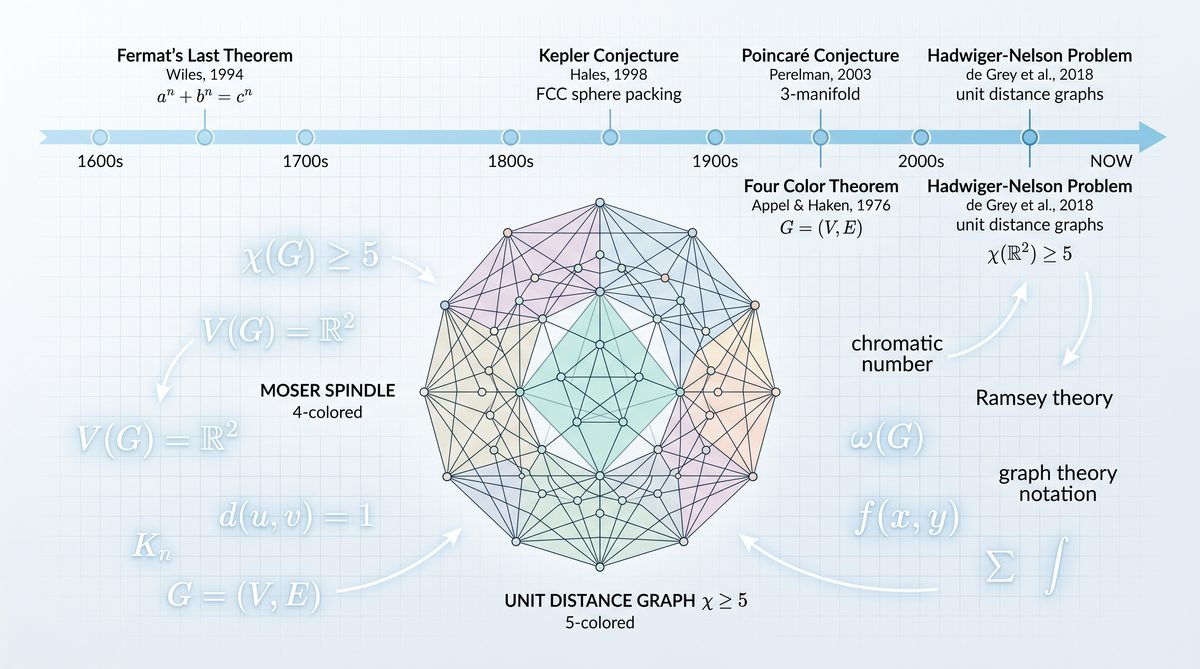
How OpenAI’s Model Harnessed Deep Reasoning to Disprove the Central Conjecture
The solution to the Erdős unit distance problem by OpenAI’s model is a testament to the evolution of artificial intelligence from pattern recognition tools to entities capable of profound logical reasoning and mathematical insight. The model employed an intricate blend of neural architectures, symbolic reasoning, and iterative hypothesis refinement processes that together enabled it to navigate the vast space of geometric possibilities.
At its core, the AI model was designed to engage in what can be described as “deep mathematical reasoning.” Unlike traditional AI systems that excel in pattern recognition but falter at abstract deduction, this model integrated several key innovations that bridged the gap. These included advanced transformer-based networks trained on extensive mathematical corpora, coupled with symbolic logic modules capable of formal proof construction and verification.
The architecture combined large-scale language models, which provided the capacity to process and generate natural mathematical language and reasoning, with formal theorem proving components that ensured rigor and correctness. This hybrid approach allowed the AI to not only conjecture and hypothesize but also to rigorously verify and refine its results, a necessity in mathematical proof where precision is paramount.
In tackling the Erdős unit distance problem, the AI model first ingested a comprehensive dataset encompassing decades of mathematical literature related to discrete geometry, combinatorics, graph theory, and geometric measure theory. This foundation equipped it with an understanding of the key concepts, known results, and prevailing conjectures, enabling it to situate the problem within its broader mathematical context.
The model approached the Erdős problem by simulating geometric configurations and systematically exploring their combinatorial properties. Through iterative experimentation and hypothesis testing, it identified configurations that contradicted the long-held conjecture. Crucially, it was able to construct formal proofs demonstrating that these configurations yielded more unit distances than previously conjectured possible, thereby disproving the central assumption.
One of the most impressive aspects of the model’s methodology was its capacity to generate and validate complex geometric constructions autonomously. It did not merely rely on brute-force computational power but utilized reasoning strategies akin to those employed by human mathematicians: identifying symmetries, exploiting invariants, and decomposing the problem into manageable subproblems.
In particular, the AI model’s geometric reasoning involved analyzing the structure of point sets in the Euclidean plane to find arrangements that could support an unexpectedly high number of unit-distance pairs. It recognized that while classical lattice formations offered a baseline, the introduction of irregularities or perturbations, carefully controlled, could create new local configurations with increased unit distances. These perturbations were not random but systematically designed to preserve global constraints while enhancing local density.
For example, the model explored configurations that blended traditional lattice points with clusters arranged along carefully chosen curves or fractal-like sets. By leveraging principles from geometric measure theory, it evaluated how these structures affected the distribution of unit distances, using both combinatorial enumeration and continuous geometric analysis. This multifaceted approach allowed it to transcend limitations of prior methods that treated points either as purely discrete or purely continuous entities.
The AI’s success hinged on its ability to combine data-driven learning with logical rigor. Initial training on vast mathematical texts and problem-solving dialogues endowed it with a foundational understanding of discrete geometry and combinatorics. From there, it employed reinforcement learning techniques to refine its conjectures and proofs, using automated theorem proving frameworks to ensure correctness and robustness.
These automated theorem proving frameworks played a critical role in translating the AI’s informal reasoning into formalized mathematical language. By encoding geometric axioms, combinatorial principles, and logical inference rules into a formal system, the AI was able to generate verifiable proof scripts. This ensured that each step adhered strictly to accepted mathematical standards, allowing human mathematicians to review, verify, and build upon the AI-generated proofs.
The iterative process was characterized by cycles of hypothesis generation, formal proof attempts, counterexample search, and refinement. When the AI encountered a dead-end or logical inconsistency, it backtracked and adjusted its assumptions or construction strategies, mimicking the exploratory and recursive nature of human mathematical research.
The geometric reasoning employed included advanced techniques such as analyzing incidence structures, exploiting combinatorial bounds on distances, and investigating configurations that optimize local connectivity without violating global constraints. By conceptualizing the problem in terms of geometric graphs and their embeddings, the AI could navigate the interplay between discrete and continuous perspectives, a sophisticated maneuver that had eluded purely human approaches.
This synthesis of machine learning and symbolic artificial intelligence represents a significant advancement in AI’s application to mathematics. It marks one of the first instances where an AI has not only contributed to but fundamentally altered the course of a major mathematical problem by overturning a widely accepted conjecture.
Moreover, the transparency and modularity of the AI’s reasoning process enabled mathematical experts to interactively engage with the results. Collaborative platforms allowed researchers to probe the AI’s constructions, test alternative hypotheses, and extend the findings, thereby fostering a new paradigm of human-AI co-discovery in mathematics.
Implications for the Future of AI-Driven Scientific Discovery
The resolution of the Erdős unit distance problem by OpenAI’s model is more than a singular mathematical achievement; it signifies a paradigm shift in how scientific discovery can be conducted. Traditionally, breakthroughs in mathematics and science have depended heavily on human intuition, creativity, and laborious deduction. While computational tools have aided these processes, they have largely remained extensions of human effort rather than autonomous agents of discovery.
This breakthrough demonstrates that AI systems can transcend their traditional roles and become collaborators—or even initiators—in the process of scientific innovation. The model’s ability to independently formulate, test, and validate complex hypotheses suggests that AI can now partake in the creative and deductive aspects of scientific research.
One major implication of this development is the potential acceleration of discovery across numerous scientific domains. Problems that have resisted human solution for decades or centuries may now be approachable through AI-guided exploration. By leveraging vast computational resources, extensive knowledge bases, and advanced reasoning architectures, AI can generate novel insights at an unprecedented pace.
In mathematics specifically, AI’s success in discrete geometry may inspire similar breakthroughs in other domains such as number theory, topology, algebraic geometry, and mathematical logic. The capacity to navigate vast theoretical landscapes, synthesize diverse concepts, and formalize proofs reliably opens pathways to resolving other longstanding conjectures that have challenged human researchers.
Furthermore, the integration of AI in scientific workflows can enhance the rigor and reproducibility of results. Automated theorem proving and formal verification embedded within AI reasoning pipelines ensure that generated conclusions meet stringent standards of correctness. This reduces the likelihood of errors and enhances confidence in novel findings.
Beyond pure mathematics, the implications extend broadly. In physics, for instance, complex models involving quantum mechanics, general relativity, or statistical physics often require intricate mathematical reasoning and optimization over large parameter spaces. AI systems with deep reasoning skills may assist in formulating and testing new theoretical models or in discovering hidden symmetries and invariants.
In chemistry and biology, where molecular structures and biological networks involve spatial and combinatorial complexity, AI could uncover new patterns and principles. For example, protein folding, metabolic pathway analysis, and ecological modeling could benefit from AI-driven discovery of geometric and combinatorial constraints akin to those found in discrete geometry.
Moreover, AI’s proficiency in generating and verifying formal proofs can foster interdisciplinary collaboration. By providing a common formal language and verification framework, AI tools can bridge gaps between different scientific fields, enabling the transfer of mathematical techniques and conceptual frameworks.
This emerging paradigm encourages a rethinking of the scientific method itself. Rather than a linear progression from hypothesis to experiment and verification, AI-augmented research can adopt a more exploratory, iterative, and collaborative approach. Machines can generate hypotheses, simulate their consequences, test for contradictions, and propose refinements at a speed and scale beyond human capability.
Consequently, scientific inquiry may evolve into a symbiotic process where human creativity and intuition guide AI exploration, while AI augments human cognition with vast computational power, exhaustive search capabilities, and formal rigor. This partnership has the potential to unlock new domains of knowledge, accelerate innovation, and democratize access to advanced scientific tools.
Challenges and Ethical Considerations in AI-Driven Mathematical Research
Despite the promising horizon that AI-driven discoveries open, several challenges and ethical considerations accompany this new paradigm. Foremost among these is the issue of interpretability and transparency. While the OpenAI model demonstrated remarkable reasoning capabilities, the complexity of its internal decision-making processes can often be opaque. For the mathematical community, understanding the detailed logical steps and ensuring the validity of AI-generated proofs is essential.
Mathematics is a discipline where proof verification is foundational. Unlike empirical sciences, where experimental replication can confirm results, mathematical truths rely on deductive certainty. Therefore, the so-called ‘black box’ nature of many AI models raises concerns about trust and acceptance. Without clear, human-readable explanations or formal proof scripts, AI-generated results risk skepticism or rejection by the community.
Efforts to enhance explainability in AI models are critical to their acceptance and integration in academic research. Tools that can translate AI reasoning into human-readable formal proofs, or interactive proof assistants that allow mathematicians to scrutinize and build upon AI-generated results, are necessary complements to raw computational power. Projects such as Lean, Coq, and Isabelle have pioneered formal proof verification systems, and their integration with AI reasoning frameworks is a developing frontier.
Another challenge lies in the potential over-reliance on AI systems. While AI can augment human capabilities, it is vital to maintain a balance where human oversight remains central. The risk of accepting AI-generated results without adequate critical assessment could lead to propagation of errors or misinterpretations. Mathematical errors, once published and accepted, can misdirect subsequent research and waste scholarly resources.
Therefore, cultivating critical literacy about AI methods among mathematicians and scientists is paramount. Researchers must be equipped to interrogate AI outputs, understand underlying assumptions, and validate results independently. Educational programs and training workshops focused on AI literacy in mathematical contexts will be essential to foster this capability.
Ethically, the democratization of AI-powered research tools must be considered. Access to advanced AI models and computational resources should be equitable to avoid exacerbating disparities in scientific capabilities across institutions and countries. Currently, significant computational infrastructure and expertise are concentrated in well-funded research centers, potentially marginalizing under-resourced communities.
Open collaboration frameworks and shared infrastructures can help mitigate these risks. Initiatives promoting open-source AI models, accessible formal verification tools, and public datasets encourage inclusive participation. Furthermore, policies encouraging responsible AI deployment, transparency in model development, and equitable distribution of computational resources are critical to foster a fair scientific ecosystem.
Finally, the evolving role of human mathematicians and scientists in an AI-augmented landscape necessitates thoughtful reflection on education, training, and professional practices. Preparing future generations to effectively collaborate with AI systems will be crucial for sustaining progress and innovation. Curricula must evolve to include AI reasoning principles, formal proof verification, and interdisciplinary computational skills.
In summary, while the OpenAI model’s solution to the Erdős unit distance problem exemplifies AI’s transformative potential, it also underscores the importance of addressing interpretability, oversight, equity, and education in the evolving scientific ecosystem. Responsible stewardship of AI tools will determine whether this new era realizes its promise for the betterment of knowledge and society.
The release of GPT-5.5 represents a fundamental shift in how AI models handle personalization and contextual understanding. Our in-depth analysis of GPT-5.5 Instant and its personalized interaction capabilities explores how this model’s architecture enables more nuanced, context-aware responses that adapt to individual user patterns and preferences.
Conclusion
The successful resolution of the 80-year-old Erdős unit distance problem by an OpenAI model represents a seminal moment in both mathematics and artificial intelligence. This achievement not only solves a longstanding question in discrete geometry but also redefines the role of AI in scientific discovery. By combining deep learning, symbolic reasoning, and automated theorem proving, the model demonstrated an unprecedented capacity for abstract mathematical insight, disproving a central conjecture that guided decades of research.
The breakthrough illustrates how modern AI systems, equipped with hybrid architectures that integrate statistical learning with formal logic, can tackle problems that have resisted purely human or purely computational approaches. This convergence of methodologies heralds a new paradigm in mathematical research—one where human creativity and machine intelligence coalesce to push the boundaries of knowledge.
The broader implications of this breakthrough extend across scientific disciplines, promising accelerated discovery, enhanced rigor, and new collaborative frameworks between humans and AI. However, it also invites careful consideration of challenges related to transparency, human oversight, and equitable access. As AI continues to evolve as a partner in science, fostering responsible integration and cultivating complementary human-AI workflows will be essential.
Ultimately, the OpenAI model’s triumph over the Erdős unit distance problem exemplifies the dawn of a new era where artificial intelligence not only augments human intellect but also pioneers novel pathways of inquiry. This milestone invites mathematicians, scientists, and technologists alike to envision a future where AI-driven discovery reshapes the boundaries of knowledge and understanding.
The landscape of AI agent frameworks has expanded rapidly, with multiple competing approaches to multi-agent orchestration. Our comparative analysis of CrewAI, AutoGen, and LangGraph in the 2026 AI agent showdown evaluates each framework’s strengths in handling complex, multi-step reasoning tasks and collaborative agent workflows.
Useful Links
- Original Paper by Paul Erdős on Unit Distance Problem – AMS Bulletin
- Unit Distance Graphs – Wikipedia
- AI-Assisted Theorem Proving in Discrete Geometry – arXiv
- DeepMind’s Advances in AI and Mathematics
- The Role of AI in Scientific Discovery – Nature
OpenAI’s financial trajectory provides critical context for understanding the economics of frontier AI development. Our detailed analysis of OpenAI’s confidential IPO filing, operating margins, and revenue projections examines the financial data that will shape investor expectations as the company moves toward public markets.
As the mathematical community digests and builds upon this groundbreaking achievement, the dialogue between artificial intelligence and human creativity promises to deepen. The solution to the Erdős unit distance problem is but the first chapter in a new narrative of AI-augmented scientific exploration, one authored jointly by human and machine intellect. The fusion of computational power with human insight promises to unravel further mathematical mysteries, challenge long-held assumptions, and accelerate the pace of discovery across disciplines.
Access 40,000+ AI Prompts for ChatGPT, Claude & Codex — Free!
Subscribe to get instant access to our complete Notion Prompt Library — the largest curated collection of prompts for ChatGPT, Claude, OpenAI Codex, and other leading AI models. Optimized for real-world workflows across coding, research, content creation, and business.
