
How OpenAI’s $30 Billion Revenue Target Is Reshaping the AI Industry: From Research Lab to Enterprise Platform
How OpenAI’s $30 Billion Revenue Target Is Reshaping the AI Industry: From Research Lab to Enterprise Platform
Featured
Strategy
AI Platforms
Executive summary
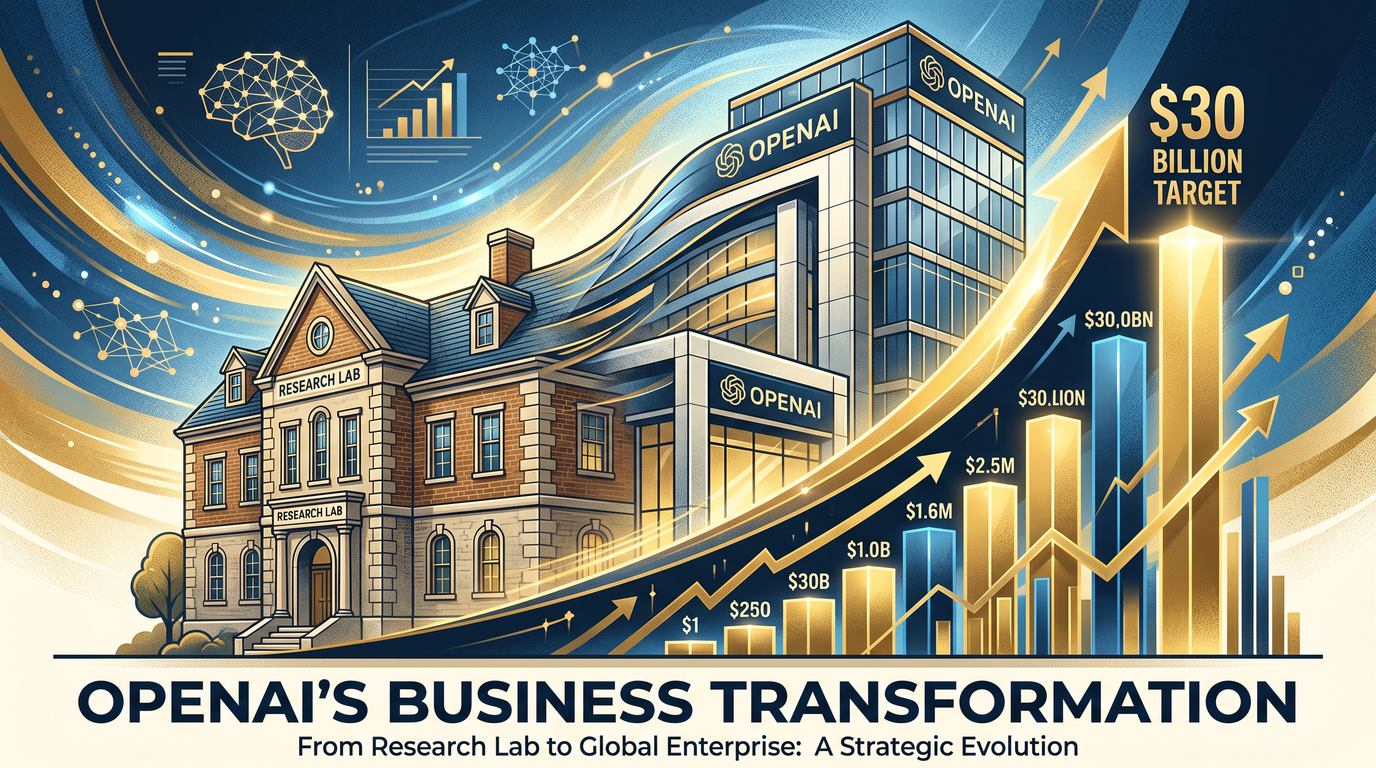
OpenAI’s evolution from a mission-driven research initiative into a scaled, enterprise-grade platform is no longer a slow pivot—it’s an aggressive sprint. With reported first-quarter 2026 revenue of roughly $5.7 billion and an annualized target of $30 billion, the company is now operating at the financial cadence of a hyperscaler, while still bearing the scientific ambition (and costs) of a frontier AI lab. Those twin imperatives—scale and science—are reshaping everything from pricing to product roadmaps, infrastructure bets, go-to-market motion, and how competitors marshal their responses.
The implications are profound. The $30B target serves as a forcing function. It prioritizes enterprise features over experimental demos, standardizes governance and compliance, and nudges the API and ChatGPT experiences toward a shared substrate of identity, data control, and reliability. Simultaneously, it catalyzes investments in custom silicon and data centers, even as it pressures pricing, model selection, and distillation strategies to preserve margins. This featured article unpacks those shifts, assesses the competitive landscape, and offers practical guidance for developers and enterprise buyers navigating the new platform era.
Annualized target: $30B
Projected net loss: ~$14B
Key bets: Enterprise platform, API ubiquity, custom silicon
From nonprofit research lab to enterprise platform
OpenAI’s origin as a nonprofit research lab fostered a culture anchored in scientific exploration and safety. Over time, the organization adopted a capped-profit hybrid structure to attract capital sufficient for training ever-larger frontier models. That shift, well underway by the early 2020s, laid the groundwork for today’s transformation: a company operating across consumer, developer, and enterprise layers, all backed by massive infrastructure investments.
What changed—and why it matters now
- Funding dynamics: Training and deploying frontier models demands capital at a scale incompatible with traditional research budgets. The hybrid model unlocked the capital stack required for long-term R&D.
- Distribution flywheel: ChatGPT established a consumer and prosumer funnel that could be upgraded into paid tiers and converted into enterprise deployments.
- Platform gravitational pull: APIs and developer tools created an ecosystem of apps and internal automations that entrenched OpenAI’s models in business workflows.
- Enterprise-grade guardrails: Security, compliance, auditability, and data governance emerged as table stakes for large contracts, reshaping product priorities.
The result is a company with dual identities: a frontier AI research leader and a commercial platform operator. The tension between the two isn’t a liability—it’s the source of competitive advantage, provided the economics can be made to work.
The numbers behind the pivot: Q1 2026 and the $30B target
As reported, OpenAI generated about $5.7 billion in revenue in Q1 2026, aiming for approximately $30 billion for the full year. That run-rate doesn’t emerge organically from research breakthroughs alone; it comes from deliberate expansion across product lines, aggressive enterprise go-to-market, and pricing experiments that grow users while protecting gross margins.
With the target set, the strategy is clear: move beyond “model as a service” into a first-class enterprise platform. That includes identity and access, zero-retention modes, granular data controls, and integrated deployment patterns (from app-level to workflow to agent). It also means rationalizing product packaging so that individual and organizational buyers can predictably understand costs and value.
The $30B target isn’t just a number. It’s the organizing principle for product, infrastructure, and go-to-market choices—a north star that forces trade-offs between breadth and depth, and between raw capability and operational efficiency.
Revenue breakdown: ChatGPT, API, Enterprise, and Codex
OpenAI’s revenue portfolio spans multiple lines that reinforce each other. While exact percentages are not publicly detailed, we can outline the primary contributors and how they interlock. Where specific 2026 splits are not officially disclosed, the ranges and dynamics discussed below should be read as directional analysis rather than audited figures.
1) ChatGPT subscriptions
The consumer and prosumer tiers create broad-based monetization and a powerful funnel. The brand familiarity reduces friction for enterprise adoption and for developers evaluating models. Subscriptions also subsidize the ongoing cost of experimentation and drive product telemetry—useful for prioritizing new features and identifying breakout use cases worthy of enterprise hardening.
2) API usage
The API remains the connective tissue for the broader AI economy—powering startups, internal enterprise tools, and consumer apps. API revenue is sensitive to:
- Model mix (frontier vs distilled)
- Modalities (text, image, audio, video, embeddings)
- Latency/sla tier (standard vs priority routing)
- Token price curves and discounting
- Enterprise commitments, reserved capacity, and private endpoints
3) Enterprise platform and services
Enterprise buyers pay for predictability, control, and integration. Revenue comes from organization-level SKUs, usage commitments, Premium/Elite support, security add-ons, and enterprise-grade features such as SSO/SAML, audit logs, data residency, and dedicated tenancy options. Over time, the enterprise line tends to exhibit higher gross margins per unit of compute consumed due to reserved economics, more consistent workloads, and rightsized model selection.
4) Codex and code generation partnerships
Coding models and related partnerships (e.g., powering code assistants and internal developer tools) represent a key vector of monetization. Demand for code transformation, migration, and test generation has surged as enterprises retrofit legacy stacks. While exact revenue recognition and revenue-sharing arrangements with partners are not detailed here, the code generation workload is a meaningful and growing pillar—one that favors model latency, function calling accuracy, and determinism.
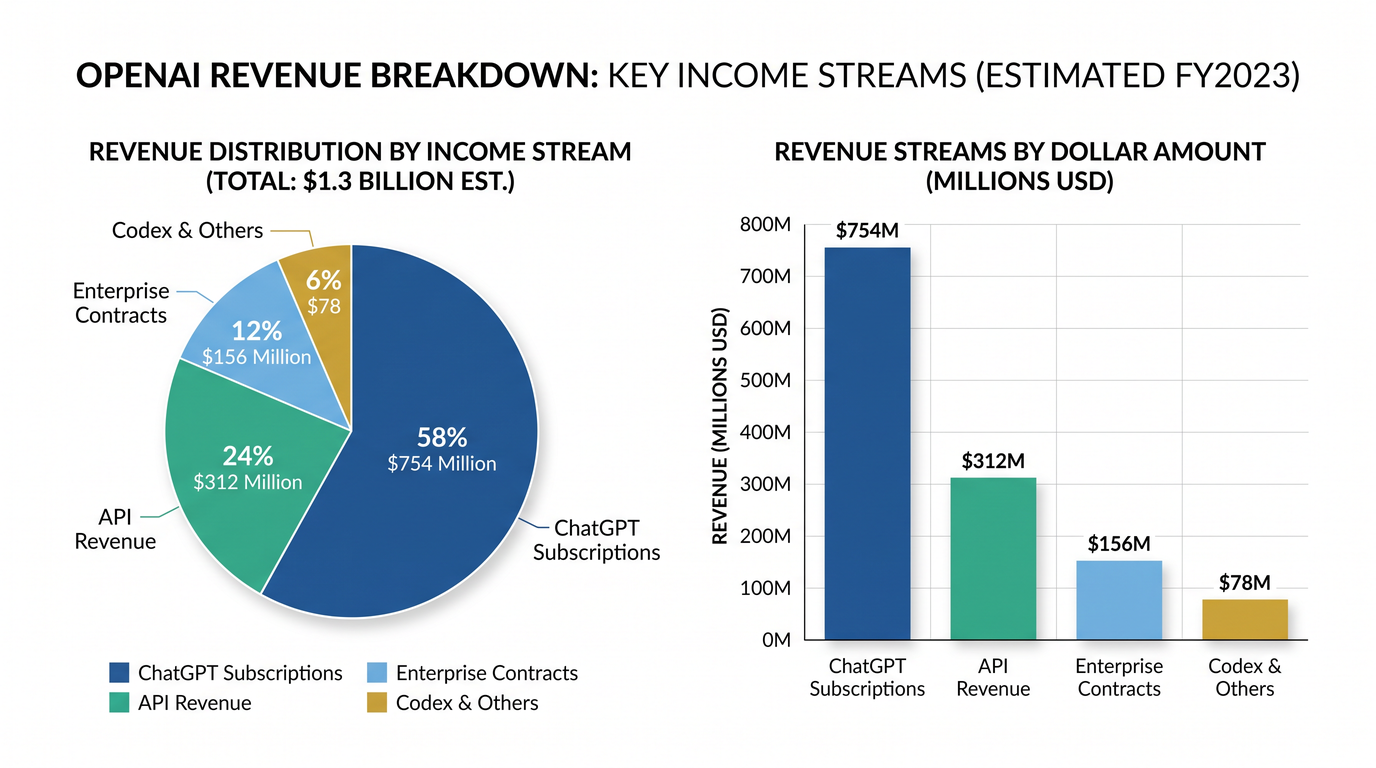
Illustrative revenue mix table (directional, not to scale)
| Line of business | Primary buyers | Key value drivers | Margin dynamics |
|---|---|---|---|
| ChatGPT subscriptions | Consumers, prosumers, small teams | Convenience, multimodal UX, personal/work assistants | Improves with model distillation and caching |
| API usage | Startups, ISVs, internal platform teams | Model quality, latency, reliability, price per token | Variable; depends on model mix and reserved capacity |
| Enterprise platform | Mid-market and Global 2000 | Security, governance, SLAs, integrations | Higher, with stickiness from compliance and tooling |
| Codex/code generation | Dev orgs, IT modernization programs | Accuracy on code tasks, tool use, deterministic outputs | Improves via distillation and workload specialization |
How the $30B target is steering product decisions
Revenue goals at this scale refocus a company’s definition of “product-market fit.” For OpenAI, that now means:
- Reliability as a feature: Hardening uptime, deterministic behaviors, and graceful degradation matter as much as raw model IQ.
- Model portfolio management: Steering non-critical workloads to distilled or specialized models while reserving frontier models for high-value tasks.
- Enterprise primitives first: Identity, role-based access control (RBAC), audit trails, DLP, data residency, and eDiscovery become default layers, not add-ons.
- Agentic workflows with guardrails: From ad-hoc prompting toward orchestrated, observable agents, with policy controls and human-in-the-loop checkpoints.
- Developer ergonomics: SDKs, tool calling consistency, batch APIs, streaming, and robust retries—because developer time is a lever for platform adoption.
- Observability and governance: Usage analytics, cost caps, approval workflows, and version pinning to make AI “change-safe” in production.
In effect, the company is codifying the informal practices of early adopters into official, supported platform features. The revenue target accelerates that codification and prioritization.
Enterprise platform strategy: what’s changed
Two years ago, the platform story was: pick a model, call an API, and build. Today, the enterprise message is closer to: bring your identity, your data boundaries, your observability needs, and deploy with policy. The difference is not cosmetic—it’s architectural.
- Unified identity and orgs: Org-level controls, SCIM provisioning, and per-workspace encryption keys for clean multitenancy.
- Data governance by default: Selectable data retention, log redaction, PII handling, and red-teamable prompts/responses for regulated workflows.
- Model catalogs and policy: Curated model sets, internal evaluations, and policy routing (e.g., which teams can access frontier vs distilled).
- Private connectivity: VPC peering, private endpoints, egress controls, and data plane isolation for sensitive contexts.
- Lifecycle management: Version pinning, test sandboxes, canary deployments, and rollback support for prompts, tools, and agents.
- Support and success: Named support, incident SLAs, TAMs/solutions architects, and co-building programs for strategic accounts.
For readers seeking a deeper dive:
OpenAI’s aggressive revenue targets are partly driven by its explosive user growth. Our analysis of ChatGPT’s 500 million user milestone and the Q2 2026 growth report examines how consumer adoption, enterprise contracts, and API usage each contribute to the company’s path toward $30 billion in annual revenue. ChatGPT’s 500 Million Users: Inside OpenAI’s Q2 2026 Growth Report.
The net effect is a credible platform for CIOs and CISOs: audit-friendly, cost-manageable, and predictably improvable through the model lifecycle. The trade-off is complexity; the platform must stay legible to developers even as it adds enterprise layers.
Pricing shifts: free tier expansion vs a $200/month Pro
Pricing is both a growth lever and a margin battlefield. Reports around 2026 indicate a broadened free tier to drive top-of-funnel usage paired with a high-powered Pro tier at roughly $200/month designed for heavy individual users and small teams who need advanced limits, faster inference, and priority access to the latest models.
Why expand the free tier?
- Acquisition engine: Grow the addressable base and feed both API and enterprise conversions.
- Learning loop: More usage yields better telemetry for fine-tuning UX and routing policies.
- Competitive parity: Aligns with rivals that use “free-to-try” to increase developer mindshare.
Why a $200/month Pro tier?
- Segment “power pros”: Researchers, indie devs, legal analysts, and consultants who value peak performance without full enterprise procurement.
- Upsell path: Bridge from consumer-grade to org-grade features, including shared workspaces and higher rate limits.
- Buffer margins: Price elasticity helps offset compute costs when usage spikes on frontier models.
The tension is obvious: free usage drives scale but risks undercutting paid conversion if the line between free and Pro gets blurry. The solution lies in clear entitlements (rate limits, latency classes, model access, and collaboration features) and thoughtful usage-based overage options.
Illustrative cost modeling
Below is a simple sketch to reason about per-user unit economics at different tiers. Exact numbers will vary by model, traffic shape, and caching efficacy.
// Pseudocode to estimate monthly margin per user segment
function estimateMargin({
  pricePerMonth,
  avgInputTokens,
  avgOutputTokens,
  requestsPerDay,
  daysPerMonth,
  costPerMillionTokensInput,
  costPerMillionTokensOutput,
  cacheHitRate // 0..1 reduces effective tokens billed to infra
}) {
  const totalRequests = requestsPerDay * daysPerMonth;
  const grossInputTokens = totalRequests * avgInputTokens;
  const grossOutputTokens = totalRequests * avgOutputTokens;

  const netInputTokens = grossInputTokens * (1 - cacheHitRate);
  const netOutputTokens = grossOutputTokens * (1 - cacheHitRate);

  const infraCost = (netInputTokens / 1e6) * costPerMillionTokensInput
                  + (netOutputTokens / 1e6) * costPerMillionTokensOutput;

  const grossMargin = pricePerMonth - infraCost;
  return { infraCost, grossMargin };
}

// Example: Pro user with heavy usage and moderate caching
const result = estimateMargin({
  pricePerMonth: 200,
  avgInputTokens: 800,
  avgOutputTokens: 400,
  requestsPerDay: 40,
  daysPerMonth: 22,
  costPerMillionTokensInput: 3.0,   // illustrative blended cost
  costPerMillionTokensOutput: 7.0,  // illustrative blended cost
  cacheHitRate: 0.25
});

console.log(result);
A sustainable strategy hinges on steering routine traffic to efficient models, using caching and tool-based decomposition, and reserving frontier inference for moments that truly justify it.
Competitive responses: Google, Anthropic, Meta
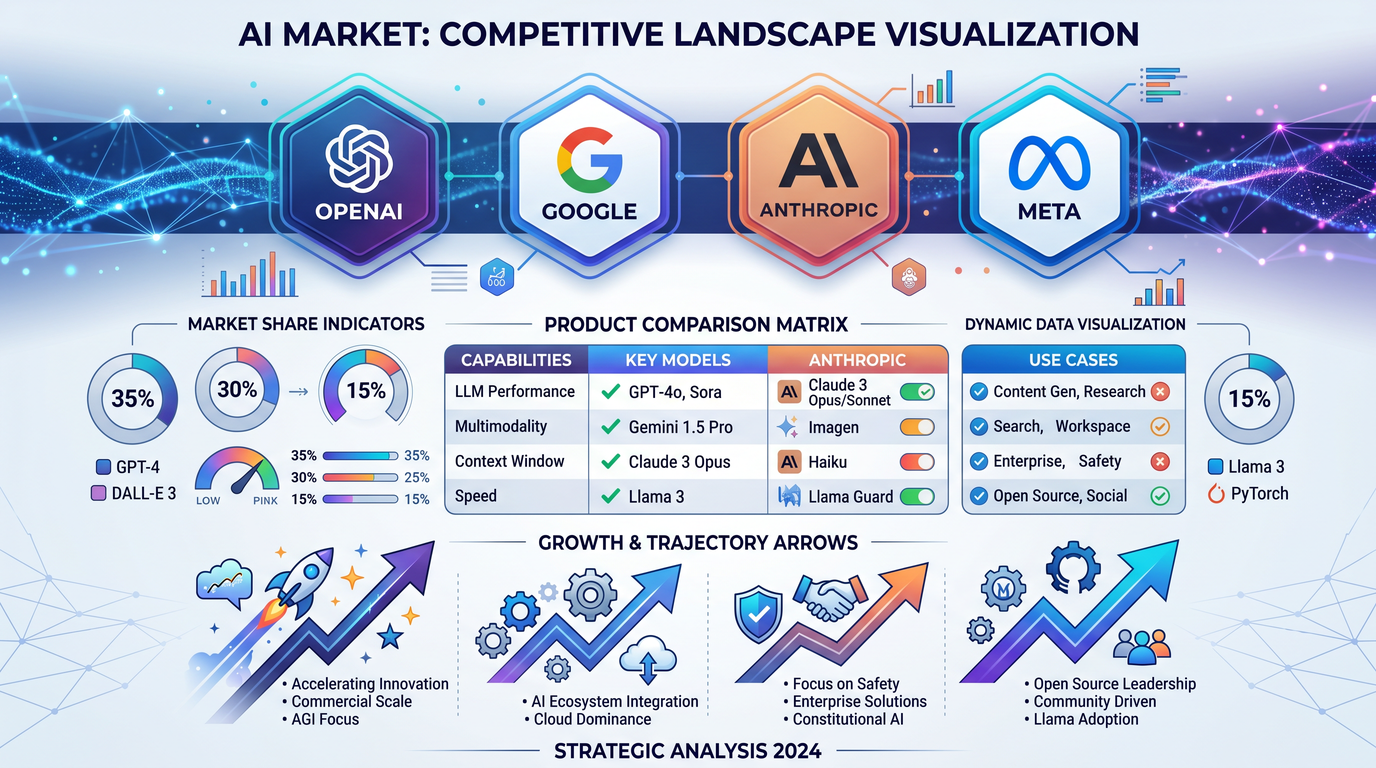
OpenAI’s commercial acceleration and enterprise posture are forcing a recalibration across the industry. While each competitor follows its own playbook, several common threads emerge: platformization, aggressive pricing for scale, and differentiated strategies around openness and integration.
- Full-stack integration: Tightly fusing models with Workspace, Search, and Cloud to monetize both end-user and developer channels.
- Cloud distribution: Using established enterprise relationships to land AI workloads with strong data controls and regional availability.
- Pricing pressure: Competitive rates, enterprise credits, and bundling to win large workloads—especially where data residency and compliance are paramount.
Anthropic
- Safety and reliability emphasis: Positioning as the model of choice for high-stakes and compliance-heavy scenarios.
- Developer-centric clarity: Clear API semantics, context window leadership, and consistent tool use to minimize integration friction.
- Selective partnerships: Deep integrations with data platforms and productivity suites to reduce switching costs for enterprises.
Meta
- Open-weight strategy: Catalyzing an ecosystem of self-hosted and cloud-hosted deployments built on Llama families.
- Hardware optionality: Enabling infra players and enterprises to tune and serve models on their platform of choice.
- Ecosystem effects: Encouraging experimentation and localization, which can pressure proprietary model pricing at the margins.
OpenAI’s pricing strategy faces unprecedented pressure from open-source competitors. Our analysis of how China’s open-source AI models are forcing OpenAI to rethink its pricing examines the strategic implications for API costs, enterprise licensing, and the broader developer ecosystem as competition intensifies. Why China’s Open-Source AI Models Are Forcing OpenAI to Rethink Its Pricing.
The takeaway: as OpenAI moves upmarket with platform controls and enterprise guarantees, competitors respond by doubling down on their unique strengths—distribution, safety posture, or openness. Buyers gain leverage from this triangulation, but also face added complexity in multi-model governance.
The $14B projected net loss and the path to profitability
A projected net loss on the order of $14 billion underscores the cost structure challenges of frontier AI. Training and inference at scale remain capital- and energy-intensive. The path to profitability must therefore blend top-line growth with a structural reduction in per-inference cost.
Cost-of-revenue drivers
- Compute depreciation and amortization: Training clusters and inference fleets carry large, ongoing depreciation schedules.
- Power and cooling: Rising energy intensity for both training and low-latency inference, with geographic variability in cost.
- Networking: Data egress and intra-DC networking for multimodal payloads and tool integration.
- Model serving overhead: Orchestration, autoscaling buffers, and redundancy for SLAs.
Levers to improve margins
- Model distillation: Smaller, targeted models capturing most of the performance of frontier models for routine tasks.
- Speculative decoding and caching: Reduce compute required per token and reuse frequent responses.
- Workload tiering: Align model and SLA tier to business value; route low-stakes work to cheaper backends.
- Custom silicon: Optimize cost/latency for the platform’s most common inference paths.
- Reserved capacity: Commit-based contracts with enterprises for steadier utilization and better capacity planning.
- Agent decomposition: Offload substeps to specialized tools, embeddings, and retrieval to minimize heavy-token generation.
Profitability is feasible if unit economics improve as the platform scales. The trade space is complex, but the vectors are clear: smarter routing, efficient models, and infrastructure that fits the workload.
Infrastructure bets: Jalapeno chip, data centers, and 51.5% office expansion
To sustain both growth and margin improvement, OpenAI is reportedly investing in custom silicon (often referenced in 2026 discussions as the “Jalapeno” chip), expanding data center capacity, and scaling its physical footprint—an office expansion on the order of 51.5%—to support headcount growth and on-site collaboration for sensitive R&D and enterprise support operations.
Why custom silicon?
- Inference economics: Tailoring chips to common inference patterns can materially lower cost per token and reduce latency variance.
- Supply resilience: Reduces dependence on constrained third-party accelerators and smooths capacity planning.
- Software co-design: Aligns runtime, compiler, and model architecture tweaks around a unified performance target.
Data center expansion
- Regional coverage: Closer proximity to enterprise data and users; lower latency and compliance-friendly data residency.
- Energy strategy: Siting facilities where power is reliable and increasingly decarbonized to mitigate long-term cost and policy risks.
- Network fabric: Upgrades to support high-throughput multimodal workloads and agentic orchestration across services.
Office expansion
- Secure collaboration: Certain safety and model evaluation workflows benefit from high-trust, in-office operations.
- Enterprise support: Scaling solution architecture, customer success, and incident response capabilities.
- Talent density: Concentrating experts accelerates research-to-production transfer—a key advantage against more diffuse competitors.
What this means for developers
Developers are the platform’s force multiplier. The shift to an enterprise-grade platform brings both benefits and obligations—better tools and guarantees, alongside clearer constraints and governance.
What gets better
- Stability: Version pinning, deprecation schedules, and backwards-compatible changes reduce breakage risk.
- Observability: Usage dashboards, cost projections, and traceability for tool calls and agent steps.
- Security features: Org-level policies, key rotation, and fine-grained scopes built into SDKs.
- Specialized models: Access to distilled models for cheaper workloads without re-architecting.
What to plan for
- Policy integration: Applications may need to enforce org policies (e.g., redaction, PII filters) at the SDK level.
- Model routing: Design for multi-model strategies with clear fallbacks and A/B evaluation harnesses.
- Cost controls: Implement per-tenant budgets, soft/hard caps, and proactive anomaly detection.
- Evaluation loops: Continuous evaluation across prompts, tools, and updated model snapshots.
Starter code: multi-tenant API integration with routing
// Example: Node.js/TypeScript pseudo-implementation
import OpenAI from "openai";
const client = new OpenAI({ apiKey: process.env.OPENAI_API_KEY });

// Policy context for a given tenant
const policy = {
  allowFrontier: false,
  maxTokensPerRequest: 1024,
  piiRedaction: true,
  defaultModel: "gpt-distilled-1.5",
  frontierModel: "gpt-elite-2026"
};

function redactPII(text: string): string {
  // Placeholder: call a DLP library or service
  return text.replace(/\b\d{3}-\d{2}-\d{4}\b/g, "***-**-****");
}

async function routeRequest({ userPrompt, useFrontier }: { userPrompt: string; useFrontier?: boolean; }) {
  const prompt = policy.piiRedaction ? redactPII(userPrompt) : userPrompt;
  const model = useFrontier && policy.allowFrontier ? policy.frontierModel : policy.defaultModel;

  const response = await client.chat.completions.create({
    model,
    messages: [
      { role: "system", content: "You are a helpful assistant complying with org policies." },
      { role: "user", content: prompt }
    ],
    max_tokens: policy.maxTokensPerRequest,
    temperature: 0.2
  });

  return response.choices?.[0]?.message?.content ?? "";
}

(async () => {
  const answer = await routeRequest({ userPrompt: "Summarize quarterly sales by region." });
  console.log(answer);
})();
Tool use and function calling with auditability
{
  "tool_schema": {
    "name": "lookup_customer_invoice",
    "description": "Retrieve invoice details by invoice_id.",
    "parameters": {
      "type": "object",
      "properties": {
        "invoice_id": { "type": "string" }
      },
      "required": ["invoice_id"]
    }
  },
  "audit": {
    "actor": "user:[email protected]",
    "tenant": "org-acme",
    "purpose_of_use": "billing_support",
    "retention": "7d"
  }
}
Continuous evaluation harness
# Example: simple eval loop (Python-like pseudocode)
tests = [
  {"prompt": "Explain PCI DSS scope.", "expect_contains": "cardholder data"},
  {"prompt": "Translate to German: 'Statement of work'", "expect_contains": "Leistungsbeschreibung"}
]

def run_eval(model):
  results = []
  for t in tests:
    out = chat(model=model, prompt=t["prompt"])
    ok = t["expect_contains"].lower() in out.lower()
    results.append({"prompt": t["prompt"], "pass": ok, "output": out})
  return results

baseline = run_eval("gpt-distilled-1.5")
candidate = run_eval("gpt-elite-2026")

compare = [{"prompt": r["prompt"], "baseline": r["pass"], "candidate": c["pass"]}
           for r, c in zip(baseline, candidate)]
print(compare)
The practical advice: instrument early, embrace multi-model design, and make policy compliance programmatic. That is how you future-proof applications against platform evolution.
What this means for enterprise customers
Enterprises buy outcomes and assurances, not just tokens. The shift to a platform-centric posture is good news: stronger guarantees, clearer contracts, and tooling that aligns with modern governance standards. It also demands stronger internal readiness—data hygiene, policy definition, and change-management.
Buying considerations
- Model portfolio: Map use cases to model tiers. Don’t default to frontier models when distilled suffices.
- Security posture: Validate isolation, data retention defaults, encryption key management, and bring-your-own-key options.
- Compliance: Assess audit logging, eDiscovery searchability, and controls for PII/PHI/PCI contexts.
- Regionality: Confirm data residency guarantees and failover designs aligned with your regulatory footprint.
- Support: Ensure incident SLAs, named support, and escalation paths meet your operational needs.
Reference architecture: governed RAG + agents
- Data layer: Document stores with per-tenant encryption and lineage metadata.
- Embedding + index: Versioned embeddings; reindex on schema/model changes with backfill tracking.
- Policy engine: Centralized allow/deny for model access, tool scopes, and prompt templates.
- Agent layer: Orchestrators with step-level logs, approvals for high-risk actions, and retry policies.
- Observability: Traces for each step, cost attribution tags, and business KPI mapping.
Example: organizational policy document (JSON)
{
  "org": "acme-corp",
  "data_retention_days": 0,
  "default_models": {
    "summarization": "gpt-distilled-1.2",
    "analysis": "gpt-distilled-1.5",
    "code": "codex-enterprise-2026"
  },
  "frontier_access": {
    "allowed_teams": ["research", "legal"],
    "approval_required": true
  },
  "rbac": {
    "roles": {
      "admin": ["policy.write", "keys.rotate", "models.approve"],
      "developer": ["apps.deploy", "logs.read"],
      "analyst": ["chat.use"]
    }
  },
  "pii_controls": {
    "redact_in": true,
    "redact_out": true,
    "masking_style": "token"
  },
  "regionality": {
    "primary": "eu-west",
    "failover": "eu-central",
    "block_cross_region": true
  }
}
Commercial structure tips
- Commit with guardrails: Secure discounts via usage commitments but insist on model flexibility and price protection.
- Reserved capacity: For stable workloads, negotiate reservations aligned to business cycles.
- Pilot to production: Tie pilot milestones to support from solutions architects and clear success criteria.
- Cost governance: Require org-level budgets, alerts, and caps; validate chargeback tags for internal allocation.
ROI modeling checklist
- Baseline today: Handle time, deflection rate, and accuracy before AI.
- Target metrics: SLA adherence, backlog reduction, revenue lift from personalization.
- Total cost: Tokens, orchestration services, integration engineering, and change-management.
- Sensitivity: Vary model choice, latency class, and cache rate; test worst-case and best-case.
Predictions for H2 2026 and beyond
1) Platform packaging stabilizes
Expect clearer, tiered packaging for individuals, teams, and enterprises—with entitlements that reduce ambiguity: model catalogs, latency classes, collaboration spaces, and governance knobs. The “$200 Pro” settles into a well-defined role between consumer and enterprise SKUs.
2) Agentic workflows mature
Agents move from demos to production-grade orchestrations with policy-aware tools, declarative plans, and human oversight. The winners will offer observability, testability, and rollback pathways as first-class features.
3) Distillation drives margins
More workloads will default to distilled/specialized models, with frontier models reserved for edge cases. Expect sophisticated routers, cost-aware planning, and transparent evaluation reports to justify routing choices.
4) Multimodal becomes routine
Text+image+audio becomes standard for enterprise apps—claims processing, field service diagnostics, and knowledge capture. Video understanding grows but remains constrained by cost and latency for many real-time cases.
5) On-device and hybrid inference
Expect growth in hybrid execution: partial on-device inference for privacy/latency, with cloud escalation for complex steps. Enterprise policy engines will govern what runs where.
6) Procurement simplification
Enterprises will demand streamlined contracts and shared assessments (e.g., standardized security questionnaires), enabling faster time-to-value and reducing AI portfolio sprawl.
7) Competition intensifies on TCO
As top-tier models converge in quality on mainstream tasks, total cost of ownership (TCO)—including developer ergonomics, observability, and governance—becomes the primary differentiator.
Risks and watchlist
- Safety and reliability: Regressions or high-profile failures can slow enterprise adoption and invite policy constraints.
- Regulatory flux: Data residency, model transparency, and IP rules are tightening; non-compliance risks rise with scale.
- Cost shocks: Hardware shortages or power price spikes can compress margins unexpectedly.
- Open-source velocity: High-quality open models may erode proprietary price power in some segments.
- Data supply: Licensing costs and constraints on high-quality data could affect training cadence and unit economics.
- Ecosystem lock-in: Excessive lock-in can backfire as buyers demand multi-model optionality and portable abstractions.
90-day action plan
If you’re a developer
- Add version pinning and circuit breakers to all production calls.
- Implement a model router with A/B evaluation before switching defaults.
- Centralize secrets, rotate keys, and adopt org-level scopes.
- Instrument cost and latency per feature; add anomaly alerts.
- Refactor heavy prompts into tool-augmented steps to reduce token load.
If you lead an enterprise program
- Publish an AI policy baseline: allowed use cases, model tiers, and data handling rules.
- Run a governed pilot in a single business unit with clear ROI targets.
- Negotiate reserved capacity aligned with near-term launches; include price protection.
- Stand up an evaluation practice: golden sets, regression checks, and change approvals.
- Create a shared components library: prompts, tools, and templates with ownership and SLAs.
Access 40,000+ AI Prompts for ChatGPT, Claude & Codex — Free!
Subscribe to get instant access to our complete Notion Prompt Library — the largest curated collection of prompts for ChatGPT, Claude, OpenAI Codex, and other leading AI models. Optimized for real-world workflows across coding, research, content creation, and business.
Conclusion
The transformation of OpenAI from a research-centric organization into an enterprise-grade platform operator is not a mere phase—it’s the new operating system for the company. The reported $5.7 billion in Q1 2026 revenue and the $30 billion annual target define a commercial arc that prioritizes enterprise primitives, predictability, and cost discipline without abandoning scientific ambition.
This is reshaping the industry. Competitors respond along their axes—distribution, safety, openness—while buyers gain leverage and complexity in equal measure. The platform era demands careful design: multi-model routing, governance-first architectures, and relentless focus on unit economics. For developers and enterprises alike, the playbook is becoming clearer: instrument and evaluate, align models to business value, and adopt the enterprise controls that turn impressive demos into dependable systems.
As H2 2026 unfolds, the most durable gains will accrue to those who master both sides of the equation: the science that pushes AI forward and the systems engineering that makes it reliable, affordable, and accountable at scale.
