
ChatGPT Work Launches: OpenAI’s Super App Brings Codex Power to Non-Coders
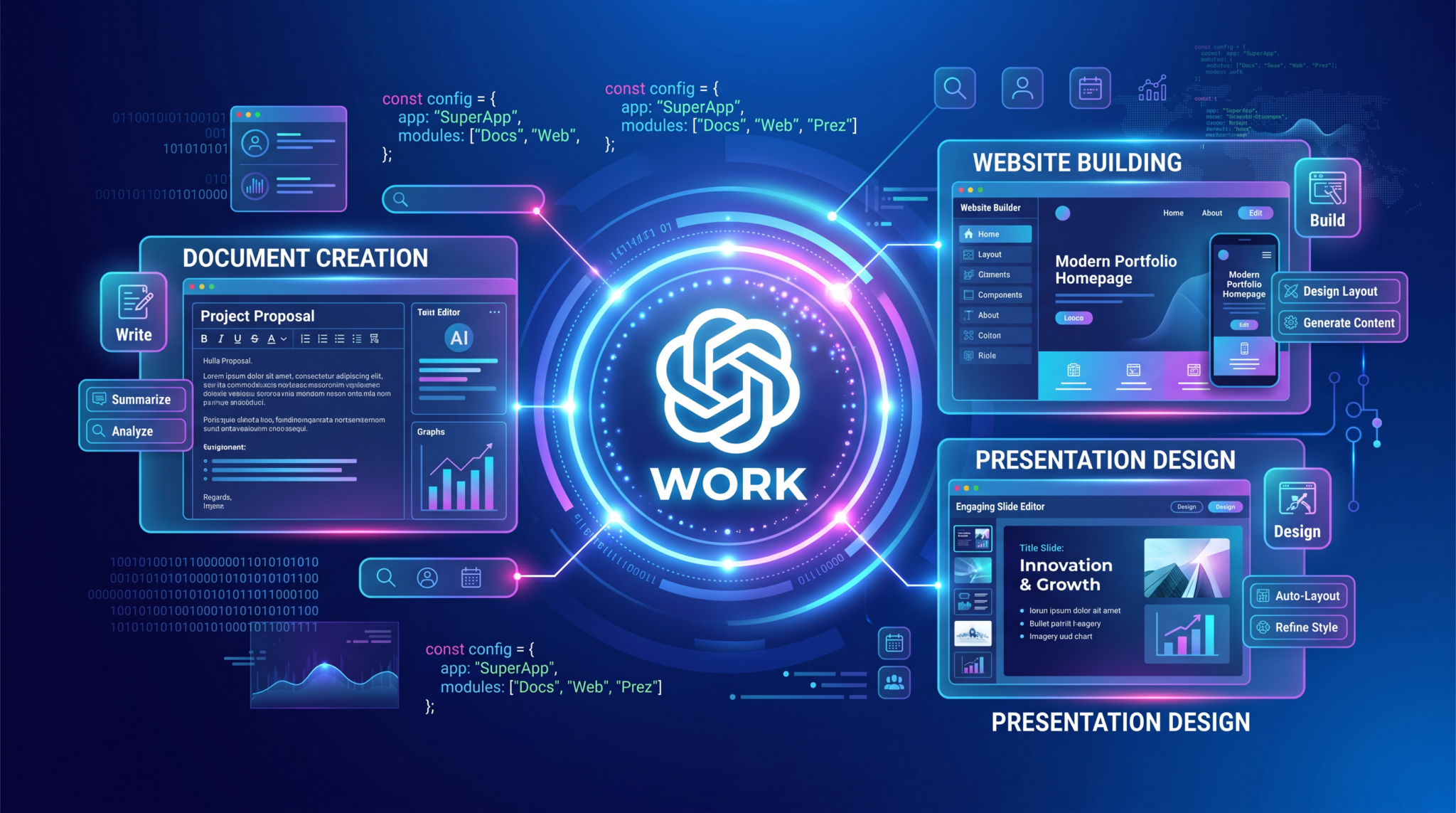
OpenAI launches ChatGPT Work: a super app agent that builds docs, decks, and websites without code
By Markos Symeonides | July 10, 2026
Executive summary
OpenAI today unveiled ChatGPT Work, a new “super app” agent designed to democratize software creation for non-coders by transforming natural language instructions into finished outputs like documents, presentations, and fully hosted websites. Rolling out initially to Pro, Enterprise, and Edu users, and then to Plus and Business plans, ChatGPT Work arrives alongside GPT-5.6—the company’s latest foundation model—whose debut had been delayed pending a government security review. With ChatGPT Work, OpenAI fuses the conversational prowess of ChatGPT and the programmatic power historically associated with Codex into a guided, agentic workspace aimed squarely at teams that need outcomes more than code.
Positioned as a direct competitor to Anthropic’s Claude Cowork and Microsoft’s Copilot Cowork, ChatGPT Work is OpenAI’s clearest bid yet to expand from a model and chatbot company into a workflow-first platform for getting business tasks done end-to-end. It also arrives with a new ChatGPT desktop application and a hosted websites capability that lets users publish AI-generated sites without managing infrastructure. The launch is freighted with strategic significance: OpenAI says 2 million businesses currently account for 40% of its revenue and wants that number at 50% by year-end, while the “super app” framing doubles as a pitch to Wall Street ahead of a possible IPO.
“You can apply the model’s ability to code to solve problems across every industry,” said Ty Geri, a product manager on ChatGPT Work, underscoring OpenAI’s thesis that coding dexterity—applied through agents and abstractions—can serve as a universal problem-solving substrate. Creative Strategies analyst Max Weinbach added another dimension: early tests show the smallest GPT-5.6 variant completes many tasks as effectively as the largest at roughly one-fifth the cost, hinting at a step-change in accessibility and unit economics for enterprises scaling AI.
Before today, OpenAI’s agentic portfolio included Operator, deep research, ChatGPT Agent, and Workspace Agents—each tackling a slice of the workflow pie. ChatGPT Work consolidates and extends those efforts into a single pane of glass that’s equal parts chat, studio, and automation canvas. It is, in a phrase, AI that does the work, not just talks about it.
- What’s new: ChatGPT Work, a super app agent that ships real deliverables—docs, decks, and websites—without requiring code.
- Under the hood: GPT-5.6, launched the same day after a government security review period.
- Who it’s for: Non-coders and cross-functional teams; Pro, Enterprise, and Edu first; Plus and Business to follow.
- Competitive set: Anthropic Claude Cowork and Microsoft Copilot Cowork.
- Add-ons: New ChatGPT desktop app and a hosted websites feature for one-click publishing.
- Operational claim: Smallest GPT-5.6 variant can achieve parity with largest for many tasks at 1/5 the cost (per analyst Max Weinbach).
- Strategy: Consolidate agentic offerings; drive enterprise revenue from 40% to 50% by year-end; prime the market ahead of a potential IPO.
For a deeper exploration of this topic, our comprehensive article on How to Build a Cybersecurity Vulnerability Scanner with OpenAI Codex provides detailed analysis, practical examples, and actionable strategies that complement the concepts discussed in this section.
What is ChatGPT Work?
ChatGPT Work is OpenAI’s new agentic hub that combines conversational guidance, automatic coding, and task orchestration to produce tangible outputs—documents, presentation decks, and fully hosted websites—without requiring users to write a line of code. Conceptually, it merges the familiar ChatGPT interface with the program synthesis and tool-use lineage of Codex to create an approachable “do engine” for business users. The promise is simple: describe what you want, iterate conversationally, and receive a production-ready artifact you can present, share, or publish.
This product departs from earlier “prompt-and-pray” paradigms in a few critical ways. First, it centers on outcomes rather than messages. Instead of a static chat transcript, users get living deliverables that can be regenerated, versioned, and remixed. Second, it abstracts away the boilerplate complexity associated with software tooling. Rather than configuring a dozen integrations, setting up environments, and stringing together scripts, ChatGPT Work claims to thread the needle from idea to artifact automatically. Third, it is grounded in agentic building blocks tested across OpenAI’s previous releases—Operator for task execution, deep research for synthesis, ChatGPT Agent for multi-step actions, and Workspace Agents for enterprise context—now packaged as a unified, cross-functional experience.
ChatGPT Work is not a developer IDE. It is a creator’s cockpit where code is a means, not an interface. Under the hood, GPT-5.6 writes, reads, and executes code and structured plans, but users interact through natural language and editor-like controls. This “coded-by-default, no-code-by-design” approach aims to unlock a new cohort of builders: product marketers assembling launch sites, operations managers spinning up SOP libraries, sales teams producing tailored proposals, educators designing syllabi and course pages, and more—all without learning programming or managing web infrastructure.
From chat to creation: a staged, agentic flow
While OpenAI hasn’t published every architectural detail, the behavior of ChatGPT Work implies a staged pipeline:
- Intent capture: The agent elicits goals, audience, tone, and constraints via dialog, often proposing a plan before execution.
- Structured planning: Behind the scenes, GPT-5.6 decomposes objectives into ordered steps, including data gathering, drafting, formatting, and publishing.
- Program synthesis: When needed, the model generates and runs code—akin to Codex heritage—to transform content, build layouts, or wire interactivity for websites.
- Iterative refinement: Users steer edits conversationally. The agent tracks changes and can selectively regenerate sections rather than starting from scratch.
- Output packaging: Deliverables are exported to shareable documents or slide decks, or published as hosted websites with a click.
The critical innovation is not any one step, but the orchestration that turns a chat session into a complete asset. This re-centers the LLM from an assistant that answers questions to an operator that finishes jobs.
Key features
Document studio for non-coders
At the heart of ChatGPT Work is a document studio that composes reports, one-pagers, white papers, FAQs, SOPs, and proposals. Users describe the audience, objectives, and length; the agent drafts, cites internal resources when available, and presents the result in a clean editor. Edits are conversational (“tighten section two,” “add a risk section,” “localize for German readers”). As with prior ChatGPT experiences, tone and voice can be tuned, but Work adds stronger layout, versioning, and multi-asset packaging to prepare documents for distribution.
Presentation designer with agentic structure
For decks, ChatGPT Work suggests an outline, generates slides with speaker notes, and conforms to user-defined structure (e.g., “Problem, Insight, Proposal, Timeline, Budget”). Users can reorder sections by asking, merge or split slides, and request alternate visual narratives (“make this more competitive,” “show a step-by-step tutorial”). The agent can generate multiple variants—executive summary vs. technical deep dive—and keep them linked so updates propagate where appropriate.
Web builder plus hosted websites
The most attention-grabbing feature is the hosted websites capability. From the same conversation used to draft a document or deck, users can say “turn this into a website,” and ChatGPT Work synthesizes layouts, navigation, and content into a site it can publish and host. This removes a persistent barrier between ideation and distribution. Instead of handing off to a CMS or wrangling templates, the site goes live from within the app—no devops, no DNS gymnastics for a basic launch, and no code needed for updates.
This fills a gap in earlier “AI page builders” that produced code snippets or one-off HTML files but stopped short of a turnkey publish pipeline. With hosting available natively, the handoff compresses from weeks to minutes. That has implications well beyond personal sites: internal microsites for policy changes, product landing pages for campaigns, event pages for recruiting, or resource hubs for customer success—each an outcome ChatGPT Work targets out of the box.
Desktop application for ChatGPT
OpenAI is simultaneously releasing a new ChatGPT desktop application. Beyond convenience, desktop presence is strategic for adoption: it brings Work’s agentic capabilities closer to where professionals actually work, with windowing, keyboard shortcuts, and OS-level share sheets that reduce friction moving content between tools. Even for organizations not ready to publish websites, the desktop app becomes a vector to embed Work’s document and deck generation into the daily flow.
Reasoning, planning, and the “Codex inside” effect
Unlike traditional no-code platforms that depend on a fixed library of blocks, ChatGPT Work relies on GPT-5.6’s ability to write and adapt code under the hood. That means the platform is less constrained by predefined widgets and more capable of synthesizing tailored logic for formatting, data transformation, and site scaffolding. Ty Geri’s remark—“You can apply the model’s ability to code to solve problems across every industry”—is as much about breadth as depth. If a process can be described, the agent can often codify it, whether it’s reorganizing a policy library, generating product FAQs from a release memo, or producing role-specific training pages from a master curriculum.
Performance tiers: smallest model, outsized results
Creative Strategies analyst Max Weinbach noted that the smallest GPT-5.6 variant completes tasks as well as the largest for many common workflows at roughly 20% of the cost. If this pattern holds broadly, it suggests a new scaling curve where enterprises default to lighter models for day-to-day creation, reserving heavyweight variants for edge cases. The result could be better cost predictability, fewer trade-offs between quality and budget, and greater freedom to experiment without finance teams tapping the brakes.
Agentic lineage: consolidation of OpenAI’s prior offerings
ChatGPT Work is not a first brush with agents for OpenAI. It consolidates functions pioneered in Operator (execute user-defined tasks), deep research (multi-source synthesis), ChatGPT Agent (multi-step tasking), and Workspace Agents (context-aware enterprise assistants). By pulling these threads into one app oriented around outputs, OpenAI reduces choice paralysis and the complexity of having separate interfaces for adjacent capabilities. For customers, that means less patchwork and more coherence.
Security posture and the GPT-5.6 review context
GPT-5.6’s same-day launch follows a government security review delay, which contextualizes OpenAI’s push for enterprise readiness. While technical specifics of the review were not disclosed alongside this announcement, the fact of it underscores the scrutiny top-tier models face and the assessments buyers increasingly expect. For risk-sensitive organizations, the subtext is reassuring: major updates are clearing external checks before general availability, even as the pace of feature delivery remains brisk.
For a deeper exploration of this topic, our comprehensive article on The Complete Guide to ChatGPT and Codex Shared Context: Memory, Projects, and Cross-Platform Workflows provides detailed analysis, practical examples, and actionable strategies that complement the concepts discussed in this section.
Pricing and availability
OpenAI is rolling ChatGPT Work out in stages. Pro, Enterprise, and Edu users are first in line, followed by Plus and Business customers. The phased approach aligns with where the company has seen the most appetite for agentic creation at scale and where governance mechanisms are typically more mature. Enterprises, in particular, are hungry for tools that shorten the path from idea to artifact without adding the overhead of new platforms to train and maintain.
OpenAI has not published full public pricing details for every tier within this announcement window. What’s clear is that the company is positioning ChatGPT Work to drive up enterprise attach rates and seat expansion. With 2 million businesses already generating roughly 40% of OpenAI’s revenue, the stated goal is 50% by year’s end. That target provides a lens for interpreting rollout decisions: landing in Pro and Enterprise first ensures early momentum among power users and organizational buyers who can greenlight large deployments quickly.
The new desktop app arrives concurrently and should help accelerate adoption regardless of plan, especially in knowledge-work environments where switching costs are real. Meanwhile, hosted websites—the headline feature for go-to-market teams—make the value proposition legible to budget holders beyond IT. A director of marketing or head of customer success can see immediate, quantifiable benefit: the same headcount shipping more assets faster, with no new infrastructure commitments.
How it compares: ChatGPT Work vs. Claude Cowork vs. Copilot Cowork
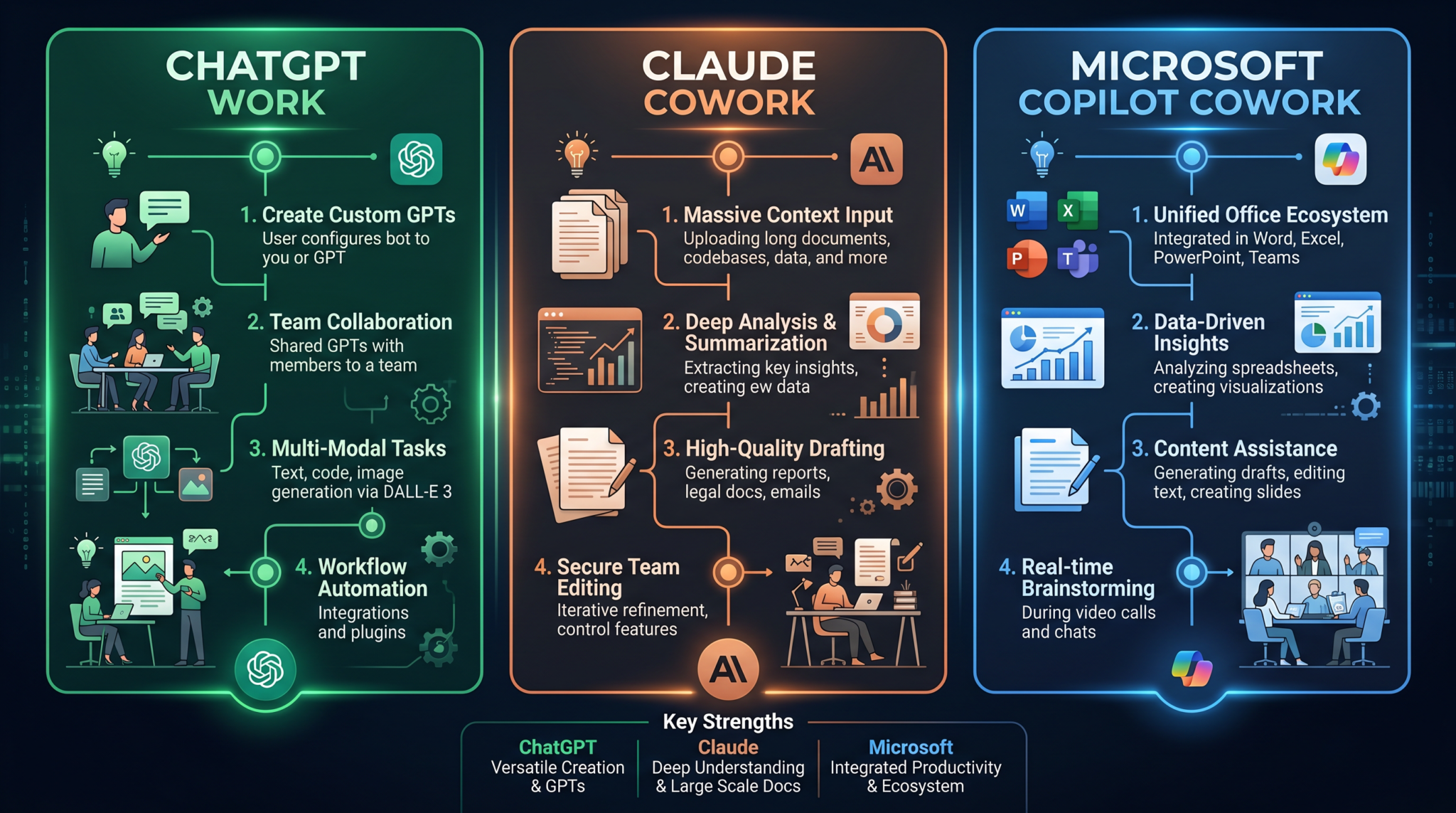
In function and positioning, ChatGPT Work is a shot across the bows of Anthropic’s Claude Cowork and Microsoft’s Copilot Cowork. Each vendor sees the same opportunity: move from general-purpose chat to a workspace where agents produce shareable outputs. But the emphases differ.
- OpenAI leans into agentic creation as an end-to-end pipeline with first-party hosting. The hosted websites capability is a visible wedge—beyond drafting, into publishing.
- Anthropic has emphasized Claude’s carefulness and reliability in multi-step workflows, appealing to teams who prioritize guardrails and explainability alongside creativity. Claude Cowork focuses on a “coworker” metaphor that participates in structured team processes.
- Microsoft’s Copilot Cowork is naturally embedded in the Microsoft 365 universe, which is a distribution juggernaut. Its strength is proximity: where Outlook, Word, PowerPoint, and Teams live, Copilot is a tap away, with enterprise identity and compliance already wired in.
OpenAI’s differentiator is the “super app” thesis: a single canvas that not only generates content but also operationalizes it into a public-facing site when needed. If Anthropic and Microsoft optimize for dependable collaboration within established suites, OpenAI is optimizing for speed from prompt to product, with fewer handoffs.

| Dimension | ChatGPT Work (OpenAI) | Claude Cowork (Anthropic) | Copilot Cowork (Microsoft) |
|---|---|---|---|
| Core positioning | Super app agent for outcomes (docs, decks, websites) with hosted publishing | Careful, reliable coworker for structured workflows and knowledge synthesis | Embedded assistant across Microsoft 365 for collaboration and productivity |
| Model | GPT-5.6 (new, post-review) | Claude family | Copilot stack integrated with Microsoft ecosystem |
| Interface emphasis | Conversational build + editor + publish | Chat-first with task and document collaboration | Sidebar and in-app experiences across Office apps |
| Target user | Non-coders, cross-functional teams shipping assets quickly | Teams prioritizing dependable reasoning and team handoffs | Organizations living in Microsoft 365 seeking native augmentation |
| Notable capability | One-click hosted websites from a single conversation | Guardrail-forward collaboration and iterative review | Deep integration with files, meetings, and identity |
In this competitive context, GPT-5.6’s cost/performance profile matters. If the smallest variant can deliver comparable quality for common tasks at 1/5 the cost, OpenAI can pitch not only new capabilities but better economics. In a world where CFOs scrutinize AI line items, that could tilt decisions at renewal time, especially for customers who run heavy content operations—marketing, documentation, onboarding, and support.
Enterprise implications
From tools sprawl to outcomes platforms
Enterprises have spent years stitching together point solutions: chatbots, summarizers, slide generators, site builders, RAG-powered document search, and more. ChatGPT Work argues for consolidation. If a single agent can ingest context, plan work, produce polished assets, and publish them, the value calculus shifts from “how many tools can we wire together” to “how quickly can we ship?” The productivity gains are tangible: fewer log-ins, fewer APIs to maintain, fewer brittle handoffs, fewer people waiting for requests to clear a queue.
Access 40,000+ AI Prompts for ChatGPT, Claude & Codex — Free!
Subscribe to get instant access to our complete Notion Prompt Library — the largest curated collection of prompts for ChatGPT, Claude, OpenAI Codex, and other leading AI models. Optimized for real-world workflows across coding, research, content creation, and business.
Budgeting and model strategy
Weinbach’s observation about the smallest GPT-5.6 model variant lands directly in the CFO’s office. Organizations can experiment broadly with lower-cost models across thousands of everyday tasks while reserving premium capacity for legal reviews, edge cases, or high-stakes outputs. That tiering strategy gives finance leaders better control of run-rate AI spend and empowers business units to try more workflows without a committee meeting each time. Procurement can tie usage to outcomes—assets shipped, campaigns launched, pages published—rather than abstract consumption metrics alone.
Governance and risk postures
Agentic systems that write code and publish websites raise natural governance questions. Enterprises will evaluate how ChatGPT Work handles auditability (who changed what), approvals (who can publish), and data boundaries (what content the agent can access). While OpenAI did not enumerate policies line-by-line in this announcement, the enterprise rollout order signals that permissioning, logging, and admin controls are a priority. The backdrop of a government security review for GPT-5.6 reinforces that buyers can expect a higher floor for controls as the model family evolves.
Change management: adoption by function
Real adoption happens job by job. In marketing, ChatGPT Work becomes a campaign engine: brief-to-deck-to-landing-page in one flow, with faster iteration. In sales, it drafts proposals, condenses discovery notes into tailored value narratives, and packages win stories as internal playbooks or external pages. Operations leaders can codify SOPs into searchable, shareable microsites that standardize onboarding and reduce shadow doc proliferation. HR and learning teams can turn policy updates into living websites with Q&A sections and role-specific guidance. Product managers can spin up feature explainers and user education hubs without burdening dev teams.
Across these functions, the agent’s ability to maintain structure matters as much as its ability to write. A deck built from a “Problem, Insight, Proposal” scaffold is easier to review and reuse than a free-form brain dump. A site with consistent navigation and linked variants of the same message (executive version vs. practitioner version) ensures coherence across touchpoints. The agent’s orchestration is thus a management ally: it nudges teams toward patterns that produce quality at scale.
Vendor consolidation and the path to 50% enterprise revenue
OpenAI’s stated goal—to grow enterprise share of revenue from 40% to 50% this year—puts a clock on consolidation. If ChatGPT Work can replace or subsume multiple point tools while also creating net-new capabilities (hosted sites), it gives account teams a credible reason to expand contracts. The hosted website feature is particularly sticky: once a team’s launch rhythm depends on it, switching costs rise. Meanwhile, the desktop app spreads usage into corners of the org where browser tabs rarely reach, compounding seat counts.
Developer and builder impact
No-code for outcomes, code behind the curtain
Developers might view no-code creation with suspicion, but the framing here is pragmatic: ChatGPT Work reserves code for the agent to wield. It is not claiming to replace software engineering; it’s moving the boundary between “what only a dev can do” and “what a team can ship today.” For builders, the effect could be liberating. Engineering maintains focus on core products and critical systems, while AI handles the long tail of collateral, microsites, and internal documentation that routinely gums up roadmaps.
Templates, components, and governance hooks
The success of a creation platform often hinges on repeatability. While OpenAI did not turn this launch into a template marketplace announcement, the natural trajectory is clear: organizations will want reusable prompts, structure blueprints, and style primitives that teams can apply consistently. That, in turn, drives requests for governance hooks: who can create or change a template, how reviews flow, and how to enforce brand voice or disclaimers. Expect adjacent tooling—inside or around ChatGPT Work—to address these enterprise-adoption pressures swiftly.
Interplay with existing stacks
Builder ecosystems rarely live in a vacuum. Even if ChatGPT Work becomes a primary creation hub, teams will continue to rely on existing repositories of truth (knowledge bases, design systems, product analytics). The connective tissue is context: the agent must absorb inputs and stitch outputs back into those systems. OpenAI’s prior Workspace Agents and Operator features telegraph a direction of travel: agents that can operate within enterprise boundaries while leaving a trail admins can follow. The desktop app’s presence hints at deeper OS-level hooks over time, but for now the headline is outcomes over plumbing—a welcome inversion for teams that have done years of integration yak-shaving.
The market context: strategy, economics, and an IPO drumbeat
From model race to outcomes race
Two shifts are visible in today’s launch. First, OpenAI is moving the conversation from raw model capability to delivered outcomes. GPT-5.6 will have its own arc of benchmarks and demos, but OpenAI chose to unveil it tethered to a super app that turns capability into shippable assets. Second, cost is now a headline feature. By highlighting the performance of the smallest variant and its 1/5 cost relative to the largest for many tasks, OpenAI is telling buyers the economics of “AI at work” are getting friendlier. Those messages resonate in procurement cycles increasingly shaped by ROI dashboards rather than demos alone.
Competitive pressures and differentiation
Anthropic’s Claude Cowork and Microsoft’s Copilot Cowork are formidable rivals. Anthropic brings a reputation for carefulness and reliable reasoning; Microsoft offers distribution muscle inside the world’s most widely used productivity suite. OpenAI’s differentiation hinges on speed-to-outcome and versatility: a single conversation that becomes a document, deck, and live website. If it executes, OpenAI positions itself not just as the place to ask questions, but as the place to ship work. It is trying to define the category in which others must respond.
The enterprise revenue mix and the road to public markets
The revenue backdrop is explicit: 2 million businesses contribute about 40% of OpenAI’s revenue today, and the company wants half by year-end. That kind of mix matters if an IPO is on the table. Public investors will scrutinize predictable, enterprise-grade revenue and gross margins tied to efficient model usage. ChatGPT Work helps on both fronts. It promises stickier use cases that expand seats and consumption, and through GPT-5.6’s lighter variants, it promises a path to sustainable unit economics. Framed as a “super app,” it’s also a narrative investors can latch onto: a consolidated platform that reduces churn risk and opens adjacent monetization (hosting, advanced governance, premium templates, training).
Signals from the security review delay
GPT-5.6’s delayed debut, pending government security review, is a reminder that cutting-edge models operate in a regulated and politically salient environment. For buyers in finance, healthcare, and the public sector, that oversight can be a positive signal: due diligence is not an afterthought. For vendors, it’s an impetus to ship features with governance in mind. In that light, ChatGPT Work’s focus on outputs you can inspect—documents, decks, sites—may be more tractable for compliance teams than black-box automations buried deep in infrastructure.
What this means for users right now
Getting started: from prompt to product
The on-ramp to value is straightforward. Start with a clear brief: the audience, the job to be done, and the desired output (doc, deck, site). Let the agent propose a plan. Push it to show structure before content. Iterate section by section, especially on the first asset you plan to publish. If the end state is a website, ask for a content model—navigation, hero messages, CTAs—then see drafts in context before wordsmithing. The agent works best when you supply constraints it can respect and improve upon.
Use cases across functions
- Marketing and comms: Turn a product brief into a launch deck and a landing page. Generate regional variants (EMEA, APAC) and maintain a master narrative that governs updates.
- Sales and success: Create tailored proposals derived from discovery notes and case studies; publish customer-facing resource hubs with implementation checklists and FAQs.
- Operations and HR: Transform policy updates into role-specific guidance microsites; produce versioned SOPs that are easier to audit and improve.
- Product and design: Publish feature explainers and “what’s new” pages synced with internal documents; draft internal alignment decks with consistent structure.
- Education: Build course pages from syllabi; generate lesson plans and slide decks with a uniform cadence across a program.
Practical guardrails for teams
Even with agentic power, human-in-the-loop discipline remains smart practice. Treat the first pass as a scaffold. Verify claims, especially for public websites. Use the agent’s strength—structure and speed—to get to a quality draft quickly, then layer in institutional nuance. Establish team norms: who requests final changes, who presses publish, how feedback loops return into templates. A few well-placed checkpoints prevent rework later and build trust in the system across stakeholders.
Measuring impact beyond “time saved”
Businesses often default to “hours saved” as the KPI for AI. With ChatGPT Work, look at outcomes: assets shipped per month per team, campaign cycle time, the ratio of internal asks to external deliverables, and consistency scores across variants (do our decks and sites tell the same story?). Tie model usage to these end metrics. When the smallest model variant accomplishes a task at 1/5 the cost of the largest, those savings grow geometrically across thousands of outputs; the point is not to merely cut cost, but to re-invest the headroom in experimentation and quality.
For a deeper exploration of this topic, our comprehensive article on The GPT-Live Voice Integration Playbook: 10 Prompts for Building Voice-First AI Workflows provides detailed analysis, practical examples, and actionable strategies that complement the concepts discussed in this section.
The bigger picture: why this launch matters
ChatGPT Work is a declaration that the center of gravity in AI software is shifting from answers to outcomes. For years, teams used AI to think, summarize, and draft. They still will. But a plateau sets in if the endpoint is always a document in a shared drive waiting on someone’s review. By making publishing a first-party action—especially via hosted websites—OpenAI is collapsing an entire stage of the content lifecycle. That may prove decisive in environments where speed and coherence are competitive advantages.
It’s also a vote for agents that code behind the curtains. Rather than meeting users where code is, OpenAI is meeting them where the job is, and letting the agent wield code as a tool of composition and transformation. That design choice gives non-coders reach they have never had, and it gives organizations a lever to ship more without ballooning operational complexity. If the smallest GPT-5.6 can deliver strong results cheaply, the calculus for scaling becomes less fraught: you don’t need to ration capability to preserve budgets.
Competition will remain fierce. Anthropic will push reliability and a coworker ethos. Microsoft will deepen Copilot Cowork’s gravity inside the 365 stack. But OpenAI’s “super app” posture is unusually legible: ask, structure, create, publish. If it resonates, you’ll see it not just in demo reels but in the mundane rhythms of work—more pages launched, more decks delivered, fewer handoffs to overloaded teams, and fewer weeks lost to software glue.
Quotes that frame the moment
- Ty Geri, product manager for ChatGPT Work: “You can apply the model’s ability to code to solve problems across every industry.”
- Max Weinbach, analyst at Creative Strategies: the smallest GPT-5.6 variant “completes tasks as well as the largest at 1/5 the cost.”
Those lines capture the dual thrust: capability that generalizes across domains, and economics that democratize access. Whether you are a three-person startup or a global enterprise, those are levers you can feel on the ground.
Final take
ChatGPT Work is OpenAI’s most assertive step yet toward a future where AI agents don’t just assist; they deliver. By marrying ChatGPT’s conversational strengths with the code-writing lineage of Codex and packaging it into a super app that outputs docs, decks, and hosted sites, OpenAI is redrawing the line between ideation and execution. The timing—paired with GPT-5.6’s debut after a security review—sends a signal to enterprises and markets alike: the company is building for durable, governed, and economically sane adoption at scale.
The category is far from settled. But with a clear value proposition, a staged rollout starting with Pro, Enterprise, and Edu, and a public goal to push enterprise revenue from 40% to 50%, OpenAI isn’t merely shipping a product. It’s staking out a narrative: the super app agent as the next layer of the productivity stack, and the keystone of its pitch to Wall Street. For users, the opportunity is immediate and tangible—describe the work, see the plan, shape the draft, and press publish. For the industry, the gauntlet is thrown: the outcomes race is on.
