
How AI Coding Agents Are Triggering Enterprise Security Alerts: What IT Teams Need to Know About Claude Code, Codex, and Cursor
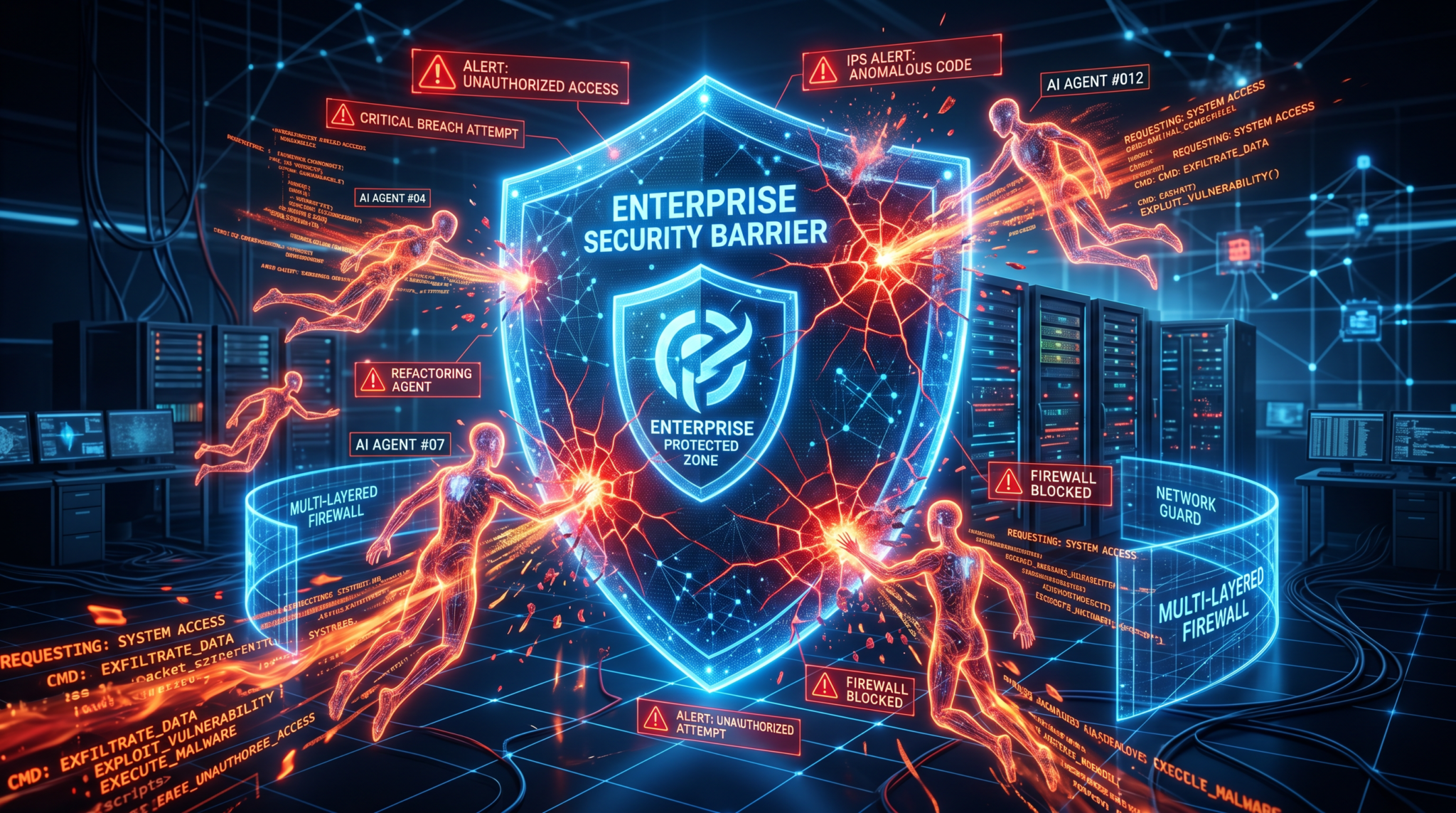
Featured Analysis: AI Coding Agents Are Triggering Enterprise Security Alerts — What IT Teams Need to Know
Author: Markos Symeonides. Date: July 10, 2026.
Executive summary
AI coding agents have crossed the threshold from early curiosity to everyday tooling inside development environments, CI/CD pipelines, and operational workflows. As they grow more autonomous—reading local files, installing dependencies, managing environment variables, and monitoring repositories for changes—these agents are beginning to look, from the perspective of endpoint detection and response (EDR) tools, very much like attackers. Sophos research published in July 2026 found that high-profile AI coding assistants such as Claude Code, Cursor, and OpenAI Codex can trigger Windows endpoint security rules when they perform common tasks that mimic well-known adversary techniques: credential access patterns (for example, reading .env files and keychains), use of Living off the Land Binaries (LOLBins) for downloads or scripting (for example, curl, wget, PowerShell), and persistence mechanisms (for example, cron jobs, startup scripts, or service registration). These detections are typically false positives stemming from how AI agents interact with the local filesystem and network.
The enterprise impact is real. Security operations centers (SOCs) report heightened alert volumes, confusing process trees peppered with benign automations, and longer triage times as analysts try to distinguish harmless agent behavior from live threats. Developers are also affected: blocked installs, quarantined binaries, and throttled network calls erode productivity and undermine trust in AI tooling. A new operational challenge has emerged—identifying AI agent behavior with high confidence and granting it the correct risk-managed latitude without opening blind spots exploitable by real attackers.
JetBrains, recognizing the friction between intelligent dev tooling and enterprise security, is building a governance layer across popular agent backends (including Claude Code, Codex, and Gemini CLI) to standardize permissions, unify prompts for user consent, and centralize policy enforcement. This governance trend will likely accelerate across the toolchain, reshaping how AI development capabilities are deployed at scale in regulated environments.
This featured analysis explores what Sophos found, why AI agents trigger security rules, and what IT and security teams need to know to handle false positives safely at scale. We examine whitelisting strategies, governance approaches, vendor responses from OpenAI, Anthropic, and Cursor, and the trajectory toward AI-aware security tools. The article concludes with size-based recommendations and practical best practices you can implement this quarter.
For a deeper exploration of this topic, our comprehensive article on GPT-5.5 Instant Mini Rolls Out: What Changes for Free and Plus Users provides detailed analysis, practical examples, and actionable strategies that complement the concepts discussed in this section.
What Sophos found: the specific security triggers
In July 2026, Sophos researchers evaluated how leading AI coding assistants behave on enterprise-managed Windows endpoints. Their testing covered a spectrum of routine developer actions executed or orchestrated by agents—project bootstrapping, dependency installation, repository cloning, configuration discovery, credential management, and background task setup. The researchers observed that agents such as Claude Code, Cursor, and OpenAI Codex triggered a variety of Windows endpoint security rules. Specifically, they documented false positive detections in three well-known categories:
- Credential access patterns: Automated enumeration of configuration files and secrets-bearing artifacts—.env files, .npmrc, .pypirc, .git-credentials, cloud provider config directories, and Windows Credential Manager queries—appeared similar to reconnaissance or credential harvesting behaviors often linked to adversary tactics.
- LOLBins (Living off the Land Binaries): Use of native Windows tools such as powershell.exe, curl.exe, bitsadmin.exe, and scripting hosts for package download and installation triggered rules that normally flag suspicious script execution, network retrievals, or encoded command usage.
- Persistence mechanisms: Legitimate installation routines that register background services, scheduled tasks, or startup scripts, along with edits to shell profiles and registry Run keys, matched patterns that EDRs monitor for early-stage foothold persistence.
Across these categories, Sophos emphasized that the triggers were false positives resulting from expected agent activities on developer workstations. Unfortunately, from the vantage of rule-based detection engines and heuristic models tuned for attacker tradecraft, the boundaries between “helpful automation” and “hands-on-keyboard intrusion” are blurry. As a result, organizations deploying AI coding assistants at scale are seeing spikes in EDR alerts and occasional enforcement events—ranging from soft warnings and policy prompts to hard blocks and binary quarantine.
To make this concrete, consider the following representative mapping of actions to security triggers observed in the wild:
| Agent Activity | Observed Trigger Category | Why It Looks Suspicious | Typical Enterprise Response |
|---|---|---|---|
| Scanning project tree for .env files and reading keys | Credential access pattern | Mimics secret discovery by adversaries after initial access | Alert logged; occasionally prompts or blocks file access |
| Using powershell.exe to install dependencies | LOLBins and script execution | Encoded or chained commands resemble malware staging | High-fidelity alert; sometimes containment/quarantine |
| Registering a user-level startup script for agent auto-update | Persistence mechanism | Matches known foothold techniques (e.g., Run keys, scheduled tasks) | Alert with recommendation to review or restrict |
| Downloading CLI helpers via curl.exe from CDNs | LOLBins network retrieval | Inbound from cloud IP blocks not on allowlist | Proxy blocks or EDR inspect-and-warn |
| Accessing Windows Credential Manager for Git operations | Credential access pattern | APIs often invoked by infostealers during lateral movement | Monitored with elevated severity in some orgs |
Sophos’ findings crystallize a broader reality: AI agents are operational software. They behave like assistants, not simple plugins. That means they read widely, write locally, spawn processes, and steward state over time—precisely the behavior patterns EDR tools have been trained to scrutinize. Distinguishing the helpful from the harmful now requires new governance and observability approaches that respect both developer velocity and security integrity.
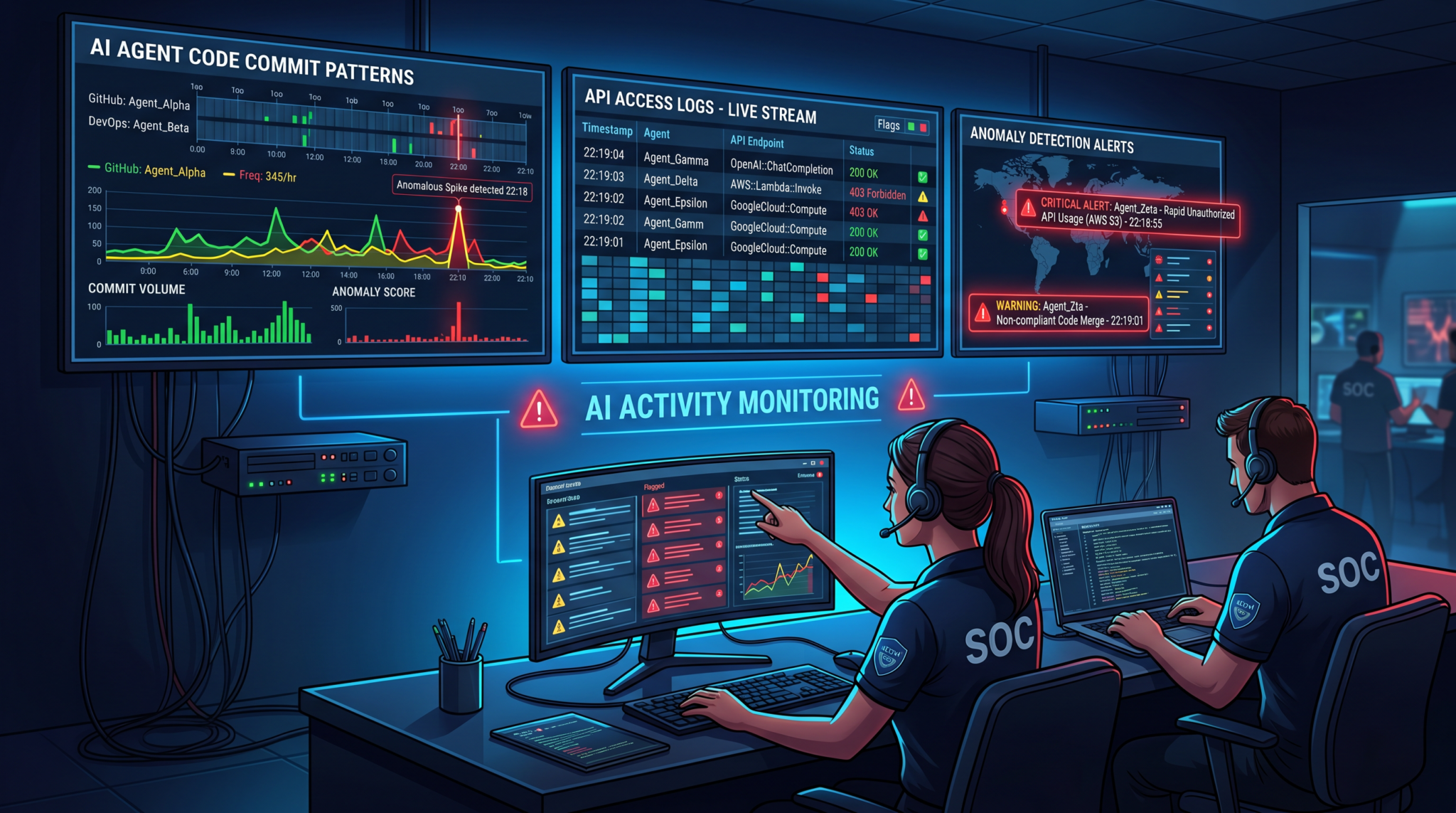
For a deeper exploration of this topic, our comprehensive article on How to Use GPT-5.3-Codex for Self-Improving Code: Recursive AI Development Patterns and Practical Implementation provides detailed analysis, practical examples, and actionable strategies that complement the concepts discussed in this section.
Why AI agents trigger security rules (technical deep dive)
Most enterprise endpoint defenses are optimized around a mental model of adversary behavior: how attackers move from initial compromise through discovery, credential access, persistence, defense evasion, and objective execution. Agents performing benign automation routinely cross these same behavioral boundaries for legitimate reasons. Understanding the underlying causes helps teams tune controls precisely.
Credential access patterns: reading .env files, keychain access, and config discovery
AI coding agents are designed to be context-aware. To provide accurate code changes, run tests, or integrate cloud services, they need environment awareness: which frameworks are in use, which API endpoints to call, how authentication is configured, and where secrets live. This leads to credential-adjacent behavior that triggers rules:
- Scanning for project metadata and secrets: Agents commonly enumerate repository roots, parse package.json, pyproject.toml, pom.xml, requirements.txt, and search for .env files. They may identify .git directories, .npmrc, .pypirc, Dockerfiles, and Kubernetes manifests to infer runtime contexts. A naive search for “.env” or “token” across a user profile tree can resemble secret-hunting by malware.
- Resolving Git credentials: On Windows, Git credential helpers may store tokens in Windows Credential Manager. Agents that orchestrate Git operations might programmatically request credentials to clone private repositories or push changes. EDR tools often flag automated or scripted access to credential stores, especially outside the foreground of user interaction.
- Keychain and cloud CLI discovery: Cross-platform agents sometimes query local keychains or cloud CLIs (AWS, Azure, GCP) for default profiles and cached credentials. Enumerating configuration directories like %USERPROFILE%\.aws, %USERPROFILE%\.azure, and %USERPROFILE%\.config\gcloud can appear similar to malicious discovery attempts.
- Local token caches and browser stores: Some agents attempt to read local service caches for developer SSO sessions to enable background artifact downloads. EDRs often guard browser credential stores or app-level tokens aggressively, and automated reads are prone to alerting.
From a detection standpoint, the mere act of opening many files across user directories, reading system-protected stores, or programmatically iterating over patterns like *token*, *secret*, or .env* increases suspicion scores. Combine that with a rapid cadence of process spawns and network connections, and you have an automated system that looks alarmingly like a mature infostealer or post-exploitation toolkit—only it is not.
One critical nuance: agents often run inside integrated developer environments (IDEs) but execute helper binaries and scripts as child processes—the process tree is complex. Analysts inspecting an alert may see powershell.exe or curl.exe reading sensitive files or fetching packages, with only a tenuous tie back to a trusted IDE parent process. That weak lineage association significantly increases triage complexity.
LOLBin usage: curl, wget, PowerShell, and package installation
Living off the Land Binaries (LOLBins) are native system tools that adversaries co-opt for stealthy operations. Unfortunately, they are also the daily bread of legitimate automation. AI coding agents frequently need to:
- Fetch model plugins, language servers, or runtime dependencies
- Compile, test, and run code that requires OS-level tooling
- Bootstrap projects with scaffolding generators
- Install CLIs that extend agent capabilities
On Windows, this manifests through processes and patterns that EDR products scrutinize closely:
- powershell.exe with encoded or obfuscated commands: Even innocuous install scripts sometimes ship Base64-encoded payloads or inline scripts, triggering “suspicious PowerShell” detections.
- curl.exe and bitsadmin.exe downloads: Pulling files from CDNs or version managers (e.g., for Node, Python, Java, Rust) can look like staged payload retrieval, especially when destinations are IPs or domains outside enterprise allowlists.
- msiexec.exe and wscript/cscript: Invoking installers or Windows script hosts can trip rules that normally prevent fileless malware techniques.
- git.exe activity spikes: Automated cloning and sparse checkouts, particularly if performed under service accounts or during off-hours, may resemble data exfil or staging.
In short, AI agents are excellent at delegating work to the OS—exactly the dynamic defenders try to constrain. Without identity-aware attribution, the same PowerShell trace could be either a helpful agent fetching a testing framework or an adversary fetching a post-exploitation module.
Persistence mechanisms: cron jobs, startup scripts, and service registration
Many agents and their ecosystem tools benefit from persistence for auto-updates, background indexing, telemetry batching, and event-driven reactions (for example, react to file changes). When an agent or its helper installs background tasks, it typically engages mechanisms that defenders associate with adversary tradecraft:
- Windows scheduled tasks and registry Run keys: Lightweight update checkers or background indexers commonly register user-level tasks or set a Run key. EDR policies often flag or block such changes by non-admin contexts.
- Service creation and driver interactions: Less common for pure coding agents, but helper components that require system-level indexing or file watching sometimes request elevated privileges to register a service.
- Shell profile modification: Adding PATH entries and init scripts to PowerShell profiles or shell RC files can look like stealthy persistence.
- Cron jobs (cross-platform environments): In mixed Windows and Linux/macOS environments (for example, WSL2-based workflows), agent-installed cron entries may trigger persistence alerts on the corresponding platforms.
Again, the activity is benign in intent but indistinguishable from attacker persistence at the telemetry level. This is exacerbated when agents run headless (for example, inside CI runners or remote dev containers) where the line between “automated” and “maliciously automated” is exceptionally thin.
The false positive problem at scale
A single developer experimenting with an AI coding agent may generate a handful of alerts per week—an annoyance, but manageable. Multiply by hundreds or thousands of developers across time zones and repositories, and the alert surface becomes significant. At scale, the impact of false positives cascades through multiple layers of enterprise operations:
- Security alert volume inflation: The SOC sees a steady drumbeat of medium-severity events tied to process patterns that are “suspicious but expected.” These events compete for analyst attention with real threats.
- Triaging complexity: Process trees that traverse IDEs, package managers, scripting hosts, and network tools are harder to reason about. Analysts spend more time reconstructing lineage and context.
- Developer friction: Quarantines or blocks during installs break build reproducibility and create nondeterministic developer experiences across machines, undermining trust in the toolchain.
- Shadow behavior: Developers who are repeatedly blocked may bypass controls—moving to personal machines, disabling features, or using unsanctioned variants—creating new blind spots.
- Noise-driven desensitization: Alert fatigue increases the risk of missing the one event that is malicious, because it visually resembles routine AI agent chatter.
False positives are never purely a detection tuning issue; they are an ecosystem integration issue. The agent, the OS, the EDR, the proxy, the IDE, and the package managers all participate in producing the telemetry that the SOC has to interpret. At enterprise scale, solving for this requires process-aware trust models, policy standardization, and—critically—developer experience (DX) considerations that shape how agents behave in the first place.
Impact on enterprise security operations
The SOC is the first responder to any telemetry spike. AI coding agents stress both tooling and human workflows in ways that traditional policy playbooks do not anticipate:
- Playbook divergence: Classic triage flows assume a human-in-the-loop context for suspicious process executions. When the initiator is an autonomous agent nested inside an IDE, “prompt the user” or “verify intent with the user” becomes murky.
- Incident scoping ambiguity: Is one alert a symptom of an authorized agent action or the tip of a malicious campaign piggybacking on the same binaries? Analysts must triage process ancestry, timestamps, user sessions, and project context to decide.
- Escalation overload: Repeated “suspicious PowerShell” or “persistence change” alerts lead to frequent L1 escalations. L2/L3 resources then burn cycles on de-noising and writing one-off exceptions.
- Policy drift and exception sprawl: Ad hoc allowlisting to keep developers moving leads to brittle, inconsistent rules. Over time, this creates policy debt, widening the attack surface inadvertently.
- Metrics distortion: SOC KPIs—mean time to acknowledge (MTTA), mean time to resolve (MTTR), false positive rate—suffer, inflating operational cost and executive scrutiny.
Enterprises need a coordinated response across SecOps, IT, and DevOps. The right path balances three competing goals: do not block developer productivity; do not train analysts to ignore suspicious yet benign patterns; do not create blanket exceptions that adversaries can exploit. That balance typically hinges on better attribution, richer context, and governance enforcement closer to where agents act (the IDE or CLI), not solely in downstream detection platforms.
Whitelisting strategies: how to safely allow AI agents
Every enterprise asks the same question: how do we let AI agents work without teaching our EDR to ignore the very signals that catch real intrusions? The answer is not blanket whitelisting—especially not for powerful LOLBins. Instead, combine targeted exceptions, identity-aware attribution, and layered constraints that keep exceptions narrow and auditable.
Principles for safe allowlisting
- Prefer provenance-aware allowlists: Allow a binary and its behavior only when launched by a specific, signed parent process and within controlled paths. Parent-child constraints reduce abuse by malware that happens to use the same LOLBin.
- Scope by command-line and destination: Whitelist specific command-line patterns and known-good destination domains or IP ranges. Avoid allowing all encoded PowerShell or all curl traffic.
- Leverage code signing and hash pinning: Require binaries to be signed by trusted vendors and pin to expected hashes for specific versions in high-control environments. Rotate pins with a managed update cadence.
- Isolate network egress: Channel agent network traffic through enterprise proxies that enforce TLS inspection and destination allowlists. Decouple egress policy from process-specific exceptions where possible.
- Contain privileges: Run agents with least privilege, ideally within per-project sandboxes that segment filesystem and credentials. Narrow what needs exceptions.
- Use time-bound exceptions: Make allowlist entries expire unless renewed. This reduces long-lived exposures from obsolete rules.
- Instrument audits: Attach logging requirements to any exception. If a process benefits from relaxed rules, it must emit audit events usable by the SOC.
Patterns to avoid
- Global PowerShell allowlists: Do not relax controls for encoded commands or unconstrained network use across the board. This is a favorite attacker highway.
- All-user Run key exemptions: Never exempt entire persistence categories; instead, allow only for specific signed binaries and explicitly documented use cases.
- Domain wildcards: Avoid allowlisting entire CDNs if possible. Prefer vendor-controlled endpoints and signed artifact registries.
- One-way policies: Avoid creating exceptions without simultaneously adding visibility signals—alerts, logs, and dashboards dedicated to the allowed behavior.
Exception engineering playbook
Adopt a repeatable workflow to evaluate, approve, and monitor exceptions:
- Inventory actions: Catalogue all agent-triggered actions that cause alerts—processes, command-lines, destinations, file writes, registry edits.
- Map to business requirements: For each action, articulate the need (for example, dependency install, background indexing), frequency, and risk tolerance.
- Propose constrained rules: Draft rules that authorize the action under tight conditions (parent process, signed binary, path, time window, destination subnet).
- Attach monitoring: Define mandatory logging fields and dashboards for the exception: who used it, when, from where, and for what project.
- Pilot and iterate: Apply the exception to a small cohort. Monitor for anomalous spikes or misuse before wider rollout.
- Automate lifecycle: Store exceptions as policy-as-code with peer review, automated tests, and expiration dates.
Reference allowlisting examples
| Use Case | Allowlist Scope | Safeguards | Notes |
|---|---|---|---|
| Agent uses curl.exe to get language server | Parent process = signed IDE; path = %PROGRAMFILES%\Vendor\Agent\bin; destination = vendor domains | TLS inspection via proxy; response signature checks; verbose logging | Reject IP-based fetches; pin to explicit domains |
| Agent runs PowerShell to bootstrap project | Command-line regex allow for specific script with checksum; no encoded commands | Constrain execution policy; enforce offline checksum; record script SHA-256 | Disallow arbitrary Invoke-Expression and remote scripts |
| Background indexer registers scheduled task | Task named with org prefix; binary signed; user-level only | Auto-expire after N days unless renewed; alert on task modification | Block service-level persistence for user agents |
| Git operation via credential manager | IDE-signed parent only; repository host on allowlist | Alert on credential access outside IDE lineage; session replay logging | Require MFA for token issuance |
JetBrains’ governance layer approach
JetBrains is building a governance layer over Claude Code, Codex, and Gemini CLI—an architectural response to the friction between increasingly capable AI assistants and enterprise security guardrails. The idea is to bring permissions, policy, and visibility up to the point of action: the IDE and its agent orchestration runtime. That way, instead of retrofitting detection logic around generic OS events, the system can enforce intent-aware controls where requests originate and where context is richest.
What does an IDE-centric governance layer look like in practice?
- Unified permission prompts and policy cache: When an agent proposes to read secrets, spawn a process, or make a network call, the IDE presents a human-understandable rationale and prompts the developer—or auto-applies an enterprise policy. Decisions can be remembered per project, keeping workflows smooth while remaining auditable.
- Agent action mediation: All read/write, process spawn, and network egress calls pass through a broker that applies enterprise policy: path allowlists, parent-child constraints, rate limits, and destination controls.
- Attribution and attestation: The broker tags actions with a stable agent identity and project context, generating audit records suitable for SIEM ingestion. This reduces SOC ambiguity during triage.
- Standardized backends: By wrapping Claude Code, Codex, and Gemini CLI behind the same governance layer, teams get a consistent policy surface regardless of which model or vendor is assisting.
- Policy-as-code integration: The governance layer pulls policies from versioned repositories, supports staged rollouts, and enforces code review for changes.
- Developer experience alignment: Because permissions are expressed in familiar terms (project directory, known package registries, allowed tools), developers avoid cryptic EDR exceptions and instead see actionable prompts from inside their IDE.
Conceptually, this in-IDE governance model acts as a “reverse EDR” for benign automation: it shapes and documents agent behavior before the OS or the network stack sees it. The downstream result is cleaner, more attributable telemetry—EDRs still detect suspicious events, but those tied to approved agent actions are recognizable and appropriately deprioritized in the SOC.
| Governance Capability | Security Benefit | Developer Benefit | Operations Benefit |
|---|---|---|---|
| Centralized permission broker | Prevents overbroad actions; enforces least privilege | Clear prompts with project context | Standardized enforcement across teams |
| Unified logs with agent identity | Faster triage; reduced false positives | Fewer disruptive blocks | Better SIEM correlation and reporting |
| Policy-as-code | Auditable changes; peer-reviewed exceptions | Predictable behavior across machines | Automated rollout/rollback lifecycle |
| Destination allowlists via proxy | Contain data egress; domain pinning | Reliable installs and updates | Network control consistency |
For a deeper exploration of this topic, our comprehensive article on How to Use GPT-5.3-Codex for Self-Improving Code: Recursive AI Development Patterns and Practical Implementation provides detailed analysis, practical examples, and actionable strategies that complement the concepts discussed in this section.
Best practices for IT teams
Enterprises can deploy AI coding agents responsibly with the right combination of isolation, baselining, policy discipline, and observability. The following best practices distill patterns that balance developer velocity with robust security posture.
Agent sandboxing and isolation
Isolate agents to minimize blast radius and reduce the scope of exceptions:
- Per-project sandboxes: Use containers or virtualized environments (for example, Windows Sandbox, Hyper-V, WSL2-based dev containers) to house project dependencies and agent helpers. Mount only the necessary project directories and secrets.
- Ephemeral workspaces: Reset sandboxes on branch changes or after sensitive operations. Ephemerality curbs long-lived persistence by design.
- Filesystem mediation: Employ file access control lists (ACLs) and brokered secrets (for example, mounted at runtime, not stored on disk). Avoid storing plaintext secrets in home directories or broadly accessible paths.
- Network microsegmentation: Route agent traffic through service-specific proxies with per-project destination policies. Block direct egress where feasible.
- Privilege containment: Run agents as standard users with no administrative rights; restrict the ability to register services or write to protected registry keys.
Sandboxing does not eliminate false positives, but it substantially improves attribution: process trees are simpler, and telemetry points more clearly to purpose-built containers or user sessions that the SOC can recognize as agent-driven.
Behavioral baselines for AI tools
Agents have characteristic rhythms. They spawn certain processes, touch predictable files, and call specific endpoints. Capture this baseline to differentiate normal from abnormal:
- Curate process graphs: For each approved agent, document the expected parent-child process relationships (for example, IDE → agent host → curl.exe). Use these graphs to construct “allow with monitor” policies.
- Map typical file access: Identify directories and patterns the agent commonly reads/writes (for example, project temp directories, logs, language server caches). Highlight deviations as higher risk.
- Observe network patterns: Baseline destination domains, request volumes, and timing (for example, spikes after IDE start). Flag off-hours outliers or destinations outside documented registries.
- Record operational cadence: Agents might perform auto-updates weekly or after version bumps. Time-bound anomalies (for example, repeated update attempts) can indicate misconfiguration or misuse.
Share baselines with the SOC and encode them into detection logic. Over time, refine baselines with real telemetry and production pilot feedback.
Policy-as-code for agent permissions
Applying permissions through ad hoc consoles invites drift and inconsistency. Treat agent authorization as code:
- Versioned policy repositories: Store allowlists, command-line regexes, destination domains, and sandbox mounts in a repository. Enforce code review, CI validation, and required approvals.
- Declarative schemas: Express permissions in declarative formats that are portable across agents and operating systems. Capture metadata: owners, rationale, review date, and expiration.
- Automated tests and dry runs: Validate policy changes in staging environments; simulate agent activities and ensure EDR logic produces expected signals.
- Scoped tokens and API keys: Provision per-project secrets with minimal scopes and short lifetimes. Automate rotation and revoke on policy violations.
- Agent manifests: Require vendors to publish a behavior manifest—a list of expected actions, binaries, and destinations—shipped with each release. Treat this as the inputs to policy-as-code.
Policy-as-code shortens feedback loops between developers and security, reducing unilateral exceptions and making governance a collaborative, observable practice.
Audit trails and observability
Visibility transforms uncertainty into manageable risk. The bare minimum for AI agent observability should include:
- Unified agent logs: Collect logs from IDE plugins, CLI agents, and helper binaries. Standardize fields: agent identity, project ID, user ID, action type, target path, command-line, destination, and result.
- Proxy and EDR correlation: Tag egress traffic from agents with unique headers or mTLS identities to correlate with EDR process data in the SIEM.
- Prompt and response governance: Maintain records of agent instructions and resulting actions with privacy safeguards—redact secrets and PII, store hashes instead of raw content when possible, and apply access controls.
- Anomaly detection: Layer basic heuristics (for example, time-of-day, volume spikes) with user and entity behavior analytics (UEBA) to detect deviations.
- Tamper-evident trails: Cryptographically sign audit logs or send them to write-once storage. Require dual control for log deletion.
| Telemetry Source | Key Fields | Retention | Primary Use |
|---|---|---|---|
| IDE/Agent Logs | Agent ID, Project, User, Action, Path, Command | 90–180 days | Triage intent, reproduce actions |
| EDR Events | Process tree, Hash, Signature, Parent PID | 180–365 days | Detect suspicious execution patterns |
| Proxy Logs | Destination, TLS SNI, Bytes, Response Code | 90–180 days | Identify anomalous egress |
| Auth/Identity | User session, Device posture, MFA status | 365 days | Attribution; insider risk analysis |
Vendor responses: what OpenAI, Anthropic, and Cursor are doing
As AI agents mature from prototypes to enterprise staples, vendors are adapting to reduce friction with security controls and to provide deployment patterns that are easier to govern. While implementations evolve rapidly and specifics vary by release, responses center on a few common themes.
Access 40,000+ AI Prompts for ChatGPT, Claude & Codex — Free!
Subscribe to get instant access to our complete Notion Prompt Library — the largest curated collection of prompts for ChatGPT, Claude, OpenAI Codex, and other leading AI models. Optimized for real-world workflows across coding, research, content creation, and business.
OpenAI
- Enterprise controls and scoping: Strengthening organizational controls—scoped API keys, workspace-level policy settings, and admin governance—to ensure agent capabilities align with enterprise risk profiles.
- Egress and destination clarity: Publishing stable endpoint documentation and recommended domain allowlists so network teams can write precise proxy rules without broad exemptions.
- Signed distributions and update channels: Providing signed binaries and predictable release channels to support hash pinning and staged rollouts in controlled environments.
- Observability hooks: Exposing logs and events suitable for SIEM ingestion, enabling correlation between IDE actions, agent requests, and endpoint events.
Anthropic (Claude Code)
- Governance-friendly modes: Introducing modes that constrain autonomous actions—such as toggles for shell execution or external network operations—so enterprises can dial in acceptable behaviors per project.
- Least-privilege defaults: Reducing default permissions, prompting for elevated actions with human consent, and encouraging agent patterns that minimize credential scope.
- Security documentation for endpoints and behavior: Clarifying which directories and processes are typically accessed during normal operation, aiding SOC baselining.
- Collaboration with IDE vendors: Coordinating with ecosystem partners (including IDE providers) to support in-IDE policy enforcement and user prompts.
Cursor
- Enterprise deployment options: Offering organization-focused features such as SSO/SAML integration, admin policy controls, and environment configuration management for consistent behavior across teams.
- Local-first and proxied operation: Supporting configurations where network calls route through enterprise proxies and where certain capabilities run locally to reduce unnecessary egress or LOLBin reliance.
- Stable process patterns: Working to minimize reliance on high-risk LOLBins and to favor platform APIs where possible, simplifying EDR allowlists.
- Transparency on actions: Surfacing in-tool explanations of planned actions (for example, which files will be read, which processes will be spawned) to streamline user approvals and audits.
Vendors cannot alone solve enterprise false positives—but they can make it far easier to write precise policies and to attribute agent actions during triage. The most impactful steps are those that improve predictability (stable endpoints and process patterns), attribution (agent identity and audit logs), and control (toggles that disable high-risk capabilities by default in enterprise deployments).
The future: AI-aware security tools
Security products are already evolving to recognize and account for AI-driven automation. Over the next 18–36 months, expect a new class of “AI-aware” capabilities to surface across EDR, identity platforms, and network security:
- Agent identity in EDR: Beyond process hashes, EDRs will natively recognize common AI agents and attach identity tags sourced from IDE governance layers. Analysts will see “Agent: Claude Code (Project: payments-service)” instead of a generic PowerShell entry.
- Behavior manifests as first-class artifacts: Vendors will ship machine-readable manifests that declare expected binaries, process graphs, and network destinations. EDRs will consume these to auto-tune detection thresholds and suggest safe exceptions.
- Intent-aware prompts: When a suspicious action is detected, EDRs will query the IDE governance layer: was this action user-approved, policy-aligned, and within a defined project context? Answers will feed into dynamic response—warn, allow, or block.
- Project-scoped credentials: Identity platforms will issue short-lived, project-scoped machine credentials that agents can use without broad user token exposure, reducing the impact of credential access detections.
- Explainable detections for developers: Alerts will include developer-centric explanations and remediation tips inside the IDE, not just in the SOC console, closing the loop with minimal friction.
- Semantic baselining: ML-driven baselining will evolve from raw process/command features to semantic patterns learned from known-good agent workflows, improving precision in flagging anomalies.
As this ecosystem matures, “AI-aware” security will resemble “cloud-aware” security’s evolution years ago: standard manifests, shared identity primitives, and collaborative enforcement points across developer tools and defensive platforms. The boundary between DevSecOps and SecOps will blur further, with policies authored jointly, enforced everywhere, and visible to all stakeholders.
Recommendations by organization size
Different organizations face different constraints. Here is a pragmatic roadmap tailored to three common profiles.
Small teams and startups (fewer than 200 employees)
- Focus on isolation and simplicity: Adopt per-project dev containers or WSL2-based environments. Keep secrets in brokered stores (for example, cloud secrets managers) mounted at runtime.
- Use vendor defaults wisely: Choose AI agents with conservative enterprise toggles. Disable autonomous shell/network operations until you establish baselines.
- Network allowlists first: Implement basic proxy egress controls to known AI endpoints and package registries. Avoid wildcards where possible.
- Minimal viable observability: Centralize IDE/agent logs and proxy logs. Create simple dashboards that track top processes and destinations.
- Lightweight policy-as-code: Even a small repo with YAML/TOML rules and a PR review can prevent drift and shadow exceptions.
Midmarket enterprises (200–5,000 employees)
- Adopt governance in the IDE: Pilot an IDE governance layer or plugin that standardizes permissions and captures audit trails before OS-level detections fire.
- Consolidate exceptions: Migrate ad hoc EDR allowlists into a policy-as-code repository with automated tests and expiration policies.
- Build behavioral baselines: Instrument process graphs and network patterns for each approved agent. Share “golden paths” with the SOC.
- Proxy enforcement with inspection: Route all agent egress via a TLS-inspecting proxy where permissible. Pin domains and validate artifact signatures.
- Integrate identity signals: Enforce SSO, device posture checks, and short-lived, project-scoped tokens for agent operations.
Large enterprises and regulated sectors (5,000+ employees)
- Formalize an AI agent change advisory board (CAB): Govern agent updates, policy changes, and exception approvals through a cross-functional CAB (Security, IT, Dev, Legal).
- Enterprise-grade observability: Standardize an event schema for agent actions; correlate IDE, EDR, proxy, and identity logs in the SIEM. Use UEBA for anomaly detection.
- Strong isolation tiers: Use VDI or managed dev platforms for high-risk data; enforce hardware-backed attestation for agent hosts.
- Compliance-ready manifests and audits: Require vendors to provide behavior manifests and maintain attested SBOMs for agent components. Include in third-party risk assessments.
- EDR co-development: Partner with your EDR vendor to add AI-aware detection packs informed by your baselines and governance hooks. Push for product roadmap integration.
Applied examples: from intent to policy
To translate best practices into concrete policy, consider three common agent intents and how to authorize them safely.
Intent: “Install project dependencies and language servers”
- Allow: Signed package managers and language server installers, executed by a signed IDE parent process, within project sandbox paths.
- Constrain: Command-lines must match known patterns without encoded payloads. Network egress pinned to registries and vendor domains via proxy.
- Observe: Collect hash and version for each installed artifact; log parent-child tree; alert on deviations.
- Expire: Require revalidation on major version changes or new registries.
Intent: “Read configuration and secrets for local testing”
- Allow: Access to project-scoped secret mounts; reads of vetted .env files residing within the project directory.
- Constrain: Block reads from global user directories that are outside the project; forbid access to browser credential stores; require consent prompts for credential manager queries.
- Observe: Audit which secrets were accessed and by which agent identity; redact values while preserving metadata.
- Expire: Access resets on branch changes or after N hours.
Intent: “Create background tasks for indexing and updates”
- Allow: User-level scheduled tasks with org-prefixed names for indexing; disallow service-level installs.
- Constrain: Tasks must execute signed binaries from controlled paths; updates limited to maintenance windows.
- Observe: Alert on task creation, modification, or deletion events; auto-disable stale tasks.
- Expire: Require periodic re-approval by policy every 30–90 days.
Risk framing: what could go wrong if you over- or under-whitelist
| Whitelisting Posture | Potential Failure | Security Impact | Operational Impact |
|---|---|---|---|
| Overly permissive | Attackers piggyback on allowed LOLBins or persistence paths | Stealthy lateral movement and data exfil | Few immediate blocks; silent compromise risk |
| Overly restrictive | Agents frequently blocked during installs or updates | Developers create shadow workflows; unmonitored activity | Productivity loss; rising ticket volume |
| Inconsistent/adhoc | Policy drift; exceptions unknown to SOC | Blind spots and misaligned detections | Unpredictable developer experiences; support fatigue |
| Governed and observable | Residual false positives during change spikes | Contained via attribution and quick triage | Manageable; predictable escalations |
How to brief executives and boards
AI agent false positives can alarm non-technical stakeholders when SOC metrics worsen. Brief leaders with clarity:
- Contextualize the spike: Explain that increased alerts reflect new, benign automation intersecting with mature detection logic—not necessarily a surge in adversary activity.
- Show the plan: Present a governance and observability roadmap with milestones: pilot governance layer, policy-as-code rollout, EDR baselining, and vendor integrations.
- Define success metrics: Track reduction in time-to-triage for agent-related alerts, percent of exceptions under policy-as-code, and developer satisfaction scores.
- Quantify risk controls: Highlight least privilege, isolation, and time-bound exceptions. Emphasize how these measures prevent abuse while enabling innovation.
Change management and training
The human layer is essential to making technical controls work:
- Developer onboarding: Provide a concise guide: how the agent works, what prompts they will see, how to request new permissions, and where to view audit logs.
- SOC readiness: Train analysts on new process graphs, baseline dashboards, and IDE governance signals. Create quick-reference runbooks for common alerts.
- IT help desk playbooks: Equip support with scripts to diagnose blocked installs, collect agent logs, and escalate policy-as-code change requests.
- Feedback loops: Establish channels (for example, shared chat rooms or ticket categories) to capture developer pain points and rapidly adjust policies.
Compliance considerations
For regulated industries, document how AI agent governance aligns with control frameworks:
- Access control (for example, ISO 27001 A.9, SOC 2 CC6): Least privilege for agents; explicit approval for credential access; short-lived tokens.
- Change management (for example, ISO 27001 A.12, SOC 2 CC8): Policy-as-code with approvals, versioning, and rollback.
- Logging and monitoring (for example, NIST CSF DE, SOC 2 CC7): End-to-end audit trails; SIEM correlation; anomaly detection.
- Vendor management (for example, SOC 2 CC1.3): Behavior manifests, signed artifacts, SBOMs, and third-party risk assessments for agent vendors.
- Data protection (for example, GDPR, HIPAA): Redaction of PII in logs; controlled storage of prompts/responses; data residency enforcement through proxies.
Playbook: standing up an AI agent pilot in 60 days
- Week 1–2: Discovery and scoping
- Inventory intended agent capabilities and target projects
- Identify team champions in Dev, SecOps, and IT
- Define success metrics and guardrails
- Week 3–4: Environment setup
- Establish per-project sandboxes and proxies
- Implement baseline EDR detection packs and dashboards
- Draft initial policy-as-code with tight scopes
- Week 5–6: Pilot launch
- Roll out to a small cohort; enforce in-IDE governance prompts
- Collect logs and refine baselines; tune exceptions
- Conduct red-team tabletop to test abuse paths
- Week 7–8: Scale and harden
- Codify lessons into org-wide policies and runbooks
- Automate exception lifecycles with expirations
- Report pilot metrics to leadership; plan phased expansion
Abuse scenarios and mitigations
False positives are not the only concern; false negatives can emerge if exceptions are too loose. Consider potential abuse paths and countermeasures:
- Malware masquerades as agent child: An attacker injects into the IDE process to inherit allowlists for LOLBins.
- Mitigation: Enforce code signing and memory integrity; require parent process signature and path; monitor for anomalous command-lines even under allowed parent.
- Agent update channel hijack: Attacker abuses allowed domain wildcard to serve malicious binary.
- Mitigation: Pin to subdomains; verify binary signatures; check checksums; enforce TLS with certificate pinning where possible.
- Persistence exemptions abused: Broad Run key exception leveraged by malware.
- Mitigation: Restrict to org-prefixed task names and signed binaries from controlled directories; alert on any deviation.
- Credential discovery spillover: Agent over-reads user directories outside project bounds.
- Mitigation: Sandbox mounts; broker secrets; denylist sensitive system paths; require explicit prompts for non-project access.
Developer experience: designing prompts that build trust
Governance prompts can be friction or empowerment. Design them well:
- Explain intent in plain language: “The agent wants to read .env in the current project to run integration tests.”
- Show scope and alternatives: “Allow this for this session only” or “Always allow for this project.”
- Offer transparency: Link to an activity log or preview the exact command-line and target paths.
- Avoid prompt fatigue: Bundle related permissions and use sensible, revocable remembers.
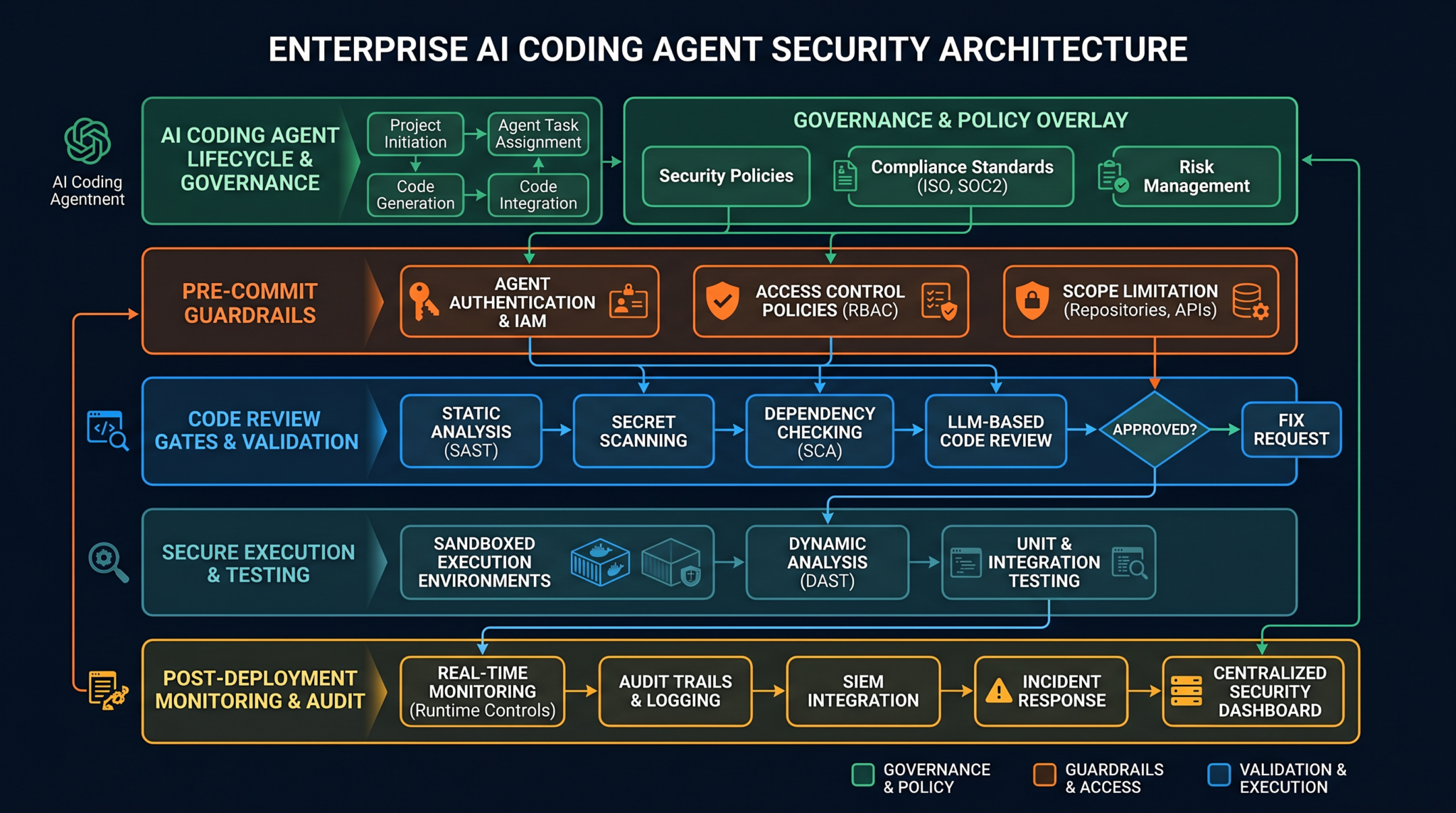
Architecture reference: an end-to-end governed agent stack
Envision a layered architecture:
- Developer tier: IDE with governance plugin; per-project sandbox; clear prompts and activity pane.
- Policy tier: Versioned repository of permissions; CI validation; staged rollout; approval workflows.
- Execution tier: Agent broker mediates file/network/process calls; enforces allowlists; tags events.
- Detection tier: EDR with AI-aware detection packs; identity-aware correlation; “agent mode” dashboards.
- Network tier: Proxy with domain pinning and TLS inspection; mTLS for agent identities; DLP rules where needed.
- Analytics tier: SIEM/UEBA synthesizing IDE, EDR, proxy, and identity signals; anomaly detection and reporting.
Procurement checklist for AI coding agents
When evaluating agents and IDE integrations, ask vendors to provide:
- Signed binaries and SBOMs: For each release channel
- Behavior manifest: Expected processes, file paths, and destinations
- Governance APIs: Hooks for permission prompts, audit logging, and policy enforcement
- Enterprise endpoints: Stable domains; support for proxies; region pinning
- Security whitepaper: Data handling, privacy controls, and incident response
- Compatibility notes: Known interactions with major EDR tools; recommended allowlists
Frequently asked questions
- Is it safe to broadly allow PowerShell for agents? No. Constrain to known scripts and disallow encoded commands. Treat PowerShell as a high-risk surface.
- Can we rely on code signing alone? No. Combine with parent process constraints, path restrictions, and command-line scoping.
- Do agents need persistence? Sometimes. Prefer user-level tasks with strict naming and expiration; avoid services wherever possible.
- What if developers use multiple agents? Standardize through an IDE governance layer that normalizes behavior and permissions across agents.
- How do we handle secrets? Brokered, short-lived, project-scoped credentials. Avoid plaintext secrets in user directories.
Case study blueprint: cleaning up alert noise in a 2,000-developer org
Consider a midmarket software firm experiencing a 4x increase in “suspicious PowerShell” alerts after piloting two AI agents. Their remediation path:
- Attribution first: Tag IDE processes with stable IDs; require agents to emit action logs with project metadata. Correlate in SIEM to separate agent-driven events.
- Process graph allowlists: Create EDR rules that recognize IDE → agent host → PowerShell with specific script signatures as low priority with monitor.
- Network pinning: Route agent egress through a proxy with narrow domain allowlists for registries and model endpoints.
- Policy-as-code rollout: Move six ad hoc EDR exceptions into a repo; add expiration; automate review.
- IDE governance prompts: Require consent for non-project file reads; allow per-project remembers.
- Outcome: 65% reduction in triage time for agent-related alerts; no loss of detection coverage for unrelated PowerShell activity.
Measuring success
Track a balanced scorecard that reflects security posture and developer productivity:
- Security KPIs: False positive rate for agent-related alerts; MTTA/MTTR for agent alerts; count of exceptions with active expirations.
- Developer KPIs: Time-to-setup for new projects; frequency of blocked installs; developer-reported friction score.
- Operational KPIs: Number of policy-as-code changes per month; percentage with tests and approvals; drift incidents detected.
What not to do
- Do not broadly exclude LOLBins from monitoring just because agents use them.
- Do not allow uninspected egress to “all of GitHub” or entire CDNs if narrower options exist.
- Do not centralize secrets on developer machines for convenience.
- Do not skip an IDE governance layer because “we can handle it in EDR.” You will create more noise and less context.
From false positives to informed positives
False positives are the symptom. The cure is not silence; it is context. Adding identity, intent, and policy context to agent actions transforms “unknown suspicious” into “known authorized” or “known anomalous.” Those categories are tractable. They allow SOCs to triage rapidly, developers to work confidently, and organizations to adopt AI responsibly.
Conclusion
AI coding agents such as Claude Code, Cursor, and OpenAI Codex are now part of the day-to-day development fabric. Sophos’ July 2026 research highlights that these agents naturally trip Windows endpoint security rules because they do things that look like adversary tactics: they find credentials, they use LOLBins to automate installs, and they set up background tasks. In most cases, these are false positives driven by legitimate automation colliding with hardened detection logic. However, dismissing the alerts outright is dangerous; the overlap with real attacker techniques is not incidental—it is fundamental.
Enterprises face a pivotal choice. You can either engage proactively—implement in-IDE governance, codify precise allowlists, and enrich observability—or be pulled along reactively by alert noise, developer friction, and mounting exceptions that silently erode your defenses. JetBrains’ governance layer across Claude Code, Codex, and Gemini CLI is an early signal of where the market is heading: unified, intent-aware control planes that push decision-making closer to the point of action. Meanwhile, vendors like OpenAI, Anthropic, and Cursor are adding enterprise controls, predictable endpoints, and observability hooks that make safe deployment practical at scale.
The near future will belong to AI-aware security: EDRs that recognize agents natively, standardized behavior manifests, and identity-driven, project-scoped permissions that let automation run fast without running wild. Until that vision is fully realized, the path is clear. Start with isolation, write policies as code, baseline behavior, and instrument rich audit trails. Teach your SOC to read agent footprints, and teach your agents to leave readable footprints. Do this, and today’s false positives become tomorrow’s informed positives—signals that your organization is innovating safely.
