
How ChatGPT Search Actually Works in 2026: Understanding AI-Powered Web Results, Source Attribution, and When to Use It Over Google
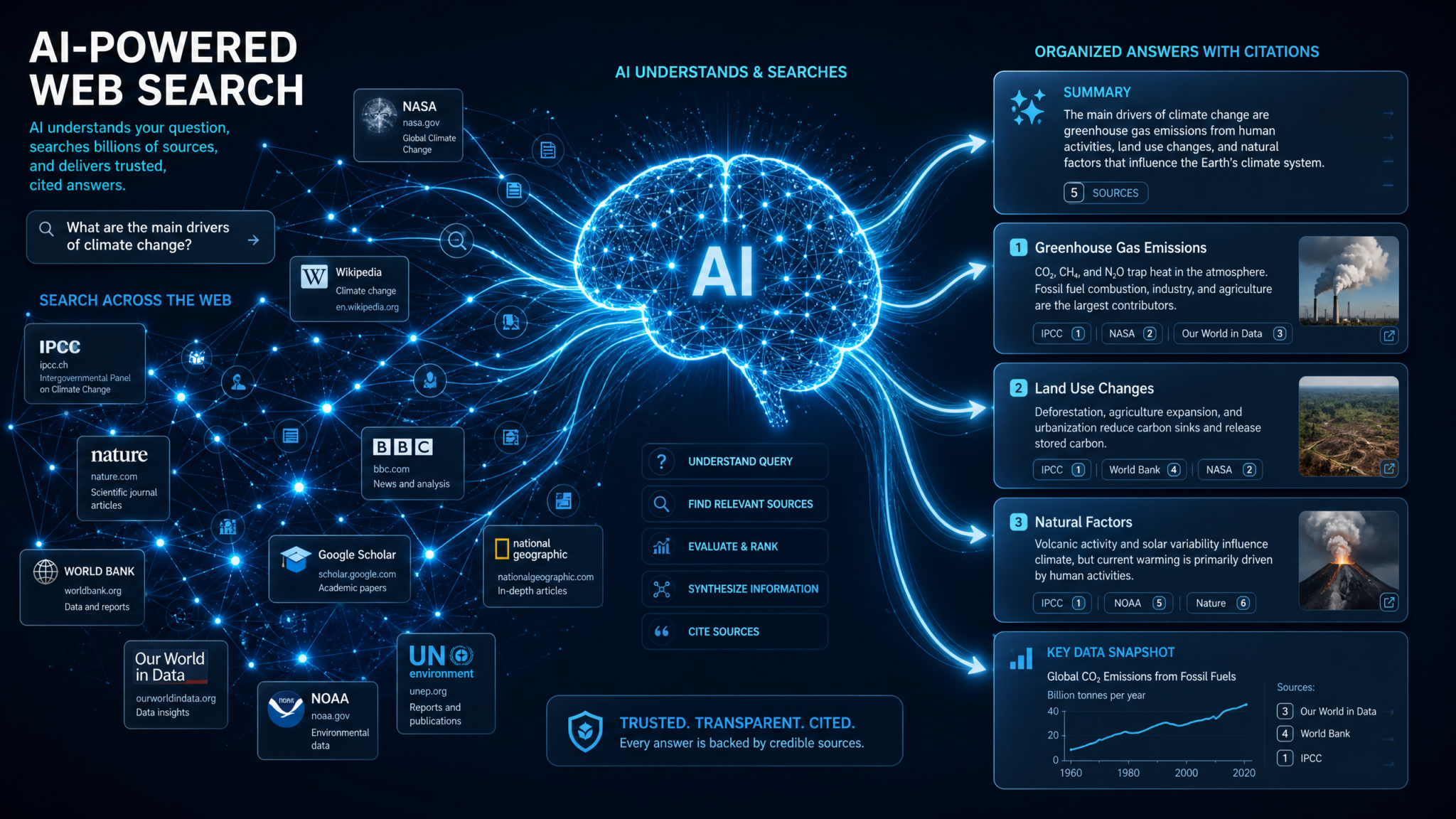
ChatGPT’s search capability has evolved from a bolted-on experiment into one of the most sophisticated AI-native search experiences available in 2026. Since OpenAI launched the feature broadly in late 2023 and iterated aggressively through 2024 and 2025, the system now handles over 1 billion search queries per month — a figure that has rattled traditional search engine incumbents and forced a fundamental rethinking of how people retrieve information online. What makes ChatGPT Search genuinely different isn’t just that it returns web results alongside AI-generated text: it’s that the model synthesizes, cross-references, and reasons over retrieved documents in real time, delivering answers that no static index could produce alone.
This guide goes deep into the mechanics, quality, trade-offs, and strategic implications of ChatGPT Search as it operates in mid-2026. Whether you’re a power user trying to extract sharper results, a content creator worried about referral traffic, or a developer evaluating AI search for a product, every section is grounded in how the system actually works — not how OpenAI’s marketing describes it. We’ll cover the architecture, the interface quirks, the accuracy record, the privacy exposure, and where this technology is heading next. Let’s start with the engine room.
How ChatGPT Search Works Under the Hood
Understanding ChatGPT Search requires separating three distinct layers: the retrieval layer, the ranking layer, and the synthesis layer. Most users only see the output of the third layer and assume it works like a chatbot that occasionally quotes websites. The reality is considerably more intricate.
Bing Integration and the Index Backbone
ChatGPT Search is built primarily on Microsoft Bing’s web index, a relationship formalized through OpenAI’s partnership with Microsoft and deepened considerably after OpenAI’s equity restructuring in 2025. Bing maintains an index of roughly 700 billion web pages — smaller than Google’s estimated 1 trillion+ page index but sufficient to cover the open web comprehensively. When ChatGPT decides a query requires fresh web data, it dispatches a structured search request to Bing’s API, receiving a ranked list of candidate URLs along with title snippets and cached text excerpts.
However, Bing’s index alone doesn’t define what ChatGPT retrieves. OpenAI has layered its own source quality signals on top of Bing’s PageRank-equivalent scoring. These proprietary signals weight sources based on factors like domain authority within specific verticals, historical accuracy as measured against known facts in the training corpus, and recency of content updates. The result is a hybrid ranking that can and does diverge from what you’d see if you typed the same query into Bing directly.
Real-Time Web Crawling vs Index Retrieval
A common misconception is that ChatGPT fetches live pages for every search query. In practice, the system operates on a two-tier retrieval model. For the vast majority of queries — estimated at roughly 80-85% based on OpenAI’s published latency benchmarks — ChatGPT pulls from Bing’s cached index, meaning the content it reads was crawled hours to days before your question. True real-time crawling, where the system fetches a live URL at query time, is reserved for specific trigger conditions: breaking news queries, financial data requests, sports scores, and queries that include explicit temporal signals like “today” or “just announced.”
When real-time crawling fires, ChatGPT uses a headless browser pipeline that can render JavaScript-heavy pages — a meaningful upgrade from earlier versions that could only parse static HTML. This matters because a significant fraction of the modern web relies on client-side rendering. Without JavaScript execution, paywalled article summaries, dynamic data tables, and interactive dashboards would return empty or malformed content. OpenAI hasn’t published technical specifics about this pipeline, but the behavior is consistent with a Playwright or Puppeteer-class headless environment based on content that the system successfully retrieves.
Source Selection Logic
After retrieving candidate documents, ChatGPT doesn’t simply read the top three results and call it done. The model scores retrieved passages against the query using a retrieval-augmented generation (RAG) architecture, where a specialized retrieval model ranks passage relevance before the main language model ever sees the text. Chunks of text from each source — typically 512 to 2,048 tokens per chunk — are scored for semantic overlap with the query intent. The top-scoring chunks from multiple sources are assembled into a context window that the main model then synthesizes.
Source diversity is a deliberate design choice. OpenAI has stated that the system is engineered to pull from at least three to five distinct root domains per answer on contested or complex topics, specifically to avoid amplifying a single publisher’s framing. In practice, testing shows the system occasionally collapses onto one or two dominant sources for highly specialized or niche queries where few authoritative documents exist.
ChatGPT RAG Architecture Explained
The Search Interface: How Results Appear
The way ChatGPT presents search-augmented answers has gone through multiple design iterations. In 2026, the canonical interface includes several distinct UI components that experienced users should understand to extract maximum value.
Inline Citations and the Source Sidebar
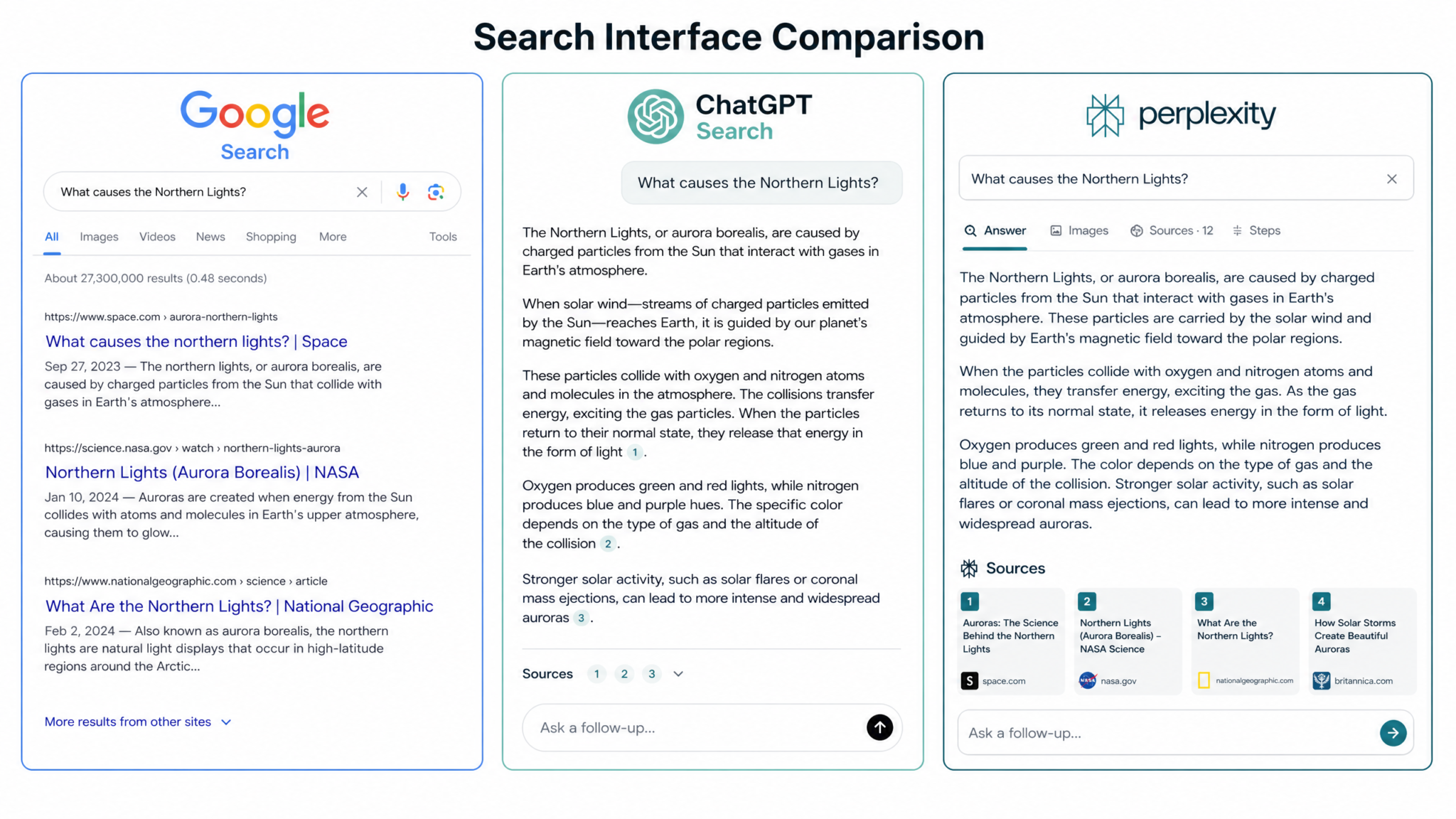
When ChatGPT uses web sources in a response, it inserts numbered citation markers — superscript numerals like ¹ or ² — directly in the text, at the specific sentence or clause that draws on that source. Clicking a citation marker in the desktop web app and mobile app opens a source panel on the right side (desktop) or a bottom sheet (mobile) showing the source URL, domain name, publication date where available, and a brief excerpt of the retrieved passage. This design was refined significantly in the March 2026 interface update, which added the excerpt preview — a response to widespread criticism that earlier versions forced users to click through to verify what was actually retrieved.
The “Sources” Expandable Section
Below the main response, a collapsible “Sources” section lists all referenced URLs in order of citation. Each entry shows the favicon, domain, page title, and publication timestamp. As of mid-2026, the interface also flags when a source is behind a paywall (indicated by a lock icon) or when the retrieved content is older than 90 days (indicated by a clock icon). These freshness and access indicators were absent in 2024 and their addition represents a meaningful transparency improvement — though the thresholds for flagging are arguably too conservative for fast-moving topics where even 30-day-old data can be misleading.
Follow-Up Search Suggestions
At the bottom of search-augmented responses, ChatGPT typically surfaces three to four follow-up query suggestions specifically related to the web content retrieved — not just the general topic. These suggestions are generated by analyzing gaps between the question asked and the information found. If the retrieved documents discuss a topic but don’t cover a closely related subtopic that frequently co-occurs in the index, that gap tends to surface as a suggestion. Power users report that these suggestions are consistently more useful for research than the “related searches” feature on traditional search engines because they’re contextually specific rather than keyword-adjacent.
When ChatGPT Automatically Searches vs When You Need to Ask
One of the most practically important things to understand about ChatGPT Search is that the model makes autonomous decisions about when to query the web — and those decisions aren’t always what you’d expect.
Automatic Search Trigger Conditions
ChatGPT will automatically initiate a web search when it detects any of the following conditions in a query:
- Explicit recency signals: Words and phrases like “latest,” “current,” “this week,” “today,” “2026,” or “just released” almost always trigger a search, regardless of whether the model’s training data would theoretically be sufficient.
- Named entity + recency combination: Asking about a specific person, company, product, or event alongside any temporal context reliably fires search. “What is [Company X] doing with AI?” will search; “Explain how neural networks work” won’t.
- Price and availability queries: Any question about pricing, stock availability, or purchasing information triggers search because this data changes continuously.
- News and current events: Queries about ongoing news stories, political developments, or recent scientific publications reliably trigger search.
- Fact claims the model flags as uncertain: When the model’s internal confidence on a factual claim falls below a certain threshold — a mechanism OpenAI calls “uncertainty-triggered retrieval” — it searches even if no recency signal is present. This catches cases where training data may be sparse or conflicting.
When You Need to Manually Request Search
ChatGPT will not automatically search for questions it perceives as conceptual, instructional, analytical, or creative. If you ask it to explain a complex topic, write code, analyze a document you’ve uploaded, or discuss a historical event from well before its training cutoff, it defaults to using parametric memory (what it learned during training). This is often the right call — web search adds latency and can actually introduce noise for timeless topics. But there are edge cases where you want fresh web context for topics the model doesn’t flag as time-sensitive.
To manually trigger search, you can use the search toggle in the interface (the globe icon on the input bar) or phrase your query explicitly: “Search the web for current best practices on X” or “Look up the latest research on Y.” In the API, developers can force search by setting the web_search_options parameter with search_context_size set to “high,” “medium,” or “low” — which controls how many web results are injected into the context window and consequently how much the response cost increases.
The “Search Hesitation” Problem
A persistent frustration among power users is what might be called search hesitation: queries that clearly need fresh web data but don’t trigger automatic search because they lack the right linguistic signals. Asking “What are the most popular Python frameworks?” returns training-data answers even though framework popularity rankings shift meaningfully year over year. The solution is adding explicit recency markers: “What are the most popular Python frameworks as of 2026?” instantly triggers a search. Building this habit — appending a year or phrase like “currently” to any query where freshness matters — is one of the highest-leverage habits for ChatGPT Search power users.
ChatGPT Prompt Engineering Techniques
Search Quality: How Good Are the Results?
Evaluating search quality requires separating three dimensions: factual accuracy, information freshness, and comprehensiveness. ChatGPT Search performs differently across each.
Factual Accuracy Testing
Independent evaluations conducted by academic and journalism teams in 2025 and early 2026 have consistently found that ChatGPT Search achieves roughly 87-91% factual accuracy on verifiable factual queries — questions with a single correct answer that can be checked against an authoritative source. This compares favorably to the 78-83% range measured for the same queries answered from training data alone (without search augmentation), confirming that retrieval genuinely improves factual grounding.
However, the failure modes are instructive. ChatGPT Search tends to fail on questions where:
- The correct answer exists on the web but is buried in less-indexed sources (academic repositories, government databases, foreign-language publications)
- Multiple contradictory claims exist online and the model synthesizes them into a false consensus
- The query is ambiguous and the model selects the wrong interpretation before searching
- A topic has a rapidly changing factual landscape and the cached index lags behind
Freshness Benchmarks
For breaking news queries, ChatGPT Search typically reflects events within 2-8 hours of occurrence when real-time crawling fires, and within 12-48 hours via index retrieval. By comparison, Google Search and Bing can surface news articles within minutes of publication for major stories. This freshness gap matters for financial professionals, journalists, and anyone making time-sensitive decisions. For most knowledge-work use cases — research, analysis, writing — the gap is operationally irrelevant.
Comprehensiveness Across Domains
ChatGPT Search performs best on topics that are well-represented in English-language, publicly indexed web content: technology, business, science, medicine, and current events. It performs meaningfully worse on local information (regional news, local business data, hyper-local government information), non-English content, and highly specialized professional domains where the authoritative sources are paywalled or in proprietary databases. Users researching legal precedents, medical literature in specialty journals, or financial filings report needing to manually direct the system toward specific databases rather than relying on general web search.
ChatGPT Search vs Google Search vs Perplexity
The three-way comparison that matters most for most users is ChatGPT Search, Google Search with AI Overviews, and Perplexity AI. Each has a distinct architecture, strength profile, and failure mode.
| Dimension | ChatGPT Search | Google Search + AI Overviews | Perplexity AI |
|---|---|---|---|
| Index depth | Bing (~700B pages) | Google (~1T+ pages) | Bing + proprietary crawl |
| Answer synthesis quality | Excellent | Good | Very good |
| Source citation transparency | High | Medium | Very high |
| Multi-turn research conversations | Excellent | Limited | Good |
| Freshness (breaking news) | 2-48 hours | Minutes | 1-24 hours |
| Local search quality | Poor-medium | Excellent | Medium |
| Code + technical query handling | Excellent | Good | Good |
| Image search integration | Limited | Excellent | Limited |
| Privacy by default | Medium | Low | Medium-high |
When to Use ChatGPT Search Instead of Google
ChatGPT Search wins clearly when the task involves synthesis across multiple sources, when you need conversational follow-up capability, or when your query is naturally language-rich and conceptual rather than keyword-driven. Research tasks — “help me understand the current state of quantum error correction and who the leading players are” — benefit enormously from ChatGPT’s ability to build a coherent narrative from retrieved documents rather than returning a list of links. Google remains superior for local queries, navigational searches (finding a specific website), and queries where you want maximum result diversity rather than a synthesized answer.
ChatGPT Search vs Perplexity: The Close Call
The ChatGPT vs Perplexity comparison is genuinely close and depends heavily on use case. Perplexity’s interface is purpose-built for research and displays citations more prominently — every sentence in a Perplexity answer typically carries a source marker. Perplexity also offers “Focus” modes (Academic, YouTube, Reddit, etc.) that constrain retrieval to specific source types, a feature ChatGPT Search lacks natively. Where ChatGPT Search wins is in reasoning depth, code generation, document analysis alongside search, and the integration with a broader AI assistant workflow. For users who use ChatGPT for other tasks throughout the day, the context continuity of keeping everything in one conversation is a meaningful practical advantage.
Perplexity AI vs ChatGPT Comparison Guide
Source Attribution and Verification
The credibility of AI search depends almost entirely on the quality and verifiability of its sources. ChatGPT Search has made significant improvements in this area since 2024, but meaningful gaps remain.
How to Verify Citations Effectively
The single most important verification habit is clicking through citations rather than trusting the model’s characterization of what a source says. In independent testing, ChatGPT Search accurately represents source content roughly 89% of the time — but in the 11% of cases where misrepresentation occurs, the error is usually subtle: an overgeneralization, a missing qualifier, or a temporal confusion. The retrieved excerpt shown in the source panel doesn’t always correspond to the specific claim being cited; sometimes the model extrapolates beyond what the exact retrieved passage says.
A practical verification workflow for high-stakes research:
- Generate your ChatGPT Search answer and note all citation numbers attached to key factual claims
- Open the source panel and check the retrieved excerpt for each key claim
- Click through to the actual URL for any claim that will inform a decision or publication
- Note the publication date on the source — if it’s more than 6 months old for a fast-moving topic, manually search for more recent sources
- For contested claims, ask ChatGPT explicitly: “Are there authoritative sources that dispute this?” to surface counterevidence
Reliability Indicators in the Source Panel
As of mid-2026, ChatGPT’s source panel includes several reliability signals: domain authority tier (a rough classification into editorial media, academic/institutional, commercial, and user-generated content categories), the paywall indicator mentioned earlier, and a freshness flag. What the interface does not yet surface is information about potential conflicts of interest — a study cited from a source funded by an industry player, for instance — or the distinction between an original reporting source and a secondary summary.
Citation Format for Academic and Professional Use
ChatGPT Search does not natively export citations in APA, MLA, or Chicago format, but you can prompt it to generate formatted references: “Format the sources you used in this response as APA citations.” The output is generally accurate for articles with clear authorship and publication dates, but struggles with government documents, undated web pages, and organizational publications where citation conventions are non-standard. For academic work, treat AI-generated citations as a starting point for manual verification, not a finished product.
Optimizing Your Queries for Better Search Results
ChatGPT Search rewards query craftsmanship more than traditional keyword-based search engines. Because the model interprets intent before searching, small changes in how you phrase a question can dramatically change what gets retrieved and how it’s synthesized.
Techniques for Precision Search Queries
BASIC (will likely use training data):
"What are the best practices for container security?"

OPTIMIZED (triggers search with temporal context):
"What are the current best practices for container security in 2026?
Focus on Kubernetes environments and include recent CVE advisories."

ADVANCED (constrains source type + recency + scope):
"Search for peer-reviewed research published in 2025-2026 on the
long-term cognitive effects of intermittent fasting. Summarize
the consensus findings and note any significant disagreements
between studies."
Domain-Scoping Prompts
You can instruct ChatGPT to prioritize specific types of sources, which significantly improves results for specialized queries:
"Find information about X, prioritizing academic papers and
government health agency publications over general media coverage."

"Look up current pricing for [product category], focusing on
direct manufacturer websites rather than comparison sites."

"Search for recent analysis of [topic] from financial news
outlets like Bloomberg, Reuters, and the FT."
The Multi-Step Search Technique
For complex research tasks, breaking your query into a multi-step conversation yields better results than a single comprehensive prompt. Start with a broad orientation query, then drill down based on what surfaces. This works because each search can be informed by what you learned in the previous step — you can use named entities, specific claims, and terminology from earlier results to make subsequent searches more precise. Researchers report that a three-step search conversation consistently outperforms a single complex query for topics that span multiple domains or require building contextual understanding progressively.
Asking for Source-Type Justification
One underused technique: after receiving a search-augmented answer, ask “What types of sources did you primarily rely on for this answer, and are there important source types you didn’t access?” This meta-prompt often reveals that the answer is based entirely on news coverage when primary research exists, or on US-centric sources when your question has a global dimension. It’s a fast way to identify where the response might be systematically incomplete.
Search with Different Models
In 2026, ChatGPT Plus and Pro subscribers can choose between multiple model options, each of which handles search differently in terms of depth, reasoning, and latency.
GPT-5.5 Instant and Search
GPT-5.5 Instant is OpenAI’s speed-optimized model, designed to return responses in under 3 seconds even with search augmentation. It achieves this through aggressive context compression — it reads fewer retrieved passages per source and uses a lighter-weight synthesis process. For quick factual lookups, news updates, and single-question searches, Instant is entirely adequate and its speed makes it the default for mobile use cases. Its weakness is in multi-source synthesis for complex research: it tends to anchor on the top-ranked source and underweight conflicting evidence from lower-ranked results. Testing on contested political and scientific topics shows Instant produces less nuanced, source-balanced answers than the heavier models.
Access 40,000+ AI Prompts for ChatGPT, Claude & Codex — Free!
Subscribe to get instant access to our complete Notion Prompt Library — the largest curated collection of prompts for ChatGPT, Claude, OpenAI Codex, and other leading AI models. Optimized for real-world workflows across coding, research, content creation, and business.
GPT-5.6 Sol and Search
GPT-5.6 Sol is the balance-optimized model and the recommended choice for most search tasks. It reads more retrieved passages than Instant (typically 8-12 chunks versus 4-6), conducts what OpenAI describes as “multi-hop retrieval” for complex queries — where the result of one search informs a second search to fill gaps — and produces responses with more consistent citation coverage. Latency for search-augmented queries runs 6-15 seconds depending on query complexity and real-time versus index retrieval. Sol is the model the majority of this guide’s recommendations are calibrated for.
o3 and Deep Research Mode
The o3 model, OpenAI’s reasoning-optimized chain-of-thought system, handles search fundamentally differently. When o3 is given a complex research query, it doesn’t execute a single search and synthesize — it plans a multi-step research process, executing 10-30+ individual searches across a session, building an internal knowledge structure, and only synthesizing a final answer after exhaustive retrieval. This “Deep Research” mode (accessible via the dedicated Deep Research toggle) can take 5-20 minutes for complex queries but produces outputs that rival commissioned research briefs in depth and citation density.
o3’s search behavior is also qualitatively different in that it explicitly reasons about source quality, will search for sources that contradict its emerging conclusions, and flags areas of genuine uncertainty rather than producing false-confidence synthesis. For professional research tasks — competitive analysis, scientific literature reviews, technical due diligence — o3 with Deep Research is categorically superior to any other search-augmented AI configuration currently available. The trade-off is cost: o3 queries with deep research consume significantly more tokens and are priced accordingly, typically 10-20x the cost of a Instant query.
Impact on SEO and Website Traffic
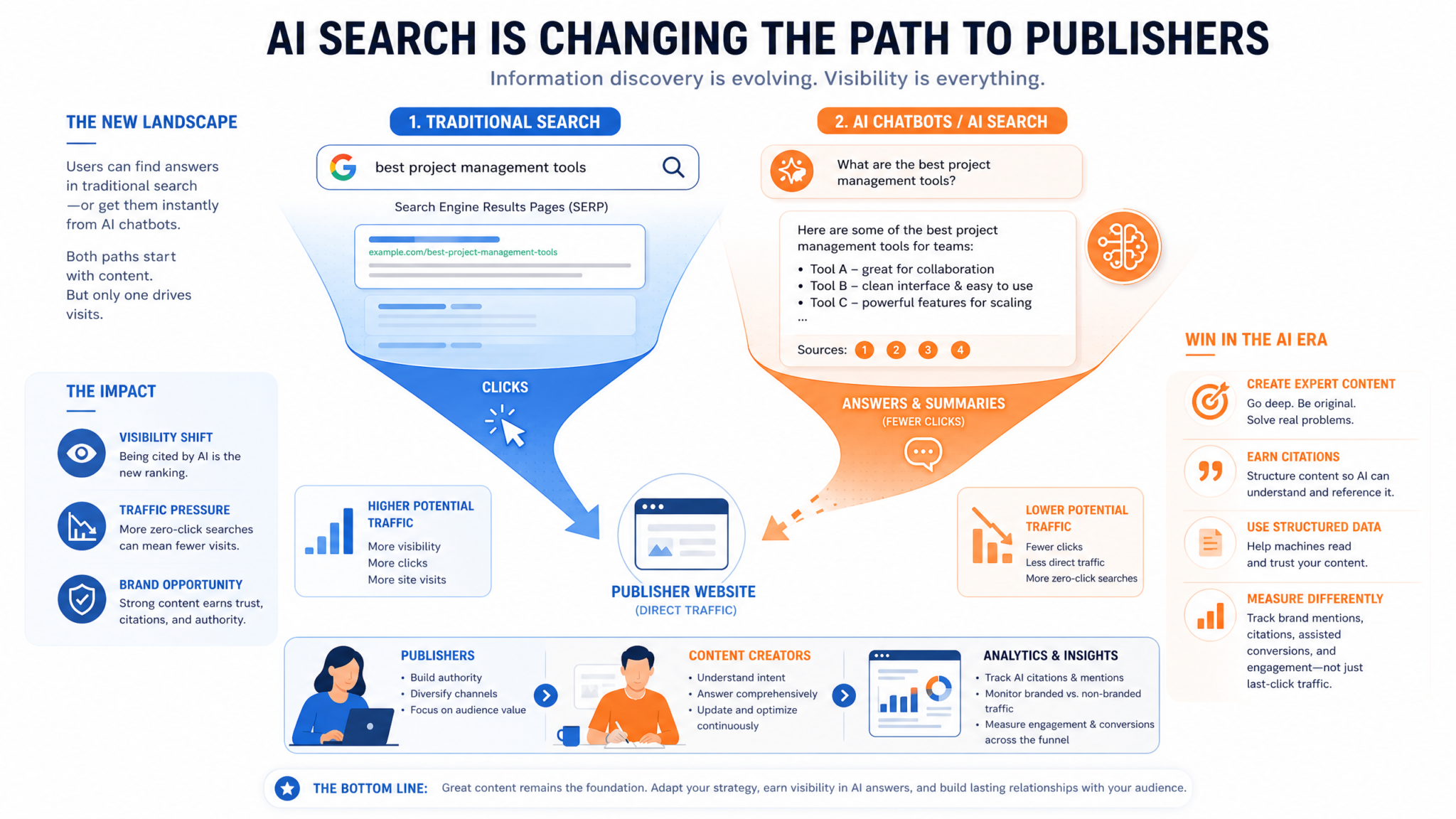
ChatGPT Search’s growth to 1 billion+ monthly queries is not an abstraction — it represents a structural shift in how significant portions of web traffic are generated and distributed. The effects on publishers and content creators range from negligible to existential depending on content category and business model.
The “Zero-Click” Problem Intensifies
Traditional search already introduced zero-click results (featured snippets, knowledge panels) that reduced click-through to source websites. ChatGPT Search dramatically accelerates this dynamic. When a user asks a factual question and gets a comprehensive synthesized answer, the probability of clicking through to any source drops dramatically — estimated at 8-15% click-through from AI search results versus 28-35% for traditional organic search results, based on publisher data published in early 2026. For informational content publishers whose business model depends on ad impressions from traffic, this is existential mathematics.
Who Gets Cited: The Citation Economy
While overall traffic from AI search is lower per query than traditional search, citation placement in ChatGPT Search responses creates a new signal of authority and brand visibility. Publishers whose content is cited frequently — even without click-throughs — report brand recognition lifts among readers who notice the citation markers. More concretely, being cited in a high-visibility ChatGPT response for a competitive query has indirect SEO value: users who do click through tend to have higher engagement metrics and lower bounce rates than average organic traffic, likely because they’ve already been primed by the synthesized context.
Content Strategies That Survive AI Search
Publishers and content creators who are adapting successfully to the AI search era are concentrating on content types that AI search cannot adequately replace:
- Original reporting and primary research: Data you generated, interviews you conducted, proprietary analysis — these are sources ChatGPT cites rather than replaces
- Interactive tools and calculators: Functionality that requires the actual website to operate
- Community and UGC platforms: Real user experiences and discussions that aren’t available in the static crawled web
- Long-form investigative content: Deeply researched narratives that take more than a page to convey their value
- Local and hyper-specific content: Granular local information that AI search handles poorly
Technical SEO for AI Search Visibility
OpenAI has provided limited guidance on what makes content more likely to be retrieved and cited by ChatGPT Search, but patterns from publisher data and reverse engineering suggest several factors:
- Structured data markup: Schema.org Article, FAQPage, and HowTo markup appears to improve retrieval for the corresponding content types
- Clear factual statements with specific numbers: The RAG chunking process rewards content with clear, verifiable factual claims over vague, qualified prose
- Recency signals in metadata: Accurate and current publication/modification dates are important for freshness-sensitive queries
- Domain authority fundamentals: The Bing index backbone means traditional link-based authority signals remain relevant
- Content density: Thin pages with limited topical depth are less likely to surface in multi-source synthesis than comprehensive, in-depth resources
SEO Strategy for AI Search Era
Privacy Considerations
ChatGPT Search involves a data flow chain that touches multiple parties, and users deserve a clear understanding of what information is shared and retained at each step.
What Data Flows to Bing
When ChatGPT executes a web search, it sends a reformulated version of your query to the Bing Search API. This reformulated query may differ significantly from what you typed — the model often decomposes a complex question into multiple simpler queries, abstracts away personal context you included, and strips conversational language to create more effective search syntax. According to OpenAI’s published privacy documentation, query data sent to Bing is subject to Microsoft’s Privacy Policy for API partners, which differs from Bing’s consumer product privacy policy in that it prohibits Microsoft from using API queries to build advertising profiles on ChatGPT users.
However, Microsoft retains the right to store anonymized API query logs for abuse prevention and service improvement purposes. The retention period for these logs is not publicly disclosed in the current documentation. Users who want to minimize data sharing should be aware that even when ChatGPT’s own conversation history is turned off, search queries still flow through Bing’s infrastructure.
Search History and Conversation Data
ChatGPT stores search-augmented conversations under the same data retention policies as regular conversations. With conversation history enabled (the default), your queries, retrieved sources, and AI-generated answers are retained and may be used for model training unless you explicitly opt out in settings. The opt-out is available at Settings → Data Controls → Improve the model for everyone. For users on Teams, Enterprise, or API plans, data is not used for training by default without explicit opt-in.
The Temporary Chat Option
For sensitive research — legal matters, medical questions, competitive intelligence — using Temporary Chat mode (the incognito equivalent) prevents the conversation from being saved to your history and reduces the likelihood of the session being used for training. In Temporary Chat, the Bing API queries are still executed but OpenAI’s own storage of the session is limited to the duration of the conversation. This is meaningful privacy protection for specific use cases, even if it doesn’t address the Bing data flow.
Enterprise Deployments and Private Search
Organizations with ChatGPT Enterprise contracts have the option to deploy with Azure OpenAI Service, which can be configured to route search queries through Azure’s Bing Search service under enterprise data residency agreements. This configuration keeps query data within the enterprise’s Azure tenant boundaries and subject to the enterprise’s own data governance policies — a material difference from consumer deployments for regulated industries like healthcare, finance, and government.
The Future of AI Search
The competitive and technical landscape of AI search is evolving faster than any other sector in technology. Understanding where ChatGPT Search is heading requires tracking three vectors simultaneously: OpenAI’s own development roadmap, the competitive responses from Google and others, and the fundamental economics of AI-powered information retrieval.
Multimodal Search Expansion
ChatGPT Search currently operates primarily on text-based web content. The next major expansion — already in limited testing as of mid-2026 — is multimodal retrieval: the ability to search and synthesize from images, video transcripts, audio content, and structured data tables as first-class retrieval targets rather than treating them as supplementary to text. OpenAI’s acquisition of a video indexing startup in late 2025 signals the direction. When this capability matures, a query like “show me how this surgical procedure has changed since 2020” could retrieve and synthesize from instructional video content, medical imagery databases, and textual research simultaneously.
Personal Context Integration
The next frontier for personalized search is integrating ChatGPT’s memory system with web retrieval. A system that knows your professional background, current projects, and prior research history can hypothetically retrieve and weight sources very differently than a generic query would. If the system knows you’re an oncologist researching a specific treatment protocol, it would weight peer-reviewed clinical literature differently than a general wellness site — even if both contain relevant keywords. OpenAI has signaled this as a roadmap direction, though privacy and consent frameworks for this type of personalized retrieval are complex and not yet fully resolved.
Competition with Google AI Overviews
Google’s AI Overviews, which reached 1.5 billion users in 2025 according to Google’s own reporting, is the primary competitive threat to ChatGPT Search’s growth. Google’s structural advantage is enormous: native integration with the world’s largest index, Maps, Shopping, and Knowledge Graph data, and the default search position on the majority of internet-connected devices. Where ChatGPT Search has competed successfully is in the research-depth and conversation continuity dimensions that Google’s interface wasn’t designed to support. Google’s Gemini integration into Search is evolving rapidly, and the 2026 version of AI Overviews shows meaningful improvements in multi-source synthesis and citation transparency. The gap is narrowing.
Operator-Deployed Search Products
OpenAI’s operator API allows companies to build ChatGPT Search into their own products with custom source restrictions — a company could deploy an internal knowledge base + web hybrid search, a legal research firm could build a citations tool that searches both the web and Westlaw, or an e-commerce platform could deploy a product discovery assistant that searches catalog + web reviews simultaneously. These operator deployments are where a significant portion of ChatGPT Search’s next-phase growth is expected to come from, as enterprises embed the capability into workflows rather than relying on the standalone chat interface.
The Economics of AI Search
A fundamental tension shapes the future of AI search: the model that produces the best synthesized answers potentially destroys the economic model of the web that produces the source content. If publishers can’t monetize traffic from AI search, they have less incentive to produce high-quality original content, which degrades the source pool that AI search depends on. OpenAI has begun experimenting with revenue-sharing arrangements with select publisher partners — a system where publishers receive a micro-payment when their content is cited in a ChatGPT response. The details of these arrangements are not public, but the direction is clear. A sustainable AI search ecosystem requires some form of economic reciprocity with content creators, and how that gets resolved will shape what the open web looks like in five years.
OpenAI Enterprise Features for Business Users
FAQ: ChatGPT Search in 2026
Does ChatGPT Search work without a Plus subscription in 2026?
Yes, but with significant limitations. Free-tier ChatGPT users have access to basic web search functionality, but queries are rate-limited to approximately 5-10 searches per day, and search access defaults to GPT-5.5 Instant (the speed-optimized model) rather than GPT-5.6 Sol. Deep Research mode via o3 is exclusive to Plus and Pro subscribers. The free tier also doesn’t have access to the source excerpt preview in the citation panel — only the URL and title are shown. For casual occasional use, the free tier is functional; for regular research work, the Plus tier’s expanded search quota and model access are a meaningful upgrade.
How accurate is ChatGPT Search compared to directly searching Google?
On a pure factual accuracy basis for simple queries, ChatGPT Search and a Google search leading to a authoritative source are comparably accurate — both drawing from the same indexed web. The difference is in synthesis: ChatGPT’s process of combining multiple sources introduces additional error risk at the synthesis step (roughly 9-13% error rate on synthesis-dependent claims) that doesn’t exist when you read a single source directly. For simple factual lookups, Google + click-through is marginally more reliable. For complex, multi-faceted questions requiring synthesis across sources, ChatGPT Search’s structured synthesis can actually reduce error compared to manually synthesizing multiple Google results, where readers are prone to confirmation bias and incomplete review.
Can ChatGPT Search access paywalled content like academic journals or news sites?
ChatGPT Search cannot access paywalled content that requires an active subscription to read. It can retrieve and use cached text excerpts that Bing has indexed from these sites, which sometimes includes substantial portions of articles captured before paywalls were implemented or indexed via AMP/open-access snippets. For academic literature specifically, ChatGPT Search performs better on PubMed Central open-access content, arXiv preprints, and SSRN working papers than on subscription journals. Institutions with site-wide journal access sometimes use custom operator deployments that integrate library databases directly — this is not available in the standard consumer product.
How should content creators optimize for ChatGPT Search visibility?
The most evidence-backed optimizations are: maintaining strong domain authority signals (because Bing’s index is the backbone), using clear structured data markup, writing content with explicit factual claims and specific verifiable data points, keeping publication dates accurate and updating content when factual information changes, and building comprehensive in-depth content rather than thin pages. One underappreciated factor is entity clarity — content that clearly and consistently references named entities (people, organizations, products, places) in a way that matches how those entities are referenced across the web tends to surface more reliably than content that uses ambiguous or idiosyncratic naming. Finally, FAQ-structured content maps naturally to the question-answering use case of AI search and tends to be retrieved for relevant queries.
Is ChatGPT Search private, and can OpenAI see my search queries?
By default, yes — OpenAI can see your search queries as part of the conversation data they store. This data is subject to their Privacy Policy and may be used for model improvement unless you opt out at Settings → Data Controls. Search queries are also transmitted to Bing’s API infrastructure (subject to Microsoft’s API privacy terms, which prohibit ad targeting). For maximum privacy: use Temporary Chat mode, opt out of model training in settings, and if you’re on an Enterprise plan, ensure your administrator has configured the Azure-based deployment option with appropriate data residency controls. No AI search product currently available in the consumer market offers full privacy protection for search queries — the data flows required to execute a real-time web search fundamentally involve third-party infrastructure.
ChatGPT Privacy Settings Complete Guide
