
Cloudflare Agents Week August 2026: How the New AI Agent Infrastructure Changes Autonomous App Development
Published: August 13, 2026 | Category: AI Infrastructure, Developer Tools, Cloud Computing
The Week That Redefined AI Agent Infrastructure
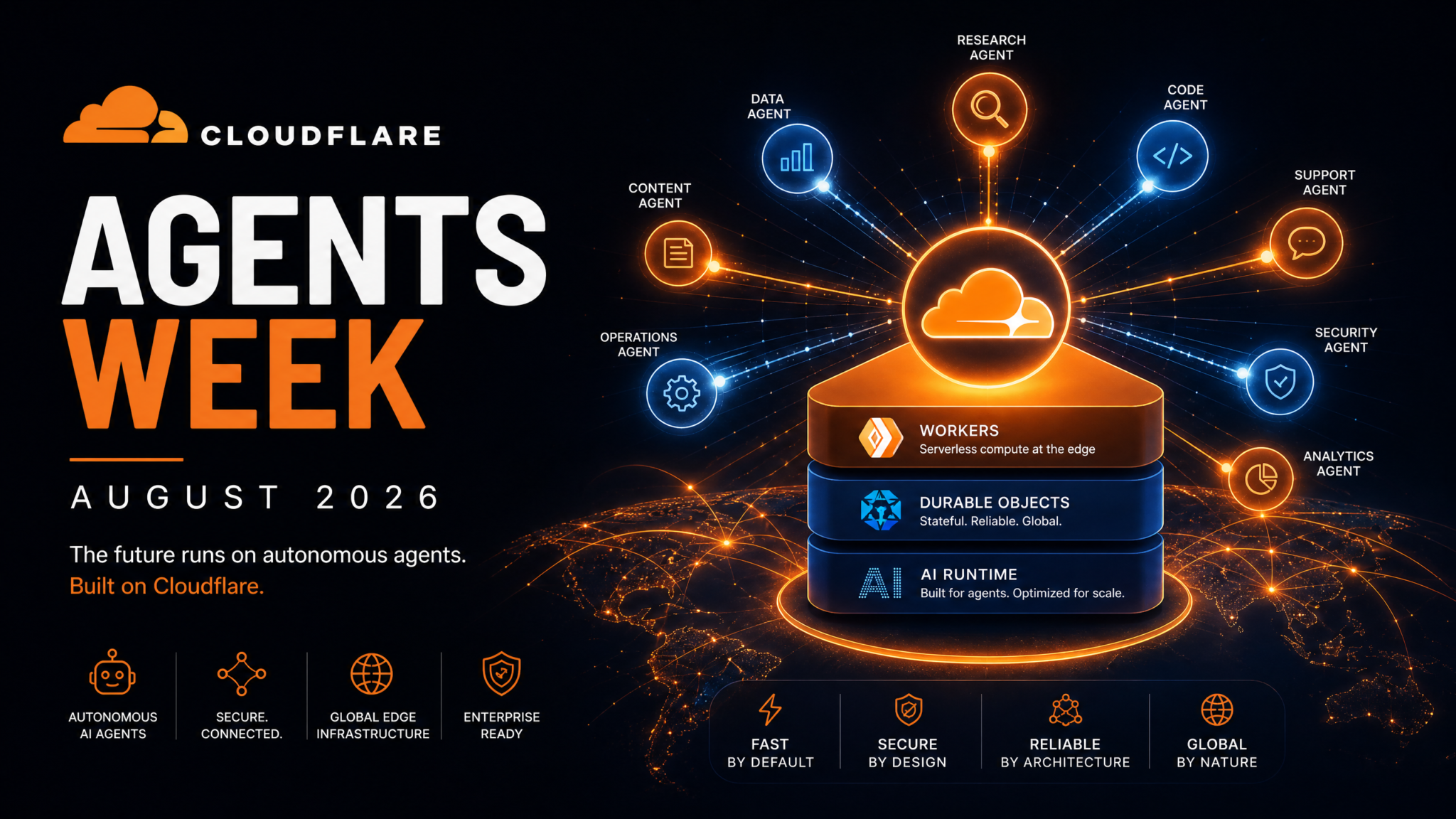
Between August 11 and August 13, 2026, Cloudflare transformed itself from a CDN and security company into what may become the defining infrastructure layer for the autonomous AI agent era. Over the course of three packed days in what the company branded Agents Week, Cloudflare shipped more than twenty distinct product announcements, architectural upgrades, and developer tooling features — all unified by a single strategic thesis: that AI agents deserve infrastructure built specifically for their behavior patterns, not retrofitted from web request handling paradigms invented in 2006.
The timing was deliberate. The AI agent market has matured rapidly. By mid-2026, analyst firm Gartner estimated that more than 40 percent of enterprise software deployments include at least one autonomous AI agent handling real decision-making workflows, up from less than 8 percent in early 2024. Developers building with frameworks like LangGraph, AutoGen, CrewAI, and OpenAI’s Swarm have been asking the same questions for two years: where do I run these things reliably, how do I manage state across multi-step reasoning loops, and how do I pay for compute that doesn’t fit the traditional request-response model? Cloudflare spent Agents Week answering all three with architectural precision.
This article breaks down every major announcement, explains the underlying architecture shifts, compares Cloudflare’s new stack against competing platforms from Amazon Web Services, Microsoft Azure, and Google Cloud, and examines what the developer community is already building. Whether you are a solo developer using ChatGPT to scaffold agent code or an engineering team at a Fortune 500 company evaluating production AI infrastructure, the decisions Cloudflare made during Agents Week will shape your roadmap for years.
Monday’s Foundation Announcements: Runtime and Core Infrastructure
Monday, August 11 set the technical foundation for everything else the week delivered. Cloudflare CEO Matthew Prince and CTO John Graham-Cumming opened the keynote with a frank admission: the V8 isolate execution model that made Cloudflare Workers fast and cheap for request-response workloads was fundamentally mismatched with how AI agents actually operate. Agents plan, pause, tool-call, receive callbacks, sleep for seconds or hours, and resume with context fully intact. They are not HTTP requests. They are processes.
The Agent Runtime: Workers for Agents
The headline infrastructure announcement was the Cloudflare Agent Runtime, a new execution environment sitting alongside traditional Workers but engineered from the ground up for stateful, long-duration, multi-step workloads. The Agent Runtime retains the global edge distribution that makes Cloudflare compelling — agents spin up in any of Cloudflare’s 310 data centers worldwide — but replaces the strict 30-second CPU time limit with a new billing and execution model the company is calling Agent Ticks.
Under the Agent Tick model, an agent process is not billed per request but per reasoning cycle. A single agent handling a complex research task might execute 40 tool calls over 12 minutes, sleeping between each LLM response while waiting for API results. In the old Workers billing model, that would either exceed execution limits or require awkward queue-based workarounds that forced developers to rebuild state from scratch. In the Agent Runtime, the process remains alive, state is preserved automatically via a tight integration with Durable Objects, and billing reflects actual CPU activity rather than wall clock time.
Cloudflare published internal benchmarking showing that a typical customer service agent handling a complex billing dispute — involving three tool calls to a CRM, one database lookup, and two LLM reasoning steps — completes in approximately 8.4 seconds of wall time but only 340 milliseconds of actual CPU time. Under Agent Ticks billing, developers pay for that 340 milliseconds. Under a container-based alternative where the process stays warm for the full 8.4 seconds, the effective cost is approximately 24 times higher for the same workload.
The Agent Coordinator: Orchestrating Multi-Agent Topologies
Also announced Monday was the Agent Coordinator, a managed orchestration layer that handles the communication topology between multiple cooperating agents. In production multi-agent systems, one of the hardest problems is routing: when an orchestrator agent needs to delegate a subtask to a specialist agent, that delegation message must be delivered reliably, the response must eventually return to the orchestrator, and the entire chain must be observable for debugging and auditing.
The Agent Coordinator provides a message bus built on top of Cloudflare’s global network with guaranteed delivery semantics. It supports three delegation patterns out of the box: synchronous blocking calls where the orchestrator waits for a specialist response, asynchronous fire-and-callback where the orchestrator continues processing and receives the specialist’s result via an event, and fan-out broadcast where a task is sent to multiple specialist agents simultaneously and the fastest or highest-confidence result is used.
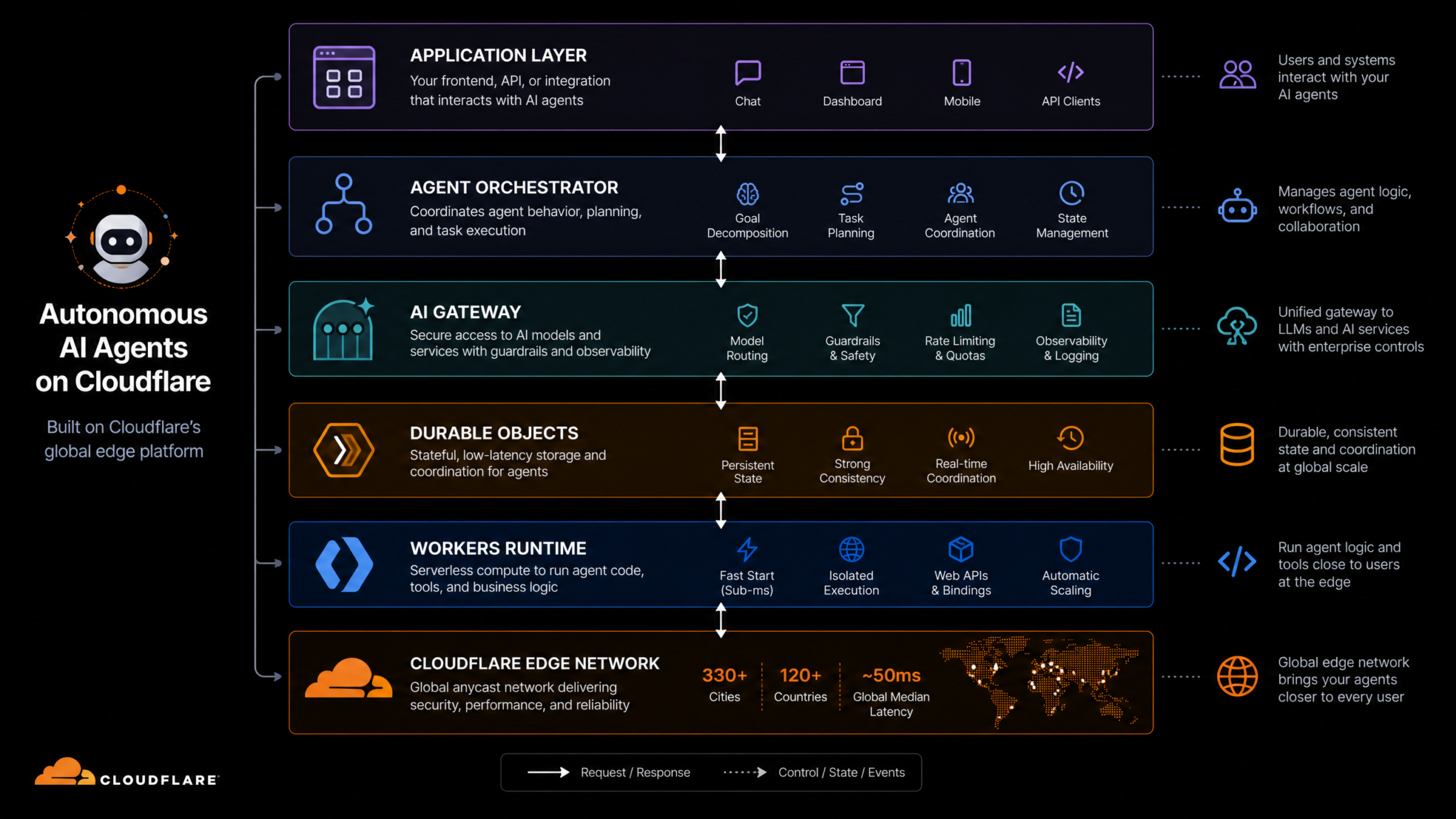
This architecture is best understood visually. Imagine an orchestrator agent at the top of a hierarchy receiving a user request like “research competitor pricing and draft a response strategy.” The orchestrator uses the Agent Coordinator to spawn three specialist agents simultaneously: a web research agent that tools-calls a search API, a pricing database agent that queries an internal data source, and a writing agent that receives the combined output and generates a strategy document. All three specialists run in separate Durable Objects on the edge, communicate through the Coordinator’s message bus, and return results to the orchestrator which synthesizes the final response. The entire topology runs across Cloudflare’s edge with sub-100 millisecond inter-agent messaging latency for agents deployed in the same geographic region.
Workers AI Model Routing: Intelligent Inference Selection
Monday’s final major announcement was a significant upgrade to Workers AI’s model routing capabilities. The new Intelligent Model Router allows agent developers to define cost-performance profiles rather than hardcoding specific model endpoints. An agent can specify that it needs “fast, cheap reasoning for classification tasks” and “high-quality generation for customer-facing output,” and the router selects appropriate models dynamically based on current availability, latency, and cost. The router currently supports 47 models across Cloudflare’s own inference fleet, as well as gateway connections to OpenAI, Anthropic, Google DeepMind, and Meta’s open-weight model ecosystem.
How Cloudflare Workers Now Support Long-Running Agent Processes
Understanding the technical change that enables long-running processes requires a brief look at what made original Cloudflare Workers both powerful and limited. Workers run in V8 isolates — lightweight JavaScript execution environments that start in under one millisecond but share CPU resources across thousands of concurrent tenants. To prevent any single tenant from monopolizing CPU, Workers enforced strict execution time limits: 50 milliseconds on free plans, 30 seconds on paid plans for CPU time.
For AI agents, this was architecturally catastrophic. A reasoning loop that calls an LLM API and waits for a response might consume only 5 milliseconds of CPU but require 2 seconds of wall clock time for the network round-trip. Multiply that across a 20-step agent plan and you have 40 seconds of wall time for 100 milliseconds of CPU — well within theoretical CPU limits but impossible in practice because the existing runtime couldn’t efficiently hibernate and resume a process around I/O waits while maintaining V8 isolate efficiency at scale.
Hibernation and Resumption Architecture
Cloudflare’s engineering solution is called Agent Hibernation. When an agent process reaches an I/O boundary — waiting for an LLM API response, a tool call result, or an external webhook — the runtime serializes the entire execution context: the JavaScript call stack state, all in-memory variables, pending promise chains, and any accumulated conversation history. This serialized state is written to a Durable Object (detailed in the next section) and the CPU isolate is released back to the shared pool.
When the awaited I/O result arrives — whether 100 milliseconds or 6 hours later — the system deserializes the agent’s context, allocates a fresh isolate, restores the execution state, and resumes the agent from precisely where it hibernated. From the agent code’s perspective, the await simply resolved. There is no application-level code required to implement hibernation — it is entirely transparent to the developer.
This is architecturally significant because it means that agent code written in the natural async/await style that JavaScript developers use daily works exactly as written, without any special hibernation annotations, state serialization code, or checkpoint mechanisms. Consider the following simplified agent loop:
export default {
  async fetch(request, env) {
    const agent = new AgentContext(env.AGENT_STORAGE);

    // This await can hibernate for hours — no special code needed
    const userIntent = await agent.analyzeIntent(request);

    // Tool call that waits for external API
    const searchResults = await agent.toolCall('web_search', {
      query: userIntent.searchQuery
    });

    // Another LLM call — another potential hibernation point
    const synthesis = await agent.synthesize(searchResults);

    return agent.respond(synthesis);
  }
}
Each await in this code is a potential hibernation point. If toolCall takes 3 seconds to return results from a remote API, the isolate hibernates for those 3 seconds and resumes seamlessly. Cloudflare’s internal testing reports that this hibernation architecture reduces agent compute costs by an average of 73 percent compared to keeping processes perpetually warm in a container.
Agent Queues: Durable Message Passing for Asynchronous Workflows
Working alongside Agent Hibernation is a new feature called Agent Queues, an upgrade to Cloudflare’s existing Queue product specifically tuned for agent-to-agent communication patterns. Agent Queues support exactly-once delivery guarantees (critical when a tool call result must not be processed twice), priority lanes (an urgent escalation from a customer service agent can jump ahead of a routine batch processing task), and a new agent callback pattern where a queue message includes a return address that allows a downstream agent to route its response directly back to the waiting orchestrator’s Durable Object without going through a central broker.
Durable Objects for Agent State Management
If the Agent Runtime is the engine of Cloudflare’s new AI infrastructure, Durable Objects are the memory. Durable Objects have existed since 2020 as a way to maintain strongly-consistent state at the edge, but Agents Week brought the most significant expansion of the Durable Objects product since its initial release, with a specific focus on the patterns that AI agents require.
Agent Memory Namespaces
The new Agent Memory Namespace feature gives each agent instance a structured storage hierarchy that maps to the three types of memory AI agent architectures typically require: working memory (the current conversation context and in-progress reasoning state), episodic memory (a log of past interactions and their outcomes), and semantic memory (persistent facts and learned preferences that survive across separate agent sessions).
Prior to Agents Week, developers implementing these memory tiers on Cloudflare had to manually design storage schemas across multiple Durable Objects, KV namespaces, and D1 database tables. Agent Memory Namespaces unify these into a single developer-facing API while handling the underlying storage routing automatically. Working memory is stored in the fast in-process storage of the Durable Object itself, episodic memory uses Cloudflare D1 with automatic indexing optimized for semantic similarity search, and semantic memory uses Cloudflare Vectorize with automatic embedding generation when new facts are stored.
The developer-facing API is intentionally simple:
// Store a learned user preference in semantic memory
await agent.memory.semantic.store({
  fact: "User prefers detailed technical explanations over summaries",
  confidence: 0.92,
  source: "inferred from session_2026_08_11"
});

// Retrieve relevant memories for current context
const relevantMemories = await agent.memory.semantic.retrieve({
  query: currentUserMessage,
  limit: 10,
  minConfidence: 0.7
});
Coordination Objects: Shared State for Multi-Agent Systems
A new Durable Object type called Coordination Objects addresses one of the thorniest problems in multi-agent systems: how do multiple independent agents share state without race conditions or stale reads? Coordination Objects implement a software transactional memory model where multiple agents can read and update shared state within atomic transactions. If two agents attempt to update the same coordination object simultaneously, one transaction succeeds and the other receives a conflict error with the latest state, allowing it to retry with fresh information.
This is essential for use cases like multi-agent customer service systems where several specialist agents might simultaneously update a shared ticket state, or autonomous trading systems where multiple analysis agents must coordinate position data without double-counting.
AI-Powered Security Features for Autonomous Applications
Tuesday, August 12 focused heavily on security — an area that Cloudflare argued has been dangerously underinvested in by the AI agent ecosystem. The company’s security research team published a companion report alongside the announcements documenting 14 categories of attack vectors that are specific to AI agent systems and largely unaddressed by existing security tooling. The announcements that followed addressed the most critical of these.
Agent Firewall: LLM-Specific Threat Detection
The Agent Firewall is positioned as the AI equivalent of a Web Application Firewall but designed for the novel threats that arise when LLMs are given tool access and the ability to take real-world actions. It operates as a transparent middleware layer that every agent message passes through before being sent to an LLM and every LLM response passes through before the agent acts on it.
On the input side, Agent Firewall performs prompt injection detection — identifying attempts by adversarial content in tool call results or user inputs to override the agent’s system instructions. Cloudflare’s research team found that 6.2 percent of web pages retrieved by research agents in a test corpus contained embedded prompt injection attempts, a figure that shocked many developers in the industry who had assumed such attacks were rare edge cases.
On the output side, Agent Firewall performs action validation — checking that the actions an LLM instructs an agent to take are within the permissions scope defined by the developer. If an agent is configured to only read from a database but the LLM instructs it to execute a write operation, Agent Firewall blocks the action and logs the anomaly. This defense-in-depth approach means that even a successful prompt injection attack that manipulates the LLM’s reasoning cannot result in unauthorized actions.
Agent Audit Trail: Compliance-Grade Observability
For enterprise deployments, Tuesday also brought the Agent Audit Trail, an immutable log of every decision, tool call, memory read, memory write, and external API call made by an agent instance. The audit trail is cryptographically signed at write time, meaning it cannot be retroactively altered — a feature specifically designed to satisfy emerging regulatory requirements around AI decision accountability in financial services, healthcare, and legal tech sectors.
The audit trail integrates with Cloudflare’s existing analytics pipeline, meaning developers can write SQL queries against their agent audit logs using Workers Analytics Engine, visualize agent behavior in the Cloudflare dashboard, and set up alerts when agents exhibit anomalous patterns — such as unusually high tool call rates that might indicate a prompt injection loop or a reasoning failure state.
AI Agent Security Best Practices for Production Deployments
Rate Limiting and Abuse Prevention for Agent Endpoints
A less dramatic but critically practical announcement was the extension of Cloudflare’s existing rate limiting capabilities to understand the structure of agent workflows. Traditional rate limiting counts requests per IP address or API key per time window. Agent-aware rate limiting understands that a single logical user interaction might legitimately generate hundreds of sub-requests as an agent fans out across tool calls and specialist agents. The new rules engine allows developers to define rate limits at the logical agent session level rather than the individual request level, preventing abuse while not throttling legitimate complex agent workflows.
Integration with OpenAI, Anthropic, and Open-Source Models
One of the most practically impactful announcements across all three days of Agents Week was the expansion and deepening of model provider integrations through what Cloudflare is calling the Universal Model Gateway. This is not merely an API proxy — it is an intelligent middleware layer that adds caching, fallback routing, cost controls, and compliance features on top of every model provider connection.
OpenAI Integration: Responses API and Real-Time Agent Support
Cloudflare’s OpenAI integration now supports the full OpenAI Responses API, including streaming tool use, background execution mode, and the newer structured output capabilities that make it easier to build reliable agent reasoning loops. More significantly, the integration includes a semantic response cache — when an agent makes an LLM call that is semantically similar to a call made by any agent on the platform within the last configurable time window, the cached response is returned if the similarity exceeds a developer-defined threshold, at a fraction of the cost of a fresh API call.
Cloudflare shared early data from beta customers showing that semantic caching reduces OpenAI API costs for typical customer service agent deployments by 34 to 51 percent, depending on the diversity of user queries. For FAQ-heavy use cases, the reduction can exceed 70 percent.
Anthropic Integration: Extended Context and Computer Use
The Anthropic integration brings Claude’s extended context window capabilities to the Agent Runtime with specific optimizations for long-context agent scenarios. When an agent’s accumulated conversation history and working memory exceeds typical context window sizes, the integration uses a retrieval-augmented approach to select the most relevant memory chunks rather than truncating the context — a behavior that dramatically improves agent performance on long-running tasks like multi-session research projects.
Support for Anthropic’s computer use capabilities is also integrated, allowing agents to interact with browser-based UIs as part of their tool repertoire. Combined with Cloudflare’s Browser Rendering product, this enables agents that can autonomously navigate websites, fill forms, and extract structured data without requiring target sites to provide APIs.
Open-Source Model Support: Llama, Mistral, and the Self-Hosted Tier
For developers with data privacy requirements or cost constraints that make proprietary API usage impractical, Cloudflare expanded Workers AI’s open model catalog to 31 fine-tunable models including the latest Llama variants, Mistral architectures, and several domain-specific models for code generation and structured data extraction. These models run on Cloudflare’s own GPU infrastructure at the edge, meaning inference happens within the same data center as the agent’s Durable Objects — eliminating the network round-trip latency that affects cloud-hosted model integrations.
The new Fine-Tune on Workers AI feature, previewed on Wednesday, allows developers to upload training datasets and fine-tune these base models directly within the Cloudflare platform without spinning up separate training infrastructure. Fine-tuned models are stored as LoRA adapters and applied at inference time, making it possible to have agent-specific model variants without the cost of full model duplication.
Comparing OpenAI and Anthropic APIs for AI Agent Development
Platform Comparison: Cloudflare vs. AWS, Azure, and Google
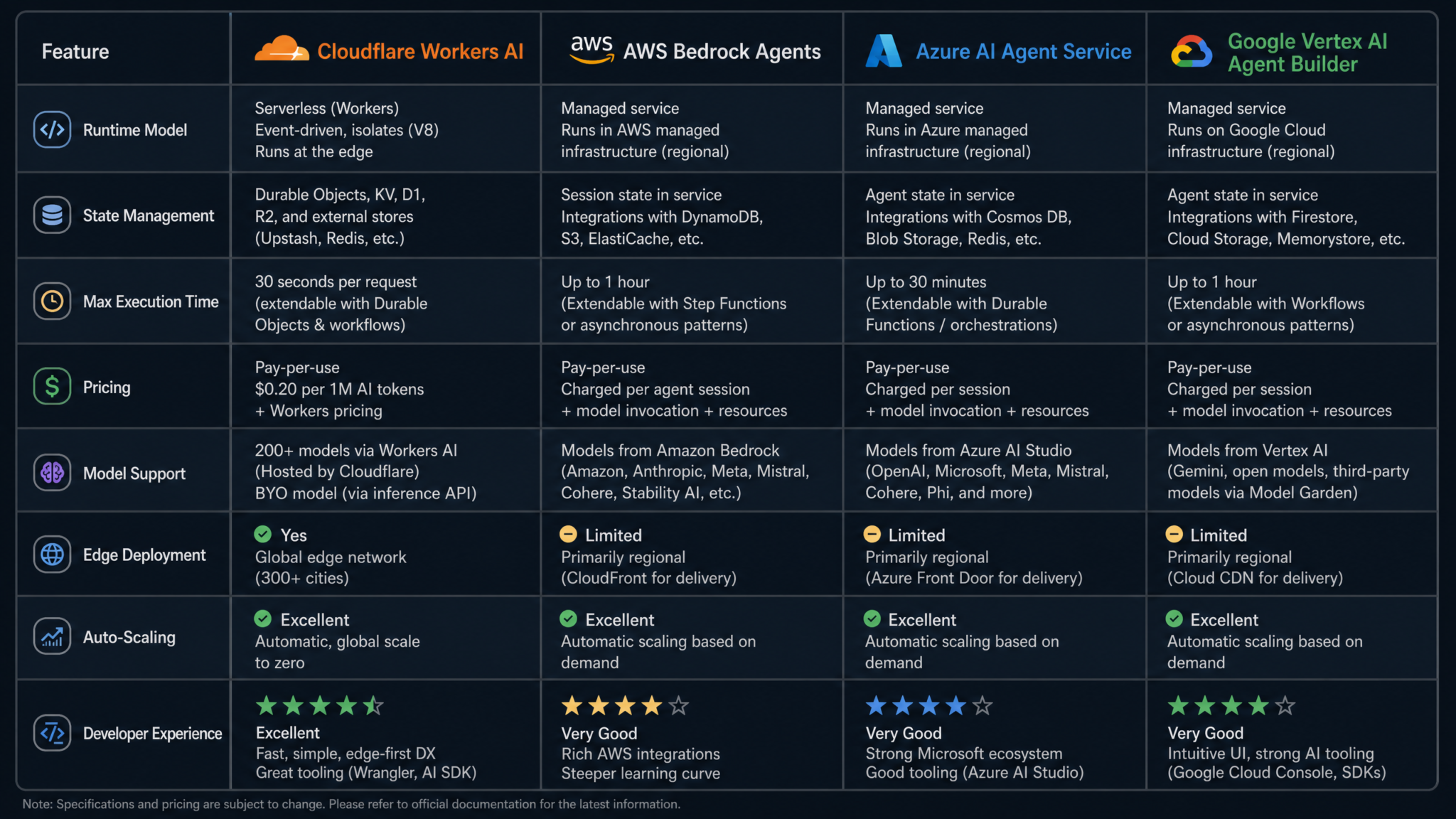
To contextualize Cloudflare’s Agents Week announcements, it is worth examining how the new stack compares with the three dominant cloud platforms that have been building AI agent infrastructure over the past 18 months. Each platform reflects its parent company’s architectural DNA — and each has meaningful strengths and weaknesses relative to what Cloudflare announced.
| Feature | Cloudflare Agents | AWS Bedrock Agents | Azure AI Agent Service | Google Vertex AI Agents |
|---|---|---|---|---|
| Execution Model | Edge isolates with hibernation | Lambda containers with Step Functions | Azure Container Apps with DAPR | Cloud Run with Eventarc |
| State Management | Native Durable Objects with memory namespaces | DynamoDB + S3 (manual integration) | Azure Cosmos DB (semi-managed) | Firestore (manual schema design) |
| Cold Start Latency | <5ms globally | 100-800ms (container cold start) | 50-400ms | 80-600ms |
| Global Distribution | 310 edge locations | 33 AWS regions | 60 Azure regions | 40 Google regions |
| Model Support | 47 models + gateway to all major APIs | Amazon Bedrock model catalog (deep AWS integration) | Azure OpenAI (strongest GPT-4/o3 integration) | Gemini-first with open model support |
| Prompt Injection Defense | Agent Firewall (built-in) | Bedrock Guardrails (configurable) | Azure AI Content Safety | Vertex AI Safety Filters |
| Developer Experience | TypeScript/Python, familiar async/await | Boto3 / CDK (AWS expertise required) | Azure SDK (significant boilerplate) | Vertex SDK (complex configuration) |
| Pricing Model | Per Agent Tick (CPU time only) | Per Lambda invocation + Step Functions state transitions | Per container-hour + orchestration requests | Per Cloud Run CPU-second + Eventarc events |
| Multi-Agent Coordination | Agent Coordinator (built-in) | Step Functions (general purpose, not agent-specific) | AutoGen integration (third-party) | Agent Builder with pre-built templates |
| Observability | Agent Audit Trail (immutable, queryable) | CloudWatch + X-Ray (requires custom instrumentation) | Azure Monitor + Application Insights | Cloud Trace + Vertex Experiments |
Where Cloudflare Leads
Cloudflare’s most significant advantage over all three hyperscalers is latency at scale. Running agent logic at the edge — within milliseconds of end users anywhere in the world — matters enormously for interactive agent applications like customer service bots and real-time coding assistants where user-perceived responsiveness drives satisfaction. An agent running in a Cloudflare edge data center 8 milliseconds from a user in Singapore will consistently outperform the same logic running in an AWS us-east-1 region 180 milliseconds away.
The second advantage is the coherence of the developer experience. AWS Bedrock Agents, despite being mature and feature-rich, requires developers to configure separate services for each capability: Step Functions for orchestration, DynamoDB for state, Lambda for execution, Bedrock Guardrails for safety. Each service has its own pricing model, its own IAM permissions model, and its own debugging interface. A developer building an equivalent agent on Cloudflare configures one platform and accesses all capabilities through a single SDK.
Where Hyperscalers Retain Advantages
AWS, Azure, and Google retain meaningful advantages in data locality for enterprise use cases. A company storing sensitive data in an AWS region can build Bedrock Agents that never route data outside that region — a compliance requirement for many regulated industries. Cloudflare’s edge-first architecture, while globally distributed, has historically offered less granular data residency control, though the company announced during Agents Week that regional processing enforcement is coming in Q4 2026.
Google’s Vertex AI Agent Builder has the deepest integration with Gemini’s multimodal capabilities, making it the strongest platform for agents that need to reason about images, video, and audio natively. Cloudflare’s multimodal support through Workers AI exists but is more limited in depth as of August 2026.
AWS Bedrock vs Cloudflare Workers AI for Enterprise Agent Deployments
Pricing Model for Agent Compute
Cloudflare published detailed pricing for the Agent Runtime on Wednesday morning, and the reaction in developer communities was immediate and largely positive. The company has structured pricing around three components: Agent Ticks (CPU execution time), Agent Messages (inter-agent communications through the Coordinator), and Agent Memory (Durable Object storage and Vectorize operations).
Agent Ticks Pricing
Agent Ticks are measured in units of 1 millisecond of CPU time. The free tier includes 10 million Agent Ticks per month — equivalent to approximately 2,800 agent reasoning cycles of 3.5 milliseconds of CPU each. The paid tier prices at $0.30 per million Agent Ticks, which means a production customer service agent handling 10,000 conversations per day with an average of 12 milliseconds of CPU per conversation would cost approximately $43.20 per day in Agent Tick compute — significantly lower than equivalent container-based deployments.
Agent Messages Pricing
Inter-agent messages through the Agent Coordinator are priced at $0.40 per million messages, with a free tier of 1 million messages per month. For multi-agent architectures, this is a meaningful consideration in system design — fan-out patterns that generate thousands of messages for a single user request can accumulate costs quickly in high-volume deployments.
Agent Memory Pricing
Agent Memory Namespaces use a tiered pricing model based on storage tier. Working memory in Durable Objects is priced at $0.20 per GB-month. Episodic memory in D1 uses standard D1 pricing at $0.75 per million rows queried. Semantic memory in Vectorize is priced at $0.04 per million vector dimensions stored per month plus $0.01 per million query operations.
Pricing Comparison for a Representative Workload
| Platform | Compute Cost | State/Storage Cost | Orchestration Cost | Estimated Total |
|---|---|---|---|---|
| Cloudflare Agents | $129/mo (Agent Ticks) | $45/mo | $12/mo (Agent Messages) | ~$186/mo |
| AWS Bedrock Agents | $280/mo (Lambda) | $95/mo (DynamoDB) | $160/mo (Step Functions) | ~$535/mo |
| Azure AI Agent Service | $310/mo (Container Apps) | $110/mo (Cosmos DB) | $70/mo | ~$490/mo |
| Google Vertex AI Agents | $255/mo (Cloud Run) | $80/mo (Firestore) | $55/mo (Eventarc) | ~$390/mo |
These estimates exclude LLM API costs, which are identical across platforms for the same underlying model providers and are not controlled by the infrastructure vendor. They illustrate that Cloudflare’s pricing model, optimized for the hibernation-heavy access patterns of real AI agents, can offer meaningful cost advantages over architectures designed for always-on containers.
How ChatGPT and Codex Developers Deploy Agents on Cloudflare
One of the most practically immediate implications of Agents Week is for the developer segment that builds with AI-assisted coding tools — specifically those using ChatGPT’s canvas feature, OpenAI Codex, or similar tools to scaffold agent code rapidly. Cloudflare has invested heavily in making this workflow as frictionless as possible.
The Wrangler Agents CLI
Cloudflare’s existing Wrangler CLI received a major update during Agents Week that adds agent-specific scaffolding and deployment commands. A developer can now run:
wrangler agents init my-research-agent --template customer-service
This command generates a complete agent project structure with TypeScript scaffolding, pre-configured Durable Objects for memory management, example tool definitions for common integrations (web search, database queries, email sending), and a local development environment that simulates the Agent Runtime including hibernation behavior. The generated project includes a wrangler.agents.toml configuration file that exposes all agent-specific settings in a single, well-documented location.
Access 40,000+ AI Prompts for ChatGPT, Claude & Codex — Free!
Subscribe to get instant access to our complete Notion Prompt Library — the largest curated collection of prompts for ChatGPT, Claude, OpenAI Codex, and other leading AI models. Optimized for real-world workflows across coding, research, content creation, and business.
ChatGPT Canvas Integration
For developers using ChatGPT to generate agent code, Cloudflare published a system prompt template specifically designed to bias code generation toward the Cloudflare Agents SDK patterns. When used, ChatGPT generates code that uses correct Agent Runtime APIs, properly instruments memory namespaces, and includes Wrangler deployment configuration automatically. The template is publicly available in Cloudflare’s developer documentation and on the community GitHub organization.
From ChatGPT to Production in Under 15 Minutes
During Wednesday’s live demo, Cloudflare engineer Kenton Varda demonstrated generating a complete customer service agent using ChatGPT, deploying it to the global edge using the Wrangler Agents CLI, and handling a live test conversation — all in under 15 minutes. The demonstration used no pre-written code: every line was generated by ChatGPT in response to a plain English description of the agent’s intended behavior. The resulting agent was production-ready, instrumented with the Agent Audit Trail, and globally available immediately upon deployment.
This demonstration resonated deeply with the developer community because it validated a workflow that a large segment of modern developers already use. The pathway from idea to deployed agent — via ChatGPT for ideation and code generation, Cloudflare Workers for deployment and execution, and Durable Objects for state — is now documented, tooled, and officially supported rather than being a collection of community workarounds.
Building Your First Autonomous AI Agent with Cloudflare Workers and ChatGPT
Real-World Use Cases Emerging From Agents Week
Cloudflare announced a set of design partners who had been building on the Agent Runtime beta since May 2026. Their use cases span the breadth of industries already investing in autonomous AI agents and illustrate how the architectural features announced during Agents Week translate into real application value.
Customer Service Agents: Autonomous Ticket Resolution
A mid-market e-commerce company with approximately 4 million active customers deployed a customer service agent on the Cloudflare Agent Runtime beta that handles tier-1 support inquiries autonomously. The agent maintains episodic memory of past customer interactions in D1, uses semantic memory in Vectorize to store product knowledge and policy information, and integrates with the company’s Shopify instance, shipping provider API, and internal CRM via tool calls.
The agent handles 67 percent of incoming support requests without any human escalation — higher than the 58 percent autonomous resolution rate they achieved with a previous implementation built on a container-based infrastructure. The improvement is attributed primarily to memory coherence: the Cloudflare Agent Runtime’s native memory namespaces allow the agent to reliably recall context from previous interactions across sessions, whereas the previous implementation’s manual Redis-based state management frequently had cache invalidation bugs that caused the agent to lose customer history.
Data Processing Pipelines: Autonomous ETL with LLM Enrichment
A market research firm uses multi-agent pipelines on the Cloudflare Agent Runtime for automated competitive intelligence gathering. Their architecture consists of a scheduler agent that runs on a cron trigger, spawning collector agents that retrieve and parse web content, enrichment agents that use Anthropic Claude to extract structured data from unstructured text, and a synthesis agent that combines results into reports and publishes them to the company’s internal knowledge base.
The pipeline processes approximately 2,400 content sources daily, running 15 to 20 agent instances simultaneously during peak hours. The Agent Coordinator’s fan-out pattern handles the parallelism, and Coordination Objects ensure that two collector agents don’t process the same source simultaneously. The company reports a 340 percent improvement in throughput compared to their previous sequential processing pipeline and a 28 percent reduction in infrastructure costs.
Autonomous Monitoring: Self-Healing Infrastructure Agents
A SaaS infrastructure company has deployed monitoring agents on the Cloudflare edge that continuously observe their application metrics, diagnose anomalies using LLM reasoning, and autonomously execute remediation actions for known failure patterns. The agents run as persistent Durable Objects that “wake up” on a 60-second heartbeat cycle, query metrics APIs, and compare current system state against a semantic knowledge base of known incident patterns built up over 18 months of documented outages.
When the monitoring agent detects a pattern matching a known incident, it autonomously executes the first three remediation steps from the documented runbook — typically restarting a service, flushing a cache, or adjusting a load balancer weight — while simultaneously creating an incident ticket and paging the on-call engineer. The system has autonomously resolved 23 incidents in the 90 days since deployment that would previously have required human intervention, reducing mean time to resolution for these incident types from an average of 14 minutes to under 90 seconds.
Legal Document Processing: Autonomous Contract Review
A legal tech startup is using the Agent Runtime for autonomous contract review workflows. Their agent ingests contract documents, uses a specialist analysis agent to identify non-standard clauses using fine-tuned Llama models running on Workers AI, routes flagged clauses to a risk assessment agent powered by Claude with extended context, and generates a structured review report with specific recommendations. The semantic memory namespace stores precedent data from thousands of previously reviewed contracts, allowing the agent to compare new clauses against historical baselines and identify emerging risk patterns.
Developer Reactions and Early Adoption Stories
Developer reaction to Agents Week across social platforms, Discord communities, and Hacker News has been notably more enthusiastic than prior Cloudflare developer weeks, which themselves tend to generate strong engagement. The shift in tone from general appreciation to genuine excitement reflects that many developers have been waiting specifically for the primitives Cloudflare shipped.
On Hacker News, a post announcing Monday’s runtime announcements accumulated over 800 comments within 48 hours — a high engagement count by platform standards. The highest-voted comment, from an engineer identifying themselves as having spent eight months trying to build production-grade agents on AWS before giving up, read: “Durable Objects with proper agent hibernation is the thing I’ve been asking for from every cloud provider for two years. I re-read the Cloudflare announcements three times to make sure I wasn’t misunderstanding what they were shipping. I wasn’t.”
The developer community around LangGraph, the popular agent orchestration framework from LangChain, responded quickly to the announcements. Within 24 hours of Monday’s press release, the LangGraph GitHub repository had three open pull requests adding Cloudflare Agent Runtime as an execution target, with the first merged on Tuesday afternoon. The LangGraph maintainers published a blog post noting that Cloudflare’s Agent Coordinator maps naturally onto LangGraph’s graph-based orchestration model, making Cloudflare a first-class deployment target for LangGraph applications.
Indie developers on platforms like X (formerly Twitter) and BlueSky noted the accessibility angle: the combination of a generous free tier, a familiar async/await programming model, and deep ChatGPT integration lowers the barrier to building production agents dramatically compared to any hyperscaler alternative. Several developers posted screenshots of functional agents deployed to the global edge within hours of the announcements being made, scaffolded with ChatGPT and deployed with a single Wrangler command.
Enterprise developer reaction was more measured but uniformly interested. Several engineering managers at large companies noted that the lack of granular data residency controls and the current limitations on compliance certifications (Cloudflare is SOC 2 Type II certified but working toward FedRAMP and HIPAA BAA coverage for the Agent Runtime specifically) would slow enterprise adoption in regulated industries. However, the same respondents indicated they were beginning evaluation processes and expected to make deployment decisions within six to nine months as Cloudflare completes these certifications.
Cloudflare Workers vs AWS Lambda for Production AI Applications
Implications for the Serverless AI Agent Ecosystem
Agents Week has implications that extend well beyond Cloudflare’s own product line. The announcements signal a broader maturation of the AI agent infrastructure market and will accelerate several trends that have been developing gradually over the past 18 months.
The End of “Duct Tape” Agent Architectures
A significant portion of production AI agent deployments today are built on infrastructure that was not designed for agents. Developers use Lambda functions with awkward timeout workarounds, DynamoDB tables with manually designed schemas for conversation state, SQS queues for agent-to-agent communication, and custom middleware to stitch it all together. These architectures work but require substantial engineering investment, generate significant operational overhead, and fail in non-obvious ways when agent behavior becomes complex.
By shipping a coherent, purpose-built agent infrastructure stack, Cloudflare is creating a new baseline expectation for what agent platforms should provide. AWS, Azure, and Google will respond — likely within 6 to 12 months — with more agent-specific abstractions built on top of their existing services. The competition benefits developers everywhere, not only those who choose Cloudflare.
Framework Consolidation and Standardization
The current fragmentation of the agent framework ecosystem — with LangGraph, AutoGen, CrewAI, Semantic Kernel, and dozens of other frameworks each with different abstractions, deployment patterns, and state management approaches — is partially a consequence of the underlying infrastructure’s lack of native support for agent primitives. When the infrastructure itself provides memory namespaces, coordinator patterns, and hibernation, framework authors can build on top of these rather than reimplementing them. This creates pressure toward standardization and makes it more likely that a smaller number of framework patterns will emerge as dominant standards.
Serverless Economics Validate the Agent Model
Perhaps the most important long-term implication of Cloudflare’s Agent Tick pricing model is that it validates a fundamental economic thesis: AI agents, when built on infrastructure that matches their actual resource consumption patterns, can be economically viable at scale even with expensive LLM API calls in the cost structure. The ability to hibernate an agent while waiting for LLM responses — paying nothing for the waiting time — changes the economics meaningfully for high-latency AI workflows.
This has downstream implications for application design. Developers who have avoided certain agent architectures because of cost concerns — multi-step research agents, extended planning loops, long-context document analysis — may find those architectures are now economically viable with infrastructure that bills for actual cognitive work rather than idle waiting time.
What This Means for the Future of Autonomous Applications
Cloudflare’s Agents Week announcements land at a moment when the broader technology industry is making foundational decisions about where AI capabilities will live and how they will be governed. The architectural choices being made today — about execution models, state management, security boundaries, and pricing structures — will shape the autonomous application landscape for years.
The Edge as the Natural Home for AI Agents
The logic of running AI agents at the edge is compelling and underappreciated. AI agents are, by nature, responsive to user context — they personalize, they remember, they adapt. The more physically proximate the execution is to the user, the more responsive and personalized the experience can be. A latency reduction from 180 milliseconds to 8 milliseconds doesn’t just make an agent feel faster — it enables interaction patterns that are categorically different. Real-time, conversational, turn-by-turn agent interactions become possible at global scale without requiring users to be near a central cloud region.
This suggests a future where the most sophisticated AI experiences are not running in hyperscaler data centers but at the edge, close to users, on infrastructure that looks more like Cloudflare’s network than like traditional cloud regions.
Agents as First-Class Citizens of the Web
Cloudflare’s framing of agents as infrastructure-level constructs — with their own runtime, their own security model, their own state management primitives — represents a philosophical claim that AI agents are not just a use case for web infrastructure but a fundamental new abstraction for the web itself. In this framing, an agent is as basic a building block as a DNS record or a TLS certificate: something the infrastructure should understand natively and support explicitly, not something built awkwardly on top of request-response primitives.
If this framing gains adoption across the industry, it will accelerate the development of open standards for agent communication, agent identity, and agent capability advertising. Cloudflare has signaled participation in several emerging standards efforts in this space, including the MCP (Model Context Protocol) ecosystem that is developing cross-platform agent interoperability standards.
The Governance Question
The Agent Firewall and Agent Audit Trail announcements reveal Cloudflare’s understanding that autonomous agents create governance challenges that have no precedent in web infrastructure. When an agent takes an action — sends an email, modifies a database record, makes a financial transaction — that action is caused by a chain of AI reasoning that may not be easily interpretable or auditable after the fact.
By building governance primitives (immutable audit trails, action validation, permission enforcement) into the infrastructure layer rather than relying on application-level implementation, Cloudflare is making a bet that AI governance will ultimately need to be a platform responsibility, not an application developer responsibility. This aligns with the direction of emerging regulatory frameworks in the EU AI Act and proposed US AI liability frameworks that are placing obligations on infrastructure providers as well as application developers.
The Next 12 Months
Several announcements made during Agents Week are explicitly forward-looking. Cloudflare previewed a Visual Agent Builder — a no-code drag-and-drop interface for creating multi-agent topologies targeting non-developer users — expected in Q1 2027. The company also previewed Agent Marketplace functionality that will allow developers to publish reusable specialist agents for consumption by other developers’ orchestrator agents, a capability that could create a new economic model around composable agent expertise.
Regional processing enforcement, compliance certifications for regulated industries, and expanded multimodal capabilities in Workers AI are all on public roadmaps with Q4 2026 and Q1 2027 target dates. If these ship on schedule, the gaps that currently prevent Cloudflare from being the obvious choice for regulated industry deployments will close significantly within the next six months.
For developers evaluating where to build their next AI agent application, Agents Week offers a clear signal: Cloudflare is not merely participating in the AI infrastructure market but attempting to define what AI infrastructure should look like for the agent era. Whether that vision succeeds will depend on execution, enterprise trust-building, and the inevitable competitive response from the hyperscalers. But the architectural foundation laid during those three days in August 2026 is serious, coherent, and built on a genuine understanding of how AI agents actually behave.
The era of duct-tape agent architectures may be ending. What replaces it looks a lot like what Cloudflare shipped this week.
