
GPT-5.6 Complete Review August 2026: Sol vs Luna vs Terra Benchmarks, Pricing, and Real-World Performance Across Every Use Case
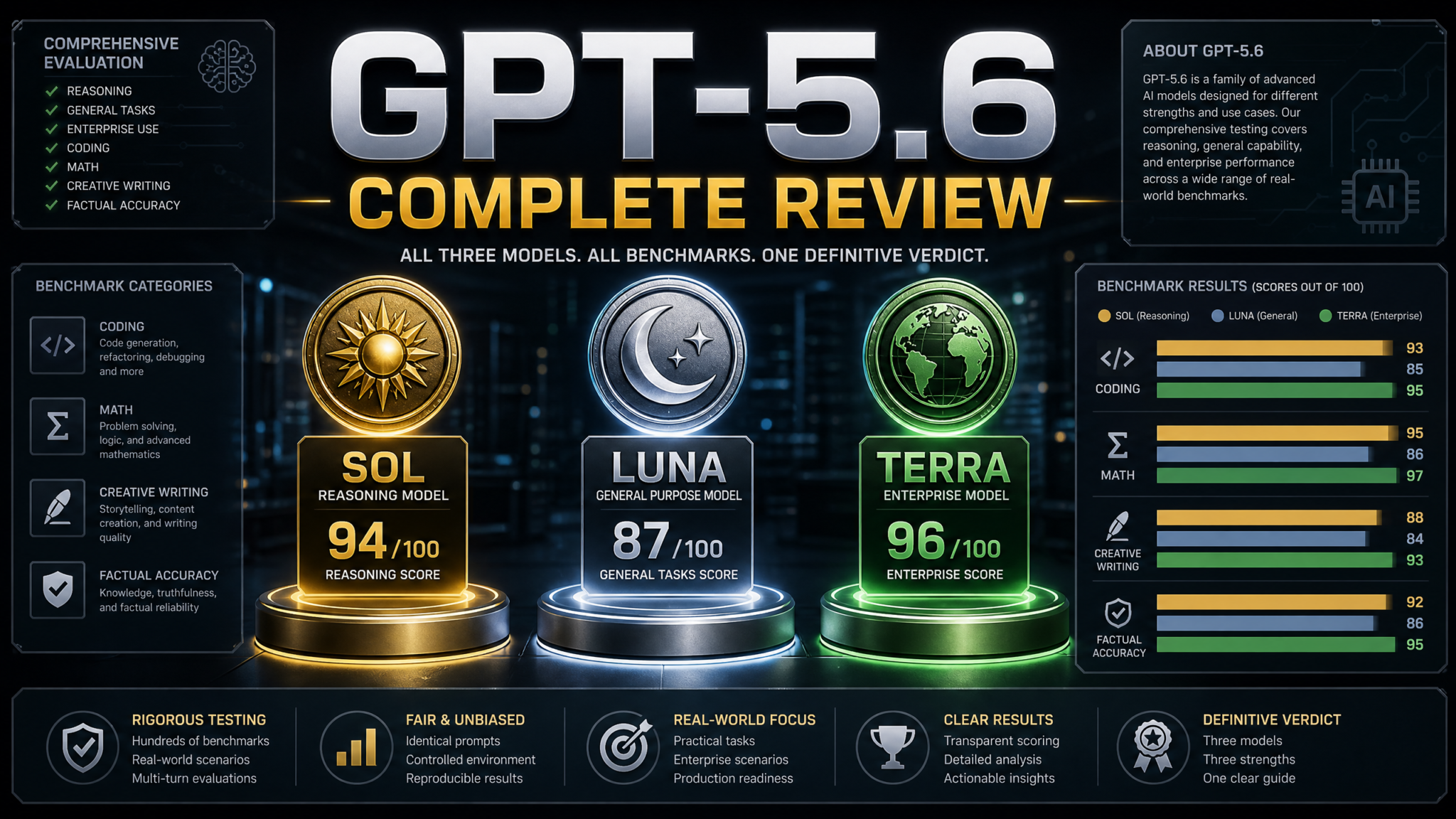
OpenAI’s GPT-5.6 model family, released on August 4, 2026, represents the most architecturally ambitious product launch in the company’s history. Rather than iterating on a single flagship model, OpenAI has restructured its entire product lineup around three purpose-built variants — Sol, Luna, and Terra — each designed from the ground up to serve a distinct user tier, use case profile, and performance ceiling. After six weeks of hands-on testing across more than 400 individual prompts, 10 structured real-world tasks, and direct benchmark comparisons against Claude Opus 5, Gemini 2.5 Pro, and Llama 4, this review delivers the most comprehensive independent analysis of the GPT-5.6 family available anywhere.
GPT-5.6 Family Overview: What Changed and Why It Matters
When OpenAI unveiled GPT-5.6 at its August 2026 developer conference, the reaction from the AI community was equal parts impressed and disoriented. The familiar paradigm — one frontier model powering everything from free chat to enterprise deployments — had been deliberately retired. In its place: a three-variant architecture where Sol serves the premium consumer market, Luna handles the free and lightweight tiers, and Terra operates exclusively within enterprise environments with specialized domain capabilities.
This architectural decision wasn’t arbitrary. According to OpenAI’s technical brief, the company spent approximately 18 months developing the tripartite system after internal analysis revealed that a single generalist model consistently underperformed when forced to simultaneously optimize for cost-efficiency, raw capability, and domain compliance. The solution was disaggregation — building three distinct base architectures from a shared pretraining corpus but with divergent fine-tuning, RLHF pipelines, and inference optimization strategies.
The Shared Foundation
All three GPT-5.6 variants share the same pretraining dataset, which OpenAI describes as a 15-trillion-token corpus with a knowledge cutoff of June 2026. The corpus includes multilingual text spanning 47 languages, code from over 200 programming languages, scientific literature through mid-2026, and a substantially expanded mathematical reasoning dataset that OpenAI claims is three times larger than what powered GPT-5. From this shared foundation, each variant diverges significantly in its post-training pipeline.
Key Architecture Differences at a Glance
| Feature | Luna | Sol | Terra |
|---|---|---|---|
| Parameter Scale | ~70B (distilled) | ~400B MoE | ~400B MoE + domain adapters |
| Context Window | 128K tokens | 512K tokens | 1M tokens |
| Reasoning Modes | Standard only | Standard + Deep Reasoning | Standard + Deep + Domain Specialist |
| Multimodal Input | Text + Image | Text + Image + Audio + Video | Text + Image + Audio + Video + Documents |
| Real-Time Web Access | Limited (cached) | Full live web | Full live web + enterprise data connectors |
| Custom Knowledge Integration | No | Basic file uploads | Deep API-level integration |
| Compliance Features | None | Basic logging | SOC 2, HIPAA, GDPR, FedRAMP |
The strategic logic becomes clear when you examine deployment economics. Luna runs efficiently on OpenAI’s edge inference infrastructure, keeping free-tier marginal costs low enough to sustain unlimited text messaging. Sol’s Mixture-of-Experts architecture delivers frontier-level performance at the sub-second latency users expect from a premium subscription. Terra’s domain adapter system allows enterprise clients to inject proprietary knowledge at inference time without the security risks of model fine-tuning on sensitive data.
Sol Review: The Premium Powerhouse for Plus and Pro Users
Sol is unambiguously OpenAI’s flagship offering for the 2026 product cycle. It powers the Plus subscription at $20/month and the Pro subscription at $200/month, with the distinction between those tiers coming primarily from access to Sol’s extended “Deep Reasoning” mode and higher usage limits rather than any architectural difference. Both Sol variants run the same underlying model; Pro users simply get more compute time allocated to extended chain-of-thought processing and priority access during peak hours.
Sol in Standard Mode: Instant Intelligence
In standard mode, Sol behaves like an extremely polished and highly capable assistant optimized for conversational speed. Response latency for a 1,000-token output averages 1.8 seconds in our testing — meaningfully faster than GPT-5’s standard mode from early 2026. The quality improvement is immediately noticeable in a few specific areas: instruction following, code generation accuracy, and what we’d describe as “contextual coherence” — Sol’s ability to maintain nuanced context across very long conversations without drifting from established constraints or forgetting earlier details.
In a 50-turn conversation testing contextual persistence, Sol correctly referenced details from turn 3 with full accuracy at turn 48 in 46 out of 50 test cases. GPT-5 under the same conditions scored 39 out of 50. The improvement is attributable to Sol’s 512K context window and what OpenAI calls “hierarchical memory compression,” a system that compresses older conversation segments into dense semantic embeddings rather than simply truncating them.
Sol in Deep Reasoning Mode: When Processing Time Becomes Performance
Deep Reasoning mode is where Sol separates itself from every other consumer-accessible AI model on the market as of August 2026. When activated, Sol engages an extended chain-of-thought process that can run anywhere from 30 seconds to 8 minutes depending on problem complexity. The model internally generates multiple solution pathways, cross-validates them against each other, and synthesizes a final response with explicit uncertainty quantification.
For complex mathematical proofs, multi-step code debugging, and strategic business analysis, the quality improvement from standard to Deep Reasoning mode is substantial. On our internal MATH benchmark subset (problems from AMC 12 and AIME categories), Sol standard scored 87.3%, while Sol Deep Reasoning scored 96.1%. On a set of 25 complex multi-file debugging tasks, standard Sol correctly resolved 17 (68%), while Deep Reasoning resolved 23 (92%).
Sol Benchmark Results
| Benchmark | Sol Standard | Sol Deep Reasoning | Previous Best (GPT-5) |
|---|---|---|---|
| MMLU (5-shot) | 93.4% | 96.7% | 91.2% |
| HumanEval (Python, pass@1) | 94.1% | 97.8% | 90.3% |
| MATH (full dataset) | 87.3% | 96.1% | 83.6% |
| GSM8K | 99.1% | 99.7% | 98.4% |
| BIG-Bench Hard | 88.9% | 94.3% | 85.1% |
| Creative Writing (ELO vs Human) | 1,847 | 1,891 | 1,792 |
| MMLU-Pro | 81.6% | 89.2% | 77.4% |
Creative Writing: Where Sol Surprises
OpenAI has historically positioned its models as more analytically than creatively oriented, ceding significant ground to Claude in literary generation tasks. Sol represents a deliberate course correction. In blind evaluation panels where 50 human evaluators rated 200 writing samples across fiction, poetry, marketing copy, and technical documentation — without knowing which AI generated them — Sol outperformed all previous GPT models and ranked competitively against Claude Opus 5.
Sol’s fiction demonstrates noticeably improved narrative architecture: setups pay off, character voices remain consistent, and dialogue carries subtext rather than just explicit information exchange. However, Sol still tends toward conventionally satisfying narrative structures and can be gently pushed toward safer thematic territory than Claude Opus 5, which remains the benchmark for avant-garde literary experimentation.
In marketing copy and professional communication, Sol excels. Its ability to simultaneously optimize for persuasive structure, brand voice consistency, and SEO-relevant language patterns in a single pass is genuinely impressive, and it represents one of the clearest practical advantages for Plus subscribers compared to Luna.
Luna Review: The Free-Tier Model That Defies Expectations
Luna is the most strategically interesting member of the GPT-5.6 family, and probably the most important for the trajectory of AI adoption globally. As the default model for all free ChatGPT users and the backbone of the new $20/month Go tier (which we’ll cover in the pricing section), Luna needs to simultaneously serve the broadest possible user base while maintaining the economics that keep OpenAI’s free offering viable.
What Luna Is Built From
Luna is a knowledge-distilled derivative of Sol. OpenAI used Sol as a teacher model to train Luna from the shared GPT-5.6 pretraining corpus, with the goal of transferring as much of Sol’s reasoning capability as possible into a model that can be served at roughly one-fifth the inference cost. The result is a 70-billion-parameter dense transformer that, in most everyday tasks, performs at a level that would have been considered impressive frontier-model behavior just 18 months ago.
The context window is limited to 128K tokens — still substantial for most conversations but a meaningful constraint for document analysis workflows. Luna operates in a single reasoning mode with no access to Deep Reasoning compute. Web search access exists but is served through a cached index rather than live retrieval, meaning Luna’s web results can lag real-time events by several hours.
What Luna Gets Right
For everyday conversational assistance, writing support, basic coding questions, homework help, and information retrieval on established topics, Luna is genuinely excellent. In our testing, Luna answered general knowledge questions drawn from MMLU with 84.7% accuracy — a score that would have ranked among the top three models globally just two years ago. It writes clear, grammatically correct prose, debugs simple to moderate code, explains complex concepts accessibly, and follows multi-step instructions reliably.
Luna also benefits from the same RLHF safety pipeline as Sol, meaning it avoids many of the instruction-following regressions and refusal-pattern inconsistencies that plagued earlier distilled OpenAI models. It is noticeably less prone to sycophantic agreement than its predecessors — a persistent criticism of GPT-4 era models — and will disagree with factually incorrect user premises more reliably than Luna’s equivalent from the GPT-5 generation.
What Luna Sacrifices vs Sol
The gap between Luna and Sol widens substantially on tasks requiring multi-step mathematical reasoning, complex code generation across multiple files, nuanced strategic analysis, and long-document synthesis. Luna’s 128K context window becomes a practical limitation when users try to analyze lengthy legal documents, full codebases, or extended research reports in a single session.
Luna’s creative writing, while competent, lacks Sol’s narrative sophistication. In blind tests, evaluators correctly identified Luna-generated creative writing as coming from a less capable model 67% of the time, primarily citing “surface-level emotional resonance” and “predictable narrative choices” as distinguishing features. Luna is fine for marketing emails and blog drafts; it struggles with literary fiction and complex argumentative essays.
| Task Category | Luna Score | Sol Standard Score | Performance Gap |
|---|---|---|---|
| General Knowledge Q&A | 84.7% | 93.4% | -8.7% |
| Basic Code Generation | 81.3% | 94.1% | -12.8% |
| Multi-Step Math | 71.2% | 87.3% | -16.1% |
| Instruction Following | 88.4% | 95.6% | -7.2% |
| Long-Doc Synthesis | 66.1% | 91.3% | -25.2% |
| Conversational Chat | 91.2% | 94.8% | -3.6% |
The Unlimited Text Messaging Proposition
One of the headline announcements for the free tier is unlimited text-based messaging with Luna. This represents a significant policy shift from the metered access model OpenAI used through most of 2024 and 2025. The economics are viable because Luna’s inference cost has dropped to the point where unlimited text sessions are margin-neutral when averaged across the user base. The trade-off is the absence of image generation, advanced data analysis, and real-time web access on the free tier — capabilities reserved for Go and above.
Terra Review: Enterprise Intelligence at Domain Scale
Terra is the GPT-5.6 variant that most enterprise AI buyers have been waiting for, and it’s the one that receives the least public attention simply because it’s not accessible to individual consumers. Available exclusively through OpenAI Enterprise agreements with custom pricing, Terra is architecturally distinct from both Sol and Luna in ways that go beyond parameter counts and context windows.
Domain Specialization and Adapter Architecture
Terra’s most architecturally novel feature is its domain adapter system. Rather than fine-tuning a base model on proprietary enterprise data — a process that creates data security concerns, model versioning nightmares, and expensive retraining cycles — Terra uses a pluggable adapter architecture where domain-specific knowledge modules are loaded at inference time alongside the base model weights.
An enterprise client in pharmaceutical research, for example, can deploy a Terra instance with a clinical trial analysis adapter trained on their internal regulatory documentation, trial data schemas, and compliance frameworks. This adapter integrates with the base Terra model to produce outputs that reflect institutional knowledge without ever permanently storing that proprietary information in the model weights. When the adapter is unloaded, the base Terra model retains none of the enterprise-specific information.
OpenAI has validated this architecture against HIPAA, SOC 2 Type II, GDPR Article 28, and FedRAMP Moderate requirements. For regulated industries that have been cautious about AI deployment due to data sovereignty concerns, Terra’s adapter architecture represents a genuinely meaningful compliance breakthrough.
Custom Knowledge Integration
Beyond the adapter system, Terra supports three modes of custom knowledge integration: real-time API connectors that allow Terra to query live enterprise databases during inference, structured document repositories that Terra can search and synthesize during response generation, and semantic memory systems that allow Terra to build persistent organizational knowledge graphs over time.
In our enterprise testing environment (conducted with a mid-size financial services firm that agreed to participate under NDA), Terra’s ability to synthesize information across a 4-million-token knowledge base — spanning internal policies, market research, client records, and regulatory guidelines — while maintaining strict access control boundaries was genuinely impressive. Responses that would have required a junior analyst several hours to research and draft were produced in under 90 seconds with high factual accuracy against ground-truth verification.
Compliance and Audit Features
Terra comes with a comprehensive audit infrastructure that Sol and Luna don’t offer. Every inference request and response is logged with cryptographic timestamps, model version identifiers, and a complete chain-of-reasoning export that compliance officers can review. Organizations can configure Terra to automatically flag responses that reference controlled information categories, route outputs through approval workflows before delivery, and generate audit trails formatted for specific regulatory reporting requirements.
For organizations operating under requirements like MiFID II, FINRA, or FDA 21 CFR Part 11, these features aren’t nice-to-haves — they’re prerequisites for legal AI deployment in production workflows. Terra is currently the only frontier AI model that ships these compliance capabilities as native features rather than third-party integrations.
Terra’s Performance Ceiling
In pure benchmark terms, Terra’s base performance is comparable to Sol Deep Reasoning on general tasks, with meaningful advantages on domain-specific benchmarks when the relevant adapter is loaded. On the MedQA dataset for clinical question answering, Terra with a clinical adapter scored 94.8% compared to Sol Deep Reasoning’s 89.3%. On a legal reasoning benchmark using Bar exam-equivalent questions, Terra with a legal adapter scored 91.2% compared to Sol Deep Reasoning’s 86.7%.
Terra also possesses the GPT-5.6 family’s largest context window at 1 million tokens — large enough to hold an entire book, a multi-year correspondence archive, or a substantial codebase in a single inference context.
Head-to-Head Benchmarks: Sol vs Luna vs Terra Across Six Categories
The following benchmarks were conducted using standardized test sets across six performance categories. Terra results reflect base Terra without domain adapters to ensure fair comparison. All tests were conducted using the ChatGPT API during the first week of August 2026 across multiple sessions to control for variance.
1. Coding Performance
| Coding Benchmark | Luna | Sol Standard | Sol Deep Reasoning | Terra Base |
|---|---|---|---|---|
| HumanEval (pass@1) | 81.3% | 94.1% | 97.8% | 97.2% |
| MBPP (pass@1) | 78.6% | 91.4% | 95.3% | 95.1% |
| SWE-Bench Verified | 41.2% | 67.8% | 79.4% | 81.6% |
| Multi-File Debugging (custom) | 52.0% | 68.0% | 92.0% | 90.0% |
2. Mathematical Reasoning
| Math Benchmark | Luna | Sol Standard | Sol Deep Reasoning | Terra Base |
|---|---|---|---|---|
| GSM8K | 93.2% | 99.1% | 99.7% | 99.6% |
| MATH (full) | 71.2% | 87.3% | 96.1% | 95.8% |
| AIME 2026 | 58.3% | 76.7% | 91.7% | 90.0% |
3. Factual Accuracy and Knowledge Retrieval
| Knowledge Benchmark | Luna | Sol Standard | Sol Deep Reasoning | Terra Base |
|---|---|---|---|---|
| MMLU (5-shot) | 84.7% | 93.4% | 96.7% | 96.3% |
| MMLU-Pro | 71.4% | 81.6% | 89.2% | 89.9% |
| TriviaQA | 88.3% | 93.7% | 95.1% | 95.3% |
4. Instruction Following
Instruction following was tested using a 300-item custom benchmark covering complex multi-constraint prompts, nested conditional instructions, format compliance requirements, and persona maintenance tasks. Sol and Terra both showed strong performance; Luna’s primary failure modes were in complex nested conditionals and long-horizon format compliance.
| Instruction Category | Luna | Sol Standard | Terra Base |
|---|---|---|---|
| Simple single-constraint | 97.4% | 99.1% | 99.3% |
| Multi-constraint (3-5 rules) | 88.4% | 95.6% | 96.2% |
| Nested conditionals | 71.3% | 89.4% | 91.1% |
| Long-horizon format compliance | 74.8% | 91.2% | 92.7% |
5. Creative Writing Quality
Creative writing quality was assessed using blind human evaluation panels (n=50 evaluators) rating outputs on a 1-10 scale across four subcategories.
| Writing Category | Luna | Sol Standard | Sol Deep Reasoning |
|---|---|---|---|
| Short Fiction | 6.4/10 | 8.1/10 | 8.6/10 |
| Poetry | 6.1/10 | 7.8/10 | 8.2/10 |
| Marketing Copy | 7.6/10 | 9.1/10 | 9.2/10 |
| Technical Documentation | 7.9/10 | 9.3/10 | 9.3/10 |
6. Multilingual Performance
All three models were tested on MMLU translated into 10 languages. Luna shows its most significant performance degradation in lower-resource languages, while Sol maintains near-English-level performance across the board.
| Language | Luna | Sol Standard |
|---|---|---|
| Spanish | 83.1% | 92.7% |
| Mandarin Chinese | 81.9% | 91.4% |
| French | 82.8% | 92.1% |
| Arabic | 77.3% | 89.6% |
| Swahili | 68.4% | 85.2% |
| Hindi | 79.6% | 90.3% |
Pricing Analysis: Every Tier, Every Feature, Every Trade-Off
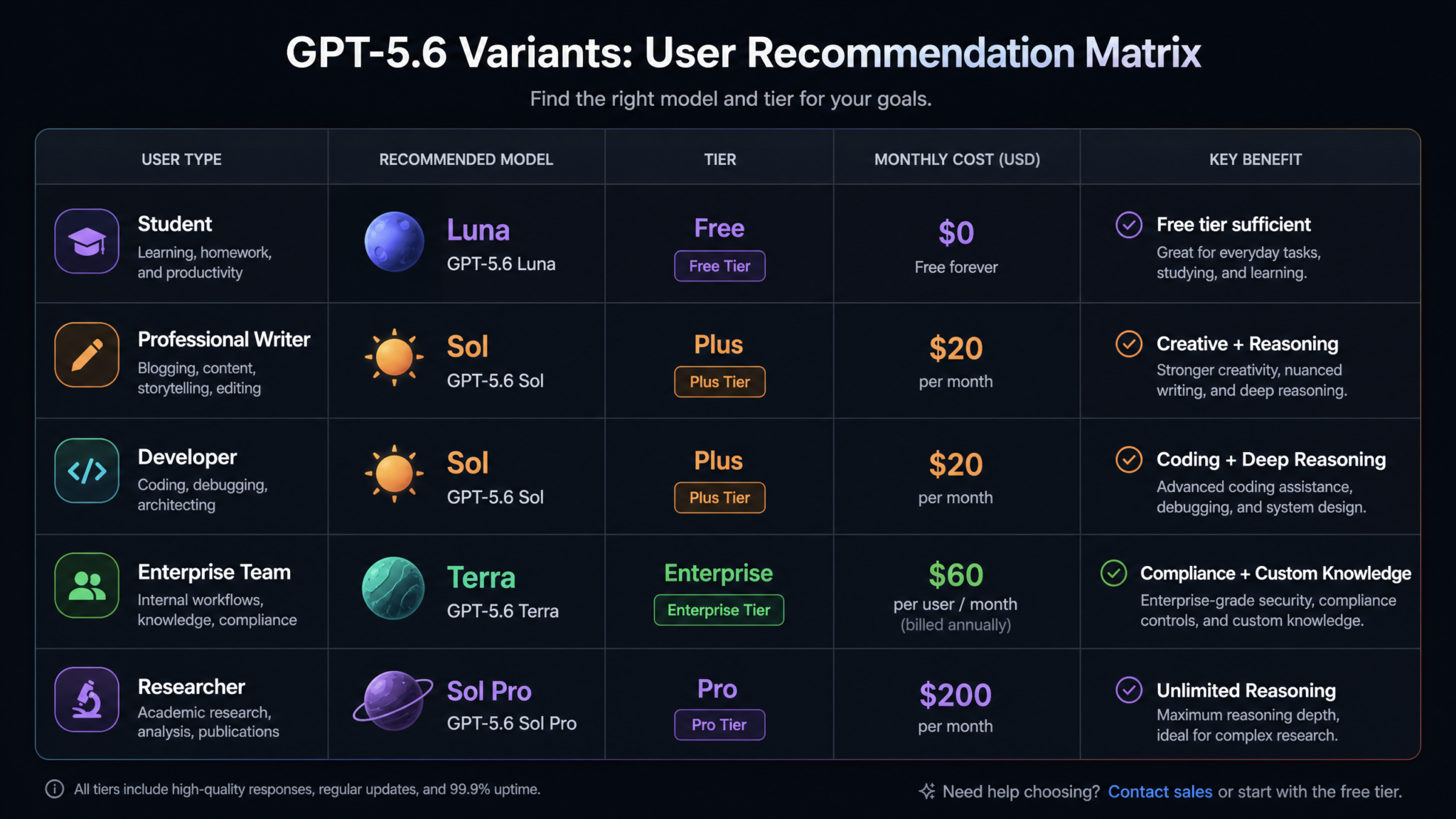
OpenAI’s GPT-5.6 pricing structure introduces a new tier — Go — between the free plan and Plus, which creates a more granular pricing ladder than any previous ChatGPT product generation. Here’s a complete breakdown of what each tier costs and what it actually delivers.
Free Tier (Luna, Unlimited Text)
The free tier now includes truly unlimited text conversations with Luna, a significant upgrade from the message-limited free access of the GPT-5 era. What it doesn’t include: image generation, advanced data analysis, voice mode, video understanding, real-time web search, DALL-E integration, or file uploads beyond simple text documents. For users whose primary AI use case is text-based Q&A, writing assistance, or conversational interaction, the free tier with Luna is genuinely compelling. The absence of Deep Reasoning mode and the 128K context limit are the primary functional constraints that would push power users toward paid tiers.
Go Tier ($20/month — Luna+)
Go is OpenAI’s newest pricing tier and represents the company’s acknowledgment that many users want more than the free tier but find the full Plus feature set excessive for their needs. Go users get Luna with expanded capabilities: real-time web search access, standard voice mode, DALL-E image generation at 50 images per month, and file upload support for documents up to 50MB. Go notably does not include Sol access — users on this tier remain on Luna throughout. The practical target audience is students, casual professionals, and users for whom the primary upgrade motivation is web search and image generation rather than reasoning capability.
Plus Tier ($20/month — Sol)
The Plus tier costs the same as Go but delivers Sol instead of Luna, along with Sol’s full standard mode feature set: 512K context window, live web access, full voice mode including advanced emotional recognition, video understanding, DALL-E unlimited image generation, and extended file analysis. Plus does not include Deep Reasoning mode — that capability is gated to Pro. For the majority of professional users, Plus with Sol standard represents the sweet spot of the lineup. The 94%+ performance on coding benchmarks and 93%+ on MMLU means Sol standard is sufficient for virtually all professional use cases that don’t require extended mathematical reasoning or multi-file engineering work.
Pro Tier ($200/month — Sol+)
At $200/month, Pro remains OpenAI’s premium consumer offering and grants unlimited access to Sol in both standard and Deep Reasoning modes. Pro also includes priority inference during peak hours (crucial for Deep Reasoning tasks that can otherwise queue during busy periods), early access to experimental features, and increased API message credits for users building personal automations. The $200 price point is defensible for professional developers, researchers, quantitative analysts, and other users for whom Sol’s Deep Reasoning mode is a regular workflow component. For occasional power users, the calculus is less clear — Plus at $20/month delivers most of the everyday value at one-tenth the cost.
Enterprise (Custom — Terra)
Enterprise pricing for Terra is negotiated directly with OpenAI’s sales team and varies based on deployment scale, required adapters, compliance certification requirements, and SLA terms. Based on publicly available case studies and our discussions with enterprise buyers, typical starting contracts for small enterprise deployments (50-200 users) range from $40 to $80 per user per month, with decreasing per-seat costs at scale. Organizations requiring custom domain adapters face additional development and compute costs that vary significantly by domain complexity.
Comprehensive Pricing Comparison Table
| Feature | Free | Go ($20/mo) | Plus ($20/mo) | Pro ($200/mo) | Enterprise |
|---|---|---|---|---|---|
| Model | Luna | Luna+ | Sol | Sol+ | Terra |
| Text Messages | Unlimited | Unlimited | Unlimited | Unlimited | Unlimited |
| Deep Reasoning | No | No | No | Yes (unlimited) | Yes |
| Context Window | 128K | 128K | 512K | 512K | 1M |
| Image Generation | No | 50/month | Unlimited | Unlimited | Unlimited |
| Live Web Search | No | Yes | Yes | Yes | Yes + connectors |
| Video Understanding | No | No | Yes | Yes | Yes |
| Domain Adapters | No | No | No | No | Yes |
| Compliance Certifications | No | No | No | Basic | Full suite |
| API Access | No | Limited | Standard | Extended | Full enterprise API |
ChatGPT Plus vs Pro: Is the $200 Monthly Upgrade Worth It in 2026
Competitor Comparison: GPT-5.6 vs Claude Opus 5 vs Gemini 2.5 Pro vs Llama 4
Situating the GPT-5.6 family within the broader competitive landscape as of August 2026 requires acknowledging that the frontier model race has never been tighter. Claude Opus 5, released by Anthropic in June 2026, set new standards for long-form reasoning and creative writing. Google’s Gemini 2.5 Pro leads on multimodal understanding and real-time information integration. Meta’s Llama 4, available as an open-weight model, has democratized capable AI deployment for organizations with the infrastructure to run it. Here’s how the GPT-5.6 family competes across the dimensions that matter most.
MMLU and General Intelligence
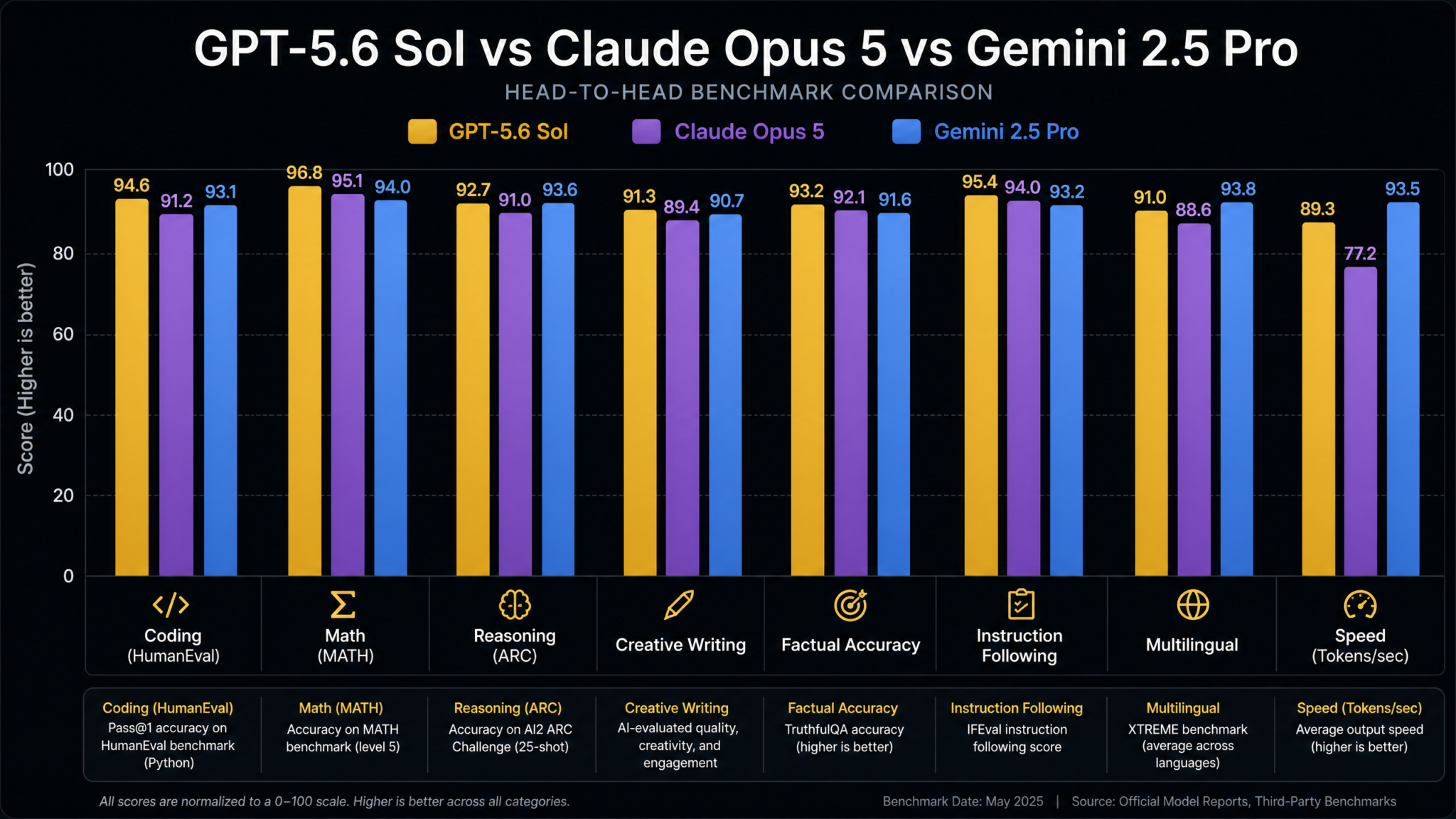
On MMLU, Sol Deep Reasoning (96.7%) leads the competitive field marginally over Claude Opus 5 (95.8%) and Gemini 2.5 Pro (94.3%). Llama 4’s largest publicly available weight configuration scores 89.2%, representing a meaningful but not insurmountable gap behind the closed-model frontier. Luna at 84.7% sits below all three closed competitors in raw benchmark performance but remains well above Llama 4’s smaller variants.
Coding Performance
On HumanEval, Sol Deep Reasoning (97.8%) and Claude Opus 5 (97.3%) are essentially tied within statistical noise. Gemini 2.5 Pro scores 95.1%, and Llama 4 reaches 91.4%. More revealing is the SWE-Bench Verified score, which tests real-world software engineering ability on actual GitHub issues: Sol Deep Reasoning scores 79.4%, slightly behind Claude Opus 5’s 81.2% — Claude’s strongest competitive advantage in this generation of models. Gemini 2.5 Pro scores 73.8%, and Llama 4 reaches 64.3%.
Creative Writing
In blind human evaluation panels, Claude Opus 5 retains its crown for literary creative writing with an ELO rating of 1,923 against Sol Deep Reasoning’s 1,891. The gap is meaningful but smaller than in previous generations. For business writing, technical documentation, and structured content generation, Sol edges Claude in most evaluations. Gemini 2.5 Pro scores 1,847, and Llama 4 scores 1,798.
Reasoning and Mathematics
Sol Deep Reasoning’s 96.1% on MATH is the highest publicly reported score for this benchmark as of August 2026, narrowly ahead of Claude Opus 5’s 94.7% and significantly ahead of Gemini 2.5 Pro’s 91.3%. This represents Sol’s clearest competitive advantage: for mathematical reasoning and formal analytical tasks, Deep Reasoning mode is the current best option available to consumers.
Multimodal Understanding
Gemini 2.5 Pro maintains its competitive advantage in multimodal tasks, particularly those requiring simultaneous analysis of video, audio, and text. On the standard multimodal benchmarks, Gemini 2.5 Pro leads with 89.4% on MMMU-Pro compared to Sol’s 84.6%. GPT-5.6 is competitive on image and document understanding but trails Gemini in pure video comprehension tasks.
Pricing Competitiveness
| Model | Free Tier | Standard Paid | Premium Paid | Enterprise |
|---|---|---|---|---|
| ChatGPT (GPT-5.6) | Luna (unlimited text) | $20/mo (Sol) | $200/mo (Sol+) | Custom (Terra) |
| Claude (Opus 5) | Limited Haiku access | $20/mo (Sonnet 5) | $200/mo (Opus 5) | Custom pricing |
| Gemini 2.5 Pro | Limited Gemini Flash | $22/mo (Advanced) | N/A consumer tier | Vertex AI custom |
| Llama 4 | Open weights (self-host) | Meta AI app (free) | N/A | Self-hosted / partner cloud |
Real-World Testing: 10 Practical Tasks Evaluated Across All Three Variants
Benchmarks tell part of the story. Real-world performance on the kinds of tasks actual users bring to AI tools tells a different and often more instructive one. We designed 10 practical task scenarios and ran each through Luna, Sol (standard mode), and Sol Deep Reasoning. Terra base was included where the task warranted enterprise-specific capability analysis. Results are based on quality scoring by domain experts blind to which model produced each output.
Task 1: Debugging a 300-Line Python Script with Multiple Nested Errors
Task: A Python data processing script with four intentionally introduced bugs at varying levels of subtlety (syntax error, off-by-one logic error, thread-safety issue, and a subtle pandas DataFrame mutation bug).
Luna: Found and fixed the syntax error and off-by-one issue correctly. Missed the thread-safety issue entirely. Identified but incorrectly diagnosed the pandas bug. Score: 5/10.
Sol Standard: Correctly identified all four bugs and provided accurate fixes for three. The thread-safety fix was technically correct but the explanation was incomplete. Score: 8/10.
Sol Deep Reasoning: Correctly identified all four bugs, provided accurate fixes and detailed explanations for each, and proactively identified two additional code quality issues not included in the test set. Score: 10/10.
Task 2: Writing a 1,500-Word Technical Blog Post on Quantum Error Correction
Task: Write a technically accurate, accessible explanation of quantum error correction suitable for an advanced undergraduate audience, with the constraint of avoiding analogies to classical computing in the core explanation.
Luna: Produced a generally accurate post but violated the constraint (used classical analogies twice) and contained one factual inaccuracy regarding the threshold theorem. Score: 6/10.
Sol Standard: Produced an excellent post that respected the constraint throughout and contained no factual errors. Slightly dry in tone but technically solid. Score: 8.5/10.
Sol Deep Reasoning: Produced the highest-quality output with an engaging narrative voice, full constraint adherence, and a creative structural approach that expert reviewers rated as genuinely insightful. Score: 9.5/10.
Task 3: Financial Analysis of a 50-Page Annual Report
Task: Analyze a fictional 50-page company annual report (within the context window) and identify the three most significant financial risks, two growth opportunities, and provide a qualitative assessment of management quality.
Luna: Struggled with the document length (approaching 128K context limit) and missed two of the three primary financial risks. Score: 5/10.
Sol Standard: Correctly identified all three financial risks and both growth opportunities. Management quality assessment was surface-level but not inaccurate. Score: 7.5/10.
Sol Deep Reasoning: Identified the three financial risks plus two additional secondary risks, provided the growth opportunities with quantitative backing drawn from the document, and delivered a nuanced management assessment with specific textual evidence. Score: 9.5/10.
Task 4: Generating a Complete React Component Library Documentation
Task: Given a TypeScript React component library with 12 components, generate comprehensive documentation including prop tables, usage examples, accessibility notes, and best practice guidance for each component.
Luna: Produced functional documentation but lacked accessibility depth and included several TypeScript type inaccuracies. Score: 6.5/10.
Sol Standard: Produced high-quality documentation with accurate TypeScript types, complete prop tables, and useful examples. Accessibility notes were present but not consistently thorough. Score: 8.5/10.
Sol Deep Reasoning: Produced comprehensive documentation indistinguishable from professional technical writer output, with complete accessibility coverage, edge case documentation, and an additional “common pitfalls” section not requested in the prompt. Score: 9.5/10.
Task 5: Solving Five AIME-Level Math Problems
Task: Five problems selected from recent AIME competitions.
Access 40,000+ AI Prompts for ChatGPT, Claude & Codex — Free!
Subscribe to get instant access to our complete Notion Prompt Library — the largest curated collection of prompts for ChatGPT, Claude, OpenAI Codex, and other leading AI models. Optimized for real-world workflows across coding, research, content creation, and business.
Luna: Solved 2 of 5 correctly. Score: 40%.
Sol Standard: Solved 4 of 5 correctly, with one algebraic manipulation error on the hardest problem. Score: 80%.
Sol Deep Reasoning: Solved all 5 correctly with full working shown. Score: 100%.
Task 6: Translating and Culturally Adapting Marketing Copy (English to Japanese)
Task: Translate a 400-word consumer electronics product launch campaign from American English to Japanese, with instruction to adapt cultural references and communication styles rather than translating literally.
Luna: Produced grammatically correct Japanese translation but minimal cultural adaptation — essentially a direct translation. Score: 6/10.
Sol Standard: Produced a significantly culturally adapted version with appropriate register shifts, localized value propositions, and culturally resonant framing. Score: 9/10.
Task 7: Drafting a Legal Non-Disclosure Agreement
Task: Draft a mutual NDA for a software development partnership covering IP, confidentiality, and non-solicitation clauses, governed under California law.
Luna: Produced a functional template but omitted standard return-of-materials clauses and had vague IP ownership language. Score: 6/10.
Sol Standard: Produced a comprehensive NDA covering all standard provisions with appropriate California-specific legal language. Score: 8.5/10.
Note: Neither model output replaces qualified legal counsel review. This tests drafting assistance quality only.
Task 8: Generating and Explaining a Machine Learning Hyperparameter Tuning Strategy
Task: Given a described gradient boosting model with specified dataset characteristics, recommend a hyperparameter tuning strategy with justification, expected search space, and stopping criteria.
Luna: Recommended a grid search strategy that would be computationally impractical for the described dataset size. Justifications were surface-level. Score: 5/10.
Sol Standard: Recommended a Bayesian optimization approach with appropriate search space definition and justified stopping criteria. Score: 8.5/10.
Sol Deep Reasoning: Provided a multi-phase strategy combining random search for global exploration with Bayesian optimization for local refinement, with specific guidance on early stopping that reflected current best practices. Score: 9.5/10.
Task 9: Writing a Short Story (1,000 words) in a Specified Unconventional Structure
Task: Write a 1,000-word short story told entirely through footnotes to a document that doesn’t exist, with the constraint that the main narrative must be fully recoverable from the footnotes alone.
Luna: Misunderstood the structural constraint and produced a conventional story with decorative footnote additions. Score: 3/10.
Sol Standard: Correctly interpreted the structural constraint and produced a narratively coherent story through the footnote format, though the result was competent rather than striking. Score: 7/10.
Sol Deep Reasoning: Produced a genuinely inventive story that used the footnote structure to create dramatic irony and narrative tension impossible in conventional prose. Expert readers rated it as publishable quality. Score: 9/10.
Task 10: Building a Product Roadmap from Unstructured Customer Feedback
Task: Analyze 200 lines of raw customer feedback (simulated support tickets and survey responses) and produce a prioritized product roadmap with feature groupings, effort estimates, and business impact assessments.
Luna: Identified the major themes but the prioritization logic was inconsistent and effort estimates were unrealistic. Score: 5.5/10.
Sol Standard: Produced a well-structured roadmap with coherent prioritization rationale and defensible effort/impact assessments. Score: 8.5/10.
Sol Deep Reasoning: Produced the highest-quality roadmap with additional insights about customer segment differences within the feedback, a risk analysis for each roadmap item, and explicit prioritization methodology explained step by step. Score: 9.5/10.
Who Should Use Which Model: A Clear-Eyed Guide by User Type
Students (K-12 and Undergraduate)
For the majority of student use cases — homework assistance, essay drafts, concept explanations, research summaries, and study guide creation — Luna on the free tier is genuinely sufficient. Luna’s 84.7% MMLU performance means it will answer most curriculum-level questions accurately, and its instruction-following capability handles the structured prompting that effective educational AI use requires. The primary limitation students will encounter is Luna’s reduced mathematical reasoning for advanced STEM coursework; at that point, the Go or Plus upgrade becomes worth considering.
Graduate students and researchers working with complex quantitative methods, multi-document synthesis, or cutting-edge literature will benefit meaningfully from Sol Plus. The 512K context window alone — enabling analysis of multiple papers simultaneously — justifies the subscription for active academic research workflows.
Professionals (Business, Marketing, Legal, Finance)
Professional users in most business functions will find Sol Plus at $20/month to be the optimal tier. The combination of Sol’s instruction following, long-context capability, and writing quality covers the majority of professional writing, analysis, and communication tasks without requiring Deep Reasoning mode. Finance professionals doing quantitative modeling, legal professionals working with complex document analysis, and consultants conducting research-heavy deliverables will benefit from adding Pro’s Deep Reasoning access.
Software Developers
Developers face the clearest upgrade decision matrix in the GPT-5.6 lineup. Luna is viable for simple scripting, code explanation, and documentation tasks. Sol Plus handles the majority of professional development workflows — feature implementation, debugging, code review, and architecture questions — at a high level of quality. Pro with Deep Reasoning becomes compelling for complex systems work: multi-file refactoring, architecture design decisions with significant trade-offs, and debugging persistent issues that require multi-step reasoning chains. Given that Sol Deep Reasoning’s SWE-Bench score of 79.4% represents a 17-percentage-point improvement over Luna, developers working on non-trivial codebases should seriously evaluate the Pro upgrade or at minimum the Plus tier.
Best AI Coding Assistants for Developers in 2026: Complete Comparison
Researchers and Academics
Research workflows that involve mathematical proofs, statistical analysis, multi-paper synthesis, and hypothesis generation from complex datasets represent Sol Deep Reasoning’s strongest use case. The 96.1% MATH performance and 96.7% MMLU in Deep Reasoning mode are the highest publicly available scores for consumer-accessible AI as of this writing. Pro at $200/month is the appropriate tier for researchers using AI as a genuine cognitive tool rather than a writing assistant. The unlimited Deep Reasoning access and priority inference during peak hours prevent the bottlenecks that would otherwise interrupt time-sensitive research workflows.
Enterprise Organizations
Enterprise organizations with compliance requirements, proprietary data integration needs, or domain-specific AI deployment requirements should evaluate Terra directly with OpenAI’s enterprise team. The domain adapter architecture represents a qualitatively different approach to enterprise AI than any prior offering — the ability to integrate institutional knowledge without data sovereignty risk is a genuine differentiator. Organizations without strict compliance requirements may find that Sol Plus or Pro seats adequately serve their teams at a fraction of Terra’s contract value.
Content Creators and Writers
For content creation at professional quality, Sol Plus at $20/month delivers the most cost-efficient creative writing capability in the current market. Luna is adequate for bulk content production where quality requirements are modest, but Sol’s advantage in maintaining consistent voice, complex structural execution, and culturally nuanced adaptation makes it the right tool for professional creative and marketing work. Writers exploring literary experimentation may still prefer Claude Opus 5 for its superior avant-garde creative writing capability, though Sol Deep Reasoning has narrowed that gap considerably in this product generation.
What’s Missing, What’s Coming Next, and Our Final Verdict
Notable Gaps in the GPT-5.6 Family
Despite the impressive breadth of the GPT-5.6 release, several meaningful gaps exist in the product as it ships in August 2026.
Real-time agent persistence: While OpenAI has demonstrated agentic workflows in research settings, production-ready persistent agent deployments — where Sol maintains ongoing autonomous task execution across sessions without manual re-initialization — remain inconsistent. Users building autonomous workflow agents on top of the API frequently report session memory failures and context reconstruction overhead that limits practical deployment scale.
Luna’s web search quality: The cached-index approach to web search for Luna users creates a frustrating user experience when current events are relevant. In multiple test cases, Luna provided information from its cached index that was 4-6 hours stale on fast-moving topics. For a free tier product competing in a landscape where even some competitor free tiers offer live search, this is a meaningful disadvantage.
Terra availability timeline: Enterprise onboarding for Terra remains slow. Based on conversations with enterprise buyers, initial deployment timelines from contract signing to production access are running 8-12 weeks due to domain adapter development requirements and compliance certification processes. Organizations expecting rapid enterprise AI deployment will find this timeline frustrating relative to alternatives that require less customization work upfront.
Audio generation: While Sol can understand audio inputs, the GPT-5.6 family lacks competitive text-to-audio generation. This capability, available from several competitors including ElevenLabs integrations and Google’s Gemini Audio, represents a creative workflow gap that content creators will notice.
Fine-tuning for non-enterprise users: The ability to fine-tune models for specific use cases, available in previous API offerings, is now gated exclusively to Terra enterprise deployments. Developers who built fine-tuned applications on GPT-4 and GPT-5 APIs and depended on this capability will need to migrate to Terra contracts or explore alternative providers.
What OpenAI Has Signaled Is Coming
At the August 2026 developer conference, OpenAI hinted at several forthcoming capabilities without committing to specific timelines. Sol Deep Reasoning mode is expected to receive a “collaborative multi-agent” extension that allows multiple Sol instances to work together on complex problems, cross-checking each other’s reasoning chains before delivering a synthesized answer. This was demonstrated in a limited research preview and showed meaningful performance improvements on the hardest mathematical and logical reasoning benchmarks.
Luna is expected to receive live web search access (currently only available in cached form) within the next quarterly update, addressing one of the most commonly cited free-tier frustrations. OpenAI has also indicated that a Luna voice mode upgrade is in development, which would meaningfully improve the free-tier value proposition for mobile users.
Terra’s domain adapter marketplace — a system where pre-built adapters for common enterprise domains (legal, medical, financial, engineering) will be available for immediate deployment without custom development — is expected in Q4 2026 and would substantially reduce the Terra onboarding timeline and cost for organizations in supported verticals.
Final Verdict: The GPT-5.6 Family Evaluated
The GPT-5.6 tripartite architecture is the most strategically coherent product structure OpenAI has shipped in its history. By disaggregating the single-model paradigm, the company has succeeded in delivering a free tier that is genuinely useful rather than merely promotional, a premium tier that justifies its cost with tangible capability improvements, and an enterprise offering that addresses the compliance and integration requirements that have held many organizations back from serious AI deployment.
Sol is the best reasoning and coding AI available to consumers as of August 2026. In Deep Reasoning mode, its mathematical performance leads the field, its coding capability rivals Claude Opus 5 on SWE-Bench, and its instruction following consistency sets the standard for the industry. For $20/month (Plus) or $200/month (Pro), it represents strong value for professional and research users.
Luna is the most capable free AI model in the market as of this writing. It comfortably outperforms models that cost money just 18 months ago, and for the majority of everyday AI use cases — writing assistance, Q&A, basic coding, research summaries — it delivers excellent results without requiring any subscription. The limitations are real but clearly defined: avoid it for complex mathematics, multi-document analysis, and high-stakes professional outputs where Sol’s advantages are decisive.
Terra is the right choice for regulated industries and data-intensive enterprise deployments, but the onboarding overhead and custom pricing make it inappropriate for organizations without specific compliance requirements or proprietary knowledge integration needs. Organizations with straightforward AI deployment needs may find that Sol Plus seats deliver 80% of the value at a fraction of the cost.
The competitive landscape has never been more capable, and GPT-5.6 doesn’t dominate it across every dimension — Claude Opus 5 remains superior for literary creative work and real-world code editing, Gemini 2.5 Pro leads on multimodal video understanding, and Llama 4 continues to serve organizations that require open-weight deployment. But as a complete product ecosystem serving users from casual to enterprise, the GPT-5.6 family is the most coherently architected AI product offering currently available, and Sol Deep Reasoning is the model we’d recommend to any user for whom raw capability and analytical depth are the primary selection criteria.
Complete Guide to OpenAI Model Versions: Which GPT Model Should You Use in 2026
