
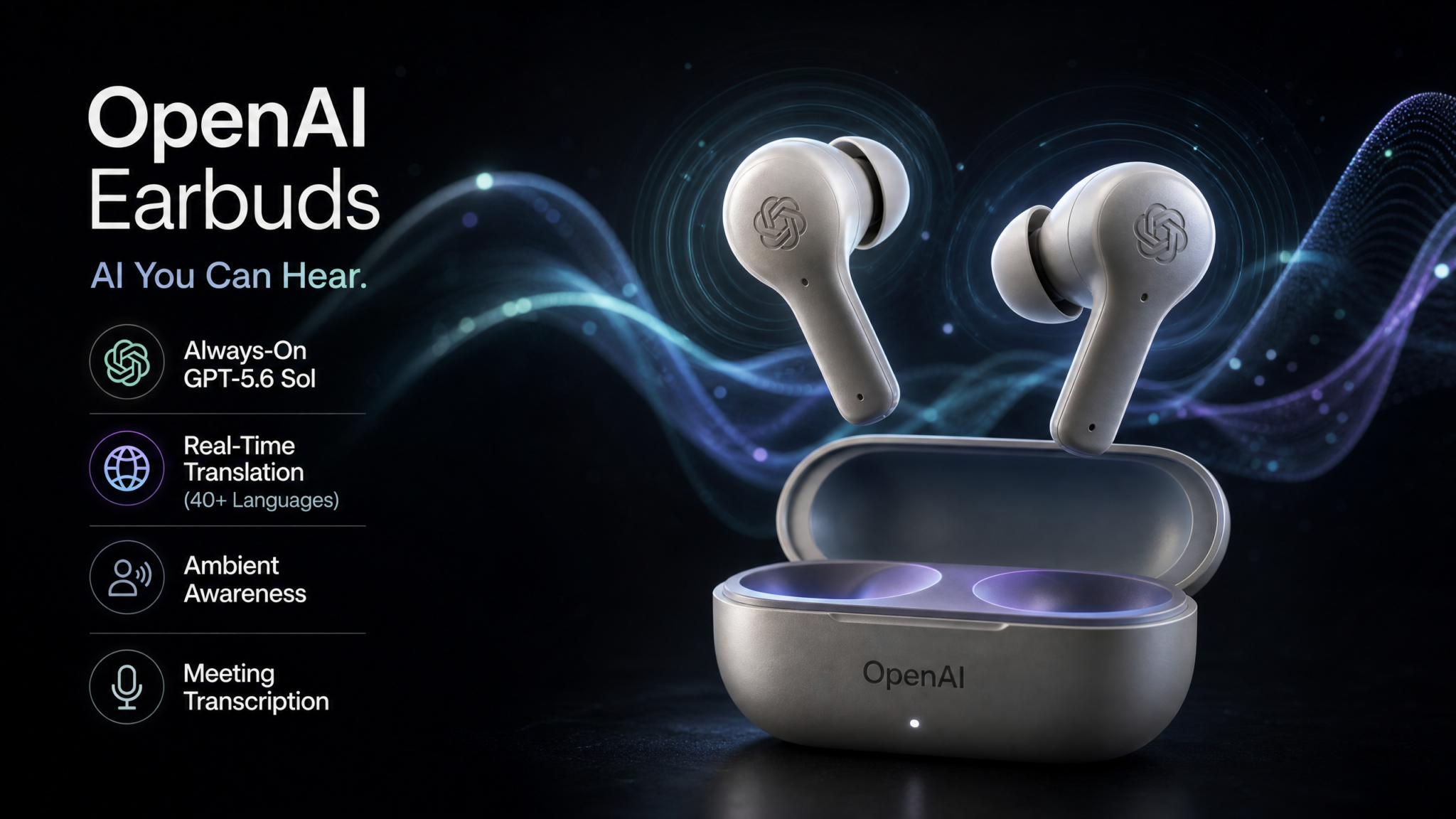
OpenAI is preparing to launch its first-ever consumer hardware product — AI-powered earbuds expected in H2 2026. We break down every confirmed detail, credible rumor, competitive implication, and market opportunity surrounding what could be the most significant wearable launch since the original AirPods.
OpenAI’s Confirmed Move Into Hardware
For most of its public existence, OpenAI operated as a pure software and research organization — a lab that trained language models, sold API access, and built consumer-facing products like ChatGPT. That era appears to be ending. Multiple credible reports emerging throughout 2024 and into 2025 have confirmed that OpenAI is actively developing its first consumer hardware device, with a target announcement window in the second half of 2026. This isn’t speculation on the level of a Reddit leak — it involves named collaborators, confirmed investment rounds, and strategic hires from the consumer electronics industry.
The device in question is reported to be a pair of AI-powered wireless earbuds, representing a deliberate decision by OpenAI to occupy the most intimate and accessible personal computing real estate available: the human ear. While details remain officially unconfirmed by OpenAI CEO Sam Altman in precise terms, Altman has made increasingly pointed public statements about the company’s interest in hardware as a strategic necessity for the next phase of AI deployment. In an interview at the Wall Street Journal’s Tech Live conference, Altman noted that “the interface layer is going to matter enormously,” a comment many analysts interpreted as signaling imminent hardware ambitions.
This guide consolidates everything credibly reported, technically feasible, and strategically logical about OpenAI’s upcoming earbuds — from industrial design partnerships to real-world use case analysis — to give you the most complete picture available before the official announcement.
“The next frontier of AI is not just what it knows — it’s how close it can get to the moments where you actually need it.” — Paraphrased from Sam Altman’s public remarks on ambient AI interfaces, 2024
Why Hardware, Why Now
OpenAI’s decision to pursue hardware is not arbitrary. It reflects several converging pressures and opportunities that have made 2025 and 2026 the natural inflection point for this move:
- Platform dependency risk: ChatGPT currently lives inside Apple’s and Google’s ecosystems. Both companies are developing competing AI assistants — Apple Intelligence and Gemini — that will increasingly prioritize their own tools over third-party integrations. Building hardware is a defensive as much as an offensive move.
- Monetization ceiling: Subscription revenue from ChatGPT Plus ($20/month) and ChatGPT Pro ($200/month) has clear ceiling effects. Hardware opens new revenue streams including device margins, bundled subscriptions, and enterprise licensing.
- The ambient AI opportunity: The most valuable AI interactions will not happen inside a browser tab. They will happen in real-time, in the physical world — during meetings, commutes, conversations, and presentations. Earbuds are optimally positioned to capture that interaction layer.
- Competitive pressure from Meta: Meta’s Ray-Ban smart glasses, enhanced with Meta AI, have demonstrated genuine consumer appetite for always-on AI wearables. OpenAI cannot afford to cede that category entirely.
The strategic logic is compelling enough that even skeptics of OpenAI’s hardware ambitions have largely come around to viewing this as an inevitable expansion rather than a distraction.
What We Know So Far: Form Factor and Core Capabilities
The most consequential early reporting on OpenAI’s hardware ambitions came from The Information and Bloomberg in late 2024, both of which described an earbuds-first strategy. Subsequent reporting from The Verge and Reuters confirmed the broad strokes. Here is what has been reported with a reasonable degree of source reliability:
The Earbuds Form Factor Decision
OpenAI reportedly evaluated multiple form factors before settling on earbuds as the primary launch vehicle. Smart glasses (following the Meta model), a standalone AI pendant (similar to the Humane AI Pin), and a wrist-based device were all considered. Earbuds won for several critical reasons:
- Existing behavioral adoption: Over 1.2 billion wireless earbud units were shipped globally between 2020 and 2024 (IDC estimate). Consumers already understand the product category, wear earbuds for hours daily, and have established charging and usage habits. OpenAI doesn’t need to create a new behavior — it needs to upgrade an existing one.
- Audio-first AI alignment: ChatGPT’s Advanced Voice Mode is already OpenAI’s most emotionally resonant and commercially differentiated feature. Earbuds are the native hardware for voice-first AI interaction.
- Microphone proximity: Unlike glasses or a phone held in a pocket, earbuds contain microphones positioned directly adjacent to the user’s mouth and ears, maximizing voice recognition accuracy and ambient sound capture quality.
- Lower regulatory complexity: Compared to devices that display information on transparent overlays or screens, earbuds avoid the privacy optics (pun intended) associated with camera-equipped wearables in public spaces.
Core AI Capabilities Beyond a Simple Voice Assistant
The defining characteristic of OpenAI’s reported approach is that these are not earbuds with a voice assistant added. They are, according to sources familiar with the project, conceived as an AI device that also plays audio. That inversion matters enormously for product design. The reported core capabilities go well beyond what Siri, Google Assistant, or Alexa offer through earbuds today:
- Real-time conversational AI with context retention across sessions
- Ambient audio awareness — the device analyzes what is happening around the user and provides proactive suggestions without requiring an explicit wake word in many contexts
- Deep integration with the user’s personal data (calendar, email, documents) with explicit permission grants
- Multi-modal AI processing that can interpret context from sound, speech, and (via phone camera integration) visual inputs
- Persistent memory across interactions, enabling the AI to build a genuine understanding of the user’s preferences, schedule, relationships, and goals over time
This capability profile positions the device not as a peripheral but as a cognitive companion — a term that multiple OpenAI-adjacent researchers have used in published papers discussing the future of AI interface design.
Rumored Specifications and Features in Detail
While OpenAI has not published a spec sheet, industry sources, patent filings, and supply chain reporting have produced a coherent picture of what the device is likely to contain. These are rumored specifications — treat them as informed projections rather than confirmed facts.
Always-On GPT-5.6 Sol Access
The most transformative rumored capability is always-on access to what sources are calling GPT-5.6 Sol — a reportedly optimized variant of OpenAI’s frontier model tuned specifically for low-latency, high-frequency audio interaction. Current language models, even fast ones, introduce perceptible processing delays when handling voice input. GPT-5.6 Sol reportedly addresses this through a hybrid architecture that runs lightweight inference locally on an embedded neural processing unit (NPU) for routine interactions, while escalating complex queries to cloud-based inference with prefetched context to minimize perceived latency.
The “always-on” designation refers to a passive listening mode that does not continuously stream audio to OpenAI’s servers (addressing privacy concerns), but instead processes audio locally to identify moments where AI assistance is relevant, then activates the full model pipeline. This is architecturally similar to how modern smartphones handle always-on voice detection for wake words without draining battery.
Real-Time Translation Across 40+ Languages
Real-time translation is among the most credibly reported feature sets. OpenAI’s Whisper model is already among the world’s most accurate multilingual speech recognition systems, supporting over 100 languages. The earbuds are rumored to deliver real-time spoken translation — hearing speech in one language and receiving an audio translation in your ear within 1-2 seconds — for an initial launch set of 40+ language pairs.
This feature alone could justify the device’s price point for international business travelers, diplomats, and professionals working in multilingual environments. Google Translate’s real-time interpretation mode offers a comparable feature but requires holding a phone, lacks contextual AI integration, and operates with meaningfully higher latency. The integration of GPT-level language understanding means the translation would also handle idioms, technical jargon, and context-dependent meaning significantly better than purely transcription-based approaches.
Ambient Awareness and Contextual Suggestions
Perhaps the most novel rumored capability is ambient awareness with proactive contextual suggestions. The device reportedly uses its microphones to analyze the acoustic environment and semantic content of nearby conversations (with user consent and explicit privacy settings) to provide unprompted, contextually relevant information and reminders.
Practical examples that have been discussed in reporting:
- You’re in a meeting and someone mentions a company name you don’t recognize — the AI quietly whispers a brief background in your ear
- You’re at a restaurant discussing dietary restrictions — the AI proactively flags menu items you’ve previously noted as relevant to avoid
- You’re negotiating and the other party states a figure — the AI instantly references your historical notes on acceptable ranges and whispers a recommendation
- You walk into a room and your device detects you’re about to enter a recorded meeting — it automatically shifts to privacy mode
AI-Enhanced Noise Cancellation
Active noise cancellation (ANC) in premium earbuds is already sophisticated, but conventional ANC uses static or semi-adaptive digital signal processing. OpenAI’s rumored implementation takes a fundamentally different approach: instead of suppressing all ambient sound uniformly, the AI model learns to classify sounds semantically — distinguishing between irrelevant background noise (traffic, HVAC systems, crowd noise) and meaningful audio signals (someone saying your name, an alarm, a car horn) — and applies differential noise cancellation that suppresses the former while preserving the latter.
This “semantic noise cancellation” capability, if it performs as described, would represent a genuine technological leap over anything currently on the market, including the best implementations from Sony (WF-1000XM5), Apple (AirPods Pro 2), and Bose (QuietComfort Ultra).
Hardware Specifications (Estimated)
| Specification | Rumored Detail | Confidence Level |
|---|---|---|
| Chip | Custom NPU co-designed with a major semiconductor partner (rumored Apple or Qualcomm) | Moderate |
| Battery Life (earbuds) | 4–6 hours with AI features active; 6–8 hours audio-only | Moderate |
| Battery Life (case) | 24–32 hours total with case charging | Low-Moderate |
| Connectivity | Bluetooth 5.4, Wi-Fi 6 via paired device, potential direct LTE in premium tier | Moderate |
| Microphones | 6-microphone array per earbud (3 inward-facing, 3 outward-facing) | Low |
| Drivers | 11mm dynamic + balanced armature hybrid | Low |
| Companion App | iOS and Android with full ChatGPT integration | High |
| OS Compatibility | iOS 18+, Android 14+ | High |
| Colors at Launch | 2–3 colorways (minimalist palette) | Low |
The Jony Ive Connection: Apple-Level Industrial Design
No aspect of the OpenAI hardware story has generated more industry commentary than the reported involvement of Jony Ive, the legendary designer responsible for the iMac G3, iPod, iPhone, and Apple Watch — arguably the four most consequential consumer electronics designs of the past 25 years. Ive departed Apple in 2019 to found LoveFrom, an independent design firm, and has been linked to OpenAI’s hardware ambitions through multiple reporting threads.
The Scale of the Reported Collaboration
Reports indicate this is not a consulting arrangement where Ive’s firm reviews color swatches and approves CAD renderings. According to The Financial Times and Bloomberg, the LoveFrom collaboration with OpenAI is described as a comprehensive design partnership covering industrial design, user experience architecture, and the broader aesthetic language of the entire OpenAI hardware ecosystem — suggesting this earbud launch is conceived as the first product in a multi-device portfolio rather than a one-off experiment.
The scale of the reported investment is significant: figures discussed in financial reporting suggest OpenAI may have committed north of $5 billion to this hardware initiative, which would make it one of the largest product development investments in the company’s history. Whether Jony Ive’s firm represents a portion of that figure or whether the hardware development costs alone account for it is unclear, but the numbers reinforce that this is not a side project.
What Apple-Level Design Actually Means for a Product
The phrase “Apple-level design” is thrown around loosely in tech journalism, but with Jony Ive literally involved, it warrants specific analysis. Ive’s design philosophy, well-documented through Apple’s history, is defined by several specific principles that will likely manifest in the OpenAI earbuds:
- Materials honesty and premium material selection: Ive’s products consistently used materials at or above what the price point strictly required — machined aluminum, ceramic, surgical-grade steel. Expect the OpenAI earbuds to use materials that feel meaningfully premium relative to competitors.
- Reduction through subtraction: Ive famously argued that the hardest design challenge is deciding what not to include. Expect a product with fewer physical controls than competitors, relying heavily on voice and gesture interaction — which aligns naturally with an AI-first device.
- System coherence: Ive never designed components — he designed systems. The earbuds, case, companion app, and packaging will be conceived as a unified aesthetic and experiential whole.
- Intentional restraint that signals premium: Where competing AI wearables like the Humane AI Pin cluttered their surface with visual indicators and ports, an Ive-designed device will communicate confidence through deliberate visual silence.
The Ive involvement is strategically significant beyond aesthetics. It signals to the consumer electronics market — and specifically to Apple — that OpenAI intends to compete at the premium tier where Apple has historically had unchallenged dominance. This is a direct statement of intent.
How OpenAI Earbuds Compare to Existing AI Audio Products
The AI-enhanced audio product category is not empty. Apple, Google, Meta, and Amazon have all deployed varying degrees of AI capability into audio wearables. Understanding where OpenAI’s device fits requires an honest assessment of the current competitive landscape.
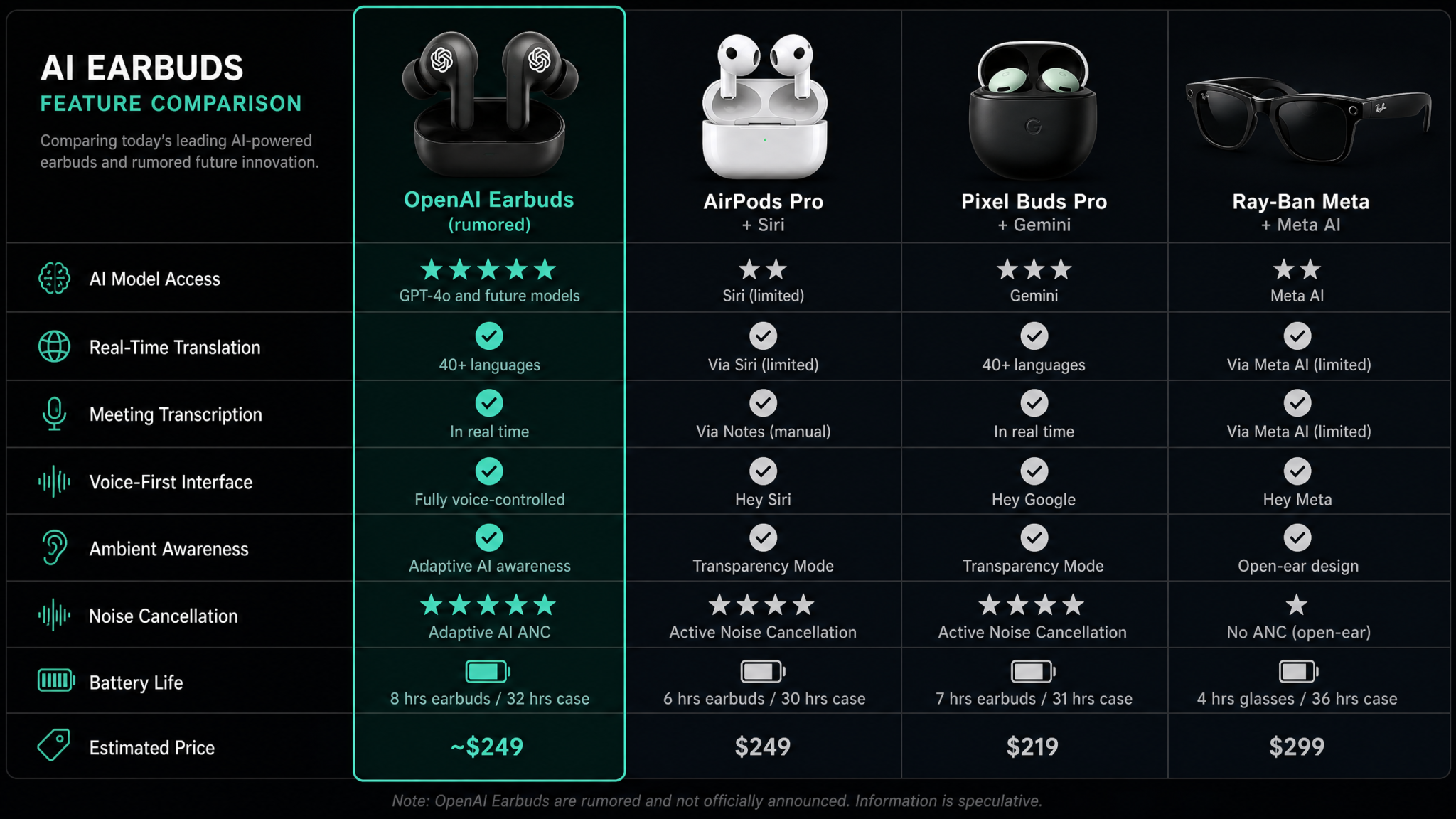
OpenAI Earbuds vs. Apple AirPods Pro 2 + Apple Intelligence
Apple’s AirPods Pro 2, updated with Apple Intelligence features in iOS 18, represent the current gold standard for premium wireless earbuds. They offer exceptional noise cancellation, Personalized Spatial Audio, and Siri with on-device Apple Intelligence integration. However, their AI capabilities remain fundamentally task-execution oriented — setting timers, playing music, reading messages. Siri does not proactively intervene with contextual suggestions, cannot conduct nuanced multi-turn conversations with persistent memory, and does not offer real-time translation at the sophistication level GPT-based models enable.
The AirPods Pro ecosystem also remains tightly locked to Apple devices, offering a meaningfully degraded experience on Android. OpenAI’s cross-platform strategy is a potential competitive advantage for the roughly 3 billion non-iPhone users globally.
OpenAI Earbuds vs. Google Pixel Buds Pro 2 + Gemini
Google’s Pixel Buds Pro 2, integrated with Gemini, represent the closest analogous AI ambition to what OpenAI is targeting. Google has genuine advantages here: deep Android integration, Google Translate infrastructure with real-time “conversation mode,” and Gemini’s multimodal capabilities. However, Google’s hardware execution has historically been inconsistent, and Pixel Buds Pro 2’s commercial performance has been modest relative to AirPods.
OpenAI’s differentiation against Gemini-powered earbuds will likely center on conversational depth, memory persistence, and the ambient awareness capabilities that Google has not yet publicly deployed at comparable sophistication. ChatGPT’s brand recognition in the AI-native user demographic also represents a real commercial advantage.
OpenAI Earbuds vs. Meta Ray-Ban Smart Glasses + Meta AI
Meta’s Ray-Ban Meta glasses are the most instructive competitive reference point — not because they are audio products, but because they demonstrate the commercial viability of always-on ambient AI in a fashionable form factor. The Ray-Ban Meta’s second generation sold significantly better than most analysts predicted, proving that consumers will accept an AI-enhanced wearable if the form factor is desirable and the AI integration is genuinely useful.
The earbuds-vs-glasses distinction matters: glasses offer visual context (camera input) that earbuds cannot match, but earbuds are acceptable in more social contexts (wearing glasses with a prominent camera in some professional or personal settings creates social friction), offer superior audio quality, and fit into existing earbud use habits more naturally.
| Feature | OpenAI Earbuds (Rumored) | AirPods Pro 2 + Siri | Pixel Buds Pro 2 + Gemini | Ray-Ban Meta + Meta AI |
|---|---|---|---|---|
| Conversational AI Depth | ⭐⭐⭐⭐⭐ | ⭐⭐⭐ | ⭐⭐⭐⭐ | ⭐⭐⭐⭐ |
| Real-Time Translation | ⭐⭐⭐⭐⭐ (40+ languages) | ⭐⭐ (limited) | ⭐⭐⭐⭐ (Google Translate) | ⭐⭐⭐ |
| Ambient Awareness / Proactive AI | ⭐⭐⭐⭐⭐ | ⭐⭐ | ⭐⭐⭐ | ⭐⭐⭐⭐ |
| Noise Cancellation Quality | ⭐⭐⭐⭐⭐ (AI-enhanced) | ⭐⭐⭐⭐⭐ | ⭐⭐⭐⭐ | ⭐⭐ (glasses form factor) |
| Visual Context (Camera) | ⭐ (phone camera only) | ⭐ | ⭐ | ⭐⭐⭐⭐⭐ |
| Persistent Memory / Personalization | ⭐⭐⭐⭐⭐ | ⭐⭐ | ⭐⭐⭐ | ⭐⭐⭐ |
| Cross-Platform Support | ⭐⭐⭐⭐⭐ | ⭐⭐ (Apple-centric) | ⭐⭐⭐ (Android-centric) | ⭐⭐⭐⭐ |
| Industrial Design Pedigree | ⭐⭐⭐⭐⭐ (Jony Ive) | ⭐⭐⭐⭐⭐ | ⭐⭐⭐ | ⭐⭐⭐⭐ (Ray-Ban collaboration) |
| Battery Life | ⭐⭐⭐⭐ (estimated) | ⭐⭐⭐⭐⭐ | ⭐⭐⭐⭐ | ⭐⭐⭐⭐ |
Advanced Potential Features: Beyond the Voice Assistant
The features discussed so far — translation, noise cancellation, ambient awareness — are impressive but represent the reasonably foreseeable near-term capability set. There is a second tier of features that industry analysts and OpenAI researchers have discussed publicly as medium-term possibilities that could appear in the 2026 launch or subsequent software updates.
Voice-First ChatGPT with Near-Zero Latency
The most common criticism of current AI voice interfaces is latency. Even OpenAI’s own Advanced Voice Mode, which represents the state of the art in conversational AI audio, introduces noticeable processing pauses that disrupt conversational flow. The earbuds project reportedly has latency reduction as a primary engineering objective, with a target of sub-300ms response time for routine interactions — approaching the threshold of human conversational expectation.
Achieving this requires the hybrid local/cloud processing architecture mentioned earlier, but it also requires rethinking the audio pipeline. Traditional voice assistants process speech-to-text, then run inference, then text-to-speech in a sequential chain. OpenAI’s rumored approach runs these stages in a more parallelized fashion, beginning inference on partial speech inputs before the user has finished speaking, similar to how a human expert can anticipate the completion of a sentence and begin formulating a response.
Meeting Transcription, Summarization, and Action Extraction
One of the highest-value professional use cases for an always-on AI audio device is automated meeting documentation. The OpenAI earbuds are reported to include a meeting mode that activates on command, transcribes multi-speaker conversations with speaker identification, and generates structured summaries with extracted action items at the end of the meeting — delivered directly to the user’s ear and synced to their connected task management or note-taking systems.
This directly targets a $4.2 billion market currently served by products like Otter.ai, Fireflies.ai, and Microsoft Copilot’s Teams integration. The advantage of an earbud-based implementation over app-based transcription is that the device works for in-person conversations, not just video calls — capturing the majority of professional meetings that never appear in calendar apps or video conferencing platforms.
Real-Time Presentation and Public Speaking Coaching
An intriguing use case that has surfaced in reporting is real-time coaching for presentations, negotiations, and interviews. The device monitors the user’s speech — pace, filler word frequency, vocal clarity, time elapsed — and provides gentle real-time audio nudges: “You’ve been speaking for 12 minutes, your key point hasn’t landed yet” or “Your pace has increased significantly — the audience may be struggling to follow.” This positions the earbuds as a persistent executive coach accessible without scheduling a human consultant.
The market for communication coaching and presentation training was estimated at $2.8 billion globally in 2024, and it is almost entirely served by expensive human professionals or generic software. An AI-powered solution embedded in a device users wear anyway during their workday represents a genuine disruption of that market.
Ambient Sound Analysis and Safety Alerts
The semantic noise cancellation capability described earlier extends into a broader ambient sound analysis framework. The AI reportedly maintains a continuous background awareness of the acoustic environment — not recording or transmitting audio, but classifying sounds in real time using the on-device NPU. This enables use cases including:
- Alerting the user when a smoke alarm or emergency vehicle is detectable behind their music or podcast
- Notifying the user when their name or a wake phrase is spoken in the environment
- Detecting patterns consistent with a medical event (rapid breathing, choking sounds) and offering emergency assistance prompts
- Recognizing the acoustic signature of a doorbell, knock, or phone ring and flagging it to the user with audio transparency
These features transform the device from a smart audio accessory into a genuine perceptual extension — arguably the most profound shift in the product’s value proposition.
Pricing Speculation and Product Tier Analysis
Pricing an entirely new product category is notoriously difficult, but the competitive landscape provides meaningful anchor points. The AI earbuds market has several reference prices that constrain where OpenAI can realistically position.
The Competitive Pricing Landscape
| Product | Launch Price | Key Differentiator |
|---|---|---|
| Apple AirPods Pro 2 | $249 | Best ANC, Apple ecosystem, Spatial Audio |
| Sony WF-1000XM5 | $299 | Best pure ANC, audiophile audio quality |
| Bose QuietComfort Ultra Earbuds | $299 | Immersive audio, comfort-focused design |
| Google Pixel Buds Pro 2 | $229 | Gemini AI, Android integration |
| Samsung Galaxy Buds3 Pro | $249 | Galaxy AI features, Samsung ecosystem |
| Meta Ray-Ban Glasses | $299 | Always-on Meta AI, camera input |
The Case for a $249–$299 Launch Price
The bulk of analyst modeling suggests OpenAI’s earbuds will launch in the $249–$299 range — precisely the premium tier occupied by Apple, Sony, and Bose. This pricing reflects several realities: the bill of materials for a device with a custom AI NPU, a 6-microphone array, and hybrid local/cloud architecture is materially higher than a conventional earbud; Jony Ive’s design pedigree justifies premium positioning; and OpenAI needs hardware margins sufficient to fund ongoing AI model development for the product.
The Case for a $399 Premium Tier
A subset of analysts argue that OpenAI should — and will — launch a premium tier at $399 or above, targeting enterprise and professional users who would pay significantly for the meeting transcription, coaching, and translation capabilities as standalone subscription tools. A $399 device that includes a ChatGPT Plus subscription bundle (currently $20/month, or $240/year standalone) represents compelling total value for professional users already paying for AI subscriptions.
Subscription Bundling and the Real Revenue Model
Hardware margin is likely not the primary financial objective of this product. The more strategically valuable outcome is subscription bundling. A device sold at $249 with a mandatory or strongly incentivized $15–$25/month “OpenAI Device” subscription — which includes premium AI feature access, priority model access, expanded memory, and additional translation capacity — generates substantial recurring revenue while creating switching costs that make customer churn expensive.
At 5 million units sold in year one (a plausible first-year figure given ChatGPT’s existing 300 million monthly active users as a funnel), a $20/month subscription conversion rate of 60% generates $720 million in annual recurring revenue — transformative for any hardware business and meaningful even for OpenAI’s scale.
Technical Challenges OpenAI Must Solve
Building a compelling AI hardware device at this ambition level is not primarily a design or business challenge — it is an engineering challenge. Several technical obstacles stand between the product vision and a working consumer device.
Battery Life for Always-On AI
The single most acute technical challenge is battery life. Current premium earbuds achieve 6–8 hours of battery life running Bluetooth audio with ANC enabled. The power draw of a continuously active NPU running semantic audio classification, the increased microphone array requirements for ambient awareness, and the wireless data transmission needed for cloud AI access all add material power consumption above the baseline.
Access 40,000+ AI Prompts for ChatGPT, Claude & Codex — Free!
Subscribe to get instant access to our complete Notion Prompt Library — the largest curated collection of prompts for ChatGPT, Claude, OpenAI Codex, and other leading AI models. Optimized for real-world workflows across coding, research, content creation, and business.
Independent electrical engineering analysis suggests the always-on AI feature set as described could add 40–80% to the power consumption of a conventional premium earbud. Without a battery capacity increase (difficult given the physical size constraints of an earbud) or a dramatic improvement in chip efficiency, this likely means 3–5 hours of full AI mode battery life — a potentially significant limitation for all-day professional use.
The engineering response involves several strategies: highly aggressive duty cycling (the AI NPU runs in burst cycles rather than continuously), maximizing on-device efficiency through model quantization and distillation, and possibly accepting that “AI mode” and “standard listening mode” are discrete user-selectable states with different battery profiles.
On-Device vs. Cloud Processing Architecture
The tension between on-device and cloud processing is fundamental. On-device processing offers privacy, lower latency, and offline functionality. Cloud processing offers access to the full capability of frontier AI models, updatability without firmware changes, and no constraint from the physical chip. Every feature decision in this product involves navigating this tradeoff.
The likely architecture is a three-tier system:
- Tier 1 (Always Local): Wake word detection, ambient sound classification, basic voice command recognition, noise cancellation processing — all handled entirely on the embedded NPU with no data leaving the device
- Tier 2 (Local with Cloud Sync): Context retention, personalization, calendar/email integration — processed locally with periodic encrypted sync to OpenAI’s servers for model updates and backup
- Tier 3 (Cloud Primary): Complex conversational AI, real-time translation, meeting summarization — requires an active connection to OpenAI’s inference infrastructure with low-latency delivery
Privacy of Ambient Audio
The privacy challenge for ambient audio devices is both technical and reputational. A device that continuously analyzes its acoustic environment will face intense scrutiny from regulators, privacy advocates, and consumers — particularly given the track record of smart speaker devices being found to transmit audio outside declared activation conditions.
OpenAI will need to make architectural commitments that are verifiable — not merely policy statements. This likely means on-device ambient processing that is cryptographically isolated from network transmission, independent third-party audits of the audio pipeline, and hardware kill switches for microphones that are physically disconnected rather than software-disabled. The EU’s AI Act and GDPR impose specific requirements that will shape how these features are implemented for European markets, and the precedents set for EU compliance will likely influence global product architecture.
Manufacturing and Supply Chain Complexity
OpenAI has no existing hardware manufacturing infrastructure, no established supplier relationships, and no experience navigating the supply chain complexities that Apple has spent 25 years mastering. Building a premium custom-chip earbud at consumer scale requires partnerships with a Tier 1 contract manufacturer (Foxconn, Luxshare, or Pegatron), a custom semiconductor partner for the NPU, and dozens of component suppliers — all of which need to be established, qualified, and ramped before a 2026 launch.
The reported $5 billion investment figure, if accurate, needs to cover not just R&D but manufacturing tooling, inventory build, and supply chain setup costs. First-generation yield rates on custom chips in a small form factor can be punishing, and managing that risk while hitting a launch window is a genuine operational challenge for a company that has never shipped hardware.
The AI Wearables Market: A $45 Billion Opportunity
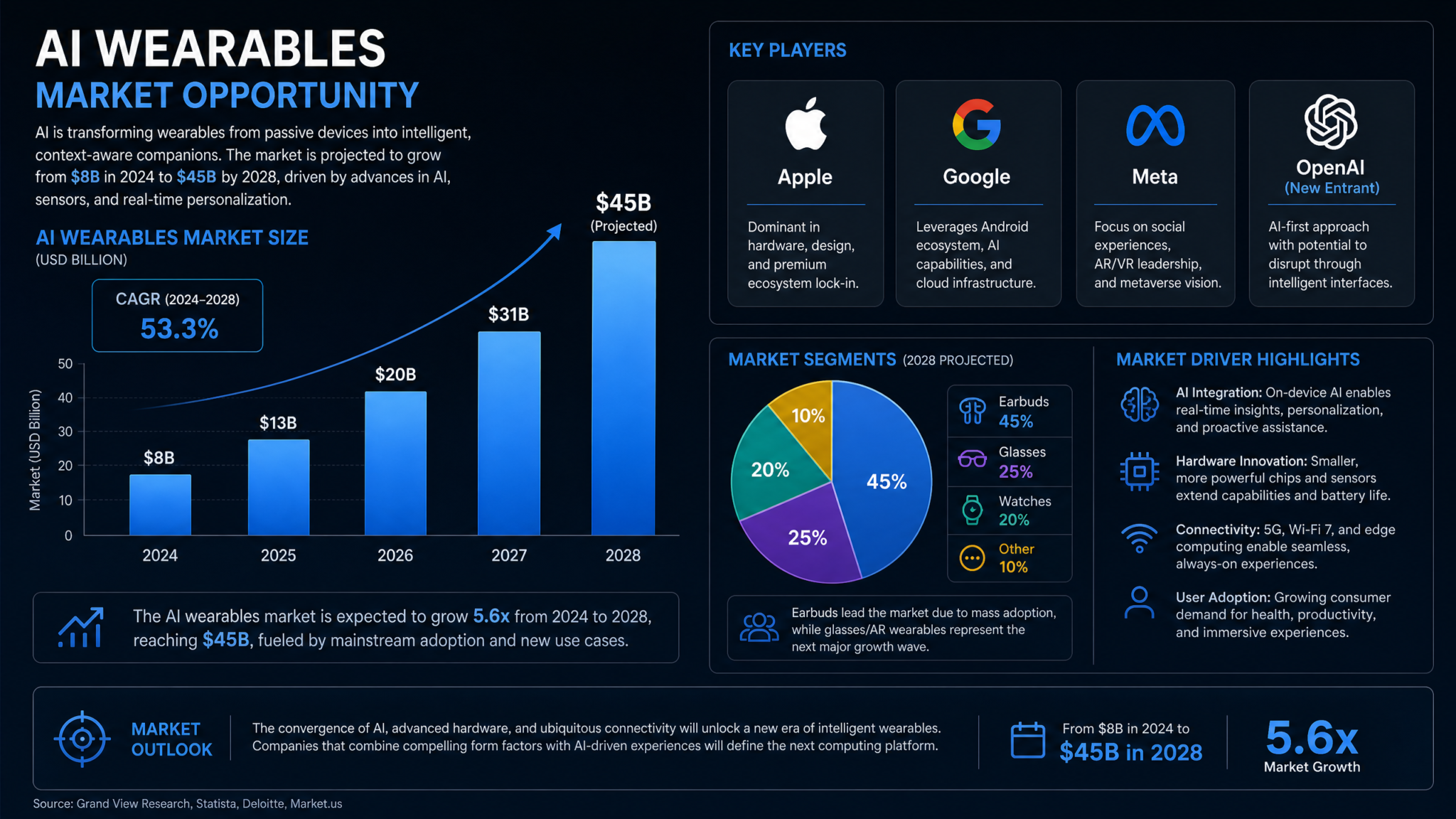
OpenAI is not entering a stagnant market. The intersection of AI and wearable technology represents one of the fastest-growing segments in consumer electronics, and the projections for where it is headed by 2028 explain why every major technology company is moving into this space simultaneously.
Market Size and Growth Projections
According to Grand View Research, the global AI wearables market was valued at approximately $15.7 billion in 2023. It is projected to reach $45.8 billion by 2028, representing a compound annual growth rate (CAGR) of approximately 24%. Within that broader market, AI-enhanced audio wearables (earbuds, hearing aids, headsets) represent the fastest-growing sub-segment, driven by:
- The normalization of premium wireless earbuds as everyday personal items
- Generational shift toward audio-first media consumption (podcasts, audiobooks, voice notes)
- Remote work permanence creating demand for professional audio tools
- Aging global demographics creating demand for AI-enhanced hearing assistance
- The demonstrated commercial success of Meta’s Ray-Ban glasses proving consumer appetite for AI wearables
The Enterprise Opportunity
Consumer unit economics are compelling, but the enterprise opportunity may be even larger. Corporate buyers will pay substantial premiums for AI earbuds that deliver demonstrable productivity improvements in meeting productivity, language accessibility, and real-time decision support. Enterprise deployments at scale — a financial services firm equipping 5,000 client-facing employees with AI-enhanced communication tools — represent a sales motion OpenAI already has experience with through its ChatGPT Enterprise offering.
The enterprise earbud market is currently served by niche players like Jabra (focused on call center applications) and Poly (focused on unified communications). Neither has a credible AI-first product strategy, and both are vulnerable to disruption from a company that can embed frontier AI directly into the device experience.
Hearing Health as a Stealth Market
One underappreciated market opportunity is hearing health. The FDA’s 2022 ruling allowing over-the-counter hearing aids in the United States opened a $3 billion market previously accessible only through audiologist visits. AI-enhanced earbuds with sophisticated audio processing capabilities overlap significantly with the feature set of modern hearing aids — selective amplification, background noise suppression, speech clarity enhancement — at a price point and distribution channel far more accessible than traditional hearing health channels.
If OpenAI’s earbuds include even basic personalized hearing enhancement features (and the rumored AI-enhanced audio pipeline is technically well-positioned to deliver them), the device competes in an entirely different economic context than “premium wireless earbuds.” The average hearing aid costs $2,000–$5,000 per unit. A $299 device that provides 80% of those benefits to the 48 million Americans with some degree of hearing loss is a genuinely disruptive proposition.
What This Means for OpenAI’s Business Model
The hardware launch, if executed well, transforms OpenAI’s business model in ways that extend far beyond the direct revenue from device sales. Understanding the full strategic logic requires looking at hardware not as a product category but as an infrastructure play.
Breaking Platform Dependency
OpenAI’s current distribution depends entirely on platforms it does not control. ChatGPT is distributed through Apple’s App Store and Google Play. ChatGPT’s voice interface depends on Apple’s microphone permissions framework and Apple’s Siri handoff protocols. Apple Intelligence is an active competitive threat in exactly the domains where ChatGPT is strongest. Google has every incentive to preference Gemini in Android’s default AI stack. Building hardware provides a direct relationship with users that does not route through Apple’s or Google’s platform gatekeeping.
This mirrors Amazon’s strategy with Echo devices — Amazon distributed Alexa through hardware to build a user relationship independent of Google Search and the iOS/Android duopoly. The parallel is imperfect (Echo relied on Amazon’s retail platform for distribution) but the strategic logic is identical.
Subscription Ecosystem Construction
Hardware is the most powerful mechanism for creating subscription lock-in because it ties a physical asset to a recurring software service. Once a user has paid $299 for an OpenAI device, they are highly motivated to maintain their subscription to access the full feature set they paid for. Churn rates for subscription services tied to hardware are consistently 30–50% lower than software-only subscriptions, according to Bain & Company analysis of subscription business models.
The device also creates a natural funnel for upselling. A free tier of AI earbud functionality (basic voice commands, limited translation) gets users into the ecosystem. The full AI feature set — ambient awareness, persistent memory, unlimited translation, meeting transcription — requires the premium subscription tier. This freemium-to-premium funnel within hardware is a proven model (Peloton, originally; Sonos with premium music service integration).
Data and Model Training Value
With explicit user consent, interaction data from AI earbuds represents extraordinarily valuable model training signal. The nuances of how people actually use conversational AI in real-world environments — the types of questions asked during meetings, the ambient contexts that trigger useful interventions, the translation errors that cause misunderstanding — are training signals that no lab-constructed dataset can fully replicate. This data flywheel provides a compounding competitive advantage that grows with device adoption, creating a virtuous cycle between user base and model quality.
OpenAI’s Path to Profitability
OpenAI reportedly lost significant amounts on a per-user basis at scale in 2023 and 2024 due to inference costs exceeding subscription revenue. Hardware changes that economics. Device margins (even modest 15–25% gross margins on a $299 device) are pure contribution to profit. Subscription revenue attached to hardware has lower churn. Enterprise contracts for device-plus-service bundles carry higher average contract values than software-only enterprise deals. The hardware launch is not peripheral to OpenAI’s path to sustainable profitability — it may be central to it.
Timeline, Release Window, and Availability Predictions
The “H2 2026” announcement window that has been most consistently reported across independent sources deserves scrutiny. What does that likely mean in practice, and what milestones should observers watch between now and then?
Development Timeline Reconstruction
If we work backward from a H2 2026 announcement — likely meaning a September or October 2026 reveal, the window favored by Apple for major hardware announcements — the development timeline is tight:
- 2023–2024: Initial concept development, LoveFrom design engagement, early-stage chip architecture decisions, competitive analysis
- Early 2025: Engineering validation prototype (EVT) builds — functional but not aesthetically final hardware for internal testing
- Mid-2025: Design validation prototype (DVT) builds — close to final industrial design, functional AI feature testing at prototype scale
- Late 2025–Early 2026: Production validation testing (PVT) — manufacturing ramp preparation, supply chain qualification, regulatory testing (FCC, CE, etc.)
- Mid-2026: Mass production initiation, inventory build for launch
- Q3/Q4 2026: Product announcement and launch
This timeline is aggressive but not impossible for a company that has committed the reported level of resources. First-generation Apple hardware products routinely followed 36–48 month development cycles; OpenAI, with access to Jony Ive’s established industrial design processes and mature contract manufacturing ecosystems that did not exist in the early iPhone era, may be able to execute more rapidly.
Risk Factors That Could Delay the Launch
Several factors could push the timeline into 2027:
- Custom chip yield issues: First-generation custom silicon in a new form factor carries higher-than-normal yield risk. If the NPU design requires revision, a 6–9 month delay is realistic.
- Battery life target failure: If the device cannot meet minimum acceptable battery life targets with the full AI feature set active, engineering work to address this could push the launch.
- Regulatory certification delays: FCC certification for a novel device category with always-on wireless transmission and multiple radio systems can take longer than planned.
- AI model readiness: GPT-5.6 Sol, the rumored earbud-optimized model, needs to be production-ready before the device ships. AI model development timelines are notoriously difficult to predict.
Geographic Launch Sequence
Based on OpenAI’s existing ChatGPT rollout patterns and the regulatory complexity described above, the most likely launch sequence is: United States first, followed within 90 days by Canada, United Kingdom, and Australia, followed within 6 months by the major Western European markets (pending GDPR compliance certification), with Asian market launches in 2027.
Final Analysis: Will This Change the AI Race?
The question of whether OpenAI’s earbuds will be transformative — for the company, for the category, and for the broader AI competitive landscape — ultimately comes down to execution quality. The strategic vision is coherent and well-timed. The market opportunity is real and large. The design pedigree is unambiguous. The AI capability foundation is the strongest of any potential competitor. But hardware is a different discipline from software, and the graveyard of ambitious tech hardware projects is crowded with companies that had equally compelling visions.
The Scenarios for Success and Failure
The success scenario looks like this: A beautifully designed, $279 device with 5–6 hours of full AI mode battery life launches in October 2026. Its ambient awareness features genuinely anticipate user needs in ways that feel magical rather than intrusive. The real-time translation is accurate enough to be trusted in professional settings. Meeting transcription works reliably across accents and environments. The companion app is elegant. ChatGPT’s 300 million existing users represent a pre-warmed audience, and 3–5 million units sell in the first year. The subscription bundle achieves 55%+ attachment rate. OpenAI establishes itself as a hardware company.
The failure scenario looks like this: Battery life in AI mode is 3 hours, which real-world users find insufficient. Ambient awareness features feel more like surveillance than assistance, triggering a privacy backlash. The device costs $349 at launch, above the psychological threshold where most non-professional users are willing to experiment. Manufacturing quality issues in the first production batch generate negative reviews. Apple quietly updates Siri’s capabilities in an iOS release that closes the feature gap. The device sells 800,000 units in year one, is revised significantly for year two, and the hardware strategy is quietly narrowed in scope.
The most likely outcome is somewhere between these poles — a device that is genuinely impressive in 2–3 feature areas, acceptable in others, and below expectations in one or two, with commercial performance that justifies continuation of the hardware strategy while revealing the significant product refinements needed for a successful second generation. This is, after all, exactly the pattern followed by the first AirPods, the first Apple Watch, and the first Meta Ray-Bans.
What is not in doubt is the strategic intention or the competitive stakes. When OpenAI announces its first hardware device — presumably in the fall of 2026 — it will mark a structural shift in the AI industry from a pure software competition to a hardware-plus-software competition where the company that owns the interface owns the relationship. That shift, more than any individual product feature, is what makes the OpenAI earbuds story one of the most consequential technology developments of the next two years.
OpenAI Business Model and Revenue Strategy Deep Dive
Key Facts Summary
| Category | Detail |
|---|---|
| Expected Announcement | H2 2026 (most likely Q3 2026) |
| Form Factor | True wireless earbuds |
| Key AI Feature | Always-on GPT-5.6 Sol with ambient awareness |
| Translation | Real-time in 40+ languages |
| Design Lead | Jony Ive / LoveFrom |
| Estimated Price | $249–$399 |
| Investment Scale | Reported up to $5B for hardware initiative |
| AI Wearables Market (2028) | $45.8 billion projected |
| Primary Competitors | AirPods Pro + Apple Intelligence, Pixel Buds Pro + Gemini |
| Subscription Model | Bundled ChatGPT subscription expected |
