

OpenAI and CrowdStrike move Codex security into the agent runtime
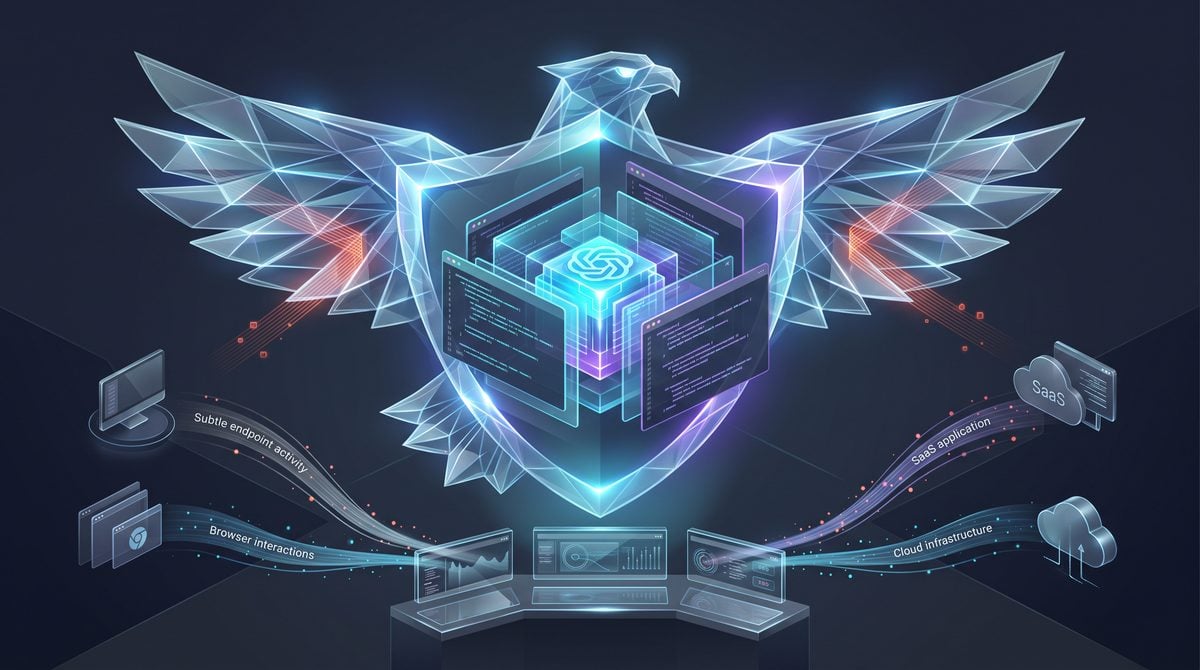
CrowdStrike announced on September 2, 2026 that its Falcon Guardian product will extend runtime AI detection and response to supported OpenAI Codex agents, adding a security layer intended to identify, monitor, and control agent activity while it is executing. The same announcement says OpenAI’s GPT-5.6 Cyber will be used within CrowdStrike’s FAIRR service for approved defensive assessments. The practical headline for enterprise teams is not simply that another security vendor is “supporting AI agents,” but that CrowdStrike is positioning Falcon Guardian as a runtime control plane for supported Codex agents rather than as ordinary endpoint monitoring alone.
According to CrowdStrike, the Falcon Guardian capabilities announced for supported Codex agents include discovering those agents across an organization, mapping who deployed them, identifying what they can access, evaluating their security status, correlating agent actions with Falcon telemetry, detecting compromised or unauthorized behavior, responding before activity spreads, and translating governance policy into enforceable runtime controls. Those are partnership claims from CrowdStrike’s release, not independent benchmark results, and organizations should treat them as product capabilities that still depend on availability, supported environments, policy configuration, and operational integration.
OpenAI’s companion security posture for Codex remains centered on prevention and containment: sandbox boundaries, approval policies, managed network access, protected identity and credentials, command rules, managed configuration, OpenTelemetry export, and Enterprise or Edu compliance logs. OpenAI describes the objective as allowing low-risk work to proceed inside bounded environments while stopping higher-risk actions for review. The new CrowdStrike announcement therefore fits into a layered model: OpenAI’s Codex controls shape what an agent is allowed to do, while CrowdStrike says Falcon Guardian adds runtime discovery, detection, response, telemetry correlation, and enforceable controls while supported agents are operating.
That distinction matters because Codex agents are not just another process on a laptop. A development agent may read repository context, run commands, open a browser, call tools, request approvals, interact with files, and produce code changes as part of one task. Traditional endpoint telemetry can observe many underlying events, such as process creation, network connections, file writes, browser activity, and user identity. Runtime agent visibility asks a different question: which agent initiated the action, who deployed or authorized it, what resources it was permitted to access, which policy applied at the time, and whether the observed sequence matches authorized agent behavior.
For security teams, the operational shift is from “did a binary execute?” to “did this agent, acting under this user and policy context, perform an authorized step inside its expected task boundary?” That does not make endpoint telemetry obsolete. It makes endpoint telemetry one input into a richer agent-security timeline. CrowdStrike’s announcement specifically emphasizes correlation with Falcon telemetry, which implies that the value is in joining agent context with existing detection-and-response signals rather than treating AI-agent events as a separate audit island.
For Codex Enterprise Security Alerts, How AI Coding Agents Are Triggering Enterprise Security Alerts: What IT Teams Need to Know About Claude Code, Codex, and Cursor is the most relevant adjacent resource. The enterprise security-alert analysis explains why normal coding-agent behaviors can resemble endpoint threats and how IT teams can distinguish legitimate activity from policy violations.
What CrowdStrike says Falcon Guardian will add for supported Codex agents
CrowdStrike’s announcement uses the phrase “supported Codex agents,” which is an important boundary. The release should not be read as universal coverage for every Codex deployment pattern, every local tool, every browser action, or every future agent surface. Enterprises evaluating the partnership should ask which Codex agent types, operating environments, identity models, telemetry paths, and enforcement actions are supported in their own deployment before designing incident-response workflows around the integration.
| Announced area | What CrowdStrike attributes to Falcon Guardian | Operational interpretation for security teams |
|---|---|---|
| Discovery | Discover supported Codex agents across an organization. | Security teams can move from manually asking teams where agents are used toward an inventory model, subject to supported deployment coverage. |
| Ownership and access mapping | Map who deployed agents, what they access, and their security status. | Agent activity can be assessed against the deploying user, workspace policy, repository access, and other organizational context rather than only host-level events. |
| Telemetry correlation | Correlate agent actions with Falcon telemetry. | Agent events can be compared with process, endpoint, identity, network, or workload signals already observed by Falcon, depending on the organization’s instrumentation. |
| Unauthorized-behavior detection | Detect compromised or unauthorized behavior. | Detection logic can evaluate whether agent behavior is inconsistent with policy or expected use, but organizations should validate detection coverage for their workflows. |
| Response and control | Respond before activity spreads and translate governance policy into enforceable runtime controls. | Runtime response should be designed as a governed security action, not assumed to be autonomous remediation without administrator-defined policies and procedures. |
The strongest near-term use case is likely inventory and context. Many enterprises already know how to monitor laptops, servers, cloud workloads, and SaaS access, but agent adoption can grow through developer teams, automation experiments, and local productivity workflows. If a supported Codex agent can be tied to a deploying user, permitted resources, security status, and endpoint signals, responders get a clearer starting point for triage: whether the activity came from an expected automation path, a misconfigured agent, a compromised credential path, or an unauthorized deployment.
The risk is over-reading the announcement as a complete AI-agent safety guarantee. CrowdStrike did not announce that Falcon Guardian replaces Codex sandboxing, approval prompts, workspace administration, repository permissions, or operating-system controls. It also did not claim that every unsafe agent action can be predicted before execution. Runtime visibility and response are powerful only when paired with preventive controls, least-privilege access, high-quality telemetry, incident playbooks, and human review for actions that materially affect code, credentials, production systems, customer data, or regulated information.
How OpenAI’s Codex controls fit underneath the runtime layer
OpenAI’s “Running Codex safely” guidance frames Codex security around bounded execution. In that model, sandboxing limits the environment available to the agent, approval policies determine when user review is required, managed network access constrains connectivity, protected identity and credentials reduce exposure, command rules shape what can run, and telemetry or compliance logs provide records for administrators. These controls are preventive and administrative: they define the walls, gates, and records around the agent’s work.
OpenAI’s managed-configuration documentation adds more detail for enterprise administrators. It distinguishes administrator-enforced requirements from managed defaults. Requirements constrain security-sensitive runtime settings and cannot be weakened by users; managed defaults are initial values that users may change during a run, with the client reapplying them at restart. The policy stack can include system requirements, cloud-managed requirements, legacy managed configuration, and macOS managed preferences, with higher-precedence sources taking priority according to documented merge behavior.
For browser use, OpenAI documents administrator controls for website defaults and per-origin exceptions; uploads and downloads; browser-history access; persistent approval; full Chrome DevTools Protocol access; automatic review; and approval lifetimes. For native computer use, administrators can deny applications by default and allow approved macOS bundle identifiers or verified Windows application identities. OpenAI also documents feature pins for browser use, in-app browser, external browser use, full CDP access, and computer use. Allow rules do not install software, grant operating-system permissions, or bypass separate review requirements.
These preventive controls answer questions such as “May Codex access this site?”, “May it download a file?”, “May it use this native application?”, and “How long does an approval remain valid?” Falcon Guardian’s announced runtime layer addresses a later and broader question: “What is this supported Codex agent actually doing now, how does that activity relate to security telemetry, and should runtime policy or response intervene?” The two layers are complementary because a denied action is best stopped by policy before it happens, while suspicious allowed activity still needs monitoring, correlation, and investigation.
Operational read: Treat Codex managed configuration as the preventive baseline and Falcon Guardian, where available and supported, as a runtime detection-and-response layer. Do not weaken sandbox, approval, browser, network, or native-app restrictions because a runtime security product is present.
Why ordinary endpoint telemetry is not enough for agent security
Endpoint detection and response tools are designed to observe host activity, and that remains essential. If an agent invokes a shell, launches a browser, writes files, or triggers network traffic, endpoint telemetry may capture the underlying events. The gap is that endpoint telemetry alone may not explain the agentic context: the task objective, the agent identity, the approval state, the configured policy, the resource scope, or the relationship between a sequence of steps and the user’s instruction.
Consider a developer-approved task that asks Codex to inspect a repository and propose a fix. A normal execution path might include reading source files, running tests, installing dependencies, and writing a patch. A suspicious path might include reading unrelated credential files, uploading artifacts to an unapproved origin, opening a browser session to an unexpected site, or invoking a native application outside policy. Endpoint telemetry can help show that those actions occurred, but agent runtime visibility is needed to connect the actions to the Codex agent, its deployment context, its permitted access, and its policy boundary.
This is also why “agent inventory” is different from software inventory. A software inventory asks which applications are installed or running. An agent inventory must also ask who deployed the agent, what workspace or project it belongs to, what repositories or tools it can reach, which approvals it has obtained, what policy profile applies, and whether its behavior is consistent with the assigned task. CrowdStrike’s announcement specifically calls out mapping who deployed supported Codex agents and what they access, which is the kind of context ordinary process lists cannot provide by themselves.
For enterprise administrators, the practical control objective is layered accountability. A user should not be able to bypass workspace policy by moving work into an agent. An agent should not gain operating-system access merely because a site or application was allowed in configuration. A security team should not need to reconstruct agent activity solely from raw endpoint events after an incident. The desired state is a chain of evidence that includes user, agent, policy, approval, resource, runtime behavior, and response action.
For GPT-5.6 Cyber Defense, GPT-5.5-Cyber: Inside OpenAI’s Advanced AI Model for Cybersecurity Professionals is the most relevant adjacent resource. The GPT-5.5-Cyber guide documents specialized defensive capabilities and trusted-access boundaries, providing a useful model-layer counterpart to Falcon Guardian runtime controls.
GPT-5.6 Cyber inside CrowdStrike FAIRR: defensive assessment, not unsupervised offense
CrowdStrike also announced that GPT-5.6 Cyber will be applied within CrowdStrike FAIRR for approved defensive assessments. CrowdStrike describes that use in the context of adversary intelligence, structured threat modeling, exploit validation, expert oversight, and remediation prioritization. The important qualifier is “approved defensive assessments.” This is not a claim that GPT-5.6 Cyber replaces human security teams, authorizes unsupervised testing, or removes the need for scoping, legal approval, asset ownership verification, and change-control discipline.
For CISOs and application-security leaders, the FAIRR element points to a second side of the partnership: using a cyber-focused model to improve defensive analysis under expert supervision. In a mature program, that could mean helping organize threat models, reason through exploitability, prioritize remediation, or validate whether a finding is meaningful within a controlled assessment. CrowdStrike’s announcement ties this to its own service model and oversight, so buyers should evaluate it as part of a governed assessment workflow rather than as a general-purpose permission to run offensive automation.
Founders and security-conscious engineering leaders should translate the announcement into procurement questions. Which assessments are in scope? Who approves them? What evidence is retained? How are exploit-validation activities controlled? How are remediation priorities produced and reviewed? Which systems are excluded? How does the engagement handle customer data, credentials, production boundaries, and third-party systems? Those questions are not signs of skepticism about AI security tooling; they are the minimum controls required when any assessment capability touches real environments.
What enterprises should do next
Recommendation: Start by separating preventive policy, runtime detection, and assessment workflows in your internal architecture. Preventive Codex policy should define allowed browser origins, upload and download behavior, approval lifetimes, native-application access, network boundaries, command rules, identity handling, and logging. Runtime detection should determine how supported Codex agent actions are discovered, correlated, triaged, and responded to. Defensive assessment workflows should define authorization, scope, oversight, evidence handling, and remediation ownership before GPT-5.6 Cyber or any similar capability is used in a security review.
Implementation checklist: Inventory where Codex is used; identify which deployments are supported by the announced Falcon Guardian coverage; compare OpenAI managed-configuration requirements against current workspace and endpoint controls; define high-risk agent behaviors that must trigger review; document who can approve runtime response actions; and require evidence that agent events can be correlated with endpoint, identity, repository, SaaS, and network telemetry where relevant. Teams should validate each assumption in a controlled environment rather than assuming that partnership language automatically maps to their fleet.
Operational warning: Do not collapse “visibility” into “permission.” Discovering an agent does not mean it is safely configured. Correlating telemetry does not mean every malicious sequence will be blocked. Allowing a browser origin or native application in Codex configuration does not grant operating-system permissions or bypass separate approval prompts. Using GPT-5.6 Cyber inside an approved service workflow does not remove the need for expert oversight, explicit authorization, or remediation accountability.
The partnership is significant because it acknowledges a real enterprise security gap: agentic development tools need controls that understand agent execution, not just device state. The measured response for security teams is to keep Codex’s preventive safeguards intact, evaluate Falcon Guardian’s announced runtime capabilities against supported environments, and place GPT-5.6 Cyber-enabled assessment work inside formal defensive governance. That layered approach is the difference between adopting agent security as a press-release feature and operating it as an enterprise control system.
Capability map: from agent discovery to enforceable runtime controls

CrowdStrike’s announcement describes Falcon Guardian as extending runtime AI detection and response to supported Codex agents, which is a different control layer from OpenAI’s local Codex safeguards. OpenAI’s published Codex safety approach focuses on keeping agent activity inside bounded environments through sandboxing, approval policies, managed network access, protected identity and credential handling, command rules, managed configuration, OpenTelemetry export, and Enterprise or Edu compliance logs. Falcon Guardian is positioned by CrowdStrike as the runtime security layer that discovers supported agents, maps what they can reach, correlates their actions with Falcon telemetry, detects compromised or unauthorized behavior, and supports response before activity spreads.
The practical security question is not whether one layer “replaces” the other. Preventive controls shape what a Codex agent is allowed to attempt; runtime controls watch what actually happens during execution and help security teams decide whether activity is expected, unauthorized, compromised, or policy-violating. That distinction matters for enterprise administrators because a browser allow rule, application allow rule, approval setting, or sandbox boundary can reduce the attack surface, but it does not by itself produce a complete inventory of supported agents across an organization or correlate agent behavior with endpoint and identity signals from another security platform.
Discovery and inventory: finding supported Codex agents before they become blind spots
CrowdStrike says Falcon Guardian will discover supported Codex agents across an organization. In operational terms, discovery is the first dependency for every other capability: security teams cannot assign ownership, assess access, investigate behavior, or enforce runtime policy against agent activity they do not know exists. For a developer platform team, the immediate value is a current inventory of where supported Codex agents are active, which teams are using them, and whether their deployment state matches the organization’s approved operating model.
Inventory should be treated as a control objective rather than a dashboard nicety. A useful enterprise inventory needs to support questions such as: which repositories, endpoints, workspaces, or execution contexts are associated with the agent; which user or service identity initiated or deployed it; whether it is running under an approved configuration; and whether its access pattern has changed since the last review. CrowdStrike’s announcement specifically references mapping who deployed agents, what they access, and their security status, so administrators should evaluate the capability against those concrete inventory fields rather than assuming a generic asset list will be sufficient.
Recommended operational workflow: reconcile Falcon Guardian’s supported-agent inventory with workspace administration records, endpoint management records, source-control ownership, and any Codex managed-configuration deployment evidence. If an agent appears in runtime discovery but has no clear business owner, no associated repository owner, or no approved policy baseline, treat it as an exception requiring triage rather than waiting for suspicious behavior. The goal is to turn “agent sprawl” into accountable assets with owners, approved scopes, and reviewable security status.
Identity and access mapping: understanding who deployed the agent and what it can reach
CrowdStrike’s stated mapping of who deployed supported Codex agents and what they access directly addresses one of the hardest parts of agent security: the difference between a human user’s authorization and an agent’s effective operating reach. A developer may have legitimate access to repositories, package registries, internal documentation, and test infrastructure, but an agent acting through that user’s context can combine those resources at machine speed. Identity mapping therefore needs to answer both “who is accountable” and “what effective privileges are available during the run.”
OpenAI’s Codex safety materials emphasize protected identity and credentials as part of safe operation, while the managed-configuration documentation distinguishes administrator-enforced requirements from managed defaults. Requirements constrain security-sensitive runtime settings and cannot be weakened by users; managed defaults are initial values users may change during a run and that the client reapplies at restart. Security teams should use that distinction when interpreting access posture: a setting that is only a default is not equivalent to an enforced access boundary, and an allow rule does not grant operating-system permissions, install software, or bypass separate approvals.
A practical access review should include the agent’s source-control scope, browser origins it can reach, native applications it can use, upload and download permissions, approval lifetimes, access to browser history, developer tooling access, and whether automatic review or persistent approvals are available. OpenAI’s managed-configuration documentation says administrators can define default and per-origin browser policies, deny uploads or allow downloads, disable browser-history access, persistent approval, full Chrome DevTools Protocol access, or automatic review, and control native computer use by allowing approved macOS bundle identifiers or verified Windows application identities. Those preventive settings provide the policy context Falcon Guardian’s runtime observations can be compared against.
Runtime telemetry correlation: connecting agent actions to endpoint and security events
CrowdStrike says Falcon Guardian will correlate agent actions with Falcon telemetry. This is the capability that turns isolated agent logs into security evidence. A Codex run may include file edits, shell commands, browser navigation, repository operations, package installation, test execution, or application interaction, while endpoint telemetry may show process creation, network connections, file writes, credential access attempts, or suspicious child processes. Correlation helps investigators determine whether an agent action was routine development work, a misconfigured workflow, or part of a broader compromise.
OpenAI’s Codex safety approach includes OpenTelemetry export and Enterprise or Edu compliance logs, which can help organizations retain execution evidence and review higher-risk actions. Falcon Guardian’s announced correlation layer should be evaluated as a complementary detection-and-response view, not as a substitute for retaining Codex-side audit evidence. The best architecture is layered: Codex controls shape and record the agent’s local behavior, workspace policies constrain who can use what, and Falcon telemetry supplies cross-environment security context that may reveal consequences beyond the agent runtime itself.
For AI Agent Runtime Monitoring, How to Embed Codex in an Internal Operations Dashboard with App-Server, MCP Tools, Streaming, and Human Approvals is the most relevant adjacent resource. The Codex operations-dashboard tutorial shows how streaming events, tool activity, and approvals can be surfaced for operators, which is the observability foundation required for agent-aware runtime monitoring.
Detection: compromised behavior versus unauthorized behavior
CrowdStrike’s announcement refers to detecting compromised or unauthorized behavior. These are related but operationally distinct categories, and incident responders should not collapse them into a single “bad agent” label. Compromised behavior suggests that an attacker, malicious instruction, poisoned input, credential exposure, or hostile environment has influenced the agent or its execution path. Unauthorized behavior means the activity may be technically possible but outside policy, ownership, approval, or business scope.
A compromised-behavior investigation should look for signs that the agent’s actions diverged from the user’s stated task or from the expected repository workflow. Examples include unexpected attempts to access credentials, invoke unusual binaries, alter security controls, exfiltrate files, connect to unfamiliar infrastructure, or modify build and deployment scripts outside the change request. OpenAI’s own safety framing emphasizes that low-risk actions should proceed inside bounded environments while higher-risk actions are stopped for review; runtime detection adds a second opportunity to catch cases where the observed behavior no longer matches the approved task or environment.
An unauthorized-behavior investigation should focus on policy alignment even when there is no evidence of external compromise. Examples include an agent using an unapproved browser origin, interacting with a native app outside the allow list, downloading files where downloads should be blocked, retaining approvals longer than policy allows, or working against a repository that lacks an approved owner. OpenAI’s managed-configuration documentation is relevant here because it defines how administrator-enforced requirements and managed defaults behave; a violation of a requirement is more serious than a user changing a managed default that the organization intentionally allowed to be mutable.
Response: stopping spread without assuming autonomous remediation
CrowdStrike says Falcon Guardian will help respond before activity spreads. That claim should be interpreted as a runtime detection-and-response capability, not as a blanket promise of autonomous remediation in every environment. The appropriate response action depends on integration details, policy configuration, severity, asset criticality, and whether the event indicates compromise, misuse, or misconfiguration. Enterprises should define response playbooks before broad deployment so the security operations center is not inventing containment rules during the first agent incident.
Recommended response tiers: first, alert and enrich when activity is anomalous but not clearly harmful; second, pause or restrict the agent session when behavior conflicts with policy or approval scope; third, isolate the affected endpoint or execution context when telemetry indicates compromise; fourth, revoke or rotate credentials if credential access or exposure is suspected; fifth, open a repository or change-management review if the agent modified code, build logic, deployment files, or security-sensitive configuration. These tiers should be mapped to the organization’s existing incident response authority so developer productivity incidents and security incidents are routed differently.
Security teams should also define evidence preservation requirements. If an agent action leads to a suspicious code change, incident responders need the prompt or task context where available, relevant Codex logs, approval records, command history, file diffs, endpoint telemetry, network indicators, identity events, and repository audit trails. If a response action terminates a session or isolates a device, the team should know whether that action preserves enough forensic context to reconstruct the event. Without that planning, an aggressive containment move can stop spread but erase the facts needed for root-cause analysis.
Runtime policy enforcement: translating governance into controls that execute
CrowdStrike says the partnership will translate governance policy into enforceable runtime controls. The important word is “runtime.” Governance documents often say agents may only use approved repositories, approved identities, approved browser destinations, approved applications, and approved data classes, but those statements only become operational controls when they are represented in systems that can evaluate activity as it happens. Falcon Guardian’s announced role is to bring runtime enforcement to supported Codex agent activity, while OpenAI’s managed configuration provides preventive controls inside the Codex operating model.
Administrators should avoid writing vague policies such as “AI agents must not access sensitive systems” unless they can turn that statement into concrete enforcement logic. Better policy inputs are origin allow and deny rules, upload and download restrictions, approval-duration limits, browser-history access settings, full DevTools Protocol restrictions, automatic-review requirements, application allow lists, repository scope rules, and ownership requirements. OpenAI’s managed-configuration documentation also warns through its behavior model that allow rules do not override other policies or approval prompts, which means runtime enforcement should be evaluated alongside—not above—the local policy stack.
A strong deployment pattern is to start with high-confidence policies that have low ambiguity: deny unapproved native applications by default, allow only verified business-required applications, restrict browser origins to approved development and documentation domains, deny uploads where data-loss risk is high, disable persistent approvals for sensitive workflows, and require explicit review for actions that cross repository, network, or identity boundaries. Falcon Guardian’s runtime layer can then be assessed on whether it detects and responds when supported agents attempt activity outside those boundaries.
| Announcement claim | Operational question to ask before relying on it | Evidence or decision rule to require |
|---|---|---|
| Discover supported Codex agents across the organization | Which Codex agents, endpoints, workspaces, and execution contexts are covered in our environment? | Compare the discovered inventory with endpoint management, workspace administration, repository ownership, and known pilot deployments. |
| Map who deployed agents and what they access | Does the map show accountable owners, effective permissions, repository scope, browser origins, native applications, and security status? | Require owner, identity, access-scope, and policy-state fields before treating the inventory as production governance evidence. |
| Correlate agent actions with Falcon telemetry | Which agent actions are correlated with process, network, file, identity, and endpoint events? | Run approved defensive tests that generate benign but reviewable events, then verify that timelines preserve task context and endpoint impact. |
| Detect compromised or unauthorized behavior | How does the detection distinguish malicious compromise from policy drift, user error, or an approved high-risk action? | Define severity classes for compromise indicators, policy violations, approval failures, and suspicious-but-explained development activity. |
| Respond before activity spreads | What response actions are available, who approves them, and what forensic evidence is preserved? | Document alert-only, session restriction, endpoint isolation, credential rotation, and repository review paths with named owners. |
| Translate governance policy into enforceable runtime controls | Can our governance statements be expressed as concrete runtime rules without blocking legitimate engineering work? | Convert policies into origins, applications, repositories, approval durations, upload/download rules, and exception workflows. |
| Use GPT-5.6 Cyber within CrowdStrike FAIRR | How are model-assisted findings validated by experts before remediation is prioritized? | Require documented threat model, exploit-validation evidence, expert review, business impact, and remediation owner for each finding. |
FAIRR and GPT-5.6 Cyber: model assistance inside a governed assessment service
CrowdStrike also says the partnership applies GPT-5.6 Cyber within its FAIRR service for approved defensive assessments. The important constraint is that this is described as part of a service combining adversary intelligence, structured threat modeling, exploit validation, expert oversight, and remediation prioritization. That combination matters because cyber model output without validation can produce noisy hypotheses, while exploit validation without prioritization can overwhelm teams with findings that are technically interesting but not operationally urgent.
Threat intelligence supplies the attacker context: which techniques, targets, tooling patterns, and exploit paths are plausible against the customer’s environment. Structured threat modeling turns that context into a disciplined assessment of assets, trust boundaries, entry points, assumptions, and failure modes. GPT-5.6 Cyber can assist within that process, according to CrowdStrike’s announcement, but the service description does not support treating the model as an unsupervised offensive operator or as a replacement for human assessment judgment.
Exploit validation is the step that separates a theoretical weakness from a demonstrated risk under approved defensive conditions. In a Codex-agent context, validation could involve confirming that a misconfiguration, overbroad access path, or unsafe workflow can actually be exercised in the assessed environment, subject to the customer’s authorization and rules of engagement. Expert oversight is essential because validation must avoid unnecessary disruption, respect scope, and distinguish exploitable security risk from harmless configuration variance.
Remediation prioritization is where FAIRR’s value should become measurable to the customer’s security and engineering leaders. A validated issue should be ranked by potential business impact, exploitability, affected assets, compensating controls, and remediation effort. For agent security, the highest-priority fixes are often not abstract model changes but concrete control improvements: narrowing access scope, hardening managed requirements, disabling unnecessary persistent approvals, reducing browser or application reach, rotating exposed credentials, or adding runtime response rules for repeatable indicators.
Operational recommendation: treat FAIRR output as an input to a remediation program with accountable owners, due dates, validation evidence, and retesting criteria. Do not treat a model-assisted assessment as proof that all agent risk has been eliminated.
How to evaluate the combined control stack
Enterprises evaluating the OpenAI and CrowdStrike announcement should build a control map rather than a product checklist. The first column should list Codex preventive controls: sandbox settings, approval policies, managed network access, credential protections, command rules, managed browser and native-app requirements, and telemetry export. The second column should list runtime detection and response controls attributed to Falcon Guardian: supported-agent discovery, ownership and access mapping, telemetry correlation, compromised or unauthorized behavior detection, response, and runtime enforcement. The third column should list assessment activities associated with FAIRR: threat intelligence, threat modeling, exploit validation, expert review, and remediation ranking.
The decision rule is straightforward: a production rollout is stronger when each high-risk agent workflow has a preventive boundary, a runtime detector, an incident response path, and a remediation feedback loop. If any one of those is missing, document the residual risk and choose whether to block the workflow, narrow its scope, or accept the risk temporarily with executive approval. This keeps the announcement grounded in operational security: CrowdStrike has described new runtime capabilities for supported Codex agents, OpenAI documents preventive Codex controls, and customers still have to configure, test, monitor, and govern the combined system in their own environments.
Layered control model: preventive Codex policy plus runtime agent defense

The practical security question is not whether OpenAI’s Codex controls or CrowdStrike’s Falcon Guardian layer is “the” control point. The safer model is layered: OpenAI documents preventive controls that constrain what Codex can do before and during execution, while CrowdStrike says Falcon Guardian will add discovery, telemetry correlation, behavior detection, response, and enforceable runtime controls for supported Codex agents. Treating those layers as substitutes creates a gap: preventive settings may stop many unsafe actions, but they do not by themselves provide the same organization-wide runtime discovery and detection posture described in CrowdStrike’s announcement.
OpenAI’s Codex safety documentation frames the goal as allowing low-risk work to proceed inside bounded environments while stopping higher-risk actions for review. That model depends on sandboxing, approval gates, managed network access, protected identity and credentials, command rules, managed configuration, OpenTelemetry export, and Enterprise or Edu compliance logs. CrowdStrike’s announcement sits above and beside those controls: Falcon Guardian is described as identifying supported Codex agents, mapping who deployed them and what they access, correlating agent actions with Falcon telemetry, detecting compromised or unauthorized behavior, and responding before activity spreads.
The important implementation boundary is that the announcement does not document a universal integration contract, a public event schema, or an automatic remediation workflow that every Codex deployment inherits. Enterprises should therefore design a control stack that works even when each layer is configured, tested, and evidenced separately. A Codex approval rule, a managed browser restriction, an OpenTelemetry export, a Falcon detection, and an incident-response action may all describe the same security event, but teams should not assume they are the same mechanism.
Control stack map: which layer answers which security question?
| Security question | OpenAI-documented preventive or evidence control | CrowdStrike-announced runtime role | Operational warning |
|---|---|---|---|
| Can the agent modify local files, run tools, or access the project environment? | OpenAI describes sandbox boundaries and approval policies as part of Codex’s safety model for containing execution and requiring review for higher-risk actions. | CrowdStrike says Falcon Guardian will extend runtime AI detection and response to supported Codex agents and correlate agent activity with Falcon telemetry. | Do not treat runtime detection as a replacement for sandbox design. A weak sandbox increases the amount of activity that downstream detection must notice and contain. |
| Can the agent reach a website, service, or network destination? | OpenAI documents managed network access and enterprise managed configuration controls, including browser defaults and per-origin exceptions. | CrowdStrike says Falcon Guardian will map what supported Codex agents access and translate governance policy into enforceable runtime controls. | An allow rule in managed configuration should not be interpreted as blanket authorization; OpenAI states allow rules do not override other policies or approval prompts. |
| Can the agent use browser or native-app computer use? | OpenAI’s managed-configuration documentation lets administrators constrain browser and native-app use, including uploads, downloads, history access, full Chrome DevTools Protocol access, approval persistence, and specific macOS or Windows applications. | CrowdStrike’s announcement describes runtime discovery, security-status mapping, and detection of unauthorized or compromised behavior for supported Codex agents. | Native-app allow lists do not install software, grant operating-system permissions, or bypass other review requirements. They only define what the managed policy permits. |
| Can the agent obtain or expose secrets? | OpenAI describes protected identity and credential handling as part of running Codex safely, with higher-risk actions subject to boundaries and review. | CrowdStrike says Falcon Guardian will correlate agent actions with Falcon telemetry and detect compromised or unauthorized behavior. | Credential storage controls and runtime detection address different failure modes. A runtime alert after a secret is touched is not equivalent to preventing the agent from receiving the secret in the first place. |
| Who owns the action and what workspace policy applied? | OpenAI points to workspace identity, rules, managed configuration, OpenTelemetry export, and Enterprise/Edu compliance logs as governance and evidence mechanisms. | CrowdStrike says Falcon Guardian will map who deployed supported Codex agents, what they access, and their security status. | Identity correlation must be validated in the customer environment. Do not assume that a username, endpoint account, repository identity, and workspace identity are automatically equivalent across tools. |
This matrix is the safest way to brief security leadership because it separates prevention, detection, and evidence. A sandbox answers “what can execute here?” An approval prompt answers “which action needs human review?” A managed network policy answers “which destinations are allowed by policy?” OpenTelemetry and compliance logs answer “what evidence can be exported or audited?” Falcon Guardian, as announced by CrowdStrike, answers a different class of questions: “where are supported agents running, what are they doing at runtime, and when should security operations intervene?”
Preventive controls: configure the blast radius before an agent starts work
OpenAI’s preventive model starts with bounded execution. For developer workflows, that means administrators and users should treat the Codex environment as a controlled workspace rather than as an unrestricted extension of the developer’s laptop, cloud account, or production network. Sandboxing is valuable because it limits the filesystem, tool, and process context in which a model-driven action can occur. Approval policies are valuable because they place human review in front of higher-risk operations instead of relying on post-event investigation.
Network policy is the next boundary. If an agent can browse, fetch dependencies, call APIs, or interact with web applications, the organization needs a rule for default access and exceptions. OpenAI’s managed-configuration documentation supports browser defaults and per-origin access policies, and the September 2026 release notes describe more granular controls over supported browser and native-app computer use. A practical baseline is default-deny for sensitive environments, explicit exceptions for approved repositories and documentation, and separate review for destinations that can receive uploaded code, logs, customer data, or credentials.
Credential storage must be handled as a first-class control rather than an implementation detail. The safest operational rule is to avoid placing long-lived production secrets in any agent-accessible environment unless the business has documented why the agent needs them, what approval is required, what logs prove use, and how revocation works. OpenAI’s safety materials refer to protected identity and credentials; security teams should translate that into concrete internal requirements such as short-lived tokens where available, least-privilege service accounts, separate development and production credentials, and tested emergency revocation steps.
Workspace identity connects Codex activity to the enterprise governance plane. If the agent is acting on behalf of a user, team, repository, or workspace, the organization needs to know which policy source applied and which human is accountable for approvals. OpenAI’s managed-configuration documentation distinguishes administrator-enforced requirements from managed defaults. Requirements constrain security-sensitive settings and cannot be weakened by users, while managed defaults are initial values that users may change during a run and that the client reapplies at restart. That distinction matters in investigations because a user-adjustable default is not the same evidence as an administrator-enforced requirement.
Command rules and managed configuration should be reviewed together. A command rule may constrain shell behavior or require approval for a risky action, while managed configuration may constrain browser use, native application access, downloads, uploads, browser-history access, persistent approval, full Chrome DevTools Protocol access, or automatic review. The correct design pattern is to make the most dangerous route hard at multiple layers: block unnecessary applications, require approvals for sensitive commands, restrict network destinations, and keep audit evidence for any exception.
For Codex Sandboxing and Approvals, How GPT-5.5 Powers OpenAI Codex: Architecture, Sandboxing, and Real-World Agent Workflows is the most relevant adjacent resource. The GPT-5.5 Codex architecture guide explains sandboxing, approval gates, and agent execution boundaries, clarifying which risks should be prevented before runtime detection is needed.
Telemetry and logs: evidence is not the same as enforcement
OpenAI documents OpenTelemetry export and Enterprise/Edu compliance logs as part of the Codex safety and governance picture. Those controls are essential for audits, incident reconstruction, and security analytics, but teams should not describe them as automatic blocking mechanisms unless the relevant product documentation says so for a specific control. OpenTelemetry is an evidence and observability pathway; compliance logs are an administrative record. They become enforcement only when a configured policy or response workflow takes action based on them.
This distinction matters during procurement and architecture reviews. A security architect should ask three separate questions: first, what policy prevents an unsafe action before it happens; second, what runtime system detects behavior that still occurs; third, what log or telemetry record proves the action, policy decision, and human approval. Mixing those questions produces weak designs, such as relying on logs to prevent exfiltration or relying on an approval prompt to provide enterprise-wide agent inventory.
Operational warning: Do not promise that a Codex event will automatically appear in a Falcon workflow, trigger a specific containment action, or map to a particular user field unless that behavior is documented and validated in your environment. CrowdStrike has announced runtime AI detection and response capabilities for supported Codex agents, but the exact customer implementation should be tested rather than inferred.
Runtime layer: what the CrowdStrike announcement adds to the model
CrowdStrike’s announcement is significant because it addresses the runtime visibility problem that preventive controls alone do not solve. Security operations teams need to know where supported agents exist, who deployed them, what they can access, whether their posture is acceptable, and whether their runtime behavior looks unauthorized or compromised. CrowdStrike says Falcon Guardian will provide discovery, mapping, telemetry correlation, detection, response, and policy enforcement for supported Codex agents. Those are security-operations functions, not merely developer-experience settings.
The “supported Codex agents” qualifier is important. It prevents over-reading the announcement as blanket coverage for every script, model wrapper, local automation, browser session, or third-party agent a developer might run. Inventory should therefore include both positively discovered supported agents and a separate search for unsanctioned agentic tooling. A mature enterprise program will compare Falcon Guardian discovery results with endpoint inventory, software asset management, identity logs, repository activity, and workspace administration records to find gaps.
Runtime detection also changes the incident conversation. If an agent performs an unexpected sequence of actions, security operations need context: was the agent operating inside an approved sandbox, under an approved identity, against an approved repository, using an approved network destination, and within the approval duration allowed by policy? CrowdStrike says Falcon Guardian will correlate agent actions with Falcon telemetry, which is the right category of capability for this investigation. The enterprise still needs to define what counts as unauthorized behavior, what counts as compromised behavior, and who is authorized to stop or isolate activity.
For Enterprise AI Agent Governance, AI Agent Governance for Enterprises: Complete Guide to Security, Compliance, and Risk Management in 2026 is the most relevant adjacent resource. The enterprise agent-governance guide covers security ownership, compliance, auditability, escalation, and risk management around autonomous systems.
Reference architecture: a layered Codex security control stack
Layer 1: Workspace governance
- Define eligible users, roles, repositories, environments, and approval authorities.
- Separate administrator-enforced requirements from user-adjustable managed defaults.

Layer 2: Codex preventive execution controls
- Use sandbox boundaries for local execution.
- Require approvals for higher-risk commands, file changes, network activity, or tool use.
- Restrict network destinations and browser/native-app capabilities through managed policy.
- Protect identity and credentials with least privilege and revocation procedures.

Layer 3: Observability and audit evidence
- Export supported telemetry through OpenTelemetry where configured.
- Retain Enterprise/Edu compliance logs according to legal, security, and audit needs.
- Preserve approval records, policy versions, and exception tickets for investigations.

Layer 4: Runtime agent defense
- Use Falcon Guardian capabilities as announced by CrowdStrike for supported Codex-agent discovery,
  access mapping, telemetry correlation, behavior detection, response, and runtime controls.
- Validate coverage, identity mapping, and response behavior in the customer environment.

Layer 5: Incident response and continuous improvement
- Triage alerts against Codex policy, workspace identity, endpoint telemetry, and audit logs.
- Revoke credentials, tighten policy, isolate affected systems, and update approval rules as needed.
- Feed lessons learned into managed configuration and governance reviews.
This architecture avoids a common mistake: placing all trust in the newest runtime layer while leaving basic agent permissions broad. It also avoids the opposite mistake: assuming that sandboxing and approvals provide enough enterprise visibility for security operations. The control stack is strongest when Codex policy reduces the number of dangerous actions that can occur, while runtime detection and response shorten the time between abnormal behavior and containment.
Incident timeline: how the controls should work together without assuming hidden integration
| Stage | Example event | Preventive control to check | Runtime or evidence control to check | Decision point |
|---|---|---|---|---|
| T0: Agent creation | A developer starts a Codex task against a repository. | Confirm workspace eligibility, managed configuration source, sandbox profile, and approval requirements. | Confirm whether the agent is within the supported scope for Falcon Guardian discovery as described by CrowdStrike. | If the agent is outside approved ownership or inventory, stop the workflow and register or remove it. |
| T1: Environment access | The task needs files, dependencies, test commands, or development credentials. | Check sandbox boundaries, command rules, and credential access policy. | Capture telemetry and compliance-log evidence showing user, workspace, policy, and tool context where available. | If production credentials are present without documented need, revoke them and replace the workflow with least-privilege access. |
| T2: Network attempt | The agent tries to reach a package registry, SaaS application, or unfamiliar domain. | Apply managed network and browser-origin policy; require approval where policy demands it. | Look for runtime correlation between the agent action and endpoint or network telemetry. | If the destination is not approved, deny the action and open an exception review rather than relying on after-the-fact monitoring. |
| T3: Browser or app use | The agent attempts upload, download, browser-history access, DevTools access, or native-app interaction. | Apply administrator requirements for uploads, downloads, history, persistent approvals, full CDP access, automatic review, and allowed applications. | Review runtime detections for unauthorized behavior and preserve policy-state evidence. | If user-adjustable defaults were changed during the run, determine whether an administrator-enforced requirement should replace the default. |
| T4: Suspicious sequence | The agent chains actions that resemble credential harvesting, unexpected data movement, or repository tampering. | Check whether approval prompts were bypassed, mis-scoped, or approved without adequate review. | CrowdStrike says Falcon Guardian is intended to detect compromised or unauthorized behavior and support response before activity spreads. | Escalate to incident response, contain affected systems according to approved playbooks, and avoid assuming the agent is the only compromised component. |
| T5: Containment and recovery | Security teams stop the activity, revoke tokens, restore files, or isolate affected endpoints. | Tighten sandbox, approvals, network exceptions, command rules, and managed configuration based on the failure path. | Retain telemetry, compliance logs, Falcon records where available, approval records, and policy versions. | Close the incident only after identity mapping, credential exposure, repository integrity, and policy remediation have been verified. |
This timeline deliberately avoids claiming that one product automatically executes every step. In a real incident, the prevention layer may deny the action before Falcon Guardian needs to respond; the runtime layer may detect behavior that policy allowed but governance did not intend; logs may prove an approval occurred but not prove the approval was wise. The response team’s job is to reconcile all three: configured policy, observed behavior, and retained evidence.
Administrator decision rules for the combined stack
- Default to prevention for known-bad actions. If a destination, application, upload path, command, or credential class is never needed for Codex work, block it with managed requirements or sandbox policy instead of waiting for detection.
- Use approvals for context-dependent risk. Actions such as modifying broad file sets, contacting a new service, or using elevated credentials may be legitimate in one project and unsafe in another, so require review with accountable human approval.
- Use runtime detection for abnormal sequences and coverage gaps. CrowdStrike’s announced Falcon Guardian capabilities are most relevant when teams need inventory, runtime correlation, unauthorized-behavior detection, and response for supported Codex agents.
- Use telemetry and compliance logs for reconstruction and audit. Preserve the policy version, approval state, user identity, workspace context, endpoint context, and response action so investigators can determine whether the failure was a policy gap, a user decision, or compromise.
- Test identity joins before an incident. Validate how a Codex user, workspace role, endpoint account, repository identity, cloud account, and Falcon entity are correlated; unresolved identity joins slow containment and weaken accountability.
- Document exceptions as temporary risk acceptances. A browser-origin allow rule, longer approval duration, app allow-list entry, or credential exception should have an owner, expiration date, evidence requirement, and rollback path.
The net effect of the OpenAI-CrowdStrike partnership is a clearer enterprise agent-security architecture: Codex preventive controls define the safe operating envelope, OpenAI telemetry and compliance logs provide evidence, and Falcon Guardian is positioned by CrowdStrike as the runtime defense layer for supported Codex agents. The security value depends on configuring each layer deliberately, validating actual coverage, and resisting the temptation to describe announced runtime capabilities as a substitute for sandboxing, approvals, network policy, credential hygiene, or workspace governance.
Operational implications by team
Security leaders should treat the CrowdStrike announcement as a reason to update the agent-security operating model, not as permission to loosen existing Codex controls. CrowdStrike says Falcon Guardian will discover supported Codex agents, map who deployed them and what they access, correlate agent actions with Falcon telemetry, detect compromised or unauthorized behavior, and support response before activity spreads. OpenAI’s Codex safety guidance remains the preventive layer: sandboxing, approval policies, managed network access, protected credentials, command rules, managed configuration, OpenTelemetry export, and Enterprise or Edu compliance logs. The practical implication is that security programs need both pre-execution restrictions and execution-time evidence.
Platform engineering teams should plan for agent inventory as a managed platform concern rather than a one-off security scan. A Codex rollout should have ownership records, workspace policy baselines, endpoint configuration state, repository access boundaries, and telemetry routing before teams scale usage. If engineering groups already route model traffic through internal gateways, identity brokers, or enterprise logging pipelines, they should document which layer governs model access, which layer governs local tool execution, and which layer observes runtime behavior. Confusing those layers will create gaps during audits and incidents.
Developers should expect clearer boundaries around what Codex can do in browser and native-app contexts. OpenAI’s managed-configuration documentation says administrators can define browser defaults and origin-specific policies, restrict uploads and downloads, disable browser-history access, control persistent approvals, limit full Chrome DevTools Protocol access, configure approval lifetimes, and allow or block specific macOS and Windows applications. Those controls are operationally useful only when developers know the approved workflow: where code may be cloned, which internal sites are reachable, when approvals are required, and how to request exceptions without bypassing policy.
Procurement and vendor-management teams should ask sharper questions than “does this secure AI agents?” The contract and security review should distinguish product availability, supported Codex agent scope, telemetry retention, administrative roles, alert-routing integrations, response authority, data-processing terms, and support obligations. CrowdStrike’s announcement describes capabilities, but an enterprise purchase decision still needs environment-specific validation, particularly if Codex is used across multiple developer platforms, identity domains, operating systems, and network zones.
Incident response teams should update playbooks for agent-mediated activity. A conventional endpoint alert may identify a process, command, or network action, but an agent incident also needs context about the initiating user, repository, prompt or task intent where available through logs, approval state, credential boundary, connected services, and whether the behavior violated an agent policy. The response workflow should include preserving Codex logs, Falcon telemetry, relevant workspace audit records, repository events, secrets-management events, and network logs before containment actions remove evidence.
Due-diligence checklist before production expansion
The following checklist is a recommended review sequence for enterprises evaluating runtime defense for Codex agents. It is intentionally evidence-based: every “yes” should map to a policy artifact, configuration export, test result, vendor confirmation, or log sample.
- Supported-agent scope: Confirm which Codex agents, client versions, operating systems, and deployment patterns are covered by the announced Falcon Guardian capabilities in your environment.
- Inventory coverage: Validate whether supported Codex agents can be discovered across managed endpoints, developer workstations, cloud workstations, and other approved execution locations.
- Ownership mapping: Confirm that each discovered agent can be associated with an accountable user, team, device, project, or repository using available enterprise identity and telemetry.
- Access mapping: Document what the agent can reach: repositories, local files, browsers, native applications, SaaS tools, internal sites, package registries, and network destinations.
- Preventive baseline: Verify OpenAI managed requirements for browser access, upload and download behavior, approval lifetimes, developer access, automatic review, and native-app allow or deny rules.
- Runtime policy: Identify which governance policies can be translated into enforceable runtime controls and which remain advisory, manual, or dependent on separate systems.
- Telemetry routing: Confirm where Codex logs, OpenTelemetry export, Falcon events, compliance logs, endpoint data, and SIEM records are retained and who can access them.
- Exception process: Require a documented path for developers to request policy exceptions, including duration, approving role, compensating controls, and rollback steps.
- Incident authority: Define whether security teams may suspend an agent, isolate an endpoint, revoke credentials, block a repository token, or disable a workspace setting during an incident.
- Shadow usage: Compare discovered agents and workspace records against procurement and endpoint data to identify unmanaged deployments and related
For Shadow AI Security Risk, Shadow AI Is the Biggest Security Risk of 2026: How 85% Developer AI Adoption Created Invisible Attack Surfaces is the most relevant adjacent resource. The Shadow AI investigation describes how unmanaged developer-tool adoption creates invisible identities, credentials, and attack surfaces that a runtime inventory must discover.
.
Proof-of-concept success criteria
A proof of concept should not be judged by a polished dashboard alone. The test should show that the combined stack answers specific operational questions: what agent is running, who initiated it, what it touched, which policy applied, what telemetry was produced, what alert fired, and what response action was available. If those questions cannot be answered from evidence, the deployment is not yet ready for high-risk repositories or regulated data workflows.
| PoC area | Recommended success criterion | Evidence to collect |
|---|---|---|
| Agent discovery | All deliberately deployed supported Codex agents in the test group are visible to the responsible administrators. | Inventory export, device list, user ownership mapping, and exceptions log. |
| Preventive policy | Managed browser and native-app requirements behave as configured and cannot be weakened by standard users where OpenAI documents them as requirements. | Effective-policy output, screenshots or logs from blocked actions, and administrator configuration records. |
| Runtime detection | Test behaviors that violate an approved policy generate actionable security events without relying on developer self-reporting. | Falcon event records, SIEM alerts, timestamps, and analyst notes. |
| Correlation | Analysts can connect agent activity to endpoint, identity, repository, or network evidence using available telemetry. | Case timeline, linked alerts, identity records, and relevant repository or network logs. |
| Response | The team can contain a test scenario using pre-approved actions without destroying required evidence. | Incident ticket, containment steps, preserved logs, and post-test review. |
| Developer impact | Approved low-risk workflows continue to function with documented approvals and escalation paths. | Developer feedback, blocked-workflow list, exception requests, and revised policy decisions. |
Data-governance questions to answer early
Data governance cannot be bolted on after agents begin operating across repositories, browsers, terminals, and local applications. Codex policies can reduce the blast radius, and Falcon Guardian’s announced runtime layer can add discovery and detection, but the enterprise still has to decide which data categories are allowed in each workflow and who owns the residual risk.
- Which repositories are approved for Codex use? Separate public, internal, confidential, export-controlled, regulated, and customer-specific codebases because the approval standard should differ by data class.
- What secrets can an agent encounter? Review environment variables, local credential stores, browser sessions, SSH keys, package tokens, cloud credentials, and build artifacts before authorizing agent access.
- Which browser origins are allowed? Use OpenAI’s documented website defaults and exceptions to separate approved engineering systems from email, finance systems, HR systems, customer-admin portals, and personal web services.
- Are uploads and downloads permitted? Denying uploads or controlling downloads can prevent accidental movement of source code, logs, datasets, and credentials into locations that were never approved for agent activity.
- How long do approvals persist? Persistent approvals and approval duration affect the window in which a mistaken or compromised workflow can continue without fresh human review.
- Where are logs retained? Decide retention, access, legal hold, and privacy review for Codex telemetry, compliance logs, OpenTelemetry exports, Falcon telemetry, and downstream SIEM records.
- What is prohibited regardless of technical feasibility? Document workflows that are not allowed even if an agent can perform them, such as accessing unrelated customer data, bypassing code review, or using personal credentials for enterprise tasks.
Recommended deployment sequence
A safe rollout should start with governance and observability before broad developer enablement. The first phase is policy design: classify repositories and workflows, decide approved execution environments, define browser and native-app rules, establish approval requirements, and name accountable owners for exceptions. This phase should produce a written baseline that security, platform engineering, developer leadership, and legal or privacy stakeholders can review.
The second phase is a constrained pilot with known users, managed endpoints, selected repositories, and pre-approved tasks. Administrators should configure OpenAI managed requirements, collect effective-policy evidence, and verify that the pilot users cannot weaken administrator-enforced settings. Security teams should simultaneously validate Falcon Guardian visibility for supported Codex agents rather than waiting until the pilot is complete.
The third phase is adversarial but defensive testing. Use approved simulations to test unauthorized repository access attempts, blocked browser destinations, disallowed uploads or downloads, unexpected native-application use, and suspicious command patterns. These exercises should be planned with legal and security authorization. CrowdStrike’s announcement also references GPT-5.6 Cyber inside FAIRR for approved defensive assessments with expert oversight, threat modeling, exploit validation, and remediation prioritization; that should be treated as a governed assessment service, not a replacement for internal approval or human accountability.
The fourth phase is staged expansion by risk tier. Low-risk internal repositories and tightly bounded workflows can move first. More sensitive codebases should wait until inventory accuracy, policy enforcement, telemetry routing, incident response, and exception handling have passed review. Expansion should be paused if unmanaged agents appear, if logs are insufficient for investigations, or if developers need repeated policy workarounds to complete normal tasks.
Limits and unresolved implementation details
The most important limitation is scope. CrowdStrike’s announcement refers to supported Codex agents, so buyers should not assume universal coverage for every agent-like workflow, every operating system state, every development surface, or every local automation pattern. Coverage has to be confirmed against the actual enterprise environment.
A second limitation is that detection is not the same as prevention. Falcon Guardian is described by CrowdStrike as adding discovery, runtime telemetry correlation, detection, response, and enforceable controls. OpenAI’s Codex controls are still needed to define sandbox boundaries, approvals, network behavior, credential protection, command rules, and managed configuration. Removing preventive controls because a runtime layer exists would increase exposure.
A third limitation is that logs are only useful when they are complete enough, retained long enough, and joined to the right identity and asset records. OpenAI describes OpenTelemetry export and Enterprise or Edu compliance logs as part of its Codex safety approach, but each organization must validate what is captured for its deployment, where it flows, and whether responders can reconstruct a timeline under legal and privacy requirements.
A fourth limitation is operational authority. A tool may surface an unauthorized behavior, but containment still depends on policy, integrations, access rights, and human decision-making. Enterprises should define in advance when security can isolate a device, revoke a token, suspend a workflow, block an origin, or require developer re-authentication.
Recommended decision rule: do not approve broad Codex agent use for sensitive repositories until preventive configuration, runtime visibility, alert triage, response authority, and evidence retention have all been tested in the same environment where developers will work.
The practical takeaway is measured adoption. OpenAI’s controls can narrow what Codex is allowed to do, while CrowdStrike’s announced Falcon Guardian expansion is intended to improve runtime visibility and response for supported agents. Enterprises that benefit most will be the ones that define ownership, data boundaries, telemetry expectations, and incident procedures before agent use becomes too distributed to govern cleanly.
Access 40,000+ AI Prompts for ChatGPT, Claude & Codex — Free!
Subscribe to get instant access to our complete Notion Prompt Library — the largest curated collection of prompts for ChatGPT, Claude, OpenAI Codex, and other leading AI models. Optimized for real-world workflows across coding, research, content creation, and business.
Useful Links
- CrowdStrike announcement: CrowdStrike and OpenAI expand partnership to secure the agentic era
- OpenAI: Running Codex safely
- OpenAI ChatGPT Enterprise documentation: Managed configuration
- OpenAI Help: ChatGPT Work and Codex
- OpenAI product release notes
- AWS: Set up OpenAI ChatGPT Codex with LiteLLM on Amazon ECS and Amazon Bedrock
