
API Connectivity Testing: A Practical Guide for Reliable Web Applications

What API Connectivity Testing Actually Proves
Connectivity tests are about establishing whether a client can successfully exchange HTTP messages with an API endpoint and what that exchange means. Because HTTP has precise semantics for methods, status codes, headers, and content negotiation, any claim of “it’s up” should be scoped to the evidence those semantics provide. Per the HTTP semantics specification, HTTP defines how requests and responses are structured and interpreted—not the business rules behind them—so connectivity proof is narrower than full application correctness (RFC 9110).
Observable layers and the minimal evidence each provides
In practice, engineers often observe several layers on the path to an HTTP exchange. Be careful not to over-claim what each layer proves about API reliability:
- Pre-HTTP setup (e.g., name resolution, connection establishment, and security negotiation): These steps are commonly checked during diagnostics, but they do not, by themselves, provide any HTTP application semantics. Evidence of HTTP semantics begins when you can send a request and receive a response defined by the protocol (methods, status codes, headers) per RFC 9110.
- HTTP layer: A received response with a well-formed status code, headers, and optional representation shows that an HTTP exchange occurred and lets you interpret availability and routing signals according to the specification (RFC 9110).
- Application layer: Business behavior (e.g., domain rules, side effects) is outside HTTP semantics. Verifying it requires contract and functional tests, not just connectivity assertions. Contract expectations can be described and validated using API specifications and testing approaches (OpenAPI; Pact).
What a successful HTTP exchange actually tells you
RFC 9110 defines the meaning of request methods, response status codes, and headers. Connectivity tests that interpret results through this lens can make precise, defensible claims:
- Methods: HTTP methods carry semantics that inform safe probing and what a successful exchange means. For example, some methods are defined as “safe” or “idempotent,” which affects whether they should be used by health checks or connectivity probes (RFC 9110).
- Status codes:
- 2xx (e.g., 200 OK, 204 No Content): Indicate successful handling of the request as defined by the method. 200 includes a representation; 204 indicates success without a representation. Both show that the server processed the request, but they carry different semantics about the presence of a message body (RFC 9110).
- 3xx (Redirection): Signal that the resource is available at another URI or that further action is needed by the client to complete the request. A 3xx response can demonstrate reachability but may indicate routing or configuration that requires following redirects to complete the interaction (RFC 9110).
- 4xx/5xx (Client/Server errors): These show that an HTTP exchange occurred, but not successful application behavior. 4xx typically reflects issues with the request as sent; 5xx indicates the server failed to fulfill a valid request (RFC 9110).
- Headers and content negotiation: Request and response header fields, along with content negotiation mechanisms, define how representations are selected and interpreted. Observing these in connectivity tests confirms that the server and client are exchanging HTTP metadata according to the protocol (RFC 9110).
Taken together, these signals prove that an HTTP endpoint is reachable and speaking the protocol correctly at the message level. They do not, by themselves, establish that the API satisfies business rules or meets performance or security objectives.
Why method idempotency and safety matter for probes
RFC 9110 defines safe and idempotent methods, which is crucial for deciding what a connectivity probe should send. Safe methods do not have semantics that imply modification of state, and idempotent methods can be repeated without changing the outcome beyond the initial application. This makes certain methods more appropriate for repeated health checks and monitoring because the act of probing will not introduce unintended side effects (RFC 9110).
Separating connectivity from correctness and performance
Connectivity is only one slice of the API testing landscape. Testing practices span contract, unit, integration, end-to-end, load, security, and functional testing, and production monitoring is a distinct lifecycle activity from pre-release testing. These activities answer different questions and should not be conflated with basic reachability checks (Postman).
- Contract and correctness: Use interface descriptions to define expected requests and responses, including status codes and representations. OpenAPI provides a language-agnostic way to describe HTTP APIs and their expected responses, and consumer-driven contract testing formalizes expectations from the client’s perspective (OpenAPI; Pact).
- Security: Connectivity checks do not validate security properties. The OWASP API Security Testing Framework offers guidance aligned to the API Security Top 10 for assessing security risks beyond simple availability (OWASP).
- Performance and load: Load testing answers capacity and latency questions and is separate from connectivity confirmation (Postman).
A suggested, minimal evidence-gathering workflow
The following pragmatic workflow keeps connectivity evidence precise while avoiding over-claims:
- Choose a safe or idempotent method for probing per RFC 9110 definitions to reduce the risk of side effects during repeated checks (RFC 9110).
- Send a request and record the full HTTP exchange: method, target URI, status code, and headers. Treat 2xx, 3xx, 4xx, and 5xx differently based on their semantics, especially when inferring availability vs. misconfiguration vs. upstream failure (RFC 9110).
- Use a diagnostic tool that can show request/response details to aid interpretation. A command-line tool commonly used for HTTP request diagnostics is curl (curl).
- Validate expected responses against your interface description so that connectivity evidence aligns with documented API behavior (OpenAPI).
- Keep connectivity checks distinct from security, load, and broader functional tests; plan those activities separately, drawing on established testing categories and frameworks (Postman; OWASP).
If your APIs power AI-driven systems, you can extend this approach with domain-specific checks while still grounding probes in HTTP semantics; for additional context on building reliable AI integrations and automation pipelines, see our API testing guide for AI development and our guide to AI-powered automation workflows (AI API testing guide; AI automation workflows).
Bottom line: a green check from a probe means the endpoint completed an HTTP exchange consistent with protocol semantics. That is valuable availability evidence at the message layer, but it is not proof of business correctness, security posture, or performance characteristics. Keep your claims aligned with the observable signals defined by HTTP, and route deeper questions to the right kinds of tests.
Start With the Contract, Not a Guess
Connectivity testing is most effective when every probe is derived from an explicit API contract, not from ad hoc requests or endpoint guesses. A formal description such as the OpenAPI Specification provides the language-agnostic interface for an HTTP API, including paths, operations, parameters, security requirements, and expected responses, which you can translate directly into test criteria rather than assumptions. OpenAPI explicitly describes expected responses for operations, making it a reliable source of truth to anchor connectivity checks and negative cases (https://spec.openapis.org/oas/latest.html).
Read the API Contract First (OpenAPI)
Begin by parsing the OpenAPI document (YAML or JSON). From this, enumerate:
- Server URLs and base paths that determine where to send requests (OpenAPI).
- Paths and HTTP methods that are officially supported, along with any required parameters and headers (OpenAPI).
- Security schemes and per-operation security requirements to understand authentication expectations (OpenAPI).
- Response sections that list status codes and content types you should validate in success and error flows (OpenAPI).
These contract elements map naturally to HTTP semantics defined by the core protocol. HTTP specifies well-known request methods, status codes, and headers, and describes how resources should behave. Those method and response expectations belong in your tests, because connectivity is more than reachability; it is confirmation that the protocol surface behaves as the contract declares (RFC 9110).
Derive Testable Connectivity Criteria from HTTP Semantics
Use HTTP’s defined semantics to turn contract fields into concrete assertions:
- Methods and capabilities: If the contract lists a method on a path, verify that invoking that method returns one of the documented responses for that operation. You can also use protocol features like OPTIONS to discover communication options for a target resource where appropriate (RFC 9110).
- Non-invasive probes: where the service documents support for HEAD, that method can retrieve headers without a response body and can help verify documented response-header characteristics (for example, content type) without transferring potentially large payloads (RFC 9110).
- Status codes: For each path–method pair, confirm that successful and error status codes match those described in the OpenAPI responses section (OpenAPI; RFC 9110).
- Headers: Validate required headers (e.g., auth-related, content negotiation) and check that response headers align with expectations documented in the contract and the protocol (RFC 9110).
- Auth requirements: If security schemes are declared in the contract, make both a negative assertion (request without credentials yields a documented error) and a positive assertion (request with credentials yields one of the documented success responses) (OpenAPI).
When you need quick diagnostics, a command-line tool that can send HTTP requests and display headers and bodies is practical; such tools are commonly used for HTTP request diagnostics (curl). Keep the probes aligned with the contract to avoid unintended side effects.
Prevent Drift with Consumer‑Driven Contracts (Pact)
Even with a well-maintained OpenAPI document, client expectations can diverge from provider behavior. Consumer-driven contract testing, as documented in Pact, formalizes client expectations into versioned contracts that providers verify, helping teams detect and prevent drift between what clients rely on and what services deliver (https://docs.pact.io/). Incorporate Pact artifacts alongside OpenAPI to capture concrete request–response examples that clients actually use, further refining connectivity assertions (e.g., required headers, minimal bodies, and expected status codes).
Map Contract Artifacts to Test Types (per Postman)
The Postman guide distinguishes multiple testing categories, including contract testing, functional testing, and integration testing, among others. Use this taxonomy to place each connectivity check in the right scope so you maintain clarity between what validates the interface versus the business behavior, and keep monitoring separate from test execution lifecycle activities (Postman API testing guide):
- Contract tests: Verify that routes, methods, headers, authentication requirements, and documented response codes conform to OpenAPI and any Pact contracts.
- Functional tests: Exercise operation logic with valid and invalid inputs to confirm behavior beyond interface conformance.
- Integration tests: Validate interactions across services, including dependencies and data propagation.
Security-focused tests can complement the above by applying patterns gathered from community frameworks. For example, the OWASP API Security Testing Framework provides a structure informed by the API Security Top 10, which teams can use to extend beyond basic connectivity and into security posture checks (OWASP API Security Testing Framework).
Suggested Workflow: From Contract to Probes
The following is a practical, contract-first workflow you can adapt to your stack:
- Import the OpenAPI document and enumerate server URLs, paths, methods, parameters, required headers, security requirements, and documented responses (OpenAPI).
- For each path–method, create connectivity assertions:
- Method advertised implies a probe using that method; confirm status codes are among documented responses (RFC 9110; OpenAPI).
- If the contract declares authentication, add negative and positive auth checks as above (OpenAPI).
- Use methods such as HEAD or OPTIONS only where the contract or service documentation says they are supported and they satisfy the check, reducing side effects (RFC 9110).
- Augment with consumer-driven Pact contracts for critical client flows to capture real request–response expectations and keep them versioned and verifiable (Pact).
- Classify each check as contract, functional, or integration to align with the Postman taxonomy and avoid conflating testing with production monitoring activities (Postman guide).
| Connectivity goal | What to read in the contract | Probe to run | Notes |
|---|---|---|---|
| Confirm a route supports a method | OpenAPI paths/operations list the allowed HTTP methods for each path | Send the documented method and validate that the status code is one of the listed responses | Use HEAD or OPTIONS only when documented by the service and appropriate for the check, reducing payload while aligning with HTTP semantics (RFC 9110) |
| Validate auth is required/optional | OpenAPI security schemes and per-operation security requirements | Negative: call without credentials and expect documented error; Positive: call with credentials and expect a documented success | Keep expected codes aligned with the operation’s responses (OpenAPI) |
| Check headers and content negotiation | Operation parameters and response content types | Issue HEAD (for headers) or a minimal request with documented Accept/Content-Type, then validate response headers/body shape | Use protocol-defined header semantics for assertions (RFC 9110) |
| Detect provider drift vs. client expectations | Pact consumer contracts capturing real request–response expectations | Verify provider against Pact contracts in CI and reconcile with OpenAPI as needed | Helps keep a shared, versioned truth between consumers and providers (Pact) |
As you operationalize this approach, maintain a clear boundary between tests that assert the contract and tests that evaluate behavior. This separation mirrors the distinctions outlined in the Postman guide and makes your connectivity suite easier to understand and evolve (Postman). For teams automating across multiple services, you can adapt the same contract-first discipline in broader automation pipelines; for example, our guide to AI-powered automation workflows discusses ways to structure reliable orchestrations (AI-powered automation workflows). If you are applying this testing posture to AI-centric systems, you may also find our API testing guide for AI development useful when integrating model or data services alongside traditional HTTP APIs (API testing for AI development).
Run Safe Connectivity Checks Before Functional Tests
Example notation: Every hostname, IP address, endpoint path, certificate path, and proxy setting in the shell snippets below is illustrative. Replace api.example.com, 203.0.113.10, /health, /path/to/…, and proxy.corp.local with values documented for your own environment and API contract. Do not send a mutating request merely by copying an example.
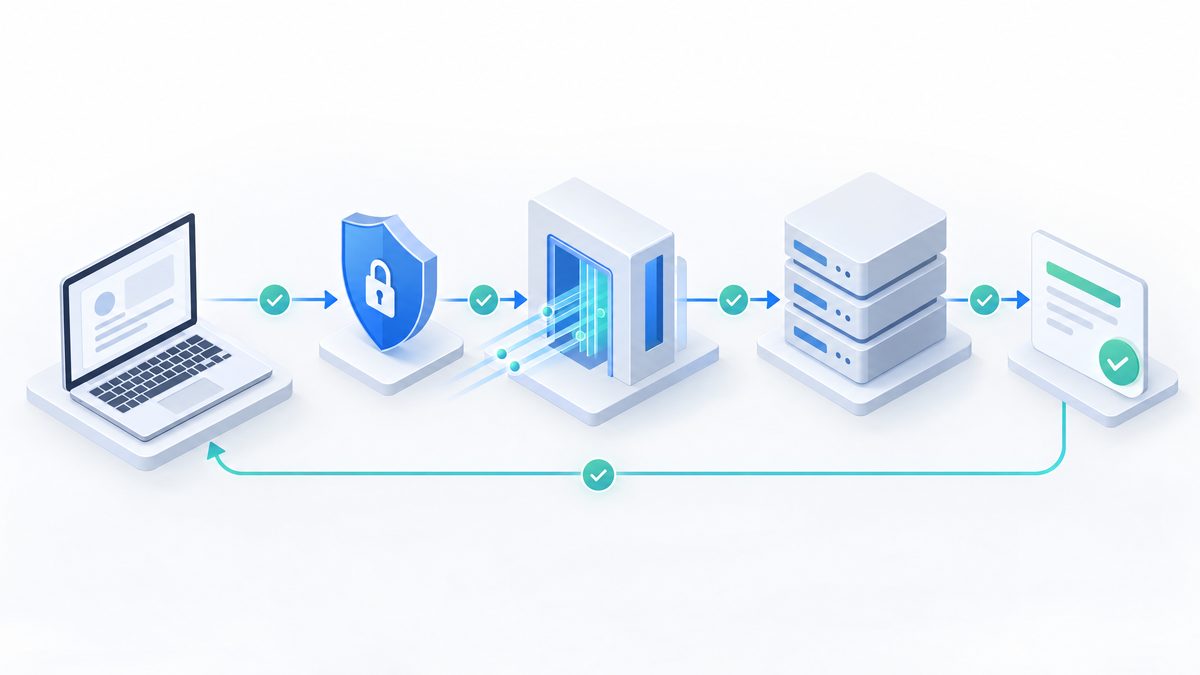
Before you run any stateful or data-mutating tests, first prove that your application can reach the API endpoints safely. The goal is to validate name resolution, routing, transport, and HTTP semantics without changing server state. The suggested workflow below proceeds from lowest risk (DNS and TCP) to HTTP-level pings that honor RFC 9110 method semantics and the applicable HTTP caching rules. Use your published API contract to select idempotent, documented endpoints, and expected headers and responses; OpenAPI documents the interface and expected responses for HTTP APIs and is a suitable contract source (OpenAPI Specification). If your teams practice consumer‑driven contracts, include those expectations as well (Pact documentation).
These checks are for pre-test connectivity. They complement, but are distinct from, ongoing production monitoring and fuller test types such as contract, functional, integration, load, and security testing described in typical API testing guidance (Postman API testing guide; OWASP API Security Testing Framework). For deeper background on designing test stages for AI-heavy stacks and automations, see our internal articles on API testing for AI development and AI-powered automation workflows.
Suggested workflow: from network reachability to HTTP semantics
-
Confirm name resolution and routing.
Validate that the hostname in your API contract resolves and that you can route traffic to the intended address. When you need to test a specific target (e.g., staging IP, new load balancer), you can override resolution for a single request with curl’s
--resolve, which maps a hostname and port to an IP for that call (curl documentation). This isolates DNS from the rest of the stack while keeping TLS hostname verification intact.# Pin the hostname to a target IP for this request only and fetch headers curl --resolve api.example.com:443:203.0.113.10 \ -I https://api.example.com/health \ --connect-timeout 3 --max-time 5 -sS -D -Interpretation: because
--resolvedeliberately bypasses normal DNS resolution, a successful response shows that the selected IP can complete the TLS and basic HTTP path for the target hostname. It does not prove that ordinary DNS lookup is working. Test the hostname without--resolve(or with a dedicated resolver query) when DNS itself is part of the question; if the pinned request fails, investigate the selected target, routing, TLS, or service path before proceeding. -
Check TCP port reachability with timeouts.
Use curl to attempt a connection to the expected port (often 443). Time-bounded attempts keep your pre-test fast and predictable.
# Attempt a TCP/TLS connection and retrieve only response headers
curl -I https://api.example.com/health \
  --connect-timeout 3 --max-time 5 -sS -D - -o /dev/null -v
Interpretation: if the connection phase consistently times out or is refused, investigate network ACLs, security groups, or proxies before any functional tests.
-
Verify TLS, including mTLS when required.
By default, curl verifies the server certificate; you can supply a custom CA bundle when using private PKI, and client certificates/keys for mutual TLS (curl documentation).
# Server TLS with custom CA bundle
curl -I https://api.example.com/health \
  --cacert /path/to/ca-bundle.pem -sS -D - -o /dev/null -v

# Mutual TLS (client cert + key) with server verification
curl -I https://api.example.com/health \
  --cert /path/to/client.pem --key /path/to/client.key \
  --cacert /path/to/ca-bundle.pem -sS -D - -o /dev/null -v
Interpretation: successful handshake and a valid certificate chain confirm transport security prerequisites are met before exercising any API behavior.
-
Send HTTP-level pings that are safe under RFC 9110 semantics.
RFC 9110 defines method semantics, status codes, and headers. Prefer methods that are safe and/or idempotent for reachability checks, such as
HEAD,GETto documented health/info endpoints, orOPTIONSwhere supported (RFC 9110). Avoid methods that could change state. Use endpoints explicitly documented in your API contract (e.g., OpenAPI “/healthz”, “/status”, or an informational resource) so the expected response and headers are known (OpenAPI Specification).# HEAD: request headers without a response body when the endpoint documents HEAD support curl -I https://api.example.com/health \ --connect-timeout 3 --max-time 5 -sS -D - # OPTIONS: ask the target for communication options; use Allow/CORS details only when the server exposes them curl -X OPTIONS -i https://api.example.com/health \ --connect-timeout 3 --max-time 5 -sS
Respect caching and rate limits; capture diagnostic headers
To minimize load while getting actionable diagnostics, prefer headers-only requests and record HTTP response metadata that the service actually exposes (for example, Date, Cache-Control, and Retry-After where applicable); interpret caching directives against the service contract and the applicable HTTP caching specification (RFC 9111). Capture and review response headers for environment signals:
- Date may be a useful service timestamp, while Server can be absent or self-reported. Treat either as a troubleshooting clue, not proof of the gateway or origin that handled the request (see the HTTP field definitions in RFC 9110).
- Cache-Control, when present, is a cache directive; interpret it against the service contract and the HTTP caching rules in RFC 9111 before deciding whether to revalidate.
- Retry-After tells clients when to retry after limits or temporary unavailability (defined in RFC 9110).
- Any rate‑limit metadata documented in your API contract; if your OpenAPI or consumer contract specifies rate‑limit headers, record them and adapt your retry budget accordingly (OpenAPI Specification; Pact documentation).
# Capture status, headers, and timing in one shot
curl -I https://api.example.com/health -sS -D - -o /dev/null \
  --connect-timeout 3 --max-time 5 \
  -w "status=%{http_code} dns=%{time_namelookup} connect=%{time_connect} tls=%{time_appconnect} ttfb=%{time_starttransfer} total=%{time_total}\n"
Interpretation: examine the headers for Date, Server, Cache-Control, and (if present) Retry-After. Use the timing metrics to localize slowness: DNS, TCP connect, TLS handshake, or server time-to-first-byte.
Validate proxies and egress paths
If your environment uses an HTTP proxy, test through it explicitly. curl supports proxies and trust configuration for proxy certificates (curl documentation).
# Through an HTTP/HTTPS proxy with explicit trust
curl -I https://api.example.com/health \
  -x http://proxy.corp.local:8080 --proxy-cacert /path/to/proxy-ca.pem \
  --connect-timeout 3 --max-time 5 -sS -D - -o /dev/null -v
Interpretation: a successful response through the proxy path confirms that egress configuration is sound before running higher-level tests.
Timeouts, retry budgets, and safety guards
- Set conservative per-request timeouts in pre-tests using curl’s
--connect-timeoutand--max-timeto avoid stalling your pipeline (curl documentation). - When transient failures occur, apply a limited retry budget with backoff. Respect any
Retry-Afterguidance per RFC 9110 (RFC 9110). If your API contract documents rate limits, align your retry policy to those limits (OpenAPI Specification).
Test Authentication, Errors, and Recovery Paths

Once basic connectivity is proven, expand your tests to authenticated scenarios and deliberate failure handling so you can trust behavior under real conditions. The goal is to verify that your client acquires credentials correctly, sends only the headers and scopes required, returns contract-aligned error responses, and recovers gracefully without violating protocol semantics. Build these checks on widely adopted references: HTTP semantics for methods, status codes, headers, and caching behavior (RFC 9110), machine-readable API contracts (OpenAPI), and recognized testing categories and lifecycle guidance (Postman). For security-focused depth, use the OWASP API Security Testing Framework as a touchstone for risk-oriented coverage (OWASP).
Plan authentication coverage with a security-first lens
If your API relies on credentials, design tests that exercise all supported flows and confirm least privilege. As a practical plan (not a report of provider behavior):
- API keys: Validate key transmission in the documented location (for example, header vs query), confirm that requests without a key receive an authentication error, and ensure the client never logs secrets in plain text. Use risk-based guidance from the OWASP API Security Testing Framework to prioritize these checks (OWASP).
- OAuth 2.0: If supported, test token acquisition and refresh paths, verify token expiration handling, and ensure scopes are minimal for the operation. Confirm that calls with missing or insufficient scope are rejected with the expected status and body as defined in your OpenAPI contract (OpenAPI).
- Mutual TLS (mTLS): Where applicable, check that requests without a client certificate are rejected and that retries do not strip required TLS parameters. Treat these as protocol-level connectivity conditions and validate using low-level diagnostics when needed.
- Security headers: Confirm that required authorization and content negotiation headers are present and formatted as expected. Tie each header to the method and representation semantics described in HTTP (RFC 9110).
For teams building AI-driven integrations, you can adapt the same authentication test principles from our API testing guide to data- and model-centric workflows, including token management and header validation in automated pipelines (API testing for AI development).
Verify error responses align to your contract and HTTP semantics
Error handling is part of the contract, not an exception to it. Represent expected responses in your OpenAPI document so tests can assert both status codes and body shapes (OpenAPI). Then validate against HTTP semantics (RFC 9110):
- Authentication and authorization: 401 (authentication required) and 403 (insufficient permissions).
- Client input issues: 400 for malformed requests or validation failures.
- Routing and methods: 404 for unknown routes; 405 when the method is not allowed on a resource.
- Content negotiation: 415 for unsupported media type; 406 when the requested representation cannot be provided.
- Rate limiting and quotas: 429 Too Many Requests, including any accompanying advisory headers.
- Server-side faults: 5xx classes for transient or internal errors.
To prevent regressions in consumer–provider expectations, consider consumer‑driven contract tests so each client asserts the specific responses it relies on, while the provider verifies it can satisfy them (Pact).
Exercise retries, backoff, and recovery without breaking semantics
Recovery strategies should be deliberate and protocol-aware. A suggested workflow:
- Only retry idempotent methods. RFC 9110 defines method semantics and idempotence, which you can use to gate retry logic and tests. In practice, restrict automatic retries to methods that are explicitly idempotent per HTTP semantics (RFC 9110).
- Honor server guidance. When a response includes Retry-After, ensure the client waits accordingly before retrying (RFC 9110). If the API returns provider-specific rate limit headers, incorporate them in pacing logic.
- Confirm client-side protections. Test request timeouts and, where applicable, circuit breakers to prevent cascading failures. Validate caching behavior against HTTP cache directives so repeated GETs follow the documented freshness and revalidation rules (RFC 9111).
Keep these recovery tests safe. Use non-production environments or accounts, and ensure negative tests that generate errors or high request volumes are isolated from production behavior.
Differentiate security testing from functional testing
Postman categorizes API testing into multiple types, including contract, integration, load, security, and functional testing (Postman). Use this separation to plan coverage: for example, validate authentication flows and access controls as part of security testing, while treating happy-path business operations and data transformations as functional tests. Also note that testing and production monitoring are distinct lifecycle activities, so keep monitors lightweight and non-destructive, and reserve negative tests for safe environments (Postman).
Practical steps and tooling to get started
The following pragmatic sequence can help teams extend basic connectivity checks into authenticated and resilient workflows:
- Start with low-level probes. Use a diagnostic tool to issue minimal HTTP requests and inspect raw status codes and headers. For simple, reproducible checks, a command-line tool commonly used for HTTP request diagnostics is helpful (curl).
- Codify expectations from the contract. Generate or write tests that assert status codes and response bodies per your OpenAPI description (OpenAPI), including error cases.
- Add authentication flows. Gate tests on successful token/key establishment, then verify least-privilege access and proper error handling on missing or insufficient credentials. Prioritize scenarios with a risk-based lens using the OWASP API Security Testing Framework (OWASP).
- Automate consumer–provider checks. Where multiple clients depend on the same API, add consumer-driven contract tests so interface expectations remain stable as both sides evolve (Pact).
- Simulate failure and recovery. Inject representative 4xx/5xx responses, throttle conditions, and timeouts to validate retry behavior only on idempotent methods and to confirm adherence to Retry-After and cache directives (RFC 9110).
- Integrate into automation. Fold these tests into CI/CD and scheduled environments. For workflow ideas, you can adapt orchestration patterns described for automation pipelines to your API test runners and monitors (AI-powered automation workflows).
By anchoring authentication, error handling, and recovery tests to HTTP semantics, machine-readable contracts, and security-focused guidance, you create a reliable basis for diagnosing issues early and preventing production surprises.
Turn Checks Into Continuous Assurance
One-off connectivity checks help in the moment; continuous assurance sustains confidence every time you ship. The practical approach below turns sporadic verifications into an automated, contract-driven workflow that promotes early detection, safe iteration, and fast diagnosis—without blurring the line between testing and monitoring.
Contract the interface, then automate the gate
Anchor your tests to explicit API contracts and make incompatibilities fail fast in CI/CD:
- Describe expected methods, paths, parameters, response structures, and status codes in an OpenAPI document. The OpenAPI Specification is a language-agnostic interface description for HTTP APIs and includes expected responses (OpenAPI).
- Adopt consumer-driven contracts so integrating teams can guard against breaking changes. Pact documents this approach and its workflow for producers and consumers (Pact).
- Suggested workflow: validate your OpenAPI contract and run Pact verification as part of your build pipeline; if the implementation or contract is incompatible with agreed behavior, break the build so issues are addressed before deployment.
- Version and publish your contracts so teams can discover, pin, and upgrade deliberately.
Keep testing and monitoring distinct, and wire both
Testing and production monitoring serve different lifecycle activities. The Postman API testing guide outlines the breadth of testing modalities—contract, unit, end-to-end, load, security, integration, and functional—and distinguishes testing from monitoring in production (Postman).
- Suggested workflow in CI: run contract tests (OpenAPI validation, Pact), functional and integration tests against ephemeral environments, and minimal connectivity probes to verify basic HTTP semantics prior to deploy.
- Suggested workflow in production: use synthetic monitors that perform low-impact probes to observe availability and basic behavior continuously, without replacing deeper pre-release testing noted by Postman.
- Layer in security testing aligned to the OWASP API Security Testing Framework to address risks cataloged in the OWASP API Security Top 10 (OWASP).
Use HTTP semantics as objective, automatable signals
HTTP semantics provide a common language for requests and responses. RFC 9110 defines request methods, status codes, headers, and resource semantics (RFC 9110). Suggested workflow:
- Classify outcomes by RFC 9110 status code classes (e.g., 2xx success, 4xx client error, 5xx server error) and fail pipelines when responses fall outside expected classes for a given endpoint and method.
- Treat method and response expectations as first-class test inputs. For example, verify that a GET does not mutate state and that documented headers are present when required, per your OpenAPI and the HTTP semantics defined in RFC 9110.
- Define internal thresholds for response characteristics your team cares about (for example, response time and any header-based signals that your API exposes), and wire alerts when they deviate from expectations, while still grounding pass/fail criteria in RFC 9110 status code semantics.
Evidence, diagnostics, and change management
Turn every automated action into actionable evidence and faster remediation:
- Record request and response metadata (method, URL, headers, status code, and timing) from tests and monitors to support audits and incident investigations.
- Route change through contract negotiation instead of ad hoc endpoint flips: propose updates in OpenAPI and Pact artifacts, agree on versions, and only then roll out server changes gated by verification.
- Document runbooks that map symptoms to likely layers—such as DNS, TLS, HTTP, and application—so on-call engineers can triage quickly using observed HTTP semantics from RFC 9110.
Portable probes with curl and headless runners
Favor portable tools so checks run identically across laptops, CI, and synthetic monitoring:
- Use curl for HTTP request diagnostics and scripted probes. curl is a command-line data-transfer tool commonly used for HTTP requests (curl).
- Run probes in headless, containerized runners so the same scripts validate connectivity in pre-merge checks, nightly builds, and production monitors.
- Keep probe payloads and intervals small to minimize impact, especially for production monitors.
For deeper background on assembling API tests into larger automation flows, see our API testing guide for AI development (guide) and our guide to AI-powered automation workflows (automation workflows).
Suggested decision guide
| Situation | Primary artifact or tool | Why this choice | Policy to automate |
|---|---|---|---|
| Defining and validating the public contract of an HTTP API | OpenAPI | Language-agnostic interface description that captures expected requests and responses | Fail CI if schema or example responses deviate from the OpenAPI document |
| Ensuring a provider does not break specific consumer expectations | Pact | Consumer-driven contract testing to detect incompatible provider changes before release | Block deploy if provider verification fails against published consumer contracts |
| Differentiating pre-release testing from production observation | Postman testing guidance | Clarifies testing types and separates testing from production monitoring activities | Run functional and integration tests before deploy; limit production to synthetic, low-impact monitors |
| Adding security-focused checks aligned to common risks | OWASP API Security Testing Framework | Framework based on the OWASP API Security Top 10 | Include security checks in CI and scheduled scans; treat critical findings as release blockers |
| Portable connectivity probes across environments | curl | Widely available command-line tool for HTTP request diagnostics and scripting | Run curl-based probes in CI and production monitors; alert on unexpected RFC 9110 status classes |
Example: minimal, automatable probe sequence
Below is a portable pattern you can adapt for both CI and production monitors:
- Check DNS resolution and TLS negotiation using a lightweight curl command that surfaces connection details.
- Issue a method-appropriate request scripted by your OpenAPI contract; validate the status code against the expected RFC 9110 class and required headers defined in your contract.
- Record request/response metadata for later inspection, and emit machine-readable output so CI or monitoring systems can decide to pass, fail, or alert.
This sequence keeps your connectivity assurance grounded in explicit contracts (OpenAPI), verifies consumer expectations where applicable (Pact), respects the separation of testing and monitoring (Postman), and relies on standard HTTP semantics for objective signals (RFC 9110), all while staying portable with command-line diagnostics (curl).
Related reading on ChatGPT AI Hub
our API testing guide for AI development. Explore our guide to AI-powered automation workflows.
Useful Links
| Resource | Why it is useful |
|---|---|
| RFC 9110: HTTP Semantics | HTTP defines request methods, status codes, headers, and resource semantics; method and response expectations should be part of tests. |
| RFC 9111: HTTP Caching | HTTP caching rules for Cache-Control, freshness, and revalidation. |
| RFC 6585: 429 Too Many Requests | Definition and cacheability guidance for the 429 status code. |
| OpenAPI Specification | OpenAPI is a language-agnostic interface description for HTTP APIs and describes expected responses. |
| Postman API testing guide | API testing can cover contract, unit, end-to-end, load, security, integration, and functional testing; testing and production monitoring are different lifecycle activities. |
| OWASP API Security Testing Framework | OWASP maintains an API security testing framework based on the API Security Top 10. |
| Pact documentation | Pact documents consumer-driven contract testing approaches. |
| curl documentation | curl is a command-line data-transfer tool commonly used for HTTP request diagnostics. |
