
The Complete GPT-4.5 to GPT-5.5 Migration Checklist: What Changed, What Broke, and How to Update Your Prompts
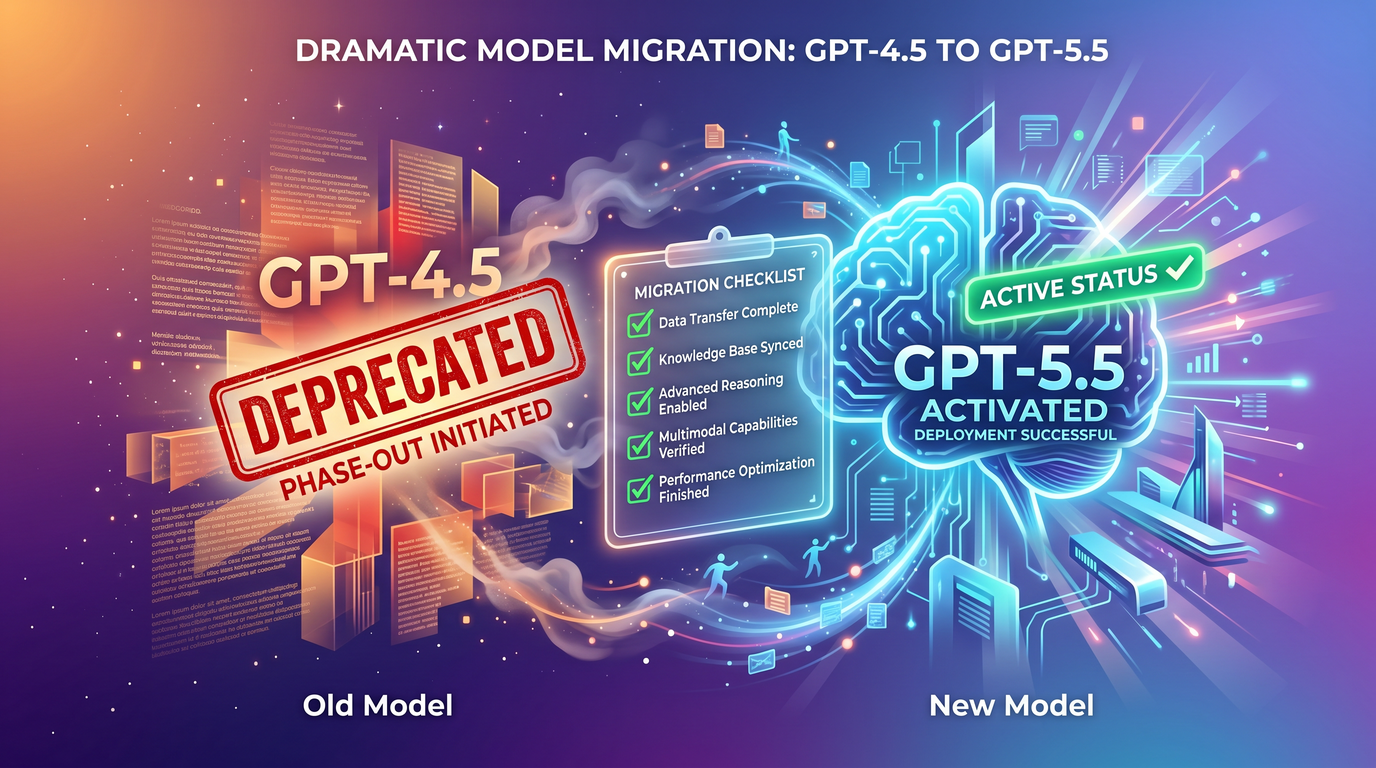
GPT-4.5’s deprecation on June 26, 2026 put a firm deadline on a move most teams were already planning: upgrade to GPT-5.5 and refresh the surrounding prompt, tooling, and evaluation stack to match the model’s new behaviors. If your team is still polishing that migration, this guide distills what changed, what broke, and how to make the transition with confidence—complete with a pragmatic checklist, remediation patterns, testing strategies, and rollback plans.
While GPT-5.5 delivers better quality, broader context handling, and tighter structured output, it also changes defaults, modifies tool-calling behavior, and enforces stricter parsing rules that can surface hidden assumptions in older prompt patterns. This article focuses on the developer-facing changes that matter in production: how to keep your app’s outputs stable, safe, and predictable while taking advantage of new capabilities.
Where you see internal navigation cues, your platform may render them as native links:
For a deeper exploration of related concepts, our comprehensive guide on 45 ChatGPT-5.5 Prompts for Technical Writers: API Documentation, SDK Guides, Rel provides detailed strategies and practical implementation steps that complement the techniques discussed in this article.
For a deeper exploration of related concepts, our comprehensive guide on The Codex Database Engineering Playbook: 20 Prompts for Schema Design, Query Opt provides detailed strategies and practical implementation steps that complement the techniques discussed in this article.
For a deeper exploration of related concepts, our comprehensive guide on Why ChatGPT’s Futures Class of 2026 Signals OpenAI’s Pivot to Develo provides detailed strategies and practical implementation steps that complement the techniques discussed in this article.
Executive Summary
- Timeline: GPT-4.5 was officially deprecated on June 26, 2026. If you still rely on archived models or cached results, plan a hard cutover to GPT-5.5 now and validate backward compatibility in staging.
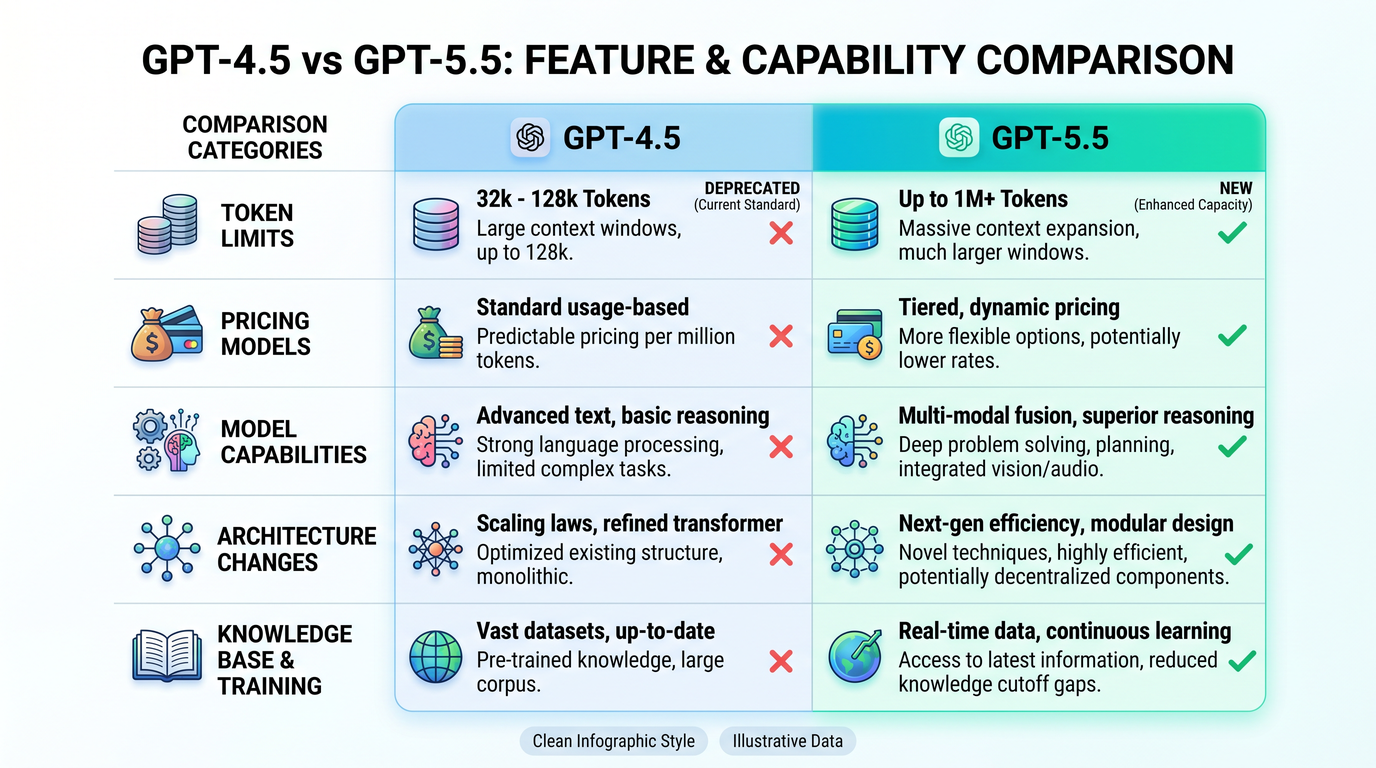
- Key Differences: GPT-5.5 tightens structured outputs, revises system/developer prompt precedence, refines tool routing, and often performs more aggressive reasoning compression (shorter, more on-task answers by default) than GPT-4.5.
- What Breaks: Vague “roleplay” system prompts, unbounded chain-of-thought coaxing, permissive XML/JSON hybrids, and implicit tool-choice assumptions are likely to produce brittle or divergent results under GPT-5.5.
- Token Limits and Pricing: Expect larger effective context windows and pricing tiers that reward crisp structured interactions. Verify your account’s current limits and costs before rollout to avoid surprise bills.
- Structured Output: GPT-5.5 is more strict. You’ll see fewer “helpful” asides in JSON mode and stronger enforcement of schemas; invalid schemas now fail faster.
- Function Calling/Tools: Tool invocation is more consistent, but parallelization and selection heuristics changed. Some apps need orchestration updates to reliably merge multi-tool results.
- System Prompt Behavior: GPT-5.5 assigns clearer priority to system instructions and can ignore contradictory developer/user instructions more aggressively. Trim, clarify, and pin your policy/voice in system scope.
- Checklist: A 20+ item step-by-step plan is provided to audit prompts, tools, tests, telemetry, and rollout.
- Testing: Use golden sets, schema fuzzing, diff-based regression, and canaries to compare models side-by-side. Audit refusal/deflection rates and structured-output error rates.
- Rollback: Keep switchable feature flags, caching, and safe fallback prompts. Maintain a “compat” prompt profile for legacy flows.
- Custom GPTs: Update instructions, knowledge, tools, and UI affordances; re-verify privacy and sandbox policies in new runtime defaults.
Timeline: GPT-4.5 Deprecation Announcement and Cutoff
June 26, 2026 marked the formal cutoff for GPT-4.5 in production environments. In practice, most organizations executed a staged migration leading up to that date, aligning their migration milestones with change freeze windows and QA capacity. Here’s a recommended reconstruction of the critical phases to organize your own effort (or to audit what you already did):
- Announcement and Triage: Review the deprecation notice delivered to your account owners and engineering contacts. Capture any model-specific recommendations and the model ID mapping published by your provider. Label all services and jobs that mention GPT-4.5 explicitly.
- Inventory and Risk Assessment: Catalog all prompts, tools/functions, agents, and Custom GPTs referencing GPT-4.5. Rank by blast radius: customer-facing chat, analyst workflows, critical batch jobs, and internal R&D sandboxes.
- Sandbox Experiments: Enable GPT-5.5 in a separate environment; run your high-traffic prompts and tool workflows to baseline differences, refusal rates, cost implications, latency, and structured-output validity.
- Fix and Harden: Apply the migration checklist below to remediate brittle patterns. Add telemetry for schema violations, tool-call anomalies, and output-regression diffs.
- Staged Rollout: Start with low-risk flows and internal users. Use canaries and dark launches to stress the new model under production data. Expand gradually as confidence grows.
- Cutover: Move traffic to GPT-5.5. Keep a feature-flag-based fallback prompt profile and a safe alternative model for contingencies during the first weeks.
- Post-Cutoff Hardening: Retire GPT-4.5-specific “quirk” handlers. Update runbooks, docs, playbooks, and guides for new defaults and customer expectations.
If your platform supports internal deep links, see:
For a deeper exploration of related concepts, our comprehensive guide on How to Build Multi-Agent Teams with OpenAI’s Agent-Team Feature: Preventin provides detailed strategies and practical implementation steps that complement the techniques discussed in this article.
Key Differences Between GPT-4.5 and GPT-5.5 Architectures (Developer-Facing)
While the exact internals are vendor-proprietary, the practical, developer-facing differences are visible in API behavior and model outputs. These are the shifts that tend to matter in production:
1) Output Discipline and Reasoning Compression
GPT-5.5 tends to produce more concise final answers under similar temperature and top-p settings than GPT-4.5. Explanations are tighter; “thinking out loud” is less likely to leak into outputs, especially when structured output is requested. This reduces post-processing effort but can surface hidden dependencies on verbose narratives.
2) Stricter Structured Output Modes
Compared to GPT-4.5, GPT-5.5 adheres more strictly to JSON schemas and formal output modes. When you request JSON, you are less likely to receive an English preamble, and more likely to get a hard failure (or an explicit refusal) if your schema is contradictory or under-specified. This rewards precise schemas but can break liberal post-parsing that depended on “close enough” outputs.
3) Tool Calling and Multi-Tool Orchestration
GPT-5.5 appears to optimize tool calls with better grounding but expects clearer tool definitions and descriptions. It is also more comfortable invoking multiple tools in sequence or parallel when allowed. As a result, naive clients that assume a single tool call per turn can fail. Incorporate orchestration to merge results or limit tool parallelism explicitly when order matters.
4) System/Developer/User Instruction Precedence
Instruction-following is more deterministic: system messages dominate, developer messages come next, and user messages are subordinate. GPT-5.5 is more willing to ignore user instructions that conflict with the system prompt. This improves safety and policy conformance but exposes brittle patterns that relied on “user override” behavior in GPT-4.5.
5) Context Utilization and Reference Fidelity
GPT-5.5 is more selective about what it surfaces from very long contexts. It tends to focus on recent and strongly relevant segments. If you relied on passive recall of distant references in GPT-4.5, you may need retrieval hints, content tags, or explicit citations to make key details salient.
6) Determinism, Seeds, and Reproducibility
Reproducibility features are more stable in GPT-5.5, but subtle differences remain across hardware and time. If you use seeding or logprobs to enforce determinism, expect closer—but not perfect—replay. Lock down temperature, top-p, and stop sequences, and replay with consistent tool availability for best results.
7) Safety and Refusal Behavior
GPT-5.5 more consistently deflects disallowed requests and follows safety instructions from the system prompt. This can increase refusal/deflection rates for edge prompts that previously produced partial answers under GPT-4.5. Design replies and UIs that gracefully handle policy guidance and redirections.
For a product-focused summary:
For a deeper exploration of related concepts, our comprehensive guide on 40 ChatGPT-5.5 Prompts for Academic Researchers: Literature Reviews, Hypothesis provides detailed strategies and practical implementation steps that complement the techniques discussed in this article.
What Breaks: Prompt Patterns That No Longer Work (or Are Now Risky)

Here are the patterns most likely to regress under GPT-5.5, along with recommended fixes.
1) Unstructured “Roleplay” System Prompts
Pattern: “You are a world-class expert who always reasons step-by-step. Speak casually and think before you answer.”
Why it breaks: GPT-5.5 separates internal reasoning from outputs more strictly. Vague voice directives can be ignored if they conflict with structured output modes or safety layers.
Fix: Convert system voice and policy to compact, testable rules. Move non-essential voice to developer messages or response post-processing. Avoid coaxing for hidden chain-of-thought—request succinct rationales or bullet-point justifications instead.
2) XML/JSON Hybrids and “Helpful” Preambles
Pattern: Asking for JSON but tolerating header text, XML tags, or commentary.
Why it breaks: GPT-5.5 is more literal with formatting modes. It’s more likely to emit pure JSON (good) or refuse when the schema conflicts (exposing bad assumptions). Code that stripped preambles may now be dead weight.
Fix: Enforce strict JSON mode and supply a valid schema. Validate at the boundary and surface schema errors fast.
3) Implicit Tool Order Assumptions
Pattern: Expecting a tool to run before thinking, then another tool, then final answer, without specifying constraints.
Why it breaks: GPT-5.5 can choose parallel or re-ordered tool calls if it believes it improves fidelity.
Fix: Encode ordering constraints in tool descriptions or orchestrate outside the model. Provide explicit steps or require a single tool at a time when order matters.
4) Overstuffed System Prompts
Pattern: Huge policy blocks, style guides, and examples in the system message.
Why it breaks: GPT-5.5 may prioritize compact, high-signal instructions; excessive system content can reduce clarity and raise token costs. Low-signal rules risk being ignored.
Fix: Compress policy into atomic rules. Move examples to developer messages or retrieval context and tag them clearly.
5) Chain-of-Thought Coaxing
Pattern: “Think step by step and show your reasoning.”
Why it breaks: GPT-5.5 is less likely to reveal internal reasoning by default. You can still request succinct rationales, but don’t depend on detailed step traces.
Fix: Ask for “short justification” or “key assumptions” as structured fields, not free-form thought dumps.
6) Loose Stop Conditions
Pattern: Relying on implicit termination when using streaming or tool calls.
Why it breaks: With stricter structured modes and changed defaults, your consumer may hang waiting for markers that never come.
Fix: Define explicit stop sequences or use protocol events from the client SDK that signal end-of-message or end-of-tool segment.
7) Ambiguous Safety Rules
Pattern: Conflicting safety directives in system vs developer prompts.
Why it breaks: GPT-5.5 enforces precedence more predictably and may side with system policy, producing refusals you didn’t see before.
Fix: Consolidate safety rules in the system prompt and remove duplicates or contradictions downstream.
8) “Best Effort” Parsing
Pattern: Letting the model bend schemas or emit strings where objects are required—and fixing it client-side.
Why it breaks: GPT-5.5 may refuse or error on invalid schemas or produce null fields rather than guessing.
Fix: Tighten schemas, set defaults explicitly, and validate. Reject early; don’t silently coerce.
9) Multi-File Knowledge Globs
Pattern: Dumping large knowledge blobs into a single message and expecting recall.
Why it breaks: GPT-5.5 is more selective; important details can be deprioritized.
Fix: Use retrieval with document chunking, salience hints, and citations to make target facts stand out.
10) Temperature-Only Tuning
Pattern: Tweaking only temperature to stabilize outputs.
Why it breaks: GPT-5.5’s defaults and sampling behavior changed; temperature alone may not deliver the same stability.
Fix: Combine temperature, top-p, and stop sequences. Consider seed support and deterministic tool availability for critical paths.
Token Limits and Pricing Changes
GPT-5.5 is designed to handle broader contexts and deliver higher throughput than GPT-4.5, but the exact token and pricing tiers depend on your account and region. Plan for the following:
- Context Expansion: You can usually pass longer prompts and documents. Verify your precise token ceilings and adjust chunking or retrieval accordingly.
- Cost Structure: Pricing typically encourages structured interactions and penalizes very large, unstructured prompts. Run cost-per-request benchmarks on representative workloads before enabling GPT-5.5 for all traffic.
- Latency: Higher-capacity models may introduce marginal latency changes. Mitigate with streaming, partial responses, or background tool calls.
Best practice: instrument per-request tokens in/out and cost estimates. Trigger alerts on budget deviations and autoscale retrieval to trade cost for relevance under load.
| Dimension | GPT-4.5 Typical Behavior | GPT-5.5 Expected Behavior | Migration Action |
|---|---|---|---|
| Context Window | Good, but recall could degrade past mid-context | Broader, more selective recall | Adopt retrieval with salience hints; avoid monolithic prompts |
| Pricing | Stable tiers | Revised tiers by model/feature | Benchmark costs; add per-route budgets and alerts |
| Streaming | Stable but sometimes chatty | More disciplined partials | Use protocol “end” events; don’t rely on regex stops |
Structured Output Differences
Structured output is where many teams see immediate wins—and some surprises. GPT-5.5 aims to be more literal and compliant when asked for structured data, whether that’s JSON objects or tool arguments. Here’s how to adapt.
Stricter JSON Mode
Under JSON mode or similar “response_format” settings, GPT-5.5 avoids commentary and preambles. That helps downstream parsers but can break code that tried to be lenient.
- Use explicit schemas when possible, not just “type: object.”
- Define required fields and allowed enums.
- Provide defaults or nullable types for optional fields.
- Instrument schema-validation metrics to detect drift.
{
  "type": "object",
  "additionalProperties": false,
  "properties": {
    "summary": { "type": "string", "maxLength": 280 },
    "priority": { "type": "string", "enum": ["low","medium","high"] },
    "assignees": {
      "type": "array",
      "items": { "type": "string" },
      "maxItems": 5
    },
    "due_date": { "type": ["string", "null"], "format": "date" }
  },
  "required": ["summary","priority","assignees"]
}
GPT-5.5 is more likely than GPT-4.5 to adhere strictly to this schema, or to raise a structured error/refusal if the schema is contradictory. That’s good for reliability—if your client is prepared to handle errors gracefully.
Refusals vs. “Close Enough” Outputs
GPT-4.5 might have attempted to populate missing fields, invent defaults, or switch a string to an object. GPT-5.5 typically prefers to either fill with nulls, comply strictly, or refuse. Update your clients to:
- Detect refusal patterns and surface helpful edits to the schema or prompt.
- Retry with relaxed constraints only when business-appropriate.
- Capture the invalid payload and model messages for offline analysis.
Narrative + JSON Hybrids
If your app interleaves narrative explanations with structured snippets, pin the order and separation explicitly. For example: “First provide valid JSON only. Then, in a second message, provide a human-readable explanation.” Or use two turns: request structured data first, explanation afterward, so the model doesn’t try to merge them.
Function Calling and Tool Use Changes
Tool use has matured: names, invocation patterns, and streaming events are more consistent, and models are better at selecting the right tool. But this also exposes older assumptions.
Access 40,000+ AI Prompts for ChatGPT, Claude & Codex — Free!
Subscribe to get instant access to our complete Notion Prompt Library — the largest curated collection of prompts for ChatGPT, Claude, OpenAI Codex, and other leading AI models. Optimized for real-world workflows across coding, research, content creation, and business.
Parallel Calls and Orchestration
GPT-5.5 can propose multiple tool calls, sometimes in parallel, to satisfy multi-part tasks. If your app expected a single call per turn, you must either constrain tool_choice to one, or add orchestration logic that:
- Queues tool calls when order matters (e.g., auth → fetch → transform).
- Merges results (e.g., aggregate results from two search tools).
- Surfaces partial failures (one tool errors, others succeed).
// Pseudocode orchestration logic
for each tool_call in message.tool_calls:
  try:
    result = dispatch(tool_call)
    append_to_context(tool_call, result)
  catch (e):
    append_error(tool_call, e)
continue_conversation()
Tool Choice Heuristics
Tool descriptions and argument schemas matter more. Vague or overlapping tool names push GPT-5.5 to make conservative choices or ask clarifying questions. Improve tool definitions:
- Use unambiguous names: “knowledgebase_search” vs “search_tool”.
- Constrain argument types and enums; avoid “any” where possible.
- Document expected side effects and error codes in the tool’s description.
- Indicate when tools are idempotent or have rate limits.
Streaming and Eventing
In some client SDKs, tool calls appear as discrete segments with explicit boundaries. Migrate away from homemade regex-based tool detection; rely on official events or message types. Always close streams cleanly and flush partial buffers.
Error Handling and Retries
Adopt idempotent tool semantics whenever possible. On transient failures, GPT-5.5 may choose to retry or ask for clarification. Provide clear error shapes that the model can summarize to the user, and evaluate whether auto-retry is safe.
System Prompt Behavior Changes
The system message is now a stronger anchor for behavior and policy. GPT-5.5 tends to follow it strictly, even if developer or user content proposes alternatives.
- Pin your policy in the system prompt; keep it short, unambiguous, and testable.
- Move role/voice styling that doesn’t affect safety into developer messages.
- Remove contradictions between system and developer messages—GPT-5.5 will prefer the system, sometimes surprising legacy flows.
- Explicitly specify refusal and redirection behaviors in the system message so the app anticipates how refusals are phrased and formatted.
Example system rules:
1) Follow the JSON schema exactly when requested; output only valid JSON.
2) If the request is disallowed, refuse with “refusal”: {“reason”:”…”} in JSON mode.
3) Be concise. Provide at most 5 bullet points in explanations unless asked to expand.
Step-by-Step Migration Checklist (20+ Items)
This checklist is designed as a practical, end-to-end plan you can copy into your issue tracker. Each item links to concrete changes you can verify with tests and telemetry.
- Model Inventory: Locate every mention of GPT-4.5 across services, configs, and CI/CD artifacts. Create a single source-of-truth mapping to GPT-5.5.
- Dependency Audit: Confirm your client SDK versions support GPT-5.5 features (structured outputs, tools, streaming events). Upgrade if needed.
- Endpoint Review: If your platform introduced a unified “responses” endpoint, migrate from legacy chat endpoints where recommended for GPT-5.5.
- Rate Limit and Quotas: Verify current rate limits and throughput policies for GPT-5.5. Update backoff logic and capacity planning.
- Prompt Cataloging: Export all system/developer/user prompts. Tag by product surface, feature flag, and risk level.
- System Prompt Consolidation: Rewrite system prompts to be concise, non-contradictory, and policy-first. Remove chain-of-thought coaxing.
- Developer/User Prompt Hygiene: Move style guidance to developer prompts, trim verbosity, and ensure instructions don’t conflict with system policies.
- Schema Tightening: For all structured outputs, provide explicit JSON schemas with required fields, enums, and defaults. Enable strict mode if available.
- Validation at Boundaries: Add JSON schema validation and graceful error paths where missing. Log schema violations with model/version tags.
- Tool Definition Hardening: Rename ambiguous tools, clarify descriptions, constrain arguments, and document side effects and error codes.
- Orchestration Layer: Support multiple tool calls per turn. Implement deterministic merging and ordering when required.
- Streaming Protocol: Stop using ad hoc parsing. Migrate to official streaming events for message chunks and tool-call boundaries.
- Stop Sequences and Timeouts: Define explicit stop sequences or rely on SDK “done” events. Tune server/client timeouts for GPT-5.5 latency profile.
- Sampling Defaults: Revisit temperature, top-p, and max tokens. Add seeds for reproducibility in automated tests where supported.
- Context Strategy: Replace monolithic long prompts with retrieval-augmented context. Add salience tags or headings to elevate key facts.
- Safety and Refusal UX: Update UI copy and API clients to handle stricter refusals. Provide “request edit” paths and compliant alternatives.
- Cost Guards: Instrument token usage and cost per route. Introduce budgets, alerts, and query shedding for non-critical paths.
- Regression Harness: Build a golden set spanning your top user intents. Capture expected structured outputs, paraphrases, and refusal cases.
- Diff Analyzer: Add semantic and structural diffing to flag degradations (missing fields, enum shifts, tone drift).
- Canary Rollout: Enable GPT-5.5 for a small user cohort. Monitor error rates, latency, cost, and satisfaction before expanding.
- Fallback Profile: Maintain a safe, conservative prompt profile and an alternate model for emergency switchbacks. Keep flags for 2–4 weeks.
- Observability: Add dashboards for schema validity, tool-call counts per request, refusal rate, and average tokens by route.
- Documentation: Update runbooks, SLAs, playbooks, and customer-facing docs to reflect GPT-5.5 behavior and any new UX affordances.
- Custom GPTs Review: Rebuild Custom GPT instructions, tools, and knowledge bundles with GPT-5.5 defaults. Re-test actions and privacy settings.
- Team Training: Share new prompting patterns and testing workflows. Document anti-patterns identified during migration.
Testing Strategies for Prompt Migration
Testing is the difference between a smooth cutover and a late-night incident. Build a multi-layered test plan to catch regressions early.
1) Golden Set and Baseline
- Create a representative corpus of prompts for your top tasks (at least hundreds per major feature). Include tricky edge cases and disallowed requests.
- Store both the final expected output and any structured intermediary artifacts (e.g., tool arguments, JSON schemas).
- Run the set against GPT-4.5 (archived results) and GPT-5.5 to build a comparative baseline.
2) Structural Validation First
Before human review, run machine checks:
- JSON schema validation (pass/fail + error localization).
- Tool invocation counts and order expectations.
- Presence of required answer fields and citations.
- Refusal detection: confirm disallowed prompts yield refusals formatted as specified.
3) Semantic Diffing
Where content is natural language, use a semantic similarity score (e.g., embeddings) and a rubric-based LLM judge to compare GPT-4.5 and GPT-5.5 outputs. Focus reviewers on cases where similarity drops below a threshold or where rubrics flag quality regressions.
4) A/B and Canary Experiments
- Route a small percentage of live traffic to GPT-5.5 and compare error rates, latency, cost, and satisfaction metrics.
- Use sticky assignment (by user or org) to reduce cross-contamination in multi-turn conversations.
- Hold out a control group to ensure observed improvements are model-driven, not seasonal or dataset noise.
5) Adversarial and Fuzz Testing
Break your schemas and prompts on purpose:
- Randomly drop required fields; ensure the model refuses or fills nulls as designed.
- Fuzz enum values and formats; confirm robust error messages and safe fallbacks.
- Inject contradictory instructions; verify system policy prevails and is logged.
6) Tool-Chain Simulations
- Simulate concurrent tool calls and partial failures.
- Test rate-limit handling and backoff across tools.
- Ensure deterministic replays under seeds and fixed tool availability in CI.
7) Human-in-the-Loop Review
- Assign domain experts to spot subtle correctness issues, missing constraints, or safety regressions.
- Calibrate evaluators with rubrics (accuracy, completeness, tone, safety adherence).
- Close the loop with prompt or schema edits, not just overrides in code.
Rollback Plans and Fallback Patterns
Even with strong preparation, real traffic can surface surprises. Keep your rollback muscle strong.
Feature Flags and Prompt Profiles
Separate model choice from prompt profile to allow partial reversions. Maintain two profiles at minimum:
- Stable Profile: Conservative, strictly structured, minimal stylistic flourishes. Use this for critical paths and during incidents.
- Optimized Profile: Richer style, longer rationales, and broader tool autonomy for high-value but less sensitive tasks.
Alternate Model and Graceful Degradation
- Keep at least one alternative model ready (smaller or previous-gen in the 5.x family), with verified structured outputs and refusals aligned to your UI.
- When cost spikes or latency increases, degrade by reducing context (use retrieval more aggressively), disabling optional tools, or shortening rationales—not by switching to unstructured answers.
Cache and Replay
- Cache deterministic or low-variance outputs for frequent prompts to reduce blast radius during incidents.
- Support replay in staging with identical seeds, tool availability, and prompts for forensic debugging.
Runbooks and Incident Response
- Document toggles for model, prompt profile, tool availability, and sampling parameters.
- Define SLOs and thresholds that trigger rollback (schema failure rate, refusal rate, latency, cost).
- Rehearse drills where you switch profiles and models under simulated load.
Custom GPTs Migration Considerations
Custom GPTs (or similar “builder” products) wrap instructions, tools, and knowledge into a single packaged assistant. Under GPT-5.5, they benefit from stricter behaviors but need careful re-tuning.
Instructions and Policy
- Rewrite instructions to be concise and unambiguous. Move essential rules to the system layer if supported.
- Explicitly define how refusals should appear. For example, “When a request is disallowed, respond with a one-sentence refusal plus a safe alternative.”
Knowledge and Retrieval
- Re-index knowledge with chunking that aligns to your tasks (headings, bullets, Q&A segments). Add metadata that hints at salience (e.g., priority tags).
- Ensure the builder’s retrieval settings match GPT-5.5’s selectivity; widen top-k if recall seems too narrow, but prefer higher-quality chunks.
Tools (Actions)
- Rename tools for clarity and reduce overlap between tools that serve similar intents.
- Constrain arguments and add examples in the tool descriptions to demonstrate correct usage.
- Test parallel and sequential tool patterns inside the builder runtime. Validate that partial failures produce usable, safe summaries.
UI and Output Modes
- If your Custom GPT surfaces JSON for internal automations, enforce strict JSON mode and display user-friendly explanations separately.
- Expose a “Why?” or “Show details” affordance to expand concise GPT-5.5 answers without nudging the default toward verbosity.
Privacy, Data Handling, and Sandboxes
- Re-validate data retention and sandbox policies in the new runtime. Confirm logs and telemetry don’t leak sensitive fields from strict JSON outputs.
- Retest file-handling and connectors (e.g., cloud drives, knowledge bases) under GPT-5.5 to catch format regressions.
Before/After: Concrete Migration Examples
Example 1: From Loose JSON to Strict Schema
Before (GPT-4.5 tolerated commentary and minor deviations):
// Prompt snippet
System: Output JSON for each ticket suggestion.
User: Suggest a ticket for the following incident...

// Typical output
Here is the JSON you requested:
{
  "summary": "Disk space alert on node-42 - threshold exceeded",
  "priority": "High",
  "assignees": ["oncall_sre"]
}
After (GPT-5.5 with strict mode and schema):
// Prompt snippet
System: Output only valid JSON conforming to the provided schema. No commentary.
Developer: If the schema is contradictory or underspecified, refuse with {"error":"schema_invalid"}.

// Output (no preamble)
{
  "summary": "Disk space alert on node-42; threshold exceeded",
  "priority": "high",
  "assignees": ["oncall_sre"],
  "due_date": null
}
Example 2: Tool Orchestration
Before: Assuming a single tool call.
// Tools
- "kb_search" (query)
- "ticket_create" (summary, priority, assignees)

// Old assumption
if (tool_call.name == "kb_search") { ... } else if (tool_call.name == "ticket_create") { ... }
After: Support multiple calls, possibly parallel.
// Orchestration
tool_calls = collect_tool_calls(message)
for call in tool_calls:
  result = dispatch(call)
  add_context({"tool": call.name, "result": result})
continue_conversation()
Example 3: Refusal Path
Before: Ambiguous refusals mixed with prose.
I'm not allowed to do that, but here's some info anyway:

{ "allowed": false }
After: Policy-pinned refusal with structured output:
{
  "refusal": {
    "reason": "Request requires privileged credentials not provided."
  },
  "alternative": {
    "steps": [
      "Authenticate with your org SSO.",
      "Re-run the request specifying the project ID."
    ]
  }
}
Prompt Engineering for GPT-5.5: Patterns That Work
GPT-5.5 favors crisp, testable instructions and clear separation of concerns.
- Atomic System Rules: Express policy and formatting in short, numbered rules.
- Developer Message for Style: Keep voice/tone non-critical and adjustable per-surface.
- Schema-First Design: When you need structure, give examples and a schema. Make it easy to be right.
- Rationales on Demand: Ask for one-sentence justifications or bullet-point assumptions, not hidden chain-of-thought.
- Retrieval with Salience: Preface chunks with short titles and “why relevant” hints. Encourage citations.
- Tool Role Clarity: Name tools distinctly, define arguments tightly, and state ordering constraints where necessary.
For deeper dives:
For a deeper exploration of related concepts, our comprehensive guide on The Codex Microservices Playbook: 20 Prompts for Designing, Implementing, and Te provides detailed strategies and practical implementation steps that complement the techniques discussed in this article.
Advanced Topics
Multi-Objective Outputs
When outputs must satisfy multiple stakeholders (compliance, UX, downstream parsers), split the request:
- First turn: Strict JSON payload.
- Second turn: Human-readable explanation referencing fields by name, not by rewriting them.
Grounding and Citations
GPT-5.5 is better at citing when asked explicitly and provided structured sources. Ask for citations with stable IDs rather than URLs alone, and enforce a schema like:
{
  "answer": "string",
  "citations": [
    {"id":"string","title":"string","snippet":"string","relevance":"high|medium|low"}
  ]
}
Programmatic Guardrails
Combine model-internal guardrails (system policy) with outer guardrails (validators and business logic). For example, reject “priority”: “urgent!” at the boundary and show a friendly correction path.
Operational Readiness: Monitoring and Telemetry
Post-migration, watch these dashboards closely for at least two weeks:
- Schema Validity Rate: Percentage of responses passing validation on first try.
- Refusal Rate: Track by route and user segment. Investigate spikes.
- Tool Invocation Metrics: Average number per request, error rates per tool, parallel call frequency.
- Latency: P50/P95 end-to-end, including tool orchestration; isolate model time vs. tool time.
- Cost per Route: Tokens in/out per route and blended cost; alert on anomalies.
- User Satisfaction: Thumbs, CSAT, or task-completion metrics.
Security and Compliance Implications
With stricter adherence to system prompts, GPT-5.5 is a better partner for compliance—if you encode policy correctly and validate at the edges.
- PII Handling: Enforce redaction at ingestion and re-validate outputs for leakage using pattern checks or a lightweight classifier.
- Data Residency: Confirm regional model availability and routing policies; ensure logs and caches respect residency constraints.
- Access Controls: Don’t expose powerful tools (e.g., deletion, secrets access) without a robust authentication handshake included in the tool schema.
- Auditability: Store prompt, system policy version, tool-call transcripts, and schemas for forensic analysis.
Migrating API Clients: Examples
Node.js Example (Unified Responses with Strict JSON)
import OpenAI from "openai";
const client = new OpenAI({ apiKey: process.env.OPENAI_API_KEY });

const schema = {
  type: "object",
  additionalProperties: false,
  properties: {
    title: { type: "string", maxLength: 120 },
    priority: { type: "string", enum: ["low","medium","high"] },
    tags: { type: "array", items: { type: "string" }, maxItems: 10 },
    rationale: { type: "string", maxLength: 240 }
  },
  required: ["title","priority","tags"]
};

const response = await client.responses.create({
  model: "gpt-5.5",
  input: [
    {
      role: "system",
      content: "Follow the schema exactly. Output only valid JSON. Be concise."
    },
    {
      role: "user",
      content: "Suggest a task to improve onboarding speed for new engineers."
    }
  ],
  response_format: { type: "json_schema", json_schema: { name: "task", schema } },
  temperature: 0.2,
  max_output_tokens: 500
});

// Validate response.output against schema in your app
console.log(response.output_text);
Python Example (Tools and Orchestration)
from openai import OpenAI
client = OpenAI()

tools = [
  {
    "type": "function",
    "name": "kb_search",
    "description": "Search the engineering knowledge base by keyword.",
    "parameters": {
      "type": "object",
      "properties": { "query": {"type":"string"} },
      "required": ["query"]
    }
  },
  {
    "type": "function",
    "name": "ticket_create",
    "description": "Create a ticket in the tracker. Use after you have enough context.",
    "parameters": {
      "type": "object",
      "properties": {
        "summary": {"type":"string"},
        "priority": {"type":"string","enum":["low","medium","high"]},
        "assignees": {"type":"array","items":{"type":"string"}}
      },
      "required": ["summary","priority","assignees"]
    }
  }
]

msg = [
  {"role":"system","content":"Use tools when necessary. If you need more info, search first, then create a ticket."},
  {"role":"user","content":"We have mounting alerts on service X latency. Please raise visibility."}
]

res = client.responses.create(
  model="gpt-5.5",
  input=msg,
  tools=tools,
  tool_choice="auto",
  temperature=0.3
)

# Pseudocode: dispatch tool calls
for call in getattr(res, "tool_calls", []):
    if call.name == "kb_search":
        result = kb_search(call.arguments["query"])
        # Append tool result and continue
    elif call.name == "ticket_create":
        ticket = ticket_create(call.arguments)
        # Append summary
Updating Documentation and Team Processes
Once your migration lands, cement the wins with updated docs and rituals:
- Prompts: Maintain a prompt library with versioning and clear ownership.
- Schemas: Store schemas as code artifacts with reviews and tests.
- Tools: Treat tool definitions as public contracts. Apply semantic versioning and changelogs.
- Evaluations: Keep your golden set fresh. Add new user intents quarterly and prune obsolete ones.
- Incident Reviews: For any GPT-5.5 incident, document the root cause and prompt/process fix, not just a one-off exception in code.
Common Pitfalls and How to Avoid Them
- Relying on Legacy Quirks: Remove brittle workarounds made for GPT-4.5 outputs (e.g., trimming headers). Let GPT-5.5 be strict, and validate.
- Ignoring System Prompt Clarity: Long, story-like system prompts reduce control. Use short, testable rules.
- Skipping Tool Orchestration: Assume multiple tool calls can happen; define order or add a coordinator.
- Under-testing Refusals: Confirm disallowed prompts are consistently refused in your chosen format, and that your UI reacts gracefully.
- Budget Blindness: Monitor cost per route. Longer contexts and strict JSON retries can inflate spend.
- Single-Parameter Tuning: Temperature alone won’t fix variance. Combine with top-p, seeds, and stop sequences, and reduce tool entropy when needed.
FAQ
Do I need to rewrite every prompt?
No. Start with system prompts and any flow that depends on structured outputs or tools. Many developer/user prompts migrate well after minor edits for concision and clarity.
Why did my JSON parser start failing after the upgrade?
Because GPT-5.5 is stricter. Add explicit schemas, enforce validation at the boundary, and design clear refusal payloads for invalid requests.
What if GPT-5.5 uses multiple tools when I only want one?
Constrain tool_choice or document strict ordering in the system prompt/tool descriptions. Implement an orchestration layer if you need flexibility later.
How do I keep costs in check?
Adopt retrieval over giant prompts, compress system messages, set max tokens, and measure cost per route with alerts.
What’s the best rollback plan?
Keep a stable prompt profile, an alternate model, feature flags to switch quickly, and cached responses for high-volume, low-variance requests.
Putting It All Together: A Model-Agnostic Migration Plan
Even though the details evolve, this pattern will carry you from GPT-4.5 to GPT-5.5 and beyond:
- Inventory and prioritize by business impact.
- Baseline quality, cost, and latency today with a golden set.
- Consolidate policy in system prompts; reduce ambiguity.
- Adopt schema-first structured outputs and boundary validation.
- Harden tool definitions; implement orchestration and streaming event handling.
- Introduce context discipline via retrieval and salience hints.
- Build telemetry for schema validity, refusals, tool calls, and costs.
- Canary and A/B test with clear rollback gates.
- Document, train, and continuously evaluate.
Conclusion
GPT-5.5 brings tangible gains in quality, structure, and control, but it also demands more precision from your prompts, schemas, and tools. Teams that embrace stricter contracts—policy-pinned system prompts, tight JSON schemas, explicit tool orchestration—see smoother migrations and more predictable outcomes. Use the checklist, examples, and testing strategies in this guide to finish the cutover with confidence, reduce operational surprises, and unlock the model’s strengths for your users.
If your platform supports internal resource links, see these related resources for deeper context:
For a deeper exploration of related concepts, our comprehensive guide on 10 Best AI Research Tools for data analysis Compared — Features, Pricing, Us provides detailed strategies and practical implementation steps that complement the techniques discussed in this article.
For a deeper exploration of related concepts, our comprehensive guide on 7 Battle-Tested Prompts for marketers in 2026 provides detailed strategies and practical implementation steps that complement the techniques discussed in this article.
For a deeper exploration of related concepts, our comprehensive guide on The Complete Guide to Google’s Agent2Agent Protocol and OpenAI Codex Inter provides detailed strategies and practical implementation steps that complement the techniques discussed in this article.
Access 40,000+ AI Prompts for ChatGPT, Claude & Codex — Free!
Subscribe to get instant access to our complete Notion Prompt Library — the largest curated collection of prompts for ChatGPT, Claude, OpenAI Codex, and other leading AI models. Optimized for real-world workflows across coding, research, content creation, and business.
