
The Complete Guide to GPT-5.6 Sol, Terra, and Luna: Choosing the Right Tier for Your Workload
The Definitive Guide to GPT-5.6: Sol, Terra, and Luna Tiers for 2026
Executive summary
GPT-5.6 is publicly launching on July 9, 2026, following approval by the U.S. Department of Commerce. Prior to general availability, the model family had been limited to a cohort of approximately twenty partner organizations across regulated industries and high-stakes enterprise workloads. That gated incubation phase allowed the vendor to harden reliability, validate safety controls, and exercise the new “max” and “ultra” reasoning modes under real operational constraints before opening access at scale.
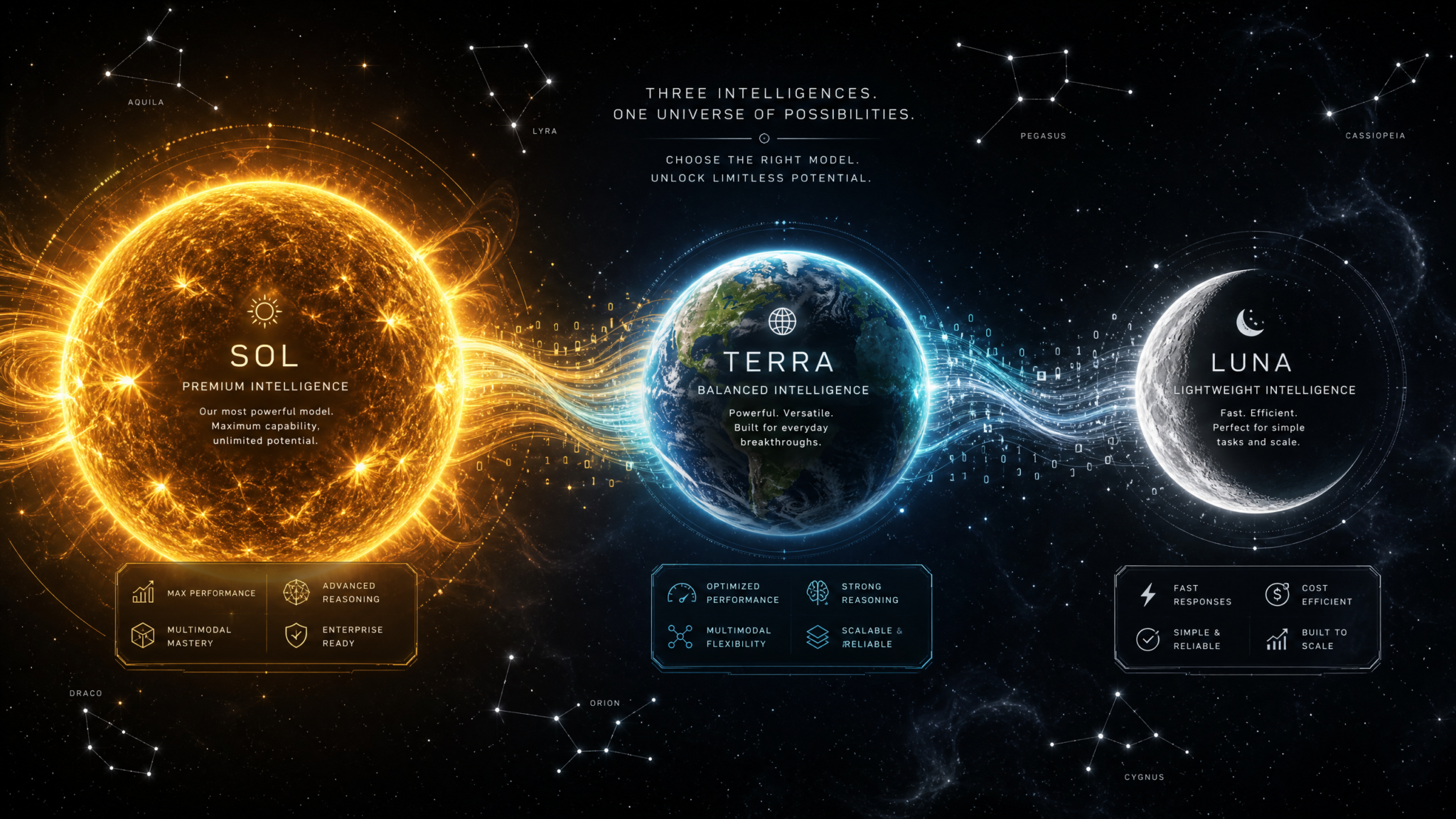
The GPT-5.6 family is offered in three distinct tiers—Sol, Terra, and Luna—engineered to cover a spectrum of capability, cost, and performance tradeoffs without fragmenting the developer experience. Sol serves as the flagship tier, optimized for complex reasoning, biology-aware tasks, and repository-aware coding across large codebases. Terra provides a balanced profile for mainstream enterprise workloads, combining strong performance with pragmatic cost. Luna is tuned for high-volume, simple interactions where throughput and price-per-output dominate.
Beyond raw model quality improvements, GPT-5.6 introduces a unified set of capabilities that align with demanding, real-world deployments: repository-aware coding support (first-party primitives to ingest and reason over multi-repo structures), biology-aware reasoning for biopharma workflows, and multimodal structured reasoning that returns reliable, machine-parseable outputs across text, images, and tabular inputs. Reliability hardening spans deterministic tool calling, schema compliance under load, and more predictable long-context behavior—areas where previous generations, including GPT-5.5, occasionally faltered in production.
For decision-makers, the core takeaways are practical. Choose Sol when the stakes and complexity are high, and exploit the “max” and “ultra” modes to trade latency for stepwise reasoning and better adherence on challenging prompts. Use Terra for the median enterprise case—customer agents, internal knowledge assistants, analytics co-pilots—where you need a strong model at a sensible cost. Rely on Luna for high-traffic, repeatable flows such as FAQ resolution, structured classification, document triage, or summarization queues, with optional fallbacks when edge complexity sneaks in. The migration path from GPT-5.5 to 5.6 is straightforward but rewards rigor: audit prompts, update schema contracts, introduce guardrails for the new reasoning modes, and execute canary rollouts with side-by-side evals before expanding traffic.
In this guide, we map the tiers, capabilities, pricing strategies, and API feature surfaces to concrete enterprise use cases across software engineering, biopharma, financial services, and the public sector. We also position GPT-5.6 against peers—Gemini 3.5 Pro, Claude, and Grok—focusing on practical selection criteria instead of marketing hyperbole. Finally, we present a step-by-step decision framework that helps technical leaders and product owners match their constraints and objectives to the right GPT-5.6 configuration, from Sol “ultra” for discovery science to Luna for contact center deflection at scale.
The three tiers explained: Sol, Terra, and Luna
GPT-5.6’s three-tier lineup intentionally separates capability, cost, and throughput to simplify architectural decisions. Each tier shares a common developer interface but differs in reasoning depth, latency ceilings, and feature toggles. The vendor’s explicit goal is to allow teams to run mixed-tier estates, routing requests to the optimal tier by workload class without maintaining divergent code paths.
Sol: flagship capability
Sol is the flagship tier with the highest overall capability envelope. It is engineered for complex problem-solving, code synthesis across large repositories, biology-aware tasks such as mechanism-of-action analysis or trial protocol scrutiny, and high-integrity reasoning in long-form, multi-step workflows. Sol tends to produce the most coherent chain-of-thought under stringent settings and tolerates ambiguous prompts better by requesting clarifications and verifying intermediate states through tool calls and structured outputs.
- Positioning: best-in-class reasoning, repository-aware coding, and biology-aware analysis.
- Typical workloads: multi-repo refactoring, automated regression triage, protocol and assay summarization, literature-grounded target validation, multi-document strategy synthesis, adjudication for complex claims or compliance checks.
- Performance profile: highest quality, relatively higher latency and cost than Terra and Luna; new “max” and “ultra” modes enable additional thinking time and intermediate verification cycles.
- Reliability stance: strongest schema adherence, tool-calling determinism, and long-context robustness in the family.
Sol “max” and “ultra” modes
For tasks where correctness and explainability outweigh speed, Sol exposes two advanced modes that intentionally trade latency and cost for deeper reasoning:
- Max mode: extends internal thinking time and encourages intermediate hypothesis formation, backtracking on contradictions, and lightweight self-consistency checks before emitting a final answer.
- Ultra mode: adds multiple passes over the prompt and retrieved evidence, structured self-critique on key claims, and targeted tool invocation (e.g., code execution or bio ontology lookups) to validate critical steps before conclusion.
In practice, max is an excellent default for safety-critical tasks with moderate latency budgets, while ultra is suitable for adjudication, regulated outputs, or autonomous agents executing complex, irreversible actions. Both modes are opt-in per request and can be combined with schema enforcement and tool-calling constraints.
Terra: balanced performance
Terra is the pragmatic choice for the majority of enterprise workloads. It maintains strong reasoning performance, multimodal structured outputs, and reliable tool calling without incurring the full compute budget of Sol. For organizations centralizing on one tier for maintainability and cost predictability, Terra is the steady baseline.
- Positioning: near-flagship capabilities at moderate cost and latency.
- Typical workloads: enterprise assistants, knowledge workers’ copilots, analytics and reporting, classification and extraction pipelines, customer support augmentation, vendor and contract review with human-in-the-loop.
- Performance profile: balanced accuracy and speed; can handle multi-step instructions and structured outputs at production scale.
- Reliability stance: solid schema compliance and tool use; best throughput per dollar for heterogeneous workloads.
Luna: speed and cost first
Luna is optimized for throughput and price-per-output. While it does not match Sol’s nuanced reasoning, it excels at high-volume, low-complexity scenarios. Developers commonly pair Luna with routing and selective escalation: straightforward prompts stay on Luna; difficult or ambiguous cases escalate to Terra or Sol to preserve accuracy and user trust.
- Positioning: fast and cost-efficient for simple and repetitive tasks.
- Typical workloads: templated summarization, FAQ deflection, entity extraction with stable schemas, form normalization, basic sentiment and topic classification, document triage, low-risk content generation.
- Performance profile: lowest latency and cost; handles short to medium prompts and constrained schemas efficiently.
- Reliability stance: best when prompts are clear, guardrails are explicit, and tool usage is minimal or deterministic.
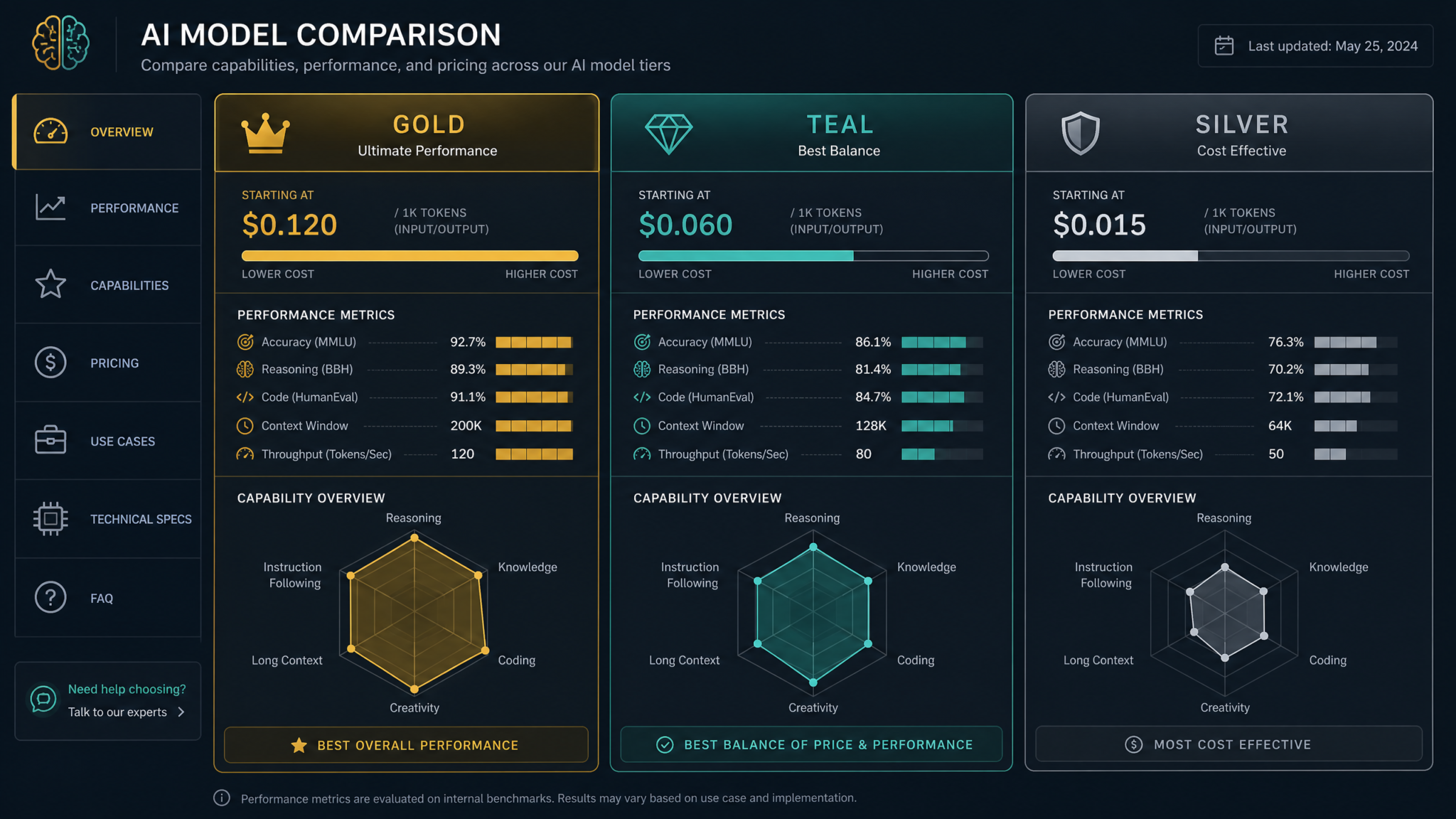
Tier comparison at a glance
| Dimension | Sol | Terra | Luna |
|---|---|---|---|
| Primary value | Highest capability and reliability | Balanced performance and cost | Throughput and price efficiency |
| Reasoning depth | Advanced; supports max/ultra modes | Strong; suitable for most chains | Basic to moderate; keep chains short |
| Repository-aware coding | Best: multi-repo, refactors, tests | Good: single repo or scoped tasks | Limited: small diffs, snippets |
| Biology-aware tasks | Best: mechanistic, protocol, ontology | Good: literature summarization, QC | Limited: glossary and entity tasks |
| Multimodal structured reasoning | Full; robust schema enforcement | Full; minor edge cases under load | Constrained schemas recommended |
| Latency | Higher baseline; tunable with modes | Moderate and predictable | Lowest |
| Cost | Highest per token; mode surcharges | Moderate per token | Lowest per token |
| Best fit | High-stakes, complex, regulated | General enterprise workloads | High-volume, simple tasks |
| Tool-calling determinism | Strongest | Strong | Good with guardrails |
| Long-context robustness | Best in family | Good; prefer targeted retrieval | Conservative contexts |
Technical capabilities in GPT-5.6
GPT-5.6 brings material upgrades over GPT-5.5 in areas that practitioners consistently flagged as mission-critical: repository-awareness for software engineering, biology-aware reasoning in scientific and clinical settings, multimodal structured outputs that stand up to automation, and reliability hardening across schema, tool calls, and long-context behavior. Each improvement translates directly into more trustworthy automation in production.
Repository-aware coding
Traditional code models respond to local snippets. In contrast, GPT-5.6’s repository-aware coding introduces first-class primitives to provide the model with a compressed, navigable representation of one or more repositories—including module dependency graphs, file-level embeddings, code ownership metadata, and recent change history. This enables the model to make decisions aligned with the project’s architecture rather than the myopia of the current file.
- Multi-repo context: ingest multiple repositories with cross-references when changes ripple across services.
- Refactor integrity: propose cohesive refactors with tests that reflect the codebase’s actual layering and domain boundaries.
- Commit plan generation: output structured change plans (diff manifests, impacted tests, migration steps) for CI automation.
Developers provide a “repo map” object alongside the prompt. Sol handles the richest maps; Terra handles smaller or scoped repos; Luna is best for targeted diffs or isolated functions.
{
  "model": "gpt-5_6-sol",
  "reasoning_mode": "max",  // optional: "standard" | "max" | "ultra" (Sol only)
  "input": {
    "task": "Refactor the payment service to isolate currency conversion.",
    "constraints": {
      "lang": ["java", "kotlin"],
      "testing": "must update affected integration tests",
      "arch": "preserve domain events; no direct DB access from controller"
    }
  },
  "repo_map": {
    "repos": [
      {
        "name": "payments-core",
        "graph": "...",         // module dependency summary
        "embeddings_ref": "...",// vector index id
        "recent_commits": ["..."],
        "owners": {"module-a": ["@alice", "@jordan"]},
        "hotspots": ["rates/ExchangeRateProvider.java"]
      }
    ]
  },
  "tools": [
    {"name": "code_search", "schema": {"q": "string"}},
    {"name": "open_pr", "schema": {"title": "string", "diff": "string"}}
  ],
  "response_schema": {
    "type": "object",
    "properties": {
      "plan": {"type": "array", "items": {"type": "string"}},
      "tests_to_update": {"type": "array", "items": {"type": "string"}},
      "risk_notes": {"type": "string"}
    },
    "required": ["plan", "tests_to_update"]
  }
}
This schema enforces machine-parseability so downstream automation (e.g., opening a PR, running CI, creating issues) can proceed without brittle scraping of free-form text. Sol in “ultra” mode will often simulate a small number of validations by calling code_search before finalizing the change plan, reducing integration risk.
Biology-aware reasoning
GPT-5.6 models, especially Sol, are trained and tuned to reason over biomedical ontologies, hierarchies, and evidence types so they do not conflate superficially similar terms or treat all papers as equal. The model distinguishes controlled vocabularies (e.g., MeSH, GO, SNOMED), understands experimental modalities (in vitro vs. in vivo, cohort vs. case study), and can annotate claims with uncertainty levels when data is sparse or contradictory. This is not merely more knowledge but a more disciplined way of handling bioscience evidence.
- Ontology alignment: mapping free text to controlled vocabularies improves retrieval, deduplication, and harmonization.
- Evidence grading: weights randomized controlled trials higher than mechanistic hypotheses when answering clinical questions.
- Protocol scrutiny: detects internal contradictions, missing controls, or endpoints mismatched to hypotheses.
Role: Biology-aware research assistant
Objective: Evaluate whether the observed phenotype (impaired glucose tolerance) could plausibly result from the proposed perturbation (hepatic PPARα inhibition).
Inputs:
– Summary of in vivo mouse study (attached)
– Key measurements: fasting glucose, insulin tolerance test, RNA-seq of liver tissue
– Constraints: Use GO and MeSH terms where appropriate; flag confounders
Output schema (JSON):
{
“mechanistic_hypotheses”: [{“go_term”: “string”, “evidence”: “string”}],
“confounders”: [“string”],
“uncertainty”: “low|medium|high”,
“next_experiments”: [“string”]
}
Sol’s “ultra” will often propose next-step experiments that increase discriminatory power (e.g., isotope tracing, time-course RNA-seq) and justify them with ontology-linked rationale. Terra will produce solid hypotheses and confounders under the schema; Luna should be reserved for glossary-level tasks (e.g., term disambiguation) or entity extraction from abstracts.
Multimodal structured reasoning
GPT-5.6 generalizes beyond text by consuming images, figures, and tabular data while returning structured outputs that are reliable enough to automate. Instead of a free-form description of a chart, you can demand a JSON table with normalized variable names and units, or a caption with confidence estimates and caveats. This is especially useful for operations teams that need deterministic extraction from heterogeneous documents and for analysts requiring consistent data pipelines from PDFs and screenshots.
- Schema-first responses: request strong schemas with required fields; models prioritize adherence without collapsing into “refusal” states.
- Tabular normalization: recognize headers, merged cells, units, and footnotes; preserve provenance for audits.
- Visual-localized reasoning: reference specific regions in an image when describing evidence (“panel B shows…”).
{
  "model": "gpt-5_6-terra",
  "input": {
    "task": "Extract trial endpoints from the attached PDF tables and figures.",
    "attachments": [
      {"type": "pdf", "ref": "s3://docs/trial_results.pdf"}
    ]
  },
  "response_schema": {
    "type": "object",
    "properties": {
      "primary_endpoints": {
        "type": "array",
        "items": {"type": "object", "properties": {
          "name": {"type": "string"},
          "unit": {"type": "string"},
          "value": {"type": "number"},
          "arm": {"type": "string"},
          "page_ref": {"type": "string"}
        }, "required": ["name", "value", "arm", "page_ref"]}}
      },
      "notes": {"type": "string"}
    },
    "required": ["primary_endpoints"]
  }
}
Reliability hardening
Reliability in GPT-5.6 is not a single feature but a collection of behaviors that stack to reduce operational surprises:
- Schema compliance: fewer silent violations and better error messaging when a schema cannot be satisfied under constraints.
- Deterministic tool calls: clearer delineation between free-text generation and function invocations; improved adherence to function signatures.
- Long-context stability: reduced “lost in the middle” errors and stronger adherence to instructions toward the tail of long inputs.
- Self-check scaffolding: especially in Sol’s “max” and “ultra,” the model runs light-touch internal checks for contradictions or missing steps before finalizing outputs.
Prompting patterns that unlock 5.6
The jump from 5.5 to 5.6 rewards structured prompting. Developers who formalize objectives, constraints, and schemas see disproportionate gains. To make the most of Sol’s modes, explicitly partition tasks into steps, state acceptance criteria, and give the model a way to ask for clarifications or to call tools to validate assumptions.
Role: Staff software engineer copilot
Objective: Produce a minimal, safe migration plan from Redis-based locks to Postgres advisory locks across services A, B, and C.
Constraints:
– Zero downtime
– Rollback within 5 minutes
– Do not modify consumer APIs
Steps:
1) List risks and monitoring signals
2) Generate phased rollout with guardrails
3) Emit PR plan per service
Output: JSON with keys [risks, signals, phases[], pr_plan{}]
Notes: Ask for missing details before planning; call tool “catalog_lookup” to fetch service ownership.
The US government approval process for GPT-5.6 involved extensive safety testing and evaluation. Our coverage of the GPT-5.6 government approval details the regulatory pathway that Sol, Terra, and Luna navigated to receive Commerce Department clearance for public deployment.
API access and feature surface
All three GPT-5.6 tiers share a consistent developer interface for chat completions, tool calling, and structured outputs. Differences show up as capability flags, quotas, and optional parameters—especially around Sol’s reasoning modes. Treat the surface as a superset: code against the shared baseline, then opt into extras when the tier supports them.
Endpoints and patterns
- Chat/completions: primary interface for instruction-following with optional schema and tool calls.
- Batch and async: queue high-volume jobs for offline processing; useful with Luna and Terra for ETL and document pipelines.
- Files and retrieval: upload artifacts and build retrieval indices that are tier-agnostic but benefit Sol’s deeper reasoning.
- Streaming: token streaming for conversational UX; event streaming for tool-call orchestration.
# HTTP example (generic)
POST /v1/chat/completions
Authorization: Bearer <token>
Content-Type: application/json

{
  "model": "gpt-5_6-terra",
  "messages": [
    {"role": "system", "content": "You are a precise assistant that uses tools responsibly."},
    {"role": "user", "content": "Summarize Q2 performance by segment from this CSV."}
  ],
  "attachments": [{"type": "csv", "ref": "s3://reports/q2.csv"}],
  "tools": [{"name": "sql", "schema": {"query": "string"}}],
  "response_schema": {"type": "object", "properties": {"summary": {"type": "string"}}}
}
Feature differences by tier
| Feature | Sol | Terra | Luna |
|---|---|---|---|
| Reasoning modes | standard, max, ultra | standard | standard |
| Repo-aware primitives | Full (multi-repo, deep graphs) | Scoped (single repo, light graphs) | Minimal (snippets, small diffs) |
| Biology-aware reasoning | Advanced ontologies + evidence grading | General biomedical reasoning | Terminology-level tasks |
| Multimodal structured outputs | Full with strict schema adherence | Full with minor caveats | Constrained schemas recommended |
| Tool-calling determinism | Highest | High | Moderate |
| Batch processing | Yes (optimized for large jobs) | Yes | Yes (best $/throughput) |
| Quota ceilings | Highest; requires approval | High | Highest throughput per cost |
| Safety and compliance knobs | Advanced filters and audit trails | Standard enterprise controls | Standard controls |
SDK usage
// Pseudocode SDK
const client = new Client({ apiKey: process.env.API_KEY });

const resp = await client.chat.completions.create({
  model: "gpt-5_6-sol",
  reasoning_mode: "ultra",
  messages: [
    { role: "system", content: "You are a meticulous compliance analyst." },
    { role: "user", content: "Assess whether the attached policy violates our standard." }
  ],
  attachments: [{ type: "pdf", ref: "s3://legal/policy.pdf" }],
  response_schema: {
    type: "object",
    properties: {
      violations: { type: "array", items: { type: "string" } },
      confidence: { type: "string", enum: ["low","medium","high"] }
    },
    required: ["violations"]
  }
});

console.log(resp.output);
Note the reasoning_mode parameter above: only Sol honors “max” and “ultra.” Calls to Terra or Luna with unsupported modes are expected to default to “standard” and return a warning, allowing a single code path across tiers.
Pricing and cost optimization
While public price sheets vary by commitment, geography, and negotiated enterprise terms, GPT-5.6 follows familiar constructs: input and output token pricing by tier, optional surcharges for extended reasoning in Sol “max” and “ultra,” storage and retrieval pricing for files and indices, and volume-based discounts or reserved capacity for predictable workloads. The modernization in 5.6 is less about novelty and more about giving teams fine-grained levers to match the right cost profile to each job without sacrificing a unified developer surface.
Pricing model components
- Input tokens: tokens consumed by prompts, system messages, tools, and attachments metadata.
- Output tokens: tokens generated in the response, including hidden chain-of-thought that is not billed directly but may correlate with reasoning modes; structured outputs typically reduce output length variance.
- Reasoning mode surcharges (Sol): “max” and “ultra” often apply incremental cost due to additional compute and verification passes.
- File storage and retrieval: costs for hosting documents and retrieval indices; may be discounted under reserved capacity.
- Batch and async discounts: lowered rates for non-interactive latency budgets in high-volume ETL and back-office pipelines.
Cost planning formulas
Rather than rely on generic multipliers, successful teams model expected cost using simple, auditable formulas:
# Per-request cost (expected)
expected_cost = (input_tokens * input_rate) + (output_tokens * output_rate) + mode_surcharge

# Monthly budget per workload
monthly_cost = request_volume_per_month * expected_cost

# Tier router savings
savings = (volume_luna * (cost_sol - cost_luna)) + (volume_terra * (cost_sol - cost_terra)) - routing_overhead

# Cache hit rate impact (prompt or response caching)
net_cost = (1 - hit_rate) * monthly_cost + cache_storage_cost
Cost optimization strategies that actually work
- Multi-tier routing: classify requests by complexity signal (prompt heuristics, historical fallbacks, user segment) and route to Luna, Terra, or Sol accordingly.
- Guardrails and schemas: constrain outputs to required fields to cap response length and reduce invalid-answer retries.
- Prompt compression and retrieval: prefer retrieval with targeted snippets over unbounded context stuffing; compress system prompts.
- Caching: cache both requests and normalized outputs for stable queries and batch workloads; propagate cache keys across microservices.
- Batch and async: defer non-interactive jobs to batch endpoints with pricing advantages.
- Mode gating: reserve Sol “ultra” for human-in-the-loop or high-stakes steps; default to “standard” or Terra unless confidence signals demand escalation.
- Distillation: train small internal classifiers to pre-filter, label, or normalize inputs before LLM steps.
| Technique | Where it helps | Expected impact | Operational risk |
|---|---|---|---|
| Tier routing (Luna→Terra→Sol) | Mixed workloads | Large cost reduction with minimal quality loss | Misrouting can degrade answer quality |
| Schema-first outputs | Automation pipelines | Fewer retries, shorter outputs | Overly strict schemas can cause refusals |
| Retrieval + compression | Long-context prompts | Lower input tokens, better relevance | Must maintain index freshness |
| Response caching | Static queries | Direct cost savings | Stale responses if TTL is too long |
| Batch processing | ETL, document queues | Discounted rates, higher throughput | Complexity in job orchestration |
| Mode gating (“ultra” on demand) | Safety-critical steps | Quality boost where it matters | Latency spikes if overused |
Reference router pattern
function route(request):
  score = complexity_score(request)     # lexical cues, length, schema difficulty, user role
  if score <= 0.3: return "gpt-5_6-luna"
  if score <= 0.7: return "gpt-5_6-terra"
  return "gpt-5_6-sol"

function select_mode(model, request):
  if model != "gpt-5_6-sol": return "standard"
  if is_high_stakes(request): return "ultra"
  if is_moderate_risk(request): return "max"
  return "standard"
Organizations currently running GPT-5.5 workloads will need a structured migration approach. The complete GPT-4.5 to GPT-5.5 migration checklist documents breaking changes, prompt updates, and testing strategies that provide a proven framework applicable to the GPT-5.6 transition.
Migration guide from GPT-5.5 to GPT-5.6
Upgrading from GPT-5.5 to 5.6 is generally straightforward thanks to compatible APIs, but you will get better outcomes by treating the migration as a small program with explicit gates. The key differences—repository-aware primitives, biology-aware reasoning, stricter schema adherence, and Sol’s reasoning modes—call for updated prompts, contracts, and evaluations. Below is a staged plan that has proven effective across early adopters.
1) Preparation and audit
- Inventory: enumerate all LLM-dependent features, prompts, and schemas; tag them by business criticality and latency budget.
- Dependencies: catalog tool-call schemas, retrieval indices, caches, and policy filters tied to 5.5 assumptions.
- Baseline: capture a snapshot of 5.5 performance—quality metrics, error rates, token consumption, and latency distributions.
2) Update contracts and prompts
- Schema strictness: 5.6 tends to obey strict schemas better; tighten “required” fields and replace free-form outputs with structured ones where possible.
- Prompt structure: reframe vague system prompts into objective/constraints/steps sections; explicitly authorize clarification questions and tool usage.
- Repo-aware: introduce repo maps where code tasks cross file boundaries; provide change history and module graphs.
3) Introduce Sol “max” and “ultra” selectively
- Define criteria: codify what counts as high stakes in your domain (e.g., financial exposure, legal ramifications, scientific integrity).
- Budget guardrails: cap the percentage of calls that can use “max” or “ultra” and monitor their latency and cost drift.
- UX expectations: communicate that some tasks take longer with “ultra”; display progress indicators and retry guidance.
4) Evaluation harness and canaries
- Golden sets: craft representative test cases with ground-truth or expert-reviewed answers, including adversarial examples.
- Side-by-side runs: run 5.5 vs 5.6 (and Sol modes) and score outputs by accuracy, schema validity, and tool-call correctness.
- Canary rollout: start with 5–10% traffic to 5.6; expand only after meeting SLOs for correctness, latency, and cost.
5) Observability and fallbacks
- Structured logging: capture model, mode, token counts, schema pass/fail, tool-call success, and retrieval stats per request.
- Fallbacks: define deterministic fallbacks—e.g., if Luna violates schema twice, escalate to Terra; if Terra flags uncertainty, route to Sol “max.”
- Human-in-the-loop: preserve review steps for regulated or irreversible actions; log provenance for audits.
Code-level diffs
// GPT-5.5 (simplified)
client.create({
  model: "gpt-5_5-pro",
  messages,
  tools,
  // free-form output parsing downstream
});

// GPT-5.6 (structured + modes)
client.create({
  model: "gpt-5_6-terra",
  messages,
  tools,
  response_schema: mySchema,         // strict JSON
  // upgrade to Sol on-demand:
  reasoning_mode: isHighStakes ? "max" : "standard"
});
6) Decommission and knowledge transfer
- Remove dead code paths and feature flags after stabilization.
- Update runbooks, playbooks, and incident response procedures to reflect new failure modes and observability signals.
- Brief stakeholders on cost/quality deltas and the handshake between routing, caching, and Sol modes.
Use case matching by industry
GPT-5.6’s tiering shines when mapped to concrete workloads. Below we translate the Sol/Terra/Luna tradeoffs into deployment archetypes across four sectors where early adopters have seen strong traction.
Software engineering
Modern software delivery is an orchestration of code synthesis, refactoring, testing, and change management. Repository-aware coding makes 5.6 a compelling co-pilot for larger organizations where changes must respect architecture boundaries and organizational norms.
- Sol: multi-repo refactors, incident root-cause analyses, test-suite hardening, design doc synthesis with architecture constraints.
- Terra: PR reviewer suggestions, single-repo scaffolding, issue triage, documentation standardization.
- Luna: snippet generation, code comments, lint rule suggestions, basic template migrations.
Pattern: a router tags tasks via signals from the issue tracker (e.g., subsystem, size estimate). Simple tickets get Luna-generated scaffolds; Terra reviews PRs and synthesizes documentation; Sol handles cross-service migrations with “max” or “ultra” providing additional checks.
Biopharma
Biology-aware reasoning makes GPT-5.6 especially relevant to discovery and development functions. Ontology alignment and evidence grading reduce the risk of false certainty and support traceable decisions that regulators and IRBs can scrutinize.
- Sol: mechanism-of-action mapping, target validation synthesis, protocol critique, safety signal adjudication; “ultra” for critical go/no-go summaries.
- Terra: literature triage, trial registry harmonization, adverse event normalization, medical writing drafts under schema constraints.
- Luna: glossary extraction, named-entity recognition across abstracts, template-based case report form population.
Architecture: ingestion pipelines extract references and metadata; a retrieval layer indexes controlled vocabulary mappings; Sol “ultra” answers high-stakes questions with structured uncertainty fields. Terra handles routine harmonization; Luna processes high-volume entity extraction.
Financial services
Financial workloads prize determinism, auditability, and latency under burst. GPT-5.6’s reliability improvements and schema-first design are a natural fit, provided guardrails and human-in-the-loop are respected for high-exposure steps.
- Sol: complex policy compliance checks, multi-document risk synthesis, SAR narrative drafting with evidence links, model governance documentation.
- Terra: KYC document normalization, internal knowledge assistants, portfolio commentary drafts with structured templates.
- Luna: transaction note triage, FAQ agents, basic classification and enrichment of statements.
Execution: align cost with risk by enabling Sol “max” only when materiality thresholds are met (e.g., transactions above certain limits or conflicts flagged). Terra anchors day-to-day assistants; Luna supports high-traffic customer cues.
Public sector
Public-sector teams face stringent data controls, transparency mandates, and budget constraints. GPT-5.6’s tiering supports mixed estates: sensitive adjudications on Sol with governance overlays, citizen-facing services on Terra or Luna with strict schema outputs and content filters.
- Sol: policy impact analysis, grant application scoring with rubric alignment, legal summary generation with citations and uncertainty notes.
- Terra: constituent service assistants, case management triage, document standardization across agencies.
- Luna: information routing, form validation, templated notifications and translations under vetted glossaries.
Implementation: ensure ingestion and prompts are logged and discoverable for audits; combine retrieval from vetted document repositories with schema-only outputs. Route sensitive determinations to Sol with “ultra” if required by policy, while insulating personal data through redaction pipelines before model ingestion.
Enterprise deployment considerations
Tier selection is only one dimension of a successful deployment. Governing data flows, managing risk, and building observability-first systems are equally critical. GPT-5.6’s design smooths many edges, but disciplined engineering and policy scaffolding remain the difference between pilot success and production reliability.
Data governance and safety
- Data classification: label inputs and outputs (e.g., public, internal, confidential, PHI/PII) and restrict tiers and modes accordingly.
- Redaction and minimization: strip or mask sensitive fields before prompts; reconstruct after responses when safe.
- Provenance: attach source URIs and hashes to extracted facts; preserve for audits and dispute resolution.
- Content filters: calibrate filters per tier; Sol may run looser content filters upstream with stricter output validation downstream.
# Example policy snippet (YAML-style pseudocode)
policies:
  - name: "PHI Guardrail"
    applies_to: ["health-app"]
    classify: ["phi", "pii"]
    actions:
      - redact: ["dob", "ssn", "address"]
      - route: {"if": "phi", "then": "gpt-5_6-sol", "mode": "max"}
      - require_schema: true
      - log_provenance: true
    audit:
      - reviewers: ["privacy_officer@org"]
      - retention_days: 365
Observability and SLOs
- Metrics: tokens in/out, schema pass rate, tool-call success, latency per mode, escalation rate by tier, cache hit rate.
- Tracing: correlate prompts, retrieval, tool calls, and model outputs under a single trace ID for post-incident analysis.
- Alerting: set tier- and mode-specific thresholds (e.g., “ultra” latency p95, schema violation spikes) to catch regressions early.
Retrieval and knowledge management
Long prompts are not a strategy. Centralize retrieval pipelines that feed lean, relevant context to the model. Favor structured indices with ontology alignment when operating in regulated or scientific domains. Cache heavily accessed artifacts and use freshness policies to trigger re-indexing on updates.
Security posture
- Secrets hygiene: never inline keys in prompts; use signed URLs for attachments.
- Egress control: restrict tool-calling functions to whitelisted endpoints; validate payloads on the server side.
- Threat modeling: consider prompt injection, data exfiltration via tool calls, and supply-chain risks in retrieval pipelines.
Operating models
- Platform team: centralize SDKs, routers, schemas, eval harnesses; expose paved roads for app teams.
- Guardrail catalogs: reusable validators for schema checks, citation presence, and harmful-content detection.
- FinOps: periodic reviews of token consumption by service and by tier; enforce budgets via routing caps and cache policies.
Playbooks and internal training
For teams evaluating Sol tier capabilities against existing options, understanding the GPT-5 Pro feature set provides important context. Our deep dive into GPT-5 Pro covers every feature, benchmark, and use case, establishing the baseline from which GPT-5.6 Sol delivers its improvements.
Competitive landscape
Enterprises rarely choose a single model family; they mix and match based on capability, policy, and cost. GPT-5.6 enters a market with credible alternatives: Gemini 3.5 Pro, Claude, and Grok. While the exact leaderboard depends on domain and prompt design, a few practical patterns can guide selection and portfolio strategy.
Model family overview
- Gemini 3.5 Pro: strong across multimodal tasks and tight integration with a broader cloud ecosystem; notable for long-context capabilities and productivity tooling hooks.
- Claude: widely regarded for guardrails, refusal behavior in risky contexts, and balanced reasoning with cooperative conversational style.
- Grok: tuned for speed and real-time contexts; excels where latency and freshness are paramount.
GPT-5.6 positions Sol as the deep-reasoning flagship with domain-aware upgrades (repository and biology), Terra as the well-balanced default for the enterprise middle, and Luna as a cost-optimized, high-throughput engine for simple flows. The family’s distinctive bet is the combination of disciplined structured outputs, repository and ontology awareness, and opt-in “max/ultra” reasoning.
Comparative view
| Criterion | GPT-5.6 (Sol/Terra/Luna) | Gemini 3.5 Pro | Claude | Grok |
|---|---|---|---|---|
| Deep reasoning options | Sol “max/ultra” for extended thinking | Strong baseline reasoning | Balanced reasoning with strong guardrails | Optimized for speed; concise reasoning |
| Repository-aware coding | First-class repo maps and change plans | Good coding with ecosystem integrations | Good code assistance; conservative changes | Fast code suggestions; tight feedback loops |
| Biology-aware tasks | Ontology and evidence grading in Sol | General biomedical support | Strong safety and summarization | Real-time orientation; domain varies |
| Multimodal structured outputs | Schema-first across tiers | Robust multimodal features | Consistent, safe outputs | Fast, concise outputs |
| Throughput per dollar | Luna optimized; Terra balanced | Competitive; varies by plan | Competitive; depends on usage | High throughput focus |
| Policy and audit tooling | Enterprise-grade, schema + provenance | Strong with cloud-native controls | Notable guardrails and refuse patterns | Lightweight and fast |
Most enterprises will conduct bake-offs in their specific domain: coding agents on real repositories, regulated summaries with uncertainty fields, and large-batch ETL. GPT-5.6’s advantage grows as prompts become structured, schemas strict, and tool calls central to the workflow. Conversely, if the workload is latency-dominant and schema-light, a portfolio that includes Grok or similar may make sense. The objective is not ideology but fit-for-purpose selection backed by data and governance.
Access 40,000+ AI Prompts for ChatGPT, Claude & Codex — Free!
Subscribe to get instant access to our complete Notion Prompt Library — the largest curated collection of prompts for ChatGPT, Claude, OpenAI Codex, and other leading AI models. Optimized for real-world workflows across coding, research, content creation, and business.
Decision framework
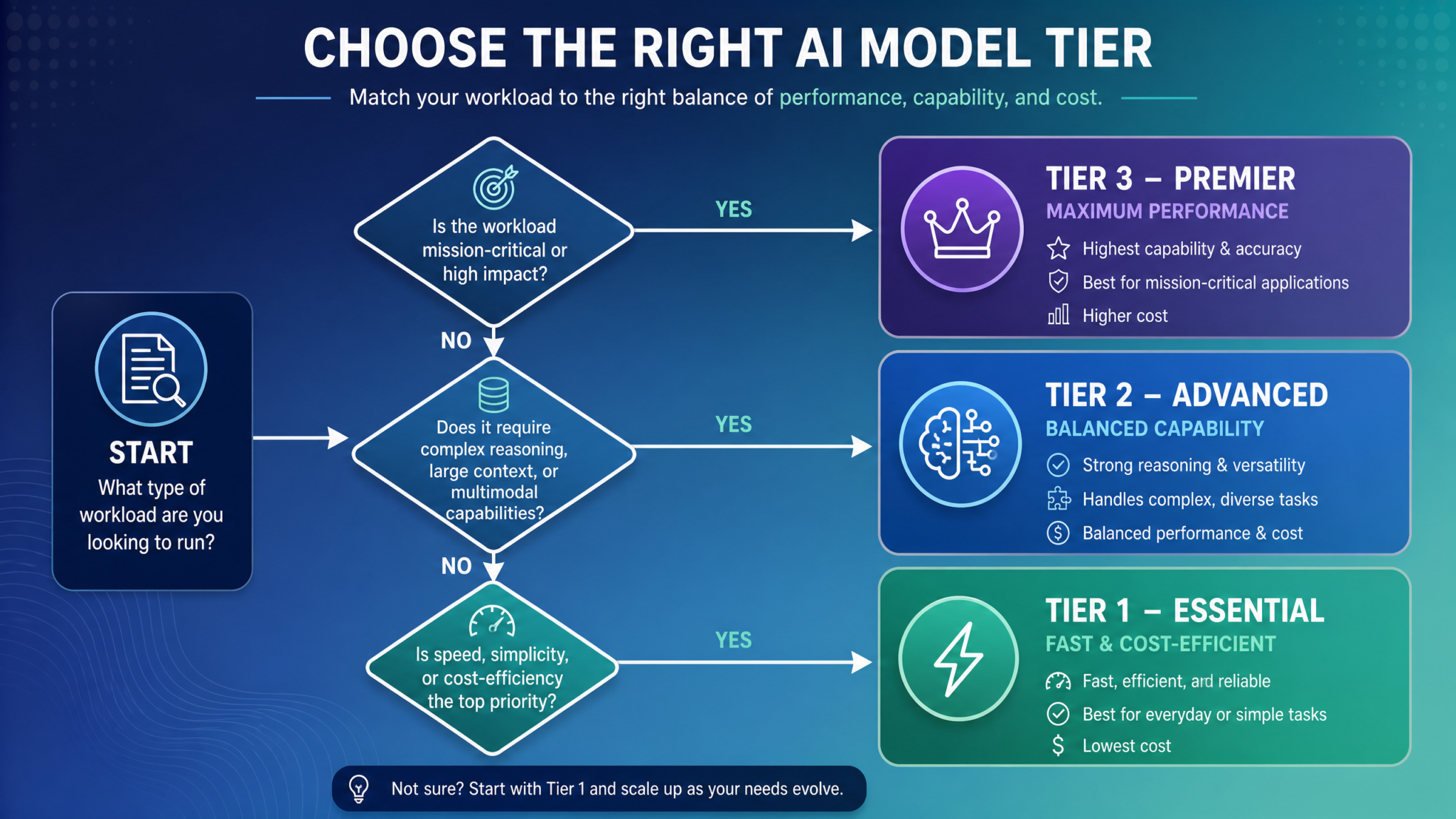
Adopting GPT-5.6 successfully is less about chasing the “most powerful” model and more about an honest accounting of constraints, objectives, and risk posture. Below is a concise framework you can apply to greenfield and migration projects alike.
Step 1: Define constraints and stakes
- What is the harm if the model is wrong? Quantify with scenarios and dollar or safety impact.
- What latency budget do users tolerate? Separate interactive from batch.
- What are the data constraints (PII/PHI/regulatory)? Document must/should/won’t for retention, egress, and auditing.
Step 2: Characterize workloads
- Simple vs. complex: does the task require multi-step reasoning or ontology-aware synthesis?
- Volume: high-traffic FAQs and classification vs. low-volume, high-value adjudications.
- Structure: are responses consumed by humans, machines, or both? Can you enforce schemas?
Step 3: Map to tiers and modes
- Sol: high-stakes, complex; enable “max” or “ultra” only where justified by risk/benefit.
- Terra: default for mixed enterprise workloads; strong balance of quality and cost.
- Luna: high-volume, simple; behind a router with escalation rules to Terra/Sol.
Step 4: Architect guardrails and observability
- Schemas: enforce strict or strong schemas for machine consumption; validate before side effects.
- Tool calls: whitelist functions; sandbox execution; capture inputs/outputs for audits.
- Tracing: implement end-to-end traces; define SLOs for accuracy, latency, and cost; alert on anomalies.
Step 5: Pilot, measure, and scale
- Run canaries with clear success criteria; compare 5.5 versus 5.6 and Sol modes as needed.
- Instrument costs; validate routing and caching assumptions with real traffic.
- Scale deliberately: increase traffic only after hitting SLOs; deprecate legacy code; update governance artifacts.
Step 6: Institutionalize learning
- Codify “what worked” in internal playbooks; templatize prompts and schemas by task.
- Share dashboards with stakeholders; create a cadence for model and mode re-evaluation.
- Keep a small R&D lane to test upcoming features without destabilizing production.
Closing perspective
GPT-5.6 arrives with a clean tiering model—Sol for depth, Terra for balance, Luna for scale—and a set of production-minded upgrades: repository-aware coding, biology-aware reasoning, multimodal structured outputs, and reliability hardening. Combined with Sol’s “max” and “ultra” modes, these features allow teams to calibrate performance and safety to the task at hand rather than force-fit everything into a single setting. The operational recommendation is simple: adopt structure everywhere—schemas, prompts, tool contracts—and bring a router to a tiered estate. With that foundation, the migration from GPT-5.5 to 5.6 becomes a quality and cost upgrade, not just a version bump.
