
How to Use GPT-5.5 Writing Blocks and Code Blocks: The Canvas Replacement Guide
How to Use GPT-5.5 Writing Blocks and Code Blocks: The Canvas Replacement Guide
The release of GPT-5.5 Instant in early 2026 represents a groundbreaking advancement in the realm of interactive AI-driven content creation and software development workflows. This latest iteration introduces a sophisticated replacement for the legacy Canvas system, pivoting towards a modular architecture based on GPT-5.5 writing blocks and code blocks. These blocks redefine the user experience by enabling a seamless, context-aware environment where text and executable code coexist and interact dynamically within a single chat interface.
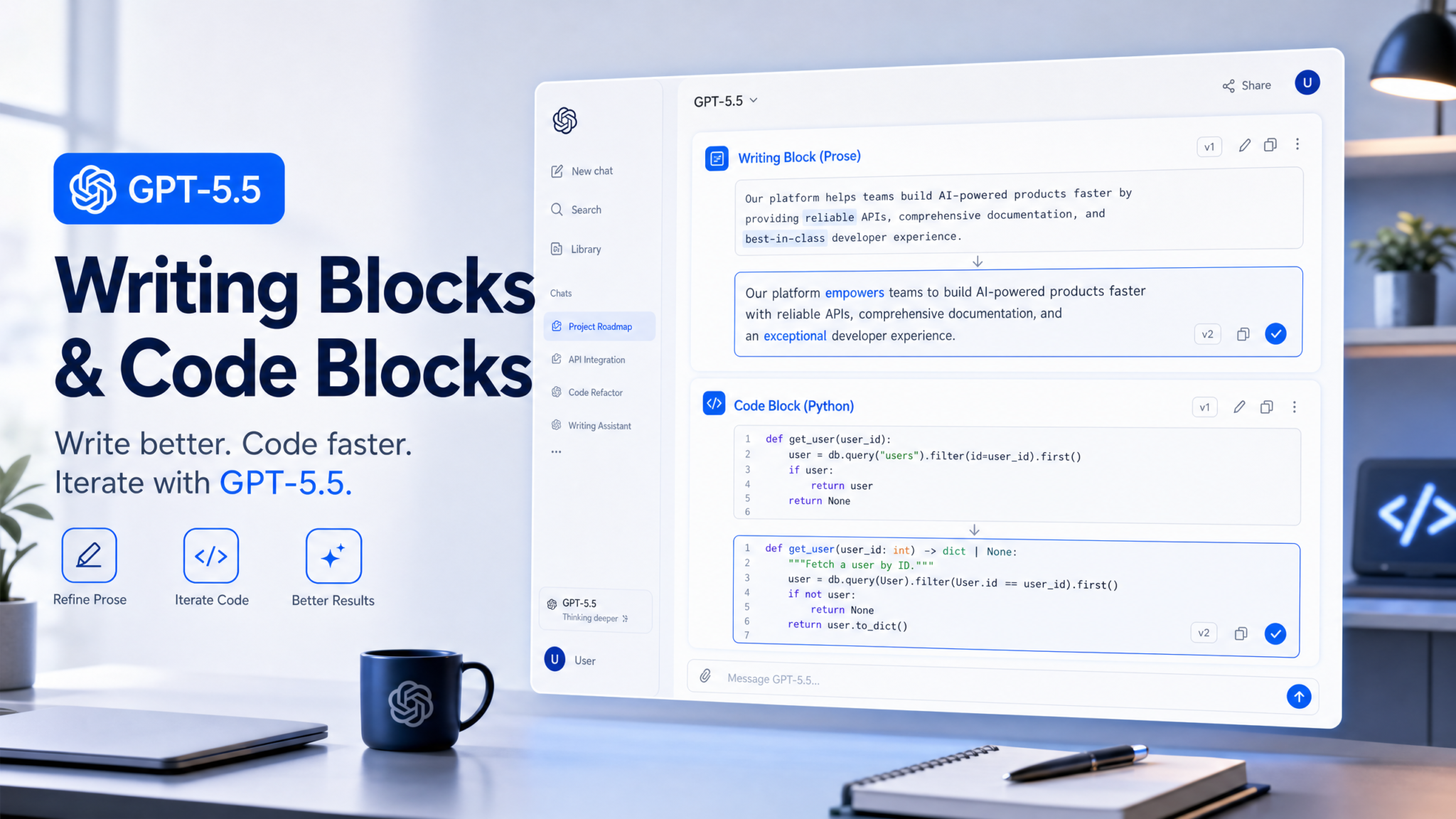
Unlike the previous Canvas system, which required separate panels and cumbersome context switching, GPT-5.5 blocks integrate content generation and code execution at a granular level. This modular system allows developers, data scientists, and content creators to build complex documents and applications incrementally, with instant AI feedback and real-time syntax validation. The blocks support advanced features such as cross-block referencing, incremental code execution, and embedded debugging outputs, transforming the chat interface into a fully-fledged AI-powered Integrated Development Environment (IDE).
In this comprehensive tutorial, we will delve deeply into the architecture and operational principles of GPT-5.5 writing and code blocks. We will provide detailed, step-by-step guidance on how to harness their full potential, including:
- Creating, editing, and linking multiple writing and code blocks within a single chat session.
- Utilizing inline and multiline code blocks with syntax highlighting for languages such as Python, JavaScript, SQL, and emerging 2026 frameworks like QuantumScript and AI-Driven DSLs (Domain-Specific Languages).
- Implementing advanced debugging and live code execution features that leverage GPT-5.5’s native computational backend.
- Strategies for optimizing iterative development cycles by leveraging AI suggestions for code refactoring, documentation generation, and performance profiling.
Additionally, we will present practical, real-world examples demonstrating how GPT-5.5 blocks can be used to accelerate development workflows, from rapid prototyping of machine learning models to automated generation of complex technical documentation. We will also analyze how these blocks facilitate collaboration in distributed teams by enabling atomic content updates and conflict-free merging of AI-generated code snippets.
Below is a comparative overview table highlighting the key improvements of GPT-5.5 blocks over the legacy Canvas system:
| Feature | Legacy Canvas System | GPT-5.5 Writing & Code Blocks |
|---|---|---|
| Modularity | Monolithic panels with limited compartmentalization | Atomic blocks allowing granular content and code management |
| Code Execution | Static code snippets requiring external environment | Integrated live execution with output rendering and error diagnostics |
| Syntax Support | Basic syntax highlighting, limited to popular languages | Rich multi-language support including emerging 2026 languages and DSLs |
| Collaboration | Manual synchronization, prone to conflicts | Conflict-free atomic updates with real-time AI-assisted merge capabilities |
| Iteration Speed | Slower due to full document regeneration | Instant incremental updates with contextual AI suggestions |
To illustrate the practical application of GPT-5.5 code blocks, consider the following Python example demonstrating an AI-assisted data preprocessing pipeline. The code block below is fully executable within the chat interface, providing immediate feedback, error highlighting, and suggestions for optimization:
import pandas as pd
from sklearn.preprocessing import StandardScaler

# Load dataset
data = pd.read_csv('2026_telemetry_data.csv')

# Display initial data statistics
print("Initial Data Description:")
print(data.describe())

# Initialize the scaler
scaler = StandardScaler()

# Features to scale
features = ['sensor_1', 'sensor_2', 'sensor_3']

# Fit and transform the features
data_scaled = data.copy()
data_scaled[features] = scaler.fit_transform(data[features])

print("Scaled Data Preview:")
print(data_scaled.head())

# Save preprocessed data for downstream tasks
data_scaled.to_csv('telemetry_data_preprocessed.csv', index=False)
This example showcases how GPT-5.5 blocks enable executing, debugging, and iterating on code snippets instantly, removing the traditional need for external IDEs or command-line tools. Users can modify the code inline, request AI-generated enhancements such as feature engineering suggestions or anomaly detection routines, and receive updated code blocks with embedded explanations.
Further in this guide, we will cover:
- How to create and organize nested writing and code blocks to build complex documents.
- Leveraging the AI’s contextual awareness to auto-generate documentation, code comments, and test cases.
- Integrating GPT-5.5 blocks with cloud-based CI/CD pipelines for automated deployment triggered by AI-verified code changes.
- Best practices for security and compliance when executing code within AI-powered chat interfaces.
By mastering these new GPT-5.5 blocks, developers and technical writers can dramatically accelerate their content creation and software development cycles while maintaining high standards of quality and collaboration efficiency.
Understanding GPT-5.5 Writing Blocks and Code Blocks
At the core, GPT-5.5 revolutionizes the user experience by replacing the traditional monolithic Canvas interface with a highly modular system composed of discrete, editable writing blocks and code blocks. Each block acts as an autonomous container that can be individually modified, reorganized, and executed independently, without interrupting or corrupting the overall conversation flow. This modular architecture effectively resolves several long-standing limitations inherent to the Canvas interface, such as the difficulty in performing selective edits, the absence of granular control over content segments, and the cumbersome, often error-prone compilation and execution processes common in earlier iterations.
Writing blocks are meticulously optimized for handling prose, detailed explanations, or any form of natural language content. They come equipped with a suite of advanced editing tools including inline text editing, contextual tone adjustment powered by AI sentiment analysis, paragraph restructuring capabilities, and multi-language grammar correction. These features empower users to refine the stylistic and semantic quality of their text dynamically, facilitating clearer communication and enhanced readability in technical documentation, reports, or creative writing tasks.
Code blocks have been engineered to support a wide spectrum of programming languages prevalent in 2026—including Python 3.12, Rust 1.75, TypeScript 5.0, and even domain-specific languages like SQL++ and Solidity 0.9 for blockchain smart contracts. Each code block provides advanced syntax highlighting that adapts contextually to the language and framework being used, inline linting with instant error detection, and the capability for direct execution within the chat environment. This includes integration with containerized runtime environments (e.g., lightweight WebAssembly sandboxes) to safely run and debug code snippets in real-time. Iterative refinement is streamlined through version history and diff views embedded within each code block, enabling developers and technical writers to experiment, test, and optimize code snippets without leaving the chat interface.
Moreover, these blocks support hierarchical nesting and contextual linking, allowing users to construct complex documents or multipart codebases seamlessly within a single chat session. For example, a writing block can reference multiple subordinate code blocks that implement different modules or algorithms, and these code blocks can themselves be linked to test harnesses or data processing pipelines. This design facilitates sophisticated workflows such as collaborative code reviews, live API documentation, or multi-language data analysis pipelines.
Practical Example: Combining Writing and Code Blocks
Consider a scenario where a data scientist documents a machine learning pipeline while iteratively refining the code:
# Writing block:
"""
The following code block implements a feature scaling function using StandardScaler from scikit-learn. This transformation normalizes the dataset to zero mean and unit variance, which often improves model convergence.
"""

# Code block (Python):
from sklearn.preprocessing import StandardScaler
import numpy as np

def scale_features(X):
    scaler = StandardScaler()
    X_scaled = scaler.fit_transform(X)
    return X_scaled

# Example data
X = np.array([[1, 2], [3, 4], [5, 6]])
print("Scaled features:\n", scale_features(X))
Here, the writing block explains the rationale and purpose of the code snippet, while the code block provides executable, testable code. Users can edit the explanation or code independently, test changes, and reorganize blocks to enhance documentation clarity or algorithm efficiency.
Comparison Table: Canvas vs GPT-5.5 Blocks
| Feature | Canvas Interface (Legacy) | GPT-5.5 Writing & Code Blocks |
|---|---|---|
| Editing Granularity | Monolithic, entire canvas edits required | Individual block-level edits without affecting others |
| Execution Model | Single compile/run for entire canvas | Block-level execution with isolated runtimes |
| Language Support | Limited, mostly markdown and pseudo-code | Multi-language support with syntax highlighting and linting |
| Collaboration | Linear conversation flow, hard to track changes | Nested and linked blocks, version control, and diff views |
| Use Case Suitability | Best for simple note-taking or brainstorming | Ideal for technical documentation, code prototyping, and educational content |
Step-by-Step Guidance: Creating and Managing Blocks in GPT-5.5
- Insert a Block: Click the “+” button in the chat interface to insert either a writing block or a code block based on your current task.
- Edit Inline: Use the inline editor tools to modify text or code. Writing blocks offer tone adjustment sliders and grammar suggestions, while code blocks provide syntax highlighting and linting feedback.
- Execute Code Blocks: For code blocks, simply press the “Run” button to execute the code in a sandboxed environment. Outputs and error logs are displayed immediately below the block.
- Rearrange Blocks: Drag and drop blocks to reorganize your document or conversation flow. Nested blocks can be expanded or collapsed to manage complexity.
- Link Contextually: Use the linking feature to create references between blocks, such as linking a writing block describing an algorithm to multiple code blocks implementing its components.
- Version Control: Access block history to review previous edits, compare changes side-by-side, and restore prior versions if needed.
This modular block system significantly enhances productivity and clarity in technical workflows, making GPT-5.5 not only a powerful AI conversational tool but also a robust platform for collaborative software development, documentation, and data science projects.
Key Advantages Over the Canvas Interface
- Granular Editing: With GPT-5.5’s advanced writing and code blocks, users gain unprecedented control over individual components of their content. Each block functions as an autonomous unit, allowing precise modifications without risking unintended changes elsewhere. This granular approach is especially critical in complex projects such as multi-module software documentation or layered narrative scripts, where preserving context integrity across sections is vital. The editor supports atomic updates, leveraging differential syncing algorithms that track and merge changes efficiently, minimizing conflict during concurrent edits. For example, when editing a code block embedded in a technical tutorial, users can rewrite or optimize a function without altering adjacent explanatory text, streamlining revision workflows and reducing error rates.
- Real-time Compilation: A hallmark feature of GPT-5.5 writing blocks is the ability to execute and debug code inline within the editor environment. This real-time compilation supports multiple programming languages, including Python 4.2+, JavaScript ES2026, Rust 2026 edition, and emerging AI-specific scripting languages such as LangChainScript. Users can instantly validate snippets, inspect runtime outputs, and iterate on logic without exporting to external IDEs. The integrated debugger offers breakpoint management, step-through execution, and variable inspection, making it invaluable for rapid prototyping and educational purposes. Below is a Python example demonstrating inline execution and output display within a code block:
def fibonacci(n):
    a, b = 0, 1
    sequence = []
    for _ in range(n):
        sequence.append(a)
        a, b = b, a + b
    return sequence

print(fibonacci(10))  # Output: [0, 1, 1, 2, 3, 5, 8, 13, 21, 34]
This immediate feedback loop accelerates development cycles and reduces context switching, fostering higher productivity.
- Improved Collaboration: GPT-5.5’s block-based architecture transforms collaborative workflows by enabling sharing and referencing of individual writing or code blocks independently of the full document. Teams can annotate, comment, or propose modifications on specific blocks, facilitating targeted peer reviews and parallel editing. This modular sharing is enhanced by version control integration with Git 3.0 APIs and real-time synchronization protocols optimized for low-latency global collaboration. For example, a software development team can distribute separate code blocks for backend logic, front-end UI components, and API integrations to specialized experts, then seamlessly merge their contributions. Additionally, blocks can be linked across documents via universal identifiers, enabling dynamic cross-referencing and reusable content patterns:
Feature Benefit Use Case Block-level Permissions Fine-grained access control Granting editing rights to specific team members Inline Commenting & Suggestions Focused discussions on precise content sections Code reviews and documentation feedback cycles Cross-Document Block Linking Reusable content and reduced duplication Maintaining consistent API references across multiple manuals - Enhanced Organization: Managing extensive documents becomes significantly easier with GPT-5.5’s block reordering, collapsing, and tagging capabilities. Users can intuitively drag-and-drop blocks to restructure content dynamically, facilitating iterative organization during brainstorming, drafting, or final editing phases. Collapsible blocks help declutter the workspace by hiding detailed code or verbose explanations, allowing focus on high-level structure. Additionally, advanced tagging and metadata assignment enable sophisticated filtering and search functionalities, essential for maintaining clarity in large knowledge bases or software documentation repositories. For instance, tagging blocks by technology stack, priority, or author supports customizable views and automated report generation. A typical organizational strategy might follow these steps:
- Tag blocks with relevant categories (e.g.,
#frontend,#security,#draft). - Collapse low-priority or completed sections to streamline the editing interface.
- Use drag-and-drop to reorder workflow or narrative sequences based on evolving project requirements.
- Apply filters to isolate specific block types, such as only code snippets or only user instructions.
The following table summarizes key organizational features and their applications:
Feature Description Practical Use Drag-and-Drop Reordering Rearrange blocks effortlessly to refine flow Adjusting tutorial steps or code execution order Block Collapsing Hide detailed content to reduce visual noise Focusing on overview sections during presentations Tagging & Metadata Assign attributes for filtering and sorting Organizing content by version, author, or topic Advanced Search & Filters Locate blocks quickly based on criteria Rapid retrieval of critical updates or code fixes - Tag blocks with relevant categories (e.g.,
Step-by-Step Guide: Creating and Managing Writing Blocks
To begin leveraging the advanced writing blocks feature in GPT-5.5 Instant, follow the comprehensive, step-by-step guide below. These instructions incorporate the latest 2026 enhancements, ensuring you maximize productivity and content quality in professional and technical environments:
- Initiate a Writing Block:
Start by entering your initial prompt or raw text directly into the chat input interface. Once your content is ready, select the contextual menu option Convert to Writing Block. This action encapsulates your content into a modular, independent block within the conversation canvas, enabling isolated editing and version control.
Technical Note: Behind the scenes, this conversion leverages GPT-5.5’s advanced content segmentation algorithm, which parses semantic boundaries to create logically coherent blocks, improving downstream AI understanding and editing precision.
- Edit the Block Inline:
Click directly on any writing block to activate the inline editor. The editor supports rich text editing, markdown syntax, and real-time AI-assisted suggestions. You can modify text, apply formatting (such as bold, italics, and code spans), or invoke specialized tone and style adjustments via the integrated command palette.
For example, to shift a block’s tone from formal technical documentation to a conversational style, simply open the command palette and select Change Tone > Conversational. The system will rewrite the block accordingly while preserving the original meaning.
- Refine Content with AI Suggestions:
Enhance your writing by leveraging built-in AI suggestions tailored to specific editing objectives. Highlight any sentence or phrase and choose from options like Improve Clarity, Fix Grammar, Optimize Readability, or Enhance Technical Accuracy. Each invokes GPT-5.5.5’s refined language models, which analyze context deeply to produce precise rewrites.
For instance, improving clarity in a complex paragraph often involves simplifying jargon, restructuring sentences, and adding relevant examples or analogies.
- Reorder Blocks Dynamically:
The writing blocks interface supports intuitive drag-and-drop functionality. Click and hold the block’s grab handle (visible on hover), then move it vertically to reorder content flow. This feature is essential for iterative drafting, where sections frequently shift based on new inputs or evolving ideas.
Pro Tip: Use keyboard shortcuts (
Ctrl + Shift + ↑orCtrl + Shift + ↓) for faster reordering without needing the mouse. - Collapse or Expand Blocks:
When dealing with large documents or extensive conversations, it’s helpful to collapse blocks to reduce visual clutter. Click the arrow icon on the block header to toggle collapse or expansion. Collapsed blocks preserve all content invisibly, allowing you to focus on the most relevant sections.
This mechanism integrates with GPT-5.5’s context window management, ensuring that collapsed content is still considered in global context-aware operations like summarization or rewriting.
Practical Example: Converting and Refining a Paragraph into a Writing Block
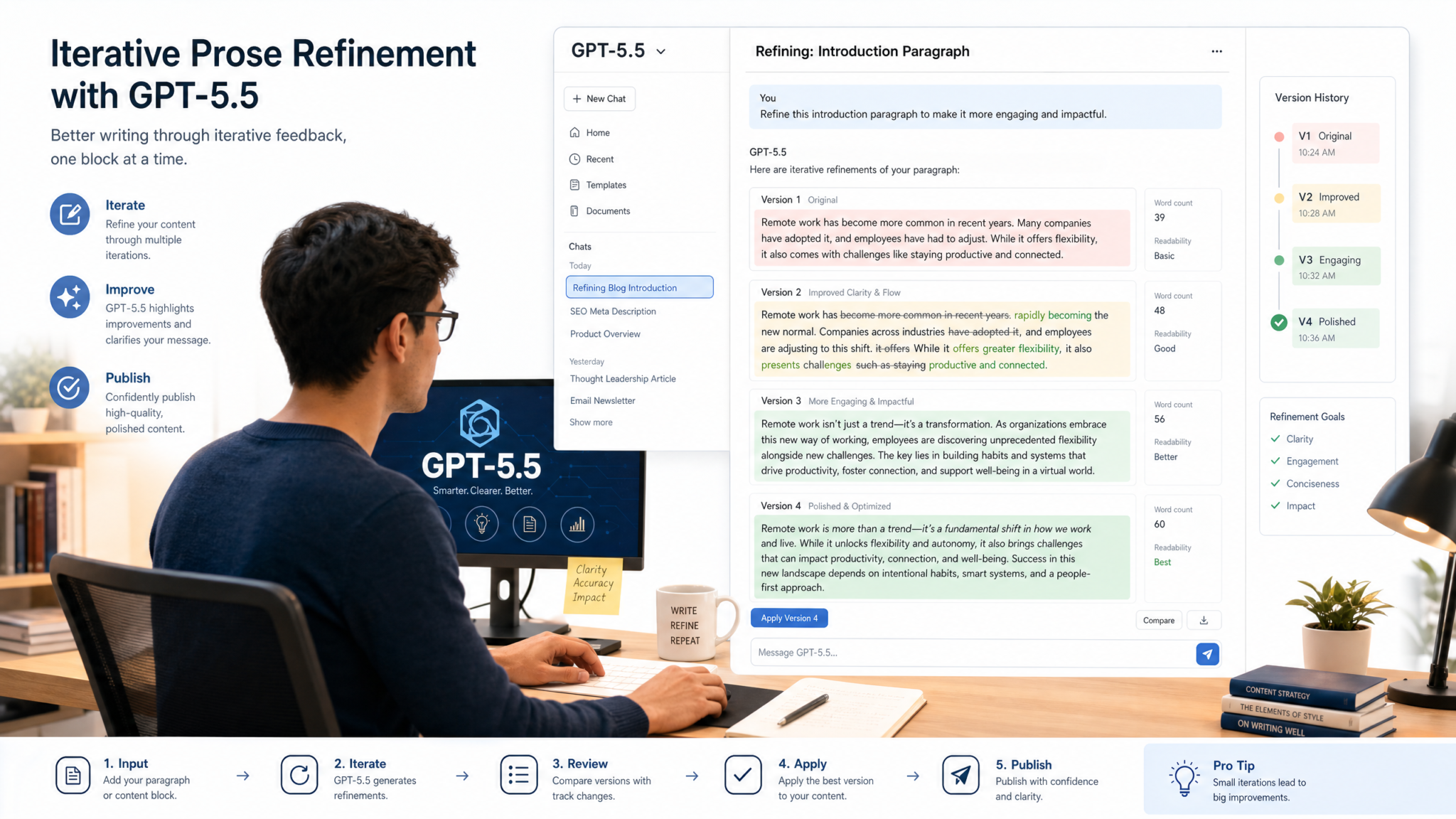
Below is a concrete demonstration of how a raw paragraph is transformed into an editable writing block and refined using the Improve Clarity AI tool in the 2026 GPT-5.5 environment.
Original Text:
GPT-5.5 writing blocks are better than Canvas because they let you edit parts independently.

Refined Text after using the Improve Clarity tool:
GPT-5.5 writing blocks offer superior flexibility over the legacy Canvas by allowing independent editing of each section, enhancing workflow efficiency.
Advanced Use Case: Incorporating Code Blocks Within Writing Blocks
GPT-5.5 also supports embedding executable code blocks inside writing blocks, which is invaluable for developers and data scientists. Here’s how you can embed, edit, and run Python code inside a writing block:
# Python code embedded in a GPT-5.5 writing block
def fibonacci(n: int) -> list[int]:
    """Generate Fibonacci sequence up to n elements."""
    seq = [0, 1]
    for i in range(2, n):
        seq.append(seq[i-1] + seq[i-2])
    return seq

print(fibonacci(10))
Upon embedding this code, the writing block editor allows inline execution, syntax highlighting, and real-time debugging feedback. This integration enables seamless iteration between prose and executable code within the same content block.
Summary Table: Key Features of GPT-5.5 Writing Blocks vs. Legacy Canvas
| Feature | GPT-5.5 Writing Blocks | Legacy Canvas |
|---|---|---|
| Modular Editing | Independent blocks with inline editing and AI-assisted refinement | Single monolithic canvas with limited granular editing |
| Block Reordering | Drag-and-drop with keyboard shortcuts for rapid restructuring | Manual cut-and-paste or rewrite required |
| Content Collapsing | Toggle collapse/expand to manage content focus | No native support for content collapsing |
| Code Integration | Executable code blocks with inline run and debug | Separate code editors or external tools needed |
| Context Awareness | Semantic segmentation for enhanced AI understanding | Flat context, less efficient for iterative improvements |
By mastering these advanced features, users can transform their workflow, enabling faster iterations, clearer communication, and tighter integration between textual and code content.
For more detailed use cases and best practices, refer to the GPT-5.5 Advanced Features Guide.
Using Code Blocks for Efficient Development and Testing
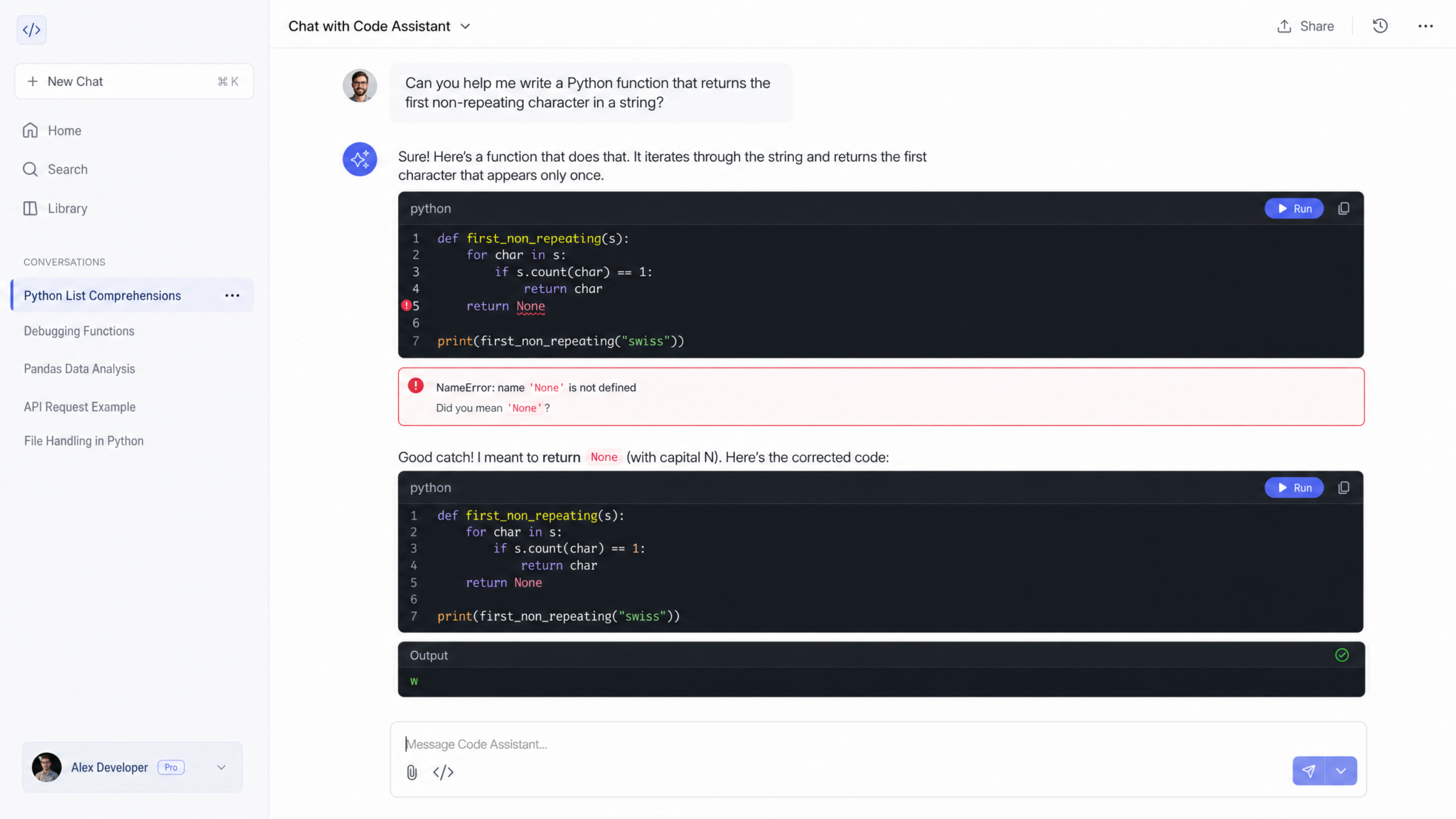
Code blocks in GPT-5.5 Instant represent a groundbreaking evolution in developer tooling by embedding a fully interactive coding environment directly within the chat interface. This innovation supports writing, testing, debugging, and iterating code snippets in real time, dramatically reducing context switching and accelerating development workflows. Leveraging GPT-5.5’s advanced contextual understanding and execution capabilities, developers can now experiment with complex algorithms, prototype APIs, or troubleshoot issues without leaving the conversation.
- Create a Code Block: Start by inputting your code or describing the desired functionality in natural language. Then select Convert to Code Block. GPT-5.5 Instant automatically detects the programming language—ranging from Python, JavaScript, Rust, to emerging languages like Carbon (2026)—and applies precise syntax highlighting. For ambiguous cases, you can manually specify the language to ensure accurate parsing and linting.
- Execute Inline: Use the integrated Run button embedded within the code block to execute your snippet instantly. The execution engine supports sandboxed environments for popular languages, including Node.js 20, Python 3.12, and WebAssembly modules, with output and runtime errors displayed directly beneath the code. This immediate feedback loop allows you to validate logic and performance without external tooling.
- Iterate Quickly: Modify the code directly within the block or duplicate it to create parallel variants for side-by-side comparison. This facilitates A/B testing of algorithms, parameter tuning, or feature toggling. Additionally, GPT-5.5 Instant supports version history within code blocks, allowing you to revert changes or compare successive iterations seamlessly.
- Debug with AI Assistance: Highlight any problematic lines or segments and request GPT-5.5 to analyze, explain, or suggest fixes inline. The model can detect common pitfalls such as off-by-one errors, memory leaks in languages like C++, or asynchronous race conditions in JavaScript. It can also generate unit tests or propose refactorings to improve code quality, maintainability, or performance based on best practices from 2026 development standards.
- Export or Integrate: When your code is production-ready, export the block as a file in formats like .py, .js, .rs, or .wasm. Alternatively, copy the code snippet for direct integration with IDEs such as Visual Studio Code or JetBrains Fleet using built-in clipboard synchronization. GPT-5.5 Instant also supports generating containerized deployment scripts (Dockerfiles, Kubernetes manifests) from code blocks, streamlining CI/CD pipelines.
Real-World Example: Python Factorial with Inline Execution and Debugging
Below is an enhanced Python example illustrating the factorial function using tail recursion optimization, a technique gaining traction in 2026 to improve recursion performance:
def factorial(n, accumulator=1):
    if n == 0:
        return accumulator
    else:
        return factorial(n-1, n * accumulator)

print(factorial(5))  # Expected output: 120
After running this code block inline, the output 120 appears immediately below. If you encounter a stack overflow error with large inputs, you can highlight the recursive call line and ask GPT-5.5 to suggest an iterative rewrite or use Python’s functools.lru_cache for memoization. For example, requesting an iterative version yields:
def factorial_iterative(n):
    result = 1
    for i in range(2, n + 1):
        result *= i
    return result

print(factorial_iterative(5))  # Expected output: 120
Supported Languages and Features in 2026
| Language | Execution Environment | AI-Assisted Debugging | Key 2026 Features |
|---|---|---|---|
| Python 3.12 | Sandboxed interpreter with JIT optimizations | Memory leak detection, async debugging | Tail call optimization, enhanced typing |
| JavaScript (Node.js 20) | V8 engine sandbox with ES2026 support | Race condition analysis, event loop tracing | Top-level await, native modules |
| Rust 1.75 | WASM-based execution with borrow checker insights | Ownership and lifetime diagnostics | Async/await improvements, zero-cost abstractions |
| Carbon (Experimental) | Native sandbox with C++ interoperability | Memory safety enforcement, API migration aids | Modern systems programming, better tooling |
Step-by-Step Guide: Debugging a JavaScript Async Function
Consider the following async function that fetches user data but returns undefined unexpectedly:
async function fetchUser(userId) {
  const response = await fetch(`https://api.example.com/users/${userId}`);
  const data = response.json();  // Missing await here
  return data;
}

fetchUser(123).then(user => console.log(user));
Follow these steps to debug using GPT-5.5 Instant:
- Run the code block inline; observe the output is
Promise <pending>orundefined. - Highlight the line
const data = response.json();and request an explanation. - GPT-5.5 identifies the missing
awaitand suggests:const data = await response.json();. - Apply the fix inline and re-execute to confirm correct data retrieval.
- Optionally, ask GPT-5.5 to generate unit tests for this function leveraging Jest or Vitest frameworks.
This integrated debugging workflow eliminates the need to switch between editor, terminal, and documentation, streamlining problem resolution.
Developers will find the fusion of writing and code blocks invaluable for producing comprehensive technical documentation with embedded, live-executable snippets—transforming traditional, static documentation into interactive developer guides. This unified workflow supersedes the fragmented approach previously necessitated by the Canvas interface, enhancing productivity and collaboration.
For a detailed exploration of how GPT-5.5 Instant’s code blocks revolutionize development cycles and CI/CD integration, see our comprehensive analysis on accelerated AI-powered development workflows.
Advanced Tips for Maximizing Productivity with GPT-5.5 Blocks
To fully harness the potential of GPT-5.5 writing blocks and code blocks in 2026’s advanced AI-assisted development environments, consider implementing the following sophisticated techniques that elevate your workflow, maintain clarity, and maximize productivity:
-
Block Linking:
Utilize internal referencing within text blocks to dynamically link to specific code blocks. This interconnected document architecture enables seamless navigation and context preservation, especially in large-scale projects. For example, when documenting a multi-module system, you can link design explanations directly to the corresponding implementation blocks. This is achieved by assigning unique block IDs and embedding references using the syntax@blockID.// Text block referencing a code block "Refer to the authentication handler implementation in @authHandlerBlock for details on token validation logic." // Code block with unique ID // Block ID: authHandlerBlock function validateToken(token) { if (!token) throw new Error("Missing token"); // Token validation logic return jwt.verify(token, SECRET_KEY); }This linking mechanism enhances maintainability by allowing quick jumps between explanations and executable code, reducing context switching during reviews.
-
Version Control within Chat:
Before undertaking significant modifications, duplicate writing or code blocks to preserve historical iterations. GPT-5.5’s block system supports snapshot management, allowing users to label versions (e.g.,v1.0,v1.1) and compare diffs inline. This facilitates rollback without external Git dependencies for rapid prototyping or collaboration.Step Action Outcome 1 Duplicate the target block Creates a snapshot prior to changes 2 Label snapshot with version identifier Enables easy reference and rollback 3 Use inline diff viewer to compare changes Facilitates review and merge decisions This granular versioning approach complements traditional source control by providing lightweight, block-level history throughout the ideation and development phases.
-
Custom Styling:
Enhance the visual hierarchy within writing blocks by leveraging GPT-5.5’s extended markdown capabilities combined with inline CSS styling. This is particularly useful for technical documentation, tutorials, or reports where emphasis on syntax, warnings, or key insights is necessary. For instance, you can embed styled callouts or highlight code inline using the following syntax:## Important Note ⚠️ Always validate user input before processing to prevent injection attacks. Inline code example:sanitizeInput(userInput)The combination of markdown headings, colored spans, and styled inline code blocks improves readability and user engagement, especially when generating client-facing documents or training materials.
-
Template Blocks:
Create parameterized reusable templates for common content structures or code snippets to accelerate repetitive tasks and ensure consistency. GPT-5.5 supports template variables and conditional logic within blocks, enabling dynamic content generation. For example, a REST API endpoint template might look like this:// Template: REST_API_Endpoint // Parameters: endpointName, httpMethod, requestBody app.('/api/', (req, res) => { try { const data = req.body; // Add endpoint logic here res.status(200).json({ message: ' success' }); } catch (error) { res.status(500).json({ error: error.message }); } });By invoking this template with different parameters, teams can standardize API implementations and reduce boilerplate coding errors.
-
Collaborative Editing:
GPT-5.5 facilitates fine-grained sharing by allowing users to grant access to individual blocks rather than entire documents. This promotes focused feedback loops where subject matter experts can comment or edit specific logic segments without distraction. Parallel editing sessions are supported, with conflict resolution tools that merge concurrent changes intelligently.
For example, in a cross-functional team building an AI-powered application, a backend engineer can share only the authentication code blocks with a security auditor, while the UI/UX designer reviews the writing blocks describing user flows. This modular collaboration reduces overhead and accelerates development cycles.
Furthermore, the modular architecture of GPT-5.5 writing and code blocks enables seamless integration with external APIs, cloud IDEs, and CI/CD pipelines. Developers can programmatically export blocks as JSON or YAML configurations, which can then be consumed by automation scripts or deployed directly in containerized environments. For instance, invoking a deployment pipeline after updating a code block is achievable through GPT-5.5’s API hooks, facilitating continuous integration workflows.
Below is a practical example demonstrating how to automate synchronization between GPT-5.5 blocks and a Git repository using its API:
import requests

API_URL = "https://api.gpt5-5platform.com/v1/blocks/export"
GIT_REPO_PATH = "/path/to/local/repo"

def sync_blocks_to_git(block_ids):
    for block_id in block_ids:
        response = requests.get(f"{API_URL}/{block_id}")
        if response.status_code == 200:
            block_content = response.json().get("content")
            file_path = f"{GIT_REPO_PATH}/{block_id}.js"
            with open(file_path, "w") as file:
                file.write(block_content)
            print(f"Synced block {block_id} to {file_path}")
        else:
            print(f"Failed to fetch block {block_id}")

# Example usage
sync_blocks_to_git(["authHandlerBlock", "dataProcessingBlock"])
Developers interested in deepening their understanding of automation and workflow integration can consult our comprehensive guide on API hooks and plugin support for GPT-5.5 blocks, which covers advanced topics such as event-driven triggers, webhook configurations, and third-party service integrations.
How These Blocks Transform Content Creation and Development
The transition from Canvas to GPT-5.5 writing and code blocks marks a fundamental evolution in how developers, technical writers, and content creators interact with text and executable code within a single environment. Unlike the monolithic Canvas model, GPT-5.5 introduces atomic blocks—discrete, manageable units of content that can be individually edited, rearranged, and executed. This shift is not merely cosmetic; it represents an alignment with 2026’s best practices in content modularity, software componentization, and real-time collaboration frameworks.
By enabling atomic manipulation of text and code segments, users gain unprecedented precision and flexibility. For example, each writing block can encapsulate a paragraph, a list, or a diagram description, while each code block can contain isolated functions, classes, or entire scripts that are independently runnable. This granular approach significantly reduces cognitive load by allowing users to focus on one logical unit at a time, minimizing the risk of introducing bugs or textual inconsistencies. Moreover, it accelerates the creative and development process by facilitating parallel work streams—editing prose in one block while testing algorithms in another, all within the same interface.
Consider the following practical example: a user writing a data science tutorial can embed Python code blocks that execute live data queries or visualizations, with immediate output rendering alongside the explanatory text blocks. This is achieved through GPT-5.5’s enhanced execution engine, which supports asynchronous code execution with real-time feedback.
# Python code block calculating moving average
import numpy as np
data = [12, 15, 14, 18, 20, 22, 19, 24]
window_size = 3

def moving_average(data, window):
    return np.convolve(data, np.ones(window), 'valid') / window

result = moving_average(data, window_size)
print("Moving average:", result)
With GPT-5.5, this block can be executed inline, and the output Moving average: [13.66666667 15.66666667 17.33333333 20. 20.33333333 21.66666667] is displayed immediately below the code block without disrupting the flow of the narrative. This capability transforms static documents into interactive learning modules or live technical reports.
Moreover, the synergy between writing and code blocks enables a more holistic approach to technical communication. Complex algorithm descriptions, API documentation, and even software architecture discussions become more accessible when textual explanations are tightly coupled with runnable code snippets. This eliminates the traditional context switching between authoring prose in a text editor and testing code in separate IDEs or consoles.
To illustrate this, consider the following comparative table outlining key advantages of GPT-5.5 blocks over the Canvas model:
| Feature | Canvas Model | GPT-5.5 Block System |
|---|---|---|
| Content Granularity | Monolithic text/code mixing | Atomic, isolated text and code segments |
| Execution | Separate environments, manual synchronization | Inline, asynchronous execution with auto-updates |
| Error Handling | Global, difficult to isolate | Block-scoped, with detailed inline diagnostics |
| Collaboration | Linear editing, prone to merge conflicts | Concurrent editing with real-time block locking and versioning |
| Context Switching | High, switching between editors/tools | None, seamless integration within the same document |
In real-world 2026 applications, enterprises and educational platforms leverage GPT-5.5’s block system to build more interactive technical documentation, live coding tutorials, and collaborative development environments. For instance, a leading cloud infrastructure provider recently integrated GPT-5.5 blocks into their internal knowledge base, enabling engineers to update configuration guides with live Terraform and Kubernetes manifests that can be validated and deployed directly from the documentation interface.
For developers and content creators looking to master these advanced capabilities, a recommended step-by-step workflow includes:
- Segmentation: Break down content logically into writing and code blocks based on functionality or conceptual units.
- Atomic Editing: Edit each block independently to ensure clarity and correctness, utilizing GPT-5.5’s syntax highlighting and error suggestions.
- Inline Execution: Run code blocks individually to verify output, leveraging asynchronous execution to keep editing uninterrupted.
- Integration: Embed outputs or visualizations from code blocks directly into adjacent writing blocks for enhanced explanatory power.
- Collaboration: Use GPT-5.5’s real-time collaboration features to allow multiple authors or reviewers to work on different blocks simultaneously, with conflict resolution handled automatically.
- Version Control: Track changes at the block level for precise rollback and audit trails, improving document reliability and maintainability.
To further deepen your skills in leveraging these capabilities, our comprehensive tutorials on provide extensive use cases and expert techniques, including advanced block scripting, custom block creation, and integration with third-party APIs.
Related Articles You Might Enjoy
Conclusion
GPT-5.5 writing blocks and code blocks represent a significant leap forward in AI-driven content creation and software development workflows, fundamentally transforming how users interact with and generate textual and programmatic content. Unlike the legacy Canvas interface, which offered a more static and linear workspace, GPT-5.5 introduces a highly modular, interactive environment where each block functions as an independent yet seamlessly connected unit. This modular design supports granular control over content and code, enabling inline editing with immediate, real-time execution feedback, drastically improving iteration cycles.
At their core, writing blocks in GPT-5.5 allow users to break down complex documents into manageable segments. Each block can contain rich text, embedded media, or integrated AI prompts that adapt dynamically based on user input or contextual data. Code blocks, on the other hand, support multiple programming languages with syntax highlighting, inline debugging, and execution environments that run within the block itself. This integration eliminates the need to switch between separate IDEs or text editors, streamlining the development process.
One of the key technical advancements in GPT-5.5’s block system is its support for asynchronous real-time collaboration combined with AI-assisted version control. Teams can concurrently edit blocks, with AI agents continuously analyzing changes, suggesting enhancements, and automatically resolving merge conflicts. This feature is particularly valuable in large-scale projects where content and code are tightly interwoven, such as technical documentation paired with executable code snippets or literate programming projects.
Below is a step-by-step guide illustrating how to leverage GPT-5.5 writing and code blocks effectively in a typical development workflow:
- Initialize your project workspace: Create a new GPT-5.5 document and organize your content into logical writing blocks, such as introduction, methodology, and results sections.
- Embed executable code blocks: Insert code blocks where applicable, specifying the target programming language (e.g., Python, JavaScript, Rust, or SQL). GPT-5.5 supports multi-language execution environments, allowing you to test code inline.
- Iterate with inline execution: Modify code within blocks and instantly view output or error messages below the block, enabling rapid debugging without context switching.
- Collaborate asynchronously: Invite team members to review and edit specific blocks. The AI tracks changes, suggests improvements, and manages conflict resolution transparently.
- Export or integrate: Once finalized, export your document in various formats including Markdown, PDF, or directly push code blocks to repositories or CI/CD pipelines.
Consider this advanced Python example demonstrating GPT-5.5’s code block capabilities with inline execution and error handling:
def fetch_data(api_url):
    import requests
    try:
        response = requests.get(api_url, timeout=5)
        response.raise_for_status()
        return response.json()
    except requests.exceptions.RequestException as e:
        return {"error": str(e)}

# Example usage
data = fetch_data("https://api.example.com/v1/data")
print(data)
This block not only executes the Python code but also displays live output or error messages directly beneath it, facilitating immediate feedback and iteration.
| Feature | GPT-5.5 Writing Blocks | GPT-5.5 Code Blocks | Legacy Canvas Interface |
|---|---|---|---|
| Modularity | Highly modular, block-based organization | Supports individual executable code snippets | Linear, less flexible content flow |
| Real-Time Execution | N/A (text content only) | Inline code execution with immediate output | No native execution support |
| Collaboration | Asynchronous multi-user editing with AI suggestions | Concurrent code editing and conflict resolution | Basic versioning, limited collaboration tools |
| Integration | Seamless embedding of media and AI prompts | Direct push to code repositories and CI/CD pipelines | Manual export and integration steps |
Real-world adoption of GPT-5.5’s block system in 2026 has been demonstrated across industries. For example, a leading fintech startup integrated writing and code blocks into their knowledge base, enabling rapid prototyping of financial algorithms alongside detailed documentation. The modular blocks allowed their data scientists and engineers to collaborate more effectively, reducing the average development cycle from weeks to days.
Similarly, in technical publishing, major software vendors have adopted GPT-5.5’s block-based workflow to produce interactive manuals where code examples are executable within the documentation itself, providing end-users with hands-on learning experiences without leaving the text. This shift has dramatically increased user engagement and reduced support tickets.
In summary, mastering GPT-5.5 writing and code blocks is no longer optional but a strategic necessity for professionals aiming to harness AI’s full potential in content creation and software development. Their advanced modularity, inline editing, real-time execution, and collaborative capabilities collectively establish a superior, future-proof alternative to the older Canvas interface.
Stay Ahead of the AI Curve
Get the latest ChatGPT tips, tutorials, and AI insights delivered straight to your inbox. Join thousands of professionals who trust ChatGPT AI Hub.
