
ChatGPT as a Commerce Superapp: How OpenAI’s Ad Integration, Agent Marketplace, and Codex Plugins Create a New AI Economy
ChatGPT as a Commerce Superapp: How OpenAI’s Ad Integration, Agent Marketplace, and Codex Plugins Create a New AI Economy
By Markos Symeonides | June 20, 2026
In early 2026, something quietly significant happened inside ChatGPT’s interface. A small cohort of users began seeing what appeared to be sponsored responses — contextually relevant product suggestions, service recommendations, and brand-adjacent content woven into the conversational flow. OpenAI confirmed the tests were real. The company had begun exploring advertising as a revenue layer, and the implications for the entire AI industry were immediate and profound.
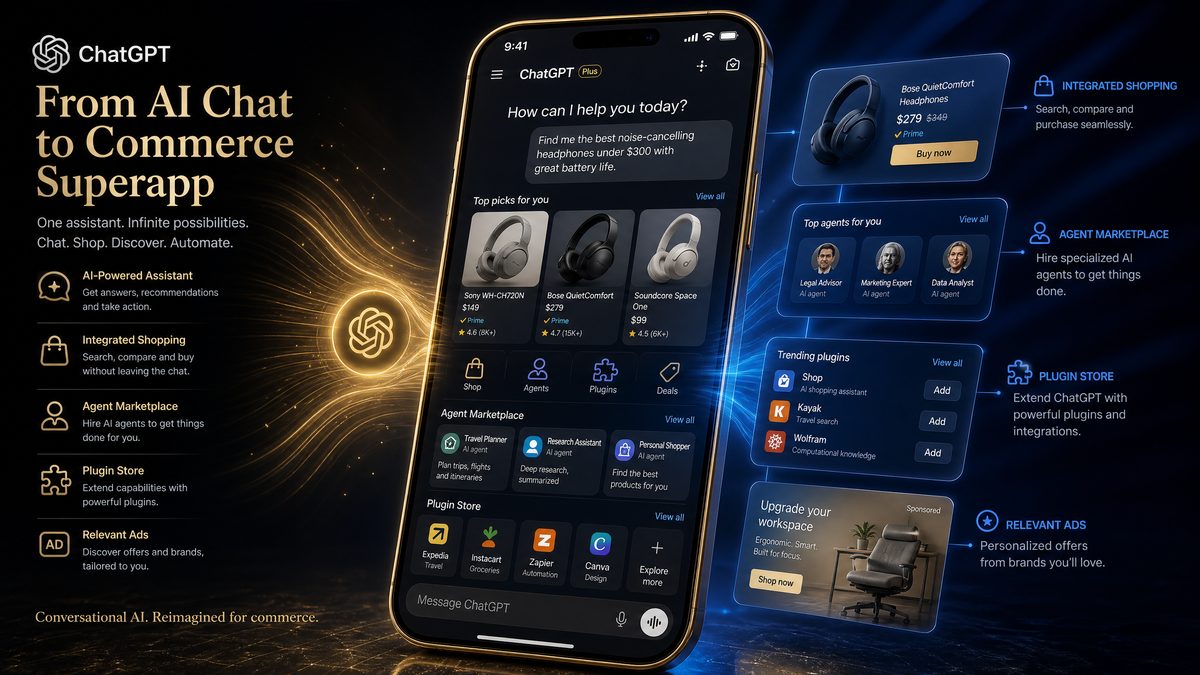
This wasn’t just a monetization pivot. It was the opening move in a much larger strategic transformation: the conversion of ChatGPT from a conversational AI assistant into a full-spectrum commerce superapp. Alongside the ad experiments, OpenAI has been building out an agent marketplace — a curated ecosystem where third-party AI agents can be discovered, deployed, and monetized. Simultaneously, the Codex plugin architecture has matured into something that looks less like a developer toy and more like an app store economy with real financial stakes.
The question isn’t whether OpenAI is building a superapp. The evidence is already in front of us. The real questions are: What does this mean for developers building on the platform? How should businesses position themselves in this emerging AI commerce layer? And what does the broader AI economy look like when the world’s most-used AI interface becomes a transactional platform with hundreds of millions of daily users?
This analysis examines every dimension of OpenAI’s superapp strategy — the ad infrastructure, the agent marketplace mechanics, the Codex plugin economy, the planned interface redesign, and the competitive dynamics that will shape who wins and who gets marginalized in the new AI commerce landscape.
“We are not building a search engine. We are building something that understands what you need and helps you accomplish it — end to end.” — OpenAI executive communications, Q1 2026
The Ad Integration: What’s Actually Being Tested and Why It Matters
The advertising tests that began in early 2026 were more sophisticated than most initial reports suggested. This wasn’t banner advertising or keyword-triggered sidebar placements borrowed from the Google playbook. OpenAI’s approach to in-conversation advertising represents a fundamentally different paradigm — one built around intent fulfillment rather than attention capture.
The Mechanics of Conversational Advertising
In the test configurations observed by users and reported by industry analysts, sponsored content appeared in several distinct formats. The most common was what insiders have been calling the “sponsored completion” — when a user asks a question that has a commercial dimension (comparing project management tools, asking about travel destinations, researching financial products), the model’s response includes a clearly labeled sponsored option alongside organic recommendations. The key architectural decision here is that the sponsored content must be contextually coherent with the user’s actual query. A user asking about marathon training shoes won’t see an ad for enterprise software. The targeting is semantic, not demographic.
The second format is the “agent recommendation” — when ChatGPT suggests using a specific third-party agent or plugin to accomplish a task, and that suggestion is commercially influenced. This is where the advertising layer and the agent marketplace begin to blur together in ways that will require careful regulatory and ethical navigation.
The third and most experimental format involves what OpenAI has internally described as “outcome-based sponsorship” — where a brand pays not for impressions or clicks but for completed user actions. A travel company doesn’t pay when ChatGPT mentions their platform; they pay when a user actually books through the interface. This is performance advertising at a level of attribution precision that traditional digital advertising has never achieved.
Revenue Projections and the Business Case
The financial rationale for advertising is compelling even against the backdrop of OpenAI’s subscription revenues. ChatGPT Plus, Pro, and Team subscriptions generate significant recurring revenue, but they capture only a fraction of ChatGPT’s actual user base. The free tier — which represents the majority of ChatGPT’s hundreds of millions of monthly active users — has historically been a cost center, not a revenue driver. Advertising changes that equation entirely.
Industry analysts at firms including Bernstein and Cowen have modeled ChatGPT’s advertising potential at anywhere from $2 billion to $8 billion in annual revenue by 2028, depending on adoption rates and average CPMs. For context, these projections assume CPMs (cost per thousand impressions) significantly above traditional digital advertising benchmarks — a reasonable assumption given the quality of intent signal that conversational AI provides. A user asking ChatGPT “what’s the best accounting software for a 50-person company” is expressing purchase intent with a specificity and immediacy that Google’s keyword advertising can only approximate.
The more important long-term play, however, isn’t display-equivalent advertising. It’s the transaction layer. If OpenAI can capture even a small percentage of the commerce that flows through ChatGPT conversations as affiliate revenue or transaction fees, the numbers become extraordinary. Consider that users already ask ChatGPT to help them make purchasing decisions, plan trips, select financial products, and evaluate vendors. The platform sits upstream of enormous transactional value. Monetizing that position — even lightly — creates a revenue stream that dwarfs subscription income.
The Privacy and Trust Architecture
The existential risk to OpenAI’s ad strategy is the same risk that has constrained every major platform that has tried to introduce advertising: user trust erosion. ChatGPT’s value proposition is fundamentally built on the perception of objectivity and helpfulness. Users trust that when ChatGPT recommends a tool or approach, it’s doing so because it’s genuinely the best option, not because someone paid for placement.
OpenAI has signaled awareness of this risk through several architectural choices in the test configurations. Sponsored content has been clearly labeled — more clearly, in fact, than Google’s sponsored search results, which many users still fail to identify as paid placements. The company has also maintained what it describes as a “relevance floor” — sponsored content that falls below a threshold of genuine relevance to the user’s query is filtered out regardless of bid price. Whether these safeguards survive the pressure of commercial scale remains to be seen, but the initial design philosophy is more user-protective than cynics might have expected.
The deeper architectural question is about model integrity. Does the presence of advertising incentives — even well-labeled ones — influence how the underlying model is trained and fine-tuned over time? This is a question that OpenAI has not yet answered publicly, and it’s one that the developer community, regulators, and enterprise customers will increasingly demand clarity on.
As ChatGPT evolves into a commerce superapp handling financial transactions, security becomes paramount. Our guide to the Codex Security Scanner explains how OpenAI’s built-in threat modeling protects enterprise repositories and plugin ecosystems from vulnerabilities that could compromise the emerging AI commerce infrastructure. Codex Security Scanner: How to Use OpenAI’s Built-In Threat Modeling.
The Agent Marketplace: Building an Economy of Autonomous AI Workers
If the advertising integration is the most immediately visible element of OpenAI’s superapp strategy, the agent marketplace is the most structurally significant. This is where OpenAI is attempting to replicate — and in some respects surpass — what Apple accomplished with the App Store: the creation of a curated, monetized ecosystem where third-party developers build products that run on a platform they don’t control, creating mutual value while the platform owner captures a substantial percentage of every transaction.
What the Agent Marketplace Actually Is
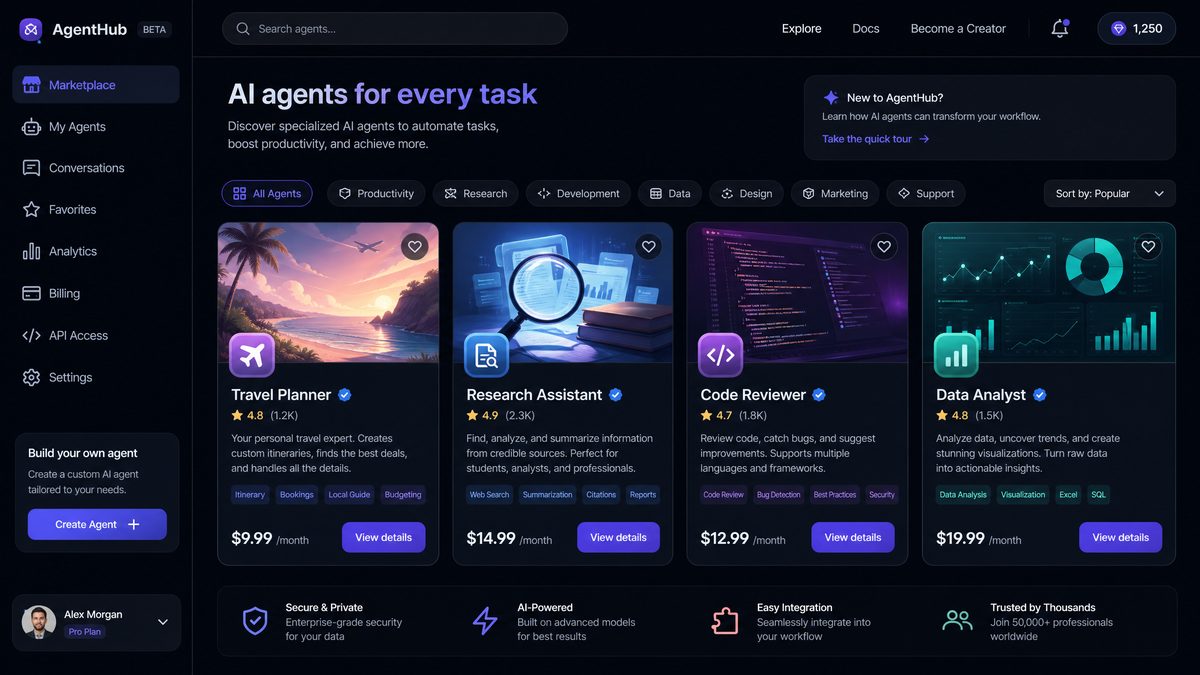
The agent marketplace is a discovery and deployment layer for specialized AI agents — autonomous systems that can perform complex, multi-step tasks on behalf of users. Unlike simple ChatGPT plugins of earlier generations (which were essentially API wrappers that gave the model access to external data), agents in the marketplace are capable of genuine autonomous action: browsing the web, writing and executing code, sending emails, managing calendars, interacting with third-party software, and completing workflows that span hours or days without continuous human input.
The marketplace organizes these agents by category — productivity, research, finance, legal, creative, engineering, and so on — and provides a standardized interface for users to discover, evaluate, and deploy them. Agents can be free, subscription-based, or pay-per-use. Developers set their pricing within OpenAI’s framework, and OpenAI takes a platform fee analogous to Apple’s 30% App Store cut (though the exact percentage has not been publicly confirmed and is likely tiered based on volume and category).
The practical experience for an end user is something like this: you open ChatGPT and tell it you need to conduct competitive research on five SaaS companies in the HR tech space, produce a 20-page analysis, and schedule a presentation with your team next Thursday. ChatGPT identifies that this task would benefit from a specialized research agent, surfaces two or three options from the marketplace with ratings and pricing, you select one, authorize it to access your calendar and email, and it begins working. You check back in a few hours. The work is done.
The Developer Opportunity and Its Constraints
For developers, the agent marketplace represents a genuinely new category of software business. The economics are different from traditional SaaS in important ways. The distribution advantage is enormous — your agent is discoverable by ChatGPT’s entire user base without any independent marketing investment. The barrier to user adoption is dramatically lower than traditional software because there’s no installation, no learning curve, no interface to master. Users interact with agents in natural language through an interface they already use daily.
The constraints, however, are real and significant. Building on any platform means building on someone else’s terms. OpenAI controls the discovery algorithm that determines which agents surface for which queries. They control the fee structure. They control the policies that determine what agents are permitted to do. And critically, they control the underlying model that agents depend on — which means a model update can break agent functionality, change the quality of outputs, or render certain agent categories obsolete overnight.
There’s also the existential risk that successful agent categories will be absorbed into native ChatGPT functionality. This is the “App Store Problem” that mobile developers know intimately: build something popular enough on a platform and the platform owner may simply build a competing native version. OpenAI has already demonstrated this pattern with features like code execution, image generation, and web browsing — all of which began as third-party integrations and were eventually incorporated as core capabilities.
Developers building for the agent marketplace need to think carefully about defensibility. The most durable agent businesses will be those built around proprietary data, specialized domain expertise, or deep integrations with enterprise software systems that OpenAI is unlikely to replicate. A generic “research agent” is vulnerable. An agent that integrates deeply with Salesforce, has been trained on industry-specific data, and has built a reputation in a specific vertical (say, pharmaceutical regulatory research) is far more defensible.
Agent Marketplace Economics: A Framework for Developers
Understanding the economics of the agent marketplace requires thinking about three distinct revenue models, each with different risk profiles:
The Subscription Model: Users pay a monthly fee for access to an agent’s capabilities. This provides predictable revenue and aligns developer incentives with user retention and satisfaction. The challenge is that users are already paying for ChatGPT subscriptions and may resist adding multiple agent subscriptions on top. Successful subscription agents will need to deliver clear, quantifiable value — the kind where users can calculate an obvious ROI.
The Pay-Per-Use Model: Users pay for each task or workflow the agent completes. This reduces friction for initial adoption but creates revenue volatility. It also creates interesting pricing challenges — how do you price a “task” when tasks vary enormously in complexity and execution time? The most sophisticated agent developers are building dynamic pricing models that charge based on compute consumption and workflow complexity rather than flat per-task fees.
The Outcome-Based Model: Users pay only when the agent achieves a defined outcome — a successful booking, a completed research report, a closed lead. This model is the most user-friendly and the most compelling from a marketing perspective, but it requires agents that are reliable enough to consistently deliver defined outcomes, and it creates significant revenue uncertainty for developers during the early stages of deployment.
Enterprise Agent Deployment: The B2B Opportunity
The most immediately lucrative segment of the agent marketplace isn’t consumer users — it’s enterprises. Large organizations are under enormous pressure to demonstrate AI ROI, and the agent marketplace offers a path to deploying specialized AI capabilities without building custom infrastructure. An enterprise can subscribe to a compliance monitoring agent, a contract review agent, a competitive intelligence agent, and a financial modeling agent, deploying them across their organization through ChatGPT’s enterprise interface without a single line of internal code.
For developers targeting enterprise customers through the marketplace, this creates a different product and business development calculus. Enterprise buyers care about security certifications, audit trails, data residency, SLA guarantees, and integration with existing systems. They’re less sensitive to price but far more demanding on reliability and compliance. Agents built for enterprise deployment need to be architected differently from the ground up — with logging, explainability, and governance features that consumer agents don’t require.
OpenAI has signaled that it will create a separate enterprise tier of the agent marketplace with enhanced vetting requirements and additional security guarantees. Developers who invest early in building enterprise-grade agents — and in obtaining the certifications and compliance documentation that enterprise buyers require — will have a significant first-mover advantage in what is likely to be the highest-value segment of the marketplace.
The Codex Plugin Economy: When AI Writes the Tools That AI Uses
The third pillar of OpenAI’s superapp strategy is perhaps the most technically fascinating and the least widely understood: the Codex plugin ecosystem. This is where the superapp strategy becomes genuinely recursive and self-reinforcing in ways that have profound implications for software development economics.
What Codex Plugins Actually Enable
Codex — OpenAI’s code-specialized model — has evolved from a code completion tool into a full software development system capable of architecting, writing, testing, and deploying functional applications. The plugin ecosystem built around Codex allows developers to create specialized tools, libraries, and integrations that extend Codex’s capabilities in domain-specific ways, and to make those extensions available to other developers through the marketplace.
The practical effect is a development ecosystem where AI writes software tools that other AI systems use to build more software. A developer specializing in financial data processing can build a Codex plugin that gives the model deep knowledge of financial data formats, regulatory requirements, and industry-standard calculations. Other developers building fintech applications can then use that plugin, dramatically accelerating their own development work. The plugin developer earns revenue every time their plugin is invoked.
This creates a new category of software business that didn’t exist before: the AI capability vendor. These are developers and companies who don’t build end-user applications — they build specialized AI capabilities that other developers incorporate into their own agents and applications. The analogy in traditional software would be something like a specialized library or API provider, but the economics are different because the capabilities are accessed dynamically by AI systems rather than statically integrated by human developers.
Building a Production-Ready Codex Plugin: Technical Architecture
For developers considering building in the Codex plugin ecosystem, understanding the technical architecture is essential. A Codex plugin consists of several components:
The capability manifest — a structured description of what the plugin can do, expressed in a format that Codex can parse and reason about when deciding whether to invoke the plugin for a given task. This is not just documentation; it’s a machine-readable specification that directly influences when and how the plugin gets used.
The execution environment — the actual code that runs when the plugin is invoked. This can be a REST API, a serverless function, a containerized microservice, or a more complex stateful system depending on the plugin’s requirements.
The context protocol — the mechanism by which the plugin receives context from the Codex model (what the user is trying to accomplish, what code has already been written, what constraints apply) and returns results in a format the model can incorporate into its ongoing work.
Here’s a simplified example of what a Codex plugin manifest and execution function might look like for a specialized database schema generator:
// Plugin Manifest (plugin-manifest.json)
{
  "name": "enterprise-schema-generator",
  "version": "2.1.0",
  "description": "Generates production-ready database schemas with normalization, indexing strategies, and migration scripts for enterprise applications",
  "capabilities": [
    {
      "id": "generate_schema",
      "description": "Generate a normalized database schema from a natural language description of data requirements",
      "input_schema": {
        "type": "object",
        "properties": {
          "requirements": {
            "type": "string",
            "description": "Natural language description of data storage requirements"
          },
          "database_type": {
            "type": "string",
            "enum": ["postgresql", "mysql", "mssql", "aurora"],
            "description": "Target database system"
          },
          "scale_profile": {
            "type": "string",
            "enum": ["startup", "growth", "enterprise"],
            "description": "Expected scale and performance requirements"
          },
          "compliance_requirements": {
            "type": "array",
            "items": {"type": "string"},
            "description": "Applicable compliance frameworks (e.g., HIPAA, PCI-DSS, SOC2)"
          }
        },
        "required": ["requirements", "database_type"]
      },
      "output_schema": {
        "type": "object",
        "properties": {
          "schema_sql": {"type": "string"},
          "migration_script": {"type": "string"},
          "index_recommendations": {"type": "array"},
          "compliance_notes": {"type": "array"},
          "estimated_storage_profile": {"type": "object"}
        }
      }
    }
  ],
  "pricing": {
    "model": "per_invocation",
    "base_price_usd": 0.05,
    "enterprise_discount_eligible": true
  },
  "authentication": {
    "type": "api_key",
    "key_header": "X-Plugin-Key"
  }
}
// Plugin Execution Handler (handler.js)
import { SchemaGenerator } from './core/schema-generator.js';
import { ComplianceValidator } from './core/compliance-validator.js';
import { IndexOptimizer } from './core/index-optimizer.js';

export async function handleGenerateSchema(request) {
  const {
    requirements,
    database_type,
    scale_profile = 'growth',
    compliance_requirements = []
  } = request.body;

  // Parse natural language requirements into structured data model
  const dataModel = await SchemaGenerator.parseRequirements(
    requirements,
    database_type
  );

  // Generate normalized schema with appropriate normal form for scale
  const targetNF = scale_profile === 'enterprise' ? '3NF' : 'BCNF';
  const schema = await SchemaGenerator.generateNormalizedSchema(
    dataModel,
    database_type,
    targetNF
  );

  // Apply compliance-specific modifications
  let complianceNotes = [];
  if (compliance_requirements.length > 0) {
    const complianceResult = await ComplianceValidator.applyRequirements(
      schema,
      compliance_requirements,
      database_type
    );
    schema.tables = complianceResult.modifiedTables;
    complianceNotes = complianceResult.notes;
  }

  // Optimize indexing strategy for scale profile
  const indexRecommendations = await IndexOptimizer.recommend(
    schema,
    scale_profile,
    database_type
  );

  // Generate migration script
  const migrationScript = await SchemaGenerator.generateMigration(
    schema,
    database_type,
    { includeRollback: true, transactional: true }
  );

  return {
    schema_sql: schema.toSQL(),
    migration_script: migrationScript,
    index_recommendations: indexRecommendations,
    compliance_notes: complianceNotes,
    estimated_storage_profile: schema.estimateStorageProfile(scale_profile)
  };
}
The key architectural principle illustrated here is that the plugin doesn’t just execute a function — it participates in a broader AI-mediated workflow. The Codex model decides when to invoke this plugin based on the manifest description, passes it contextually relevant parameters derived from its understanding of the user’s task, and incorporates the results into an ongoing development process that may involve dozens of such plugin invocations.
Monetization Strategies for Plugin Developers
The economics of the Codex plugin ecosystem are more favorable for developers than many comparable platform economies because the invocation model creates natural alignment between developer revenue and actual value delivery. Unlike advertising-based models where revenue is decoupled from user outcomes, plugin developers earn money precisely when their capability is useful enough to be invoked.
The most successful plugin businesses in the early ecosystem have clustered around several patterns:
Domain expertise encoding: Plugins that encode deep, specialized knowledge that would take the base model significant compute to reason about from first principles. Legal citation analysis, medical coding, financial instrument pricing, structural engineering calculations — these are domains where specialized plugins dramatically outperform general-purpose model reasoning and where the expertise is genuinely difficult to replicate.
Data access and enrichment: Plugins that provide access to proprietary or real-time data sources. A plugin that provides live access to patent databases, real-time regulatory filings, or current market data creates value that no amount of model training can substitute for.
Workflow integration: Plugins that provide deep integration with specific enterprise software systems. A Codex plugin that can read from and write to a company’s Jira instance, understand its ticket schema, and generate properly formatted tickets with appropriate labels and assignments is enormously more valuable than a generic project management capability.
Quality and verification: Plugins that verify, test, or validate outputs from other AI systems. As AI-generated code and content proliferates, plugins that can reliably check correctness, security vulnerabilities, compliance adherence, or factual accuracy become increasingly valuable — and increasingly trusted.
The Interface Redesign: What the Superapp Actually Looks Like
OpenAI’s planned interface redesign — details of which have leaked through developer documentation, design patents, and insider reports throughout early 2026 — represents the visual and experiential manifestation of the superapp strategy. Understanding the redesign helps clarify how all three pillars (advertising, agent marketplace, Codex plugins) will be integrated into a coherent user experience.
From Chat Interface to Command Center
The current ChatGPT interface is fundamentally a chat window. The redesign, as described in leaked materials, moves toward what might be described as a “workspace with an AI core” — a more complex interface that includes a persistent sidebar for active agents, a project management layer for ongoing multi-session tasks, a discovery panel for the agent and plugin marketplace, and a command palette that allows power users to invoke specific capabilities without navigating through conversational turns.
The chat interface doesn’t disappear — it remains the primary interaction mode for most users and most tasks. But it’s supplemented by a layer of persistent context and active agent management that makes it possible to run multiple autonomous agents simultaneously, monitor their progress, and intervene when human judgment is required. This is a significant departure from the current experience where each conversation is essentially isolated and stateless.
The advertising integration is woven into this redesign in ways that are more subtle than a traditional ad placement. Sponsored agents appear in discovery panels with clear labeling. When the model generates a recommendation that has a commercial component — suggesting a specific software tool, recommending a service provider, proposing a course of action that involves a purchase — the interface provides a direct action pathway (a booking button, a trial signup, a purchase flow) that is the mechanism through which outcome-based advertising revenue is generated.
The Mobile Superapp Vision
The most ambitious element of the redesign is the mobile experience. OpenAI has been working on a mobile interface that positions ChatGPT as a genuine smartphone superapp — a single application that handles tasks currently distributed across dozens of specialized apps. The vision is explicitly modeled on the WeChat superapp paradigm that has been dominant in China for years: a single interface through which users handle communication, commerce, productivity, entertainment, and services.
The mobile superapp concept is more plausible for AI-native interfaces than it was for traditional apps because the interaction model is fundamentally different. You don’t need a specialized app for every function if a single AI interface can understand what you need and either perform it directly or orchestrate the appropriate specialized agent. The complexity that justified specialized apps — the need to learn different interfaces, manage different accounts, navigate different UX paradigms — is abstracted away when natural language is the universal interface.
For businesses, this mobile superapp vision has significant implications. The question of whether your service is accessible through ChatGPT’s agent marketplace may become as strategically important as whether you have a mobile app — and potentially more so, given that discovery through an AI interface that understands user intent may be more valuable than visibility in an app store that relies on keyword search and ratings.
Competitive Dynamics: Who Wins and Who Gets Displaced
The emergence of ChatGPT as a commerce superapp doesn’t happen in a vacuum. It reshapes competitive dynamics across multiple industries simultaneously, and understanding those dynamics is essential for anyone building a business that touches the AI ecosystem.
The Search Advertising Threat
The most obvious competitive casualty of ChatGPT’s advertising integration is Google Search advertising. This isn’t a new observation — the threat of AI-native search to Google’s advertising dominance has been discussed since ChatGPT’s launch. But the advertising integration makes the competitive threat concrete in a way that was previously theoretical. OpenAI is not just building a better search experience; it’s building a competing advertising business that targets the same high-intent commercial queries that generate the vast majority of Google’s revenue.
The structural advantage ChatGPT has in this competition is the quality of intent signal. When a user types a query into Google, the advertiser must infer intent from keyword patterns. When a user has a conversation with ChatGPT about a purchase decision, the intent is explicit, the context is rich, and the attribution is direct. For advertisers, this is an enormously more valuable environment — which means CPMs can be higher, which means OpenAI can generate more revenue per user than Google even with a smaller user base.
Google’s response has been to accelerate its own AI-native advertising products through Gemini, but the company faces a structural conflict: its existing advertising business is built on a model that AI-native search disrupts. Cannibalizing your own revenue stream to defend against a competitor is a notoriously difficult organizational challenge, and Google’s 2025 and 2026 moves in this space have been more defensive than transformative.
The App Store Economy Threat
Apple and Google’s app store businesses face a different but equally significant threat from the agent marketplace. If AI agents can perform functions that currently require specialized apps — and the evidence from early agent marketplace deployments suggests they increasingly can — the economic rationale for many app categories weakens substantially.
This doesn’t mean the app store economy collapses overnight. Native apps retain significant advantages in performance, offline functionality, hardware integration, and user experience quality for complex, frequently-used applications. But the long tail of specialized utility apps — the apps people download once, use a few times, and forget — is highly vulnerable to displacement by AI agents that can perform the same functions on demand without installation.
For app developers in this vulnerable category, the strategic question is whether to compete with AI agents (by building deeper, more differentiated native experiences) or join the agent marketplace (by converting their capabilities into agents that run within the ChatGPT ecosystem). The developers who navigate this transition most successfully will likely be those who do both — maintaining native apps for their core power users while building agent versions that extend their reach to the broader ChatGPT user base.
The SaaS Disruption Vector
The most underappreciated competitive dynamic in OpenAI’s superapp strategy is its potential to disrupt the SaaS industry. Enterprise software companies have built enormously valuable businesses on the premise that complex business functions require specialized, purpose-built software with dedicated interfaces, training programs, and support organizations. The agent marketplace challenges this premise directly.
Access 40,000+ AI Prompts for ChatGPT, Claude & Codex — Free!
Subscribe to get instant access to our complete Notion Prompt Library — the largest curated collection of prompts for ChatGPT, Claude, OpenAI Codex, and other leading AI models. Optimized for real-world workflows across coding, research, content creation, and business.
If an AI agent can perform the core functions of a project management tool, a CRM, a marketing automation platform, or a financial reporting system — accessed through natural language via ChatGPT — the value of the specialized interface that traditional SaaS companies have built diminishes. The data and the workflows that the SaaS company manages remain valuable. The interface becomes a commodity.
This dynamic is already visible in the early agent marketplace. Several agents in the productivity and project management categories have achieved rapid adoption by offering functionality that overlaps significantly with established SaaS products, at a fraction of the cost, with zero training required. The SaaS companies most at risk are those whose primary differentiation is interface design and ease of use — precisely the differentiation that AI agents neutralize.
The new AI commerce ecosystem creates complex legal considerations around agent liability, transaction disputes, and regulatory compliance. Our comprehensive collection of GPT-5.5 prompts for legal professionals covers contract analysis and compliance workflows that are directly applicable to navigating the legal frameworks emerging around AI-powered commerce. 50 GPT-5.5 Prompts for Legal Professionals.
The SaaS companies best positioned to survive and thrive in the agent marketplace era are those with deep proprietary data assets, strong network effects, and workflow integrations that are genuinely difficult to replicate. Salesforce’s value isn’t its interface — it’s the decade of customer relationship data that organizations have accumulated in it. That data becomes an asset that powers agents rather than a liability that agents displace.
Regulatory and Ethical Dimensions
The transformation of ChatGPT into a commerce platform brings with it a regulatory complexity that OpenAI is only beginning to navigate. Several distinct regulatory domains intersect in ways that will shape how the superapp strategy can be implemented in different markets.
Advertising Standards and Disclosure Requirements
In most major markets, advertising disclosure requirements are well-established for traditional media but poorly adapted to AI-native environments. The FTC in the United States, the ASA in the UK, and the European Advertising Standards Alliance all require that advertising be “clearly distinguishable” from editorial content — but their frameworks were designed for static visual media, not dynamic conversational AI.
OpenAI will need to engage proactively with regulators to establish disclosure standards that satisfy the spirit of existing requirements in an AI context. The company’s early approach — clear “Sponsored” labels on commercially influenced responses — is a reasonable starting point, but regulators will likely require more detailed disclosure about how sponsored content influences model outputs, what data is used for targeting, and how users can opt out.
The EU’s AI Act, which came into full effect in 2025, adds additional complexity. AI systems used in commercial communications are subject to transparency requirements that go beyond traditional advertising standards. OpenAI will need to demonstrate that its advertising integration complies with these requirements in European markets — a non-trivial undertaking given the Act’s broad scope and the novelty of conversational advertising as a format.
Competition Law and Platform Dominance
As ChatGPT’s market position strengthens, competition regulators in the EU, UK, and US are paying increasing attention to OpenAI’s platform practices. The agent marketplace, in particular, raises questions that are structurally similar to those that have driven antitrust action against Apple’s App Store and Google’s search practices.
If OpenAI controls both the discovery algorithm that surfaces agents and the ability to build competing native capabilities, it has the structural power to disadvantage third-party developers in ways that competition law may ultimately prohibit. The Digital Markets Act in Europe, which designates large digital platforms as “gatekeepers” subject to specific interoperability and non-discrimination requirements, may apply to ChatGPT’s agent marketplace if the platform reaches sufficient scale.
Developers building for the agent marketplace should be aware that the competitive landscape may look quite different in two to three years as regulatory frameworks catch up with the technology. Building businesses that depend entirely on OpenAI’s platform terms is a risk that should be consciously managed — through diversification across multiple AI platforms, through building direct user relationships that exist outside the marketplace, and through advocacy for fair platform practices through developer organizations.
Strategic Implications: A Playbook for Developers and Businesses
Understanding OpenAI’s superapp strategy is only valuable insofar as it informs concrete strategic decisions. Here is a practical framework for the different stakeholders who need to navigate this landscape.
For Independent Developers
The agent marketplace and Codex plugin ecosystem represent genuine new business opportunities, but realizing them requires a different approach than traditional software development. The most important strategic principle is to build around defensible differentiation rather than general-purpose capability. The marketplace will be flooded with generic agents in every category. The agents that survive and thrive will be those with proprietary advantages — specialized data, domain expertise, enterprise integrations, or network effects — that make them genuinely irreplaceable.
Invest heavily in the capability manifest and discoverability of your agent or plugin. The quality of your manifest — how accurately and compellingly it describes your capability to the model — directly determines how often your agent gets surfaced and invoked. This is a new form of SEO, and it will be as important to agent marketplace success as traditional SEO has been to web business success.
Build enterprise-grade reliability from day one. The agents that generate the most revenue will be those deployed at enterprise scale. Enterprise buyers require 99.9%+ uptime, comprehensive audit logs, data residency options, and compliance certifications. Building these capabilities in retroactively is far more expensive than building them in from the start.
For Businesses Considering the Agent Marketplace
If you run a business that provides services that could potentially be delivered through an AI agent — research, analysis, content creation, data processing, customer service, scheduling, compliance monitoring — you need to make a strategic decision about whether to build your own agent or partner with existing agent developers. Building your own agent gives you more control and potentially more margin, but requires technical investment and marketplace expertise. Partnering with an existing agent developer is faster but creates dependency.
The businesses that will benefit most from the agent marketplace in the near term are those that can use agents to dramatically reduce the cost of delivering their existing services. A law firm that uses a contract review agent to handle first-pass document analysis can serve more clients with fewer associates. A marketing agency that deploys a competitive intelligence agent can deliver richer research to clients at lower cost. The agent marketplace is, in this sense, a productivity multiplier for service businesses — and the businesses that adopt it earliest will have a significant competitive cost advantage over those that don’t.
For Advertisers Considering ChatGPT’s Ad Platform
The advertising tests of early 2026 are not yet a mature ad platform available to all advertisers. But the trajectory is clear, and sophisticated advertisers should be preparing now for the moment when ChatGPT advertising becomes broadly available.
The most important preparation is building the capability to create contextually coherent, genuinely helpful sponsored content. ChatGPT’s advertising system is designed to filter out content that doesn’t meet a relevance threshold — which means the traditional approach of broad-reach, attention-grabbing ad creative will not work. Advertisers who will succeed in this environment are those who can create content that is genuinely informative and helpful in the context of a user’s specific query, and who can do so at scale across a wide range of query types.
Outcome-based advertising — paying for completed actions rather than impressions — is the format that offers the most compelling ROI for most advertisers, but it requires the most sophisticated attribution infrastructure. Advertisers should be investing now in building the measurement and attribution systems that will allow them to participate in outcome-based ChatGPT advertising when it becomes available.
The Broader AI Economy: What OpenAI’s Superapp Strategy Means for Everyone
Stepping back from the specific mechanics of ads, agents, and plugins, OpenAI’s superapp strategy represents a fundamental shift in how value is created and distributed in the AI economy. The implications extend well beyond the immediate competitive dynamics to reshape the structure of the technology industry itself.
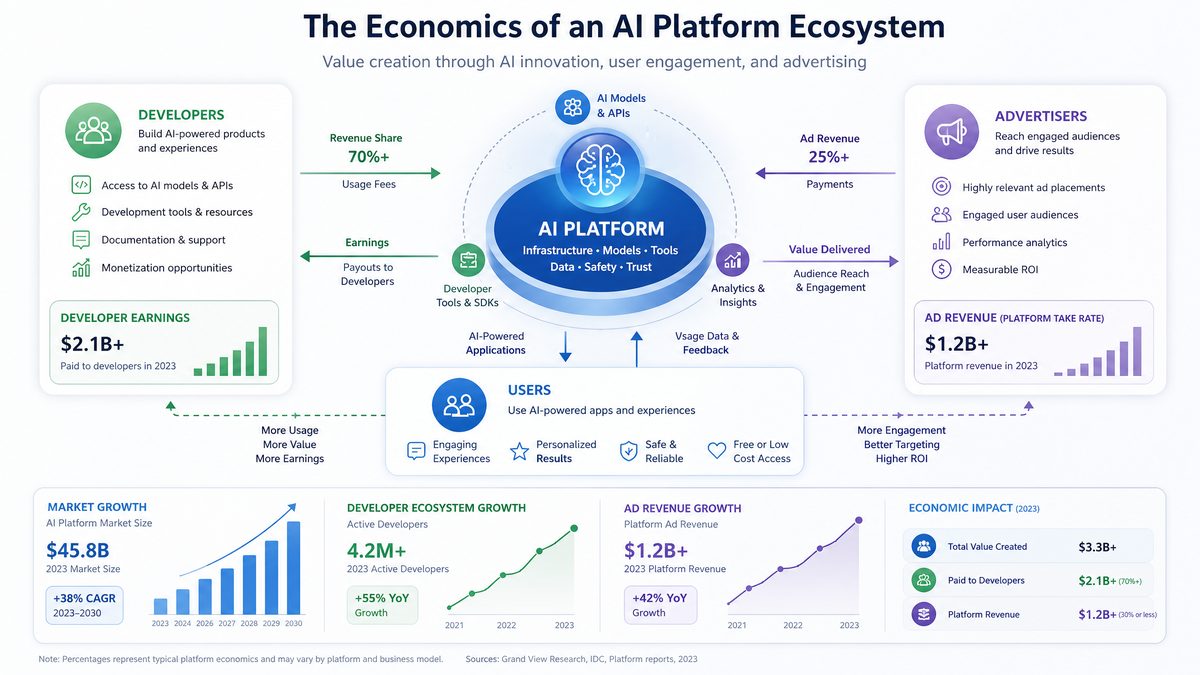
The most significant structural shift is the emergence of AI platforms as the new infrastructure layer of the digital economy. In the same way that cloud computing platforms (AWS, Azure, GCP) became the infrastructure on which most digital businesses are built, AI platforms are becoming the infrastructure on which most digital interactions are mediated. The company that controls this infrastructure has extraordinary leverage — not just over the businesses that build on it, but over the entire flow of information and commerce that passes through it.
OpenAI’s superapp strategy is, at its core, a bid to own this infrastructure position for the AI era. The advertising integration monetizes the attention and intent of users who pass through the platform. The agent marketplace captures value from the economic activity that users accomplish through the platform. The Codex plugin ecosystem creates a developer dependency that makes the platform more capable and more sticky over time. Each element reinforces the others in a flywheel dynamic that, if it achieves sufficient scale, becomes very difficult for competitors to disrupt.
The critical question for the broader AI economy is whether this flywheel dynamic produces a winner-take-all outcome — a single dominant AI superapp that captures the majority of value — or whether it produces a more fragmented ecosystem with multiple competing platforms. The historical precedent of mobile operating systems (which produced a duopoly) and social media (which produced a handful of dominant platforms) suggests that AI superapps are likely to consolidate rather than fragment. But the AI landscape has characteristics — the importance of specialized domain knowledge, the value of proprietary data, the complexity of enterprise requirements — that may support more platform diversity than mobile or social media achieved.
What is certain is that the AI economy of 2028 will look dramatically different from the AI economy of 2024. The transition from AI as a tool to AI as a platform — from something you use to something you live and work within — is already underway. OpenAI’s superapp strategy is the most ambitious and most fully-realized expression of this transition, and understanding it is essential for anyone who wants to participate in what comes next.
Conclusion: The New Rules of the AI Commerce Era
OpenAI’s transformation of ChatGPT into a commerce superapp is not a future possibility — it is a present reality that is accelerating. The advertising tests of early 2026, the agent marketplace that is already generating revenue for developers, and the Codex plugin ecosystem that is already powering enterprise workflows are not experiments. They are the early stages of a platform strategy that will define the structure of the AI economy for years to come.
For developers, the opportunity is real and immediate, but it requires building with a platform-era mindset: defensible differentiation, enterprise-grade reliability, and clear awareness of the risks of platform dependency. For businesses, the agent marketplace represents both a competitive threat and a productivity opportunity that demands strategic engagement rather than passive observation. For advertisers, the emergence of intent-based conversational advertising creates a new channel that will eventually rival search advertising in scale and surpass it in precision.
The superapp era of AI is not coming. It is here. The question is not whether to engage with it, but how to engage with it in ways that create sustainable value rather than temporary advantage. The businesses and developers who answer that question most clearly, and most quickly, will define the AI economy of the next decade.
Markos Symeonides is a senior technology analyst and contributing editor at ChatGPT AI Hub, covering OpenAI strategy, enterprise AI adoption, and the economics of AI platforms. This analysis reflects reporting and research conducted through June 2026.
