
How Enterprise AI Governance Is Evolving in 2026: From Microsoft Purview to OpenAI’s Built-In Compliance Tools

How Enterprise AI Governance Is Evolving in 2026: From Microsoft Purview to OpenAI’s Built-In Compliance Tools
Author: Markos Symeonides, ChatGPT AI Hub
In 2026, enterprise AI governance is no longer a peripheral compliance exercise. It is an operational discipline that blends risk management, data protection, security engineering, product management, and organizational change. As generative AI systems graduate from isolated pilots to mission-critical platforms powering customer support, software development, finance, legal, and R&D, the governance fabric must keep pace with the scale, speed, and sensitivity of AI-enabled processes. The questions boards and CISOs ask have evolved: How do we align AI usage with the EU AI Act and sectoral rules without throttling innovation? Can Microsoft Purview, together with security stack controls, oversee ChatGPT Enterprise and custom GPTs with the same rigor as traditional SaaS? How far do OpenAI’s built-in compliance tools—such as audit logs, data residency, and data loss prevention (DLP) controls—take us, and where do we need compensating controls? What does a unified framework look like across multiple vendors, models, and data perimeters?
This featured article provides a comprehensive blueprint for AI governance in 2026. It examines emerging challenges, compares platform-native and third-party controls, details an implementation roadmap, and supplies ready-to-use policy templates and Python code for practical audit log analysis. Whether you are building your first AI usage policy or scaling to a federated, global governance program, the objective is to help your organization ship AI safely, quickly, and compliantly.
The State of Enterprise AI Governance in 2026
AI adoption is pervasive and heterogeneous. A single enterprise may rely on ChatGPT Enterprise for knowledge work, Azure OpenAI Service for application backends, Anthropic or Google models for specialized tasks, and an internal fine-tuned LLM hosted on Kubernetes. At the same time, knowledge workers continue to experiment with new tools. This creates a dual challenge: central governance teams must define policies that are technology-agnostic yet enforceable, while platform teams must integrate control points natively and via connectors across clouds and vendors.
Compared to 2024, the 2026 governance conversation has matured in three ways:
First, visibility and logging have improved. Enterprise AI platforms provide richer audit trails, including prompt/response metadata, control-plane changes, file operations, model versions, and administrative actions. Microsoft Purview and security stacks offer broader coverage of generative AI traffic, including managed mobile and browser sessions.
Second, regional data residency and sovereign processing options have become more accessible. Many organizations now design data perimeters that bind AI inference and storage to specific jurisdictions, with routing policies enforced by cloud identity and network segments. OpenAI’s enterprise offerings include regional processing choices, complemented by enterprise encryption controls and integration hooks for DLP and eDiscovery workflows.
Third, the regulatory environment has crystallized. The EU AI Act has entered phased applicability with concrete provider and deployer obligations. In the United States, federal executive actions, NIST AI RMF adoption, and sectoral guidance have established realistic expectations for documentation, impact assessments, incident reporting, and transparency. This allows governance leaders to translate legal requirements into actionable controls and metrics more effectively than in prior years.
Despite progress, new risks have emerged: prompt supply chain attacks, training data provenance disputes, model output ownership, and autonomy boundaries for agentic systems. Governance cannot be static; it must be treated as a lifecycle discipline—designed, tested, monitored, and continuously improved across roles, processes, and tooling.
AI Governance Challenges That Matter in 2026
While every organization’s risk profile is unique, seven categories consistently appear in board-level discussions and audits:
1. Shadow AI and Tool Sprawl
Hundreds of AI-enabled SaaS tools, browser extensions, and add-ins proliferate beyond IT’s line of sight. Even enterprises with approved platforms still face ad-hoc experimentation that bypasses procurement and security review. The core challenge is not prohibition; it is converting experimentation into managed usage. That requires discovery (network and endpoint), prioritization (which tools warrant fast-track review), and rapid onboarding to centrally managed platforms with comparable capabilities.
2. Data Residency, Sovereignty, and Cross-Border Transfers
Regional regulatory regimes, data localization laws, and cross-border rules require precise control over where personal and sensitive data is processed and stored. AI systems compound the challenge with embeddings, vector databases, and logs that may replicate data flows beyond traditional SaaS boundaries. Enterprises must define residency policies, classify data that can traverse borders, and configure platform controls to align with legal counsel-advised transfer mechanisms.
3. Intellectual Property Leakage and Trade Secrets
Prompts and file uploads often contain proprietary source code, product roadmaps, and customer contracts. Without strong DLP policies, safe sandboxing, and approved knowledge bases, AI usage can unintentionally exfiltrate high-value assets. The risk is exacerbated by agent features that autonomously retrieve documents or invoke connectors across repositories. IP-aware governance means tagging sensitive sources, defining allow/deny retrieval rules, and instrumenting guardrails that enforce least privilege for AI agents.
4. Safety, Bias, and Model Risk
Generative AI failure modes include hallucinations, harmful content, and biased outputs. When models are embedded into business workflows (e.g., claims adjudication, lending, or HR screening), safety issues become regulatory risks. Model risk management (MRM) and Responsible AI programs must extend to foundation model usage, covering pre-deployment assessments, human oversight design, documentation artifacts, and post-deployment monitoring of output quality and drift.
5. Prompt Injection, Retrieval Poisoning, and Tool-Use Abuse
As retrieval-augmented generation (RAG) and tool-use become mainstream, adversaries exploit prompt instructions and poisoned knowledge bases to subvert system policies. This requires both preventive controls (content sanitization, signed documents, trust boundaries) and detective controls (prompt chain logging, anomaly detection, and red-team exercises). Governance must codify how untrusted content is handled and what escalation thresholds trigger human review.
6. Vendor Dependencies and Multi-Model Orchestration
Enterprises rarely standardize on a single model provider. They orchestrate model choice by task, cost, and latency. This introduces versioning and lifecycle management complexity, with real implications for explainability and reproducibility. Governance must track model lineages, version changes, and deprecation policies, ensuring downstream audits can reconstruct decisions with sufficient fidelity.
7. Human Factors and Change Management
Governance fails when users perceive it as opaque or punitive. Training must be role-specific, policies must be comprehensible, and exemptions must be time-bound and logged. Establishing a community-of-practice for AI product owners, risk partners, and developers turns governance into a shared competency rather than a gatekeeping function.
Microsoft Purview and the ChatGPT Enterprise Connector Pattern
Microsoft Purview has evolved into a broad data security and compliance suite encompassing information protection, DLP, insider risk management, records, and eDiscovery. In 2026, many organizations employ Purview together with Microsoft Defender for Cloud Apps and identity controls to govern generative AI traffic, including ChatGPT Enterprise and custom GPTs. While the exact naming and packaging may vary, the architectural pattern is consistent: treat ChatGPT Enterprise as a sanctioned cloud app, onboard it through your cloud access security broker (CASB) capabilities, and apply Purview DLP labels and policies to sanctioned traffic while monitoring and governing unsanctioned instances.
Architecture Overview
The Purview-ChatGPT Enterprise connector pattern typically includes:
1) Discovery: Use endpoint telemetry and CASB discovery to identify AI app usage by domain, user, and volume.
2) Sanctioning: Approve your enterprise ChatGPT tenant, enforce access via SSO, and block or alert on non-enterprise domains.
3) Session Controls: Apply conditional access and session control policies (e.g., monitor or block uploads of sensitive content in-browser for unmanaged devices).
4) DLP Enforcement: Extend Purview information protection labels to AI prompts and file attachments where feasible, applying rules to prevent uploads of confidential data outside allowed contexts.
5) eDiscovery and Legal Hold: Integrate AI usage logs and attachments into discovery workflows to support investigations and regulatory requests.
6) Audit and Analytics: Centralize activity logs for analysis, retention, and reporting, enabling correlation with identity, device posture, and data classification signals.
Typical Onboarding Steps
1) Register ChatGPT Enterprise as a sanctioned app under your CASB. Configure SSO/SAML or OIDC with user and group mappings aligned to your data access policies.
2) Define access conditions: enforce device compliance, restrict high-risk sign-ins, mandate step-up MFA for privileged actions such as adding connectors or uploading large files.
3) Create DLP policies mapped to labels (e.g., Confidential, Restricted). Target sanctioned ChatGPT Enterprise domains with block/override rules for uploads containing PII, PHI, source code patterns, or contractual identifiers.
4) Use session control to monitor and, when necessary, redact or block clipboard and file uploads in browser sessions that hit ChatGPT Enterprise URLs from unmanaged devices.
5) Set up activity and anomaly policies: high upload volumes, mass file downloads from GPT workspaces, or abnormal prompt lengths may indicate exfiltration or automation misuse.
6) Route audit logs to your SIEM and data lake for long-term retention and advanced analytics. Configure Purview eDiscovery to include AI interactions where policy or legal requires.
Policy Design Considerations
Balance usability and protection by:
– Differentiating between personal productivity prompts and file-based tasks. For example, block uploading customer datasets, but allow simple text prompts under size thresholds with monitoring.
– Enforcing redaction-on-upload for detected PII when business workflows require AI assistance on semi-structured content.
– Providing managed alternatives: if uploads are blocked, offer a sanctioned RAG workspace with pre-approved documents and lineage tracking.
– Enabling frictionless exemptions: time-bound approvals for specific projects with explicit owners and automated expiry.
OpenAI’s Built-In Compliance Capabilities for Enterprises
OpenAI’s enterprise-grade offerings in 2026 provide native controls that meaningfully reduce integration friction. While exact features and configurations depend on your subscription and regional availability, governance programs commonly rely on the following categories:
Audit Logging and Administrative Telemetry
Enterprise administrators can access audit trails covering user sign-ins, workspace management, GPT creation and sharing actions, file uploads and deletions, prompt/response metadata, and integration changes. These logs generally support export to SIEM and data platforms, enabling correlation with identity and DLP signals. Granularity is critical: logs should allow filtering by user, team, GPT, data source, IP, and time window. Retention options help align with legal hold policies.
Data Residency and Processing Controls
Regional data residency options provide enterprises with choices regarding where prompts, files, and logs are processed and stored. Policies can restrict inference to specified regions, with routing enforced at the workspace or organization level. Combined with encryption in transit and at rest, and integration with enterprise identity, these controls help satisfy cross-border data transfer requirements and internal data-perimeter strategies. Legal and privacy teams should validate that residency claims cover both hot-path inference and associated storage (logs, embeddings, caches).
Data Loss Prevention (DLP) and Redaction
Built-in DLP features can scan prompts and file uploads for sensitive patterns (e.g., PII, secrets) and either block, warn, or redact prior to processing. Administrative policies can be scoped by group, content type, and channel (chat, attachments, API-connected tools). Native redaction can be complemented with external DLP connectors via CASB for layered defense, ensuring uniform enforcement across web, desktop, and mobile clients.
Security and Access Management
Enterprise controls typically include SSO with SAML/OIDC, SCIM-based provisioning, role-based access controls (RBAC) for admin, builder, and user roles, and granular sharing policies for GPTs and datasets. Customer-managed key (CMK) options and enterprise key management integrations may be available depending on plan and region, allowing tighter control over encryption and key rotation practices. Admins can enforce policies for public sharing, external collaboration, and marketplace usage.
Safety and Content Moderation
Platform safety systems, including configurable content filters and policy templates, help align outputs with organizational standards. Admins can set stricter safety modes for regulated teams and define escalation paths when content filters are triggered. While safety does not replace domain-specific validation, it reduces the frequency of unsafe outputs and supports human-in-the-loop workflows.
Documentation and Assurance
Enterprises should leverage vendor-provided documentation mapping platform controls to standards such as ISO/IEC 42001 (AI management systems), ISO/IEC 27001, SOC 2, and controls aligned with the NIST AI Risk Management Framework. Evidence packages, model cards, and system cards, where available, support internal reviews and external audits. Governance documentation should reference these mappings to avoid duplicative control definitions.
Building a Unified AI Governance Framework
Effective AI governance harmonizes people, process, and technology across the lifecycle of AI capabilities. The goal is not to replicate software development governance but to extend it with AI-specific risks and artifacts.
Core Principles
– Proportionality: Controls should scale with risk. A low-risk internal writing assistant warrants lighter oversight than a claims adjudication model.
– Transparency: Stakeholders must understand what models are used, when, and how. Document model choices, data sources, and human oversight mechanisms.
– Accountability: Clear ownership prevents diffusion of responsibility. Assign a product owner, a risk partner, a data steward, and an engineering lead.
– Defense in Depth: Combine vendor-native controls, Purview/CASB policies, and process measures (training, approvals, monitoring) rather than relying on a single layer.
Reference Operating Model
1) Strategy and Portfolio: Define AI objectives and acceptable use. Maintain an AI use-case backlog with risk ratings and business value estimates.
2) Risk Assessment and Design Assurance: Use templated assessments aligned to NIST AI RMF and EU AI Act obligations. Require design reviews for medium/high-risk use cases.
3) Data Governance: Classify datasets; define which classes can be used for prompts, training, or RAG. Document data lineage and apply retention policies.
4) Build and Integrate: Apply secure development lifecycle (S-SDLC) extensions for AI. Use model catalogs and approval gates for model/version changes.
5) Deployment and Monitoring: Instrument logs, safety filters, and metrics. Establish human oversight checkpoints for critical decisions.
6) Incident Response and Continuous Improvement: Define AI-specific incident playbooks (prompt injection, data leakage, unsafe outputs). Feed lessons back into policy and training.
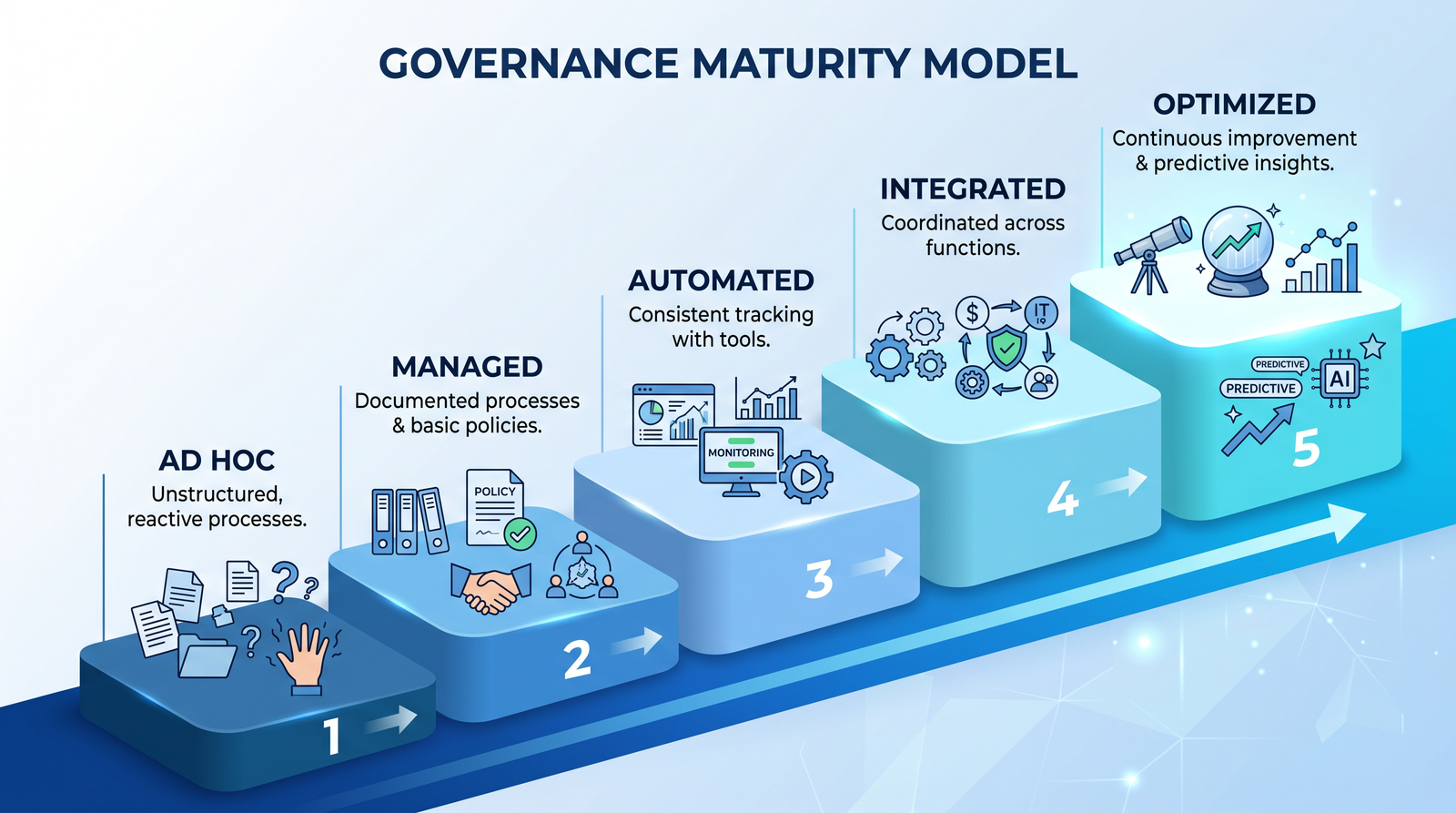
AI Governance Maturity Model (2026)
The following table summarizes a pragmatic maturity model across nine dimensions. Use it to baseline your current state and plot a roadmap.
| Level | Strategy & Policy | Data Governance | Model Lifecycle | Access & Identity | Monitoring & Logging | Risk & Compliance | Regulatory Readiness | Tooling & Integration |
|---|---|---|---|---|---|---|---|---|
| 1 – Ad Hoc | No formal AI policy; sporadic experimentation | Unlabeled data in prompts; no residency controls | No model catalog; unmanaged versions | Basic SSO; no role separation | Limited logs; no centralized storage | No formal risk assessments | Unaware of applicable regulations | No CASB/DLP integration; unmanaged tools |
| 2 – Emerging | Basic acceptable-use policy; pilot guardrails | Initial data classification; some block lists | Manual approvals for model use | Group-based access; limited SCIM | Audit logs enabled; ad-hoc queries | Template-based assessments for high-risk cases | Tracking EU AI Act and US guidance | Purview/CASB discovery; limited DLP rules |
| 3 – Defined | Organization-wide AI policy; RACI defined | Residency rules; RAG data catalogs | Model registry; change management gates | RBAC; SCIM automation; approval workflows | Centralized logs; dashboards with KPIs | Formal MRM; red-team exercises | Compliance mapping to AI Act/NIST RMF | Purview DLP + session controls; SIEM integration |
| 4 – Managed | Policy-as-code; exception SLAs; training by role | Fine-grained access; lineage and retention enforced | Continuous evaluation; shadow model monitoring | Just-in-time access; privileged access reviews | Automated anomaly detection; alert triage runbooks | Quarterly risk reporting; audit-ready evidence | Impact assessments operationalized; DPIAs integrated | Multi-model orchestration; unified governance APIs |
| 5 – Optimized | Outcome-based controls; adaptive guardrails | Policy-driven RAG; privacy-preserving retrieval | Canary releases; policy-driven routing | Attribute-based access across models and tools | Root-cause analytics; business impact metrics | Predictive risk scoring; automated mitigations | Proactive regulatory change management | Federated governance; continuous control validation |
Comparing Governance Capabilities: Purview, OpenAI, and Third-Party
No single tool covers every governance need. The table below contrasts common capability categories across Microsoft Purview + security stack, OpenAI enterprise admin features, and third-party governance/DLP platforms. The goal is to help you design a layered control strategy.
| Capability | Microsoft Purview + Defender/CASB | OpenAI Enterprise (Admin & Security) | Third-Party Governance/DLP | Notes |
|---|---|---|---|---|
| Discovery of AI App Usage | Strong via CASB and endpoint signals | N/A for non-OpenAI apps | Varies; strong in multi-SaaS discovery tools | Use CASB for visibility across all AI tools |
| Access Control & Session Protection | Conditional Access; session monitoring/blocking | SSO, RBAC, sharing policies; workspace restrictions | Browser isolation; proxy-based session control | Layer session controls with OpenAI RBAC |
| DLP on Prompts and File Uploads | Label-aware DLP; inline inspection for web apps | Native DLP/redaction policies for uploads/prompts | Advanced classifiers; code/secret detection | Use native first; extend with Purview and third-party |
| Audit Logs & Export | Centralized across apps; SIEM connectors | Granular logs for admin and usage; export APIs | Normalization and enrichment pipelines | Standardize schemas for cross-tool analytics |
| Data Residency Controls | Policy enforcement; network egress boundaries | Regional processing/residency options | Assurance, monitoring, and supplemental controls | Align all layers to a common residency policy |
| eDiscovery & Legal Hold | Integrated with Purview eDiscovery | Exportable artifacts; admin-accessible logs | Case management, review workflows | Define cross-platform preservation strategies |
| Model Risk & Responsible AI | Policy management; limited model evaluation | Safety settings, content filters, documentation | Risk registers, assessments, testing frameworks | Combine process governance with platform settings |
| Developer Integration | Policy inheritance across M365 ecosystem | Admin APIs; workspace controls; tool governance | SDKs for policy-as-code; CICD hooks | Implement policy gates in CI/CD for AI apps |
Regulatory Landscape in 2026: What Matters and Why
AI regulation has matured from high-level principles to enforceable obligations, especially for deployers of AI systems in regulated contexts. Governance leaders should track and operationalize the following regimes and standards:
EU AI Act
The EU AI Act introduces obligations based on the risk category of an AI system. High-risk systems require risk management, data governance, technical documentation, logging, human oversight, accuracy/robustness/cybersecurity requirements, and post-market monitoring. Generative AI and general-purpose models carry transparency and, where applicable, systemic risk obligations. Even when an enterprise is a “deployer,” not a “provider,” governance must ensure documentation exists to justify model choice, training data policies (for in-house models), and controls commensurate with use-case risk.
Practical implications include maintaining a system registry, impact assessments, human oversight design documents, and procedures for incident reporting and post-deployment monitoring. Contracts with providers should specify information access required for compliance, including change notifications for model versions and safety updates.
United States: Executive Actions, NIST AI RMF, and Sector Rules
Federal executive actions have catalyzed adoption of the NIST AI Risk Management Framework, encouraging agencies and contractors to implement governance processes covering AI risk identification, measurement, and mitigation. Sector regulators (healthcare, finance, critical infrastructure) have issued guidance on testing, documentation, and monitoring requirements for AI-enabled decisions. State privacy laws continue to expand opt-out, consent, and data minimization requirements, affecting how personal data may be used in prompts, fine-tuning, and RAG.
Keep a living mapping from policy requirements to controls, tests, and evidence. Where precise regulations are still evolving, adopt best-available guidelines from NIST, ISO, and industry consortia, documenting rationale and residual risk.
ISO/IEC 42001 and ISO/IEC 23894
ISO/IEC 42001 formalizes an AI Management System (AIMS), offering a management-system approach analogous to ISO 27001 for information security. ISO/IEC 23894 provides AI risk management guidance. Certifications and alignment can streamline audits and demonstrate due diligence, especially for global enterprises and B2B relationships.
Data Protection Laws and Cross-Border Transfers
GDPR, UK GDPR, and other data protection laws remain central to AI governance. Data Protection Impact Assessments (DPIAs) should be triggered for high-risk AI applications. Cross-border transfers must be supported by appropriate transfer mechanisms and vendor commitments. Residency controls and documented processing flows are essential evidence.
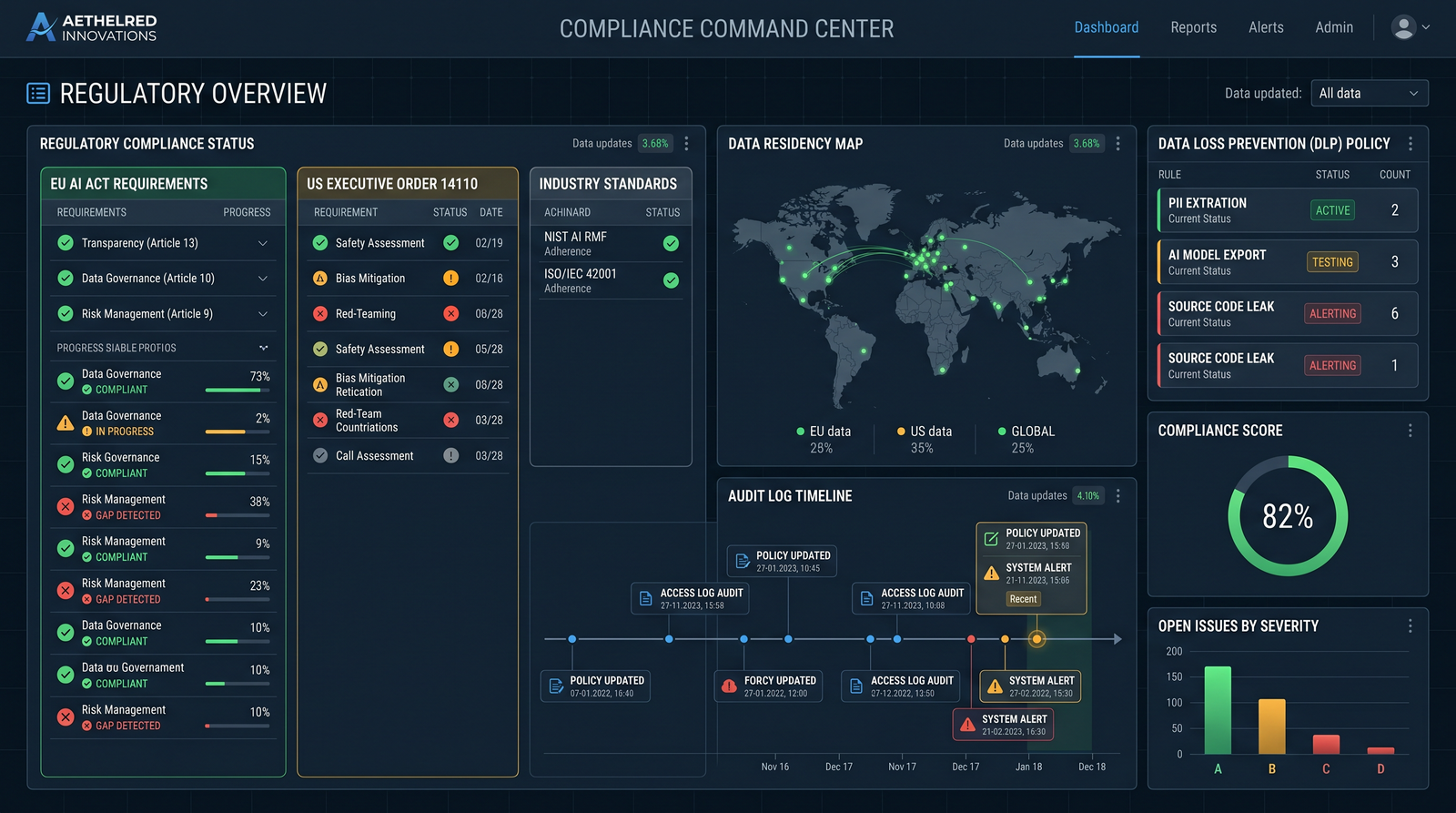
Implementation Roadmap: From First Principles to Federated Scale
A phased roadmap accelerates time-to-value while laying a solid foundation for scale. The timeline below assumes a 90–180 day initial program launch, followed by iterative maturation.
Phase 0 (Weeks 0–2): Mobilize and Baseline
– Appoint executive sponsor, establish AI Governance Council (security, privacy, legal, compliance, product, data, engineering).
– Define scope: in-scope platforms (ChatGPT Enterprise, Azure OpenAI, internal LLM), business units, and priority use cases.
– Rapid discovery: inventory AI tool usage with CASB and endpoint telemetry; identify top 10 usage patterns by volume and data sensitivity.
Phase 1 (Weeks 2–6): Policy and Minimum Viable Controls
– Publish Acceptable Use Policy (AUP) for AI; define sensitive data classes permitted/prohibited in prompts and uploads.
– Enable platform-native controls: OpenAI enterprise audit logs, residency selections, DLP policies; enforce SSO and RBAC.
– Integrate Microsoft Purview DLP and session control for ChatGPT Enterprise traffic; block non-sanctioned AI domains.
– Turn on centralized logging and initial dashboards; define tiered incident response playbooks for AI-specific scenarios.
Phase 2 (Weeks 6–12): Risk Assessment and Assurance
– Deploy templated AI risk assessments aligned to NIST AI RMF and EU AI Act obligations; require for all medium/high-risk use cases.
– Stand up a model/system registry: track use case, model version, data sources, owners, and human oversight design.
– Establish change management for model version updates; pilot canary releases for critical workflows.
– Begin red-team exercises focusing on prompt injection and RAG poisoning; document findings and mitigations.
Phase 3 (Weeks 12–18): Federate and Automate
– Delegate governance responsibilities to business-aligned AI product owners with clear RACI; standardize training.
– Implement policy-as-code: enforce residency, DLP, and sharing policies through admin APIs and CI/CD gates.
– Expand monitoring with anomaly detection; integrate with SOC playbooks; refine KPIs and thresholds.
– Formalize eDiscovery integration; align retention with legal and privacy requirements.
Phase 4 (Ongoing): Optimize and Evolve
– Introduce outcome-based metrics (accuracy, quality, value), and tie guardrails to performance and incident trends.
– Periodically recalibrate risk ratings and control strength; retire duplicative tools where vendor-native features suffice.
– Track regulatory changes and refresh mappings; prepare for audits with curated evidence packages.
Policy Templates You Can Adopt
The following templates are starting points. Adapt them to your legal, regulatory, and organizational context.
1) Acceptable Use Policy for Generative AI (Excerpt)
Title: Enterprise Generative AI Acceptable Use Policy
Version: 1.0
Owner: AI Governance Council
Effective: 2026-01-15
Scope: All employees, contractors, and third parties using enterprise AI platforms

1. Purpose
This policy defines acceptable use of enterprise-approved generative AI platforms and guardrails to protect customers, employees, intellectual property, and compliance obligations.

2. Approved Platforms
- ChatGPT Enterprise (organization workspace)
- Azure OpenAI Service (approved subscriptions)
- [Insert additional approved platforms]

3. Prohibited Content in Prompts/Uploads
- Special Category Personal Data (GDPR Art. 9) unless explicitly approved
- Payment card full PAN, CVV, track data (PCI-DSS)
- Production credentials, secrets, private keys
- Unreleased financial results or M&A information
- Customer datasets unless processed within approved RAG workspaces

4. Data Residency
All processing must comply with the organization’s data residency policy. Users must not route prompts or uploads through non-approved regions.

5. File Handling
Files must be labeled and scanned prior to upload where required. Confidential documents must only be used in approved RAG projects with documented retrieval policies.

6. Sharing and Publication
Users must not make GPTs or prompts publicly available without review. External collaboration requires business owner approval and must use sanctioned workspaces.

7. Human Oversight
Outputs used for customer, legal, or financial decisions require human review and sign-off. Automated decisions must meet applicable regulatory standards.

8. Exceptions
Time-bound exceptions may be granted by AI Governance Council with explicit scope, owner, and expiration date. All exceptions are logged and reviewed quarterly.

9. Violations
Violations may result in access restriction and disciplinary actions consistent with HR and legal policies.
2) Data Classification to LLM Exposure Policy (YAML)
policy:
  name: data-class-to-llm
  version: 1.0
  objective: "Map data classification to allowable LLM actions (prompting, RAG, fine-tune)"
  scope: ["ChatGPT Enterprise", "Azure OpenAI", "Internal LLM"]
  rules:
    - classification: Public
      allow:
        prompt_text: true
        upload_files: true
        rag_use: true
        fine_tune: true
      residency: any
    - classification: Internal
      allow:
        prompt_text: true
        upload_files: restricted
        rag_use: approved_workspace_only
        fine_tune: false
      residency: approved_regions
    - classification: Confidential
      allow:
        prompt_text: limited_redaction_required
        upload_files: blocked
        rag_use: approved_workspace_only
        fine_tune: false
      residency: region_locked
    - classification: Restricted
      allow:
        prompt_text: blocked
        upload_files: blocked
        rag_use: restricted_sandbox_only
        fine_tune: false
      residency: sovereign_only
  exceptions:
    process: "Submit via GRC portal; risk review within 3 business days"
    duration: "Max 90 days; auto-expire"
  enforcement:
    chatgpt_enterprise:
      dlp: enable
      redaction: pii,secrets
      sharing: internal_only
    purview:
      labels: enforce
      session_controls: browser_upload_block
    api:
      gateway: "Block disallowed classifications at policy proxy"
3) Prompt and Audit Logging Policy
Title: AI Prompt & Audit Logging Policy
Version: 1.0
Retention:
  prompts_metadata: 365 days
  prompts_content: 90 days (hash+sample for tuning safety)
  admin_actions: 730 days
Access Control:
  - least_privilege_roles: ["AI Auditor", "Security Analyst", "eDiscovery Manager"]
  - pii_masking: enabled_for_viewers
SIEM Export: enabled_daily
Tamper Evident: checksum_per_batch
User Transparency: "Users are notified at first use; privacy notice accessible"
Incident Response:
  - detection: anomalous volume, sensitive pattern spikes
  - escalation: within 1 hour for high-severity events
4) Purview DLP Policy (JSON Example)
{
  "name": "Block-Confidential-Uploads-to-ChatGPT",
  "scope": {
    "domains": ["chat.openai.com", "enterprise.openai.com"],
    "devices": ["unmanaged", "managed"]
  },
  "conditions": {
    "classifications": ["Confidential", "Restricted"],
    "patterns": ["PII:SSN", "PCI:PAN", "Secret:APIKey", "SourceCode:HighEntropy"]
  },
  "actions": {
    "unmanaged": "block",
    "managed": "block_or_justify",
    "redact": true,
    "user_notification": "Upload blocked due to policy. Use approved RAG workspace."
  },
  "logging": {
    "siem_export": true,
    "fields": ["user", "device", "label", "pattern", "filename", "timestamp"]
  }
}
Python Reference: Cross-Platform AI Audit Log Analysis
The following Python script demonstrates how to ingest OpenAI enterprise admin logs and Purview CASB/DLP events, normalize them, detect potential policy violations (PII, secrets, code exfiltration), and produce summary metrics by team. Adapt parsers to your concrete schemas and APIs.
#!/usr/bin/env python3
# -*- coding: utf-8 -*-
"""
AI Governance Audit Log Analyzer (2026)
- Ingests OpenAI admin logs (JSON/CSV export)
- Ingests Purview/CASB events (JSONL)
- Normalizes fields
- Detects PII/secrets and policy violations in prompts/uploads
- Computes KPIs and generates a compact report (CSV and console)
"""

import os
import re
import json
import gzip
import hashlib
import datetime as dt
from typing import List, Dict, Any, Iterable, Optional

import pandas as pd

PII_PATTERNS = {
    "SSN": re.compile(r"\b(?!000|666|9\d{2})\d{3}-\d{2}-\d{4}\b"),
    "Email": re.compile(r"\b[A-Za-z0-9._%+-]+@[A-Za-z0-9.-]+\.[A-Za-z]{2,}\b"),
    "Phone": re.compile(r"(?:\+?\d{1,3})?[\s\-]?(?:\(\d{2,4}\)|\d{2,4})[\s\-]?\d{3,4}[\s\-]?\d{3,4}"),
    "PAN": re.compile(r"\b(?:\d[ -]*?){13,19}\b"),
}

SECRET_PATTERNS = {
    "AWSKey": re.compile(r"AKIA[0-9A-Z]{16}"),
    "APIKey": re.compile(r"(?:api|secret|key|token)[=:]\s*[A-Za-z0-9_\-]{16,}", re.IGNORECASE),
    "PrivateKey": re.compile(r"-----BEGIN (?:RSA|EC|OPENSSH) PRIVATE KEY-----")
}

CODE_INDICATORS = [
    re.compile(r"\bclass\s+\w+"),
    re.compile(r"\bdef\s+\w+\("),
    re.compile(r"#include\s+<"),
    re.compile(r"\bimport\s+\w+"),
    re.compile(r"public\s+(class|static|void)")
]

def load_jsonl(path: str) -> Iterable[Dict[str, Any]]:
    opener = gzip.open if path.endswith(".gz") else open
    with opener(path, "rt", encoding="utf-8") as f:
        for line in f:
            line = line.strip()
            if line:
                try:
                    yield json.loads(line)
                except json.JSONDecodeError:
                    continue

def sha256(s: str) -> str:
    return hashlib.sha256(s.encode("utf-8")).hexdigest()

def parse_openai_logs(path: str) -> pd.DataFrame:
    """
    Expected minimal fields:
    - timestamp, user, team, event_type (chat.prompt|file.upload|gpt.create|admin.action)
    - content (for prompt excerpts), filename, bytes, ip, region, workspace
    """
    records = []
    if path.endswith(".jsonl") or path.endswith(".jsonl.gz"):
        for rec in load_jsonl(path):
            records.append(rec)
    elif path.endswith(".json"):
        with open(path, "r", encoding="utf-8") as f:
            data = json.load(f)
            records.extend(data if isinstance(data, list) else data.get("events", []))
    elif path.endswith(".csv"):
        df = pd.read_csv(path)
        return df
    else:
        raise ValueError("Unsupported OpenAI log format")

    df = pd.json_normalize(records)
    if "timestamp" in df.columns:
        df["timestamp"] = pd.to_datetime(df["timestamp"], errors="coerce", utc=True)
    df["source"] = "openai"
    return df

def parse_purview_logs(path: str) -> pd.DataFrame:
    """
    Expected minimal fields:
    - timestamp, user, device, action (upload.block|upload.allow|session.monitor)
    - app (chat.openai.com), label, pattern, filename, bytes, ip
    """
    records = [rec for rec in load_jsonl(path)]
    df = pd.json_normalize(records)
    if "timestamp" in df.columns:
        df["timestamp"] = pd.to_datetime(df["timestamp"], errors="coerce", utc=True)
    df.rename(columns={"action": "event_type"}, inplace=True)
    df["source"] = "purview"
    return df

def detect_content_risks(text: str) -> Dict[str, Any]:
    if not text or not isinstance(text, str):
        return {"pii": [], "secrets": [], "code_like": False}
    pii = [k for k, rx in PII_PATTERNS.items() if rx.search(text or "")]
    secrets = [k for k, rx in SECRET_PATTERNS.items() if rx.search(text or "")]
    code_like = any(rx.search(text) for rx in CODE_INDICATORS)
    return {"pii": pii, "secrets": secrets, "code_like": code_like}

def normalize(df_openai: pd.DataFrame, df_purview: pd.DataFrame) -> pd.DataFrame:
    cols = ["timestamp","user","team","event_type","content","filename","bytes","ip","region","workspace","label","pattern","device","source","app"]
    for df in [df_openai, df_purview]:
        for c in cols:
            if c not in df.columns:
                df[c] = None
    # Harmonize event types
    df_openai["event_family"] = df_openai["event_type"].str.split(".").str[0]
    df_purview["event_family"] = df_purview["event_type"].str.split(".").str[0]
    # Standard app marker for Purview records
    df_purview["app"] = df_purview["app"].fillna("chat.openai.com")
    combined = pd.concat([df_openai[cols + ["event_family"]], df_purview[cols + ["event_family"]]], ignore_index=True)
    combined.sort_values("timestamp", inplace=True)
    return combined

def apply_policy(df: pd.DataFrame) -> pd.DataFrame:
    """
    Evaluate basic policy:
    - Blocked if Purview event shows upload.block
    - Violations if OpenAI prompt/upload contains PII/secrets and team not allowed
    - Residency drift if region not in approved set for team
    """
    APPROVED_REGIONS = {
        "default": {"US","EU"},
        "finance": {"EU"},
        "health": {"US"}
    }
    TEAM_RULES = {
        "default": {"allow_pii": False, "allow_secrets": False, "allow_code": True},
        "engineering": {"allow_pii": False, "allow_secrets": False, "allow_code": True},
        "finance": {"allow_pii": True, "allow_secrets": False, "allow_code": False},
        "legal": {"allow_pii": True, "allow_secrets": False, "allow_code": False}
    }

    results = []
    for _, row in df.iterrows():
        team = (row.get("team") or "default").lower()
        rules = TEAM_RULES.get(team, TEAM_RULES["default"])
        region = row.get("region") or "US"
        approved = APPROVED_REGIONS.get(team, APPROVED_REGIONS["default"])
        content = row.get("content") or ""
        risks = detect_content_risks(content)
        violation = []

        # Residency check (for OpenAI events with region info)
        if row["source"] == "openai" and region not in approved:
            violation.append(f"Residency:{region}")

        # Content checks
        if risks["pii"] and not rules["allow_pii"]:
            violation.append(f"PII:{','.join(risks['pii'])}")
        if risks["secrets"] and not rules["allow_secrets"]:
            violation.append(f"Secrets:{','.join(risks['secrets'])}")
        if risks["code_like"] and not rules["allow_code"]:
            violation.append("CodeLike")

        # Purview enforced block
        if row["source"] == "purview" and str(row.get("event_type","")).startswith("upload.block"):
            violation.append("PurviewBlock")

        result = dict(row)
        result["violations"] = violation
        result["violation_count"] = len(violation)
        result["content_hash"] = sha256(content) if content else None
        results.append(result)

    return pd.DataFrame(results)

def summarize(df: pd.DataFrame) -> Dict[str, pd.DataFrame]:
    df["date"] = pd.to_datetime(df["timestamp"]).dt.date
    # KPIs
    kpi = pd.DataFrame({
        "events_total": [len(df)],
        "events_with_violations": [int((df["violation_count"] > 0).sum())],
        "purview_blocks": [int(df["violations"].apply(lambda v: any("PurviewBlock" in (v or []) for _ in [0])).sum())],
    })
    # Violations by team
    by_team = df.groupby(df["team"].fillna("unknown")).agg(
        events=("user","count"),
        violations=("violation_count","sum")
    ).reset_index().rename(columns={"team":"group"})
    # Top patterns
    def has_tag(vs, tag):
        return any(tag in (vs or []) for _ in [0])
    tags = ["PII","Secrets","Residency","CodeLike","PurviewBlock"]
    tag_rows = []
    for tag in tags:
        tag_rows.append({"tag": tag, "count": int(df["violations"].apply(lambda v: has_tag(v, tag)).sum())})
    by_tag = pd.DataFrame(tag_rows).sort_values("count", ascending=False)

    # Time series
    time_series = df.groupby(["date"]).agg(
        events=("user","count"),
        violations=("violation_count","sum")
    ).reset_index()
    return {"kpi": kpi, "by_team": by_team, "by_tag": by_tag, "time_series": time_series}

def main(openai_path: str, purview_path: str, out_dir: str):
    os.makedirs(out_dir, exist_ok=True)
    df_openai = parse_openai_logs(openai_path)
    df_purview = parse_purview_logs(purview_path)
    df = normalize(df_openai, df_purview)
    dfp = apply_policy(df)
    reports = summarize(dfp)

    # Write detailed events with violations
    events_out = os.path.join(out_dir, "events_with_violations.csv")
    dfp.to_csv(events_out, index=False)

    # Write summaries
    for name, frame in reports.items():
        frame.to_csv(os.path.join(out_dir, f"{name}.csv"), index=False)

    # Console report
    print("=== KPI ===")
    print(reports["kpi"].to_string(index=False))
    print("\n=== Violations by Team ===")
    print(reports["by_team"].to_string(index=False))
    print("\n=== Violations by Tag ===")
    print(reports["by_tag"].to_string(index=False))
    print("\n=== Time Series ===")
    print(reports["time_series"].to_string(index=False))

if __name__ == "__main__":
    import argparse
    ap = argparse.ArgumentParser(description="Analyze AI audit logs from OpenAI and Purview")
    ap.add_argument("--openai", required=True, help="Path to OpenAI export (json/jsonl/jsonl.gz/csv)")
    ap.add_argument("--purview", required=True, help="Path to Purview/CASB events (jsonl/jsonl.gz)")
    ap.add_argument("--out", default="./report", help="Output directory")
    args = ap.parse_args()
    main(args.openai, args.purview, args.out)
Measuring Governance Effectiveness
Governance is only as strong as its outcomes. Define a concise set of metrics with target thresholds. Avoid vanity metrics; choose measures that inform action.
Core KPIs
– Policy Coverage: Percentage of active AI users and apps under enforceable policies (target: >90%).
– Audit Completeness: Percentage of AI events logged with required fields (user, team, region, GPT/model, action) (target: >95%).
– DLP Effectiveness: Ratio of prevented to attempted sensitive uploads, adjusted for justified overrides (target: increasing; false positive rate <5%).
– Residency Conformance: Percentage of OpenAI events processed in approved regions per team (target: 100% for restricted teams).
Access 40,000+ AI Prompts for ChatGPT, Claude & Codex — Free!
Subscribe to get instant access to our complete Notion Prompt Library — the largest curated collection of prompts for ChatGPT, Claude, OpenAI Codex, and other leading AI models. Optimized for real-world workflows across coding, research, content creation, and business.
– Incident MTTR: Mean time to triage and resolve AI incidents (high severity <24 hours).
– Review Velocity: Median time from submission to approval for medium/high-risk assessments (target: <5 business days).
– Outcome Quality: Business-specific quality metrics (e.g., hallucination rate in support responses, code defect density) with quarterly improvement targets.
Leading Indicators
– Red-Team Findings: Number of critical findings closed per quarter.
– Training Completion: Percentage of AI users and product owners with up-to-date training.
– Exception Hygiene: Percentage of exceptions expired or renewed on time; trend in total active exceptions.
Reporting and Governance Rhythm
Establish a monthly governance review with dashboards covering adoption, risk, incidents, and value metrics. Quarterly, refresh your control evaluations and external regulatory mapping. When model or platform updates occur, require change impact assessments and targeted regression testing for controls (e.g., confirm DLP still functions for new upload endpoints).
Cost-Benefit Analysis for AI Governance in 2026
Governance investments must be justified in business terms. A structured cost-benefit analysis compares the total cost of ownership (TCO) to quantifiable and strategic benefits.
TCO Components
– Licensing: Purview add-ons, CASB/session controls, SIEM ingestion, OpenAI enterprise plan tiers, and third-party governance tools.
– Infrastructure: Log storage and analytics (data lake, SIEM), policy proxies, gateways, and key management services.
– Personnel: Governance council time, risk analysts, security engineers, data stewards, and compliance staff. Consider role-based training costs.
– Integration: API development for policy-as-code, CI/CD gates, and connectors for eDiscovery and GRC systems.
– Assurance: Red-teaming, audits, certifications (e.g., ISO/IEC 42001 alignment), and legal counsel.
Benefit Categories
– Risk Reduction: Avoided data exposure incidents, regulatory fines, and litigation. Use scenario-based estimates (e.g., expected annual loss reduction).
– Operational Efficiency: Reduced time to approve AI use cases, faster incident response, and lower manual review overhead through automation.
– Productivity and Innovation: Safe enablement of AI for more teams; higher throughput in software development and knowledge work; time saved per user.
– Customer and Partner Trust: Ability to pass due diligence and audits; competitive advantage in regulated industries.
ROI Modeling Approach
Inputs:
  - Users_enabled: 10,000
  - Time_saved_per_user_per_week: 0.5 hours
  - Blended_hourly_rate: $75
  - Annual_productivity_value = Users_enabled * Time_saved * Rate * 48 weeks

  - Baseline_incident_rate: 4/year
  - Avg_incident_cost: $1,200,000
  - Reduction_due_to_governance: 50%
  - Annual_risk_avoidance = Baseline_incident_rate * Avg_incident_cost * Reduction

  - Annual_TCO: $3,800,000

Outputs:
  - Annual_benefit = Productivity_value + Risk_avoidance
  - ROI = (Annual_benefit - Annual_TCO) / Annual_TCO
  - Payback_period_months = 12 * Annual_TCO / Annual_benefit
Present scenarios (conservative, expected, aggressive) with sensitivity analysis on the two biggest drivers: time saved per user and incident reduction. Include qualitative benefits such as audit readiness and faster customer onboarding.
Advanced Topics for 2026 Governance Architects
Data Perimeters and Sovereign AI
Design AI data perimeters combining identity, network, and platform controls. Enforce region-locked inference, restrict data egress, and use private endpoints where available. For highly regulated workloads, consider sovereign AI architectures offering additional operational and legal safeguards, coordinated with provider capabilities and legal counsel.
RAG Governance
RAG systems warrant special handling:
– Curate knowledge bases with signed content, provenance metadata, and lifecycle management. Disallow public internet sources unless sandboxed and annotated as untrusted.
– Implement document-level access controls and run-time checks to ensure retrieval respects user entitlements (ABAC).
– Log retrievals, prompts, and citations together to support reproducibility and audit.
– Periodically evaluate retrieval quality, toxicity, and leakage risk with red-team prompts and automated tests.
Agent Governance
For AI agents that can take actions (send emails, create tickets, execute scripts), enforce capability whitelists and require explicit human approval for high-impact actions. Limit tool invocation to pre-approved connectors, log tool traces, and design interlocks that prevent recursive or chained actions without oversight.
Model Portfolio and Routing Policy
Define a portfolio strategy mapping tasks to models by cost, latency, safety, and residency. Implement routing policies in your API gateway, with kill switches and budget caps. For regulated outputs, pin to specific model versions and maintain regression test suites for breaking changes.
Evidence Management
Create reusable evidence packages for audits: policies, process descriptions, logs, assessment templates, model cards, training records, and control test results. Automate evidence collection where possible, tagging artifacts with control IDs and dates to simplify audits and renewals.
Common Pitfalls and How to Avoid Them
– Relying on a Single Control Plane: Vendor-native controls are powerful but do not eliminate the need for CASB/DLP, SIEM analytics, and process governance. Layer your defenses.
– Over-Blocking and User Workarounds: Excessively rigid policies push users to shadow tools. Provide usable, sanctioned alternatives and rapid exception processes.
– Ignoring Residency Edge Cases: Ensure residency covers not just inference but all associated storage, including logs, caches, embeddings, and backups.
– Missing Human Oversight: For consequential decisions, define human review points and track actual adherence, not just intent.
– Weak Change Management: Model updates can alter output behavior. Require version pinning, change impact assessments, and rollback procedures.
Practical Walkthrough: Purview + OpenAI in an Enterprise Scenario
Consider a global manufacturer enabling ChatGPT Enterprise for 15,000 knowledge workers and deploying Azure OpenAI for internal apps:
1) Discovery shows widespread use of unsanctioned AI tools. The governance team sanctions ChatGPT Enterprise, blocks non-enterprise domains, and enables session controls for unmanaged devices.
2) OpenAI enterprise admin configures SSO, SCIM groups, audit logs, data residency in the EU and US, and native DLP policies that block uploads with PAN, SSN, or secrets.
3) Purview DLP enforces label-aware policies on web sessions; uploads of Confidential or Restricted documents to ChatGPT Enterprise are blocked or require justification, with logs routed to SIEM.
4) The AI product team introduces a RAG workspace for approved internal documents with ABAC controls and retrieval logging. Users are directed to the workspace for file-supported tasks.
5) The company publishes the AUP and data classification policy, sets up a risk assessment process for high-impact AI use cases, and trains managers and AI product owners.
6) Audit log analytics, as illustrated in the Python example, produce weekly KPI reports, highlighting teams with elevated violation rates. Targeted enablement reduces workarounds, and exceptions are reviewed each quarter.
Frequently Overlooked Questions for 2026 Readiness
– Are your data classification labels consistently applied to files entering RAG workspaces, and does retrieval enforce entitlements at query time?
– Do your audit logs include sufficient context (team, GPT/model version, region) to reconstruct decisions months later?
– Can you demonstrate effective human oversight in regulated workflows, with sampled evidence of review and sign-off?
– Are vendor contracts updated to include timely notifications of model changes and access to necessary compliance artifacts?
– Have you tested residency boundary conditions (failover routing, DR tests) and validated that controls hold during incidents?
Actionable Next Steps
– Establish your AI system registry this quarter. Even a simple spreadsheet with owners, models, data sources, and risk levels offers immediate value.
– Turn on and export OpenAI audit logs and Purview CASB/DLP events to your SIEM. Normalize schemas early to accelerate analytics and incident response.
– Implement a minimal, enforceable AUP and data classification-to-LLM policy with native controls first, then extend via CASB/DLP as needed.
– Pilot a RAG workspace with curated content and ABAC. Channel file-based AI work into controlled environments.
– Define and publish 7–10 KPIs. Review them monthly with an executive sponsor and AI product owners.
Internal Knowledge Base Anchors
As you operationalize governance, link this article to deeper internal guidance such as:
For a deeper exploration of related concepts, our comprehensive guide on 15 Best AI Coding Agents for Data Analysis (2026): Benchmarks, Pricing, and Use provides detailed strategies and practical frameworks that complement the approaches discussed in this section.
For a deeper exploration of related concepts, our comprehensive guide on The Codex Debugging Playbook: 20 Prompts for Systematic Bug Isolation, Root Caus provides detailed strategies and practical frameworks that complement the approaches discussed in this section.
For a deeper exploration of related concepts, our comprehensive guide on How to Set Up ChatGPT Enterprise for Your Team: Admin Console, SSO, Data Control provides detailed strategies and practical frameworks that complement the approaches discussed in this section.
For a deeper exploration of related concepts, our comprehensive guide on What’s New in GPT-5.1 (2026) for Developers: A Complete, Practical Guide to the provides detailed strategies and practical frameworks that complement the approaches discussed in this section.
Conclusion
In 2026, enterprise AI governance is both feasible and indispensable. Platform-native capabilities—from OpenAI’s audit logs, data residency, and DLP controls to Microsoft Purview’s label-aware DLP and session protections—cover a significant portion of control needs. Yet governance excellence arises from how these tools are embedded into a coherent framework of policies, processes, roles, and continuous monitoring. By adopting a maturity model, aligning with the EU AI Act and NIST AI RMF, executing a practical roadmap, and measuring outcomes, organizations can unlock AI’s transformative value with confidence. The combination of vendor-native controls, security stack integration, and disciplined operations turns governance from a perceived brake into a competitive flywheel.
Author: Markos Symeonides, ChatGPT AI Hub
