
ChatGPT Ads Are Here: What Sponsored Results Mean for Users, Marketers, and the Future of AI Search
ChatGPT Ads Are Here: Everything You Need to Know About OpenAI’s Sponsored Results (July 2026)
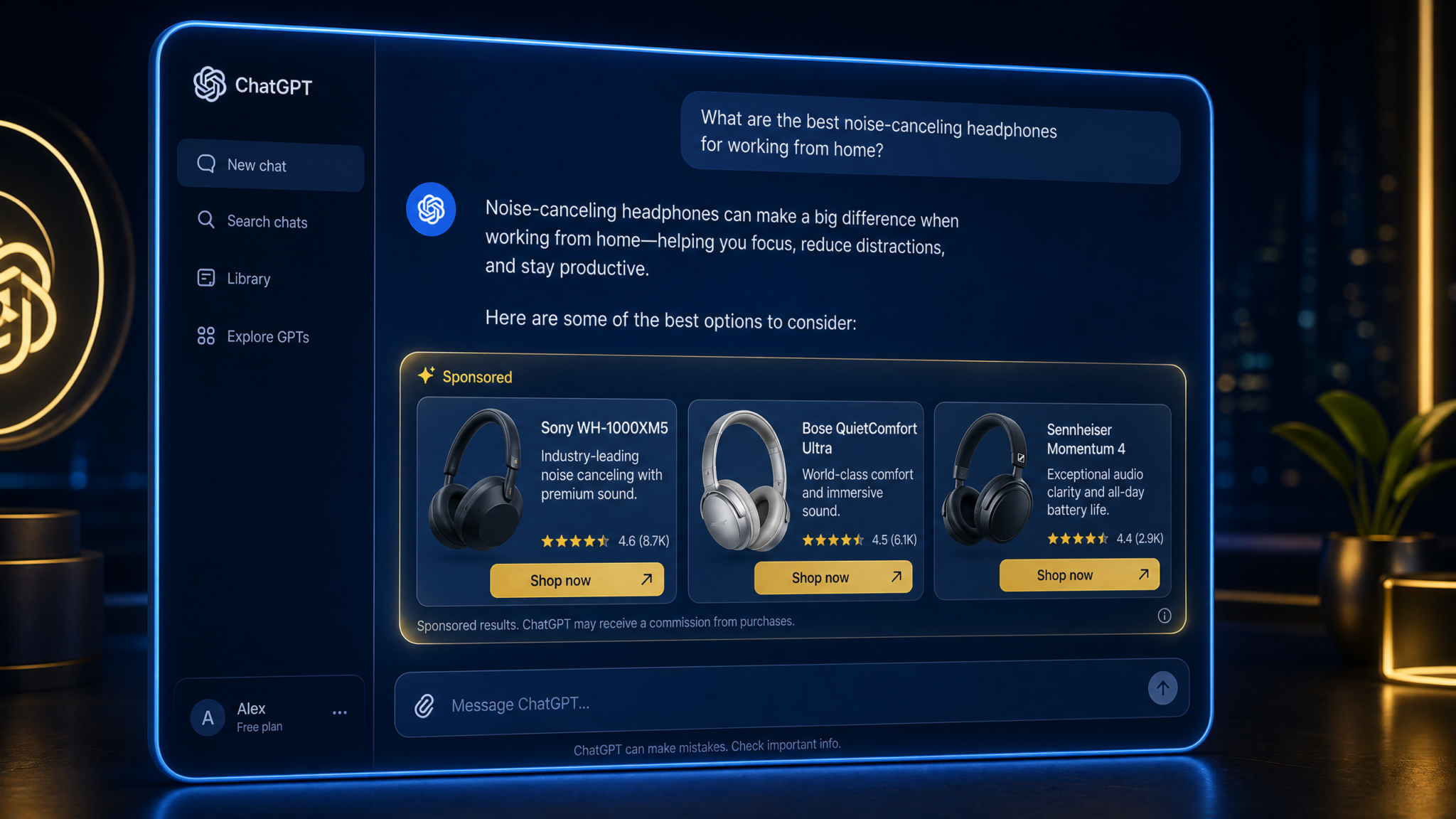
In July 2026, OpenAI crossed a threshold that many industry analysts had been anticipating — and some dreading — for over a year: the company officially launched a native advertising system inside ChatGPT, introducing sponsored result cards that appear at the bottom of selected conversational responses. This isn’t a rumored feature, a beta test limited to a handful of users, or a quiet experiment buried in settings menus. It is a full-scale, monetization-first deployment that fundamentally changes the experience of interacting with the world’s most-used AI assistant. As of its launch, ChatGPT serves roughly 200 million weekly active users, and approximately half of all queries submitted by free-tier users now trigger at least one sponsored card. For marketers, SEO strategists, privacy advocates, and everyday users alike, the implications are significant, far-reaching, and in many cases still unfolding.
This guide breaks down everything we currently know about ChatGPT’s advertising system: how it works under the hood, what the ads actually look like inside the interface, how OpenAI uses conversational context for targeting, what this means for brands wanting to advertise through the platform, and what power users can do to minimize or eliminate the sponsored experience. We’ll also examine why OpenAI needed to make this move in the first place — the company was burning through approximately $8 billion annually before this launch — and what the arrival of AI-native advertising means for the broader landscape of search, content, and digital marketing.
What ChatGPT Ads Actually Look Like: The Sponsored Card Format
Unlike Google’s approach of embedding sponsored links directly into a list of results where they can be easily mistaken for organic content, OpenAI has taken a more structurally distinct approach, at least in its initial deployment. Sponsored results in ChatGPT appear as discrete “Sponsored Cards” — visually separated modules that render at the bottom of a conversational response, below the main answer content. The card format includes a brand logo or product image, a short headline (currently capped at 80 characters), a two-to-three sentence description written in natural language rather than ad copy shorthand, a clearly labeled “Sponsored” badge in the upper-right corner of the card, and a call-to-action button that links to the advertiser’s landing page.
Importantly, the sponsored cards do not appear mid-response. OpenAI has — at least in this initial rollout — resisted the temptation to interrupt the actual answer with commercial placements. The AI still produces its full, uninterrupted response first. The sponsored content is appended afterward, creating a visual separation that the company argues preserves answer integrity. Whether that separation remains psychologically meaningful to users as they habituate to the format is a different question, and one that user experience researchers are already beginning to study.
Single Card vs. Multiple Card Placements
The system currently supports between one and three sponsored cards per response, though the vast majority of triggered responses in the first weeks of launch showed only a single card. Multiple cards appear primarily when the query has sufficiently broad commercial intent — for instance, a question like “What’s the best project management software for a small remote team?” is more likely to surface two or three cards from competing vendors than a narrowly specific technical question that happens to touch on a commercial product. OpenAI’s documentation for advertisers notes that the relevance score must exceed a minimum threshold for each card slot, meaning the platform will not force-fill three cards just because the inventory exists — a design decision that reflects lessons learned from Google’s early era of low-quality ad stuffing.
The Visual Design Language
The sponsored cards use a slightly muted background compared to the white or dark-mode surface of ChatGPT’s main chat window, making them visually distinct without being jarring. The “Sponsored” label is displayed in gray text — small but legible — which has already drawn criticism from some digital rights organizations who argue the disclosure should be more prominent. Comparing this to Google’s own disclosure history is instructive: the FTC issued guidance in 2013 specifically because search engine ad labels had become too subtle, and critics are raising similar concerns about ChatGPT’s approach. OpenAI has stated that label prominence may be adjusted based on regulatory feedback and user testing data.
Interactive Elements Within Cards
Unlike static display ads, ChatGPT’s sponsored cards include a secondary interaction layer: users can click a small “Ask about this” link embedded in each card, which opens a follow-up prompt in the conversation window pre-populated with a question about that brand or product. This is a genuinely novel feature with no direct analogue in traditional search advertising. It allows advertisers to invite deeper conversational engagement rather than simply pushing users off to a landing page. Early engagement metrics shared by OpenAI in their advertiser launch documentation suggest that the “Ask about this” interaction has a click-through rate approximately 2.3x higher than the primary CTA button — a finding that is shaping how sophisticated advertisers are structuring their card descriptions to encourage this deeper engagement pathway.
ChatGPT Plus vs Free Tier Feature Comparison
How the Ad System Works: Conversational Intent Matching vs. Keyword Matching
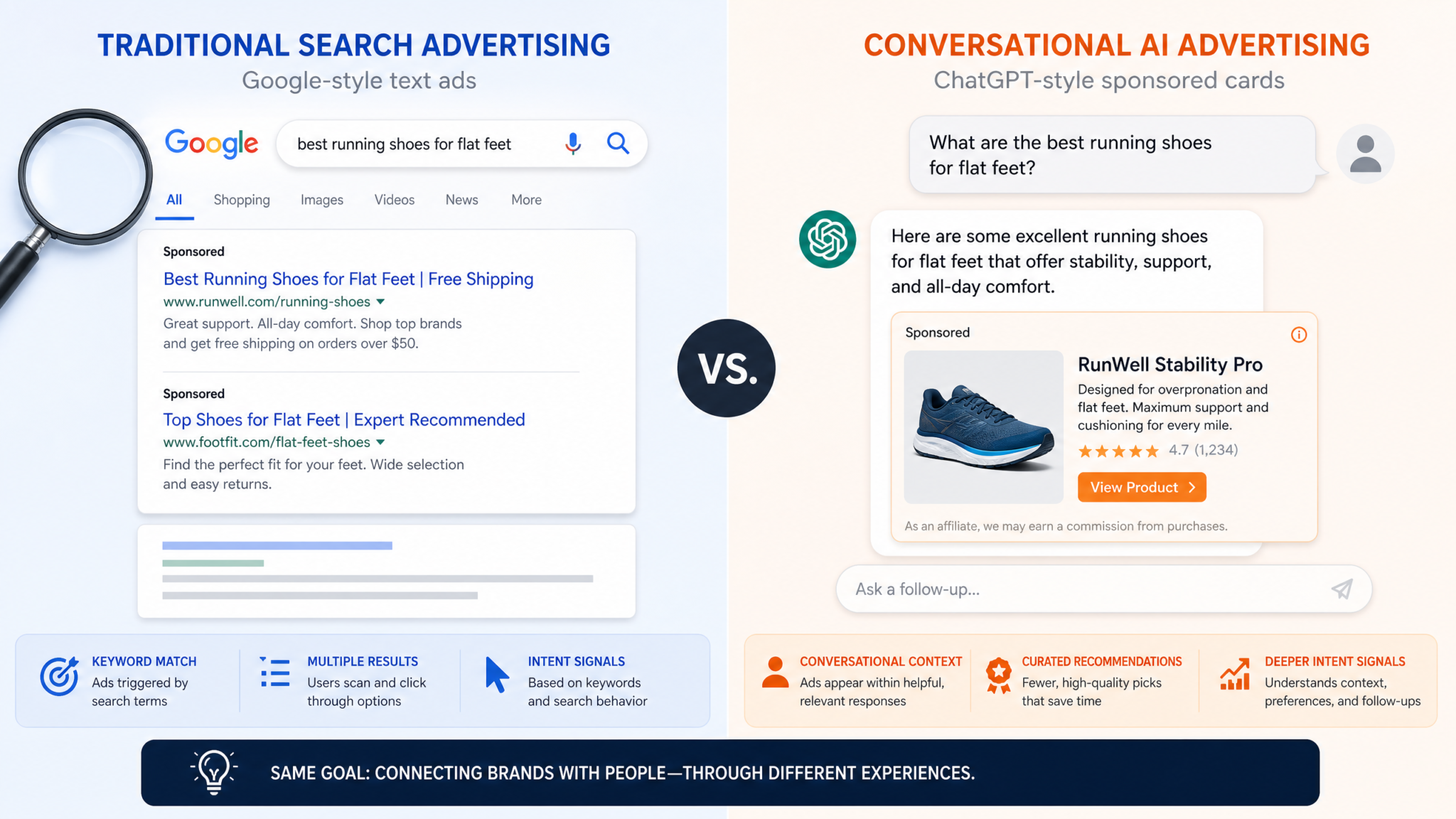
The most technically interesting — and commercially significant — aspect of ChatGPT’s advertising system is its departure from keyword-based ad triggering. Google Search Ads, Bing Ads, and virtually every other search advertising product built in the last two decades operate on a keyword auction model: advertisers bid on specific words and phrases, and when a user’s query matches (exactly, broadly, or via some variant), an eligible ad enters the auction. This system is well-understood, highly optimized, and also has well-documented limitations — keyword matching is a proxy for intent, not intent itself.
OpenAI’s system operates differently. Rather than parsing a query for keyword matches against an advertiser’s bid list, the system feeds the full conversation context — including prior turns in the session, not just the most recent message — into an intent classification model. This model produces a multi-dimensional intent vector that describes what the user is trying to accomplish, at what stage of a decision-making process they appear to be, and with what degree of commercial readiness. Advertisers don’t bid on keywords; they define intent profiles: structured descriptions of the types of conversations and user goals they want their ads to appear alongside.
The Role of Conversational Context
This is where ChatGPT’s advertising model diverges most sharply from anything that has come before. Consider a user who spent the first fifteen minutes of a session asking detailed technical questions about cloud database architecture before finally asking “which managed Postgres service should I use?” A keyword-based system sees only that final query. ChatGPT’s intent matching system sees the full arc of the conversation — the technical depth of the user’s knowledge, the specific constraints they’ve mentioned (budget considerations discussed three turns earlier, a preference for AWS-native services mentioned in passing, a team size implied by earlier questions) — and uses all of that context to select an ad that is genuinely relevant to this specific user’s situation rather than to the generic population of people who search for “managed Postgres service.”
For advertisers, this represents a fundamental shift in how targeting is conceived. Instead of asking “what keywords does my audience use?” the question becomes “what does a conversation look like when someone is genuinely ready to consider my product?” This is a harder question to answer, but a much more valuable one, and OpenAI’s advertiser platform — launched simultaneously with the ad system itself — provides tools to help brands map out these conversational intent profiles.
Relevance Signals and Quality Scoring
OpenAI’s ad ranking system uses a composite quality score that combines three primary signals: intent relevance (how well the ad’s defined intent profile matches the current conversation context), response coherence (how naturally the advertised product or service fits into the subject matter of the AI’s answer), and engagement history (how users with similar conversational profiles have previously interacted with similar ads). This third signal — effectively a form of collaborative filtering applied to ad engagement — is only possible because of the rich behavioral data ChatGPT has accumulated across its massive user base. It represents a competitive moat that new entrants to AI advertising will struggle to replicate.
What Advertisers Actually Configure
Through OpenAI’s self-serve advertising platform, which launched in beta for select advertisers in May 2026 and opened more broadly alongside the July launch, brands configure their campaigns using a combination of natural language intent descriptions, audience parameters (geographic targeting, language, and a limited set of inferred demographic signals), bid settings expressed as cost-per-click or cost-per-1000-impressions, and creative assets (logo, headline, description, and destination URL). The minimum daily budget at launch is $50, placing the platform within reach of small and medium-sized businesses while still reflecting the premium context ChatGPT offers relative to traditional display networks.
Impact on Free-Tier Users: The New Reality of Free ChatGPT
OpenAI’s data, shared during the advertiser launch briefing, indicates that approximately 50% of queries submitted by free-tier users in the first weeks of the rollout triggered at least one sponsored card. This figure is not uniform across query types — informational queries with no commercial angle (e.g., “explain the French Revolution”) have a near-zero ad trigger rate, while queries with clear or implied commercial intent trigger ads at a rate closer to 80-85%. The 50% figure is an average across the full free-tier query distribution.
This is a significant change in the free-tier experience. From ChatGPT’s launch in November 2022 through early 2026, the free tier was ad-free — a remarkable fact given that the service was losing hundreds of millions of dollars per month. For users who have come to rely on ChatGPT as a daily productivity tool, research assistant, or creative collaborator, the appearance of sponsored cards represents a noticeable shift, even if the cards are structurally separated from the answer content.
Query Frequency and Ad Exposure
The exposure gap between light and heavy free-tier users is notable. A user who submits five queries per day, roughly half of which have commercial intent, will encounter approximately 12-18 sponsored cards per week. A power user on the free tier submitting 30+ queries per day could encounter 50-70+ sponsored cards weekly. This asymmetry has the practical effect of making heavy free-tier usage feel increasingly commercial, which OpenAI may intend as a conversion mechanism toward paid subscriptions — a dynamic that mirrors the freemium playbook used by Spotify, LinkedIn, and many other platforms.
User Reaction and Early Sentiment Data
Early social media sentiment analysis from the first two weeks after the July 2026 launch showed a mixed but not catastrophically negative response. A rough breakdown of vocal user reactions on X (formerly Twitter) and Reddit’s r/ChatGPT community skewed approximately 45% negative or critical, 30% neutral or accepting, and 25% supportive or indifferent. The most common criticism was not that ads existed at all but that their placement — while technically below the main answer — felt “intrusive” in a way that traditional search ads do not. Several users noted that the conversational format of ChatGPT creates a stronger sense of a one-on-one exchange than a search results page, making the insertion of sponsored content feel more like an interruption of a conversation than an addition to a list.
How to Upgrade to ChatGPT Plus
What This Means for Marketers and SEO Professionals
For digital marketers, the launch of ChatGPT advertising represents both an opportunity and a strategic challenge. The opportunity is obvious: access to one of the world’s most engaged, intent-rich digital environments, with a targeting system that operates at the level of conversational intent rather than keyword proxies. The challenge is equally significant: the skills, tooling, and mental models that define expertise in Google Ads and traditional SEO do not map cleanly onto this new environment.
Creating Ads Through OpenAI’s Platform
The advertiser onboarding process begins at ads.openai.com (launched in beta May 2026). The account setup process will feel familiar to anyone who has used Google Ads or Meta Business Manager: business verification, payment method, billing threshold configuration, and basic account structure. Where it diverges is in campaign creation. Instead of keyword research as the foundation of campaign strategy, OpenAI’s platform asks advertisers to complete what it calls a “Conversation Profile” — a structured form where you describe the types of conversations your ideal customer is having when they would be receptive to learning about your product or service.
The platform includes an AI-assisted intent mapping tool that helps advertisers translate their product descriptions and target audience definitions into effective Conversation Profiles. In practice, this tool works reasonably well for common B2C and SaaS B2B categories but requires more manual refinement for niche or technically complex offerings. Early advertiser feedback collected by marketing communities suggests that the intent mapping tool tends to over-broaden profiles for unfamiliar product categories, leading to wasted impressions in the first days of a campaign before the system’s learning algorithms can optimize based on actual engagement data.
Creative Best Practices for ChatGPT Ads
The creative requirements for ChatGPT sponsored cards differ meaningfully from those for traditional search or display ads. The 80-character headline limit is similar to Google Ads expanded text, but the description field rewards natural, conversational language rather than benefit-stacked ad copy. Early A/B test data from advertisers who participated in the May beta suggests that descriptions written in a tone consistent with ChatGPT’s own response style — informative, measured, specific — outperform traditional promotional copy by approximately 35-40% on the “Ask about this” engagement metric. Descriptions that feel like they were ported directly from a Google Ads campaign without modification tend to perform poorly, possibly because the jarring tonal shift between the AI’s response and the ad description creates cognitive friction.
Implications for SEO and Organic AI Visibility
The SEO implications of ChatGPT advertising deserve particular attention. For years, SEO professionals have been grappling with the “zero-click” problem — the erosion of organic traffic as search engines answer more queries directly in results pages without requiring users to visit source websites. ChatGPT, in its non-advertising form, dramatically accelerates this trend: users get comprehensive answers without clicking through to any source. The introduction of sponsored cards creates a paid pathway for brands to maintain visibility in this environment, but it does not solve the organic visibility problem. If anything, it reinforces it — the existence of a paid channel implicitly suggests that organic “rank” in conversational AI responses will become a distinct discipline from traditional SEO.
This is pushing forward the emerging field that practitioners are beginning to call “Generative Engine Optimization” or GEO — the practice of structuring content, data, and brand signals to improve the likelihood that an AI system will recommend or cite your brand in its organic responses. The arrival of ChatGPT ads doesn’t make GEO less important; it makes it more so, because brands that lack organic presence in AI responses will now need to pay for every touchpoint, while brands with strong GEO strategies may achieve meaningful organic mentions and supplement them selectively with paid placements.
Generative Engine Optimization (GEO) Guide for Marketers
Privacy and Data Implications: How OpenAI Uses Conversation Context for Targeting
The privacy implications of ChatGPT’s advertising system are significant and, as of the July 2026 launch, still being scrutinized by regulators in multiple jurisdictions. The core concern is this: the data used to target ads in ChatGPT is not just search queries. It is full conversational transcripts, including personal disclosures, emotional context, health-adjacent discussions, financial questions, and relationship situations — the kinds of things people type into an AI chat interface that they would never type into a search bar.
What OpenAI Says It Uses (and Doesn’t Use)
OpenAI’s advertising privacy documentation, published alongside the July launch, states that ad targeting uses “conversation intent signals derived from the current session” and explicitly states that personally identifiable information, health-related conversation content, and financial specifics are excluded from the intent classification pipeline. The company further states that conversation content is processed for ad targeting purposes using a separate inference pipeline that does not retain conversation text after the intent vector is generated — meaning the actual words you type are not stored in association with your ad targeting profile.
These are meaningful commitments, but they require trust in OpenAI’s implementation and ongoing compliance with them. Privacy researchers have pointed out that intent vectors derived from sensitive conversations can themselves be sensitive, even if the underlying text is not retained. If a user’s conversation about managing a chronic illness produces an intent vector that routes pharmaceutical ads to that user, the privacy harm occurs at the intent vector level, not at the level of retained conversation text.
GDPR and Global Regulatory Scrutiny
The European Data Protection Board announced in late July 2026 that it would open a preliminary inquiry into ChatGPT’s advertising system, focused specifically on the legal basis for processing conversation content for commercial targeting purposes under GDPR Article 6. Several national data protection authorities, including those in Germany and France, have indicated they may issue provisional guidance restricting conversational data-based targeting before a formal GDPR determination is reached. OpenAI has stated that European users in the initial rollout are served ads based on more limited contextual signals pending regulatory clarification — a de facto two-tier system that has itself drawn criticism for creating unequal privacy protections based on geography.
Children and Vulnerable Populations
ChatGPT’s terms of service require users to be 13 or older, with parental consent required for users under 18 in most jurisdictions. OpenAI’s advertising documentation states that users identified or inferred to be minors are excluded from behavioral targeting, with ads for these users served on a topic-contextual basis only (equivalent to showing a textbook ad when the conversation is about studying, regardless of any user-specific intent signals). Child advocacy organizations have called for more robust age verification and stronger protections, noting that self-reported age data is unreliable and that the “inferred minor” classification system has not been independently audited.
How to Disable or Minimize Ads in ChatGPT
The most direct way to eliminate sponsored cards from your ChatGPT experience is to upgrade to a paid subscription tier. OpenAI’s pricing structure as of the July 2026 ad launch positions ad exposure as the primary differentiator between free and paid tiers in terms of user experience — a deliberate design choice that makes the value proposition of upgrading more tangible for users who previously found the free tier adequate for their needs.
Paid Tier Ad Policies
ChatGPT Plus subscribers ($20/month) see significantly reduced ad frequency — approximately 10-15% of queries trigger sponsored cards, down from roughly 50% for free users. The Plus tier continues to show ads in high-commercial-intent scenarios, which OpenAI justifies as consistent with the “relevant, non-intrusive” advertising philosophy they have articulated for the platform.
Access 40,000+ AI Prompts for ChatGPT, Claude & Codex — Free!
Subscribe to get instant access to our complete Notion Prompt Library — the largest curated collection of prompts for ChatGPT, Claude, OpenAI Codex, and other leading AI models. Optimized for real-world workflows across coding, research, content creation, and business.
ChatGPT Pro subscribers ($200/month) are entirely ad-free as of the July 2026 launch, a policy OpenAI has committed to maintaining “for the foreseeable future” in their advertiser documentation. This positioning makes the Pro tier explicitly valuable for power users and professionals who use ChatGPT as a primary work tool and find ad interruptions — even structurally separated ones — unacceptable in that context.
ChatGPT Enterprise and API access remain entirely ad-free, as these products are sold directly to businesses and developers who are paying for access at volume pricing that doesn’t require supplemental ad revenue.
Settings-Level Options for Free Users
For users who cannot or choose not to upgrade, OpenAI has introduced a limited set of settings-level controls under Settings → Privacy → Advertising Preferences. These controls allow users to opt out of conversational context targeting (defaulting to topic-contextual targeting only), opt out of ad personalization entirely (resulting in generic, non-targeted sponsored cards), and submit a data subject request to review and delete their advertising profile. Notably, there is no option for free-tier users to disable sponsored cards entirely — the only path to complete ad removal is a paid subscription, which aligns with OpenAI’s commercial incentives but has prompted criticism from digital rights groups who argue a meaningful opt-out should be available to all users regardless of payment.
Practical Tips for Minimizing Exposure
- Use specific, technical queries: Highly specific questions with no commercial ambiguity (e.g., detailed coding questions, academic research queries) have near-zero ad trigger rates.
- Avoid broad purchase-intent language: Phrasing like “what should I buy,” “best [product] for,” or “recommend a service” reliably triggers sponsored cards. Rephrasing as technical comparisons (“compare the architecture of X and Y”) can sometimes reduce ad trigger rates.
- Use the API: For technically capable users, accessing ChatGPT through the API (which remains ad-free) via a third-party interface or custom integration avoids the sponsored card system entirely, though this requires coding comfort and API costs.
- Opt out of conversational targeting: While this doesn’t eliminate ads, moving to topic-contextual targeting may result in less personally relevant — and therefore less engaging — ads, which some users may prefer.
- Use Projects or System Prompts: Some users have reported that queries submitted within ChatGPT’s Projects feature, which maintains a persistent system prompt context, show somewhat lower ad frequency — possibly because the system prompt context shifts the intent classification away from purely commercial signals.
Comparison with Google Ads and Traditional Search Advertising
Understanding ChatGPT’s advertising system requires placing it alongside the existing paradigms it will compete with and potentially disrupt. The comparison with Google Search Advertising is the most instructive, both because of Google’s dominance and because the two systems are built on fundamentally different information retrieval and monetization philosophies.
| Feature | Google Search Ads | ChatGPT Sponsored Cards |
|---|---|---|
| Targeting mechanism | Keyword bidding + audience layering | Conversational intent profiling |
| Query context used | Current query + recent search history | Full current session + user intent history |
| Ad placement | Top and bottom of SERP, mixed with results | Below AI response, visually separated |
| Ad format | Text headline + description + extensions | Card with image, headline, description, CTA |
| User interaction | Click through to landing page | Click through OR in-chat follow-up query |
| Minimum daily budget | No formal minimum (practically ~$10+) | $50/day |
| Advertiser skill required | Keyword research, bid management | Intent profiling, conversational creative |
| Transparency to users | “Sponsored” label, regulated by FTC | “Sponsored” badge, regulatory status pending |
| Organic alternative | SEO-driven organic rankings | GEO / brand mentions in AI responses |
| Ad-free option | No (Google One AI Premium doesn’t remove Search Ads) | Yes (Pro tier, $200/month) |
One of the most commercially significant differences is that Google currently offers no ad-free version of Google Search for consumers, making ChatGPT Pro’s entirely ad-free experience a genuine differentiator for the segment of users willing to pay premium rates to avoid commercial interruption. This is a positioning move that Perplexity Pro has also made, suggesting that the “premium ad-free AI search” category may become a distinct and growing market segment over the next 12-24 months.
ChatGPT vs Perplexity vs Google Gemini: AI Search Compared
The Business Case: Why OpenAI Needed Ad Revenue
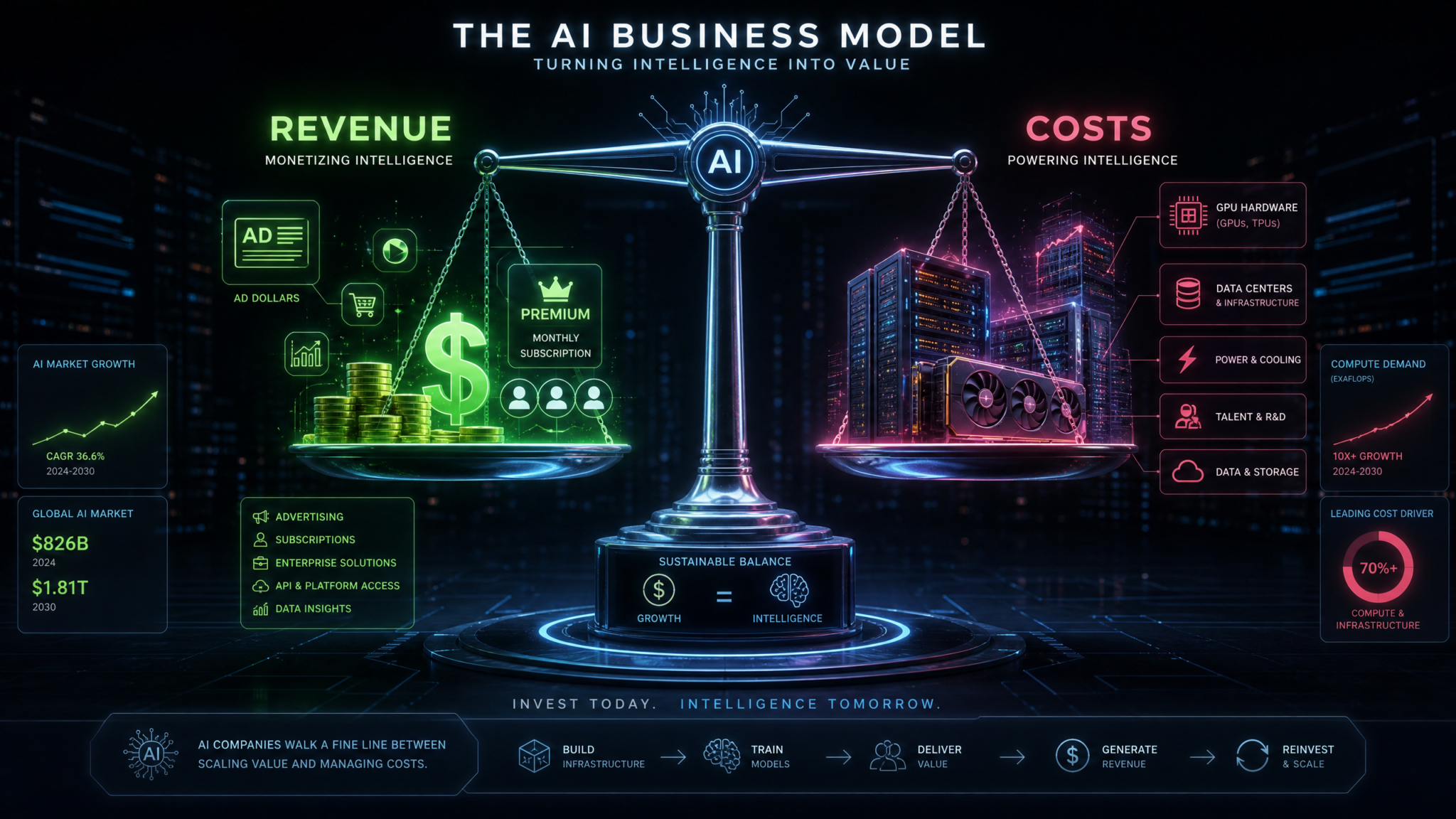
OpenAI’s financial situation in the period leading up to the advertising launch was, by any measure, extraordinary in both scale and precariousness. The company was burning through approximately $8 billion per year in operational costs as of early 2026, driven primarily by inference compute costs (running ChatGPT’s responses across 200 million weekly active users requires a staggering amount of GPU compute), ongoing model training and research investment, and the rapid global expansion of its workforce.
Against this cost base, OpenAI’s subscription revenue — while substantial — was insufficient to approach profitability. Estimates of ChatGPT’s subscription revenue in 2025 placed the figure between $3.5 billion and $4 billion annually, with additional revenue from enterprise licenses and API access bringing total revenue to an estimated $5-6 billion for the year. The gap between revenue and expenditure, running at $2-3 billion annually even with aggressive subscriber growth, necessitated the $6.6 billion fundraising round completed in late 2024 and the $40 billion round completed in early 2026 — the largest single fundraise in tech history at that time.
The Math Behind the Ad Launch
Industry analysts had been modeling ChatGPT’s potential advertising revenue for over a year before the July 2026 launch. The core inputs to these models were monthly active users (estimated at 400-500 million in mid-2026), the proportion on free tiers (estimated at roughly 75-80%), average queries per free user per day, and expected CPM rates in the AI conversational context. Estimates varied widely, but a midpoint consensus suggested that a 50% ad trigger rate across free-tier users with CPMs in the $15-25 range (reflecting the premium intent context) could generate between $1.5 billion and $2.5 billion in annual advertising revenue at current user scale — potentially closing a significant portion of the gap between revenue and expenditure without requiring OpenAI to double its subscription pricing.
Strategic Imperatives Beyond Cash Flow
The advertising launch was also strategically motivated by factors beyond immediate revenue. OpenAI’s major competitors in the consumer AI space — Google Gemini and Microsoft Copilot — are backed by parent companies with established, massive advertising businesses. For OpenAI to remain independent rather than becoming acquisition fodder or a permanent dependent of Microsoft (which holds a significant revenue share agreement with OpenAI under their partnership terms), the company needs a path to sustainable revenue that doesn’t require perpetual fundraising. Building an advertising business is one of very few paths to the kind of recurring, scalable revenue that could eventually support the company’s cost structure without external capital dependency.
What This Means for the Future of AI-Powered Search
The July 2026 launch of ChatGPT advertising is not just a product announcement — it is a signal about the structural direction of AI-powered information access. For nearly four years after ChatGPT’s public launch, there was a widespread assumption in the technology industry that AI would remain separate from commercial advertising, at least in the near term. That assumption has now been definitively refuted, and the ripple effects will be felt across the technology and media landscape for years.
The Commoditization of Answer-Space
Perhaps the deepest implication is what the advertising launch reveals about the nature of AI-generated responses themselves: they are, from a commercial standpoint, inventory. The “answer space” — the cognitive moment when a user receives information and considers action — is now explicitly a place where commercial messages can be inserted. This is a fundamental redefinition of what AI assistants are, from purely informational tools to commercially mediated information environments. The parallel with search engines is direct and intentional: just as the web’s information layer became the foundation for Google’s advertising business, the AI response layer is becoming the foundation for a new generation of conversational advertising.
Competitive Responses from Perplexity, Anthropic, and Google
OpenAI’s move has accelerated competitive responses from other major AI players. Perplexity AI had already piloted a “sponsored follow-up” format in late 2025, and the ChatGPT ad launch is expected to accelerate Perplexity’s commercial rollout. Anthropic, maker of Claude, has maintained a no-advertising policy through the writing of this piece, though analysts note that Anthropic faces similar financial pressures and a similar eventual choice between advertising revenue and raising ever-larger rounds of external capital. Google, whose Gemini AI assistant is deeply integrated with Google’s existing advertising infrastructure, is in the unique position of having had a native advertising system available from Gemini’s launch — the question for Google is not whether to monetize AI responses but how to evolve its existing system to compete with ChatGPT’s more structurally separated format.
The Quality Arms Race
One of the more optimistic readings of AI advertising’s arrival is that it creates a new quality competition. Because ChatGPT’s ad system is explicitly built on relevance and response coherence — and because user trust in the platform is directly tied to users’ belief that the AI’s answers are genuinely helpful rather than commercially biased — OpenAI has a stronger structural incentive to maintain ad quality and relevance than display advertising networks have historically had. This doesn’t mean the incentive will always win out against revenue pressure, but it does mean that the architecture of the system creates alignment between user experience quality and advertiser performance in a way that traditional display advertising never did.
Long-Term Implications for Content Creators and Publishers
For the publishers, bloggers, and content creators who have watched their organic search traffic erode as AI assistants answer questions that previously sent users to their websites, the advertising launch has a bittersweet dimension. On one hand, it confirms that AI responses are now commercially valuable — which validates the assertion that AI systems are extracting economic value from content they were trained on. On the other hand, it provides no direct compensation mechanism for content creators whose work underlies the AI responses that are now generating advertising revenue. This tension is likely to fuel ongoing legal and regulatory pressure around AI training data compensation, and several content creator organizations have already cited the advertising launch as evidence that OpenAI is fully commercially exploiting content assets without adequate attribution or payment.
How ChatGPT Uses the Web: Sources, Citations, and Real-Time Data
Frequently Asked Questions About ChatGPT Ads
Do ChatGPT ads affect the quality or accuracy of the AI’s answers?
Based on OpenAI’s stated architecture and early user testing, sponsored cards appear below the completed AI response and are generated separately from the response itself — the answer generation process is not influenced by advertiser relationships. However, critics have raised legitimate long-term concerns: as advertising revenue becomes structurally important to OpenAI, there are downstream incentives to surface more commercially relevant responses even in the organic answer layer. OpenAI has stated that answer generation and ad selection are operated by entirely separate systems with no shared ranking signals, but this separation requires ongoing trust and third-party verification that does not yet exist. Users who rely on ChatGPT for high-stakes research or professional use should be aware of this structural tension even if there is no current evidence of organic answer contamination.
Can advertisers specifically target me based on personal information I’ve shared in conversations?
According to OpenAI’s advertising privacy documentation, personally identifiable information shared in conversations (name, email, phone number, etc.) is explicitly excluded from ad targeting signals. Health-related conversation content and financial specifics are also stated to be excluded. The system uses “intent vectors” derived from conversation context, which are abstract representations of what you appear to be trying to accomplish rather than direct recordings of what you said. That said, intent vectors derived from sensitive topics can themselves carry sensitive implications, and the adequacy of these protections is currently under regulatory review in the EU. For maximum privacy protection, free-tier users can opt out of conversational context targeting in Settings → Privacy → Advertising Preferences, limiting targeting to topic-contextual signals only.
Will ChatGPT Plus subscribers eventually see more ads as OpenAI needs more revenue?
This is a legitimate concern with a genuinely uncertain answer. OpenAI has stated that Plus subscribers will see “significantly reduced” rather than zero ads, and that Pro subscribers will remain ad-free “for the foreseeable future” — language that provides a committed near-term policy without a permanent guarantee. The history of consumer tech subscriptions suggests that ad-free tiers tend to remain ad-free as long as the platform values subscriber trust and subscription renewal rates. However, if OpenAI’s revenue pressure intensifies, the financial incentive to expand ad placements into paid tiers will grow. Monitoring this policy is important for heavy ChatGPT users who are making subscription decisions based on the ad experience.
How do I know if a ChatGPT response has been influenced by advertising relationships with specific companies?
Currently, there is no way for end users to independently verify that organic responses are free from commercial influence, beyond trusting OpenAI’s stated architecture. The sponsored cards themselves are clearly labeled, making it easy to identify explicitly commercial placements. What cannot be easily verified is whether OpenAI’s recommendations of brands and services in the organic answer layer are purely based on quality signals or are influenced by commercial relationships. OpenAI has published a policy stating that advertisers receive no preferential treatment in organic response generation, but independent auditing mechanisms do not yet exist. This is an area where regulatory requirements for algorithmic transparency — already being discussed in EU AI Act implementation — could eventually mandate more robust disclosures.
As a marketer, should I be allocating budget to ChatGPT ads now, or wait for the platform to mature?
The most defensible answer for most marketers is: run a small test now, and scale based on results — do not allocate significant budget before the platform’s measurement and optimization capabilities mature. The early-mover advantage is real: CPMs and CPCs are likely at their lowest point during the initial rollout, before competition for inventory from major advertisers fully develops. The intent-matching system also improves with advertiser and engagement data, meaning brands that enter now will have earlier access to better-performing optimized delivery. However, the measurement infrastructure — conversion tracking, attribution modeling, cross-platform view — is currently limited compared to Google Ads or Meta. Marketers should treat the first 3-6 months of ChatGPT advertising as a learning and data-gathering phase rather than a performance channel expected to deliver optimized ROAS immediately. Starting with $50-200/day budgets, clear conversion tracking where possible, and rigorous creative testing will position brands well for the platform’s inevitable maturation.
