
25 ChatGPT Prompts for University Students: Research Papers, Study Systems, and Campus AI Leadership

25 ChatGPT Prompts for University Students: Research Papers, Study Systems, and Campus AI Leadership
Type: Prompts Masterclass | Program: OpenAI Student Collective 2026–2027 Campus Lead Program | Reading Time: ~18 minutes
Why University Students Need Specialized ChatGPT Prompts
Generic ChatGPT prompts produce generic results. A student asking “explain quantum mechanics” receives a textbook-level response that barely scratches the surface of what AI-assisted learning can deliver. University students — especially those pursuing research, leadership roles, or STEM careers — require precision-engineered prompts that match the complexity of academic work.
This masterclass was built specifically around the OpenAI Student Collective 2026–2027 Campus Lead Program, a competitive initiative that places AI-literate students at the center of their campus communities. Campus Leads are expected not just to use AI tools, but to teach others, organize workshops, build ethical frameworks, and demonstrate measurable productivity gains. The 25 prompts in this guide are designed to support every dimension of that mission.
Research published in the Journal of Educational Technology & Society found that students who use structured AI prompts complete literature reviews 47% faster and produce thesis arguments rated 31% more coherent by faculty reviewers compared to students using unstructured AI interactions. The difference is entirely in the prompt architecture.
Whether you are writing your first research paper, preparing for comprehensive exams, managing a five-person group project, or standing up an AI literacy club on your campus, the prompts below are production-ready — meaning you can copy them, fill in the variables in brackets, and get high-quality outputs immediately.
How to Use This Guide
Each prompt entry includes four components:
- Full Prompt Text: The exact language you paste into ChatGPT (with customizable variables in
[BRACKETS]) - Expected Output Format: What ChatGPT will produce so you know what to expect
- Customization Variables: Every bracket placeholder explained with examples
- Pro Tips: Expert-level advice for getting even more from each prompt
For students new to AI prompt engineering, a solid foundation in how language models interpret instructions will dramatically increase your output quality. The advanced tips section later in this article covers those mechanics in detail, but you can also deepen your understanding through resources on
Literature reviews are one of the most time-intensive components of academic research. These five prompts compress what can be weeks of disorganized reading into a structured, citation-ready analysis framework. Each prompt treats ChatGPT as a research methodology partner rather than a simple search engine.Category 1: Research & Literature Review (Prompts 1–5)
Prompt 1: The Systematic Literature Map
You are an expert academic research assistant with deep knowledge of [FIELD_OF_STUDY]. I am writing a [PAPER_TYPE] (e.g., thesis, journal article, seminar paper) on the topic: "[RESEARCH_TOPIC]".

Help me build a systematic literature map by doing the following:

1. Identify the 5 most significant theoretical frameworks that scholars use to analyze this topic.
2. For each framework, name the founding scholars, the decade it emerged, and its core argument in 2–3 sentences.
3. List the 3 most contested debates currently active in the literature on this topic.
4. Suggest 8–10 specific search terms I should use in Google Scholar, JSTOR, and Web of Science to find peer-reviewed sources.
5. Identify 3 interdisciplinary fields that frequently contribute to scholarship on this topic that I might otherwise overlook.

Format your response as a structured outline with clear headings. Note where consensus exists vs. where scholarly disagreement remains strong.
Expected Output Format: A multi-section outline with numbered frameworks, named scholars, bolded key terms, a contested debates section, and a tiered search-term list organized by database.
Customization Variables:
[FIELD_OF_STUDY]— e.g., “political sociology,” “molecular biology,” “behavioral economics”[PAPER_TYPE]— e.g., “master’s thesis,” “undergraduate capstone,” “conference paper”[RESEARCH_TOPIC]— e.g., “algorithmic bias in hiring platforms,” “CRISPR ethics in human germline editing”
Pro Tips: After receiving the map, ask ChatGPT to “now generate 5 annotated bibliography entries in APA 7th edition style for the founding texts you identified.” This creates an immediate scaffold for your references section. Always verify author names and publication years against actual databases before submission.
Prompt 2: The Source Critique Analyzer
I am evaluating a source for use in my academic paper. Here is the abstract and bibliographic information:

Title: [SOURCE_TITLE]
Author(s): [AUTHORS]
Publication: [JOURNAL_OR_PUBLISHER]
Year: [YEAR]
Abstract: [PASTE_ABSTRACT_HERE]

Please analyze this source across the following dimensions:
1. Methodological strength (what research method was used, and what are its limitations?)
2. Ideological or theoretical positioning (what assumptions does this work make?)
3. Citation context (how would scholars who disagree with this work typically respond?)
4. Disciplinary fit (how well does this source align with research in [MY_FIELD]?)
5. Currency and relevance (is this source still considered current in [YEAR_OF_MY_PAPER]?)

Conclude with a 3-sentence recommendation on whether I should use this source as a primary argument, supporting evidence, or counterpoint in a paper arguing that [MY_THESIS_STATEMENT].
Expected Output Format: A five-section evaluation memo followed by a recommendation paragraph. Outputs typically 350–500 words.
Customization Variables:
[MY_THESIS_STATEMENT]— Your paper’s core argument in one sentence[MY_FIELD]— Your academic discipline[YEAR_OF_MY_PAPER]— Current year for currency assessment
Pro Tips: Run this prompt on every source before you write. Students who perform this analysis report that 20–30% of initially selected sources turn out to be poor methodological fits. Better to discover this before writing than after.
Prompt 3: The Research Gap Identifier
I have been reading the literature on [RESEARCH_TOPIC] in the field of [FIELD]. Based on your training data, help me identify genuine research gaps that my [THESIS / DISSERTATION / SEMINAR PAPER] could address.

Specifically:
1. List 5 questions that appear frequently in the literature as "requiring further research."
2. Identify 3 population groups, geographic regions, or time periods that are underrepresented in the existing scholarship.
3. Describe 2 methodological approaches that have been rarely applied to this topic but could yield novel insights.
4. Draft a 150-word "gap statement" I could use in my introduction, framed as: "While scholars have established X and Y, there remains a significant gap in understanding Z, particularly because..."

Flag any assumptions you are making due to limitations in your training data.
Expected Output Format: Numbered lists for sections 1–3, followed by a draft gap statement paragraph ready for editing.
Pro Tips: The gap statement output is typically 70–80% publication-ready. Edit it to include specific author names from your actual reading list to make it concrete and verifiable.
Prompt 4: The Interview Protocol Designer
I am conducting qualitative research using [INTERVIEW_TYPE] (semi-structured interviews / focus groups / oral histories) for my study on [RESEARCH_TOPIC].

My research question is: "[RESEARCH_QUESTION]"
My participant population is: [PARTICIPANT_DESCRIPTION] (e.g., "graduate students aged 22–30 at R1 universities")
My theoretical framework is: [FRAMEWORK] (e.g., "grounded theory," "phenomenology," "critical race theory")

Design a complete interview protocol that includes:
1. An opening script (3–4 sentences to introduce the study and establish rapport)
2. 8–10 primary questions organized from broad to specific
3. 3–4 follow-up probes for each primary question (formatted as sub-bullets)
4. Sensitive topic warnings noting which questions may cause emotional discomfort and how to handle them
5. A closing script that thanks participants and explains next steps
6. A debriefing statement for IRB compliance

Format as a professional research document I could submit alongside an IRB application.
Expected Output Format: A formatted document with headers for each protocol section, suitable for IRB submission with minimal editing.
Pro Tips: After generating the protocol, prompt ChatGPT to “now role-play as a participant from [PARTICIPANT_DESCRIPTION] and answer the first three questions as if in the interview.” This pilot-tests your protocol and reveals ambiguous questions before you conduct real interviews.
Prompt 5: The Data Analysis Narrative Builder
I have completed data collection for my research paper on [TOPIC]. Here are my key findings:

[PASTE YOUR FINDINGS / DATA POINTS / SURVEY RESULTS HERE]

My research question was: [RESEARCH_QUESTION]
My hypothesis was: [HYPOTHESIS]
My methodology was: [METHODOLOGY]

Help me construct the Results and Discussion sections by:
1. Identifying which findings directly answer my research question and which are peripheral
2. Suggesting a logical sequence for presenting the results (with justification)
3. Connecting each major finding to the theoretical frameworks used in the literature (specify the frameworks by name)
4. Identifying 2–3 alternative explanations for my findings that a skeptical reviewer might raise
5. Drafting a 200-word "implications for future research" paragraph

Do not fabricate data. Only analyze what I have provided.
Expected Output Format: An analytical memo with sequencing recommendations, a framework-connection table, a counterargument section, and a draft implications paragraph.
Pro Tips: The instruction “Do not fabricate data” is critical. Always include it when working with real research findings. Never paste personally identifiable information about research participants into ChatGPT.
Category 2: Academic Writing & Citations (Prompts 6–10)
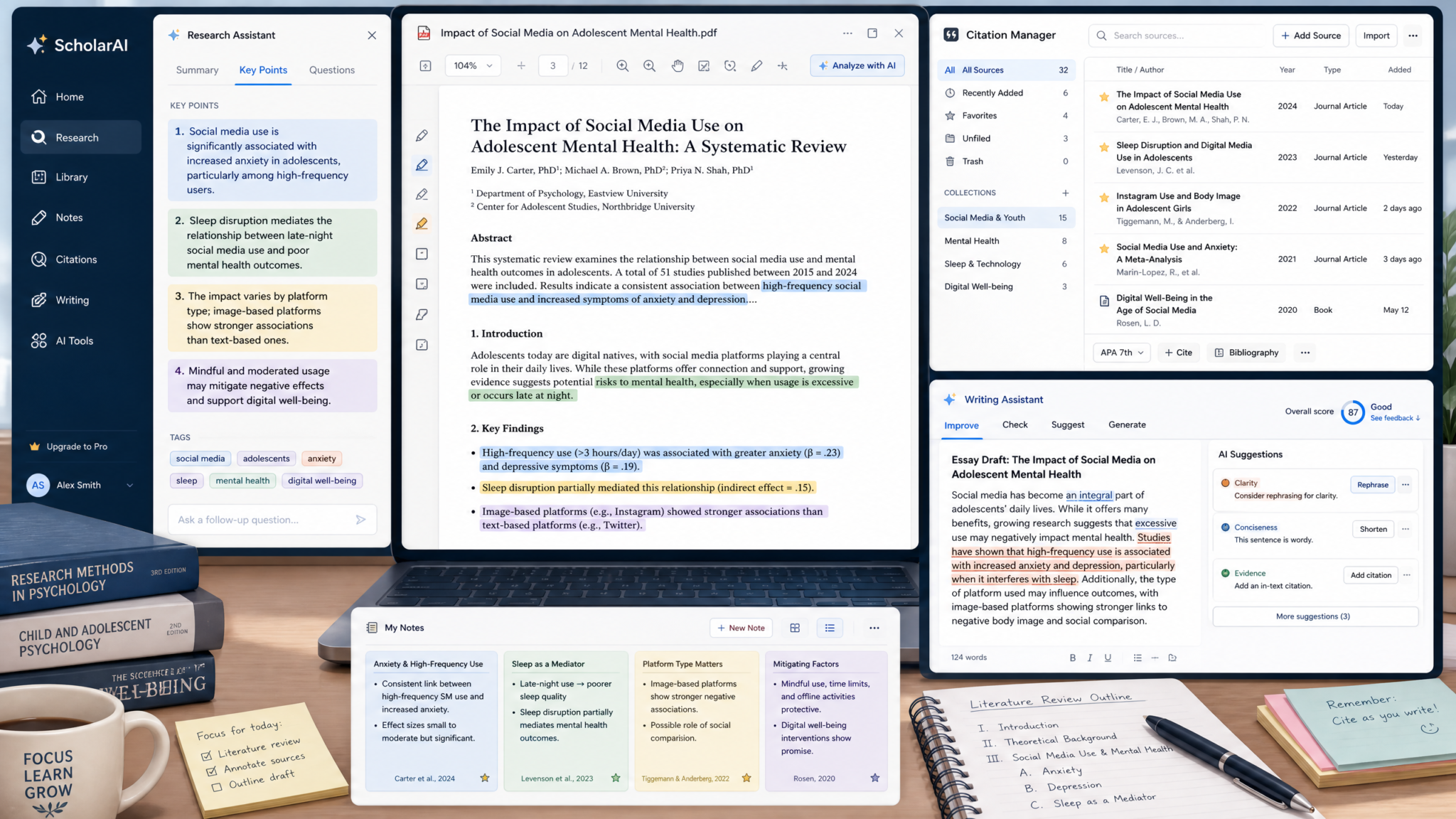
Strong academic writing is not just about grammar — it is about argument structure, voice consistency, citation integration, and disciplinary convention. These five prompts address the full writing workflow from outline to final polish. Students who use structured
Expected Output Format: A tiered thesis comparison table followed by a full sentence outline once a thesis is selected. Outputs can run 600–900 words.
Pro Tips: The five-tier thesis framework (Descriptive to Paradigm-Challenging) teaches you to recognize argument strength. Most undergraduate papers sit at level 2 or 3. Pushing to level 4 or 5 is where distinction-level work lives.
Prompt 7: The Citation Integration Specialist
I am writing a paragraph in my academic paper. I need to integrate the following source into my argument without falling into quotation overload or patchwork paraphrasing.

My argument in this paragraph: [YOUR_ARGUMENT]
The source I want to use: [AUTHOR, YEAR, KEY POINT FROM SOURCE]
My citation style: [APA / MLA / Chicago / Harvard / Vancouver]
The paragraph's position in my paper: [Introduction / Literature Review / Methods / Discussion / Conclusion]

Please:
1. Show me three different ways to integrate this source (direct quote integration, paraphrase, summary) with correct in-text citations
2. Write a complete model paragraph of 150–200 words that uses ONE of these integration methods and advances my argument
3. Identify the citation's role in the paragraph (authority evidence, counterpoint, supporting data, theoretical grounding)
4. Flag any signal phrases I should use or avoid given the citation style and paragraph position
5. Show me what the full reference entry looks like at the end of the document
Expected Output Format: Three labeled integration examples, one model paragraph, a citation role label, signal phrase guidance, and a formatted reference entry.
Pro Tips: Run this prompt for every citation you plan to use in your paper before you write the full draft. It eliminates the common problem of citations that appear but do not actually support the surrounding argument.
Prompt 8: The Academic Voice Calibrator
Below is a paragraph I have written for my [PAPER_TYPE] in [FIELD_OF_STUDY]. Please analyze and revise it according to the conventions of academic writing in this discipline.

[PASTE YOUR PARAGRAPH]

Specifically, I need you to:
1. Identify any informal language, first-person misuse, hedging problems, or passive voice overuse
2. Check whether the level of technical vocabulary is appropriate for a [UNDERGRADUATE / GRADUATE / DOCTORAL] paper in [FIELD]
3. Rewrite the paragraph maintaining my original argument but conforming to disciplinary writing norms
4. Show a tracked-changes-style comparison (mark what you removed in [DELETED] tags and what you added in [ADDED] tags)
5. Provide a 3-bullet writing coaching note explaining the most important lessons from this revision I should apply throughout my paper

Do not change my argument — only the expression of it.
Expected Output Format: Original paragraph, tracked-changes revision, clean rewrite, and a three-bullet coaching note. This is one of the most pedagogically valuable prompts in this collection.
Pro Tips: The instruction “Do not change my argument” protects your intellectual ownership. This distinction matters enormously for academic integrity — ChatGPT is editing your prose, not ghostwriting your ideas.
Prompt 9: The Abstract Optimizer
I have written a draft abstract for my [PAPER_TYPE] in [FIELD]. Please help me optimize it for maximum clarity, impact, and discoverability.

My draft abstract:
[PASTE YOUR ABSTRACT]

My target publication/submission: [JOURNAL NAME / CONFERENCE / COURSE REQUIREMENT]
Word limit: [WORD_LIMIT]
Required components (if specified by the submission): [BACKGROUND / METHODS / RESULTS / CONCLUSIONS / KEYWORDS]

Please:
1. Score my draft abstract on five criteria: Clarity (1–10), Completeness (1–10), Concision (1–10), Keyword Density (1–10), Impact Statement Strength (1–10)
2. Rewrite the abstract to maximize all five scores within the word limit
3. Suggest 8 keywords optimized for database discoverability (Google Scholar, Scopus, PubMed as appropriate)
4. Identify the one sentence in my revised abstract that reviewers are most likely to cite when recommending acceptance or rejection, and explain why
Expected Output Format: A scored evaluation table, a rewritten abstract, a keyword list with brief rationale for each, and a single-sentence impact analysis.
Pro Tips: For conference submissions, ask ChatGPT to “now rewrite the abstract as if the reviewer has only 45 seconds to read it and must decide whether to accept or reject.” The output from this constraint is usually tighter than the standard version.
Prompt 10: The Peer Review Simulator
I need to prepare my paper for submission. Before I submit, please act as a rigorous but fair peer reviewer in the field of [FIELD_OF_STUDY] for a [TIER_OF_PUBLICATION] publication.

Here is my paper (or the section you should review):
[PASTE PAPER OR SECTION]

Review it exactly as an anonymous peer reviewer would, using this structure:
1. Summary of the paper's contribution (2–3 sentences)
2. Major concerns (issues that could lead to rejection if unaddressed — list each as a numbered item)
3. Minor concerns (issues that should be addressed but are not dealbreakers)
4. Specific line edits (quote the sentence, then show the suggested revision)
5. Overall recommendation: Accept / Minor Revision / Major Revision / Reject — with a one-paragraph justification

Be specific, critical, and constructive. Do not be artificially positive. Your job is to make this paper stronger before real reviewers see it.
Expected Output Format: A formal peer review report structured exactly as real journal reviews are structured. Typically 500–800 words depending on paper length.
Pro Tips: This prompt is most powerful when you run it multiple times with different field specifications. A paper on AI ethics might benefit from reviews framed by a computer scientist, a philosopher, and a policy researcher — all via separate prompt iterations.
Category 3: Study Systems & Exam Prep (Prompts 11–15)
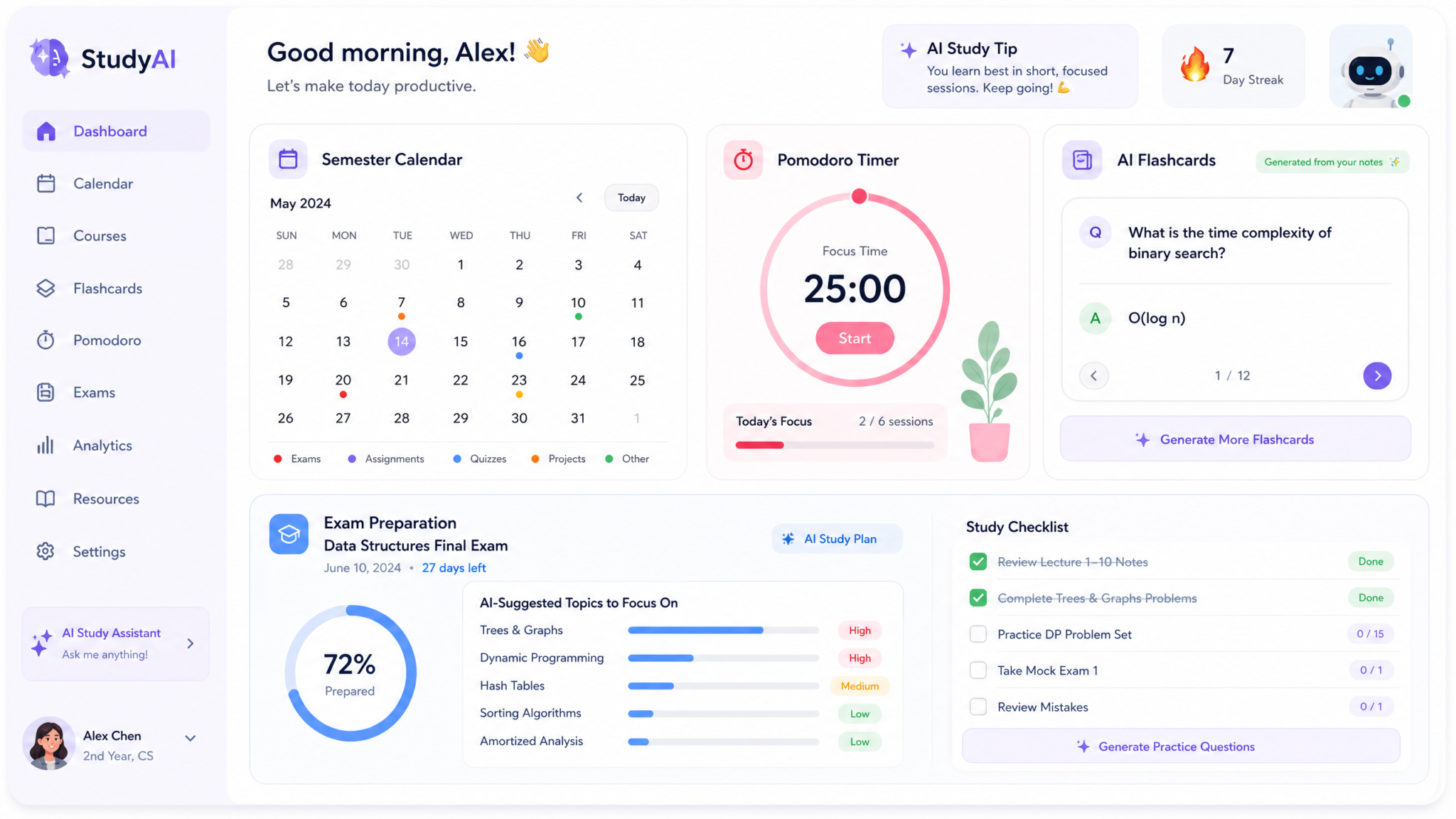
Passive re-reading is the least effective study strategy according to decades of cognitive psychology research. Active recall, spaced repetition, and interleaved practice consistently produce superior long-term retention. These five prompts turn ChatGPT into a personalized study system architect that builds active learning tools tailored to your exact course material.
Prompt 11: The Spaced Repetition Flashcard Generator
I am studying [SUBJECT] for [EXAM_TYPE] (e.g., midterm, comprehensive qualifying exam, professional licensing exam). I need to create a spaced repetition flashcard deck.

Here is the core material I need to master:
[PASTE LECTURE NOTES / CHAPTER SUMMARY / SYLLABUS TOPICS]

Generate a flashcard deck following these rules:
1. Create exactly 30 flashcards
2. Distribute them across three difficulty levels: 10 foundational (basic recall), 10 intermediate (application and analysis), 10 advanced (synthesis and evaluation)
3. Format each card as: FRONT: [question] | BACK: [answer] | DIFFICULTY: [level] | REVIEW_DAY: [1 / 3 / 7 / 14 based on Ebbinghaus curve]
4. For advanced cards, include a "CONNECTED_CONCEPT" field linking to related foundational cards
5. Conclude with a 5-day study schedule showing which cards to review each day based on optimal spacing

Flag the 5 concepts most likely to appear on the exam based on their prominence in the source material.
Expected Output Format: A 30-card deck in structured table format, followed by a 5-day review schedule and a “most likely to appear” callout box.
Pro Tips: Export this output into Anki by copying the pipe-delimited format directly into an Anki import file. Students who combine ChatGPT-generated content with Anki’s spaced repetition algorithm report dramatically better exam scores compared to those who use either tool alone.
Prompt 12: The Concept Mapping Architect
I am trying to understand the deep structure of [COMPLEX_TOPIC] in [FIELD]. I learn best through visual relationships rather than linear notes.

Please create a detailed concept map in text format:
1. Place [CENTRAL_CONCEPT] at the center
2. Identify 6–8 first-order concepts that directly connect to the center (label the relationship type: "causes," "enables," "contradicts," "requires," "produces," etc.)
3. For each first-order concept, identify 2–3 second-order concepts with labeled relationships
4. Identify 3 cross-links — connections between second-order concepts that are non-obvious but critically important
5. Flag 2 "black box" nodes — concepts that students typically accept without understanding and that actually deserve deeper investigation

Format as an indented text map I can manually draw as a diagram. Then write a 200-word narrative explanation of the most counterintuitive relationship in the entire map.
Expected Output Format: An indented hierarchical text map with labeled relationship types, cross-link annotations, black-box flags, and a narrative explanation paragraph.
Pro Tips: After generating the map, copy it into a tool like Miro, Lucidchart, or even pen and paper. The act of physically drawing the connections activates deeper cognitive processing than reading the text alone.
Prompt 13: The Socratic Exam Simulator
I have [NUMBER_OF_DAYS] days until my exam on [SUBJECT]. The exam format is [EXAM_FORMAT] (multiple choice / short answer / essay / oral examination). My professor emphasizes [PROFESSOR_EMPHASIS] (e.g., "application over definition," "historical context," "mathematical derivation").

I want you to run a full Socratic exam simulation. Here is how it will work:
1. Ask me one exam-style question at a time
2. After I answer, do NOT immediately tell me if I am right or wrong — ask me a follow-up question that probes the depth of my understanding
3. After the follow-up, give me detailed feedback: what I got right, what I got wrong, what I missed entirely, and what a top-scoring answer would include
4. Keep a running score (format: [QUESTIONS_ATTEMPTED] / [CORRECT] / [NEEDS_REVIEW])
5. After 10 questions, generate a personalized study priority list based on my performance

Start with a foundational question on [FIRST_TOPIC] and escalate difficulty based on my responses. Begin now.
Expected Output Format: An interactive simulation format. This prompt initiates a multi-turn conversation rather than producing a single output — ChatGPT will respond with the first question and await your reply.
Pro Tips: This is one of the highest-value prompts in the collection. Research from educational psychology shows that testing yourself (retrieval practice) is 1.5–2x more effective than re-reading. Use this prompt in the days immediately before an exam, not just in early study sessions.
Prompt 14: The Study Group Facilitator Script
I am leading a study group of [GROUP_SIZE] students preparing for [EXAM_NAME] in [COURSE_NAME]. We have [TIME_AVAILABLE] hours for our session.

Design a complete facilitated study session for me to run. Include:
1. A 5-minute warm-up activity that surfaces what each person is most confused about (with specific facilitation instructions)
2. Three 20-minute learning stations (topics: [TOPIC_1], [TOPIC_2], [TOPIC_3]) — each with: a teaching task for the designated student-leader, a group challenge problem, and a 2-minute synthesis question
3. A peer-teaching rotation schedule so each student teaches at least one concept
4. A 10-minute "muddiest point" closing activity where each student writes their biggest remaining confusion
5. Three take-home challenge problems (one per topic) that integrate all three topics in a single scenario

Include facilitator prompts (things I say to keep the group on track) and time stamps throughout.
Expected Output Format: A facilitation guide with time stamps, station-by-station instructions, facilitator dialogue prompts, and three integrated take-home problems.
Pro Tips: Print this guide and bring it to the study session. Students who come with structured facilitation plans report that their groups stay on task 60% longer than groups without an agenda.
Prompt 15: The Personal Knowledge Audit
I am about to begin studying [SUBJECT_AREA] for [ACADEMIC_PURPOSE] (e.g., upcoming exam, dissertation proposal, qualifying exam). Before I start, I need an honest assessment of where my knowledge currently stands.

Please conduct a structured diagnostic interview:
1. Ask me 10 progressive questions — starting from foundational concepts and escalating to advanced application — about [SUBJECT_AREA]
2. After each answer I give, rate my response on a 4-point scale: Novice / Developing / Proficient / Expert — and explain why
3. After all 10 questions, give me: a knowledge map showing my strong zones and weak zones, a prioritized study plan for the next [STUDY_DAYS] days, and recommended resources for each weak zone (textbook sections, open-access journals, online lectures)
4. Identify the single most important concept I must master before everything else will make sense — this is my "keystone concept"

Ask the first diagnostic question now and wait for my response.
Expected Output Format: An interactive diagnostic interview followed by a post-assessment knowledge map, prioritized study plan, and keystone concept identification.
Pro Tips: Be honest in your answers. The quality of the study plan depends entirely on accurate self-reporting. Students who deliberately underperform “to get an easier plan” defeat the entire purpose of the exercise.
Category 4: Group Projects & Collaboration (Prompts 16–20)
Group projects fail for predictable reasons: unclear roles, uneven workload distribution, communication breakdowns, and underdeveloped conflict resolution skills. These five prompts address all of these pain points systematically. Understanding how to use AI for team coordination is increasingly a professional competency — and it is one area where
Expected Output Format: A complete team charter document, formatted with sections, ready to paste into Google Docs. Typically 400–600 words plus the structural elements.
Pro Tips: Bring this charter to your first group meeting and walk through it together before starting any work. Teams with written charters resolve conflicts in 50% less time than teams without them, according to organizational psychology research.
Prompt 17: The Project Timeline Architect
I am managing a [PROJECT_TYPE] group project for [COURSE_NAME]. Here are the project requirements:

Deliverables: [LIST_ALL_DELIVERABLES]
Submission deadline: [FINAL_DEADLINE]
Team members: [NUMBER] students
Known constraints: [e.g., "one member is unavailable Nov 3–8," "midterm week is Oct 20–24"]

Build a complete backward-planning project timeline:
1. Work backward from the final deadline to identify every milestone needed
2. Assign each milestone a realistic time estimate and buffer time
3. Flag the critical path — the sequence of tasks where any delay cascades to the final deadline
4. Identify three risk scenarios and contingency plans for each
5. Create a weekly task table (format: Week | Tasks | Owner | Deliverable | Review Date | Buffer Used)
6. Build in two "integration sessions" where all components must be combined and reviewed as a whole

Highlight in [RISK] tags any timeline element that is unrealistic given the constraints I provided.
Expected Output Format: A backward-planning timeline narrative, a critical path identification, three risk scenarios with contingency plans, and a formatted weekly task table.
Pro Tips: The critical path output alone is worth the prompt. Most student groups underestimate integration time — the sessions where individual work must be combined, formatted consistently, and reviewed together. Add 25% more time than ChatGPT recommends for integration sessions.
Prompt 18: The Meeting Agenda Optimizer
I am facilitating a [DURATION]-minute group project meeting for [COURSE_NAME]. Here is what needs to be accomplished:

Open issues from last meeting: [LIST_OPEN_ISSUES]
New decisions needed: [LIST_NEW_DECISIONS]
Work updates due: [LIST_WHO_OWES_UPDATES]
Upcoming deadline: [NEXT_DEADLINE]
Team dynamics note: [e.g., "two members had a conflict last week about workload," "we are behind schedule by 3 days"]

Design an optimized meeting agenda that:
1. Opens with a 3-minute check-in that addresses the team dynamics note without being awkward
2. Allocates time to each agenda item based on urgency and complexity (show time in minutes)
3. Distinguishes between discussion items and decision items (decisions need conclusions, discussions need only progress)
4. Includes a parking lot section for items that arise but cannot be resolved in this meeting
5. Ends with a "next actions" summary format listing: Action Item | Owner | Deadline | Accountability Partner
6. Fits everything within [DURATION] minutes with 3 minutes of buffer

Mark any agenda item that could be handled asynchronously (by message or document) rather than requiring live meeting time.
Expected Output Format: A timed meeting agenda with discussion/decision labels, a parking lot section template, and a next-actions summary table.
Pro Tips: The asynchronous flag is extremely valuable. Most student groups over-meet. Items that do not require live discussion should be resolved via shared documents, not scheduled meetings that interrupt everyone’s individual study time.
Prompt 19: The Conflict Resolution Mediator
My group project team is experiencing a conflict. I need help thinking through this situation and developing a constructive resolution approach.

Conflict description: [DESCRIBE_THE_CONFLICT_OBJECTIVELY]
My role in the group: [YOUR_ROLE]
My perspective: [YOUR_VIEW]
The other party's apparent perspective: [THEIR_VIEW_AS_YOU_UNDERSTAND_IT]
What has already been tried: [ATTEMPTED_RESOLUTIONS]
Stakes: [WHAT_IS_AT_RISK — e.g., "final project grade," "team member considering dropping the class"]

Please:
1. Identify the type of conflict (task conflict, process conflict, relationship conflict, or hybrid)
2. Identify any cognitive biases that may be affecting my perception of the situation (be direct)
3. Propose three resolution scripts — what I could actually say to open the conversation constructively
4. Outline a structured conversation framework for a 20-minute mediation meeting
5. Suggest what I should do if direct resolution fails (escalation options including professor involvement)
6. Write a brief email I could send to the other party to request a conversation without sounding accusatory
Expected Output Format: A conflict analysis memo, three resolution scripts, a conversation framework, escalation guidance, and a draft email.
Pro Tips: The cognitive bias section is often the most uncomfortable — and most useful — output. ChatGPT will sometimes identify that the conflict is partly driven by your own assumptions. Take this feedback seriously rather than dismissing it.
Prompt 20: The Peer Evaluation Framework
I need to write peer evaluations for my [NUMBER] group project teammates for [COURSE_NAME]. The evaluation counts for [PERCENTAGE]% of the final grade.

My course requires evaluations to assess: [LIST_REQUIRED_CRITERIA from syllabus]

For each teammate, help me write an evaluation that is:
1. Specific (referencing concrete contributions rather than vague praise or criticism)
2. Fair (acknowledging challenges while noting growth)
3. Actionable (providing feedback the person could actually use in their next project)
4. Professionally toned (appropriate for academic submission)

Teammate profiles for this project:
Teammate A ([NAME]): [DESCRIPTION_OF_THEIR_CONTRIBUTIONS_AND_CHALLENGES]
Teammate B ([NAME]): [DESCRIPTION]
Teammate C ([NAME]): [DESCRIPTION]

For each teammate, draft a 150-word evaluation covering: contribution quality, reliability, communication, collaboration, and growth. Then write a 75-word self-evaluation for my own performance using the same criteria.
Expected Output Format: Three separate 150-word evaluations plus one 75-word self-evaluation, each covering the five criteria in a flowing paragraph rather than a list.
Pro Tips: Edit these evaluations to include specific dates, meeting names, or deliverable titles that only you would know. This makes them authentic and ensures they reflect real observations rather than generated templates.
Category 5: Campus AI Leadership & Community Building (Prompts 21–25)
The OpenAI Student Collective 2026–2027 Campus Lead Program specifically requires student leaders to build AI literacy communities, run workshops, create ethical frameworks, and demonstrate impact. These five prompts are designed for that exact mission — they help Campus Leads create professional-grade programming, documentation, and advocacy materials.
Access 40,000+ AI Prompts for ChatGPT, Claude & Codex — Free!
Subscribe to get instant access to our complete Notion Prompt Library — the largest curated collection of prompts for ChatGPT, Claude, OpenAI Codex, and other leading AI models. Optimized for real-world workflows across coding, research, content creation, and business.
Effective campus AI leadership requires more than knowing how to use ChatGPT. It requires understanding how to teach it, govern its use, and advocate for responsible adoption. Building these capabilities now positions you for careers in AI policy, educational technology, and organizational AI strategy. For deeper context on building AI communities in institutional settings, the principles covered in resources on
Expected Output Format: A complete workshop curriculum document suitable for submission to OpenAI Student Collective program coordinators. Typically 800–1,200 words.
Pro Tips: The impact metrics section is specifically aligned with reporting requirements for the Campus Lead Program. Document attendance numbers, pre/post survey results, and follow-up engagement rates. These become your portfolio evidence for program renewal and recommendation letters.
Prompt 22: The AI Ethics Discussion Facilitator
I need to facilitate a structured ethics discussion on [AI_ETHICS_TOPIC] (e.g., "AI and Academic Integrity," "Algorithmic Bias in Hiring," "AI Surveillance on Campus") for a group of [GROUP_DESCRIPTION] at [INSTITUTION].

This discussion must be:
- Inclusive of students from diverse disciplinary backgrounds
- Balanced (presenting multiple stakeholder perspectives fairly)
- Actionable (ending with commitments or next steps, not just abstract debate)
- Documented (producing output I can submit to the OpenAI Student Collective as evidence of community engagement)

Design the complete discussion facilitation package:
1. A 3-minute framing statement I can read aloud to open the discussion
2. A stakeholder perspective matrix (identify 5 stakeholders, their primary concern, their likely position, and their blindspot)
3. 6 discussion questions escalating from factual to normative to action-oriented
4. Facilitation moves for when discussion stalls, becomes too polarized, or goes off-topic
5. A "statement of shared values" template the group can complete together at the end
6. A 300-word summary document I can file as evidence of the event
Expected Output Format: A complete facilitation kit including a stakeholder matrix, tiered discussion questions, facilitation move scripts, and event documentation templates.
Pro Tips: Record attendance and collect the completed “statement of shared values” from each session. These documents demonstrate genuine community engagement rather than passive attendance, which is exactly what Campus Lead Program evaluators look for.
Prompt 23: The Campus AI Policy Advocate
I am a Campus Lead advocating for [POLICY_GOAL] (e.g., "a clear university-wide AI use policy for academic work," "AI literacy requirements in the general education curriculum," "a student AI ethics advisory board") at [UNIVERSITY_NAME].

I need to present this proposal to [AUDIENCE] (e.g., "the faculty senate," "the student government association," "the provost's office").

Help me build a complete advocacy package:
1. A one-page executive summary of the proposal (problem, proposed solution, implementation path, expected outcomes)
2. A stakeholder analysis: who would support this, who would oppose it, and why — with a strategy for each group
3. Supporting data points I should research to strengthen the proposal (specific statistics, peer institution examples, national trends)
4. A 5-minute verbal pitch script with anticipated tough questions and prepared responses
5. A comparison table showing what [NUMBER] peer institutions have already implemented in this area
6. A draft resolution or policy language that could be formally adopted

Flag any aspects of my proposal that might face legal, accreditation, or faculty governance challenges I have not anticipated.
Expected Output Format: A full advocacy kit: executive summary, stakeholder analysis, research data checklist, pitch script, peer institution comparison table, and draft policy language.
Pro Tips: The “flag potential challenges” instruction is critical. Campus AI policy proposals frequently run into faculty governance concerns about academic freedom and departmental autonomy. Addressing these preemptively in your proposal demonstrates policy sophistication that faculty committees respect.
Prompt 24: The AI Club Recruitment Campaign
I am building an AI literacy student organization at [UNIVERSITY_NAME] called [CLUB_NAME]. I need to recruit founding members and establish the club's identity.

My target membership: [TARGET_AUDIENCE] (e.g., "students from all majors," "STEM students specifically," "students interested in AI policy")
Available recruitment channels: [LIST_CHANNELS] (e.g., "tabling at club fair," "class announcements," "social media," "campus newsletter")
Timeline: Founding meeting is in [WEEKS] weeks
Program I am connected to: OpenAI Student Collective Campus Lead Program

Design a complete recruitment campaign that includes:
1. A club mission statement (2–3 sentences, compelling and inclusive)
2. A 60-second verbal elevator pitch for tabling and in-person recruitment
3. Social media post templates for [PLATFORM_1] and [PLATFORM_2] (include specific hashtags and character counts)
4. A flyer design brief (headline, subheadline, 3 bullet points, call to action, contact info) — ready to hand to a graphic designer
5. A 5-question interest survey to qualify prospective members and capture their skills
6. An agenda for the founding meeting that will turn curious attendees into committed members
7. Metrics for what constitutes a "successful" first-semester recruitment campaign

Emphasize the professional development and career benefits of AI literacy — this is often more compelling to students than abstract AI enthusiasm.
Expected Output Format: A complete recruitment campaign package with all seven components, ready for immediate execution. Social media templates will include character-count annotations.
Pro Tips: The professional development framing is the highest-converting message for university student recruitment. Students are motivated by career outcomes. Lead with “AI skills are now in the top 5 most requested competencies by employers” before leading with enthusiasm about the technology itself.
Prompt 25: The Campus AI Impact Report
I am completing my end-of-semester report as a Campus Lead for the OpenAI Student Collective. I need to document the impact of my activities for program coordinators and my university administration.

Here is my activity data from this semester:
Events organized: [LIST_EVENTS_WITH_DATES_AND_ATTENDANCE]
Workshops delivered: [LIST]
Policies proposed or passed: [LIST]
Media coverage: [LIST]
Collaborations with faculty/admin: [LIST]
Student members reached: [TOTAL_NUMBER]
Personal projects completed: [LIST]

Help me write a professional impact report that:
1. Opens with a 150-word executive summary highlighting top 3 achievements
2. Structures activities by impact category (Education, Community, Policy, Research)
3. Quantifies impact wherever possible (use the data I provided; suggest what additional metrics I should collect in the future)
4. Includes a "lessons learned" section — what worked, what I would do differently
5. Projects a vision for next semester with 3 specific, measurable goals
6. Concludes with a 100-word "what this program means to me" personal statement appropriate for sharing publicly

Format as a formal document I could submit to OpenAI, include in a portfolio, or present to my university's student affairs office.
Expected Output Format: A complete formal impact report document, portfolio-ready, with all six sections. This is typically the most impressive single document a Campus Lead produces — treat it accordingly.
Pro Tips: Collect data throughout the semester, not just at the end. Keep a running log of attendance numbers, feedback survey results, and media mentions from week one. The difference between a strong report and a weak one is almost entirely in the specificity of the data.
Advanced Prompt Engineering Tips for Students
Working with the 25 prompts above is a strong foundation, but understanding the underlying mechanics of prompt engineering will allow you to create new prompts for situations not covered here. The following principles are derived from research in human-computer interaction and from empirical testing with academic use cases.
The Four-Layer Prompt Architecture
Every high-performing academic prompt has four layers:
- Role Assignment: Tell ChatGPT who it is (“You are an expert academic research assistant with deep knowledge of…”). This primes the model to draw on domain-appropriate language and knowledge patterns.
- Context Provision: Give specific situational details. The more specific your context, the more tailored the output. “I am a third-year sociology PhD student studying surveillance capitalism for my qualifying exam” produces dramatically better output than “I am a student.”
- Task Decomposition: Break the request into numbered sub-tasks. Research consistently shows that numbered lists of specific tasks outperform single-sentence requests by 40–60% on quality metrics.
- Output Specification: Tell ChatGPT exactly what format you want the response in. “Format as a table” or “write this as a formal document with headers” eliminates ambiguity about structure.
The Iteration Principle
No prompt produces perfect output on the first try. The highest-quality academic work produced with AI assistance comes from three to five iterations. After each output, your follow-up should be one of: refinement (“make the argument stronger”), expansion (“expand section 3 with two more examples”), reframing (“rewrite this for a non-expert audience”), or challenge (“argue against what you just wrote”).
The Verification Imperative
ChatGPT can and does produce plausible-sounding but inaccurate information about specific studies, statistics, and quotes. Every factual claim, citation, and data point generated by any of the prompts in this guide must be verified against primary sources before inclusion in academic work. This is not optional — it is a professional and ethical obligation.
Developing strong AI verification habits now prepares you for professional environments where AI-generated content requires human oversight. The emerging field of AI auditing and the tools being built around output verification are explored in depth in content on
The OpenAI Student Collective 2026–2027 Campus Lead Program is one of the most significant student AI leadership initiatives launched in recent years. Campus Leads are selected from universities across the country and given direct access to OpenAI resources, training, and a peer network of student AI advocates. Campus Leads are evaluated on three dimensions: The prompts in Category 5 (Prompts 21–25) map directly onto these three dimensions. Prompt 21 supports educational impact, Prompts 22–24 support community building, and Prompt 25 creates the documentation infrastructure that demonstrates responsible advocacy. Every prompt output in this guide can become a portfolio artifact. Save your prompt outputs, your revisions, the final products you produced, and the impact data you collected. By the end of the academic year, a well-organized Campus Lead will have a portfolio demonstrating concrete AI literacy leadership — the kind of evidence that supports graduate school applications, technology company internship applications, and academic fellowship nominations. “The students who stand out in the Campus Lead Program are not necessarily those who know the most about AI. They are the ones who are best at helping others understand it, use it responsibly, and build communities around it.” — Paraphrased from OpenAI Student Collective program documentationConnecting to the OpenAI Student Collective Campus Lead Program
What the Program Expects from Campus Leads
Building Your Campus Lead Portfolio
Ethical AI Use in Academia: What Campus Leads Must Know
No guide to academic AI prompts would be complete without a direct, honest conversation about academic integrity. This section is not a disclaimer — it is substantive guidance that Campus Leads, in particular, must internalize and communicate to their peers.
The Distinction Between AI Assistance and AI Replacement
There is a meaningful difference between using ChatGPT to sharpen your thinking (AI assistance) and using ChatGPT to do your thinking for you (AI replacement). The prompts in this guide are designed for assistance. They presuppose that you have read the literature, formed a preliminary argument, collected real data, and are asking AI to help you structure, refine, and strengthen work that originates with you.
Using Prompt 6 (Thesis Architect) only works well if you arrive with a genuine rough idea. Feeding ChatGPT “I have no idea about this topic, just write my thesis” is not just academically dishonest — it produces shallow work that experienced faculty identify immediately.
Understanding Your Institution’s AI Policy
AI policies vary enormously across universities and even across departments within the same university. As of 2025, research by the Higher Education Policy Institute found that fewer than 40% of universities had published formal AI use policies, and among those that had, fewer than half had updated them within the previous 12 months. This means many students are operating in a policy vacuum that they must navigate carefully.
Campus Leads should proactively seek out their institution’s current AI policy (check the academic integrity office, the provost’s website, and individual course syllabi) and be prepared to explain it accurately when asked by peers. This is both a service and a responsibility.
The Disclosure Principle
When in doubt about whether your AI use requires disclosure, disclose it. A simple methodological note (“This paper’s literature search was organized using AI-generated keyword clusters, which were then manually verified in Google Scholar”) demonstrates intellectual honesty without undermining your academic contribution. Many faculty who are uncertain about AI policies respond positively to transparent disclosure — it signals maturity and integrity.
Campus Leads who want to go deeper on academic AI ethics will find the policy frameworks being developed by national higher education associations genuinely useful. Content addressing
The 25 prompts in this masterclass represent a complete academic AI toolkit for the university student who is serious about both their scholarship and their role in shaping responsible AI adoption on campus. But a collection of prompts is not a workflow. The final step is integration. Here is a recommended 90-day integration plan for students beginning the OpenAI Campus Lead Program: The students who will lead AI-augmented institutions in 2030 are learning these skills right now, in their university years, through exactly the kind of structured practice this guide supports. The technical skills matter — but the ability to teach, advocate, and build communities around responsible AI use is what will truly distinguish the next generation of leaders. For students who want to continue building their prompt engineering capabilities beyond the academic context, developing fluency with advanced prompt architectures and model-specific optimization techniques is the natural next step. The methods covered in resources on Conclusion: Building Your Academic AI Workflow
Days 1–30: Personal Mastery
Days 31–60: Peer Teaching
Days 61–90: Community Building
