
ChatGPT Native Video Generation Is Coming: What OpenAI’s 2026 Roadmap Means for Content Creators and the AI Video Market
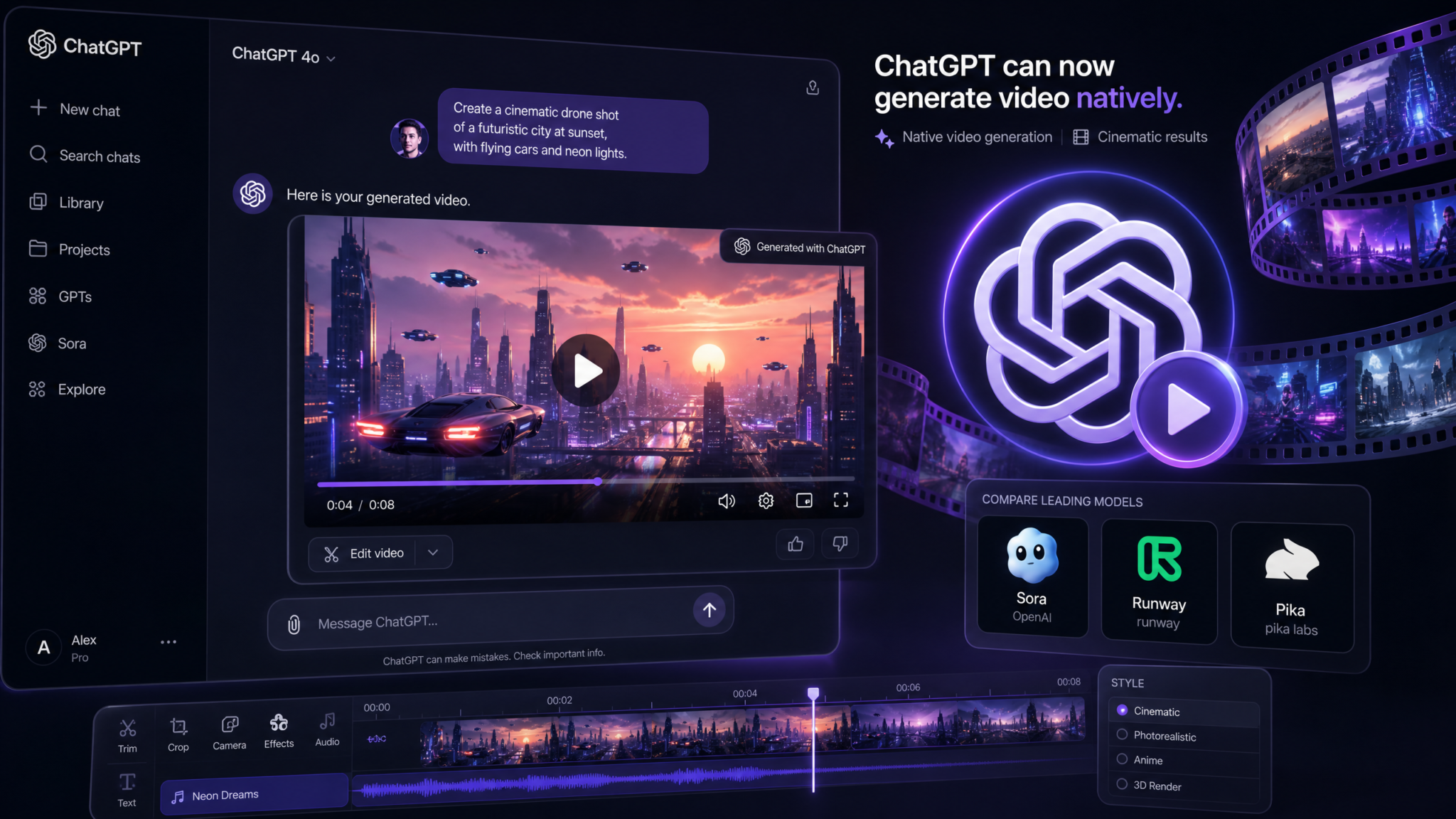
The AI content creation landscape is about to experience its most significant disruption since generative image tools first appeared inside productivity platforms. OpenAI’s confirmation in August 2026 that native video generation capabilities are coming directly into ChatGPT conversations represents far more than a feature update — it signals a fundamental restructuring of how creators, marketers, agencies, and developers think about video production workflows. For anyone who builds content professionally or semi-professionally, understanding what this shift means, how it differs from what already exists, and how to position yourself ahead of it is no longer optional. It is strategic survival.
OpenAI’s August 2026 Announcement: What Was Confirmed
OpenAI’s August 2026 product update was not a quiet blog post. It was a structured technical communication aimed squarely at developers, enterprise clients, and the broader creative community — and it laid out something the industry had been anticipating for well over a year: the forthcoming integration of video generation directly into the ChatGPT conversation interface. Rather than routing users to a separate tool like Sora or requiring API configuration to stitch different modalities together, OpenAI announced that video generation would become a first-class citizen inside ChatGPT itself.
The announcement confirmed three core capabilities arriving in phases. First, text-to-video generation directly within chat threads — users will be able to type a natural language prompt and receive a generated video clip inline, the same way they currently receive images through DALL-E integration. Second, image-to-video generation that allows any image already in the conversation — whether uploaded, generated, or referenced — to be animated with motion, physics simulation, and stylistic transformation. Third, and arguably most disruptive: conversational video editing, a capability that lets users refine, extend, re-cut, and restyle generated video through follow-up natural language instructions without leaving the chat thread.
OpenAI was careful to frame the announcement around the concept of conversational context persistence. This is the technical core of what makes native video generation inside ChatGPT fundamentally different from any existing video AI tool: the model maintains full awareness of every prior instruction, image, piece of code, and text within the conversation. That context window does not reset when you generate a video. It informs the video.
What was not confirmed includes specific release dates for all three phases, exact technical specifications like maximum resolution and clip duration, and pricing tiers for ChatGPT Plus, Pro, and API subscribers. These gaps are significant, and this article addresses them through analysis of publicly available compute economics and competitive market behavior. OpenAI GPT-5 Technical Capabilities and Model Architecture Explained
Feature Breakdown: Text-to-Video, Image-to-Video, and In-Chat Editing
Text-to-Video: The Entry Point for Mass Adoption
Text-to-video is the feature most users will interact with first, and for good reason — it requires no prior assets, no technical knowledge, and no workflow redesign. You describe what you want in plain language, and the model generates a video. The sophistication of what OpenAI is building here extends well beyond what standalone prompt-entry tools currently deliver, however, because the underlying model can draw on the full conversational context to understand intent, brand voice, stylistic preference, and prior feedback from within the same session.
Consider the workflow difference. With a standalone text-to-video tool, a marketing professional generating a product clip must re-describe the brand aesthetic, the product features, the desired emotional tone, and the target demographic in every single prompt. With ChatGPT’s native video generation, all of that context lives in the thread. If you spent twenty minutes earlier in the conversation analyzing your brand guidelines — uploading the PDF, having ChatGPT extract color palettes, typography rules, and tone descriptors — that information feeds directly into your video generation request. You type “make a 15-second clip of this product being used by someone in a modern kitchen” and the model already knows what “this product” looks like, what your brand’s visual language is, and what tone your previous content has established.
Image-to-Video: Breathing Life Into Static Assets
Image-to-video capability transforms ChatGPT’s existing image generation and image analysis functions into the front end of a video production pipeline. When OpenAI introduced DALL-E 3 integration natively into ChatGPT, many creators began using the platform iteratively to refine visual concepts — generating dozens of variations until a hero image matched their vision. That workflow now extends forward in time: that refined hero image becomes a video.
The technical complexity here is substantially higher than text-to-video. Image-to-video requires the model to infer plausible three-dimensional structure from a two-dimensional image, apply physically coherent motion, maintain style consistency across frames, and do all of this without the motion artifacts — sometimes called temporal flickering — that plague less sophisticated models. OpenAI’s work on Sora demonstrated mastery of these challenges at a technical level. The question for native ChatGPT integration is whether that technical mastery transfers cleanly into a conversational interface that must respond in near-real-time rather than the longer generation queues Sora users have accepted.
For social media content creators, image-to-video is transformative. A single DALL-E-generated illustration of a product, a character, a landscape, or an abstract concept becomes infinitely reusable as video content across platforms with different aspect ratio requirements and duration expectations. DALL-E 3 Advanced Prompting Techniques for Professional Content Creators
In-Chat Video Editing: The Feature That Changes Everything
If text-to-video is the gateway and image-to-video is the power tool, in-chat video editing is the architectural shift. No professional video tool currently allows a user to refine generated video through natural language follow-up in the same conversational session. You do not export to Premiere, adjust, re-export, and bring back. You type “slow down the second half,” “add motion blur to the background,” “change the lighting to late afternoon,” or “extend this to 30 seconds with the same character walking out of frame,” and the model modifies the existing clip accordingly.
This is not simple video filtering. Genuine conversational editing requires the model to maintain a semantic understanding of the video’s content — knowing what objects are present, what the motion trajectory of each element is, what the lighting model looks like — and apply targeted modifications to specific attributes without degrading unrelated elements. This is a computationally expensive capability that requires architectural choices at the model level, not just the interface level. OpenAI’s confirmation that this is in development suggests the underlying architecture has already demonstrated proof-of-concept at this level of control.
How Native Video Differs From Sora: Integration Versus Isolation
Sora, OpenAI’s dedicated video generation model released in late 2024, was and remains technically impressive. Its ability to generate long-form, physically coherent video from complex prompts set a new benchmark for the industry. But Sora exists as a standalone tool accessed either through a dedicated interface or the API. Its relationship to ChatGPT is limited to the fact that both share OpenAI infrastructure. There is no context sharing, no conversational memory, and no iterative refinement loop between a ChatGPT conversation and a Sora generation session.
| Dimension | Sora (Standalone) | ChatGPT Native Video |
|---|---|---|
| Access Point | Dedicated tool / API endpoint | Inline within any ChatGPT conversation |
| Context Awareness | Prompt-only, no session memory | Full conversation context window |
| Iterative Editing | New prompt required for each revision | Natural language follow-up in same thread |
| Multi-modal Input | Text prompt or image (limited) | Text, image, code, document, voice |
| Workflow Integration | Isolated — requires manual asset transfer | Native — images, scripts, briefs in same session |
| Target User | Developers, power users | All ChatGPT subscribers |
| Pricing Model | Credit-based API pricing | Subscription tier or credit hybrid (predicted) |
The distinction between integrated and isolated is not merely a convenience issue. It is a capability issue. When video generation is integrated into a conversation, the model can use code it wrote in the same session to generate a data visualization as a video. It can use a brand guidelines document you uploaded at the start of the conversation to inform color choices in a generated clip. It can use a script it drafted for you five messages ago as the structural backbone for a video sequence. None of this is possible with a standalone tool regardless of how powerful that tool’s video model is.
What Sora retains as an advantage — at least initially — is likely maximum technical capability. Dedicated tools built for a single modality can optimize compute allocation, model architecture, and interface design exclusively for that modality. ChatGPT’s native video generation will operate within the constraints of a generalist multi-modal system. This will manifest in practical limitations around maximum resolution, generation speed, and clip duration. The trade-off, however, massively favors the integrated approach for the majority of content creation workflows. How to Use OpenAI Sora API for Automated Video Production Workflows
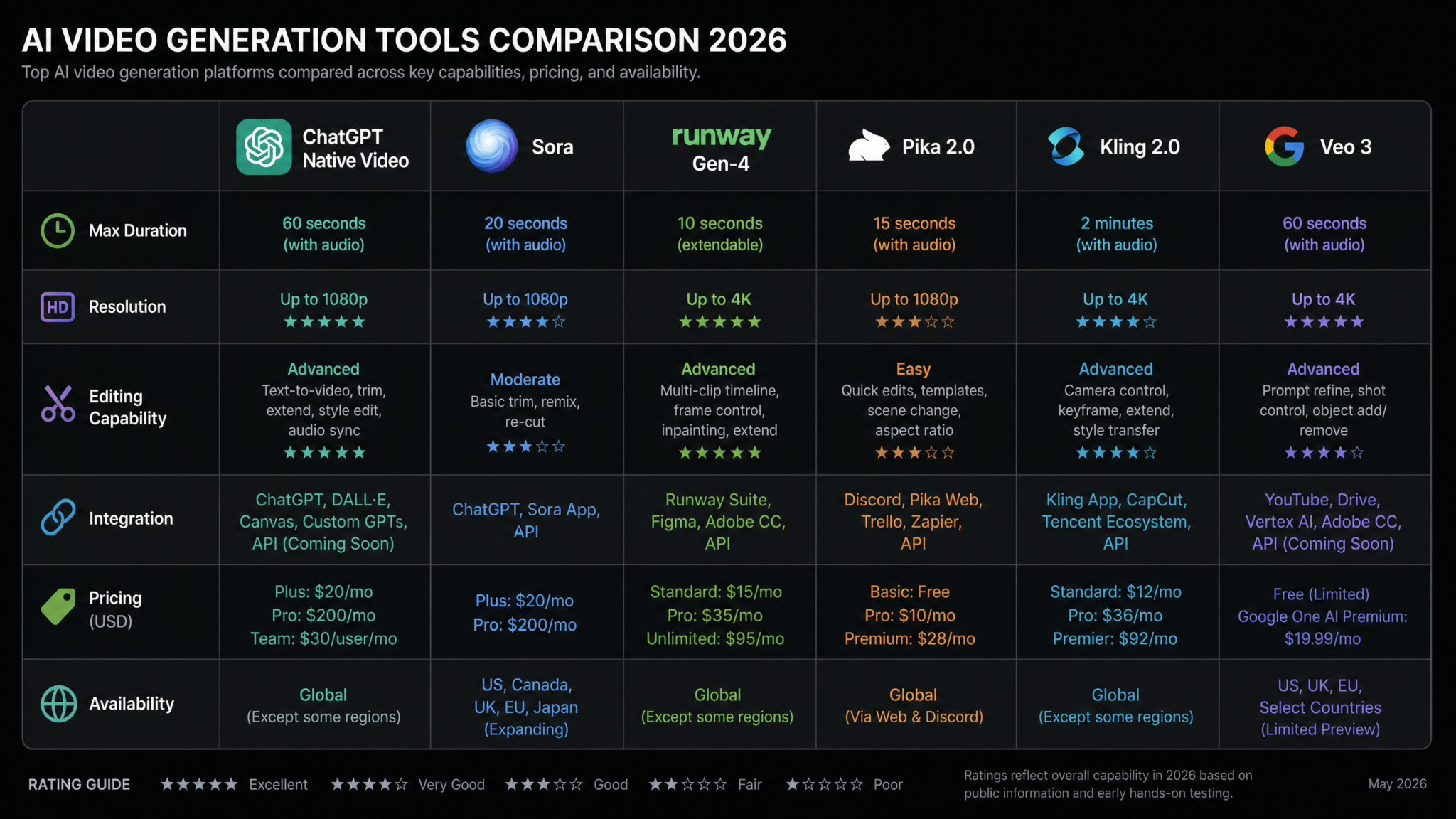
Technical Capabilities: Resolution, Duration, Styles, and Editing Power
Resolution Expectations
Based on OpenAI’s existing Sora capabilities and the compute constraints of serving video generation to millions of simultaneous ChatGPT users, technical analysts expect native ChatGPT video generation to launch with support for 720p resolution as the standard tier, with 1080p available to ChatGPT Pro subscribers. 4K generation is unlikely at launch given the exponential compute cost increase — a 4K video frame contains roughly nine times the pixel data of a 720p frame, and that cost multiplies across every frame of every generated clip.
This resolution ceiling will be a genuine limitation for creators who need broadcast-quality footage, but it will be entirely sufficient for social media content. TikTok, Instagram Reels, and YouTube Shorts are all viewed predominantly on mobile screens where the perceptual difference between 720p and 4K is minimal for non-static content. For YouTube long-form or commercial production, professional editors will continue to require dedicated tools even if they use ChatGPT native video for ideation and rough-cut generation.
Duration: Short-Form First, Long-Form Later
Initial clip durations will likely be capped at 15-30 seconds per generation, with the ability to generate sequential clips and request the model to maintain consistency across them. This is not a technical limitation of the underlying model — Sora can generate clips of one minute or longer. It is a practical limitation of the compute economics of serving conversational AI at scale. Generating a 60-second video at 1080p/30fps requires processing and rendering approximately 1,800 frames. At the scale of ChatGPT’s user base, this creates infrastructure demands that require careful capacity planning before being made freely available.
The likely evolution path is 15-second clips at launch, 30-second clips within six months, and 60-second clips within twelve months of feature launch, gated by subscription tier and credit allocation.
Style and Aesthetic Control
ChatGPT’s native video generation will likely inherit and extend Sora’s existing style vocabulary, which includes photorealistic, cinematic, animated, stop-motion, documentary, abstract, and stylized aesthetics. More importantly, the conversational interface allows style to be communicated in natural language that the model interprets through its language understanding capabilities rather than requiring users to learn a specialized prompt syntax.
This is a meaningful democratization of capability. Current video AI tools require users to understand which stylistic descriptors reliably influence generation outcomes — knowledge that takes significant experimentation to accumulate. With conversational video generation, a user can say “make it look like a documentary about urban architecture, similar in feel to the Netflix series on design” and the model draws on its training knowledge of visual style, cinematic language, and the referenced reference point. The barrier between creative vision and generated output drops substantially.
Audio Generation Integration
One underreported aspect of the announcement is the indication that native video generation will include synchronized audio generation — ambient sound, music bed generation, and potentially voiceover synthesis using ChatGPT’s existing voice capabilities. This would create a true end-to-end video production capability within a single conversation thread: script development, visual style definition, image asset creation, video generation, audio layering, and caption/subtitle generation all in one session. The implications for solo content creators are profound.
Implications for Content Creators: YouTube, TikTok, Instagram, and Marketing
YouTube Creators: The Long-Form Opportunity
For YouTube creators, the most immediate practical application is B-roll generation. Long-form YouTube content — tutorials, explainers, documentaries, vlogs — typically requires hours of supplementary footage to maintain visual interest while a creator speaks on camera or provides voiceover. Sourcing this footage currently means shooting it yourself, licensing stock footage from services like Storyblocks or Getty, or using free platforms like Pexels with limited relevance to specific topic needs.
Native ChatGPT video generation eliminates this bottleneck entirely for many use cases. A creator filming a video about the history of architecture can generate historically-accurate-looking visual sequences of building styles, urban development patterns, and interior spaces without travel, licensing costs, or dependence on stock footage availability. A finance creator explaining market dynamics can generate animated visualizations of economic concepts that would previously require a motion graphics specialist.
The SEO-adjacent workflow implication is also significant. ChatGPT can simultaneously assist with keyword research, script optimization, thumbnail concept generation, video description writing, and chapter structure — and now video asset generation — within a single working session.
TikTok and Short-Form: The Volume Problem Solved
Short-form video platforms like TikTok and Instagram Reels have created a content volume demand that exceeds what individual creators can sustain through traditional production methods. The platforms’ algorithms reward posting frequency, content consistency, and trend responsiveness in ways that require production capability most individuals simply do not have access to.
Native ChatGPT video generation changes this equation significantly. A consistent daily posting schedule on TikTok — which the algorithm rewards substantially — is achievable for a solo creator who can generate 15-30 second clips conversationally, iterate rapidly based on performance feedback, and maintain brand visual consistency through the context-aware generation that the integrated approach enables.
The risk, which we address in the limitations section, is that platform algorithms may develop detection methods for AI-generated video and apply distribution penalties. This is already a live conversation in the creator community around AI-generated images and text, and video will intensify it.
Marketing and Brand Content
For brand marketers, the workflow implications are transformational at the campaign level. Consider the current production pipeline for a social media campaign: brief development, creative concept approval, asset production (photo and video shoot), editing, review cycles, platform-specific reformatting, and scheduling. For a mid-size brand, this process takes three to six weeks and costs tens of thousands of dollars in production alone.
With ChatGPT native video generation, a marketing team can compress the concept-to-asset pipeline dramatically. A brand strategist begins a ChatGPT session by uploading the brand guidelines, target persona documents, and campaign brief. They use the conversation to develop and refine creative concepts, generate image assets for visual direction approval, and then generate video clips for rapid creative testing — all in the same session. The production cycle for social content compresses from weeks to days, and the cost structure shifts from per-production to per-subscription.
This does not eliminate the need for high-production-value hero content — the anchor creative that a campaign builds around typically still requires professional production. But it dramatically reduces the volume of professional production required by replacing supplementary, platform-specific, and testing assets with generated alternatives. AI Marketing Workflow Automation Strategies for Enterprise Teams
Competitive Landscape: Runway Gen-4, Pika 2.0, Kling 2.0, Google Veo 3, Meta Movie Gen
ChatGPT native video generation does not enter an empty market. By mid-2026, the AI video landscape includes several mature, well-funded, technically capable platforms that have built substantial user bases. Understanding how native ChatGPT video competes with each requires analyzing not just technical capability but workflow positioning, pricing, and target user alignment.
| Platform | Max Resolution | Max Duration | Conversational Editing | Multi-modal Context | Pricing Model | Primary Strength |
|---|---|---|---|---|---|---|
| ChatGPT Native Video | 1080p (Pro tier, predicted) | 30-60s (predicted) | Yes — full conversational | Yes — text, image, code, voice | Subscription + credits | Workflow integration, context awareness |
| Runway Gen-4 | 4K | Up to 4 minutes | Limited (reference frames) | Limited | Credit-based tiers | Cinematic quality, professional tools |
| Pika 2.0 | 1080p | Up to 30s | Partial (scene modification) | Image input | Freemium + subscription | Ease of use, social media optimization |
| Kling 2.0 | 1080p | Up to 2 minutes | No | Image input | Credit-based | Character consistency, Asian market |
| Google Veo 3 | 4K | Up to 2 minutes | Partial (Gemini integration) | Via Gemini (limited) | Vertex AI / Workspace tiers | Photorealism, Google ecosystem integration |
| Meta Movie Gen | 1080p | Up to 16s | No (as of mid-2026) | No | In development | Character animation, social integration |
Runway Gen-4: The Professional’s Choice Under Pressure
Runway has consistently positioned itself as the professional-grade AI video platform — the tool that VFX artists, post-production studios, and high-end content agencies use when quality cannot be compromised. Gen-4 extended this positioning with 4K output capability, multi-minute generation, and a suite of professional editing features that go well beyond what any conversational interface offers. Runway’s camera control features, precise subject inpainting, and style transfer capabilities represent genuine technical differentiation.
ChatGPT native video does not directly threaten Runway’s professional positioning at launch. Where it does threaten Runway is in the middle market — the thousands of creators and small agencies that currently use Runway for social content production rather than cinematic work. For this segment, the workflow integration advantage of ChatGPT native video will be compelling enough to capture significant market share, particularly because these users already live inside ChatGPT for their text and image work.
Google Veo 3: The Most Credible Technical Competitor
Google’s Veo 3, integrated into the Gemini ecosystem and available through Vertex AI, represents the most technically credible competitor to ChatGPT native video generation. Google benefits from comparable infrastructure scale, a multi-modal assistant in Gemini that mirrors ChatGPT’s conversational architecture, and deep integration with Google’s creative and productivity ecosystem — Workspace, YouTube Studio, and Google Ads are all potential integration surfaces.
The critical difference is ecosystem entrenchment. ChatGPT has built its user base on a model of creative and intellectual partnership that users have deeply personalized through custom instructions, GPTs, and conversation histories. The switching cost for these users is not just a preference — it is the accumulated context and workflow refinement they have built inside the OpenAI platform. Google must overcome this entrenchment with technical superiority, and while Veo 3’s photorealistic quality is exceptional, technical superiority alone has historically not been sufficient to dislodge established workflow habits in creative software.
Pika 2.0 and Kling 2.0: Niche Survival Strategies
Both Pika and Kling face the most acute pressure from ChatGPT native video integration. Their current value propositions — ease of use, social media optimization, and accessible pricing — are precisely the attributes that a ChatGPT-integrated video tool will deliver, with the additional advantage of full workflow context. For these platforms, survival will depend on finding and deepening differentiated capabilities: Pika through platform-specific optimization features, Kling through its character consistency strengths in Asian language and cultural content contexts.
Pricing Predictions Based on Real Compute Economics
Pricing predictions for any AI capability require honest engagement with the underlying compute economics, which are not speculative — they are knowable within ranges based on GPU infrastructure costs, model inference efficiency, and the pricing behavior of comparable existing features.
Generating a single 15-second video at 1080p/24fps requires rendering 360 frames. At the inference cost profile of current large video diffusion models, and accounting for OpenAI’s infrastructure efficiency advantages at scale, the raw compute cost of a single generation is estimated between $0.08 and $0.25 depending on resolution, duration, and model complexity. This cost profile suggests several possible pricing structures:
Scenario A: Credit Inclusion in Existing Subscription Tiers
The most likely model at launch mirrors how DALL-E image generation was introduced — a monthly credit allocation included with ChatGPT Plus and ChatGPT Pro subscriptions, with additional credits purchasable. ChatGPT Plus subscribers ($20/month) might receive 20-40 video generation credits monthly, while ChatGPT Pro subscribers ($200/month) receive 200-400 credits. At the compute cost estimates above, this creates a per-video effective cost to OpenAI of roughly $3-10 per credit bundle, which is sustainable at Pro pricing but requires careful management at Plus pricing.
Scenario B: Separate Video Generation Add-On
OpenAI may choose to position video generation as a premium add-on, similar to the model used by some competitors, charging $15-30 per month for a defined credit package above the base subscription. This approach allows OpenAI to manage compute demand while creating a natural upsell path from ChatGPT Plus to a “ChatGPT Plus + Video” tier.
Scenario C: API-First with Consumer Trickle
A less consumer-friendly but infrastructure-sensible approach would be to launch video generation capabilities through the API first — where enterprise clients pay per-token equivalents for video generation — and bring consumer access to ChatGPT interfaces in a subsequent phase. This allows OpenAI to calibrate capacity against enterprise demand before absorbing the much higher and less predictable volume of consumer requests.
For enterprise API pricing, the expected range based on comparable video AI API pricing is $0.10-0.40 per generated second of video at standard resolution, with 4K premium pricing at 2-3x that rate if and when available.
Workflow Integration: Video, Image, Voice, and Code in One Conversation
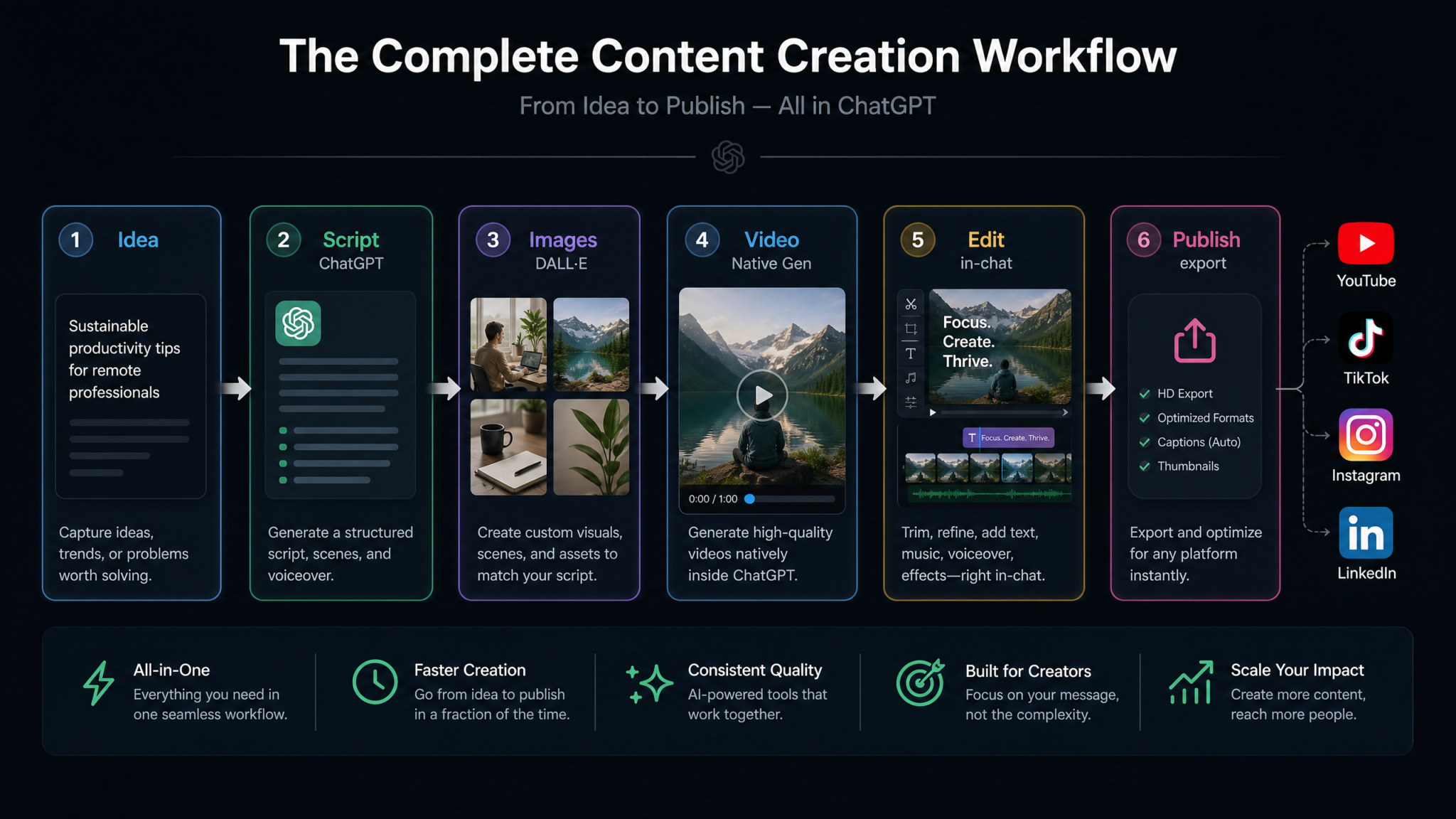
To fully understand the transformative potential of native video generation in ChatGPT, it is necessary to map the integrated workflow capability that emerges when video joins the existing modality stack. ChatGPT currently integrates: natural language processing and generation, image generation via DALL-E, image analysis and understanding, voice input and output via Advanced Voice Mode, code generation and execution via the Code Interpreter, web browsing and search, and document analysis. Adding video generation to this stack does not simply add one more capability — it creates integration possibilities that multiply across all existing capabilities.
A Practical Integrated Workflow: Product Launch Video Package
Consider the following workflow for a product marketing manager preparing a launch campaign, described step by step as it would occur in a single ChatGPT session:
- Brief Upload and Analysis: Upload the product brief, brand guidelines PDF, and target persona document. Ask ChatGPT to extract key messaging pillars, visual style descriptors, and audience emotional motivators.
- Script Development: Request a 30-second social video script based on the extracted brief. Iterate through three revisions using natural language feedback (“make the opening more urgent,” “add a question in the middle third,” “end with a specific call to action”).
- Storyboard in Images: Ask ChatGPT to generate DALL-E images for each of the six scenes in the script, using the brand color palette and visual style guidelines extracted earlier. Refine individual scenes through follow-up prompts.
- Video Generation: Request video clips for each approved storyboard frame, specifying motion, duration, and transition intent in natural language.
- Caption Generation: Request formatted captions for each platform (TikTok, Instagram, LinkedIn) with character count compliance and hashtag strategy.
- Audio Direction: Request a music brief for the sound designer, or — with audio generation integration — request a generated ambient sound layer directly.
This entire workflow, which currently requires multiple tools (a word processor, a design tool, a stock video platform, a video editing application, and a caption writing tool), occurs in a single conversation thread. The context established in step one informs every subsequent step. The total clock time from upload to assets ready for review: potentially under two hours for a solo creator or small team. Complete Guide to Building Multi-Modal AI Workflows with ChatGPT API
Access 40,000+ AI Prompts for ChatGPT, Claude & Codex — Free!
Subscribe to get instant access to our complete Notion Prompt Library — the largest curated collection of prompts for ChatGPT, Claude, OpenAI Codex, and other leading AI models. Optimized for real-world workflows across coding, research, content creation, and business.
Code and Data Visualization as Video
One underappreciated integration is between ChatGPT’s Code Interpreter and video generation. Data journalists, financial analysts, and educational content creators frequently need to animate data stories — showing how metrics change over time, how geographic patterns shift, how statistical relationships evolve. Currently this requires either dedicated data visualization tools like Flourish or D3.js expertise or motion graphics software like After Effects.
With code-to-video integration possibilities, a user could ask ChatGPT to analyze a dataset uploaded to the conversation, identify the three most visually compelling data stories within it, write the code to generate the visualization, and produce an animated video of that visualization playing out over time. This is not a speculative capability — it is the logical extension of capabilities that already exist individually, now operating in combination.
Limitations and Ethical Considerations
Temporal Consistency at Scale
Despite the remarkable progress in AI video generation, temporal consistency — keeping characters, objects, and environments visually coherent across multiple generated clips or within longer single clips — remains the most persistent technical challenge. Sora demonstrated major advances here, but even Sora produces artifacts in complex multi-character scenes with dynamic camera movement. For ChatGPT native video generation operating within the computational constraints of a conversational interface, this limitation will be more pronounced at launch.
Practically, this means creators using native video generation for content requiring consistent human characters across multiple clips — narrative series, brand spokesperson content, educational sequences with a recurring host — will encounter challenges that require either careful prompt engineering, post-production correction, or acceptance of visible inconsistencies.
The Platform Detection Problem
TikTok, YouTube, and Instagram have all publicly stated commitments to developing AI content detection and disclosure systems. TikTok already requires creators to label AI-generated content, and there is active development of algorithmic detection to enforce this at scale. As AI video generation becomes more accessible — and ChatGPT native video will be the most accessible AI video tool in history given the platform’s user base — the platforms will accelerate detection development.
This creates a strategic risk for creators who build their workflow entirely around AI-generated video without developing a disclosure and hybrid-production strategy. The combination of AI-generated and human-filmed content is likely to remain the most resilient approach — using AI generation for B-roll, supplementary footage, and stylized sequences while maintaining a human-filmed core.
Copyright, Training Data, and Visual Ownership
The copyright status of AI-generated video remains legally unsettled in most jurisdictions. In the United States, the Copyright Office has consistently held that purely AI-generated content without sufficient human creative authorship is not copyrightable. OpenAI’s terms of service grant users rights to use generated content for commercial purposes, but these rights exist in a legal gray area that commercial clients — particularly large brands and agencies — will require legal counsel to navigate.
There is also the ongoing question of what visual styles, artists, and intellectual property are embedded in the training data underlying the video generation model, and the liability exposure this creates when generated content visually resembles specific copyrighted works.
Deepfake and Misinformation Risks
The integration of video generation into a conversational interface used by hundreds of millions of people dramatically lowers the barrier to creating potentially misleading video content. OpenAI will implement content policy restrictions — as they do for image generation — prohibiting the generation of real individuals without their consent, political misinformation, and content designed to deceive. But the enforcement challenge scales with the user base, and no content policy eliminates misuse entirely. The provenance and authentication standards that C2PA (Coalition for Content Provenance and Authenticity) and similar initiatives are developing will become critical infrastructure for the broader video ecosystem as native generation tools proliferate.
What This Means for Professional Video Editors and Agencies
The professional video production industry has watched the development of AI video tools with a mixture of fascination and legitimate concern. The history of creative technology suggests a pattern: tools that automate one layer of production work do not eliminate demand for production professionals — they restructure what professionals are paid to do. Photoshop did not eliminate photographers. Non-linear editing systems did not eliminate editors. The question is not whether the profession survives but which specific skills retain premium value and which become commoditized.
What Gets Commoditized
The capabilities most directly commoditized by ChatGPT native video generation are: basic B-roll acquisition and editing, simple social media format adaptation, template-based promotional video production, and entry-level motion graphics for social content. These are currently the bread-and-butter revenue sources for many junior freelance video producers and small video production shops. The economic pressure on this segment will be significant and relatively rapid.
What Increases in Value
Paradoxically, the rise of accessible AI video generation is likely to increase the premium commanded by capabilities that AI cannot replicate: directorial vision and creative judgment in high-stakes production contexts, on-location narrative storytelling that requires human presence and real-world event capture, client relationship management and creative brief translation in complex campaign environments, technical post-production for broadcast and theatrical delivery standards, and the craft of performance direction with human talent.
Agencies that recognize this shift early will restructure their service offerings around AI-augmented production — using ChatGPT native video and comparable tools for ideation, rapid prototyping, and supplementary asset generation while redirecting their human creative resources toward the differentiated work that justifies premium pricing. Agencies that resist this restructuring will face margin compression as clients discover they can produce acceptable social video assets themselves.
The New Skill: AI Video Direction
A new professional skill is emerging that does not yet have a widely recognized job title: AI video direction. This is the discipline of translating creative vision into effective conversational prompts, iterative refinement sequences, and multi-modal context setups that reliably produce high-quality AI-generated video assets. Like the distinction between someone who knows how to use Photoshop and a professional retoucher, there will be a significant skill gap between users who can generate adequate AI video and practitioners who can reliably generate excellent AI video at production quality. This skill gap represents a professional opportunity that is currently wide open.
Timeline Predictions: When to Expect What
OpenAI’s August 2026 announcement indicated phases of rollout rather than a single launch date. Based on the phased approach OpenAI used for DALL-E integration, voice capabilities, and the GPT-4o multimodal launch, the following timeline represents the most analytically grounded prediction:
| Phase | Predicted Timing | Capabilities | Availability |
|---|---|---|---|
| Phase 1: Limited Beta | Q4 2026 | Text-to-video, 720p, up to 15s, basic styles | ChatGPT Pro subscribers, selected API partners |
| Phase 2: Expanded Access | Q1 2027 | Image-to-video added, 1080p for Pro, 720p for Plus | ChatGPT Plus and Pro subscribers |
| Phase 3: Conversational Editing | Q2 2027 | In-chat editing, 30s clips, audio generation | All paying subscribers |
| Phase 4: Full Integration | Q3-Q4 2027 | 60s clips, 4K for Pro (potentially), API full access | All users (free tier with heavy restrictions) |
This timeline is subject to acceleration if OpenAI perceives competitive pressure from Google Veo 3’s deeper Gemini integration, or deceleration if infrastructure capacity constraints prove more challenging than anticipated at the scale of ChatGPT’s full user base. OpenAI has historically moved faster than predicted timelines when competitive pressure is acute — the GPT-4o multimodal launches and the rapid deployment of DALL-E 3 integration both suggest a bias toward speed over phased caution when strategic momentum is at stake.
How to Prepare Your Content Workflow Right Now
The most actionable question for any content creator, marketer, or production professional reading this is: what can I do today to be positioned ahead of this capability when it arrives? The answer involves both skill development and workflow restructuring.
Step 1: Master Conversational Prompt Craft for Visual Content
The single highest-leverage skill for AI video generation is the ability to describe visual content with precision, specificity, and stylistic vocabulary. This skill is not native to most people — it requires practice and deliberate development. Begin now by using ChatGPT’s existing DALL-E image generation at a deeper level: describe cinematic scenes with camera angle, lighting, mood, color palette, depth of field, and compositional references. The vocabulary you build for precise visual description in image generation transfers directly to video generation.
Study cinematic language. Learn the difference between a dolly shot and a zoom, between golden hour and magic hour lighting, between a shallow depth of field and a deep focus composition. These are the descriptive dimensions that will separate creators who get excellent AI video outputs from those who get mediocre ones.
Step 2: Audit Your Current Workflow for Integration Points
Map your current content production workflow and identify every point where video assets are sourced, created, or modified. For each point, ask: is this a task where AI-generated video could substitute, augment, or compress the process? Create a list of the specific asset types — B-roll categories, motion graphics templates, social format variations — that currently consume the most production time. These are your highest-priority integration targets when native video generation launches.
Step 3: Build Brand Context Documents for ChatGPT Sessions
The context-awareness advantage of ChatGPT native video generation is only valuable if you have comprehensive context to provide. Build rich brand context documents now: visual guidelines with color palettes in hex codes, typography specifications, mood board descriptions in detailed text, target audience personas, content tone and voice guidelines, and a library of reference video examples with annotated descriptions of what makes them on-brand. These documents become the foundation of every video generation session, and having them ready before the feature launches means you can begin productive generation immediately rather than spending your early access time rebuilding context from scratch.
Step 4: Experiment With Current AI Video Tools to Build Intuition
Do not wait for ChatGPT native video to begin developing your AI video intuition. Use Runway, Pika, or Kling today to understand what works, what fails, and what requires multiple iterations to achieve. The specific tools will matter less as the landscape evolves; the intuition you build about how AI video models interpret motion descriptions, handle human figures, manage lighting consistency, and respond to style references will transfer across platforms. Creators who have already generated hundreds of AI video clips when ChatGPT native video launches will have a substantial head start over those encountering the medium for the first time.
Step 5: Develop an Ethical and Disclosure Framework
Before you begin using AI-generated video at scale in your content, establish a clear personal or organizational policy on disclosure, content authenticity, and acceptable use. Which content types will you disclose as AI-generated? Where will you use AI generation versus human-produced footage? How will you handle requests from clients or platforms that have specific AI content policies? Having these decisions made in advance — before the excitement of a new capability pushes you into gray areas without having thought them through — is both ethically sound and strategically protective.
Step 6: Stay Informed on Platform Policy Evolution
YouTube, TikTok, Instagram, and LinkedIn are all actively developing and revising their policies on AI-generated video content. These policies will evolve rapidly over the next twelve to eighteen months as native generation tools make AI video ubiquitous. Monitor announcements from each platform’s creator policy teams and build flexibility into your workflow so you can adapt to new disclosure requirements, distribution restrictions, or monetization rules without disrupting your content schedule.
The creators who navigate this transition most successfully will not be those who adopt AI video generation most aggressively. They will be those who adopt it most thoughtfully — understanding where it genuinely serves their creative and business goals, where human craft remains irreplaceable, and how to position themselves as skilled practitioners of a new discipline rather than undifferentiated users of a mass-access tool. Building a Future-Proof AI Content Creation Strategy for Independent Creators
Conclusion: The Inflection Point We Have Been Approaching
The arrival of native video generation inside ChatGPT is not a surprise — it is the arrival of an inflection point that has been visible in the trajectory of generative AI development for several years. The convergence of increasingly capable video generation models, the infrastructural maturity to serve them at conversational scale, and the strategic imperative for OpenAI to maintain platform dominance against well-resourced competitors has made this development inevitable. What was uncertain was timing and form; now both are becoming clear.
For content creators, the honest assessment is that this development removes more barriers than it creates. The barriers it creates — content authenticity questions, platform policy navigation, the risk of commoditized output in a saturated market — are real but manageable with thoughtful strategy. The barriers it removes — production cost, technical skill requirements, asset sourcing time, multi-tool workflow fragmentation — are among the most significant constraints that have prevented talented creators from achieving their creative and commercial potential.
For professional video producers and agencies, the honest assessment is more uncomfortable: the lower rungs of the production value chain will be automated away more rapidly than most professionals are currently planning for. The appropriate response is not denial or resistance but deliberate repositioning toward the capabilities that gain value in an environment where baseline video production is cheap and accessible.
And for the broader AI video market — Runway, Pika, Kling, Google, Meta, and the dozens of smaller players — the arrival of ChatGPT native video is the competitive pressure event that will consolidate the market around a smaller number of meaningfully differentiated platforms. Tools that cannot articulate and deliver genuine differentiation beyond “we also generate video” will face subscriber migration toward the platform where video generation integrates with everything else a creator already does.
The conversation interface is becoming the video production studio. The time to understand that, and prepare for it, is now.
