
GPT-6 Astra Pricing Explained: When the 2.5x Token Premium Can Cost Less Per Completed Task
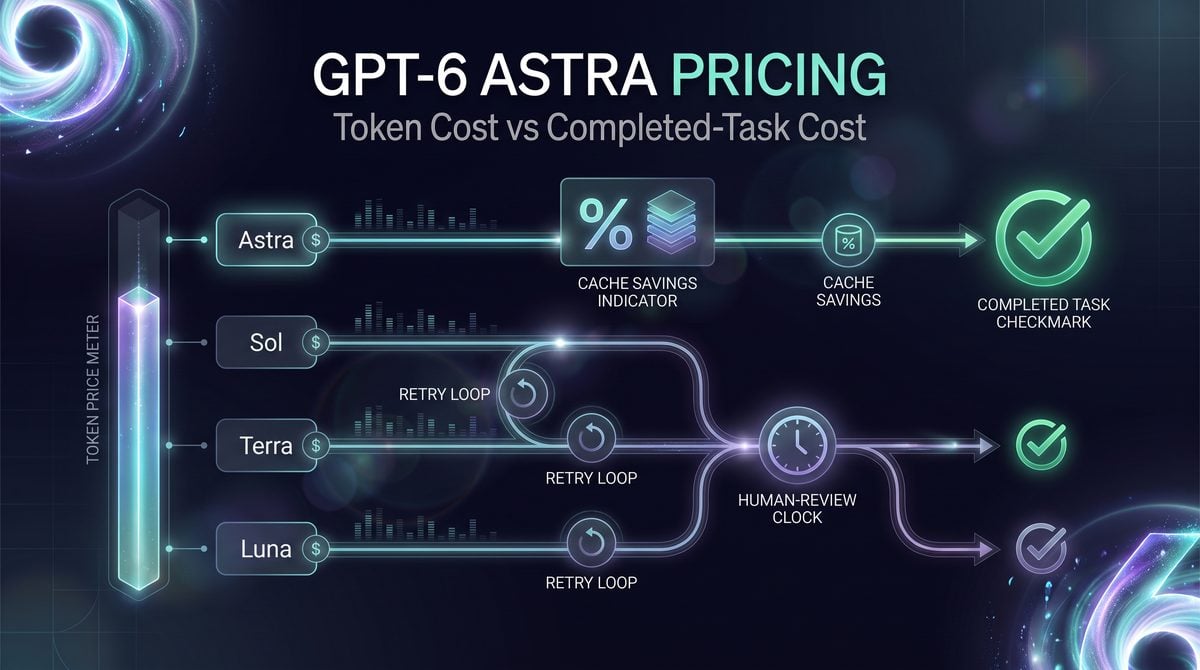

The pricing question is not “Is Astra 2.5× more expensive?” It is “What does one accepted result cost?”
OpenAI’s published short-context Standard API prices make the headline comparison straightforward: GPT-6 Astra is priced at 2.5× GPT-5.6 Sol on the core token lines. For short-context Standard requests, Astra is listed at $10 per million input tokens and $50 per million output tokens, while GPT-5.6 Sol is listed at $4 per million input tokens and $20 per million output tokens. The same 2.5× ratio also applies to cached-input reads and cache writes in the published short-context table: Astra is $1 per million cached-input tokens and $12.50 per million cache-write tokens, while Sol is $0.40 per million cached-input tokens and $5 per million cache-write tokens.
That 2.5× comparison is real, useful, and easy to audit. It is also incomplete if the business question is whether Astra is more expensive for a workflow. Token rate is the price of a unit of model usage. Cost per completed task is the cost of producing an accepted answer, merged pull request, completed investigation, validated spreadsheet, resolved support case, working prototype, or reviewed legal summary. Those are different denominators. A model can have a higher token rate and still cost less per completed task when it reduces failed attempts, shortens review cycles, avoids excessive outputs, makes better tool choices, or completes difficult work without escalation to a human specialist.
This distinction matters because OpenAI positions GPT-6 Astra as its most capable and aligned broadly deployed model and reports stronger performance in areas such as computer use, browsing, software engineering, cybersecurity, science, and professional work. OpenAI also reports that Astra completed computer-use tasks in OSWorld simulations in roughly 47% less time than GPT-5.6 Sol and that an updated Codex harness plus Astra’s efficiency yielded 1.9× faster task completion on Mind2Web compared with the then-current GPT-5.6 Sol experience. Those are OpenAI-reported benchmark and workflow measurements, not a guarantee that every internal automation, agent, coding assistant, or document workflow will become cheaper. They are a reason to measure completed-task economics rather than stopping at the rate card.
For teams already modeling GPT-5.6 usage, the practical migration question is not whether every prompt should move to Astra. It is which tasks are valuable or difficult enough that higher per-token prices can be offset by higher first-pass quality, fewer retries, lower human correction time, better long-horizon tool use, or faster delivery. If your use case is a simple classification job with short prompts, short answers, high Sol accuracy, no material review cost, and loose latency requirements, the 2.5× token premium is likely to dominate. If your use case is a multi-step coding repair, regulated document transformation, computer-use workflow, high-value sales analysis, security triage, or executive-ready artifact where failed attempts are expensive, the token-rate comparison is only the first line of the model-selection spreadsheet.
The exact short-context Standard rates to put in your spreadsheet
| Model | Short-context Standard input | Short-context Standard cached input | Short-context Standard cache write | Short-context Standard output | Ratio versus GPT-5.6 Sol |
|---|---|---|---|---|---|
| GPT-6 Astra | $10 / 1M tokens | $1 / 1M tokens | $12.50 / 1M tokens | $50 / 1M tokens | 2.5× |
| GPT-5.6 Sol | $4 / 1M tokens | $0.40 / 1M tokens | $5 / 1M tokens | $20 / 1M tokens | Baseline |
Use these rates only for short-context Standard calculations. OpenAI’s pricing table also defines higher long-context rates when requests exceed the documented input-token threshold, and it defines separate economics for Batch, Flex, and Fast modes. Those variations can materially change the arithmetic, but the common “2.5×” statement in this article refers specifically to the published short-context Standard token lines for GPT-6 Astra compared with GPT-5.6 Sol. If an internal memo says “Astra costs 2.5×,” require the author to specify whether they mean input, output, cached input, cache write, Standard mode, short-context only, or a full workflow after retries and review.
The easiest way to avoid a bad procurement decision is to separate three layers: token price, attempt cost, and accepted-result cost. Token price is the published rate per million tokens. Attempt cost is the cost of one model run, including input tokens, cached-input reads, cache writes, output tokens, reasoning/output budget behavior, and any tool-related token overhead. Accepted-result cost is attempt cost divided by the probability that the attempt produces a result that passes your acceptance gate, then adjusted for latency, human review, human correction, rework, and downstream failure costs. A platform team buying model capacity should care about all three layers; a product owner shipping an automation should care most about the third.
For GPT-5.6 Sol Pricing, GPT-5.6 Sol vs Terra vs Luna: Complete Pricing and Performance Guide for Developers is the most relevant adjacent resource. The Sol, Terra, and Luna pricing comparison supplies the exact prior-generation baseline required to understand Astra’s 2.5-times short-context Standard token-rate premium.
A simple cost-per-completed-task model
The following model is a recommendation for analysis, not an OpenAI pricing formula. It gives finance, engineering, and operations teams a common language for deciding when Astra’s higher token rate is justified.
Expected cost per completed task =
  (average API cost per attempt × expected attempts per accepted result)
+ average tool and infrastructure cost per task
+ average human review cost per task
+ average human correction or rework cost per task
+ average latency or SLA cost per task
The most important term is often “expected attempts per accepted result.” If a model succeeds 95% of the time on a defined task, the expected number of attempts per accepted result is approximately 1 / 0.95, or 1.053. If another model succeeds 70% of the time, the expected number of attempts is approximately 1 / 0.70, or 1.429, before considering capped retry policies, manual fallback, or degraded outputs that pass automatically but create downstream work. A 2.5× token premium is hard to overcome on tasks where both models already succeed nearly all the time. It becomes easier to overcome on tasks where the cheaper model triggers retries, escalations, review loops, or customer-visible corrections.
For example, consider a workflow where GPT-5.6 Sol produces an accepted result on the first attempt 60% of the time and Astra produces an accepted result 90% of the time. Holding per-attempt token volume constant for illustration, Sol needs about 1.67 attempts per accepted result and Astra needs about 1.11. That improvement alone does not erase a 2.5× token premium, but it narrows the gap. If the failed Sol attempts also create longer outputs, more tool calls, human triage, or additional review time, the total cost can move further. Conversely, if Astra produces longer answers than needed or uses expensive workflows where Sol would have been sufficient, the premium can widen.
Decision rule: do not compare Astra and Sol on “cost per prompt.” Compare them on “cost per accepted task under the same acceptance rubric.” The acceptance rubric should be observable: tests pass, schema validates, reviewer approves, customer issue is resolved, spreadsheet formulas reconcile, or the agent completes the procedure without manual intervention.
Why output length can dominate the premium
Output tokens are priced higher than input tokens in the short-context Standard table for both models: Astra output is $50 per million tokens, and Sol output is $20 per million tokens. Because output is the more expensive line item, a verbose completion can erase the value of an otherwise efficient prompt. A model-selection test that ignores output length can make the wrong model look expensive or cheap for the wrong reason.
For operational evaluation, log accepted-output tokens separately from total-output tokens. Accepted-output tokens are the tokens in the final answer that your system uses. Total-output tokens include discarded drafts, failed retries, overlong explanations, unnecessary tables, diagnostic chatter, and intermediate responses that a user or application does not need. If Astra solves a difficult task in one concise response while Sol needs multiple attempts with long explanations, Astra can be economically competitive despite the higher output rate. If Astra produces polished but unnecessarily long deliverables for a simple extraction task, Sol may remain the better default.
A practical mitigation is to set output contracts by task class. For extraction tasks, require a compact JSON object or fixed schema. For support drafting, specify maximum sections and require only decision-relevant evidence. For code review, request a ranked list of actionable findings rather than a full tutorial. For executive summaries, state the audience, length, and decision the output must support. This is not merely prompt hygiene; it is cost control because the highest-priced tokens are often the ones you could have avoided generating.
Retries are not free, even when they are automated
Retries make cheap models look cheaper in dashboards than they are in production. A retry consumes more input and output tokens, may rewrite the same context into the request, and can trigger another round of tool calls. It also adds latency and can complicate state management. If the user sees only the final response, the product may appear smooth while the operator is paying for a hidden cascade of failed attempts.
Measure retry reasons, not just retry counts. Separate retries caused by malformed output, failed tool arguments, incomplete reasoning/output budget, missing context, policy refusal, timeout, irrelevant answer, and reviewer rejection. These categories lead to different decisions. Malformed output may be solved by stricter schemas or validation. Missing context may be solved by retrieval design. Reviewer rejection on nuanced tasks may justify Astra. Timeout or latency pressure may require a different service tier, mode, or workflow design rather than a more capable model.
Retries also interact with prompt caching. For GPT-5.6 and later, OpenAI’s prompt-cache economics make cached reads cheaper than uncached input while cache writes cost more than uncached input. Stable prefixes, append-only conversations, stable tool definitions, and explicit cache planning can reduce repeated input cost when workflows reuse large instructions or context. However, caching does not make output tokens cheaper, and a cache hit does not repair a poor acceptance rate. Treat caching as a multiplier on a well-designed workflow, not as a substitute for task-level evaluation.
Tool calls change both the numerator and the denominator
GPT-6 Astra’s documented API surface includes support for Responses API tools such as web search, file search, image generation, code interpreter, hosted shell, apply patch, skills, computer use, MCP, and tool search. Tool-enabled workflows should not be priced as if they were single-turn chat completions. Tool definitions, tool arguments, retrieved content, tool results, intermediate observations, and final synthesis can all affect token usage. Your application may also incur non-token infrastructure costs when it runs its own tools or executes jobs outside the model call.
Astra-specific capabilities can alter the denominator as well. OpenAI documents asynchronous tool calling for Astra and later models, allowing the model to continue independent work while an application-executed tool runs. OpenAI also documents mid-turn steering over a WebSocket connection to the Responses API and configuration updates that can change reasoning effort during a conversation while preserving the prompt prefix for caching. These capabilities do not automatically lower bills, and they should not be assumed to apply to every tool or deployment mode. They do create opportunities to reduce idle time, avoid restarting long tasks, and preserve useful work when a human or system update arrives mid-execution.
The key pricing implication is that tool quality can reduce rework. A cheaper model that calls the wrong tool, passes incomplete arguments, or requires a human to diagnose tool misuse may have a low token rate and a high task cost. A more capable model that asks a focused clarifying question, selects the relevant tool, and produces an artifact that passes validation may have a high token rate and a lower accepted-result cost. The only defensible way to know is to instrument tool-call count, tool-call success, tool-result token volume, wall-clock time, and acceptance outcome by model.
For AI Model Total Cost of Ownership, What AI Coding Tools Really Cost in 2026: Complete Guide to Hidden Expenses, Token Budgets, and ROI Calculation for Engineering Teams is the most relevant adjacent resource. The AI coding-cost guide breaks down token budgets, developer time, retries, and hidden expenses, supporting this article’s focus on cost per completed task instead of token price alone.
Latency, review time, and correction cost belong in the same model-selection meeting as token price
Latency is not just a user-experience metric. In internal operations, latency can mean a support agent waiting before replying, an engineer waiting before applying a patch, a compliance reviewer waiting before approving a document, or an autonomous workflow holding locks and resources. If a higher-priced model completes a high-value task faster or with fewer review loops, the labor and SLA savings may matter more than the token delta. If the task is offline batch enrichment with no urgency, lower-priced routing may be the better economic decision.
Human review time is usually the largest hidden cost in AI-assisted professional work. A response that is technically correct but hard to verify can be expensive. A response that cites the exact changed files, lists assumptions, conforms to a required template, and highlights uncertainty can reduce reviewer minutes. OpenAI’s Astra launch materials emphasize professional artifact production and relevant-context use, but teams should validate those claims against their own documents, codebases, approval standards, and reviewer behavior. The right metric is not “reviewer liked it”; it is median review minutes, correction minutes, rejection rate, and severity of missed issues.
Human correction cost is different from review cost. Review is inspection; correction is repair. A reviewer may spend two minutes approving a good answer, ten minutes diagnosing a flawed answer, and thirty minutes rewriting it. For a founder, this may be the founder’s own time. For an enterprise administrator, it may be a specialist’s time. For a marketing team, it may be legal or brand review. For a developer platform team, it may be an engineer untangling a bad patch. If Astra reduces correction burden on difficult tasks, that savings can dominate token spend. If it does not, the premium is harder to justify.
The opening routing framework: do not pick one model for everything
The best early posture is workload routing, not wholesale replacement. Keep GPT-5.6 Sol or lower-cost models on tasks where success rates are already high, outputs are short, stakes are low, and failure is cheap. Route to Astra when the task is complex, ambiguous, tool-heavy, review-expensive, latency-sensitive, or valuable enough that a higher first-pass completion rate changes the economics. Re-evaluate routing after prompts, schemas, caching, and tool definitions are optimized, because a poorly designed Astra workflow can still waste money and a well-designed Sol workflow can still be the right answer.
For the rest of this analysis, the controlling principle is simple: “2.5×” is a token-rate comparison, not a verdict on total cost. A disciplined evaluation measures input, cached input, cache writes, output, retries, tool calls, completion rate, latency, review time, and human correction under the same task rubric. Only then can a team decide when GPT-6 Astra’s premium is an avoidable luxury, when it is an insurance policy against failure, and when it is the cheaper path to a completed task.
Pricing matrix: the rate card you need before routing Astra, Sol, Terra, and Luna

OpenAI’s pricing table makes the Astra premium precise: in short-context Standard mode, GPT-6 Astra is 2.5× GPT-5.6 Sol on input, cached input, cache writes, and output. The comparison is not a vague “premium model” label; it is the arithmetic difference between Astra at $10 per million input tokens and $50 per million output tokens versus Sol at $4 per million input tokens and $20 per million output tokens. The same 2.5× relationship appears in cached reads and cache writes because OpenAI prices cached input at 0.1× uncached input and cache writes at 1.25× uncached input for GPT-5.6-and-later models.
The matrix below uses OpenAI’s current per-million-token API rates for short-context Standard requests. Treat these numbers as the base layer of your routing spreadsheet, not as the whole decision. A task that fails, needs a retry, produces an unusable artifact, or requires an engineer to repair its output can cost more than its token line item suggests.
| Model | Standard input | Standard cached input | Standard cache write | Standard output | Best-fit pricing role |
|---|---|---|---|---|---|
| GPT-6 Astra | $10.00 / 1M tokens | $1.00 / 1M tokens | $12.50 / 1M tokens | $50.00 / 1M tokens | Highest-difficulty reasoning, high-value deliverables, complex tool use, professional artifacts where first-pass quality matters. |
| GPT-5.6 Sol | $4.00 / 1M tokens | $0.40 / 1M tokens | $5.00 / 1M tokens | $20.00 / 1M tokens | Strong default for difficult work when Astra’s additional capability is not expected to change acceptance rate or review time. |
| GPT-5.6 Terra | $1.00 / 1M tokens | $0.10 / 1M tokens | $1.25 / 1M tokens | $5.00 / 1M tokens | Mid-cost production routing for structured extraction, drafting, classification, and moderate reasoning with clear acceptance tests. |
| GPT-5.6 Luna | $0.20 / 1M tokens | $0.02 / 1M tokens | $0.25 / 1M tokens | $1.00 / 1M tokens | High-volume, low-risk work where unit economics dominate and failures can be cheaply detected or escalated. |
The service tier multiplier is simple but operationally important. OpenAI prices Batch and Flex at half the applicable Standard rate, while Fast mode is twice the applicable rate. “Applicable” matters because the multiplier applies after the short-context or long-context rate has been selected. If a request crosses the long-context threshold, Fast is not two times the short-context price; it is two times the long-context price for that request.
| Model and short-context tier | Input | Cached input | Cache write | Output | Decision rule |
|---|---|---|---|---|---|
| Astra Batch/Flex | $5.00 | $0.50 | $6.25 | $25.00 | Use when completion time can tolerate asynchronous or flexible execution and the task is still difficult enough to justify Astra. |
| Astra Standard | $10.00 | $1.00 | $12.50 | $50.00 | Use as the baseline for interactive high-value work, evaluation runs, and tasks where latency is important but not premium-priced. |
| Astra Fast | $20.00 | $2.00 | $25.00 | $100.00 | Reserve for latency-sensitive workflows where faster response time is worth more than the doubled token bill. |
| Sol Batch/Flex | $2.00 | $0.20 | $2.50 | $10.00 | Use for back-office reasoning, document processing, and scheduled analysis where Sol is accurate enough. |
| Sol Standard | $4.00 | $0.40 | $5.00 | $20.00 | Use as the comparison baseline for measuring whether Astra’s higher acceptance rate or lower review time pays for itself. |
| Sol Fast | $8.00 | $0.80 | $10.00 | $40.00 | Use when latency matters more than the model upgrade from Sol to Astra. |
| Terra Batch/Flex | $0.50 | $0.05 | $0.625 | $2.50 | Use for large delayed queues with validation, such as tagging, extraction, and first-draft generation. |
| Terra Standard | $1.00 | $0.10 | $1.25 | $5.00 | Use for the middle lane: more capable than the cheapest route, materially cheaper than Sol and Astra. |
| Terra Fast | $2.00 | $0.20 | $2.50 | $10.00 | Use when the work is not hard enough for Sol but must complete quickly. |
| Luna Batch/Flex | $0.10 | $0.01 | $0.125 | $0.50 | Use for very high-volume queues with deterministic checks and escalation to a larger model on failure. |
| Luna Standard | $0.20 | $0.02 | $0.25 | $1.00 | Use for inexpensive first passes, simple transformations, and workloads where human review already catches errors. |
| Luna Fast | $0.40 | $0.04 | $0.50 | $2.00 | Use for lightweight user-facing tasks where speed matters and model depth does not. |
The most common spreadsheet mistake is to apply the long-context multiplier only to the tokens above the threshold. OpenAI’s current pricing notes say that requests above 272,000 input tokens are billed at the long-context rates for the full request. In practice, a request with 273,000 input tokens is not priced as 272,000 tokens at the short-context rate plus 1,000 tokens at the long-context rate; the whole request moves to the higher schedule, including output.
| Model | Long-context Standard input | Long-context Standard cached input | Long-context Standard cache write | Long-context Standard output | What changes above 272K input tokens |
|---|---|---|---|---|---|
| GPT-6 Astra | $20.00 / 1M tokens | $2.00 / 1M tokens | $25.00 / 1M tokens | $75.00 / 1M tokens | Input, cached input, and cache writes double versus Astra short context; output rises from $50 to $75 per million. |
| GPT-5.6 Sol | $8.00 / 1M tokens | $0.80 / 1M tokens | $10.00 / 1M tokens | $30.00 / 1M tokens | The same long-context pattern makes large Sol requests substantially more expensive than short-context Sol requests. |
| GPT-5.6 Terra | $2.00 / 1M tokens | $0.20 / 1M tokens | $2.50 / 1M tokens | $7.50 / 1M tokens | Terra remains much cheaper than Sol or Astra, but the threshold can still double the input side of the bill. |
| GPT-5.6 Luna | $0.40 / 1M tokens | $0.04 / 1M tokens | $0.50 / 1M tokens | $1.50 / 1M tokens | Luna is the cheapest long-context lane, but cost can still jump if applications send unnecessary history or oversized tool definitions. |
Here is the threshold effect in concrete Astra Standard terms. A request with 271,000 uncached input tokens and 20,000 output tokens costs about $3.71 before any cache effects: 0.271 × $10 plus 0.020 × $50. If the same task grows to 273,000 input tokens and still produces 20,000 output tokens, it costs about $6.96: 0.273 × $20 plus 0.020 × $75. The extra 2,000 input tokens are not the real issue; the full-request repricing is.
The operational warning is simple: budget by request shape, not by average daily tokens alone. If your application sometimes sends a 40,000-token case file and sometimes sends a 320,000-token archive, the average may hide a small number of expensive long-context requests. Instrument request-level input tokens, cached input tokens, cache-write tokens, output tokens, service tier, and selected model so finance and engineering can identify which workflows cross the threshold.
Recommended cost-log fields:
- model_id
- service_tier
- input_tokens
- cached_input_tokens
- cache_write_tokens
- output_tokens
- request_crossed_272k_input_threshold
- prompt_cache_key_family
- workflow_name
- accepted_without_retry
- human_review_minutes
- escalation_model_id
Cache economics are favorable only when the prefix is stable enough to be reused. OpenAI documents cached input at 0.1× uncached input and cache writes at 1.25× uncached input for GPT-5.6-and-later models. That means the first write is more expensive than sending the same tokens as ordinary input once, but the second use can already be cheaper than paying uncached input twice. The minimum cacheable visible prefix is 1,024 tokens, and a 30-minute TTL is supported through prompt_cache_options.ttl: "30m", so cache design should start with stable system instructions, stable tool definitions, and append-only conversation structure.
| Cache event | Relative rate | Astra short-context example | Sol short-context example | Routing implication |
|---|---|---|---|---|
| Uncached input | 1.0× | $10.00 / 1M | $4.00 / 1M | Use as the baseline when the prompt changes materially on every request. |
| Cache write | 1.25× | $12.50 / 1M | $5.00 / 1M | Accept the premium only for prefixes likely to be reused within the cache-retention window. |
| Cached read | 0.1× | $1.00 / 1M | $0.40 / 1M | High reuse can make large prompts viable, especially for repeated agent runs with stable tools and instructions. |
Astra’s documented support for configuration_update items matters for cache-aware cost control because a conversation can change reasoning effort while preserving the prompt prefix for caching. The practical pattern is to keep the reusable prefix stable, start with the least reasoning effort that passes your evaluation, and raise effort only when the task state requires it. Do not rewrite the system prompt or tool schema just to change reasoning behavior if a configuration update can express the change in a cache-preserving way.
Fast mode needs a separate residency check. OpenAI’s Astra documentation states that Fast mode is unavailable for Astra with EU data residency. If your enterprise deployment requires EU data residency, do not design a production SLA that assumes Astra Fast will be available as the latency escape hatch. Your routing plan should instead compare Astra Standard, Astra Batch/Flex where appropriate, and lower-cost model tiers that meet the residency and service requirements documented for your account.
Recommendation: maintain two routing matrices if you operate globally. One should represent the full service-tier menu available to non-EU-residency workloads. The other should represent the EU-residency policy reality, where Astra Fast should be excluded unless OpenAI’s documentation and your contract explicitly support it at the time you deploy.
For GPT-5.6 Luna Cost Optimization, The Complete Guide to GPT-5.6 Luna for High-Volume Production — Classification, Routing, Summarization, and Cost Optimization at Scale is the most relevant adjacent resource. The Luna production guide explains classification, routing, summarization, and high-volume optimization, showing where a lower-cost model can remain preferable within an Astra-era stack.
A useful production policy is a three-stage lane. First, run Luna or Terra for cheap deterministic work, such as normalization, classification, or extraction with schema validation. Second, route failures, ambiguous cases, and high-value cases to Sol. Third, reserve Astra for cases where the business value of a correct completion exceeds the token premium, such as complex code repair, multi-tool professional workflows, long-context synthesis, or deliverables that would otherwise consume expensive human review time.
Example routing rule, expressed as policy rather than API syntax:

IF task_value is high
  OR prior_model_failed_validation
  OR required_context_tokens > 100000 and synthesis_quality is critical
  OR human_review_cost is expected to exceed Astra premium
THEN consider gpt-6-astra

ELSE IF task_requires_strong_reasoning and latency is normal
THEN consider gpt-5.6-sol

ELSE IF task_has_schema_validation or low-risk review
THEN consider gpt-5.6-terra

ELSE use gpt-5.6-luna with escalation on validation failure
The final spreadsheet column should be accepted-result cost, not model price. For each workflow, calculate token cost under the expected model and tier, add retry probability, add escalation probability, and add human review time where it is material. Astra can be cheaper per completed task when it prevents enough retries or review minutes to overcome the 2.5× short-context token premium over Sol; it can also be wasteful when a cheaper model already satisfies the acceptance test. The matrix gives you the rates, but your evaluations decide where the premium is economically justified.
Scenario math: five workload patterns where the token premium may or may not matter

The following scenarios are illustrative calculations, not claims about guaranteed model performance. OpenAI publishes the GPT-6 Astra and GPT-5.6 Sol token prices, the Astra context specifications, the Batch/Flex and Fast multipliers, and launch claims about Astra’s strength in software engineering, computer use, browsing, and professional work. It does not publish a universal success probability for your codebase, documents, browser workflows, or review policy, so every success rate, retry rate, and human-review cost below is explicitly labeled as an assumption.
Per-attempt API cost =
  (uncached_input_tokens / 1,000,000 × input_rate)
+ (cached_input_tokens / 1,000,000 × cached_input_rate)
+ (cache_write_tokens / 1,000,000 × cache_write_rate)
+ (output_tokens / 1,000,000 × output_rate)

Expected cost per accepted task =
  ((per_attempt_API_cost × (1 + retry_rate)) + human_review_cost_per_assigned_task)
  / accepted_result_probability
This formula intentionally separates “retry rate” from “accepted result probability.” A retry rate is the share of assigned tasks that trigger an additional model attempt, tool run, or reformulation. Accepted result probability is the share of assigned tasks that eventually produce a result the team can use after the allowed retry path. In production, teams should estimate both from logs: count retries, count accepted outputs, and count human minutes spent on each task class.
Scenario 1: code review where reviewer time dwarfs token price
Assumptions for this example: each review attempt sends 18,000 input tokens and receives 3,000 output tokens; there is no prompt-cache hit; GPT-6 Astra uses short-context Standard pricing at $10 per million input tokens and $50 per million output tokens; GPT-5.6 Sol uses short-context Standard pricing at $4 per million input tokens and $20 per million output tokens. The human reviewer is assumed to cost $120 per hour, or $2 per minute. Astra is assumed to need 7 minutes of human review per assigned task, with a 15% retry rate and an 86% accepted-result probability. Sol is assumed to need 12 minutes of human review, with a 45% retry rate and a 70% accepted-result probability.
| Code-review calculation | GPT-6 Astra Standard | GPT-5.6 Sol Standard |
|---|---|---|
| Input cost per attempt | 18,000 × $10 / 1M = $0.180 | 18,000 × $4 / 1M = $0.072 |
| Output cost per attempt | 3,000 × $50 / 1M = $0.150 | 3,000 × $20 / 1M = $0.060 |
| API cost per attempt | $0.330 | $0.132 |
| Human-review cost per assigned task | 7 minutes × $2 = $14.00 | 12 minutes × $2 = $24.00 |
| Expected cost per accepted task | (($0.330 × 1.15) + $14.00) / 0.86 = $16.72 | (($0.132 × 1.45) + $24.00) / 0.70 = $34.56 |
The break-even lesson is not that Astra is universally cheaper for code review. If both models required the same reviewer time, retry rate, and acceptance rate, Sol would be cheaper on this short-context token bill because the published Astra Standard input and output rates are 2.5× Sol’s corresponding rates. In this example, Astra becomes cheaper only because the assumed reviewer time and retry rate fall enough to overcome the API premium.
Break-even review savings, holding the assumed success and retry rates above:

Astra API component per accepted task:
($0.330 × 1.15) / 0.86 = $0.44

Sol total per accepted task with $24 review:
(($0.132 × 1.45) + $24.00) / 0.70 = $34.56

Astra can spend up to:
($34.56 × 0.86) - ($0.330 × 1.15) = $29.34
of review cost per assigned task before it loses this example.
Scenario 2: long-document synthesis where crossing 272,000 input tokens changes the rate class
OpenAI documents a 1,050,000-token context window for gpt-6-astra, with up to 922,000 input tokens and up to 128,000 output tokens. OpenAI’s pricing page also states that requests above 272,000 input tokens are billed at the long-context rates for the full request: Astra Standard becomes $20 per million input tokens, $2 per million cached-input tokens, $25 per million cache-write tokens, and $75 per million output tokens. That means a single 310,000-token request is not priced as “272,000 short-context tokens plus 38,000 long-context tokens”; the full request uses the higher tier.
Assumptions for this example: a legal, regulatory, or diligence synthesis task uses one 310,000-token input and an 8,000-token answer. The single-request Astra workflow has a 10% retry rate, an 88% accepted-result probability, and 8 minutes of reviewer time at $90 per hour, or $12.00. The alternative chunked workflow uses two 155,000-token chunk calls with 4,000 output tokens each, plus one final synthesis call with 8,000 input tokens and 6,000 output tokens; it has a 25% retry rate, a 75% accepted-result probability, and 20 minutes of human integration review at $90 per hour, or $30.00.
| Long-document option | Token-cost calculation | Expected cost per accepted synthesis |
|---|---|---|
| Single Astra long-context request | (310,000 × $20 / 1M) + (8,000 × $75 / 1M) = $6.20 + $0.60 = $6.80 | (($6.80 × 1.10) + $12.00) / 0.88 = $22.14 |
| Chunked short-context Astra workflow | Two chunk calls: 2 × (($1.55 input) + ($0.20 output)) = $3.50; final call: $0.08 input + $0.30 output = $0.38; total = $3.88 | (($3.88 × 1.25) + $30.00) / 0.75 = $46.47 |
The chunked path has the lower API bill in this example, but the single-request path has the lower expected cost per accepted synthesis because the assumed integration-review burden is lower. The operational decision rule is straightforward: if the task’s answer depends on cross-document relationships that are expensive for humans to reconcile, model context may be worth buying; if the task can be independently summarized by section with little synthesis risk, chunking may remain cheaper.
Scenario 3: computer-use automation where time, retries, and supervision are part of cost
OpenAI says Astra achieved state-of-the-art results in computer use and reports that Astra completed computer-use tasks in OSWorld simulations in roughly 47% less time than GPT-5.6 Sol; OpenAI also says a Codex harness update plus Astra’s efficiency produced 1.9× faster task completion on Mind2Web compared with the then-current GPT-5.6 Sol experience. Those are OpenAI-reported launch claims, not a guarantee for a company’s internal browser flows, desktop applications, identity checks, or exception screens.
Assumptions for this example: each automation attempt consumes 25,000 input tokens and 6,000 output tokens, including instructions, visible state summaries, and action rationale. Astra uses Standard short-context pricing, has a 20% retry rate, a 78% accepted-result probability, and requires 4 minutes of operator supervision at $60 per hour, or $4.00. Sol uses Standard short-context pricing, has a 55% retry rate, a 60% accepted-result probability, and requires 9 minutes of operator supervision at $60 per hour, or $9.00.
| Computer-use calculation | GPT-6 Astra Standard | GPT-5.6 Sol Standard |
|---|---|---|
| API cost per attempt | (25,000 × $10 / 1M) + (6,000 × $50 / 1M) = $0.25 + $0.30 = $0.55 | (25,000 × $4 / 1M) + (6,000 × $20 / 1M) = $0.10 + $0.12 = $0.22 |
| Expected cost per accepted task | (($0.55 × 1.20) + $4.00) / 0.78 = $5.97 | (($0.22 × 1.55) + $9.00) / 0.60 = $15.57 |
| Astra Fast-mode variant | Fast doubles the applicable rates: $1.10 per attempt; (($1.10 × 1.20) + $4.00) / 0.78 = $6.82 | Not calculated here |
Fast mode should be modeled as a latency purchase, not as an automatic quality purchase. OpenAI’s pricing table says Fast mode is twice the applicable rates, while the Astra model documentation notes that Fast mode is unavailable for Astra with EU data residency. A team should use Fast only when lower elapsed time protects revenue, reduces staff waiting, meets an SLA, or improves queue health enough to justify the doubled token rate.
Scenario 4: batch analysis where the mode multiplier can matter more than the model premium
OpenAI prices Batch and Flex at half of Standard, while Fast is twice the applicable rates. That creates a practical routing question: an offline workload on Astra Batch may be closer in API cost to an online Sol Standard workload than the 2.5× headline comparison suggests. This does not mean Astra Batch is always cheaper than Sol Batch; if both models run in the same discounted mode and deliver the same acceptance rate, Sol’s lower published token rates remain lower.
Assumptions for this example: an offline marketing, compliance, or support-analysis job processes 50,000 records. Each record uses 2,000 input tokens and 300 output tokens. Astra runs in Batch at half of Standard, so this example uses $5 per million input tokens and $25 per million output tokens. Sol Standard uses $4 per million input tokens and $20 per million output tokens; Sol Batch, shown as a sensitivity row, uses half of those rates. Astra is assumed to have a 5% retry rate, a 94% accepted-result probability, and $0.12 of human QA cost per assigned record. Sol is assumed to have a 20% retry rate, an 86% accepted-result probability, and $0.30 of human QA cost per assigned record.
| Batch-analysis route | API cost per assigned record | Expected cost per accepted record | Expected cost for 50,000 accepted-equivalent records |
|---|---|---|---|
| Astra Batch | (2,000 × $5 / 1M) + (300 × $25 / 1M) = $0.0100 + $0.0075 = $0.0175 | (($0.0175 × 1.05) + $0.12) / 0.94 = $0.147 | 50,000 × $0.147 = $7,350 |
| Sol Standard | (2,000 × $4 / 1M) + (300 × $20 / 1M) = $0.0080 + $0.0060 = $0.0140 | (($0.0140 × 1.20) + $0.30) / 0.86 = $0.368 | 50,000 × $0.368 = $18,400 |
| Sol Batch sensitivity | $0.0070 | (($0.0070 × 1.20) + $0.30) / 0.86 = $0.359 | 50,000 × $0.359 = $17,950 |
The decision rule is to separate queue urgency from task difficulty. If a job can wait and does not require immediate user interaction, Batch or Flex can be the first discount lever to test. If the lower-cost model produces enough borderline classifications to require manual adjudication, the discounted token rate may still lose to the higher-capability route; if QA is minimal and acceptance rates are equal, the lower-cost model usually remains the economic winner.
Scenario 5: repeated-prefix agents where prompt caching changes the average attempt cost
Prompt caching matters most when a workflow repeats a large stable prefix: tool definitions, policies, repository maps, schema instructions, evaluation rubrics, or long project context. OpenAI documents cache writes for GPT-5.6 and later at 1.25× uncached input and cached reads at 0.1× uncached input; for Astra Standard short context, that is $12.50 per million cache-write tokens and $1 per million cached-input tokens. The minimum cacheable visible prefix is 1,024 tokens, and OpenAI documents prompt_cache_options.ttl: "30m" for GPT-5.6-and-later cache retention.
Assumptions for this example: a repeated-prefix agent runs 20 related tasks within the cache-retention window. Each task shares an 80,000-token stable prefix, adds 4,000 dynamic input tokens, and produces 2,000 output tokens. The first task writes the 80,000-token prefix to cache; the next 19 tasks read it from cache. Astra is assumed to have an 8% retry rate, a 90% accepted-result probability, and 3 minutes of review at $100 per hour, or $5.00. Sol is assumed to have a 35% retry rate, a 72% accepted-result probability, and 8 minutes of review at $100 per hour, or $13.33.
| Repeated-prefix calculation | GPT-6 Astra Standard | GPT-5.6 Sol Standard |
|---|---|---|
| First task with cache write | (80,000 × $12.50 / 1M) + (4,000 × $10 / 1M) + (2,000 × $50 / 1M) = $1.00 + $0.04 + $0.10 = $1.14 | (80,000 × $5 / 1M) + (4,000 × $4 / 1M) + (2,000 × $20 / 1M) = $0.40 + $0.016 + $0.040 = $0.456 |
| Each cached follow-up task | (80,000 × $1 / 1M) + $0.04 + $0.10 = $0.22 | (80,000 × $0.40 / 1M) + $0.016 + $0.040 = $0.088 |
| Average API cost across 20 tasks | ($1.14 + 19 × $0.22) / 20 = $0.266 | ($0.456 + 19 × $0.088) / 20 = $0.106 |
| Expected cost per accepted task | (($0.266 × 1.08) + $5.00) / 0.90 = $5.88 | (($0.106 × 1.35) + $13.33) / 0.72 = $18.71 |
For Prompt Cache Economics, Prompt Caching Strategies: 89% Cost Reduction Playbook is the most relevant adjacent resource. The prompt-caching strategy playbook shows how prefix reuse changes effective input cost, providing the necessary background for the repeated-prefix scenarios modeled here.
How to turn these examples into a routing rule
A practical model-selection rule starts with the task’s cost of failure, not the model name. Use Astra when the task is difficult enough that better reasoning, larger context, tool use, or professional-artifact quality plausibly reduces retries, review minutes, or rejected outputs. Use Sol or lower-cost routes when the task is simple, the output is short, the reviewer must inspect everything anyway, or historical acceptance rates are indistinguishable. Use Batch or Flex when the job is offline. Use Fast only when the latency reduction has measurable business value and the deployment constraints allow it.
Routing test for one task class:

1. Measure current model:
   tokens_in, tokens_out, cache_hit_rate, retry_rate, accepted_result_probability,
   human_review_minutes, correction_minutes, latency impact.

2. Run an Astra sample on the same task class:
   keep the rubric constant, record the same fields, and separate API cost from labor cost.

3. Promote Astra only if:
   Astra_expected_cost_per_accepted_task < incumbent_expected_cost_per_accepted_task
   OR the extra cost buys a documented business requirement such as higher assurance,
   shorter queue time, larger-context synthesis, or fewer escalations.

4. Keep mixed routing if:
   Astra wins on hard cases but loses on routine cases.
The most common spreadsheet error is to multiply token price by volume and stop there. That is sufficient only for workloads where success probability, retry rate, review time, and latency value are equal across models. For most developer, operator, founder, marketer, and enterprise-administrator workflows, the measurable unit is the accepted result: a merged review, a finished synthesis, a completed browser task, an approved classification, or an agent output that passes the team’s rubric.
For AI Model Routing Framework, How to Run a Two-Tier Model Routing Stack (Sentinel + Executor) for 90% Cost Cut is the most relevant adjacent resource. The two-tier routing-stack guide gives a concrete architecture for sending routine work to economical models and escalating difficult jobs to a stronger executor, which is the central selection principle in this analysis.
Operational routing: assign the cheapest model that can reliably finish the job
The practical routing rule is to start from business consequence, not from model enthusiasm. OpenAI’s reasoning guidance positions GPT-6 Astra for the most difficult reasoning workloads and points teams toward lower-cost GPT-5.6 Terra or Luna when economics or latency dominate. GPT-5.6 Sol remains the relevant published-price comparison for the “2.5×” premium, because Astra’s short-context Standard input and output prices are 2.5× Sol’s corresponding published rates. That ratio is useful for procurement, but it is not sufficient for production routing because a failed low-cost attempt, a human correction loop, or an overlong output can erase the apparent discount.
| Default route | Use when | Avoid when | Economic test |
|---|---|---|---|
| Luna | Tasks are low-risk, repetitive, latency-sensitive, or already validated by deterministic rules. | The task requires deep reasoning, high-value synthesis, or tool-heavy recovery from ambiguous instructions. | Does Luna pass acceptance checks without creating review burden? |
| Terra | The job needs stronger reasoning than the cheapest route but still has tight unit economics. | Failures are expensive, outputs must be publication-grade, or the task needs long-horizon planning. | Does Terra reduce retries enough to beat Luna on accepted-result cost? |
| Sol | The workflow is established on GPT-5.6 Sol and needs dependable general capability at the known Sol price point. | Astra materially improves completion rate, tool execution, artifact quality, or human-review time for the workload. | Does Sol’s lower token rate still win after retries and corrections? |
| Astra | The task is difficult, high-value, long-context, tool-intensive, or requires strong professional artifact production. | The acceptance criteria are simple, failure cost is low, or the organization cannot justify the incremental spend. | Does Astra lower the total cost per accepted outcome, not merely the number of attempts? |
A useful default is “route down until quality breaks, then route back up.” Begin with the least expensive model that has a credible chance of passing the task’s acceptance checks. Promote only the failure classes that matter: incorrect conclusions, malformed deliverables, missed policy constraints, unsafe tool use, or human edits that exceed a defined threshold. Do not promote because a reviewer prefers Astra’s prose style if the customer, regulator, or downstream system would have accepted the cheaper output.
For workflows that already use prompt caching, keep the stable prefix identical across candidate models where the API and application design allow it. OpenAI documents that GPT-5.6-and-later prompt-cache writes cost 1.25× uncached input while cached reads cost 0.1×, with a minimum cacheable visible prefix of 1,024 tokens and support for a 30-minute TTL through prompt_cache_options.ttl: "30m". A routing test that rewrites system prompts, tool definitions, or long policy blocks for each model can accidentally measure cache instability rather than model economics.
Evaluation design: measure acceptance, correction effort, and spend together
A model-economics evaluation should use production-shaped tasks, not trivia prompts. For each workload family, sample recent real inputs, redact sensitive data as required by policy, preserve typical document length, and include the same tool schemas, retrieval sources, and formatting requirements that the production system uses. Astra’s documented context window is large, but long context is not free: OpenAI’s pricing table applies higher Astra rates when a request exceeds 272,000 input tokens, and that higher long-context rate applies to the full request. Your evaluation set should therefore include both ordinary cases and the few oversized cases that drive the monthly invoice.
Define acceptance before running the models. For a contract summary, acceptance might require correct party names, dates, obligations, exceptions, and a structured risk table. For a support response, acceptance might require policy compliance, correct account-state interpretation, and no unsupported promise. For code assistance, acceptance might require tests passing, patch minimality, and reviewer approval. If the team only scores “looks good,” it will overvalue fluent outputs and undervalue the cheaper model that produces dull but correct work.
Recommended evaluation record per attempt:
{
  "workload": "contract_risk_summary",
  "model": "gpt-6-astra",
  "mode": "standard",
  "reasoning_effort": "medium",
  "input_tokens": 84000,
  "cached_input_tokens": 61000,
  "cache_write_tokens": 0,
  "output_tokens": 4200,
  "accepted_without_edit": true,
  "review_minutes": 6,
  "retry_count": 0,
  "tool_failures": 0,
  "regional_requirement": "eu_data_residency_required"
}
Quality-adjusted cost is the decision metric that procurement and engineering can share. A simple version is total model spend plus review labor plus retry spend, divided by accepted outputs. A more conservative version adds an error-risk reserve for outputs that pass review but later create rework. The exact labor rate and risk reserve are internal business assumptions, so label them explicitly instead of burying them inside an executive slide.
Quality-adjusted cost per accepted task =
(model tokens + cache writes + tool-related model retries + review labor + correction labor + risk reserve)
/
(number of outputs accepted by the defined standard)
This metric can justify Astra even when its token rate is higher, but it can also disqualify Astra for routine work. For example, if a Luna or Terra route passes deterministic validation 98 times out of 100 and failures are cheaply retried, Astra’s premium may not be rational. If a Sol route repeatedly produces almost-correct artifacts that take a senior employee 25 minutes to repair, Astra can be cheaper even with higher token spend. The winning model is the one with the lowest accepted-result cost under the real acceptance standard.
Fallback cascades: promote selectively, not automatically
A fallback cascade should classify failure before escalating. If the cheaper model fails because the user request is missing a required file, routing to Astra may only produce a more articulate clarification question. If it fails because the output is malformed JSON, a constrained repair pass may be cheaper than a full rerun. If it fails because the reasoning path is wrong, escalation to Sol or Astra is more defensible. Treat “retry on bigger model” as one recovery action among several, not as the default response to every exception.
| Failure signal | Recommended recovery | Why this controls cost |
|---|---|---|
| Missing user input or ambiguous goal | Ask a targeted clarification before model promotion. | A stronger model cannot infer unavailable business facts reliably. |
| Schema or formatting failure | Run a small repair step or deterministic validator loop. | Do not pay for full reasoning when only the wrapper failed. |
| Low confidence on high-impact decision | Escalate to Sol or Astra and require reviewer approval. | Promotion is reserved for consequential uncertainty. |
| Long-context synthesis failure | Escalate to Astra only after confirming retrieval and prompt packing are correct. | Bad context assembly can make every model look expensive. |
| Tool-use dead end | Inspect tool logs, then rerun with a higher-capability route if planning failed. | Separates model reasoning errors from application integration errors. |
Reasoning effort should also be part of the cascade. Astra supports low, medium, high, xhigh, and max, and OpenAI notes that none is not supported for Astra. Start evaluations with enough output budget for reasoning and final content; OpenAI recommends reserving at least 25,000 tokens for reasoning and output during initial experimentation. If responses are incomplete because reasoning consumed the configured output budget, lowering the model tier will not fix the budget design.
Budget controls that prevent premium models from becoming the hidden default
For Enterprise AI Cost Governance, Why 82% of Companies Can’t Track Their AI Spending: Complete Guide to AI Cost Visibility, Budget Governance, and FinOps for 2026 is the most relevant adjacent resource. The AI spending and FinOps guide covers cost visibility, budget ownership, allocation, and governance, translating model-level economics into controls a finance or platform team can operate.
Use budget ceilings at three layers. The request layer should cap maximum input and output tokens, especially for long-context jobs. The workflow layer should cap retries and define when human review replaces additional model calls. The account or business-unit layer should set monthly spend alerts and require approval for new Astra routes. These controls are not anti-innovation; they are what allow a team to use Astra for valuable work without letting exploratory prompts consume the same budget as revenue-critical automation.
Mode selection is another budget lever. OpenAI documents Batch and Flex as half Standard pricing and Fast mode as twice the applicable rates. That means an overnight classification, extraction, or evaluation job may save more by moving from Standard to Batch or Flex than by downgrading the model. Conversely, a customer-facing workflow may justify Fast only when latency has measurable business value. Do not pay a speed premium for work that sits in a queue waiting for a human approver.
Regional processing, monitoring, and procurement checks
Regional requirements can override an otherwise elegant routing plan. OpenAI’s Astra documentation notes that Fast mode is unavailable for Astra with EU data residency. If an enterprise policy requires EU data residency for a workload, the routing table should exclude Astra Fast for that workload rather than allowing engineers to discover the incompatibility during launch. Procurement should ask whether each proposed mode, model, and deployment channel satisfies the organization’s residency, retention, and vendor-risk requirements before performance testing begins.
Monitoring should combine cost telemetry with quality and safety telemetry. Track accepted-result cost, cache-hit behavior, long-context rate crossings, retry reasons, reviewer minutes, tool errors, and incomplete responses. For tool-using agents, monitor tool-call frequency and failure modes because tool loops can increase output tokens and retries even when the model’s base answer quality is high. For high-impact workflows, add periodic human audits of accepted outputs rather than assuming that a high first-pass acceptance rate proves continuing reliability.
Procurement should ask concrete questions before committing volume to Astra. Which workloads are approved for Astra by default? Which must attempt Luna, Terra, or Sol first? Which are eligible for Batch or Flex? Which require Standard or Fast? What is the maximum cost per accepted task? Who can change reasoning effort? Who can approve long-context requests above the 272,000-input-token threshold? What evidence will trigger downgrade, escalation, or rollback? Answers to these questions are more useful than a single blended “AI cost per user” estimate.
Recommendation: make Astra an explicitly routed capability for hard, high-value work, not an invisible global replacement. The pricing premium becomes economically defensible when it reduces retries, review time, malformed deliverables, or failed tool plans enough to lower accepted-result cost.
A 30-day model-economics experiment
Days 1–5: choose workloads and define acceptance. Select three to five workload families with different economics: one routine high-volume job, one long-context synthesis job, one tool-using workflow, one customer-facing response workflow, and one high-value professional artifact. For each, write acceptance criteria, rejection reasons, maximum review time, allowed modes, regional requirements, and the current baseline cost.
Days 6–12: run controlled model comparisons. Test Luna, Terra, Sol, and Astra where each is appropriate and available to your organization, using the same inputs and stable prompt prefixes. Record model spend, cache reads and writes, output tokens, retries, incomplete responses, validator failures, and reviewer minutes. Include at least one Batch or Flex run for asynchronous workloads so the experiment measures mode economics as well as model economics.
Days 13–18: build the cascade. Convert evaluation results into routing rules. Route simple accepted cases to the lowest-cost model that passes. Escalate only specific failure classes. Add token caps, retry caps, and human-review exits. For Astra routes, test reasoning effort settings and ensure output budgets are large enough for the chosen task.
Days 19–24: pilot with live shadow traffic. Run the proposed cascade beside the existing production path where policy permits. Do not expose unvalidated outputs directly to customers or critical systems. Compare the proposed route’s accepted-result cost against the incumbent route, and separate savings from reduced token spend, reduced review time, reduced retries, and reduced correction work.
Days 25–30: approve, limit, or reject each route. Promote routes that beat the incumbent on quality-adjusted cost and satisfy residency, safety, and procurement requirements. Limit routes that are promising but need narrower eligibility. Reject routes where Astra’s higher capability does not translate into accepted-result savings. The deliverable should be a routing table, not a slogan: model, mode, reasoning effort, cache design, budget ceiling, escalation rule, owner, and review date.
Access 40,000+ AI Prompts for ChatGPT, Claude & Codex — Free!
Subscribe to get instant access to our complete Notion Prompt Library — the largest curated collection of prompts for ChatGPT, Claude, OpenAI Codex, and other leading AI models. Optimized for real-world workflows across coding, research, content creation, and business.
Useful Links
