
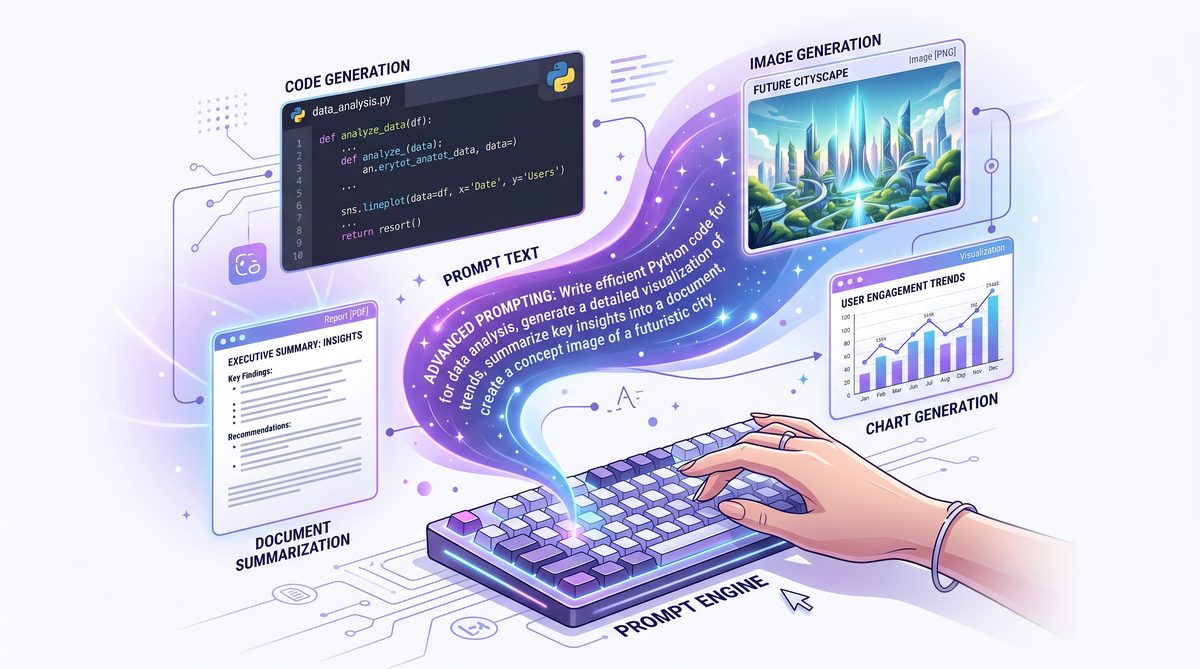
Understanding GPT-5.5’s New Capabilities
Enhanced Memory Architecture: Expanding Contextual Awareness
GPT-5.5 represents a significant advancement over its predecessors by introducing enhanced memory capabilities that fundamentally change how users interact with the model. Unlike earlier iterations that operated primarily on input provided in a single session, GPT-5.5 can now reference and build upon past conversations explicitly, allowing for a continuous and evolving dialogue experience. This persistent memory is not merely short-term context retention; it enables complex, multi-turn interactions where the model recalls user preferences, previously shared information, and earlier instructions with remarkable accuracy.
For example, in a professional setting, a user can engage GPT-5.5 to draft a multi-part report over several sessions. The model remembers the style, terminology, and specific data points introduced earlier, ensuring consistency and coherence without needing to reintroduce context. This memory-aware prompting paradigm demands new techniques in prompt design, where users explicitly direct the model to recall or update memory states, making interactions more efficient and contextually rich.
Multimodal Reasoning: Integrating Text, Images, and Data
One of the hallmark features of GPT-5.5 is its robust multimodal reasoning ability. Achieving a score of 76 on the MMMU-Pro benchmark—a comprehensive metric that assesses a model’s proficiency in understanding and reasoning across multiple modalities—GPT-5.5 can seamlessly process and integrate inputs such as text, images, and structured data. This multimodal capability enables complex analytical tasks that were previously challenging or impossible for language models.
Consider a scenario where a developer uploads a technical diagram alongside a textual project brief. GPT-5.5 can analyze the visual elements of the diagram, cross-reference them with the brief, and generate insightful summaries, identify inconsistencies, or propose design improvements. Similarly, in data-driven environments, users can provide spreadsheets or JSON data files combined with descriptive queries, prompting GPT-5.5 to perform nuanced cross-modal reasoning—such as correlating data trends with textual explanations or visual patterns.
File and Email Integration: Expanding the Information Horizon
Beyond conversational memory and multimodal inputs, GPT-5.5 introduces the ability to search and reference external information sources dynamically, including files and Gmail accounts. This integration allows the model to contextualize its responses with up-to-date, user-specific information stored in documents or emails, vastly extending its utility in real-world applications.
For instance, a business leader can ask GPT-5.5 to summarize recent client communications by instructing the model to search their Gmail inbox for relevant threads, or to extract key data from attached spreadsheets or Word documents. This capability reduces manual data retrieval efforts and enhances decision-making by providing consolidated and contextually accurate insights drawn directly from the user’s data repositories.
Memory-Aware Prompting: A New Paradigm for Interaction
These new capabilities necessitate a shift from traditional prompting techniques to what is now termed memory-aware prompting. Unlike static prompts, memory-aware prompts explicitly manage the model’s memory state—allowing users to instruct GPT-5.5 when to recall, update, or discard information from past interactions. This control enables more sophisticated workflows, such as iterative content refinement, progressive data analysis, and personalized assistance that evolves over time.
Effective memory-aware prompting often involves designing prompts that reference specific conversation IDs, timestamps, or tags, guiding GPT-5.5 to retrieve relevant contextual data. For example, a user might prompt: “Recall the project outline we discussed last week and integrate the new budget figures from the attached spreadsheet.” Such instructions ensure the model intelligently merges historical and current data, facilitating more accurate and contextually informed outputs.
Implications for Developers and Business Leaders
For developers and AI practitioners, understanding and leveraging these new GPT-5.5 capabilities unlocks a spectrum of innovative applications—from dynamic knowledge management systems and personalized virtual assistants to advanced analytical tools that combine textual and visual data. Business leaders can harness GPT-5.5 to streamline operations, enhance customer engagement, and foster data-driven decision-making by integrating the model into existing workflows that span emails, documents, and multi-format data sources.
Mastering the nuances of memory-aware prompting and multimodal inputs will be critical for maximizing the return on investment when deploying GPT-5.5-based solutions. This guide will delve into specific strategies and examples in subsequent sections, equipping readers with the tools to exploit these advancements effectively.
Memory-Aware Prompting Techniques
Introduction to Memory-Aware Prompting
With the release of GPT-5.5, OpenAI has introduced significantly enhanced memory capabilities that redefine how users interact with large language models. Unlike previous iterations where prompts were treated as isolated queries, GPT-5.5’s memory-aware prompting allows the model to reference and build upon past conversations, search through integrated personal data such as Gmail and files, and combine multimodal inputs like text, images, and tabular data for comprehensive reasoning. This new paradigm shifts the focus from one-off requests to dynamic, context-rich dialogues that evolve over time.
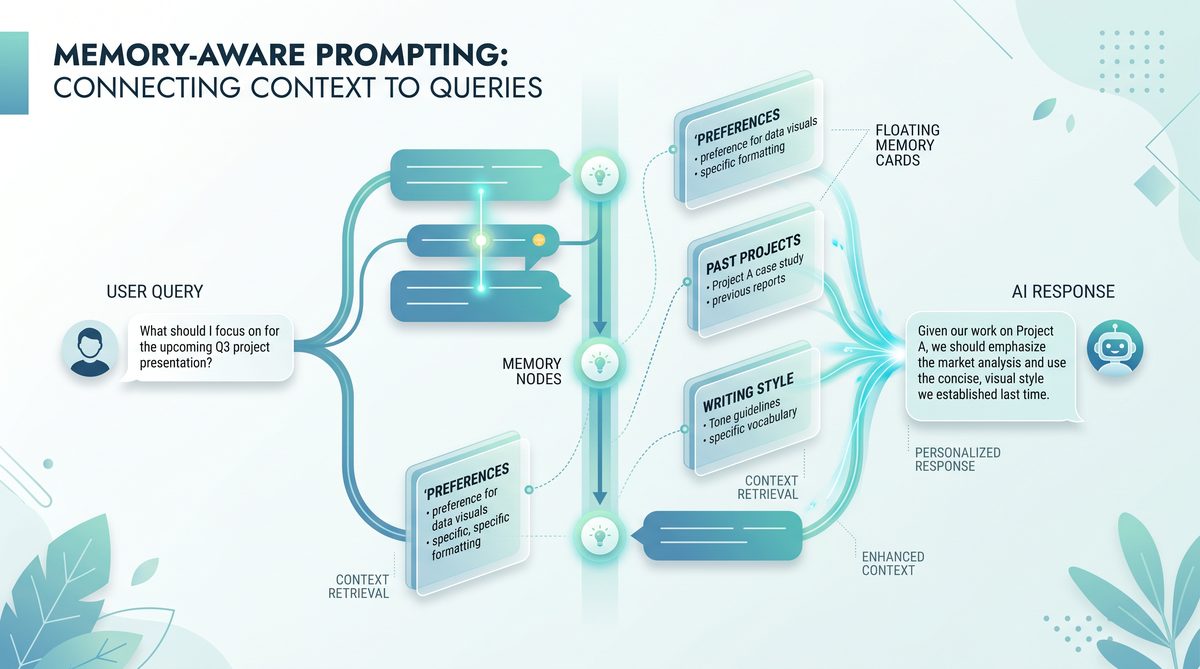
Memory-aware prompting leverages the model’s ability to retain and access contextual knowledge from previous interactions. This enables developers and business users to design workflows where GPT-5.5 remembers user preferences, ongoing project details, and historical data points, making the conversational AI an adaptive and personalized assistant. The implications for productivity, long-term collaboration, and complex problem-solving are substantial.
Techniques for Leveraging Past Conversations
One of the core strengths of GPT-5.5 is its ability to explicitly reference previous dialogue turns in the same session or even across sessions. This capability is critical for applications such as customer support, project management, and iterative content creation. To effectively utilize this, prompting techniques must be designed to:
- Summarize and Reference: Embed concise summaries of prior conversations within new prompts to refresh context without overwhelming token limits.
- Contextual Anchoring: Use explicit markers or keywords that direct GPT-5.5 to recall specific details, such as “As we discussed last week about the product roadmap…”
- Progressive Detailing: Build complexity over multiple prompt cycles, where each prompt recalls and expands on prior information, enabling deep dives into multi-step reasoning.
For example, in a legal contract review scenario, a user might initially prompt GPT-5.5 to analyze key clauses. Subsequent prompts can explicitly refer back to those clauses for revision suggestions or risk evaluation, maintaining a coherent thread throughout the interaction.
Combining Multimodal Inputs for Complex Analysis
The advanced multimodal reasoning capabilities of GPT-5.5, which achieved an impressive 76 score on the MMMU-Pro benchmark, allow the model to process and integrate diverse data types seamlessly. Memory-aware prompting techniques can now incorporate images, charts, tables, or scanned documents alongside text to perform sophisticated analyses.
Consider a financial analyst who uploads quarterly earnings reports as PDFs and accompanying spreadsheets. By crafting prompts that include these multimodal inputs, the analyst can ask GPT-5.5 to cross-reference textual financial commentary with numerical data trends, generating comprehensive insights or forecasts. This kind of combined reasoning was previously unachievable at this scale and speed.
When constructing multimodal prompts, it is essential to:
- Clearly delineate input types within the prompt (e.g., “Refer to the attached image showing sales growth trends…”).
- Use explicit questions or instructions that guide GPT-5.5 to connect information from different modalities.
- Leverage the model’s memory to relate new multimodal data to previous conversations or files for cumulative analysis.
Practical Examples of Memory-Aware Prompting
To illustrate, consider a product development team collaborating with GPT-5.5. The team uploads a design mockup image, shares a project timeline file, and references prior conversations about feature prioritization. Using memory-aware prompting, the team can ask GPT-5.5 to evaluate how the design meets timeline constraints and suggest adjustments, all while recalling earlier feedback and decisions. This streamlines project alignment and reduces the need to reiterate context manually.
Another example is personal productivity. Users can prompt GPT-5.5 to review their Gmail inbox for relevant emails, recalling prior instructions such as “Flag all client emails related to project X” and then request a summary or action items based on that filtered data. This demonstrates how memory-aware prompting enhances task automation by combining natural language instructions with personal data access.
Bridging to Related AI Concepts
Memory-aware prompting also intersects with concepts such as persistent context management and retrieval-augmented generation (RAG), which aim to blend external knowledge sources with language model outputs dynamically. Understanding these relationships can further empower users to design AI workflows that optimize for accuracy, relevance, and user intent over long-term interactions. For an in-depth exploration of these techniques and their implementation strategies, refer to our detailed guide on advanced context management Prompting AI Agents: How to Write Effective Instructions for Codex, Claude Code, and Autonomous Systems.
Multimodal Prompting Strategies
GPT-5.5 represents a significant advancement in AI capabilities, particularly in its ability to process and reason across multiple modalities such as text, images, and structured data. With an impressive score of 76 on the MMMU-Pro benchmark—a leading measure for Multimodal Understanding and Reasoning—GPT-5.5 offers developers and business leaders a powerful toolset to design prompts that integrate diverse inputs for richer, more nuanced outputs.
Understanding Multimodal Reasoning in GPT-5.5
Multimodal reasoning refers to the model’s capacity to interpret and synthesize information from various data types simultaneously. Unlike previous iterations that primarily handled text, GPT-5.5 can combine textual data with images and even extract meaning from attached files or Gmail content referenced during the conversation. This enables complex analytical tasks that require correlating visual cues with textual context or datasets.
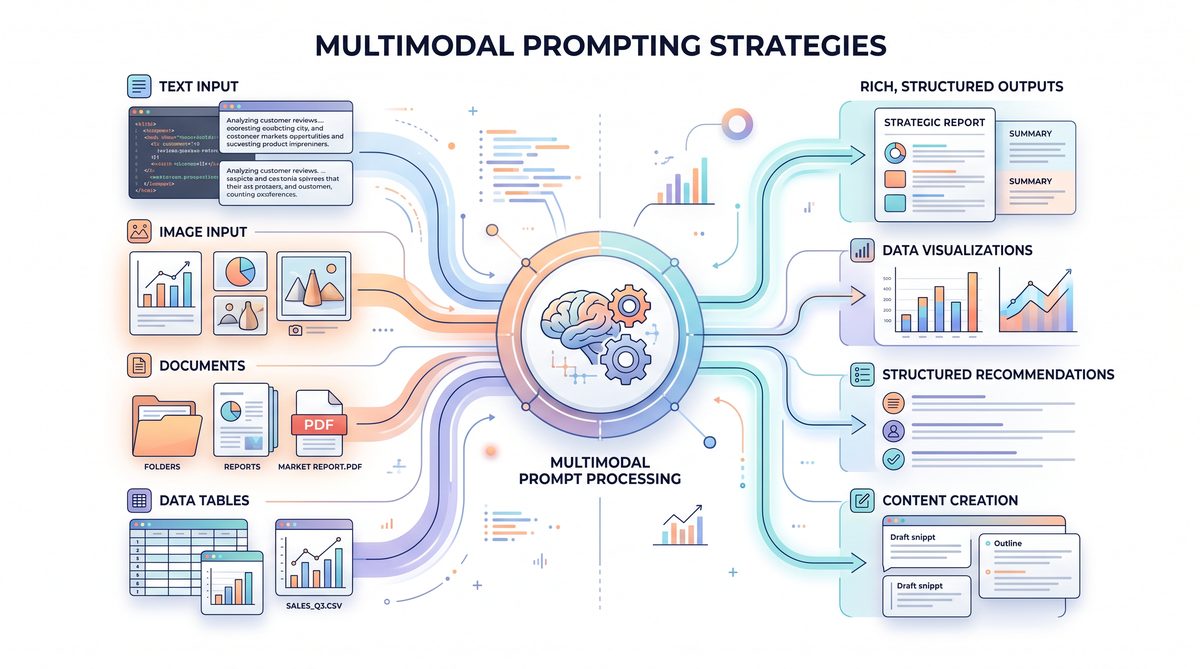
For example, a prompt can include a product specification sheet (as an image or PDF), a customer email, and a set of sales figures, all within the same interaction. GPT-5.5’s memory-aware capabilities ensure that it not only processes this multimodal input but also recalls previous related conversations or data points, allowing for cumulative knowledge building and more insightful responses.
Techniques for Crafting Effective Multimodal Prompts
To fully leverage GPT-5.5’s multimodal reasoning, prompt engineers must adopt new strategies that exploit its enhanced memory and cross-modal integration:
- Explicit Context Linking: When referencing past conversations or files, explicitly mention the context or key details you want the model to recall. For instance, “Based on our last discussion about Q2 marketing data, analyze the attached sales graph.” This clarity helps the model retrieve and integrate relevant prior information efficiently.
- Combined Input Formatting: Structure prompts to clearly delineate between modalities. Use headings or labels such as “Text Summary,” “Image Description,” or “Data Table” before each input segment, guiding GPT-5.5’s parsing process.
- Incremental Prompting: Build prompts in stages that progressively add multimodal elements. Start with a textual summary, then introduce an image or dataset, followed by a request for comparative analysis. This stepwise approach aligns with GPT-5.5’s memory-aware design, enabling deeper understanding and reasoning.
- Referencing External Files and Emails: Leverage GPT-5.5’s ability to search and reference Gmail conversations or uploaded documents. For instance, instruct the model: “Retrieve the latest client email regarding project timelines and compare it with the attached Gantt chart image.” This can reduce manual data preprocessing and accelerate decision-making workflows.
Practical Example: Multimodal Prompt for Market Analysis
Consider a scenario where a product manager wants GPT-5.5 to analyze customer feedback alongside product images and sales trends. An effective multimodal prompt might look like this:
- Text Input: “Here is the summary of customer reviews from last quarter highlighting concerns about battery life and design aesthetics.”
- Image Input: “Attached are the latest product images showcasing the new design changes.”
- Data Input: “The sales data table for the last six months is included below.”
- Instruction: “Considering these inputs and our previous conversation on product strategy, provide a detailed assessment on how design changes impact customer satisfaction and sales.”
GPT-5.5 will integrate the textual feedback, visually analyze the design changes depicted in images, and correlate this with sales data trends while recalling prior discussions—generating a comprehensive, actionable report.
Memory-Aware Multimodal Prompting: A Paradigm Shift
One of the most transformative features of GPT-5.5 is its memory-aware prompting paradigm. Users can now explicitly build on prior conversations or data references within multimodal prompts. This contrasts with traditional stateless prompting where each interaction was isolated.
For instance, a developer can initiate a conversation about a complex engineering design, upload images and CAD diagrams, and in follow-up prompts, refer to these earlier inputs by name or description. GPT-5.5’s memory mechanism retains these multimodal elements, allowing the model to evolve its reasoning and generate refined outputs over multiple exchanges.
This capability opens doors for use cases such as:
- Iterative Design Reviews: Teams can iteratively refine product designs, feeding updated images and annotations while referencing prior feedback, all within a continuous chat session.
- Complex Document Analysis: Legal or financial experts can upload contracts, spreadsheets, and related emails, then ask GPT-5.5 to synthesize insights across these documents over multiple prompts.
- Personalized Customer Support: Customer service agents can leverage past conversation history, attached screenshots or error logs, and knowledge base articles simultaneously to resolve issues more effectively.
Summary
GPT-5.5’s multimodal prompting strategies enable users to harness its enhanced memory and multimodal reasoning for sophisticated, context-rich interactions. By explicitly linking prior conversations, structuring combined inputs, and incrementally building multimodal prompts, developers and business leaders can unlock new levels of AI-driven insights and automation. The memory-aware paradigm marks a fundamental shift, facilitating continuous, evolving dialogue across text, images, and data—ushering in the next generation of intelligent, multimodal AI applications.
Building on Previous Conversations
One of the most transformative advancements in GPT-5.5 is its enhanced memory capabilities, enabling users to build on previous conversations with unprecedented continuity and contextual depth. Unlike earlier iterations, which treated each interaction as largely isolated, GPT-5.5 can now explicitly reference prior dialogues, allowing for more coherent, evolving discussions. This shift fundamentally changes how developers, business leaders, and AI practitioners approach prompt design, ushering in what is known as memory-aware prompting as a new paradigm.
Enhanced Memory Utilization for Contextual Continuity
GPT-5.5’s memory is not just a passive log of past messages; it actively integrates past conversation threads to enrich responses. For example, when discussing a complex technical issue over multiple exchanges, the model can recall specific details such as previously identified problems, user preferences, or nuanced constraints without requiring restatement. This capability significantly streamlines workflows, reducing friction and redundancy.
Practically, this means that prompts can be designed to explicitly instruct GPT-5.5 to “refer back to the earlier explanation about database schema optimization” or “build on the previous conversation regarding customer segmentation strategy.” The model’s memory allows it to maintain topic coherence and develop ideas progressively, which is particularly valuable for long-term project collaborations or multi-session consultations.
Leveraging Multimodal Context in Conversational Memory
Beyond textual memory, GPT-5.5’s multimodal reasoning prowess—demonstrated by its impressive 76 score on the MMMU-Pro benchmark—enables the integration of images, structured data, and text from previous conversations. This multimodal memory allows users to build on complex analyses that incorporate visual elements, charts, or tabular data referenced earlier in the dialogue.
For instance, a user might upload an architectural diagram during an initial session, then in subsequent conversations ask the model to highlight potential design flaws or suggest improvements based on the same diagram without needing to re-upload or describe it. Similarly, users can combine text-based instructions with data extracted from files or Gmail threads previously searched by the model to create a rich, layered context for problem-solving or decision-making.
Memory-Aware Prompt Engineering Techniques
To fully exploit GPT-5.5’s memory features, prompt engineers must adopt memory-aware prompting techniques. This involves explicitly referencing prior context, summarizing key points from earlier interactions, or instructing the model to retrieve specific information from past conversation segments stored within its memory framework.
One effective approach is to use “checkpoint prompts” that mark significant milestones or conclusions in a conversation. For example, after resolving a technical bug, a prompt might say: “Remember this fix and apply it when we discuss related modules.” These checkpoints serve as anchors for the model’s memory retrieval system, enabling smoother transitions and more focused responses in future exchanges.
Another technique is iterative refinement, where the user incrementally builds on a response from a previous conversation. Instead of starting from scratch, the prompt references the last output and requests enhancements or modifications. This approach is particularly useful in creative fields such as content generation, code development, or strategic planning, fostering a dynamic interaction cycle that leverages the model’s memory.
Integrating External Data Sources: Files and Gmail
GPT-5.5’s ability to search and reference external data sources such as user files and Gmail conversations further amplifies the potential of building on previous conversations. Users can instruct the model to incorporate relevant information extracted from emails or documents discussed earlier, creating a seamless integration between AI reasoning and real-world data repositories.
For example, a project manager might engage GPT-5.5 in a discussion about client feedback and then prompt it to retrieve specific comments from recent email threads to inform the next steps of product development. This capability reduces context-switching and manual data gathering, enabling more efficient, informed decision-making processes.
This new integration also opens avenues for advanced knowledge management systems, where GPT-5.5 acts as a bridge between conversational AI and enterprise data ecosystems, ensuring that AI interactions remain grounded in up-to-date, relevant information.
Implications for AI-Driven Workflows and Collaboration
The ability to build on previous conversations fundamentally elevates GPT-5.5 from a reactive tool to a proactive collaborator. Teams can maintain ongoing dialogues with the AI, preserving institutional knowledge and evolving strategies over time. This is particularly impactful in domains such as software development, customer support, legal advisories, and technical consulting, where continuity and context are critical.
Moreover, this memory-aware interaction model aligns closely with human communication patterns, fostering more natural and productive exchanges. By combining this with multimodal inputs and external data retrieval, GPT-5.5 sets a new standard for AI-assisted workflows.
For those interested in further exploring how memory and contextual awareness intersect with other AI capabilities, such as adaptive learning and long-term user modeling, the concepts elaborated in The Complete Guide to OpenAI’s Trusted Access for Cyber Program: Eligibility, Setup, and Workflow Integration offer a valuable extension to this discussion.
Practical Prompt Templates and Examples
With GPT-5.5’s advanced memory capabilities and multimodal reasoning, the art of crafting effective prompts has evolved into a sophisticated discipline. Practical prompt templates help users harness these features efficiently, enabling complex tasks such as referencing past conversations, integrating multiple data types, and performing nuanced analysis. This section provides detailed examples and templates to illustrate how to leverage GPT-5.5’s memory-aware prompting and multimodal inputs in real-world scenarios.
1. Memory-Aware Prompt Templates
One of GPT-5.5’s standout features is its ability to reference and build upon past interactions explicitly. This capability allows for dynamic, context-rich conversations that feel more natural and coherent over time. Below is a template for memory-aware prompting designed to recall and update information across sessions:
Template:
"In our previous conversation on [topic], you mentioned [key point]. Based on that, can you provide an updated analysis including [new detail or question]?"
Example:
"In our previous conversation on renewable energy trends, you mentioned the growth rate of solar power installations in Europe. Based on that, can you provide an updated forecast for 2025 including the impact of recent government policies?"
This approach explicitly cues GPT-5.5 to access and integrate earlier dialogue, producing responses that are contextually richer and more relevant. It is especially effective for business scenarios involving ongoing projects, such as tracking market research, product development discussions, or customer support tickets.
2. Multimodal Prompt Templates
GPT-5.5’s multimodal reasoning, which scored 76 on the MMMU-Pro benchmark, enables it to process and integrate text, images, and structured data simultaneously. This capability allows professionals to submit complex queries that combine various content types for comprehensive analysis. Here is a flexible template for multimodal prompting:
Template:
"Analyze the attached [image/chart/document] along with the following text: '[text description or question]'. Summarize key insights and highlight any correlations or anomalies."
Example:
"Analyze the attached sales chart for Q1 2024 along with the following text: 'Our marketing campaigns targeted social media platforms heavily in February.' Summarize key insights and highlight any correlations between campaign timing and sales spikes."
In this example, GPT-5.5 combines visual data interpretation with textual context, demonstrating its ability to perform multimodal reasoning for data-driven decision making. This template applies well to domains like finance, healthcare, and engineering, where integrating graphical data with textual reports is critical.
3. Leveraging File and Email Search in Prompts
GPT-5.5’s new ability to search files and Gmail content extends prompting beyond immediate input, enabling the model to retrieve and synthesize information from a user’s personal or organizational data repositories. Incorporating this feature requires prompts that explicitly instruct the model to access and analyze stored documents or emails.
Template:
"Search my [folder/email inbox] for documents related to [specific topic or project]. Summarize the main points and suggest next steps based on the most recent files."
Example:
"Search my email inbox for correspondence regarding the 'Q2 product launch.' Summarize client feedback and highlight any action items mentioned."
This prompt directs GPT-5.5 to perform targeted retrieval, making workflow automation and knowledge management much more efficient. It’s particularly useful for busy professionals requiring rapid synthesis of dispersed information.
4. Combining Memory and Multimodal Prompts
To fully exploit GPT-5.5’s capabilities, users can combine memory-aware and multimodal prompting techniques. This hybrid approach enables the model to recall previous interactions while analyzing new multimodal inputs, fostering continuity and depth in complex tasks.
Template:
"In our last discussion on [topic], you provided an analysis of [previous data]. Now, analyze the attached [image/data] and update your insights considering the new information."
Example:
"In our last discussion on customer satisfaction trends, you provided an analysis of survey results from 2023. Now, analyze the attached heatmap of customer service call volumes for Q1 2024 and update your insights considering this new data."
This technique encourages iterative refinement and deeper understanding, ideal for strategic planning, research, or complex problem-solving contexts.
5. Practical Considerations and Best Practices
When using these templates, keep the following best practices in mind:
- Explicit Contextual Cues: Clearly reference prior conversations or data sources to guide GPT-5.5’s memory retrieval effectively.
- Clear Multimodal Input Description: Describe the nature of images or data attached to ensure accurate interpretation.
- Concise and Specific Requests: Avoid ambiguity in instructions to reduce irrelevant or overly general responses.
- Feedback Loops: Use follow-up prompts to refine outputs and build layered insights over time.
As an example of advanced application, combining these templates with the concept of context windows and memory management can further optimize interactions. For an in-depth exploration of these foundational AI concepts, see The Rise of the Agentic Super App: OpenAI’s Cross-Platform Vision.
| Technique | Use Case | Input Types | Benefits | Example Scenario |
|---|---|---|---|---|
| Memory-Aware Prompting | Ongoing conversations, project tracking | Text (with past conversation references) | Context continuity, personalized responses | Product development status updates |
| Multimodal Prompting | Data analysis combining visuals and text | Text + Images + Structured Data | Comprehensive insights, richer analysis | Sales chart and marketing campaign analysis |
| File/Email Search Prompting | Document retrieval and summarization | Text + Document/email content | Efficient knowledge synthesis, automation | Email feedback summarization for client projects |
| Combined Memory + Multimodal | Iterative, data-intensive tasks | Text + Images + Past Conversation Data | Iterative refinement, deep contextual analysis | Customer service trend analysis with heatmaps |
In summary, mastering these practical prompt templates empowers users to unlock the full potential of GPT-5.5’s memory and multimodal capabilities. By tailoring prompts to specific tasks and leveraging the model’s contextual awareness, professionals can achieve greater accuracy, efficiency, and insight in AI-assisted workflows.
Author: Markos Symeonides
Common Mistakes and How to Avoid Them
As developers and AI practitioners adopt GPT-5.5’s advanced capabilities—especially its enhanced memory and multimodal reasoning—understanding common pitfalls is crucial to maximizing performance and reliability. While GPT-5.5 offers significant improvements over previous versions, improper prompting or mismanagement of its new features can lead to suboptimal results, increased latency, or even confusing outputs. This section outlines the most frequent mistakes encountered when leveraging GPT-5.5’s memory-aware prompting and multimodal inputs, along with practical strategies to avoid them.
1. Overloading Memory Contexts Without Clear Structure
GPT-5.5’s ability to reference past conversations and maintain memory is a game changer, but it is not limitless. One common mistake is to overload the model’s memory context with unstructured or irrelevant information, which can dilute focus and cause the model to generate inconsistent or tangential responses.
Example: Feeding an entire multi-threaded conversation without segmenting or prioritizing key points often causes the model to lose track of the main query or repeat earlier answers unnecessarily.
How to Avoid:
- Summarize and segment: Prior to prompting, summarize long conversations or documents into focused, relevant snippets that highlight essential facts or decisions.
- Use explicit memory markers: Leverage GPT-5.5’s new memory-aware prompting schema to tag or flag important prior messages with metadata, making retrieval more accurate.
- Limit context windows: Be mindful of token limits. Instead of passing entire histories, selectively reference only the most relevant parts.
2. Failing to Synchronize Multimodal Inputs
GPT-5.5’s multimodal reasoning capabilities enable the integration of text, images, and structured data for complex analyses. However, a frequent pitfall is treating multimodal inputs as disjointed or unrelated, causing the model to misinterpret context or fail to draw meaningful correlations.
Example: Submitting an image of a technical diagram alongside unrelated text without clear linkage may confuse the model, leading to generic or irrelevant responses.
How to Avoid:
- Explicitly reference multimodal elements: In prompts, clearly describe how each image or data file relates to the question or task at hand.
- Use integrated prompt templates: Structure multimodal prompts that combine text and visual inputs cohesively, for example: “Based on the attached circuit diagram, explain the function of component X described in the text below.”
- Validate input formats: Ensure images and data files are properly formatted and compatible with GPT-5.5’s input requirements to avoid processing errors.
3. Ignoring the Importance of Iterative Prompt Refinement
Another common error is expecting perfect results from a single prompt iteration, especially when using complex memory and multimodal features. GPT-5.5’s advanced reasoning often requires iterative refinement of prompts to coax out precise and actionable responses.
Example: Prompting GPT-5.5 with a vague question and multimodal inputs without follow-up clarification can yield incomplete or ambiguous answers.
How to Avoid:
- Adopt an iterative approach: Treat interactions as a dialogue where each prompt builds on the previous output, enhancing or correcting as needed.
- Use explicit feedback loops: Provide the model with feedback such as “Focus more on the data trends in the attached graph” to guide subsequent outputs.
- Leverage conversation referencing: Utilize GPT-5.5’s ability to remember prior turns to maintain continuity and refine context gradually.
4. Mismanaging File and Gmail Search Capabilities
GPT-5.5 integrates powerful search functions across files and Gmail, enabling retrieval of external information. Improper handling of these features can result in irrelevant or outdated data being mixed into responses, undermining accuracy.
Example: Triggering a broad Gmail search without precise keywords or date filters may surface thousands of emails, overwhelming the model and delaying response time.
How to Avoid:
- Use targeted queries: Apply specific keywords, date ranges, or sender filters when using file or Gmail searches.
- Pre-filter before retrieval: Use external tools to curate relevant documents or emails before passing them to GPT-5.5 for analysis.
- Validate retrieved data: Cross-check returned documents or email excerpts for relevance and accuracy before incorporating them into prompts.
Summary Table: Common Mistakes vs. Best Practices
| Common Mistake | Impact | Best Practice |
|---|---|---|
| Overloading memory with unstructured context | Confused or inconsistent responses | Summarize and segment key information; use explicit memory markers |
| Disjointed multimodal inputs | Misinterpretation and irrelevant answers | Explicitly link multimodal elements; use integrated prompt templates |
| Expecting one-shot perfect answers | Ambiguous or incomplete results | Iterative prompt refinement with feedback loops |
| Broad or imprecise file/Gmail searches | Slow, inaccurate, or irrelevant information retrieval | Use targeted queries and pre-filter data before prompting |
By recognizing and proactively addressing these common mistakes, AI developers and users can fully leverage GPT-5.5’s memory and multimodal reasoning strengths. Thoughtful prompt design, clear structure, and iterative refinement remain critical to extracting the highest value from this cutting-edge model.
Author: Markos Symeonides
Advanced Patterns for Power Users
GPT-5.5 represents a significant leap forward in large language model capabilities, especially with its enhanced memory and multimodal reasoning features. For power users, these advances unlock a new paradigm of memory-aware prompting and complex multimodal interactions that go well beyond traditional text-only input-output exchanges. This section dives deep into the advanced prompting patterns that leverage GPT-5.5’s persistent memory, file and Gmail search integration, and multimodal comprehension to enable highly sophisticated workflows, automation, and analysis.
Memory-Aware Prompting: Building Context Over Time
Unlike prior models that treated each interaction as largely stateless, GPT-5.5 can explicitly reference and build upon past conversations, creating a continuous, evolving context. This capability is transformative for long-term projects, iterative problem solving, and personalized AI assistants.
Key techniques for memory-aware prompting include:
- Explicit References to Past Conversations: Incorporate identifiers or timestamps from earlier dialogues to anchor the model’s memory retrieval. For example, “Referring to our discussion on Q2 marketing strategies on March 3rd, please update the forecast based on new data.”
- Progressive Refinement Prompts: Use successive prompts that build upon each other’s output. Prompt 1 could generate a draft report; Prompt 2 asks for a summary focusing on identified KPIs; Prompt 3 requests visual insights based on the summary.
- Memory Scoping Parameters: Users can specify how far back in the conversation history the model should draw from, balancing context richness with response relevance. For instance, “Use only the last three exchanges for context.”
- Contextual Memory Updates: After receiving output, users can instruct GPT-5.5 to “remember” or “flag” certain details for future prompts, effectively crafting a dynamic knowledge base within the session.
These patterns allow GPT-5.5 to act like a collaborative partner that remembers prior instructions, critiques, and preferences, reducing repetitive clarifications and enabling highly personalized AI interactions.
Multimodal Reasoning Patterns: Combining Text, Images, and Data
GPT-5.5’s multimodal reasoning abilities, demonstrated by its 76 score on the MMMU-Pro benchmark, empower users to input heterogeneous data types simultaneously, such as images, tables, and natural language. This enables complex analytical tasks that require synthesizing visual and textual information.
Effective advanced multimodal prompting involves:
- Composite Prompts: Provide a textual question alongside an image or data table, asking the model to integrate these inputs for comprehensive analysis. Example: “Analyze the sales trend from this graph and explain the key drivers.”
- Stepwise Multimodal Analysis: Break down complex queries into stages, first asking GPT-5.5 to identify features or anomalies in the image, then to cross-reference these with text data or prior conversation context.
- Data-Driven Inquiries: Upload CSV or spreadsheet files and prompt GPT-5.5 to perform statistical analysis or generate summaries referencing both numerical data and accompanying narrative descriptions.
- Visual Reasoning with Memory Integration: Combine persistent memory with multimodal inputs by asking the model to recall previous visual analyses and update them with new images or documents.
For example, a product manager can upload a heatmap image of user engagement, paired with user feedback logs, and ask GPT-5.5 to identify pain points and suggest prioritized feature improvements. This level of cross-modal reasoning was previously cumbersome or impossible with earlier models.
Leveraging File and Email Search in Prompts
Another advanced pattern involves incorporating GPT-5.5’s ability to search external data sources such as cloud files and Gmail accounts during a session. This capability integrates AI-generated insights with real-world data located outside the immediate prompt.
Power users can craft prompts like:
- “Search my Gmail for emails related to ‘Q3 budget revisions’ from the last month and summarize the main points.”
- “Find the latest project plan document in my Google Drive folder named ‘Product Launch’ and extract the milestone dates.”
- “Using the attached spreadsheet from the ‘Sales Reports’ folder, update the forecast model discussed earlier.”
These prompts require specifying clear search parameters and integrating the retrieved content into subsequent reasoning or generation steps. The model’s ability to contextualize this external data within the ongoing conversation enhances productivity and decision-making.
Combining Advanced Patterns: A Practical Example
Consider a scenario where a business analyst is preparing a quarterly review. Using GPT-5.5:
- The analyst references a previous conversation outlining key performance indicators (KPIs) to focus on, ensuring continuity.
- They upload a set of sales charts and customer sentiment heatmaps, asking GPT-5.5 to interpret trends and anomalies.
- They prompt the model to search recent emails for client feedback and integrate this qualitative data into the analysis.
- Finally, they instruct GPT-5.5 to draft a comprehensive report that combines all these insights, referencing historical context and visual data.
This workflow exemplifies how memory-aware prompting, multimodal reasoning, and external data search synthesize to deliver a powerful, unified AI assistant experience.
| Advanced Pattern | Capabilities Leveraged | Example Use Case | Benefits |
|---|---|---|---|
| Memory-Aware Prompting | Contextual memory, conversation history | Iterative report refinement over multiple sessions | Reduces repetition, personalized AI collaboration |
| Multimodal Reasoning | Text + images + data tables, MMMU-Pro scoring | Analyzing sales charts alongside textual feedback | Deeper insights, cross-modal synthesis |
| File and Gmail Search Integration | External data retrieval, contextual integration | Summarizing client emails and updating project plans | Real-world data inclusion, improved accuracy |
In conclusion, mastering these advanced prompting patterns transforms GPT-5.5 from a simple generative tool into a dynamic, context-aware, multimodal reasoning partner. Power users who adopt these techniques will unlock unprecedented levels of AI productivity, creativity, and decision support.
Author: Markos Symeonides
Access 40,000+ AI Prompts for ChatGPT, Claude & Codex — Free!
Subscribe to get instant access to our complete Notion Prompt Library — the largest curated collection of prompts for ChatGPT, Claude, OpenAI Codex, and other leading AI models. Optimized for real-world workflows across coding, research, content creation, and business.
