
The ChatGPT Super App Era: How OpenAI Is Unifying ChatGPT, Codex, and Atlas Into One Platform
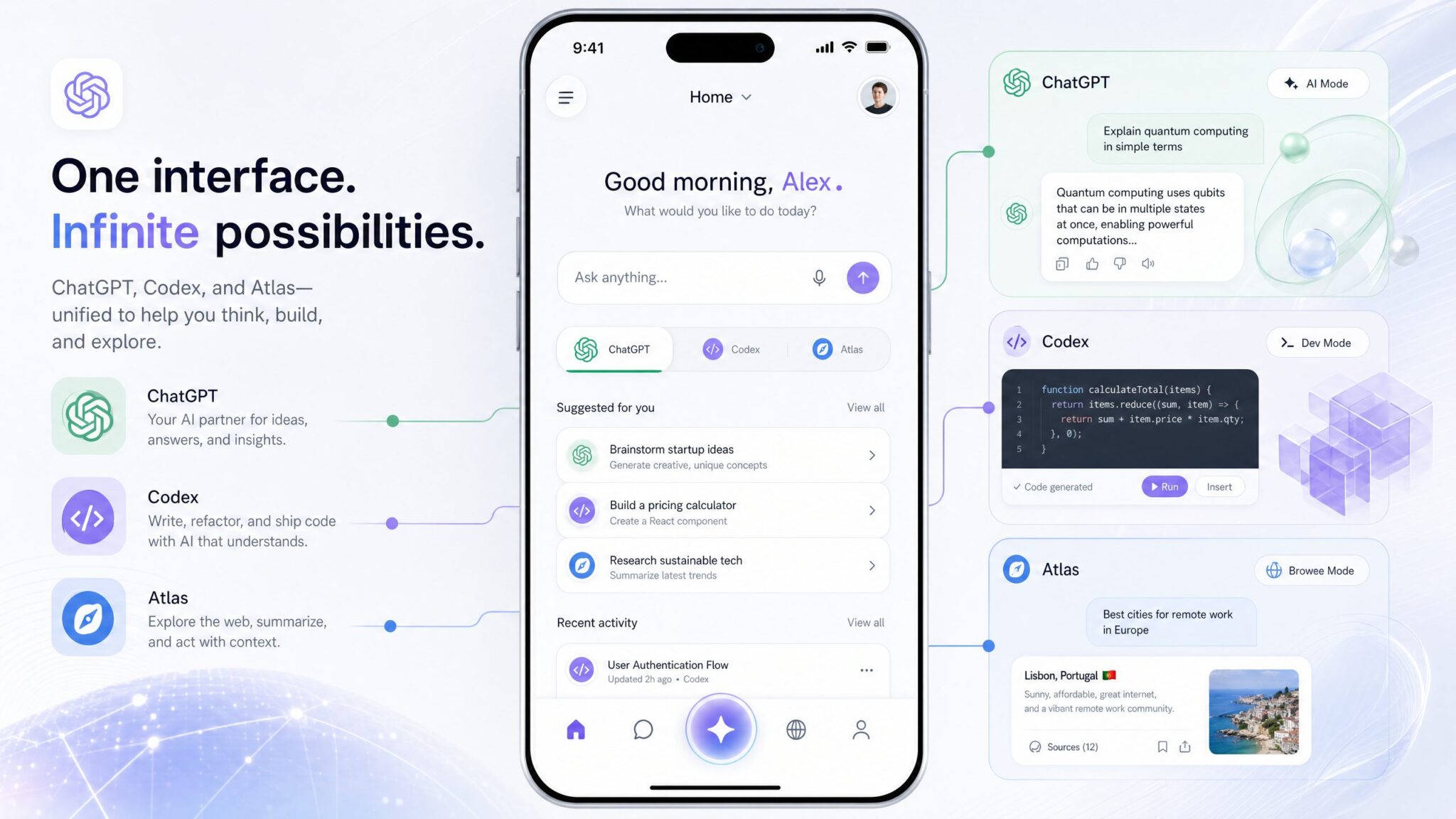
OpenAI’s Unified Desktop Super App: Merging ChatGPT, Codex, and Atlas Browser
Author: Markos Symeonides
In an ambitious move that signals a paradigm shift in AI application design, OpenAI has officially announced the merger of its flagship products—ChatGPT, Codex, and the Atlas web browser—into a single, unified desktop super app. This consolidation, launched alongside the rollout of ChatGPT 5.5, was first reported by Wired in May 2026 and represents a fundamental transformation from siloed AI tools to an integrated AI workspace designed to streamline workflows, enhance productivity, and redefine the user experience.
This pivotal development illustrates OpenAI’s commitment to elevating AI’s role from isolated capabilities to a comprehensive platform that supports diverse, interconnected tasks in a seamless environment. By converging these advanced tools, OpenAI is challenging conventional software paradigms and positioning AI as a central, intelligent operating system layer for the future.
From Disparate Tools to an Integrated AI Workspace
For years, OpenAI’s ChatGPT, Codex, and Atlas browser have served distinct purposes: ChatGPT as a conversational agent, Codex as a coding assistant, and Atlas as a specialized web browser optimized for research and information retrieval. The decision to unify these under a single desktop application reflects a strategic vision to offer users a seamless, context-aware environment where conversational AI, coding assistance, and web exploration coexist harmoniously.
Greg Brockman, OpenAI’s co-founder and key strategist, has taken official control of the unified product experience, driving the integration effort. His leadership signals a commitment to evolving OpenAI’s offerings from discrete AI services to a cohesive platform, effectively positioning AI as an indispensable operating system layer for both developers and business professionals.
The new super app not only simplifies the user experience but also enables deeper interconnectivity between tools, allowing AI models to share context and user intent across tasks. This results in more intelligent responses and a fluid dynamic where switching between coding, researching, and chatting is effortless and intuitive. Moreover, the unified platform supports extensibility for third-party integrations, signaling a move toward an open AI ecosystem.
By breaking down barriers between individual applications, users are empowered to harness the full spectrum of OpenAI’s AI technologies within one cohesive environment — ultimately accelerating innovation and operational efficiency.
Additionally, the integration facilitates a shared memory system that retains user context across sessions and modules. This means that insights derived from research in Atlas can immediately inform coding assistance from Codex or conversational queries in ChatGPT without manual inputs, vastly improving AI relevance and reducing redundant interactions.
These capabilities combined effectively shift AI usage from fragmented task-specific engagements to a continuous, highly personalized interaction model, where the user’s needs and intentions are anticipated proactively.
ChatGPT 5.5 and the GPT-5.5 Instant Model: Speed Meets Contextual Intelligence
Integral to the launch of the unified super app is ChatGPT 5.5, OpenAI’s latest conversational model. ChatGPT 5.5 Instant serves as the default model within the application, emphasizing rapid response times and enhanced contextual understanding. This iteration improves on earlier versions by offering more nuanced and contextually relevant replies, which is critical when users transition fluidly between coding tasks, web research, and conversational queries within the same interface.
The upgrade represents a significant advancement in AI conversational capability. GPT-5.5 Instant delivers responses up to 40% faster than GPT-4 models, minimizing latency and supporting real-time engagement that suits high-pressure professional environments. This speed enhancement does not compromise depth; enhanced context retention ensures the model maintains a rich understanding of longer conversations, reducing repetitive prompts and user corrections.
Adaptive tone and style adjustments allow the AI to intuitively shift between formal technical responses for coding and debugging, and more casual or explanatory language suitable for brainstorming or knowledge discovery phases.
Key enhancements of GPT-5.5 Instant include:
- Optimized Latency: Responses generated up to 40% faster compared to GPT-4, significantly improving user productivity and satisfaction.
- Improved Context Retention: Maintains conversational context across longer sessions, reducing repetition and misunderstandings during prolonged use.
- Adaptive Tone and Style: Customizes language tone based on user preferences and the task at hand, be it formal coding queries or casual conversational exchanges.
- Multilingual Proficiency: Enhanced support for over 30 languages, aiding global teams and international collaboration.
Importantly, GPT-5.5 Instant is engineered to understand and participate across the diverse modalities present in the super app. Whether parsing complex code snippets, generating summaries from web pages, or engaging in multi-turn dialogues, it dynamically adjusts its reasoning depth and conversational flow.
For developers specifically, this means faster debugging cycles and more insightful coding assistance. For analysts and researchers, improved summarization and contextual awareness streamline data aggregation and hypothesis testing. Overall, the model’s blend of speed and intelligence underpins the super app’s mission to unify workflows.
Those interested in the technical aspects and advanced capabilities of these models might explore in-depth analyses such as Advanced Prompting and Reasoning Techniques.
The Atlas Browser: Web Research Reimagined for AI-Enhanced Productivity
The Atlas browser, previously a standalone product, now operates natively within the super app, providing users with powerful web research capabilities that complement coding and conversational tasks. Unlike conventional browsers, Atlas is optimized to extract, summarize, and contextualize information using AI, enabling users to conduct complex research without leaving the application.
This integration eliminates disruptive context-switching that traditionally plagues developers and researchers who need to juggle multiple windows and apps. For example, a developer can simultaneously debug code with Codex while consulting real-time web resources through Atlas within the same workflow. This streamlined interaction not only accelerates productivity but also enhances decision-making quality.
Atlas introduces several innovative features that redefine web research:
- AI-Powered Summarization: Automatically distills lengthy articles, research papers, and documentation into concise, digestible summaries, reducing reading time and increasing focus.
- Contextual Highlighting: Highlights relevant information based on ongoing tasks or queries from ChatGPT and Codex modules to present precisely the most pertinent data.
- Advanced Data Extraction: Pulls tabular data, figures, and key metrics into organized formats that can be directly leveraged by developers or analysts, streamlining data integration in projects.
- Integrated Note-Taking: Enables users to capture insights and annotate sources directly within the browser for reference and collaboration, fostering knowledge sharing.
- Privacy and Security: Employs robust encryption and zero-tracking policies to ensure user research remains confidential, addressing increasing concerns over data privacy.
Collectively, these features position Atlas as a cutting-edge research assistant, transforming how professionals gather and synthesize information online.
Atlas vs. Traditional Browsers: A Feature Comparison
| Feature | Atlas Browser | Traditional Browsers (Chrome, Firefox) |
|---|---|---|
| AI Summarization | Built-in, context-driven with adaptive focus | Not available natively; requires extensions |
| Contextual Highlighting | Integrated with AI workspace and task context | Absent |
| Data Extraction | Automated and structured to AI models | Manual tools or third-party extensions needed |
| Privacy Controls | Zero-tracking and encrypted by default | Varies widely; many browsers track user data |
| Integrated Note-Taking | Native AI-enhanced support within browser | Depends on third-party plugins |
| Workflow Integration with ChatGPT/Codex | Seamless integration within super app via shared context | Requires separate applications and manual transfer |
Atlas’s AI-enhanced capabilities enable users to push beyond simple search paradigms, engaging in active sense-making and synthesis directly through the browser interface. This integration curve dramatically reduces the “cognitive load” of managing research workflows and contextualizing data.
Industry experts anticipate such integrated browsers could transform knowledge work, especially when combined with code generation tools like Codex and conversational assistants such as ChatGPT. Professionals can now tackle complex queries that blend coding, research, and communication without context loss or fragmentation.
Codex: Expanded AI Coding Assistance Across Devices
Codex, OpenAI’s renowned AI coding agent, has also been expanded in this release. It is now fully accessible on mobile devices through the unified app, enabling developers to write, review, and debug code on-the-go. This mobile accessibility aligns with broader trends in remote and flexible work environments, where developers require powerful AI tools beyond the traditional desktop setting.
In the super app, Codex functions as a core component of the integrated workspace, allowing users to invoke coding assistance seamlessly during conversations or while browsing the web. The amalgamation of these functionalities supports complex development cycles without friction, setting a new standard for AI-powered programming environments.
Capabilities enhanced in Codex 5.5 include:
- Multi-Language Support: Expanded language coverage including Python, JavaScript, Rust, Go, and emerging domain-specific languages, catering to diverse developer ecosystems.
- Contextual Code Suggestions: AI-driven predictive coding that adapts to user style and project context for more accurate and efficient programming.
- Cross-Platform Debugging: Integration with popular IDEs and mobile environments for on-the-go fixes, bridging desktop and mobile workflows.
- Collaborative Coding Features: Real-time code sharing and AI annotation within team environments fostering synchronous development and peer reviews.
Codex’s enhancements reduce cognitive overload by automating repetitive tasks, error detection, and complex syntax generation, allowing developers to focus more on architecture and problem-solving. The app also supports seamless integration with existing software development tools and repositories, ensuring minimal disruption during adoption.
Developers aiming to deepen their usage of Codex can explore comprehensive guides like OpenAI Codex’s Latest Updates and Ecosystem Integration for technical insights and best practices.
The Super App Concept: Inspiration, Vision, and Industry Impacts
OpenAI’s super app strategy draws clear inspiration from successful multi-functional platforms such as WeChat, which combines messaging, social media, payments, and more into a single interface. By creating a unified AI ecosystem, OpenAI aims to replicate this “all-in-one” model within the AI domain, where users no longer need to switch between specialized applications.
This approach is particularly significant given the increasing fragmentation of AI tools in recent years. By consolidating capabilities, OpenAI is fostering a holistic environment that supports diverse user needs—from casual conversation and complex coding to intensive research—thereby driving greater user retention and creating a platform that can evolve with emerging AI capabilities.
The impact of this consolidation can be appreciated across various dimensions:
- Developer Efficiency: Reports indicate task-switching overhead reduction by over 30%, facilitating faster development cycles and fewer errors due to contextual loss.
- Business Productivity: Reduced operational complexity and cost savings from integrated AI automation, enabling quicker decision-making and resource allocation.
- User Experience Innovation: Context-aware AI responses and unified workflows enhance satisfaction and engagement, lowering barriers to AI adoption.
- AI Ecosystem Growth: The platform’s extensibility encourages third-party integrations, fostering innovation and collaboration within the industry.
By positioning AI not merely as a collection of tools but as an integrated operating system layer, OpenAI is setting a precedent for the next generation of software platforms that are intelligent, adaptive, and user-centric.
AI Super App vs. Traditional AI Tools: Side-by-Side Comparison
| Aspect | OpenAI Super App | Traditional AI Tools |
|---|---|---|
| Integration Level | All-in-one platform combining ChatGPT, Codex, Atlas | Separate standalone applications requiring manual data transfers |
| User Workflow | Fluid switching and contextual sharing of data across modules | Fragmented workflows with task-switching overhead |
| Collaboration Support | Real-time sharing and joint AI usage within the platform | Limited collaboration; often asynchronous and external |
| AI Model Access | Unified GPT-5.5 Instant powering all features for consistency | Multiple AI versions with separate access points |
| Device Accessibility | Cross-platform: desktop and mobile unified app ensuring work continuity | Limited mobile capabilities and platform fragmentation |
Impacts on Developer Workflows and Productivity
The integration of ChatGPT, Codex, and Atlas into a single desktop super app is poised to revolutionize developer workflows. Early adopters report a significant reduction in task-switching overhead by over 30%, with measurable gains in code quality and debugging efficiency. The ability to leverage GPT-5.5 Instant’s speed, combined with contextual insights from Atlas and real-time coding support from Codex, creates a synergy that accelerates the software development lifecycle.
Moreover, the unified interface supports collaborative features that enable teams to share AI-generated insights, code snippets, and research findings within the same environment, fostering enhanced communication and innovation. Integrated version control and annotation systems reduce errors and speed-up peer reviews, leading to higher quality deliverables.
For business leaders, this translates into faster time-to-market and reduced development costs, as AI-driven automation and integration reduce manual workloads and error rates. Enterprises adopting the super app report improved cross-team alignment, smoother project management, and a more innovative culture stimulated by easier AI access.
An increasing number of companies are leveraging such AI integration strategies to automate infrastructure and streamline operations. Detailed case studies highlighting these transformations can be found in our coverage of OpenAI Codex-Driven Infrastructure Automation, providing real-world insights into the super app’s role in organizational efficiency.
These transformative effects position the OpenAI super app as a vital asset in the future of software development and digital business operations.
OpenAI’s Vision: AI as an Operating System Layer
Beyond immediate product enhancements, OpenAI’s unified super app embodies a broader vision of AI as an operating system layer—an omnipresent intelligence embedded across all facets of digital interaction. By embedding conversational AI, coding assistance, and research tools into a single platform, OpenAI is effectively creating an AI-centric desktop environment that supports all user needs in a context-aware manner.
This vision anticipates a future where AI is not merely a tool but an integral component of daily computing, shaping workflows, decision-making, and creativity. The unified super app is a critical step toward this future, demonstrating how integrated AI can break down traditional barriers between applications and enable more fluid, intelligent user experiences.
Additional goals aligned with this vision include:
- Personalized AI Agents: Adaptive models that learn from user behavior to offer predictive assistance and pre-emptive suggestions, enhancing productivity over time.
- Multi-Modal Inputs: Integration of voice, vision, and gesture controls for natural and diverse interaction modes that accommodate varied user preferences and accessibility needs.
- Enterprise Customization: Scalable AI modules tailored to industry-specific workflows, compliance requirements, and security policies, ensuring suitability across sectors.
- Open AI Ecosystem: Encouraging third-party AI developers to build plugins and extensions to expand super app capabilities, fostering innovation and community-driven growth.
This holistic ecosystem approach promotes sustainable AI development, where interoperability and extensibility become foundational pillars. By bringing together developers, businesses, and AI researchers on one platform, OpenAI is cultivating a collaborative environment that accelerates the evolution of AI technology itself.
Industry analysts predict that the AI super app concept will serve as a blueprint for future software platforms across diverse domains, from healthcare and education to finance and creative industries, heralding a new age of intelligent digital assistants.
Frequently Asked Questions (FAQ)
What is the OpenAI super app?
The OpenAI super app is a unified desktop platform that integrates ChatGPT’s conversational AI, Codex’s coding assistance, and the Atlas AI-powered browser, providing a seamless AI-driven workspace tailored for diverse professional workflows.
How does ChatGPT 5.5 Instant improve user experience?
ChatGPT 5.5 Instant offers faster response times, better contextual understanding, and adaptive language to enhance interactions across coding, research, and conversational tasks within the app. These improvements reduce latency and increase relevance during extended sessions.
Can I use Codex on mobile devices?
Yes, Codex is now fully accessible on mobile devices through the unified super app, allowing users to write, debug, and review code while on-the-go, supporting modern flexible work styles.
How does Atlas differ from other web browsers?
Atlas is optimized for AI-enhanced research, featuring automatic summarization, data extraction, and contextual integration with ChatGPT and Codex, eliminating the need to switch applications during research. Additionally, it emphasizes privacy with zero-tracking policies.
Is the super app suitable for enterprise users?
Definitely. The platform supports collaboration, compliance, customization, and scalability needed for enterprise AI adoption, helping organizations streamline AI workflows and accelerate innovation.
Summary
OpenAI’s launch of a unified desktop super app that merges ChatGPT, Codex, and the Atlas browser marks a transformative milestone in AI application design. Powered by GPT-5.5 Instant, the platform streamlines workflows by consolidating conversational AI, coding assistance, and web research into a single, context-aware interface. Under Greg Brockman’s leadership, OpenAI is pioneering a shift from fragmented AI tools to an integrated AI operating system layer that enhances developer productivity, supports enterprise needs, and opens pathways for ecosystem innovation.
The super app’s introduction ushers in a new era of intelligent, adaptive, and collaborative AI experiences, providing professionals and businesses with unprecedented capabilities to drive creativity, efficiency, and innovation in an increasingly complex digital landscape.
For developers, AI professionals, and business leaders seeking to understand the evolving landscape, detailed insights and technical analysis are available in our coverage of OpenAI Codex Infrastructure Automation Case Studies, The Evolution of AI Agents in 2026, and Economics of AI Coding Platforms in 2026.
Useful Links
- OpenAI ChatGPT Official Release Notes
- Wired: Inside OpenAI’s Latest Innovations
- Attention Is All You Need (Transformer Paper)
- MDN WebExtensions API Guide
- How to Use GPT-3 Language Models
- Designing User Experiences for AI Applications
- McKinsey: AI’s Impact on Business
- Nielsen Norman Group: AI and User Experience
- Understanding Tech Ecosystems in 2026
