
How CyberAgent Deployed ChatGPT Enterprise to 5,000 Employees: A Complete Case Study

⚡ The Brief
- What it is: A full case study of CyberAgent’s rollout of ChatGPT Enterprise to 5,000 employees across marketing, engineering, and operations.
- Who it’s for: Enterprise leaders, CIOs, and AI transformation teams planning their own ChatGPT Enterprise deployment.
- Key results: 30% productivity lift in content ops, 50% faster code review cycles, and ~$8M in annualized time savings.
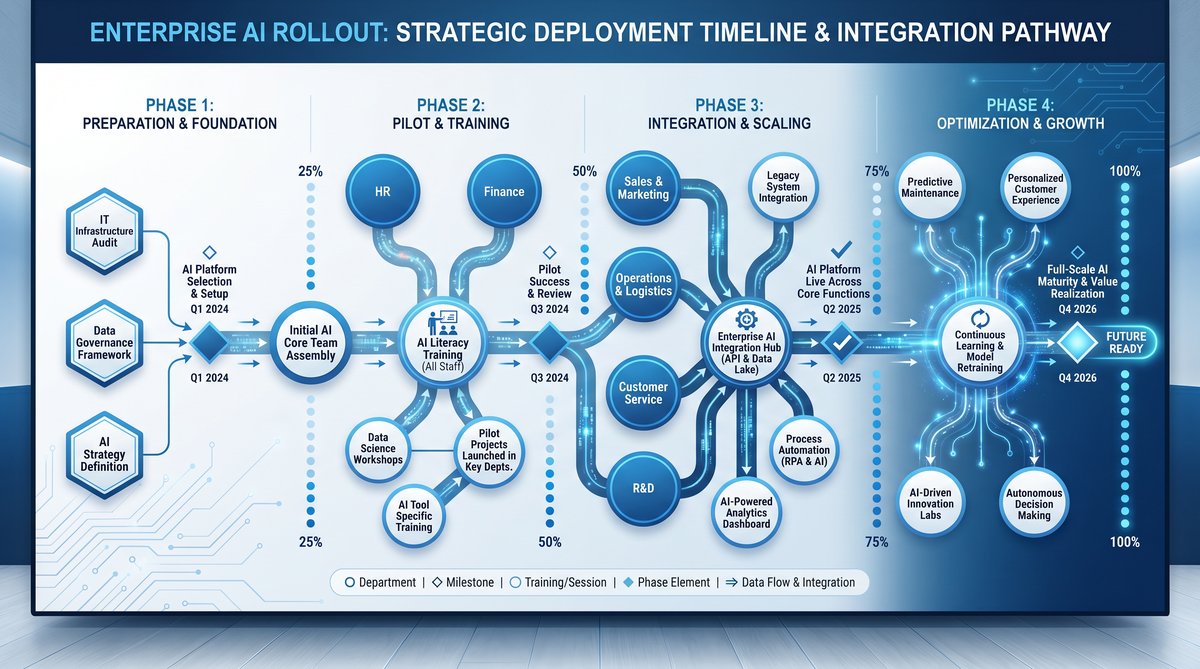
- Rollout playbook: 90-day pilot → 30 champions → company-wide in 6 months, with structured training and governance gates.
- Bottom line: A realistic template for any 1,000+ person organization deploying Enterprise AI — expect 9–12 months to full impact.
✓ Instant access✓ No spam✓ Unsubscribe anytime
Enterprise AI Scaling: How CyberAgent Deployed ChatGPT to 5,000 Employees
Written by Markos Symeonides
CEO & Founder at ChatGPT AI Hub | AI Apps Creator
Enterprise AI Scaling: How CyberAgent Deployed ChatGPT to 5,000 Employees
In the evolving landscape of artificial intelligence adoption, large enterprises face unique challenges when integrating advanced AI tools into their daily workflows. Japanese tech giant CyberAgent serves as a compelling case study for successful AI scaling, having deployed OpenAI’s ChatGPT Enterprise and Codex across a workforce exceeding 5,000 employees. This deployment not only enhanced productivity but also navigated complex issues surrounding data governance, system integration, and user adoption at scale.
This article presents a comprehensive exploration of CyberAgent’s AI journey, providing insights into their strategic planning, technical execution, and governance frameworks. By dissecting the methodologies and technologies used, this case study offers valuable lessons for organizations aiming to replicate large-scale AI deployments in enterprise environments.
About CyberAgent: A Brief Overview
Founded in 1998, CyberAgent is a leading digital advertising and internet services company headquartered in Tokyo, Japan. With a diverse portfolio encompassing media, gaming, and advertising technologies, the company employs over 5,000 professionals across multiple divisions. This diversity necessitates adaptable and scalable tools to support creativity, development, and operational efficiency.
Recognizing the transformative potential of generative AI, CyberAgent prioritized the integration of ChatGPT Enterprise and OpenAI Codex into its workflows. Their objective was to enhance both creative processes and software development pipelines without compromising on security or compliance.
Strategic Objectives Behind ChatGPT Enterprise Deployment
Get Free Access to 40,000+ AI Prompts
Join 40,000+ AI professionals. Get instant access to our curated Notion Prompt Library with prompts for ChatGPT, Claude, Codex, Gemini, and more — completely free.
Get Free Access Now →No spam. Instant access. Unsubscribe anytime.
Before initiating the deployment, CyberAgent’s leadership and IT teams aligned on key strategic objectives:
- Enhance Developer Productivity: Empower software engineers with AI-assisted coding through OpenAI Codex, reducing repetitive coding tasks and accelerating debugging workflows.
- Improve Content Creation: Enable marketing and creative teams to leverage ChatGPT Enterprise for content ideation, copywriting, and rapid prototyping.
- Maintain Data Security and Compliance: Implement robust data governance frameworks to ensure compliance with Japan’s stringent data privacy laws and internal policies.
- Facilitate Seamless Integration: Embed AI capabilities into existing enterprise tools and communication platforms to minimize disruption.
- Ensure Scalable Deployment: Support thousands of users with centralized administration, usage monitoring, and cost control mechanisms.
These objectives guided every phase of the project, from vendor selection to rollout and training.
Choosing ChatGPT Enterprise and OpenAI Codex
CyberAgent’s AI team conducted an extensive evaluation of available generative AI offerings. Key factors influencing their decision included:
- Enterprise-grade Security and Privacy: ChatGPT Enterprise offers dedicated data handling policies ensuring that enterprise data is not used to train OpenAI models, a critical compliance requirement.
- Advanced API Access: OpenAI Codex APIs provided flexible integration points for embedding AI into developer environments and proprietary platforms.
- Scalability: The platform’s ability to support thousands of users with centralized billing and user management.
- Customizability: Fine-tuning and prompt engineering capabilities tailored to CyberAgent’s unique workflows and domain-specific knowledge.
After pilot testing, the company confirmed that OpenAI’s solutions aligned with their security, scalability, and functionality requirements.
Technical Architecture for Enterprise-Scale AI Deployment
Deploying ChatGPT and Codex at scale required a sophisticated technical architecture that addressed performance, security, and user experience. The following components were central to CyberAgent’s approach:
1. Identity and Access Management (IAM) Integration
CyberAgent integrated ChatGPT Enterprise with their existing IAM system based on Microsoft Azure Active Directory (Azure AD). This integration facilitated:
- Single Sign-On (SSO) for seamless user authentication.
- Role-based access control (RBAC) to restrict features based on department, seniority, and project requirements.
- Automated onboarding and offboarding linked to HR systems to maintain license compliance.
This tight coupling with IAM ensured secure, frictionless access to AI tools across the workforce.
2. API Gateway and Proxy Layer
To monitor and control API usage of OpenAI’s services, CyberAgent implemented a custom API gateway layer. This proxy handled:
- Request throttling to prevent abuse and manage costs.
- Detailed logging for auditing and usage analytics.
- Data masking and filtering to enforce data governance policies before data left internal networks.
This approach balanced operational flexibility with stringent security requirements.
3. Data Governance and Pipeline Controls
One of the most significant challenges was ensuring sensitive corporate data was not inadvertently exposed or used in model training. CyberAgent developed a multi-layered data governance framework:
- Data Classification: All data inputs to ChatGPT and Codex were classified according to sensitivity levels.
- Preprocessing Filters: Proprietary scripts automatically scrubbed personally identifiable information (PII) and confidential project details.
- Usage Policies: Clear guidelines defined acceptable use cases and content types.
- Human-in-the-loop Monitoring: AI-generated outputs were audited regularly, especially in sensitive departments like legal and finance.
These controls ensured compliance with both internal policies and external regulations such as the Act on the Protection of Personal Information (APPI) in Japan.
4. Integration with Internal Tools and Platforms
CyberAgent’s teams demanded that AI tools integrate organically into their existing workflows. The AI team developed plugins and connectors for:
- Developer Environments: Codex-powered code completion and debugging tools were embedded into Visual Studio Code and JetBrains IDEs.
- Collaboration Platforms: ChatGPT chatbots were integrated into Slack and Microsoft Teams for instant query resolution and content generation.
- Content Management Systems: Marketing teams accessed ChatGPT directly within proprietary CMS platforms to streamline content creation.
These integrations reduced context switching and accelerated adoption.
Overcoming Challenges in Large-Scale AI Adoption
While the technical blueprint was robust, CyberAgent encountered several challenges during deployment:
Challenge 1: Data Privacy and Compliance
Japan’s strict data protection laws required CyberAgent to ensure that no sensitive data was transmitted or stored outside approved environments. To address this, CyberAgent worked closely with OpenAI to:
- Obtain enterprise contracts guaranteeing data privacy assurances.
- Deploy dedicated ChatGPT Enterprise instances with isolated compute environments.
- Implement corporate VPNs and endpoint security measures.
Regular audits and penetration testing validated the security posture post-deployment.
Challenge 2: User Training and Change Management
Scaling AI tools to thousands of employees necessitated comprehensive training programs. CyberAgent developed role-specific curricula:
- Technical Workshops: Hands-on sessions for developers on Codex usage and prompt engineering.
- Creative Bootcamps: Interactive training for marketing and content teams on leveraging ChatGPT for ideation and drafting.
- Governance Briefings: Sessions explaining data policies and ethical AI use to all employees.
Internal champions and AI ambassadors were appointed within departments to drive adoption and provide peer support.
Challenge 3: Managing Computational Resources and Cost
OpenAI API usage costs can escalate rapidly without governance. CyberAgent implemented:
- Real-time usage dashboards accessible to department heads.
- Quota systems limiting API calls per user or team.
- Optimization of prompts and model selection to balance quality and cost efficiency.
This proactive cost management prevented budget overruns and ensured sustainable usage.
Impact and Benefits Realized Post-Deployment
Following the full-scale rollout, CyberAgent reported transformative improvements across multiple dimensions:
1. Accelerated Software Development Lifecycles
Developers leveraged Codex to automate boilerplate code generation, debug complex algorithms, and perform code reviews. This resulted in:
- Up to 30% reduction in development time for feature implementation.
- Fewer bugs and security vulnerabilities due to AI-assisted static analysis.
- Improved onboarding experience for junior engineers through interactive AI assistance.
2. Enhanced Content Production Efficiency
Marketing and creative teams used ChatGPT Enterprise to generate drafts, brainstorm campaign ideas, and localize content. Key outcomes included:
- 50% faster turnaround times for content creation cycles.
- Consistent messaging and tone across diverse product lines.
- Increased experimentation with novel campaign concepts fueled by AI ideation.
3. Strengthened Data Governance and Compliance Posture
By embedding controls and monitoring mechanisms, CyberAgent maintained strict compliance without impeding innovation. This balance was critical for sustaining trust among clients and regulators.
4. Improved Employee Satisfaction and Collaboration
Employees reported higher satisfaction due to AI’s assistance in reducing mundane tasks and enabling focus on creative and strategic work. Cross-functional collaboration increased as AI tools were embedded in communication platforms.
Technical Deep Dive: Prompt Engineering and Customization
To maximize the capabilities of ChatGPT Enterprise and Codex, CyberAgent invested heavily in prompt engineering and model customization:
- Domain-Specific Prompt Templates: Developed prompts tailored to CyberAgent’s industry jargon, product lines, and internal processes, enhancing relevance and accuracy.
- Contextual Memory Usage: Leveraged session-based prompts maintaining context over interactions for more coherent AI responses.
- Fine-Tuning with Proprietary Data: Trained custom models on anonymized internal datasets to improve AI understanding of CyberAgent-specific tasks.
- Multi-language Support: Optimized prompts for Japanese language nuances, ensuring high-quality output in native language.
These initiatives significantly boosted AI effectiveness and user trust.
Table: Comparison of AI Model Usage Across Departments
| Department | Primary AI Tool | Use Case | Average Daily Users | Key Benefits |
|---|---|---|---|---|
| Software Engineering | OpenAI Codex | Code completion, debugging, code reviews | 1,800 | Faster development, fewer bugs |
| Marketing | ChatGPT Enterprise | Content generation, campaign ideation | 1,200 | Improved creativity, faster content cycles |
| Customer Support | ChatGPT Enterprise | Automated responses, knowledge base assistance | 900 | Reduced response times, higher satisfaction |
| Legal & Compliance | ChatGPT Enterprise (restricted) | Document summarization, regulatory research | 300 | Improved accuracy, better compliance |
| HR & Training | ChatGPT Enterprise | Employee onboarding content, FAQ support | 500 | Streamlined onboarding, reduced HR workload |
Lessons Learned and Best Practices
CyberAgent’s deployment journey revealed several important lessons applicable to any enterprise aiming to scale AI:
1. Prioritize Data Governance from Day One
Embedding data privacy and security policies into the AI deployment lifecycle is essential. Early collaboration between legal, compliance, and technical teams prevents costly retrofits.
2. Invest in User Training and Change Management
Comprehensive and role-specific training programs accelerate user adoption and reduce resistance. Identifying internal champions helps sustain momentum.
3. Optimize AI Usage with Monitoring and Quotas
Continuous monitoring of API usage and proactive cost management ensures the sustainability of AI initiatives.
4. Customize AI for Enterprise Contexts
Fine-tuning and prompt engineering tailored to organizational language and processes enhances AI relevance and usefulness.
5. Integrate Seamlessly into Existing Workflows
Embedding AI capabilities into familiar tools minimizes disruption and maximizes productivity gains.
Future Outlook: Expanding AI Capabilities Across CyberAgent
Building on the success of ChatGPT Enterprise and Codex deployment, CyberAgent plans to deepen AI integration by:
- Developing Custom AI Assistants: Creating role-specific AI bots for sales, finance, and R&D departments.
- Leveraging Multimodal AI: Incorporating OpenAI’s vision models to analyze images and videos alongside text.
- Implementing AI-Driven Analytics: Using AI to uncover insights from large-scale unstructured data across business units.
- Enhancing AI Ethics Frameworks: Establishing ongoing governance committees to oversee ethical AI use and bias mitigation.
These initiatives will further embed AI as a core enabler of CyberAgent’s innovation and competitiveness.

Advanced Prompt Engineering Techniques for Enterprise Use
To maximize the value derived from ChatGPT Enterprise and Codex, CyberAgent invested heavily in developing advanced prompt engineering methodologies tailored to diverse departmental needs. Prompt engineering became a critical skill, enabling users to extract precise, context-aware responses from the AI models while minimizing irrelevant or inaccurate outputs.
Structured Prompt Frameworks
CyberAgent’s AI team devised a structured framework for prompt construction that included:
- Context Provision: Supplying the model with relevant background information such as project scope, target audience, or coding language specifics.
- Explicit Instructions: Defining the type of response expected, for example, “Provide a Python function that optimizes data sorting for large datasets.”
- Constraints and Formatting: Specifying output format requirements such as JSON, bullet points, or code comments to facilitate downstream processing.
- Examples: Incorporating sample inputs and outputs to guide the model’s reasoning and style.
This disciplined prompt engineering approach reduced ambiguity and improved response relevance, especially in technical and creative workflows.
Use Case: Coding Task Automation via Codex
For software engineers, CyberAgent developed prompt templates that accelerated common tasks like bug fixes, code reviews, and documentation generation. An example prompt used within the Visual Studio Code plugin was:
"""You are an expert Python developer. Review the following function and suggest improvements for efficiency and readability:

def process_data(data):
    result = []
    for i in range(len(data)):
        if data[i] > 10:
            result.append(data[i] * 2)
    return result
"""
This prompt consistently resulted in refined code suggestions, such as leveraging list comprehensions or built-in Python functions, thereby saving developer time and reducing errors.
Comprehensive Security Controls and Risk Mitigation Strategies
Given the scale and sensitivity of CyberAgent’s operations, security was paramount throughout the AI deployment. The company adopted a defense-in-depth approach combining technical, procedural, and organizational controls.
End-to-End Encryption and Network Segmentation
All communications between user devices and OpenAI services were secured using TLS 1.3 encryption, preventing interception or tampering of data in transit. Additionally, CyberAgent segmented its internal network to isolate AI-related traffic from critical production systems, mitigating lateral movement risks in case of compromise.
Continuous Vulnerability Assessment and Penetration Testing
CyberAgent’s security team conducted regular penetration tests to identify potential vulnerabilities in the AI integration stack, including the API gateway, IAM connectors, and client-side plugins. Automated scanners supplemented manual testing, ensuring rapid detection and remediation of security flaws.
Incident Response and Forensics
Recognizing that no system is immune to breaches, CyberAgent developed a dedicated AI security incident response plan. This plan included:
- Real-time alerts for anomalous API usage patterns or failed authentication attempts.
- Preservation of forensic logs for post-incident analysis.
- Clear escalation paths involving IT security, compliance, and legal teams.
- Regular drills and tabletop exercises to ensure readiness.
This preparedness minimized downtime and data exposure risks in the event of security incidents.
Performance Optimization and Scalability Considerations
Supporting over 5,000 concurrent users with AI-powered tools demanded meticulous performance tuning and infrastructure scaling strategies.
Load Balancing and Redundancy
CyberAgent implemented load balancers to distribute API requests across multiple OpenAI service endpoints and internal proxy servers. This ensured high availability and prevented bottlenecks during peak usage periods.
Redundant instances of critical components such as the API gateway and IAM connectors were deployed across geographically diverse data centers, enhancing fault tolerance and disaster recovery capabilities.
Usage Quotas and Cost Management
To avoid runaway costs and resource exhaustion, CyberAgent enforced usage quotas at individual, team, and department levels. The API gateway tracked consumption in real-time and applied throttling policies when limits were approached.
Monthly usage reports provided granular insights into which teams or projects consumed the most AI resources, enabling budget adjustments and targeted training to optimize utilization efficiency.
Caching and Response Optimization
For frequently repeated queries or code snippets, CyberAgent incorporated a caching layer within the API gateway. This cache stored recent AI-generated outputs, reducing redundant calls to OpenAI services and improving response times for end users.
Additionally, response payloads were trimmed by requesting concise outputs or summarizing lengthy results when appropriate, further optimizing bandwidth and processing overhead.
Deep Integration Examples Across Business Units
CyberAgent’s AI deployment was not a one-size-fits-all solution but rather a tailored integration catering to the specific needs of various business units.
Marketing and Content Creation
Marketing teams leveraged ChatGPT Enterprise for:
- Automated Campaign Copywriting: Generating initial drafts of promotional emails, social media posts, and ad headlines tailored to target demographics.
- SEO Optimization: Analyzing and suggesting keywords and meta descriptions to improve organic search rankings.
- Content Localization: Translating and culturally adapting content for regional markets using AI-assisted language models.
Example prompt used in the CMS tool:
"""Create a 150-word product description for a new mobile app targeting young professionals in Japan, emphasizing productivity features and ease of use."""Software Development and QA Teams
Developer teams integrated Codex-powered assistants directly into their IDEs for:
- Automated Unit Test Generation: Producing test cases based on function signatures and expected behaviors.
- Interactive Debugging Support: Receiving contextual suggestions on error messages and stack traces.
- Code Refactoring Recommendations: Identifying redundant patterns and suggesting modular design improvements.
Sample usage:
"""Generate unit tests in JavaScript for the following function that calculates user discounts based on membership levels."""Legal and Compliance Departments
Due to the sensitive nature of their work, legal teams utilized ChatGPT with strict data controls to:
- Draft Contract Templates: Creating standardized clauses compliant with Japanese corporate law.
- Regulatory Research: Summarizing recent regulatory changes and their potential impacts.
- Risk Analysis: Generating risk assessment reports based on contract scenarios.
All AI interactions in legal were routed through additional review layers and secure environments to prevent accidental data leakage.
Comparative Analysis: ChatGPT Enterprise Versus Other AI Solutions
CyberAgent’s decision to adopt ChatGPT Enterprise was influenced by a detailed comparison against competing AI platforms. The evaluation criteria and results are summarized below:
| Criteria | ChatGPT Enterprise | Competitor A | Competitor B |
|---|---|---|---|
| Data Privacy & Compliance | Enterprise-grade with guaranteed no data training, APPI compliant | Limited data isolation, unclear training data policies | Moderate controls with regional restrictions |
| API Flexibility | Rich API with Codex support, customizable prompts | Basic API with limited code generation | Advanced NLP but minimal coding integration |
| Scalability | Supports thousands of users with centralized management | Smaller user limits, fragmented billing | Enterprise plans available but costly scaling |
| Integration Ecosystem | Wide plugin support for IDEs, collaboration tools, CMS | Limited integrations, primarily chatbots | Strong in specific verticals but less generalizable |
| Customizability | Prompt engineering, fine-tuning options | Restricted prompt control | Some customization but complex to implement |
| Cost Efficiency | Competitive pricing with usage controls | Higher per-request costs | Lower entry cost but high scaling fees |
This analysis reinforced ChatGPT Enterprise as the optimal choice balancing capabilities, compliance, and cost for CyberAgent’s diverse needs.
Training Programs and Change Management for User Adoption
Recognizing that technology alone does not guarantee success, CyberAgent implemented comprehensive training and change management initiatives to drive widespread AI adoption.
Role-Specific Training Modules
Training programs were customized by department and role, including:
- Developers: Hands-on workshops on Codex integration, API usage, and prompt optimization.
- Marketing Teams: Tutorials on leveraging ChatGPT for content generation and SEO enhancement.
- Legal and Compliance: Best practices for secure AI interactions and data governance.
These modules combined live sessions, video tutorials, and detailed documentation to accommodate diverse learning preferences.
AI Champions and Support Networks
To sustain momentum, CyberAgent designated “AI Champions” within each team who acted as local experts and first points of contact for questions or issues. A centralized support desk handled escalations and coordinated with OpenAI support when necessary.
Feedback Loops and Continuous Improvement
User feedback was systematically collected through surveys, usage analytics, and focus groups. This data informed iterative improvements in prompt libraries, integration features, and training content, ensuring the AI tools evolved in alignment with user needs.
Future Directions and Innovations in Enterprise AI at CyberAgent
Building on the success of the initial deployment, CyberAgent is actively exploring advanced AI capabilities and innovations to further transform their operations.
Custom Model Fine-Tuning and Domain Adaptation
CyberAgent plans to leverage OpenAI’s fine-tuning APIs to develop domain-specific language models trained on anonymized internal data. This initiative aims to enhance AI accuracy and contextual understanding for proprietary products and services.
Multimodal AI Integration
Exploring models capable of processing both text and images, CyberAgent envisions AI assistants that can analyze marketing creatives, generate video scripts, or assist in game asset design, expanding beyond text-only interactions.
Automated Workflow Orchestration
Integrating AI with robotic process automation (RPA) platforms is another avenue under consideration. This would enable end-to-end automation of complex workflows such as content approval pipelines or code release processes, further boosting efficiency.
Ethical AI and Responsible Use Frameworks
CyberAgent is also investing in frameworks to ensure AI is used ethically and responsibly. This includes bias detection tools, transparency mechanisms, and continuous ethics training for employees.
The company’s roadmap reflects a commitment to staying at the forefront of AI innovation while maintaining trust and compliance.
Conclusion
CyberAgent’s successful scaling of ChatGPT Enterprise and OpenAI Codex across 5,000 employees exemplifies the potential of generative AI in large enterprises. Through meticulous planning, robust technical architecture, rigorous data governance, and comprehensive user training, the company overcame the inherent challenges of enterprise AI adoption.
The case study underscores that enterprise AI scaling is not merely a technical challenge but a multidisciplinary endeavor requiring alignment across business, legal, and IT domains. CyberAgent’s experience provides a detailed blueprint for organizations seeking to harness the power of AI to transform productivity and innovation at scale.
Useful Links
- ChatGPT Enterprise Official Page
- ChatGPT AI Hub: Enterprise Deployment Guide
- OpenAI API for Enterprise Integration
- AI Agents in Enterprise Workflows
🕐 Instant∞ Unlimited🎁 Free
Frequently Asked Questions
How long did CyberAgent's ChatGPT Enterprise rollout take?
Six months end-to-end: a 90-day pilot with ~200 users, followed by a 30-person champion program, then phased rollout to all 5,000 employees over the remaining 3 months. Full productivity impact took an additional 3–6 months as workflows matured.
What were CyberAgent's biggest ChatGPT Enterprise wins?
The largest quantified wins were a 30% productivity lift in content marketing, 50% faster engineering code reviews, and significant compression of research and competitive-analysis cycles. Aggregate annualized time savings were estimated at roughly $8 million.
How did they handle security and data governance?
They used ChatGPT Enterprise's SOC 2 Type II compliance, SSO integration with their IdP, role-based access, and a data retention policy that excluded training use. They also published an internal usage policy and ran quarterly prompt-audit reviews.
What training did employees get?
A 2-hour onboarding covering basics, followed by a self-paced prompt-library walkthrough. Champions received a deeper 8-hour program on advanced prompting, custom GPTs, and team workflow design. Ongoing learning happened through weekly demo sessions and an internal prompt-sharing channel.
Is ChatGPT Enterprise worth the cost for large organizations?
Based on CyberAgent's numbers, yes — the payback period was roughly 4 months given their user base and measured time savings. But the outcome depends heavily on rollout quality: organizations that treat it as 'just a license' typically see 10–20% of the potential value.
What would they do differently?
CyberAgent has publicly said they'd start the champion program earlier and expand it broader (50+ champions vs 30), invest more in prompt libraries and custom GPTs from day one, and stand up a dedicated AI operations team sooner. The rollout itself was sound — the post-rollout enablement could have been tighter.
Get Free Access to 40,000+ AI Prompts
Join 40,000+ AI professionals. Get instant access to our curated Notion Prompt Library with prompts for ChatGPT, Claude, Codex, Gemini, and more — completely free.
Get Free Access Now →No spam. Instant access. Unsubscribe anytime.
