
Published: 2026 | Category: AI Industry News | Reading Time: ~18 minutes
The Empire Strikes Back—But Is It Too Late?
In November 2022, when OpenAI released ChatGPT to the public, it ignited an AI revolution that reshaped industries, rewrote boardroom priorities, and minted one of the most valuable private companies in history. For nearly two years, OpenAI stood essentially unchallenged at the frontier of artificial intelligence. GPT-4 was the benchmark every competitor chased, and ChatGPT was the product that defined what AI could do for everyday users and enterprise customers alike.
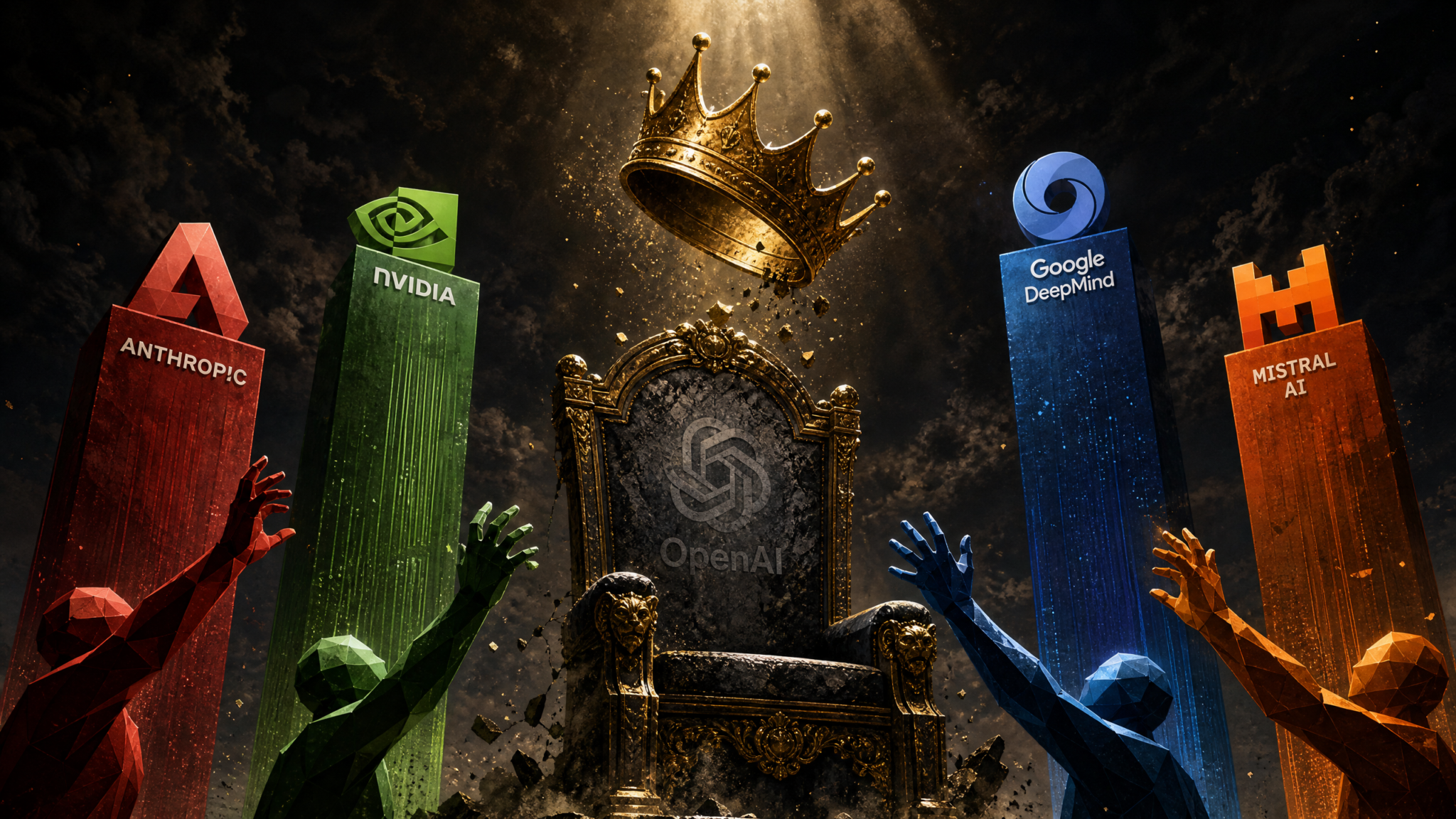
But 2026 is a very different story. A detailed investigation published by The Wall Street Journal laid bare what many insiders had been whispering for months: OpenAI is no longer the unambiguous leader in AI, and the gap between it and its closest rivals has narrowed to a whisker—or in some categories, has already flipped. Google, Anthropic, Meta, and a sprawling ecosystem of open-source developers are not just catching up; they are, in specific benchmarks and use cases, pulling ahead.
This is not merely a story about technology. It is a story about strategy, corporate culture, talent attrition, capital allocation, and the extraordinary difficulty of sustaining first-mover advantage in the fastest-moving technology sector in human history. It is also an urgent guide for developers, CTOs, product managers, and business leaders who must make consequential decisions right now about which AI platforms to build on.
This article examines the structural forces eroding OpenAI’s position, the specific competitive threats from each major challenger, the hard data on market share and model performance, and OpenAI’s multi-pronged response. Most importantly, it offers a frank, evidence-based assessment of whether the company that started this revolution can win back the crown it may be losing.
How OpenAI Rose to Dominance—and Began to Slip
OpenAI’s dominance was never guaranteed; it was earned through a combination of bold research bets, a unique partnership with Microsoft, and a product philosophy that prioritized accessibility over purity. When GPT-3 launched in 2020, it was a research artifact. ChatGPT transformed that artifact into a consumer product and, within five days, it had a million users. Within two months, it had 100 million—the fastest-growing consumer application in history at that point.
By early 2023, OpenAI had secured a reported $10 billion investment from Microsoft, locked in API integrations across thousands of enterprise applications, and launched GPT-4, which posted state-of-the-art scores across medical licensing exams, legal bar exams, coding benchmarks, and reasoning tasks. The narrative was intoxicating: OpenAI was not just building AI tools, it was building artificial general intelligence, and it had a head start nobody could close.
The cracks, however, were already forming. The November 2023 boardroom drama—in which CEO Sam Altman was briefly fired before being reinstated after a staff revolt—exposed a governance structure that was, at best, idiosyncratic, and at worst, dangerously unstable for an enterprise-class technology provider. Dozens of senior researchers departed in 2023 and 2024, including co-founders Ilya Sutskever and others who went on to start competing ventures. Each departure took with it not just talent but institutional knowledge, research direction, and, in some cases, key relationships with enterprise customers.
Simultaneously, the competition that OpenAI had dismissed as years behind began shipping products that were, at minimum, competitive with GPT-4—and in some domains, demonstrably superior. Google, embarrassed by an early stumble with Bard, mounted a systematic and well-resourced recovery. Anthropic, founded largely by former OpenAI researchers, built an enterprise-grade safety-first model that resonated powerfully with regulated industries. Meta made the audacious decision to open-source its frontier models, fundamentally altering the economics of AI deployment for anyone willing to run their own infrastructure.
“The advantage OpenAI had in 2022 was a head start measured in months, not years. In AI, months can feel like decades—until they don’t.”
— Senior ML Engineer at a Fortune 500 company, speaking anonymously
By 2025, the evidence of competitive pressure was impossible to ignore. Enterprise customers began issuing dual-vendor RFPs, explicitly comparing OpenAI’s GPT-4o with Claude 3.5 and Gemini 1.5 Pro. Developer surveys showed a sharp increase in teams running multi-model architectures, hedging their bets rather than committing exclusively to OpenAI’s API. And on several key benchmarks—particularly long-context reasoning, multimodal understanding, and coding assistance—OpenAI’s models were no longer consistently on top.
The Four Forces Dismantling OpenAI’s Monopoly
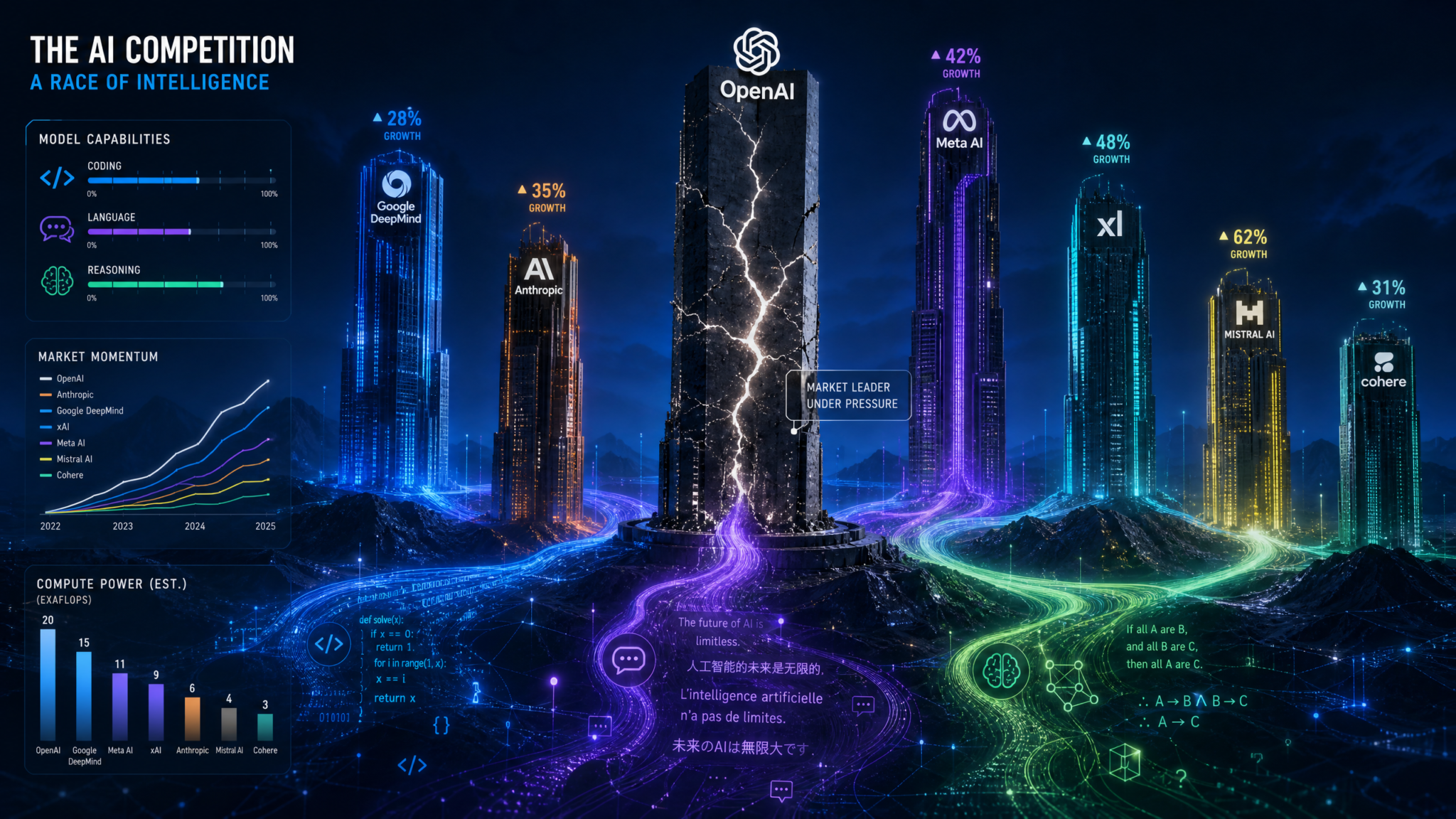
Understanding why OpenAI’s lead has eroded requires examining each major competitive force individually. Each competitor brings a distinct strategic philosophy, a different resource base, and a different vision of what AI should be. Together, they constitute an unprecedented multi-front assault on a single company’s market position.
Google’s Gemini 3.x: The Search Giant Fights Back
Google’s entry into the large language model race was, by the company’s own admission, messier than it should have been. Bard was widely mocked for factual errors in its launch demo, and early versions of Gemini struggled to match GPT-4 on standardized benchmarks. But dismissing Google as a serious competitor was always a mistake, and 2025–2026 has proven why.
Gemini 3.x, released in late 2025, represents a qualitative leap that has caught many analysts off guard. The model benefits from Google’s unrivaled data infrastructure—including Search, YouTube, Gmail, Maps, and a decade of work on Transformer architectures that Google itself invented. Gemini 3.x posts state-of-the-art or near-state-of-the-art results on MMLU, HumanEval, and MATH benchmarks, and its native multimodal capability—processing and generating text, images, audio, and video within a single architecture—sets a new bar for integrated AI systems.
Critically, Google has also solved a distribution problem that no other competitor can match. Gemini is integrated directly into Google Search, Gmail, Google Docs, Google Cloud, and Android—giving it a potential addressable user base measured in billions, not millions. When a product is woven into the daily workflows of 3 billion people, the barrier to trial is essentially zero. OpenAI, by contrast, must convince users and businesses to actively adopt a new tool. Google simply has to make an existing tool better.
For developers building on Google Cloud, the economics are also compelling. Gemini models accessed through Vertex AI come with deeply integrated MLOps tooling, enterprise SLAs, and the prospect of long-term pricing stability backed by a company generating over $80 billion in annual free cash flow. This financial bedrock matters enormously when enterprises are making multi-year platform commitments.
Developers evaluating AI infrastructure for large-scale applications should understand how Google’s model-serving architecture compares to alternatives. Google Gemini API vs OpenAI API for Enterprise Developers provides a detailed technical breakdown of latency profiles, pricing structures, context window limits, and integration patterns that are essential for making an informed platform decision.
Anthropic’s Claude 4.x: Safety Meets Capability
Anthropic was founded in 2021 by Dario Amodei, Daniela Amodei, and several other former OpenAI researchers who believed that the race to capability needed to be matched by an equally serious commitment to safety. For the first year or two, this positioning was sometimes dismissed as a marketing differentiator more than a technical reality. Claude 4.x has put that dismissal to rest.
Released in stages throughout 2025 and 2026, Claude 4.x models—particularly Claude 4 Opus and Claude 4 Sonnet—have posted benchmark results that are genuinely competitive with GPT-4o and Gemini 3.x across a wide range of tasks. More significantly, Claude 4.x has established a clear lead in specific categories that matter enormously for enterprise adoption: instruction following, reduction of harmful outputs, consistency in long-context tasks (Claude now supports a 200K token context window), and what Anthropic calls “constitutional AI” behavior—a measurable tendency to decline harmful requests while maintaining usefulness.
In regulated industries—healthcare, legal, financial services, and government contracting—these properties are not nice-to-haves; they are procurement requirements. HIPAA-compliant deployments, SOC 2 certified environments, and FedRAMP authorization are table stakes for selling AI to large healthcare systems, law firms, and defense contractors. Anthropic has invested heavily in these certifications and has built a partnership network, including a major investment from Amazon Web Services, that gives it enterprise credibility and distribution muscle to match its technical strengths.
Claude’s coding capability deserves particular attention. Anthropic’s models have shown remarkable performance on SWE-bench, a rigorous evaluation of an AI’s ability to resolve real GitHub issues in production codebases. Claude 4 Sonnet, in particular, has become a preferred model for agentic coding tools—systems that can autonomously navigate, edit, and debug multi-file codebases with limited human supervision. This is the category that OpenAI has identified as existential and is scrambling to address.
Meta’s Llama: Open Source as a Strategic Weapon
Of all the competitive threats facing OpenAI, Meta’s Llama strategy may be the most structurally disruptive. Not because Llama models are necessarily the best on every benchmark—though Llama 4 is remarkably capable for its size—but because Meta’s decision to release its weights openly has fundamentally altered the AI market’s economics in a way that systematically disadvantages API-dependent business models like OpenAI’s.
Meta’s reasoning is sophisticated and worth understanding carefully. As Mark Zuckerberg has articulated repeatedly, Meta does not need to monetize AI models as a standalone product. Meta’s business model is built on advertising, which is powered by data and user engagement. If open-source AI models commoditize the foundation model layer, the companies that are hurt most are those whose primary revenue comes from charging for model access—namely OpenAI. Meta, by contrast, benefits from a healthy open-source AI ecosystem that keeps its own costs low while ensuring no single competitor can lock up the frontier model layer as a proprietary moat.
Llama 4, released in early 2026, comes in variants ranging from 8B to 405B parameters and can be fine-tuned on proprietary data, deployed on private infrastructure, and integrated into products without per-token API charges. For startups, mid-market companies, and cost-sensitive enterprise deployments, the total cost of ownership calculus has shifted dramatically. A team that can deploy a fine-tuned Llama 4 70B model on dedicated GPU instances may achieve 80–90% of GPT-4o’s capability at 20–30% of the per-query cost—a trade-off that is very attractive for high-volume applications.
Understanding how to effectively fine-tune and deploy open-source models has become a critical skill for AI engineers in 2026. Fine-Tuning Llama 4 for Production Applications: A Complete Guide walks through the full pipeline, from dataset preparation and LoRA fine-tuning to quantization, inference optimization, and production deployment on major cloud providers.
The Broader Open-Source Movement
Beyond Meta’s Llama, the open-source AI ecosystem has produced a proliferating ecosystem of capable models that are eating OpenAI’s market from below. Mistral AI, the Paris-based startup, has released a series of models—including Mistral Large 2 and the Mixture-of-Experts Mixtral architecture—that punch far above their weight class. Mistral 7B outperforms many models twice its size and can run comfortably on consumer-grade hardware. DeepSeek, a Chinese AI lab, released models in late 2024 and early 2025 that briefly topped several benchmarks and sparked genuine alarm among Silicon Valley observers.
The cumulative effect of this ecosystem is a marketplace where “good enough” AI is freely available, and “excellent” AI is available at dramatically lower cost than OpenAI’s premium tier. For many use cases—content summarization, classification, simple question answering, data extraction, basic code generation—an open-source model running on owned infrastructure is genuinely sufficient. OpenAI is thus being squeezed from both ends: by frontier competitors matching or exceeding it at the top, and by open-source models commoditizing the middle and bottom of the market.
OpenAI’s Response: New Models, New Leadership, Restructured Strategy
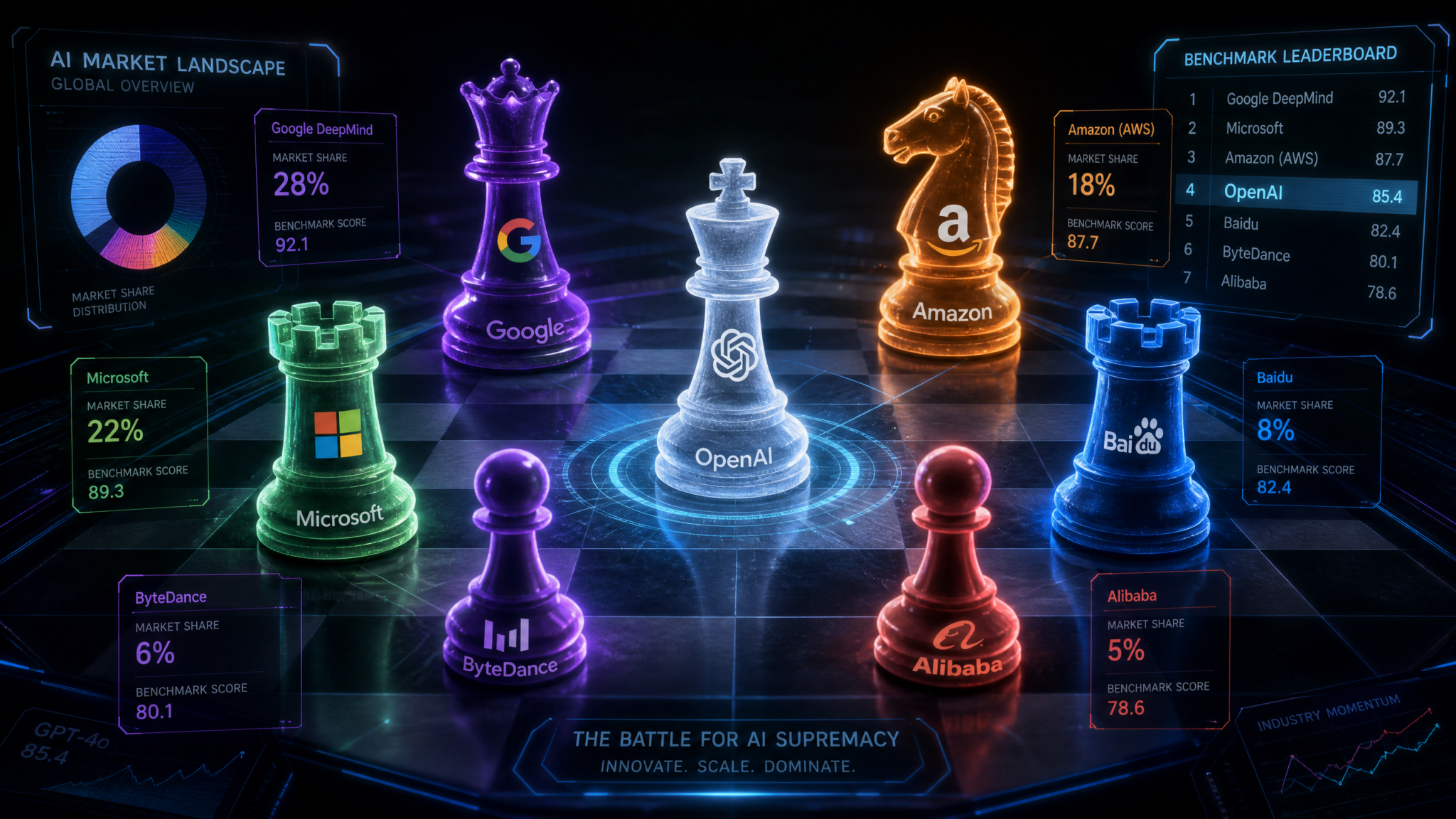
OpenAI is not passive in the face of these competitive pressures. The company has mounted a multi-dimensional response that touches its product roadmap, organizational structure, and corporate governance. Whether these moves will be sufficient—or whether they will prove to be too little, too late—is the central question facing the AI industry in 2026.
The Coding Model Push
The most visible element of OpenAI’s competitive response is an aggressive push into AI-assisted software development. The company correctly identified coding as the highest-value, highest-growth segment of the enterprise AI market—and one where it was at risk of being eclipsed by both Anthropic’s Claude and a wave of open-source competitors.
OpenAI’s strategy has several components. First, the company has released specialized coding-optimized variants of its frontier models, including o3 and the o-series reasoning models, which show particular strength on programming tasks requiring multi-step logical reasoning. Second, OpenAI has deepened its integration with GitHub Copilot—the AI coding assistant backed by Microsoft that processes hundreds of millions of coding suggestions daily—ensuring that GPT-4o and its successors power one of the most widely adopted AI products in developer workflows.
Third, and most ambitiously, OpenAI has begun investing in “agentic” coding capabilities—AI systems that can not only suggest code completions but autonomously execute multi-step programming tasks: writing tests, refactoring modules, debugging errors, and even deploying changes. This is the category that OpenAI’s leadership has described internally as representing the next major inflection point in AI utility, and the company’s Operator and Agent frameworks are designed to capture this opportunity.
The competitive picture in AI coding assistants is fierce and fast-moving. Best AI Coding Assistants Compared: GitHub Copilot, Cursor, Claude Code, and Gemini Code Assist provides a comprehensive evaluation of the leading tools, including benchmark performance on real-world coding tasks, IDE integration quality, pricing, and the specific use cases where each tool shows its strongest performance.
However, OpenAI faces a genuine challenge in the coding space: the feedback loop between coding AI quality and developer adoption is extremely tight. Developers switch tools quickly when they find something better, and they are vocal about their preferences in communities like Hacker News, Reddit’s r/MachineLearning, and X (formerly Twitter). The fact that Claude 4 Sonnet and several open-source code-specialized models have developed strong followings among professional developers suggests that OpenAI’s coding push, while necessary, will not be sufficient on its own.
Leadership Restructuring and Corporate Governance
The governance crisis of November 2023 left a residue of uncertainty about OpenAI’s organizational stability that took over a year to fully address. By 2025, Sam Altman had consolidated his position as CEO more firmly than before, but the process involved significant changes to the board composition, the nonprofit structure, and the relationship between OpenAI’s commercial arm and its original safety-focused mission.
Most significantly, OpenAI announced plans to restructure from a “capped-profit” limited partnership into a public benefit corporation—a for-profit entity that nonetheless carries explicit public interest obligations. This restructuring was designed partly to resolve internal governance tensions, partly to satisfy investor demands for a more conventional equity structure ahead of a potential public offering, and partly to address regulatory scrutiny from state attorneys general concerned about whether the conversion was consistent with the nonprofit’s charitable mission.
The departure of key safety-focused figures—including Ilya Sutskever, who left to found Safe Superintelligence Inc., and several members of the superalignment team—raised pointed questions about whether OpenAI’s commercial pressures were crowding out its original safety commitments. OpenAI has pushed back vigorously on this characterization, pointing to continued investment in interpretability research and the formation of a new safety and security committee with board-level oversight.
For enterprise customers, the governance question is not merely philosophical; it is a vendor risk consideration. A company with a stable, predictable governance structure and a clear safety track record is a more trustworthy long-term partner than one that appears to be navigating existential internal conflicts. Anthropic has leveraged this concern masterfully, positioning its governance structure—featuring a Long-Term Benefit Trust and a culture that foregrounds safety—as a feature rather than a constraint.
The Delayed IPO and What It Signals
OpenAI’s path to a public offering has been repeatedly delayed, and each delay carries both financial and narrative implications. The company raised $6.6 billion at a $157 billion valuation in October 2024—a staggering number that made OpenAI the most valuable private company in the United States at the time. But the funding round came with unusual terms: some investors were reportedly offered the ability to renegotiate terms if OpenAI had not completed its corporate restructuring within a defined timeframe.
The IPO delay matters for several reasons. First, it limits OpenAI’s ability to use public market equity as a currency for acquisitions and talent retention. Competitors like Google and Meta can offer their employees liquid public stock; OpenAI must rely on paper equity in a private company, and the novelty of that proposition has worn thinner as the IPO timeline extends. Second, an IPO would impose public disclosure obligations that would make OpenAI’s financial performance, customer concentration, and competitive positioning far more transparent—information that could be powerful for competitors and uncomfortable for a company whose revenue growth trajectory may be under pressure.
Third, the delay signals—or is perceived to signal—that OpenAI is not yet confident it can meet the revenue growth and margin targets that would justify its valuation in public markets. For a company valued at $157 billion based primarily on its perceived leadership in the most important technology of the decade, any perception that the competitive moat is narrowing is deeply consequential.
Head-to-Head: Comparing the Top AI Models in 2026
Beyond strategic narratives and market share estimates, the most concrete way to assess the competitive landscape is to examine actual model performance across the dimensions that matter most to developers and enterprise buyers. The following comparison covers the leading models as of early 2026.
| Metric | GPT-4o (OpenAI) | Gemini 3.0 Ultra (Google) | Claude 4 Opus (Anthropic) | Llama 4 405B (Meta) |
|---|---|---|---|---|
| MMLU (Knowledge) | 88.7% | 90.1% | 89.4% | 85.2% |
| HumanEval (Coding) | 90.2% | 88.9% | 92.1% | 84.7% |
| MATH Benchmark | 76.6% | 79.4% | 73.8% | 69.1% |
| Context Window | 128K tokens | 1M tokens | 200K tokens | 128K tokens |
| SWE-bench (Real Bugs) | 46.1% | 44.8% | 49.2% | 38.3% |
| Multimodal Native | Yes | Yes (best-in-class) | Yes | Yes |
| API Cost (per 1M input tokens) | $5.00 | $3.50 | $15.00 (Opus) | Self-hosted variable |
| Enterprise Compliance | SOC 2, HIPAA | SOC 2, HIPAA, FedRAMP | SOC 2, HIPAA | Self-managed |
Several observations from this data are worth highlighting. First, there is no single “best” model across all dimensions—a fact that strongly supports multi-model architectures. Google’s Gemini 3.0 Ultra leads on knowledge and mathematics benchmarks and offers by far the largest context window. Claude 4 Opus leads on coding benchmarks, particularly the practically significant SWE-bench evaluation. GPT-4o offers a strong balance across all categories with competitive pricing at the frontier tier.
Access 40,000+ AI Prompts for ChatGPT, Claude & Codex — Free!
Subscribe to get instant access to our complete Notion Prompt Library — the largest curated collection of prompts for ChatGPT, Claude, OpenAI Codex, and other leading AI models. Optimized for real-world workflows across coding, research, content creation, and business.
Second, the pricing dynamics have become interesting and strategically important. Anthropic’s Claude 4 Opus is the most expensive at $15 per million input tokens, positioning it explicitly as a premium product for high-stakes enterprise use cases. Google’s pricing is the most aggressive among the closed models, reflecting its desire to gain market share using the financial leverage of its overall business. OpenAI sits in the middle—neither the cheapest nor the most capable in every category, a precarious position for a company that needs to justify a $157 billion valuation.
Third, Llama 4’s competitive positioning at the open-source tier is genuinely remarkable. At 405 billion parameters, it approaches the capability of the leading closed models at a cost that depends entirely on infrastructure—and for large-volume deployments, self-hosting can reduce per-query costs by 60–80% compared to OpenAI’s API prices. This is a force that is restructuring the economics of AI deployment from the ground up.
For teams building prompt engineering workflows and multi-model pipelines, understanding how to structure inputs to maximize performance across these different model architectures is increasingly important. Advanced Prompt Engineering Techniques for GPT-4o, Claude, and Gemini covers chain-of-thought structuring, few-shot examples, system prompt design, and model-specific optimization patterns that translate directly into better outputs and lower costs.
Strategic Implications for Developers and Businesses Choosing AI Providers
The competitive dynamics described above have immediate, practical implications for anyone making decisions about AI infrastructure in 2026. The era of defaulting to OpenAI because “it’s the best” is over—not because OpenAI’s models are bad (they are not), but because the assumption of clear, durable superiority is no longer warranted. Here is a framework for thinking through provider selection in the current landscape.
Principle 1: Design for Portability from Day One
The single most important architectural decision you can make right now is to build AI-dependent applications with model portability as a first-class concern. This means abstracting model calls behind a standardized interface layer, using prompt structures that do not rely on provider-specific behaviors, and maintaining evaluation datasets that allow you to benchmark alternative models against your production workload at any time.
The practical implementation involves using abstraction frameworks like LangChain, LlamaIndex, or OpenRouter, which provide unified API interfaces that can route queries to multiple providers with minimal code changes. It also means investing in evals—structured test suites that capture the quality dimensions that matter for your specific use case—so that model switching is an informed, measured decision rather than a gamble.
Principle 2: Match the Model to the Task
The performance data makes clear that different models lead in different categories. A rational AI infrastructure strategy in 2026 routes tasks to the model best suited for them, rather than processing everything through a single “good enough” provider.
- Complex coding and software engineering tasks: Claude 4 Sonnet or Opus, or specialized code models like DeepSeek Coder V3, based on SWE-bench performance.
- Long-document analysis and summarization: Gemini 3.0’s 1M token context window is a genuine differentiator for tasks involving large codebases, legal documents, or research corpora.
- Math and quantitative reasoning: Gemini 3.0 Ultra and OpenAI’s o3/o4 reasoning series show strongest performance on structured mathematical and scientific reasoning tasks.
- General-purpose Q&A, content generation, and instruction following: GPT-4o, Claude 4 Sonnet, and Gemini 3.0 Pro are all highly competitive; cost and integration ecosystem should drive the decision.
- High-volume, cost-sensitive deployments: Llama 4 fine-tuned on domain-specific data, or Mistral models for even smaller footprints, can deliver significant cost savings with minimal quality degradation for well-scoped tasks.
Principle 3: Evaluate Total Cost of Ownership, Not Just API Pricing
The sticker price of API calls is only one component of the total cost of deploying AI in production. Integration complexity, fine-tuning capabilities, observability tooling, SLA guarantees, compliance certifications, vendor support quality, and the hidden cost of prompt engineering for a specific model all factor into the true economics. A model that is 20% cheaper per token but requires twice the prompt engineering investment to achieve equivalent output quality may actually be more expensive in total when engineering time is valued accurately.
Principle 4: Enterprise Compliance Is Non-Negotiable in Regulated Industries
For healthcare, financial services, legal, and government deployments, the compliance posture of your AI vendor is a hard constraint, not a soft preference. As of early 2026, Google Cloud’s Vertex AI offers the most comprehensive compliance certification portfolio, including FedRAMP High authorization that makes it accessible for U.S. federal government workloads. Anthropic’s compliance roadmap has been aggressive and is now broadly comparable to OpenAI’s for HIPAA and SOC 2. For companies that must maintain data residency in specific geographies, all three major providers now offer region-specific deployment options, but the specifics vary and require careful verification.
Principle 5: Monitor the Open-Source Trajectory
The gap between the best open-source models and the best closed models continues to narrow with every quarterly release cycle. Teams that are not actively evaluating Llama 4, Mistral, and other open-source frontier models against their workloads risk being caught flat-footed as the economics of open-source deployment become increasingly compelling. The right time to build the operational capability to deploy and maintain self-hosted models is before you urgently need it, not after.
For organizations building AI-powered products and services at scale, a coherent multi-model strategy is now a competitive necessity rather than a theoretical ideal. Building Multi-Model AI Architectures: Routing, Evaluation, and Cost Optimization explores the technical patterns and tooling ecosystem for implementing intelligent model routing, automated quality evaluation, and cost management across heterogeneous AI provider configurations.
Can OpenAI Win Back the Crown? A Realistic Analysis
The question of whether OpenAI can recover its dominant position is one of the most consequential strategic questions in technology today. Answering it requires separating signal from noise, distinguishing structural disadvantages from temporary setbacks, and being honest about both the company’s genuine strengths and the real challenges it faces.
The Case for OpenAI’s Recovery
OpenAI retains several structural advantages that should not be underestimated. The first is brand recognition that is extraordinary even by the standards of major technology companies. “ChatGPT” has become a generic verb in many languages and contexts in the way that “Google” became synonymous with internet search. This brand equity translates into default product adoption among consumers and serves as a powerful starting point for enterprise sales conversations.
The second advantage is the Microsoft relationship. Microsoft has invested over $13 billion in OpenAI and has woven GPT models deeply into its most widely used enterprise products: Office 365 (via Microsoft 365 Copilot), Azure (via Azure OpenAI Service), GitHub (via GitHub Copilot), Bing (via Bing Chat), and Teams. The combined installed base of these products represents hundreds of millions of enterprise users worldwide. This distribution advantage is not easily replicated, and it provides OpenAI with a revenue and adoption floor that gives it time to address competitive gaps.
The third advantage is research talent and culture. Despite significant departures, OpenAI retains a concentration of world-class AI researchers who produced some of the field’s most important papers and techniques. The company’s investment in compute infrastructure—including its reported plans for a data center network spending hundreds of billions of dollars over the next several years—gives it the raw resources to attempt capability leaps that smaller, less-capitalized competitors cannot match.
The fourth advantage is the o-series reasoning models. OpenAI’s o1, o3, and subsequent reasoning-focused models represent a genuine architectural innovation: systems that engage in extended internal chain-of-thought reasoning before producing output. This approach has demonstrated exceptional performance on mathematics olympiad problems, scientific reasoning tasks, and complex multi-step problems that trip up standard next-token prediction models. If OpenAI can translate this research advantage into consumer and enterprise products that demonstrably outperform alternatives on high-value tasks, it has a viable path to regaining technical leadership.
The Case Against Full Recovery
However, several structural factors make a full return to OpenAI’s 2022–2023 dominance unlikely.
The fundamental problem is that the AI market has matured beyond the point where a single company can sustain the kind of insurmountable lead that OpenAI once enjoyed. The training techniques, architectural insights, and scaling laws that produced GPT-4 are now widely understood and replicated. The massive increase in available compute, training data, and ML engineering talent globally means that the barriers to building frontier models—while still substantial—are not prohibitive for well-capitalized organizations.
Google’s structural advantage in data and distribution is, in the long run, probably more durable than any model architecture advantage that OpenAI can maintain. Google not only has more data than any other organization on earth; it has uniquely valuable, continuously refreshed data across Search, YouTube, Gmail, Maps, and the broader product ecosystem. This data advantage compounds over time, and it is not something that OpenAI—or any other competitor—can replicate by spending money.
The talent attrition issue deserves more attention than it typically receives. Beyond the high-profile departures of co-founders and safety researchers, OpenAI has faced a steady exodus of engineering and research talent to well-funded competitors and new ventures. The brain drain is not existential—OpenAI remains one of the most sought-after employers for top ML talent—but it has modestly eroded the concentration of expertise that generated OpenAI’s early breakthrough performance. In a field where the gap between the best researchers and average researchers is enormous, even modest talent distribution matters at the frontier.
Finally, the delayed IPO creates a compounding challenge. Every quarter that the IPO is deferred is a quarter in which OpenAI cannot use liquid public equity for acquisitions, cannot provide public market liquidity for employees deciding between OpenAI and public companies, and cannot test its financial narrative against the rigors of public market scrutiny. The longer this continues, the more the perception grows that OpenAI’s valuation is an artifact of private market exuberance rather than a reflection of durable competitive advantage.
The Most Likely Outcome
The most realistic scenario is neither OpenAI’s complete recovery nor its collapse. It is a structurally competitive market in which OpenAI retains a large and commercially important position—perhaps 35–45% of the enterprise API market and 40–50% of the consumer AI assistant market by 2027—while Google, Anthropic, and open-source alternatives collectively account for the majority of new growth and continued market share erosion.
In this scenario, OpenAI remains a dominant player and a highly valuable company. But it is no longer the category-defining monopolist it briefly appeared to be. The AI market, like the cloud market before it, will likely support three to four major commercial players plus a robust open-source ecosystem—a healthy, competitive structure that is ultimately better for users, developers, and the broader economy than any single company’s dominance would be.
For developers building AI-powered products, understanding which OpenAI models remain best-in-class for which specific tasks is essential for making informed technology decisions. OpenAI GPT-4o vs o3 vs o4-mini: Which Model Should You Use in 2026? breaks down the practical differences between OpenAI’s current model lineup, including cost-performance trade-offs, reasoning depth, latency characteristics, and the specific task categories where each variant excels.
Conclusion: The Age of AI Monopoly Is Over
The WSJ’s characterization of OpenAI “losing its AI crown” is not hyperbole. The empirical evidence—benchmark performance data, market share estimates, developer survey results, enterprise adoption patterns, and the strategic positioning of competitors—confirms that OpenAI’s period of uncontested leadership in artificial intelligence has ended. The question is no longer whether competition will constrain OpenAI; it already has. The question now is what kind of competitor OpenAI will be in a genuinely multi-polar AI market, and how developers and businesses should respond.
The answers to those questions are actually more interesting—and more empowering—than the period of OpenAI’s monopoly was. When one company controls a foundational technology, it can set prices, dictate capabilities, and make architectural decisions without meaningful market feedback. When four or five sophisticated competitors are driving the market forward simultaneously, the pace of innovation accelerates, prices decline, capabilities improve faster, and the ecosystem that grows around the technology becomes richer and more diverse.
We are now in that second phase of AI development. Google’s Gemini 3.x has raised the bar on long-context reasoning and multimodal capability. Anthropic’s Claude 4.x has demonstrated that safety-first design and frontier capability are not mutually exclusive. Meta’s Llama has proven that open-source models can be genuinely competitive with the best closed alternatives and has permanently altered the economic calculus of AI deployment. And the broader open-source ecosystem is producing capable, specialized models that address specific use cases more effectively than any general-purpose frontier model can.
OpenAI’s response—specialized coding models, organizational restructuring, a revamped governance structure, and massive infrastructure investment—shows a company that understands the gravity of its situation and is fighting to maintain its position. Whether it succeeds will depend on execution quality, the outcome of its IPO process, and its ability to retain and attract the talent that will determine AI capabilities at the frontier over the next three to five years.
For everyone else—the millions of developers building on these APIs, the thousands of enterprises making platform decisions, and the billions of users whose daily digital experience is increasingly shaped by AI—the competitive pressure is entirely good news. More competition means better models, lower prices, more choices, and a healthier long-term ecosystem. The age of AI monopoly is over, and the age of AI competition has begun. That is a development worth welcoming.
As you evaluate your own AI strategy in this rapidly shifting landscape, staying current with both model capabilities and provider dynamics is more important than it has ever been. The decisions made today about which platforms to build on, which models to deploy, and which architectural patterns to adopt will shape competitive advantage for years. The companies and development teams that approach these decisions with rigor, flexibility, and a willingness to continuously re-evaluate will be the ones best positioned to capture the extraordinary value that AI is creating—regardless of which company is wearing the crown.
