
The Complete Google AI Stack 2026: 50+ Tools, Cloud Next Keynote Breakdown, and How They Compare to OpenAI, Anthropic & Microsoft
As we step further into the AI-driven era, Google continues to set the pace with groundbreaking innovations designed to empower enterprises worldwide. The recent Google Cloud Next ’26 conference unveiled a sweeping update to the Google AI stack, marking a pivotal moment in the evolution of AI-enabled enterprise solutions. From the launch of the Gemini Enterprise Agent Platform to the introduction of next-generation TPU v8 hardware and strategic security partnerships, Google is redefining how organizations develop, deploy, and secure AI-powered workflows at scale.
✓ Instant access✓ No spam✓ Unsubscribe anytime
This article provides an authoritative, in-depth examination of the Google AI stack updates announced at Cloud Next ’26. We will explore the new Gemini AI model series, the transformative Enterprise Agent Platform, advanced TPU infrastructure, the innovative Agentic Data Cloud, the strategic alliance with Wiz for enhanced security, and the integration of Workspace Intelligence. Additionally, we provide benchmark data comparing Gemini 3.1 Pro against key industry competitors, delivering insights for developers and tech professionals seeking to harness Google’s latest AI capabilities.
1. Gemini 3.1 Pro and the Next Generation of AI Models
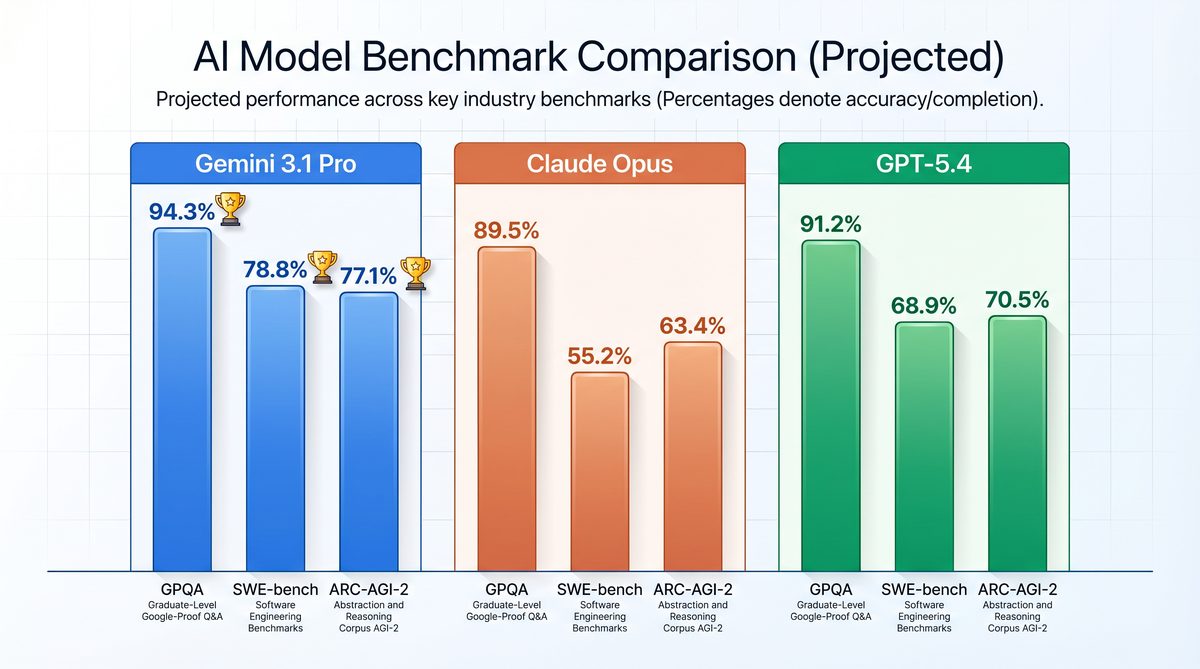
The heart of Google’s AI revolution at Cloud Next ’26 is the Gemini 3.1 series, culminating in the flagship Gemini 3.1 Pro model. This latest iteration of Google’s multimodal AI model delivers unmatched performance across a broad spectrum of tasks, from natural language understanding to complex reasoning and audio processing.
Gemini 3.1 Model Variants
- Gemini 3.1 Flash-Lite: Optimized for speed and cost-efficiency, this model delivers low-latency responses for real-time applications, making it ideal for budget-conscious deployments that still require high responsiveness.
- Gemini 3.1 Flash Live: The premier audio model in the series, deployed globally in over 200 countries through Search Live and Gemini Live platforms, enabling real-time voice and camera-based dialogue experiences.
- Gemini 3.1 Pro: The most advanced model, excelling in multimodal tasks with a staggering GPQA score of 94.3%, support for over 1 million tokens in context, and state-of-the-art capabilities in reasoning and comprehension.
Benchmarking Gemini 3.1 Pro: Performance and Value
Comparing AI models’ performance is critical for enterprises selecting their foundational AI technology. Below is a detailed comparison of Gemini 3.1 Pro against leading competitors such as OpenAI’s GPT-5.4 and Anthropic’s Claude Opus 4.6, focusing on coding, reasoning, context handling, and pricing.
| Metric | Gemini 3.1 Pro | Claude Opus 4.6 | GPT-5.4 | Claude Sonnet 4.6 |
|---|---|---|---|---|
| SWE-Bench Verified (Coding) | 78.8% | 80.8% | ~76% | ~72% |
| GPQA Diamond (Graduate-Level QA) | 94.3% | ~89% | 92.0% | N/A |
| ARC-AGI-2 (Abstract Reasoning) | 77.1% | N/A | N/A | N/A |
| MRCR v2 @ 1M tokens (Long Context) | 18.3% | 78.3% | 36.6% | N/A |
| Context Window (Max Tokens) | 1M+ tokens (64K output max) | 1M tokens (128K output max) | 256K tokens (32K output max) | 1M tokens |
| Pricing (per million tokens, Input/Output) | $2 / $12 | $5 / $25 | $15 / $60 | $3 / $15 |
| Artificial Analysis Intelligence Index | 57 pts | ~55 pts | 57 pts | N/A |
From these figures, Gemini 3.1 Pro emerges as a top-tier model for multimodal reasoning and cost efficiency. While Claude Opus 4.6 leads slightly in coding benchmarks and long-context handling, Gemini 3.1 Pro’s combination of high reasoning scores, massive context window, and competitive pricing positions it as a strong all-rounder for enterprise AI deployments.
The model’s ability to handle over one million tokens in context dramatically extends the scope of applications, from lengthy legal document analysis to real-time multi-session chatbot interactions. This capability alone opens new frontiers for AI-powered enterprise solutions, aligning with Google’s vision of intelligent, context-aware agents that operate seamlessly across data silos and workflows.
Gemini in the Enterprise Workspace
Google has deeply integrated Gemini models into Workspace applications such as Docs, Sheets, Slides, and Drive, significantly elevating productivity with AI-powered assistance. For instance, the state-of-the-art AI embedded in Sheets enables complex data analysis and formula generation through natural language prompts, dramatically simplifying workflows for data professionals. For more on this topic, see our guide to building AI agents that actually work.
Furthermore, innovations like Canvas in AI Mode offer dynamic workspaces where teams can organize projects, combine creative writing with coding, and collaborate in real time—all powered by Gemini’s advanced capabilities. These developments demonstrate Google’s commitment to embedding AI deeply into the daily fabric of enterprise work.
2. Gemini Enterprise Agent Platform: The New AI Frontier for Enterprises
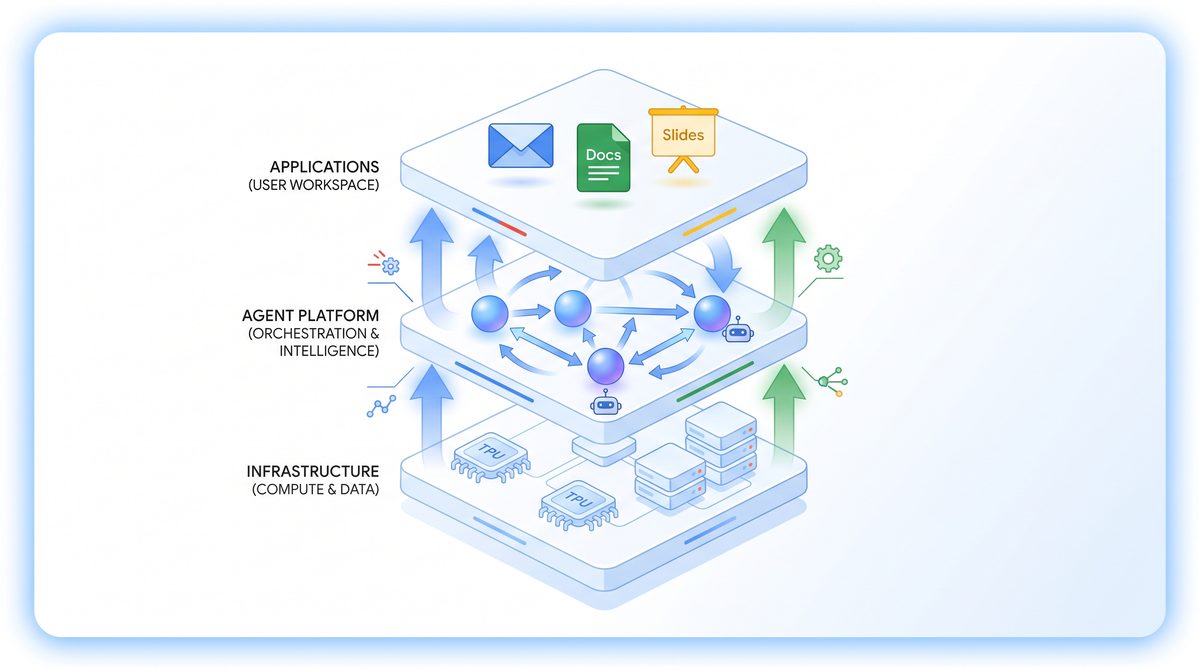
One of the most transformational announcements at Cloud Next ’26 is the Gemini Enterprise Agent Platform. This platform represents a new paradigm in AI deployment, focusing on scalable, governable, and mission-critical agentic systems that enterprises can tailor to their unique operational needs.
Platform Overview and Capabilities
The Gemini Enterprise Agent Platform builds upon and expands the foundations laid by Google’s Vertex AI, introducing a comprehensive, layered architecture designed to:
- Build and Deploy Agents at Scale: Enterprises can create hundreds of specialized AI agents that operate concurrently, automating complex workflows across departments and functions.
- Governance and Security: The platform integrates rigorous governance frameworks, ensuring that all agents comply with enterprise security policies and regulatory requirements.
- Optimized Performance: Leveraging the latest TPU v8 hardware and network infrastructure, agents can handle millions of concurrent interactions with near-zero latency.
- Multi-Agent Systems: The platform supports orchestrating multiple sub-agents, allowing for modular and adaptive AI solutions that can dynamically adjust to changing business needs.
- Permanent Memory and Collaboration: Gemini Enterprise Agents feature persistent memory capabilities, enabling them to retain context over long periods and across interactions, facilitating more meaningful and productive collaborations.
Use Case Spotlight: Liverpool’s AI Shopping Assistant
Demonstrating the platform’s real-world impact, Liverpool, a leading retailer, has deployed a Gemini-powered in-store shopping assistant projected to yield a tenfold return on investment. This innovation exemplifies how the Enterprise Agent Platform can transform customer engagement by delivering personalized, conversational AI experiences at scale.
AgentIQ and Automated Security Review
Security remains a top priority in any enterprise AI deployment. Gemini Enterprise introduces AgentIQ, a workflow automation system that detects new AI agents as they are shipped, automatically conducting comprehensive security reviews. This process involves:
- Identifying the agent and its architecture
- Validating potential security risks
- Suggesting fixes and delivering them to development teams through native tools
This level of automated security governance ensures that AI agents can be deployed rapidly without compromising enterprise security postures, a critical advantage in today’s accelerated innovation cycles. The partnership with Wiz further extends this protection by covering on-premises and multi-cloud environments, providing a unified security framework for all assets managed by AI agents. For more on this topic, see our guide to comparing leading AI models.
Omnichannel Gateway and Context Preservation
The platform also features an Omnichannel Gateway that maintains conversational context across diverse interaction surfaces — including web, mobile, and voice interfaces. This ensures users experience seamless, coherent dialogues regardless of the communication channel, vital for customer-facing applications and internal workflows alike.
Developers and Tech Professionals: Why This Matters
For developers, the Gemini Enterprise Agent Platform offers a robust, scalable foundation for building intelligent agents that can automate complex processes, integrate deeply with enterprise data sources, and maintain compliance with stringent security policies. This platform shifts AI development from isolated experiments to enterprise-grade, production-ready deployments, enabling organizations to unlock new efficiencies and innovation pathways.
3. Next-Generation TPU v8 and Agentic Data Cloud
Get Free Access to 40,000+ AI Prompts
Join 40,000+ AI professionals. Get instant access to our curated Notion Prompt Library with prompts for ChatGPT, Claude, Codex, Gemini, and more — completely free.
Get Free Access Now →No spam. Instant access. Unsubscribe anytime.
Underpinning Google’s AI stack update is the introduction of the TPU v8 hardware and the associated Agentic Data Cloud, which collectively redefine the infrastructure layer for AI training and inference.
TPU v8: Specialized Training and Serving Platforms
Google unveiled its eighth generation of Tensor Processing Units (TPUs), designed from the ground up to address the distinct demands of AI training and serving:
- Training Platform: Incorporates 2 petabytes of shared bandwidth memory within a single superpod, combined with TPU Direct Storage to enable ultra-fast data transfers from managed storage systems.
- Serving Platform: Employs the new Boardfly Topology, which deploys 1,152 TPU chips into a single pod, supporting millions of concurrent AI agents with near-zero latency.
This architectural innovation dramatically enhances scalability and performance, enabling enterprises to deploy massive AI workloads efficiently and cost-effectively. The TPU v8 infrastructure is complemented by advancements such as Managed Lustre supporting throughput up to 10 terabytes per second and the Virgo network, ensuring ultra-low latency and high reliability.
Agentic Data Cloud: A Universal Context Engine
Alongside hardware upgrades, Google introduced the Agentic Data Cloud, a reimagined data platform designed to support intelligent agents by breaking down traditional data silos and enabling universal context awareness across enterprise datasets.
- Knowledge Catalog: Acts as a universal context engine, indexing and cataloging diverse enterprise data assets to provide agents with accurate and relevant contextual information.
- Data Agent Kit: A Gemini-powered authoring experience that transforms how data scientists and practitioners build data workflows, leveraging AI-driven automation and natural language interfaces.
- Cross-Cloud Lakehouse: Enables AI models and analytical engines to reason over data stored across multiple cloud providers, eliminating fragmentation and facilitating seamless data interoperability.
These components together allow enterprises to operationalize “agentic” AI—intelligent agents that proactively resolve issues like infrastructure outages and optimize network performance, saving millions annually. The integration of AI with a universal data fabric marks a significant leap towards truly autonomous enterprise operations. For more on this topic, see our guide to enterprise AI ROI case studies.
Industry Impact and Use Cases
Examples of this infrastructure in action include CME Group achieving nanosecond precision in ultra-low latency trading environments, and new AI-driven spatial analysis models enabling advanced sports training and fan engagement applications. The Agentic Data Cloud’s ability to unify data and AI workflows across clouds and departments unlocks unprecedented agility and innovation potential for enterprises.
4. Workspace Intelligence and Strategic Security Partnerships
Beyond infrastructure and AI models, Google’s latest AI stack update introduces innovations designed to enhance productivity and security within the enterprise ecosystem.
Workspace Intelligence: AI-Driven Collaboration at Scale
Google Workspace has been deeply infused with Gemini-powered AI intelligence, with new capabilities that transform how teams collaborate and innovate:
- Regional Operations Agent: An example of a Gemini-built AI assistant that alerts teams proactively—for instance, notifying about early shipments and automatically generating branded slide decks.
- AI-Enhanced Creativity: Tools like Canvas Mode in Google Slides allow real-time collaborative editing powered by advanced AI, blending creative and analytical workflows seamlessly.
- Accelerated Migration and Interoperability: Google announced that migrating complex, finance-oriented teams from Microsoft 365 to Google Workspace is now up to five times faster, significantly reducing friction in enterprise adoption.
These features demonstrate Google’s commitment to embedding AI as a natural extension of the workspace, helping teams convert data into actionable insights and product concepts in minutes rather than months.
Wiz Security Partnership: AI-Powered Enterprise Defense
Security is paramount in the AI era, and Google’s partnership with Wiz represents a major step forward in securing AI assets and enterprise infrastructure at machine speed. Key aspects of this collaboration include:
- Comprehensive Asset Protection: Extends Gemini Enterprise Agent security to all assets on-premises and across major cloud platforms.
- Automated Threat Hunting: AI-driven agents continuously scan environments for vulnerabilities and threats, surpassing human teams in speed and scale.
- Integrated Remediation: Security findings are automatically triaged and fixes are suggested directly within developers’ native tools, accelerating response times and minimizing risk exposure.
This partnership exemplifies the shift towards proactive, AI-enabled security postures that are essential for safeguarding complex, distributed enterprise environments.
5. Creative & Media AI Tools: Veo 3, Nano Banana 2, and Lyria 3 Pro
Google’s 2026 AI stack enhancements brought a significant leap forward in creative and media AI tools, positioning the company at the forefront of content generation technology. Among the standout announcements were Veo 3, Nano Banana 2, and Lyria 3 Pro, each addressing different facets of creative workflows with state-of-the-art AI capabilities.
Veo 3 marks a breakthrough in video generation technology. Supporting native audio synthesis and delivering ultra-high 8K video output, Veo 3 allows creators to produce cinematic-quality videos using AI-driven workflows. Complementing this, Veo 3.1 Lite introduces a free tier option, democratizing access to video generation for hobbyists and educators alike. This tier maintains high-speed processing and reasonable output quality, making it ideal for rapid prototyping and social media content creation.
Nano Banana 2 continues Google’s innovation in presentation design by automatically generating polished AI-powered presentation slides directly from text inputs. It leverages advanced layout optimization and stylistic consistency to produce professional decks that save hours of manual work. With the release of Nano Banana 2, users experience improved character consistency and richer visual elements.
For musicians and audio creators, Lyria 3 Pro offers AI-generated music compositions with granular control over song sections such as intros, verses, and bridges. This tool integrates seamlessly with the Gemini API, enabling developers and artists to embed sophisticated music generation into their applications or creative projects.
Google also expanded its image remixing capabilities with Whisk and Whisk Animate, which allow users to manipulate and animate images effortlessly. These tools support dynamic image editing and animation driven by AI, enabling new possibilities for digital storytelling.
Flow enhances cinematic video workflows by streamlining the entire production pipeline from storyboarding to final cut using AI-assisted editing and effects. Complementing Flow is Imagen 4, the latest iteration of Google’s flagship image generation model that produces highly realistic and customizable images for diverse creative applications.
Comparison Table: Google Creative AI Tools vs Competitors (2026)
| Feature / Tool | OpenAI | Runway | Adobe Firefly | |
|---|---|---|---|---|
| Video Generation | Veo 3 (8K, native audio), Veo 3.1 Lite (free tier) | Sora (shut down March 2026) | Gen-4 (high-res video, multi-modal) | Not yet launched |
| Presentation Slides from Text | Nano Banana 2 (auto design, character consistency) | None dedicated | Partial support via video tools | Some integration with Photoshop AI |
| Music Generation | Lyria 3 Pro (granular control) | Jukebox (limited update) | Partial third-party plugins | AI music in Creative Cloud beta |
| Image Remixing & Animation | Whisk & Whisk Animate (dynamic, AI-driven) | DALL·E 3 (static images) | Animation focus with Gen-4 | Firefly (image generation, editing) |
| Image Generation | Imagen 4 (high fidelity, customizable) | DALL·E 3 (industry standard) | Yes (Runway Gen-4) | Firefly (broad support) |
6. Developer Tools Ecosystem: From AI Studio to Gemini CLI
Google’s 2026 AI developer ecosystem continues to mature with a comprehensive suite of tools designed to accelerate AI application development and streamline workflows for both novice and expert developers.
At the core is Google AI Studio, a free prototyping environment that allows developers to quickly build, test, and iterate on AI models and applications without complex setup. Complementing this is Firebase Studio, which provides a full-stack development framework tailored for AI-powered apps, integrating backend, database, and hosting services with AI capabilities seamlessly.
One of the most impactful new tools is Jules, an autonomous coding agent that has now reached general availability (GA). Jules can write, debug, and optimize code in multiple programming languages autonomously, greatly enhancing productivity and reducing time to market.
The terminal remains a critical interface for developers, and Google’s Gemini CLI brings AI assistance directly to the command line. This terminal-based AI assistant allows developers to query models, generate code snippets, and manage projects without leaving their workflow.
Integration into popular IDEs is streamlined through Gemini Code Assist, which offers inline AI-powered code suggestions, refactoring recommendations, and documentation generation. This tool is designed to reduce cognitive load and improve code quality.
Design-to-code workflows are simplified with Stitch, a tool that converts UI/UX designs into production-ready code automatically, helping bridge the gap between designers and developers.
Experimental projects like Google Antigravity bring “vibe coding” to the ecosystem — a novel approach where developers can collaboratively build AI-powered applications with multiplayer modes, database integrations, and real-world service connections in a shared environment.
Communication between AI agents is standardized via the Agent2Agent (A2A) protocol, enabling multi-agent systems to coordinate complex tasks effectively. This is complemented by support for the Model Context Protocol (MCP), which ensures models can share and manage extended context efficiently during interactions.
Comparison Table: Developer Tools Across Major AI Platforms (2026)
| Feature / Tool | OpenAI | Anthropic | Microsoft | |
|---|---|---|---|---|
| Prototyping Environment | AI Studio (free, browser-based) | OpenAI Playground | Claude Labs | Azure AI Studio |
| Full-Stack AI App Dev | Firebase Studio | OpenAI API + Azure Functions | Anthropic API + integrations | Power Platform + Azure AI |
| Autonomous Coding Agent | Jules (GA) | CodeX (deprecated) | Claude Code Assistant | GitHub Copilot X |
| Terminal AI Assistant | Gemini CLI | OpenAI CLI (limited) | None | Azure CLI with AI extensions |
| IDE Integration | Gemini Code Assist | Copilot | Anthropic IDE Plugin (beta) | Visual Studio IntelliCode |
| Design to Code | Stitch | None | None | Power Apps AI Builder |
| Experimental Coding Tools | Google Antigravity (vibe coding) | None | None | Project Bonsai (limited) |
| Multi-Agent Protocol | Agent2Agent (A2A) | None | None | Azure Cognitive Agents (early) |
| Context Sharing Protocol | Model Context Protocol (MCP) | None | None | None |
7. The Complete Google AI Ecosystem: 50+ Tools Working Together
Google’s AI ecosystem in 2026 is a vast, interconnected suite of over 50 AI tools and platforms, organized into nine comprehensive categories. Together, they form a unified framework enabling developers, researchers, creatives, enterprises, and consumers to leverage AI seamlessly across all domains.
- Core Gemini Apps: This category includes Gemini, Gemini Advanced, Deep Research, Deep Think, and AI Overviews. These foundational models power a broad range of AI tasks, from natural language understanding to complex reasoning and multimodal processing.
- Research Tools: NotebookLM Plus and Google Scholar AI facilitate academic and scientific workflows by providing AI-assisted literature review, summarization, and data analysis.
- Labs Experiments: Innovative projects like Pomelli, Help Me Script, Disco, GenTabs, Beam, and Virtual Try On provide experimental AI-driven experiences, pushing creative and practical boundaries.
- Creative & Media Tools: This category features Veo 3, Nano Banana 2, Flow, Whisk, Lyria 3 Pro, and Imagen 4. These tools empower artists, designers, and media professionals to create high-quality content with AI assistance.
- Customization & Creation: Gems and Opal allow users and developers to tailor AI models and workflows to specific needs, enabling personalized and domain-specific AI solutions.
- Developer Tools: Encompassing AI Studio, Firebase Studio, Jules, Gemini CLI, Stitch, Antigravity, Code Assist, and Vertex AI, this category supports the full lifecycle of AI app development and deployment.
- Workspace & Consumer: Google’s AI enhancements within Gmail, Sheets, Slides, Meet, Maps, Lens, and Android provide intelligent assistance to everyday users, improving productivity and user experiences.
- Enterprise Agent Platform: Comprising Agent Studio, Registry, Marketplace, and AgentIQ, this platform enables enterprises to build, manage, and monetize custom AI agents tailored to business needs.
- Infrastructure: Underlying all tools is Google’s robust infrastructure, including TPU v8, Agentic Data Cloud, and Wiz Security, which provide high-performance computation, scalable data management, and enterprise-grade security.
These nine categories are not isolated silos but interwoven components of a holistic AI ecosystem. For instance, Core Gemini Apps provide the intelligence powering Creative & Media Tools, Developer Tools, and Workspace applications. Research Tools feed insights back into model improvements and inform Labs experiments. Customization & Creation tools bridge user needs to developer capabilities, while the Enterprise Agent Platform leverages infrastructure to deliver scalable AI solutions for businesses.
By integrating these diverse tools and platforms, Google offers a seamless AI experience where data, models, and applications interact fluidly. This interconnected ecosystem enables rapid innovation, personalized AI experiences, and broad accessibility, setting a new standard for AI in 2026 and beyond.
Useful Links
- Google Labs — Explore AI Experiments
- Google AI for Developers — AI Studio & Gemini API
- Google Cloud Vertex AI Platform
- Google AI Blog — Latest Announcements
- NotebookLM — AI Research Assistant
- Firebase Studio — Full-Stack AI App Builder
- Google DeepMind Veo — AI Video Generation
- Google Cloud TPU — AI Accelerator Hardware
Conclusion: Embracing the Enterprise AI Revolution
The updated Google AI stack introduced at Cloud Next ’26 marks a profound transformation in the enterprise AI landscape. With the launch of Gemini 3.1 Pro delivering industry-leading reasoning capabilities, the Gemini Enterprise Agent Platform enabling scalable, secure AI agent deployments, next-generation TPU v8 infrastructure powering unprecedented performance, and innovations in workspace intelligence and security partnerships, Google is delivering a holistic, future-ready AI ecosystem.
For developers and tech professionals, these advancements open a wealth of new possibilities — from building sophisticated, multimodal AI applications to deploying mission-critical agents that automate complex business processes with confidence. The integration of AI into every layer of the enterprise stack, combined with rigorous security frameworks and universal data access, positions organizations to lead in the AI-first world.
To explore these groundbreaking technologies in greater detail, including comprehensive architectural diagrams, use case deep dives, and technical specifications, we invite you to download the full 26-slide Google Cloud Next ’26 AI presentation. This resource offers invaluable insights for professionals looking to architect the next generation of AI-powered enterprises. Subscribe for free to get instant access to the full presentation, plus our complete library of 40,000+ AI prompts, coding guides, and enterprise AI resources.
Get Free Access: Download the Full Cloud Next ’26 AI Presentation PDF + 40,000+ AI Prompts
Stay Updated with AI Insights
Subscribe to ChatGPT AI Hub for weekly AI tips, tool reviews, and enterprise AI guides delivered straight to your inbox.
🕐 Instant∞ Unlimited🎁 Free
