
OpenAI launches GPT-Live: a new generation of full‑duplex voice models for natural human–AI interaction
By Markos Symeonides — July 8, 2026
Executive summary
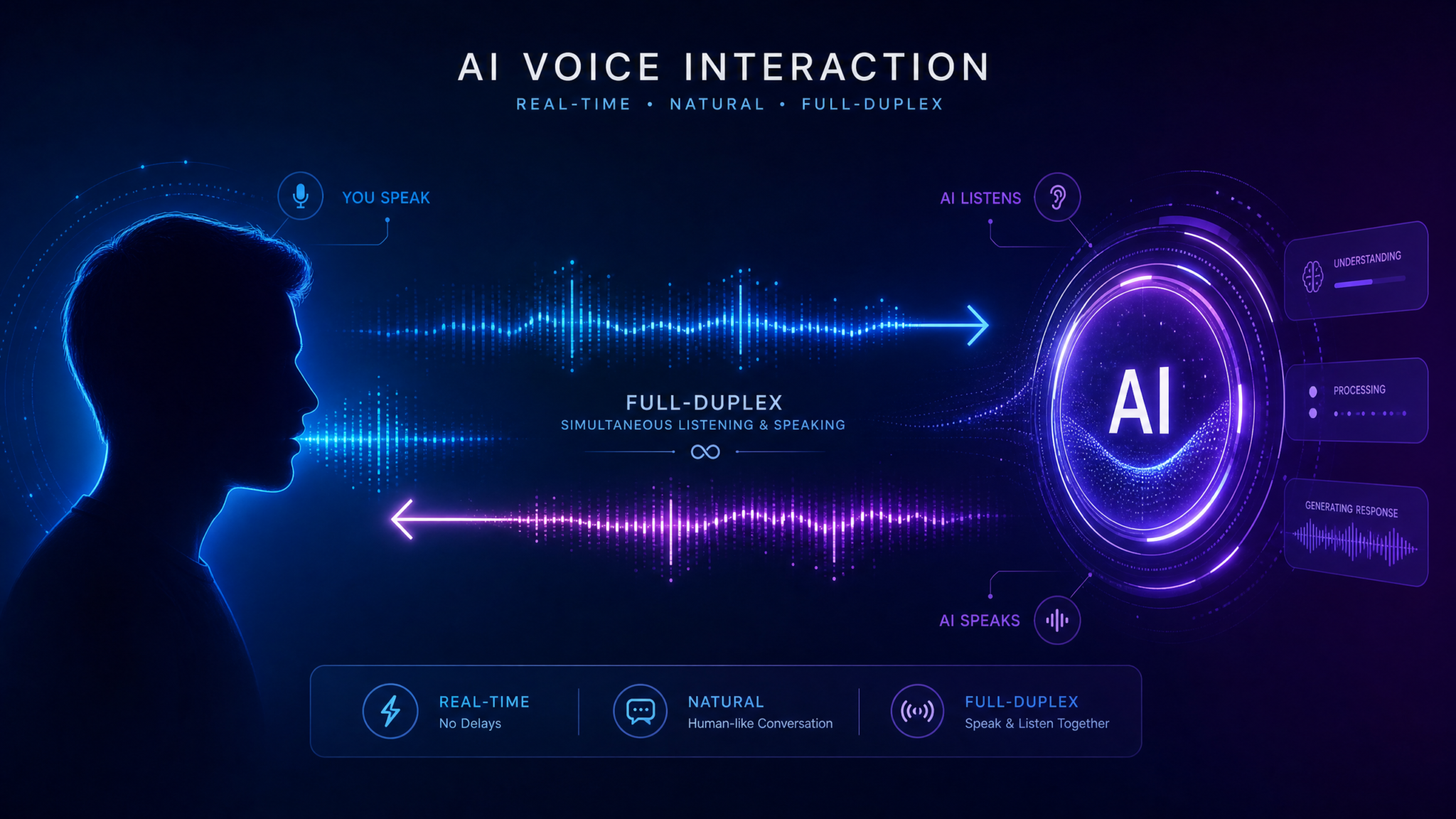
On July 8, 2026, OpenAI announced GPT‑Live, a new family of voice models designed to make conversational AI feel more naturally human. The release introduces a full‑duplex architecture that can listen and speak at the same time, enabling continuous, flowing interaction punctuated by natural acknowledgements — short verbal cues such as “mhmm” and “yeah” that humans use to signal attention. GPT‑Live replaces the company’s previous Advanced Voice Mode and ships in two variants: GPT‑Live‑1 for paid users and the smaller GPT‑Live‑1 mini for free users. OpenAI says GPT‑Live is already active across iOS, Android and ChatGPT.com, and reports more than 150 million weekly voice users are engaging with the platform.
Technically, GPT‑Live performs a division of labor: the front‑end voice model manages real‑time audio analysis and the conversational surface (including acknowledgements and short replies), while delegating complex reasoning tasks to a dedicated background engine — GPT‑5.5. Users can select reasoning modes (Instant, Medium, High) to balance latency and depth. The product also introduces visual response cards for structured information like weather, stocks and sports, and debuts nine remastered voices optimized for clarity and expressiveness. OpenAI emphasized expanded testing, voice‑specific safety filters and teen protections as part of the launch.
This article examines GPT‑Live in depth: what it is, how it works, how it compares to prior voice systems, what the feature set and UX look like, the safety posture, availability and product segmentation, developer implications, and the likely market impact. The intent is to provide a comprehensive, technical and commercial analysis for product teams, developers, enterprise buyers and media readers tracking voice AI evolution.
What it is
At its core, GPT‑Live is a new generation voice model family and conversational architecture optimized for continuous, naturalistic verbal interaction. Where earlier voice assistants and chat systems operated in discrete request‑and‑response cycles — you speak, the system processes, then replies — GPT‑Live is architected to sustain fluid two‑way audio dynamics. That change is more than aesthetic: it requires rethinking how audio is captured, processed, interpreted and acted upon in real time, and how decisions are made about when to interrupt, acknowledge, or hand off work to more capable reasoning agents.
OpenAI’s public positioning frames GPT‑Live as replacing Advanced Voice Mode. Practically, GPT‑Live offers:
- Full‑duplex audio handling so the model can listen and speak simultaneously.
- Natural auditory acknowledgements to sustain conversational grounding without needing interruptive clarifications.
- Two product tiers: GPT‑Live‑1 (paid) and GPT‑Live‑1 mini (free) with a feature and capability gap that mirrors earlier free/paid distinctions.
- Background delegation to GPT‑5.5 for complex reasoning, with user‑selectable latency/quality trade‑offs.
- Visual response cards that surface structured information within mobile and web clients.
- Nine remastered voices designed for different conversational tones and clarity.
The net result aims to be the closest mainstream AI product to sustained, human‑like spoken dialog: agents that can nod audibly while you finish a thought, ask clarifying questions mid‑utterance when needed, or quietly begin a complex computation after you say “hold on” and return with a structured result.
Architecture: full‑duplex, turn‑based and cascaded models
The architecture behind GPT‑Live must reconcile three demanding requirements:
- Low‑latency reactive behavior so the assistant sounds responsive and attentive.
- High‑quality reasoning for queries that involve planning, multi‑step reasoning, or retrieval from context.
- Robust safety and content moderation across streamed, partially transcribed audio.
OpenAI chose a hybrid, cascaded architecture built around a full‑duplex front end. Below I break down the three architectural paradigms, then explain how GPT‑Live combines them.
Full‑duplex (GPT‑Live’s core)
Full‑duplex systems can send and receive audio simultaneously. For conversational AI, that capability enables the model to inject brief acknowledgements, interjections or short confirmations while the user is still speaking. Full‑duplex is common in human human communication (backchannels such as “uh‑huh”, “mm‑hm”), but historically rare in voice AI because of synchronization, latency and model design challenges.
Key technical traits of full‑duplex GPT‑Live front ends:
- Streaming audio ingestion with real‑time speech activity detection and partial transcription hypotheses.
- Micro‑responses generated from lightweight acoustic/contextual embeddings (the acknowledgement layer) — extremely low compute and latency cost.
- Buffering and incremental decoding strategies to avoid cutting off user speech when longer replies are required.
- Stateful session management so the ongoing context remains coherent as partial utterances arrive.
Turn‑based
Turn‑based architectures treat interaction as a sequence of discrete inputs and outputs: the user speaks (or types), the system stops listening, processes the request, then responds. Advantages include simpler semantics for state handling, easier moderation checkpoints, and straightforward mapping to high‑capacity models. Drawbacks are lower conversational naturalness and higher perceived latency.
Cascaded or multi‑agent (delegate to stronger reasoners)
Cascaded systems combine several modules: a fast front end for surface‑level processing and latency‑sensitive behavior, and one or more higher‑capacity background models invoked for complex tasks. GPT‑Live’s cascade pairs a full‑duplex voice resolver (GPT‑Live‑1 / mini) with GPT‑5.5 running asynchronously in the background for heavy reasoning. That separation allows the UX to remain responsive while heavy reasoning proceeds offline and returns structured outputs (or visual cards) to the user.
How GPT‑Live combines the three
GPT‑Live’s implementation is a hybrid pipeline:
- Micro‑layer: a real‑time acoustic and conversational microcontroller listens continuously and emits backchannels and short clarifications when appropriate. This micro‑layer is optimized for latency (tens of milliseconds to a few hundred ms) and runs locally or at the edge.
- Surface‑layer: the immediate speech understanding and conversational response generator (GPT‑Live‑1 or GPT‑Live‑1 mini) handles most short queries and routine instructions. This layer streams partial hypotheses to the client for a responsive feel.
- Background reasoning layer: for tasks that require extended reasoning, long context windows, or multi‑step planning, the surface layer delegates to GPT‑5.5. GPT‑5.5 computes asynchronously and returns richer responses or structured visual cards that the surface layer then surfaces to the user.
Crucially, the system’s signals determine when to hand off: confidence scoring, task classification, token budget estimates, and heuristics around interactivity (e.g., “when the user expects an on‑the‑fly answer” vs “when a detailed report is acceptable with slight delay”). The delegation is transparent to the user in many cases: GPT‑Live may say “I’m pulling more details” and then present the richer result when GPT‑5.5 finishes.
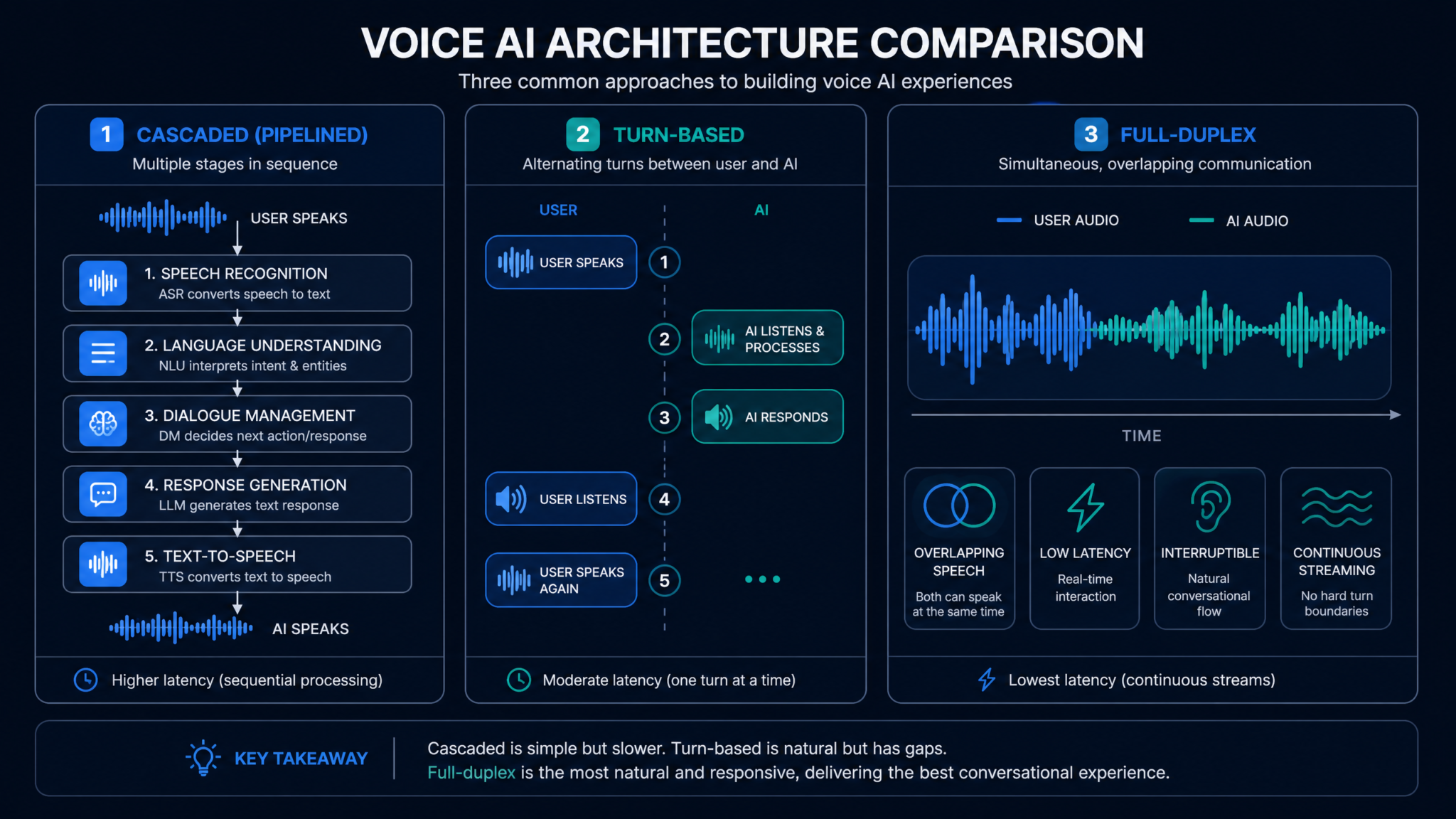
Comparison: full‑duplex vs turn‑based vs cascaded (table)
| Characteristic | Full‑duplex (GPT‑Live) | Turn‑based | Cascaded / Multi‑agent |
|---|---|---|---|
| User experience | Fluid, continuous, supports backchannels and interruptions | Discrete, clear turn boundaries but less natural | Responsive surface + deeper background results |
| Latency | Very low for micro‑responses; variable for complex outputs | Single RTT latency per turn (can be long) | Low surface latency, high latency for deep tasks |
| Implementation complexity | High (streaming, synchronization, partial transcripts) | Moderate (batch processing easier) | High (orchestration, model selection, async handling) |
| Reasoning capability | Limited unless delegated | High when backed by powerful models per turn | Best when combining fast front end and deep back end |
| Safety & moderation | Challenging (streaming content, partial hypotheses) | Easier (clear moderation checkpoint per turn) | Complex but controllable (apply filters at each stage) |
Key features and user experience
GPT‑Live’s UX and feature set are designed to make voice AI feel conversationally natural while preserving reliability and depth. Below I unpack the main components, how they work in practice and what users should expect.
Full‑duplex conversation flow and natural acknowledgements
Backchannels are central to GPT‑Live’s claim to naturalness. The system emits short non‑intrusive cues (“mhmm”, “yeah”, “I see”) timed to the user’s pauses and prosodic signals. These are not merely canned audio clips: they are generated by the voice front‑end using acoustic context and lightweight semantic features so their placement and phrasing are contextually appropriate.
Examples of how this changes interaction:
- When a user narrates a multi‑step instruction — “First do X… then I’ll want you to check Y…” — GPT‑Live can supply acknowledgements that keep the user in flow without taking a full turn.
- In noisy environments, real‑time confidence scoring can trigger a brief clarification request only when the front end’s transcription confidence drops below a threshold, reducing unnecessary interruptions.
- For long‑running tasks, GPT‑Live can provide intermittent “I’m on it” audio cues, improving the perception of progress.
Two model families: GPT‑Live‑1 and GPT‑Live‑1 mini
OpenAI ships two variants of GPT‑Live: GPT‑Live‑1 targets paid users with broader capabilities and higher quality, while GPT‑Live‑1 mini is offered for free users with a more compact footprint. The mini variant is optimized for lower compute and bandwidth while preserving the core full‑duplex UX. Both support the acknowledgement micro‑layer, but GPT‑Live‑1 invokes GPT‑5.5 more freely for complex delegations and benefits from higher token budgets and model capacities.
Visual response cards
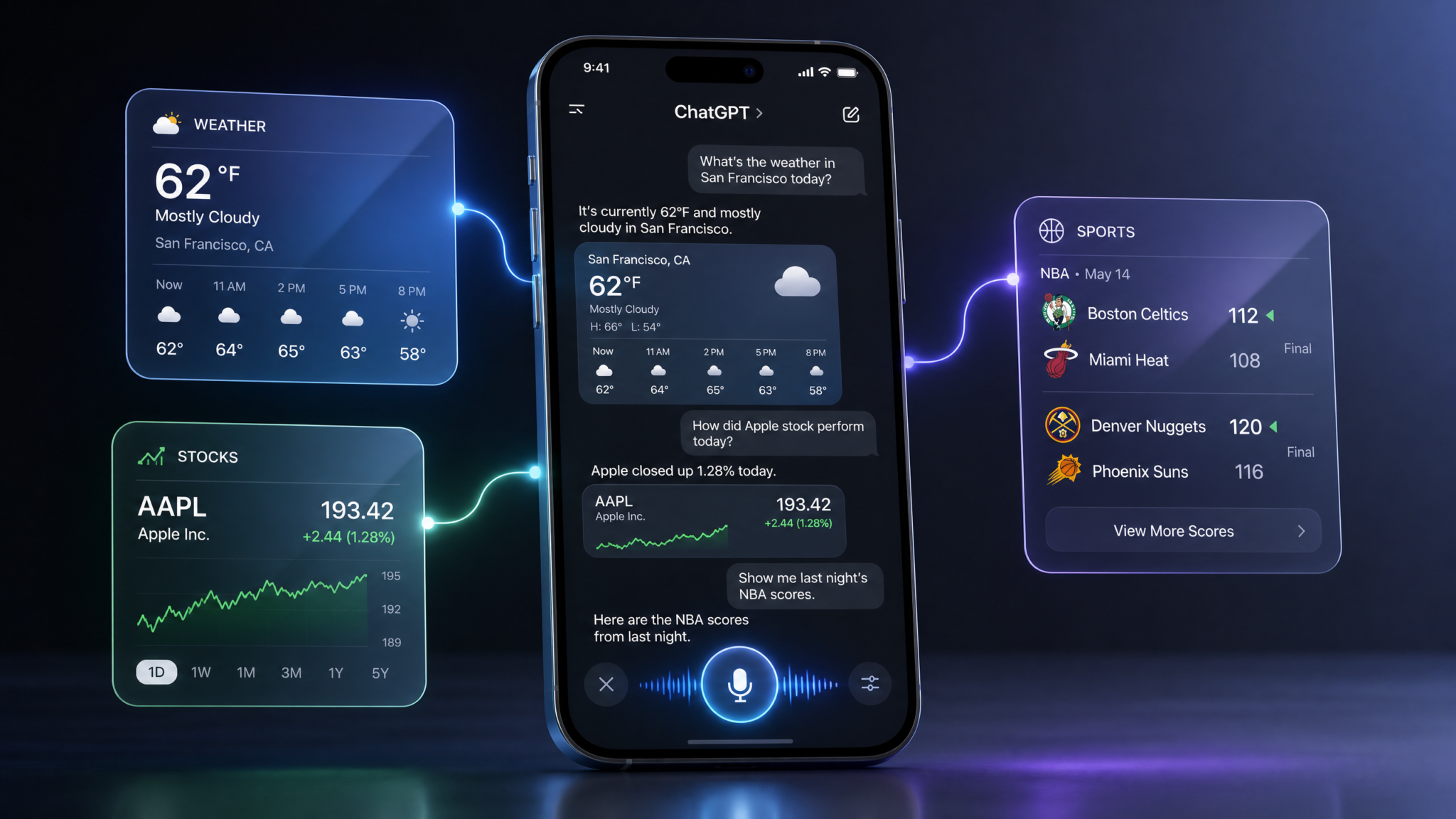
When a user asks for structured information — e.g., “What’s the weather in Boston today?” or “How did the Dow close?” — GPT‑Live can return a visual response card in the mobile or web client. These cards contain concise highlights, charts, quick links, and suggested follow‑up actions (such as “Set weather alert” or “Track this stock”). Visual cards are especially important on phones and embedded screens where concise, scannable information improves utility.
Three reasoning modes: Instant, Medium, High
Users (or apps) can select reasoning modes to trade off latency and depth:
- Instant — prioritizes minimal latency, returning the surface model’s quick answer or acknowledgement while delegating heavyweight reasoning only when necessary.
- Medium — balances speed and quality; for many informational queries it will wait briefly (hundreds of ms to a couple seconds) for a more considered result.
- High — prioritizes thoroughness and accuracy, invoking GPT‑5.5 for full background reasoning and returning the richer result when complete.
These modes shape whether the user hears a provisional early reply followed by a refined card, or a single delayed but higher‑quality result.
Nine remastered voices
OpenAI included nine remastered voices spanning different ages, genders, and dialects. The company positioned these as tuned for intelligibility across noisy environments, natural prosody for backchannels and expressive nuance for longer turns. While the press release did not enumerate gender or accent breakdowns, the emphasis is on a palette that enables developers and users to select tones appropriate for brand, accessibility, and cultural preference.
Replacement of Advanced Voice Mode
GPT‑Live replaces the previous Advanced Voice Mode. For users, the migration will be largely seamless: prior voice settings and preferences should port to the new system, but operationally the model stack, UX expectations and safety posture have been updated. OpenAI’s decision to subsume Advanced Voice Mode under GPT‑Live signals a consolidation and positioning of voice as a first‑class modality across ChatGPT products.
Usage scale and metrics
OpenAI reported more than 150 million weekly voice users engaging with its voice products. This figure reflects the cumulative usage across iOS, Android and ChatGPT.com, and suggests that voice interactions have transitioned from novelty to mainstream behavior within the ChatGPT ecosystem. High‑frequency use cases include hands‑free information retrieval, conversational assistants for messaging and productivity, and voice‑first interactions for accessibility.
Reasoning modes and background delegation
One of GPT‑Live’s most significant technical design choices is explicit delegation: the front‑end voice model handles real‑time conversational duties while GPT‑5.5 provides heavier reasoning. This pattern enables the system to preserve interactivity without compromising on deep reasoning capability. Below I detail how delegation works, how reasoning modes control behavior, and what trade‑offs developers and product designers will face.
Delegation triggers and workflow
Delegation to GPT‑5.5 is not automatic for every utterance. The system uses a combination of signals to decide when to escalate:
- Task classification: if the utterance falls into predefined categories requiring multi‑step reasoning, planning, or long‑context retrieval (e.g., “draft a policy memo,” “debug this bug”), delegate.
- Confidence & ambiguity: if the surface model’s answer confidence is low or if user utterance is ambiguous in intent, call GPT‑5.5 to avoid a wrong commit.
- User mode: when a user has explicitly selected High reasoning mode, the system will route more requests to GPT‑5.5.
- Resource constraints and policy: for free tier/mini users the system might constrain GPT‑5.5 calls to preserve capacity.
When delegation occurs, the conversational surface provides immediate micro‑feedback (e.g., a brief vocal cue) and may present a provisional text or visual placeholder that is updated when GPT‑5.5 completes. The user can continue speaking while the background reasoning proceeds; the front end tracks new utterances and can either (a) interrupt and incorporate them into the ongoing reasoning job, (b) queue them for a new job, or (c) inform the user that their earlier request is in progress.
Instant vs Medium vs High: operational trade‑offs
The three reasoning modes are central to user control of latency vs depth. Operationally they affect queueing priorities, selection of model endpoints, and the allowance for speculative precomputation:
| Mode | Primary goal | Latency target | Expected use cases |
|---|---|---|---|
| Instant | Fastest perceived responsiveness | <500 ms for micro‑responses; 1–2s for short replies | Brief factual lookups, conversational guidance, follow‑ups |
| Medium | Balanced speed and quality | ~500 ms–2s | Most consumer queries, moderate planning |
| High | Highest answer quality | 2s–10s+ depending on task | Complex reasoning, long documents, multi‑step plans |
From a design perspective, Instant mode is the one that benefits most from full‑duplex micro‑interactions; High mode relies on asynchronous background processing and often yields a visual card or longer spoken synthesis once GPT‑5.5 completes its output.
Background reasoning and state continuity
Maintaining conversational continuity while a background job runs is complex. GPT‑Live handles this by snapshotting the relevant context at hand‑off, then allowing incremental updates if the user intervenes. The system therefore supports three state patterns:
- Frozen snapshot: do not accept edits to the delegated task until it completes. Useful for batch jobs where consistency matters.
- Mutable job: accept incremental user inputs and apply them to the ongoing job; requires cancellation, merging and revision semantics.
- Parallel jobs: if the user starts a different task, spin off a new job and prioritize according to mode and user intent.
OpenAI’s public materials indicate that the system uses a mix of mutable and parallel job handling, with heuristics to preserve user intent and reduce surprising overwrites.
Visual response cards and multimodal output
GPT‑Live augments spoken responses with visual cards when the client supports them. Cards are compact, structured outputs summarizing the answer, surfacing data visualizations, and enabling quick actions (e.g., calendar add, set reminder, buy tickets). The card design follows mobile conventions: a headline, supporting bullets, optional chart or map, and action buttons.
Card types and examples
| Card type | Primary content | Example use case |
|---|---|---|
| Weather | Current conditions, hourly/daily forecast, alerts | “What’s the weather in Boston this weekend?” |
| Stocks / Markets | Price summary, sparkline, percent change, news headlines | “How did Tesla close today?” |
| Sports | Scores, player stats, upcoming schedule | “Did the Celtics win?” |
| Knowledge snippet | Summary, sources, related links | “Summarize this article” (with link) |
| Actions | Buttons for follow‑up tasks (calendar, reminder, share) | “Remind me to call at 3 pm” — show confirm action |
Cards can be generated by GPT‑5.5 for richer responses or by the surface model for simple items. Importantly, cards are intended to be canonical: when a card appears it represents the authoritative output for that request, minimizing divergence between the voice reply and the structured data presented.
Safety, testing and teen protections
Given the continuous, streaming nature of GPT‑Live, safety and moderation are both harder and more important. OpenAI emphasized expanded testing and voice‑specific safeguards as part of the rollout. Below I summarize the key measures the company described and analyze their implications.
Expanded testing and platform quality assurance
OpenAI reported a substantial increase in pre‑launch testing focused on real‑world conversational flows: multi‑turn conversations, interrupted speech, background noise, and cross‑lingual code switching. This testing regime included human evaluations designed to measure “groundedness” (factual accuracy), user experience metrics (perceived responsiveness), and safety tests (to observe failure modes where partial transcripts could cause inappropriate responses).
Voice‑specific safety filters
Streaming audio and partial transcripts mean that content moderation cannot always rely on complete utterances. GPT‑Live uses layered safeguards:
- Acoustic anomaly detection to flag possible synthetic audio or voice cloning attempts.
- Streaming moderation that runs on partial transcripts to detect and mask disallowed content as early as possible.
- Rate limits and behavioral heuristics to detect manipulative or automated speaker behavior.
- Persona and voice usage policies to prevent misuse of specific voices (e.g., impersonation limits).
These measures emphasize early detection and mitigation to reduce the chance that the system will produce or repeat harmful content while still preserving conversational fluidity.
Teen protections and age gating
OpenAI stated that GPT‑Live includes expanded teen protections. While details are not exhaustive in the public announcement, the core elements are:
- Default settings that apply stricter content filters for accounts marked as teens (where age verification exists).
- Limitations on voice personalization and voice cloning features for minors.
- In‑conversation parental consent flows for certain types of sensitive tasks.
These protections are a response to regulatory and societal pressure to protect minors from harmful content and manipulation, especially given voice’s immediacy and persuasiveness.
Privacy, data retention and on‑device processing
OpenAI reiterated commitments around data minimization and user control. The architecture allows for edge or on‑device execution of some micro‑layers (acknowledgements and local VAD), reducing the need to stream every utterance. For higher‑risk uses or enterprise customers, OpenAI noted options for stronger data residency controls and retention limits. Still, any system that delegates to cloud‑based GPT‑5.5 will necessarily transmit portions of user speech and metadata to remote endpoints, which remains a core privacy consideration for adopters.
Safety tradeoffs with full‑duplex
Full‑duplex systems implicitly increase the complexity of safety because content can be generated while new content is still streaming in. This creates scenarios where the assistant might begin to respond to an utterance built from partial, inaccurate transcription. GPT‑Live’s mitigations include:
- Conservative production of substantive output until the model reaches a high confidence threshold.
- Preference for acknowledgements or short, non‑committal cues when confidence is intermediate.
- Rapid revision mechanisms: if a delegated task completes with a correction, the system can retract or update prior micro‑utterances in the UI (visual cards) and with follow‑up spoken clarifications.
Availability and product positioning
OpenAI made GPT‑Live available across iOS, Android and ChatGPT.com on launch day. The product structure is straightforward:
- GPT‑Live‑1: available to paid ChatGPT subscribers with full access to reasoning modes, higher delegation quotas to GPT‑5.5, and priority in background compute.
- GPT‑Live‑1 mini: available for free users with a reduced capability set, tighter delegation limits and smaller token budgets.
The company also indicated that the feature replaces Advanced Voice Mode, so current Advanced Voice Mode users will be migrated. For enterprises, OpenAI highlighted priority access, higher usage quotas and enhanced controls, although detailed enterprise pricing was not disclosed in the initial announcement.
Developer implications and APIs
GPT‑Live’s launch has immediate implications for developers building voice experiences, platform partners, and AI infrastructure vendors.
For developers, three pragmatic items matter most:
- API access and orchestration patterns for full‑duplex: developers will need to adopt streaming audio protocols, low‑latency socket management and partial transcript handling for the micro‑layer. SDKs that encapsulate these primitives will be crucial for rapid adoption.
- Design patterns for multi‑stage UX: build flows that handle provisional early answers, in‑flight background reasoning, and graceful updates of visual cards or spoken follow‑ups.
- Safety and data governance: developers must incorporate voice‑specific moderation checks, user consent flows and retention policies into their apps.
Below is a contextual description of an internal resource that can help teams get started with real‑time integration and best practices:
The introduction of GPT-Live builds on the momentum of OpenAI’s recent model releases, including the GPT-5.5 Instant Mini rollout that brought faster inference to free and Plus tier users, establishing a pattern of making frontier capabilities accessible across all subscription levels.
On the API side, OpenAI’s offering likely includes endpoints for:
- Streaming audio ingestion and partial hypotheses streaming.
- Micro‑response generation for acknowledgements with low resource requirements.
- Delegation APIs that start asynchronous GPT‑5.5 jobs and return job handles and status updates.
- Visual card generation endpoints returning structured JSON for client rendering.
Operationally, app developers will face new QoS and orchestration challenges: maintaining socket stability on poor mobile networks, ensuring that background jobs do not consume quota inadvertently, and reconciling multi‑turn conversational state across transient disconnections.
For developers focusing on accessibility, GPT‑Live opens new possibilities. Natural acknowledgements and continuous listening reduce friction for users with motor impairments. But accessibility designers should carefully test ack‑timing to ensure it does not inadvertently interrupt users using assistive technologies.
Companies building voice‑enabled products should also re‑evaluate privacy and consent UI. The fact that some micro‑processing can occur on device is an implementation lever: where on‑device processing is used, developers should provide transparent settings for local audio processing vs cloud processing.
For organizations already leveraging ChatGPT in production workflows, GPT-Live’s delegation architecture mirrors the shared context system between ChatGPT and Codex that enables memory persistence and cross-platform project continuity, suggesting a unified approach to AI interaction across modalities.
Market, competitive and ecosystem impact
GPT‑Live’s introduction marks a material step in voice AI adoption for several reasons: the scale of deployment across OpenAI’s ecosystem, the shift to full‑duplex interaction, and the strategic use of cascaded reasoning. I analyze implications across competitors, platform owners, developers and end users.
Competitive dynamics: Apple, Google, Microsoft and others
All major platform players have voice capabilities, but GPT‑Live matters because it centralizes a sophisticated conversational architecture alongside a large pre‑existing user base. Consider the following dynamics:
- Apple and Google have deep OS‑level integration and proprietary voice assistants; GPT‑Live challenges them at the application and cloud layer where multi‑modal, multi‑agent reasoning offers a differentiated experience.
- Microsoft, which has broad collaboration with OpenAI, benefits from tighter integration across Windows and Microsoft 365; GPT‑Live expands the range of voice APIs that enterprise apps can surface.
- Startups focused on voice UX, call automation, and conversational agents now must support full‑duplex paradigms or risk comparability gaps; this raises the bar for audio engineering and product design.
GPT‑Live is not an immediate OS replacement for system assistants (e.g., Siri), but for many use cases — knowledge work, complex information retrieval, and third‑party voice experiences within apps — it will be a compelling alternative because of its reasoning depth and fluidity.
Impact on contact centers and voice automation
Contact centers and voice automation vendors will view GPT‑Live as both an opportunity and a threat. The combination of low‑latency acknowledgements and asynchronous deep reasoning enables new agent assist patterns: the system can listen to a call, supply micro‑acknowledgements, and simultaneously prepare recommended responses or complex analyses to the agent’s console via GPT‑5.5 background jobs.
Adopters in customer support can reduce handle time and increase first‑contact resolution by leveraging the surface micro‑layer for front‑line responsiveness and GPT‑5.5 for root cause analysis, scripting, and compliance checks. However, contact centers with legacy systems will need to invest in integration, compliance workflows and quality‑assurance regimes tailored for streaming voice AI outputs.
Platform and developer ecosystem effects
By surfacing robust voice capabilities to a broad developer base, OpenAI accelerates the “voice as a surface” trend. Developers will need audio SDKs, cross‑platform rendering components for visual cards, and monitoring tools to observe user flows. Third‑party tooling — from analytics and observability to moderation services for voice — will see increased demand.
Enterprise customers will demand stronger SLAs, on‑prem or VPC deployments, and stricter data controls. OpenAI’s ability to offer those enterprise guarantees will determine how quickly GPT‑Live penetrates regulated industries such as healthcare and finance.
GPT-Live represents a key component of what analysts are calling OpenAI’s superapp strategy. Our complete guide to OpenAI’s superapp vision explores how ChatGPT, Codex, and Agents are being unified into a single platform that handles everything from voice conversations to autonomous code generation.
Consumer adoption and behavioral shifts
150 million weekly voice users is a signal that people increasingly prefer voice in situations where hands‑free interaction is advantageous: while driving, cooking, exercising, or when multitasking. The naturalness of full‑duplex interaction may further expand voice usage in social and productivity contexts, where previously typing or tapping was preferred because voice assistants were too rigid.
Regulatory and policy ramifications
Policymakers will pay close attention to a model that can audibly and continuously interact with users. Concerns about voice impersonation, consent, targeted persuasion, and cross‑border data flows are likely to drive new guidance and legislation. GPT‑Live’s built‑in countermeasures — voice usage policies, teen protections, and acoustic anomaly detection — are necessary but will not be sufficient to address all regulatory questions. Expect further scrutiny around transparency (e.g., declarations that a user is talking to an AI), voice cloning restrictions, and data retention policies.
Technical comparisons and benchmarks
To help product and engineering teams evaluate GPT‑Live relative to prior voice modes and competing offerings, I provide a technical comparison across dimensions that matter in production deployments: latency, transcript quality, reasoning depth, safety controls, and resource cost. These are not exhaustive benchmarks but illustrative of how to think about trade‑offs.
| Dimension | Advanced Voice Mode (pre‑GPT‑Live) | GPT‑Live‑1 mini (free) | GPT‑Live‑1 (paid) |
|---|---|---|---|
| Primary interaction pattern | Turn‑based with optional streaming | Full‑duplex micro‑layer + surface responses | Full‑duplex micro‑layer + surface responses + higher GPT‑5.5 delegation |
| Latency for micro‑acknowledgements | Not supported | ~50–300 ms | ~50–200 ms |
| Complex reasoning | Handled synchronously by the core model per turn | Limited; selective delegation subject to quotas | Robust delegation to GPT‑5.5 with higher quotas |
| Visual cards | Limited or absent | Basic card generation | Full card generation with richer visuals and action hooks |
| Safety controls | Moderation per turn | Streaming moderation with some limitations | Streaming moderation + voice‑specific safeguards + expanded testing |
| Intended users | General users | Free users, casual use | Power users, enterprise, high‑volume use |
In practice, the most salient differences for product decision‑making are the delegation quotas and performance SLAs for GPT‑5.5: businesses that need predictable, deep reasoning will favor GPT‑Live‑1 for the higher consistency and capacity.
Conclusion and next steps
GPT‑Live represents a notable step forward in the evolution of conversational AI. By combining full‑duplex responsiveness with a cascaded reasoning architecture, OpenAI has delivered a product that feels more conversationally natural while retaining access to deep reasoning capabilities through GPT‑5.5. The product’s user-facing upgrades — natural acknowledgements, visual response cards, and remastered voices — address real user experience weaknesses in prior voice systems and can materially increase voice adoption across contexts.
Adoption challenges remain. Developers must manage increased architectural complexity, especially around streaming audio, orchestration of background jobs, and voice‑specific safety controls. Enterprises and regulators will press for stronger data residency, auditability and impersonation safeguards. But the potential benefits — more natural interfaces, faster human–computer loops, and new applications that blend voice and deep reasoning — are substantial.
For product managers and engineering leads, the immediate actions are clear:
- Audit current voice integrations and identify where full‑duplex interaction would improve task completion or engagement.
- Design UX patterns that incorporate provisional micro‑responses and graceful updates when background reasoning completes.
- Evaluate privacy, compliance and safety requirements and test end‑to‑end moderation across streamed and post‑processed audio.
- Plan for developer tooling and analytics to measure new voice KPIs: acknowledgement timing, task hand‑offs, and card interactions.
OpenAI’s deployment of GPT‑Live signals that voice is no longer an experimental modality for large language models; it is a mature surface prioritized for quality and scale. The coming months will reveal how quickly consumers, developers and enterprises adopt the new model and how effectively OpenAI operationalizes safety and governance at scale.
Access 40,000+ AI Prompts for ChatGPT, Claude & Codex — Free!
Subscribe to get instant access to our complete Notion Prompt Library — the largest curated collection of prompts for ChatGPT, Claude, OpenAI Codex, and other leading AI models. Optimized for real-world workflows across coding, research, content creation, and business.
Appendix: feature matrix and notes
The table below summarizes features, intended audiences and recommended migration considerations for teams moving from prior voice modes to GPT‑Live.
| Feature | GPT‑Live‑1 mini | GPT‑Live‑1 | Recommendation |
|---|---|---|---|
| Full‑duplex acknowledgements | Yes | Yes | Design UX to use acknowledgements for flow; avoid overuse to prevent perceived interruptions. |
| Delegation to GPT‑5.5 | Limited | Full | Conserve delegation for complex tasks when using mini; paid apps should leverage GPT‑Live‑1 for depth. |
| Visual response cards | Basic | Rich with action hooks | Use cards to reduce vocal verbosity and increase scannability on screen devices. |
| Safety/teen protections | Streaming moderation; teen defaults | Expanded safeguards and testing | Implement age gating and parental consent flows as needed. |
| Customization (voices, tones) | Nine remastered voices available | Nine remastered voices + brand tuning | Test for clarity in target environments and for potential cultural sensitivity issues. |
Finally, for teams conducting procurement or competitive evaluation, our internal checklist lays out feature comparisons, contractual terms, and security controls that buyers should request from vendors offering real‑time voice AI capabilities. GPT-5.6 Gets US Government Approval
Author’s note: This article synthesizes OpenAI’s July 8, 2026 announcement and public technical details available at launch. The analysis includes my interpretation of likely engineering trade‑offs and product implications based on observed industry patterns. As with any major platform release, implementation details, pricing and enterprise offerings may change as the product matures and as OpenAI collects real‑world usage data.
Contact the author at Markos Symeonides for inquiries or follow‑up reporting on GPT‑Live integrations, developer tooling, and regulatory responses.
