
25 ChatGPT-5.5 Prompts for Product Managers: Roadmap Planning, Feature Prioritization, Stakeholder Communication, and Market Analysis
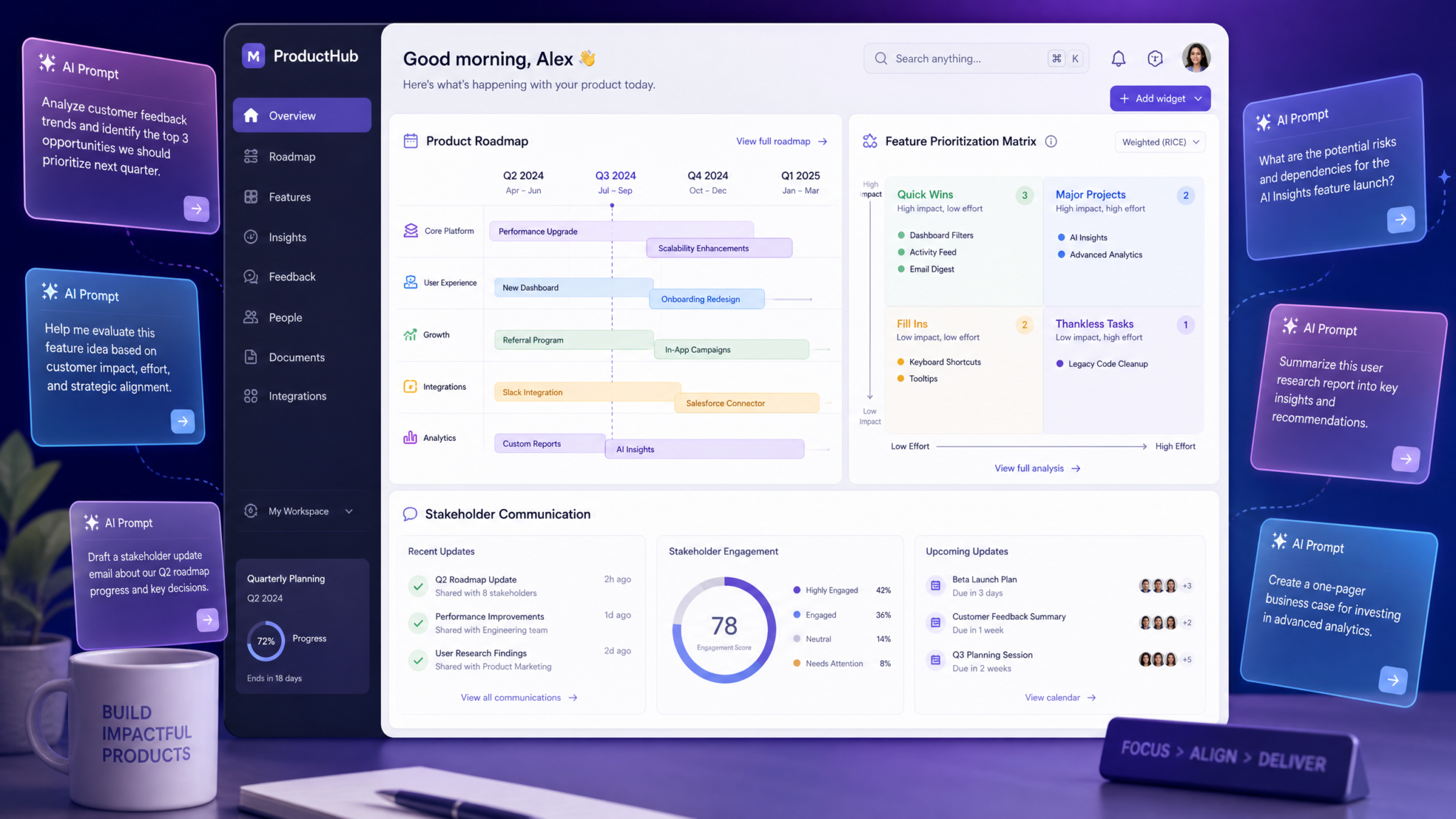
25 Production-Ready ChatGPT‑5.5 Prompts for Product Managers
Author: Markos Symeonides
Table of Contents
- 1. Roadmap Planning (6 prompts)
- 2. Feature Prioritization (6 prompts)
- 3. Stakeholder Communication (6 prompts)
- 4. Market Analysis (7 prompts)
1. Roadmap Planning (6 prompts)
This section provides prompts to produce structured quarterly plans, surface dependencies, keep milestones on track, optimize resource allocation, create realistic timelines, and craft clear communications. Each prompt is written for ChatGPT‑5.5 to output actionable artifacts: timelines, tables, risk registers, stakeholder summaries and slide-ready copy. Use these prompts directly with your product data (features, teams, availability) to generate next-stage-ready plans.
Product managers working closely with design teams will find complementary prompt strategies in our collection of 40 ChatGPT-5.5 prompts specifically crafted for UX designers, covering user journey mapping, wireframe descriptions, and usability testing scripts that align with product development workflows.
1.1 Quarterly Roadmap — Create a focused quarter plan
Context: You’re planning the upcoming quarter. You need a concise roadmap that aligns objectives, key results, major features, and implementation owners. The output should be executive-ready and operationally actionable, with priorities and risks called out.
Act as an experienced product leader. I will provide: the company goal for the quarter, top 8 candidate features (title + brief description), team capacity (FTEs per squad), known constraints (e.g., compliance, integrations), and two strategic priorities. Produce a quarterly roadmap that includes:
1) A one-paragraph executive summary linking features to strategic priorities.
2) A prioritized list of features with 1-2 sentence rationale.
3) A Gantt-style table with feature start/end weeks across 12 weeks.
4) Assigned squad and owner for each feature.
5) Top 5 risks and mitigation plans.
6) A short list of success metrics per feature (one KPI each).
Format: Executive summary, table, risks, metrics. Use concise, actionable language suitable for a leadership review.
Expected output: A one-paragraph summary; a prioritized feature list (6–8 items) with rationale; a 12-week Gantt-like table indicating weeks (1–12); owner and squad assignments; five risks with mitigations; one KPI per feature. The table should be copy-paste friendly for spreadsheets.
Pro tip: Feed the prompt with accurate team velocity (story points or FTE weeks) and mark any immovable dates (e.g., regulatory deadlines). ChatGPT will scale timelines more accurately when you specify capacity in FTE-weeks instead of generic “low/medium/high”.
1.2 Dependency Mapping — Surface and sequence dependencies
Context: Complex releases need clear dependency visualization (internal teams, third-party vendors, platform readiness). You want a dependency map that identifies critical path, upstream blockers, and parallelization opportunities.
You are a product operations analyst. I will provide: a list of features (title + required deliverables), an inventory of teams and external vendors, and any platform constraints. Produce:
1) A dependency matrix: rows = features, columns = teams/vendors/platforms, cells = "R" (required), "I" (informed), or "B" (blocking dependency).
2) A critical-path list (2–5 items) explaining why each is critical and estimated delay impact.
3) A recommended sequencing with grouped parallel work and suggested handoff points.
4) A short "action plan" of who to engage and when (owner + week).
Format: matrix, critical path, sequencing, action plan. Provide concise notes and highlight any single points of failure.
Expected output: A dependency matrix suitable for Excel, a prioritized critical-path list with delay estimates (e.g., +2 weeks), a sequencing plan showing which items can run in parallel, and a week-by-week action plan with named owners.
Pro tip: When you include each team’s SLA or typical delivery lead time, ChatGPT can annotate the matrix with expected latency and propose specific buffer windows to reduce risk.
1.3 Milestone Tracking — Build a milestone tracker for the release
Context: You need a reliable tracker that monitors milestone completion, ownership, acceptance criteria, and risk level for a release spanning several teams. The tracker should be usable in weekly syncs and should highlight overdue items.
Act as a release manager. Given a release scope (10–12 milestones with owners and due dates), produce:
1) A milestone tracker table with columns: Milestone, Owner, Due date, Acceptance criteria, Status (Not started / In progress / Blocked / Done), Risk (Low/Med/High), Next action, Dependencies.
2) A formula or rule-set to flag overdue or at-risk milestones.
3) Suggested agenda and talking points for a weekly milestone review meeting (10–15 minutes per milestone).
Format: Table + the meeting agenda. Provide sample status language for "Blocked" and "Mitigated" states.
Expected output: A comprehensive milestone tracker table ready for a collaborative doc, clear rules to auto-flag issues, and a concise meeting agenda with talking-point templates for each milestone update.
Pro tip: Include “age of status” (days since last update) in the tracker; teams are more likely to react when items show stale status and visible ownership.
1.4 Resource Allocation — Align people to priorities
Context: You’re reallocating QA, engineering, and design capacity across priorities. You need a resource plan that minimizes context switching and ensures core features have sufficient test coverage.
You are a senior PM optimizing resource allocation. I will give: list of features with estimated effort (story points or FTE-weeks), teams and their available capacity for the quarter, and a small set of constraints (e.g., hiring freezes, key PTO weeks). Provide:
1) A recommended allocation table mapping features to teams and FTE weeks.
2) A versioned plan (base case and two alternatives: constrained capacity, accelerated timeline).
3) Risks from context switching and recommended guardrails (e.g., WIP limits).
4) A short memo (3 paragraphs) to HR/engineering leadership explaining the trade-offs and asking for approvals.
Format: Allocation table, scenarios, risks, memo.
Expected output: A defensible allocation matrix, two alternative plans, a brief risk analysis, and a professional memo tailored for leadership that enumerates trade-offs and requests.
Pro tip: Provide explicit FTE-week numbers per role; ChatGPT will produce clearer allocation tables and can compute total utilization percentages per squad.
1.5 Timeline Estimation — Produce realistic delivery dates
Context: Stakeholders expect target dates. You need a defensible timeline estimate that uses inputs such as past velocity, complexity bands, and integration effort, and that quantifies uncertainty.
Act as a product planning expert. Provide me: list of features (with complexity tags: low/medium/high), historical velocity (story points per sprint or average FTE weeks), number of cross-team integrations, and desired confidence level (e.g., 70% CI). Generate:
1) An estimated timeline for each feature and for the overall release with confidence intervals (best case, likely, worst case).
2) A table showing assumptions used (velocity, concurrency, integration lag).
3) A short paragraph describing major sources of uncertainty and suggested contingency buffers.
Format: Timeline (table) + assumptions + uncertainty analysis. Use plain language suitable for a delivery review.
Expected output: Per-feature estimated completion dates with best/likely/worst windows, a transparent assumptions table, and prioritized uncertainties with buffer recommendations (e.g., add 2 weeks for X high-risk integration).
Pro tip: Use a simple Monte Carlo-style language if you can: provide distributions for velocity or lead times. Even a qualitative “30% longer if integration delayed” guidance helps stakeholders interpret the confidence intervals.
1.6 Roadmap Communication — Convert the plan into a stakeholder-ready brief
Context: Leadership and cross-functional partners need a concise one-page brief and a slide deck narrative that explains the roadmap, trade-offs, and asks. You want executive summary text and slide bullets.
You are a communications lead for product. Given the quarter roadmap (features, owners, high-level timeline, major dependencies, and top three risks), produce:
1) A one-page executive brief (max 300 words) for the CEO with top-level asks.
2) A 6-slide deck outline: slide titles and speaker notes (title slide, goals, roadmap highlights, critical dependencies, risks & mitigations, asks & decisions).
3) Two email templates: one for an all-hands announcement, one for a partner integration kickoff.
Format: Brief, slide outline with notes, two email templates. Keep language crisp and executive-focused.
Expected output: A 300-word CEO brief, a 6-slide outline with suggested speaker notes for each slide, and two tailored email templates ready for sending. The brief should include explicit asks (e.g., headcount, budget signoff) aligned to the roadmap.
Pro tip: When you include stakeholder titles and their likely concerns, the generated speaker notes will anticipate questions and provide pre-baked responses for Q&A during the meeting.
2. Feature Prioritization (6 prompts)
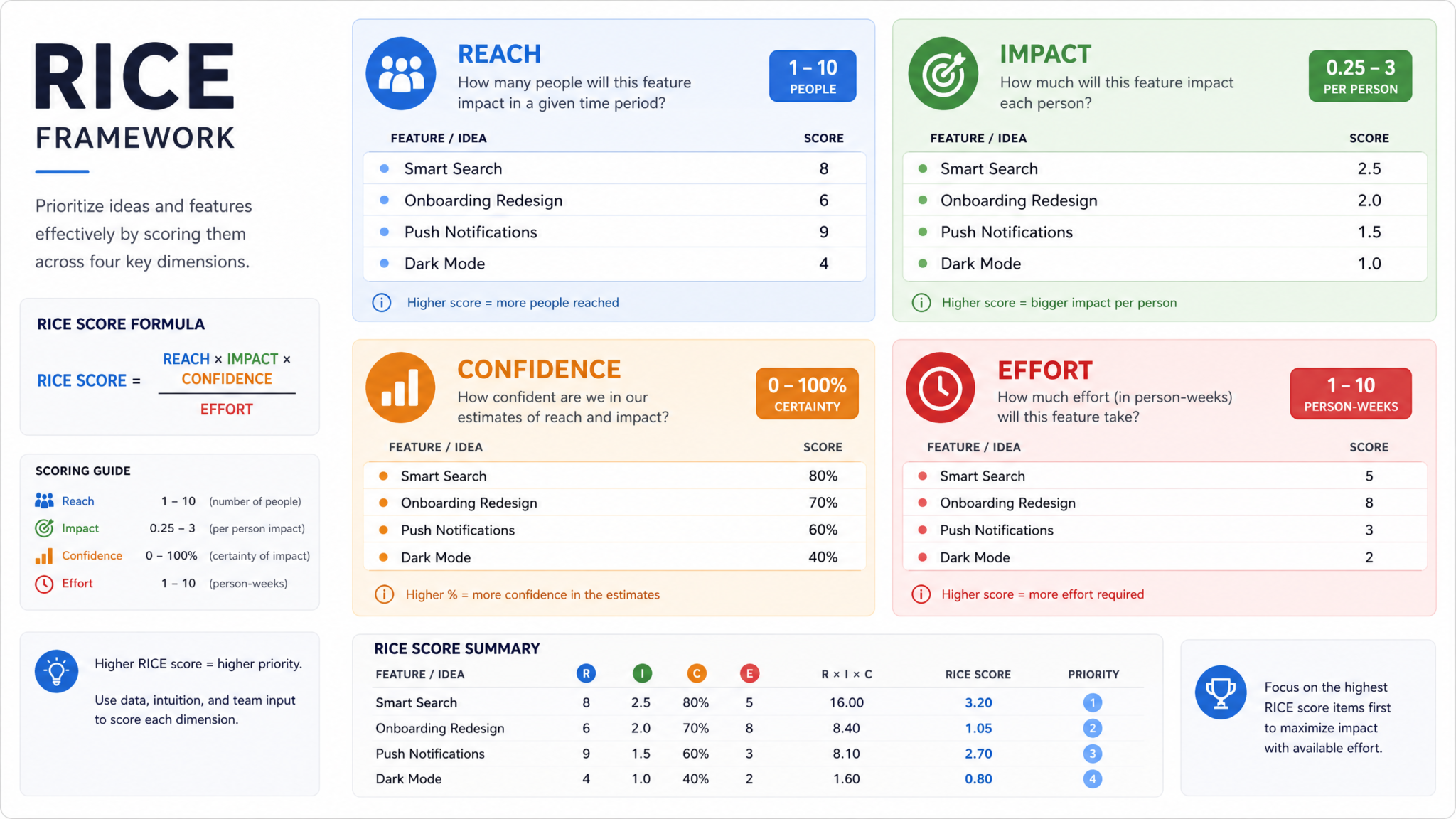
Prioritization is the core discipline of product management. These prompts help evaluate features against frameworks (RICE, MoSCoW), quantify opportunity, balance technical debt, assess customer impact, and run build-vs-buy decisions. Use the prompts to create reproducible prioritization artifacts that your PMs and engineering partners can validate.
This section includes an analytical comparison of prioritization frameworks so you can choose the right approach. The table below summarizes strengths, weaknesses, and ideal use cases for RICE, MoSCoW, Opportunity Scoring, and Weighted Scoring.
| Framework | Strengths | Weaknesses | Ideal Use Case |
|---|---|---|---|
| RICE | Quantitative, balances reach/impact/confidence/cost | Estimates can be subjective; less effective for exploratory bets | Feature prioritization where user metrics and impact estimates exist |
| MoSCoW | Clear categories, easy stakeholder alignment | Can be coarse-grained; categories get inflated | Release scoping with clear must/should/could/won’t distinctions |
| Opportunity Scoring | Focuses on unmet user needs and value gaps | Requires user research data; subjective if missing | Deciding on new product or major feature direction |
| Weighted Scoring | Customizable factors, transparent weighting | Weights can be contested; needs governance | Cross-functional prioritization with clear company criteria |
For product managers overseeing supply chain products or logistics platforms, specialized domain prompts can accelerate analysis. Our 35 ChatGPT-5.5 prompts for supply chain managers cover demand forecasting, inventory optimization, and vendor risk assessment frameworks that complement the general PM prompts in this guide.
2.1 RICE Scoring — Apply RICE to a feature set
Context: You have a backlog of candidate features and want to objectively rank them with RICE (Reach, Impact, Confidence, Effort). The prompt should request a reproducible table and a short narrative on borderline cases.
Act as a senior PM and data-informed prioritizer. I will provide: up to 12 candidate features with a short description and any existing metrics (e.g., estimated # users impacted per month). Use the RICE framework and produce:
1) A scoring table with columns: Feature, Reach (# users or sessions per month), Impact (0.25/0.5/1/2/3), Confidence (0–100%), Effort (person-weeks), RICE score (formula: Reach * Impact * Confidence / Effort).
2) A ranked list by RICE score and short rationale for the top 5.
3) Notes on items with close scores (within 10%) recommending tie-breakers (strategic fit, technical dependency).
Format: Table + ranked rationale. Show calculation example for one row.
Expected output: A complete RICE table with numeric calculations, ranks, and a short write-up explaining tie-breakers and suggested next steps for the top 5 features.
Pro tip: Provide real reach numbers where possible (MAUs, DAUs, transactions). Confidence is often the most influential input—document its basis (A/B results, user interviews, educated guess).
2.2 MoSCoW Analysis — Categorize for release planning
Context: The upcoming release needs a clear Must/Should/Could/Won’t (MoSCoW) breakdown to align engineering, sales, and customer success. You need definitions that are actionable and guardrails to prevent scope creep.
Act as a release planner. I will supply: a list of ~10 candidate items with brief descriptions and ideal outcomes. Produce:
1) A MoSCoW table categorizing each item with a concise justification (20–40 words).
2) Clear definitions and acceptance criteria for each category tailored to our organization (e.g., "Must" = must be in the GA build to meet contractual obligations).
3) A simple escalation rule for reclassification (who can move items and under what conditions).
Format: Table + definitions + escalation policy.
Expected output: A MoSCoW table, organization-specific category definitions, and a short escalation policy to maintain scope discipline during delivery.
Pro tip: Anchor “Must” items to measurable or contractual requirements. That reduces subjective debates and keeps scope decisions defensible.
2.3 Opportunity Scoring — Prioritize by unmet user needs
Context: You’re deciding which new capabilities best address unmet user needs. Opportunity scoring weights user importance against current satisfaction to find high-opportunity features.
You are a product strategist. Given: a list of user needs mapped to proposed features and, where available, user importance and satisfaction scores (1–5). Produce:
1) An opportunity scoring table: Need/Feature, Importance (1–5), Satisfaction (1–5), Opportunity = Importance - Satisfaction (or use provided formula), Opportunity rank.
2) Two short personas most affected by the top 3 opportunities.
3) Suggested lightweight experiments for validating the top two opportunities (hypothesis, metric, sample size or qualitative approach).
Format: Table + personas + experiments. Be specific about metrics and success criteria.
Expected output: Ranked opportunity table, two personas with contexts, and concrete experiment plans (e.g., prototype test with N=30, primary metric: task completion rate).
Pro tip: Use real user research if you have it. If not, ask ChatGPT to generate reasonable proxy numbers and flag them clearly as estimates for later validation.
2.4 Tech Debt Prioritization — Balance new features with refactor work
Context: Engineering requests prioritization of technical debt items. Leadership needs a view of short-term impact vs long-term maintainability to decide how much capacity to allocate.
Act as a technical product manager. Provide: a list of technical debt items (short description, impacted components, estimated remediation effort). Respond with:
1) A prioritization table using factors: Customer Impact (0–3), Developer Productivity Impact (0–3), Risk (0–3), Effort (person-weeks), Composite Priority Score and rank.
2) Recommended allocation of total sprint capacity (%) to tech debt for the next quarter (e.g., 10–25%) with rationale.
3) An elevator pitch (2–3 sentences) to present to execs justifying the chosen allocation.
Format: Table + allocation recommendation + exec pitch.
Expected output: A prioritization table with composite scores and ranked items, recommended percent capacity for tech debt with rationale, and a concise exec justification.
Pro tip: Include observed frequency of bugs or time lost to rework if you can—these hard numbers make the case for allocating sprint capacity far more compelling.
2.5 Customer Impact Prioritization — Prioritize by customer value
Context: You want to prioritize features by direct customer impact, considering revenue, retention, and customer effort reduction. This prompt should produce a ranked backlog emphasizing customer value and commercial outcomes.
You are a customer-centric PM. I will provide: feature list with any known customer segments, revenue impact estimates or qualitative value indicators. Produce:
1) A customer impact table with columns: Feature, Primary segment, Expected revenue/retention uplift (qual/quant), Customer effort change (reduced/increased/neutral), Priority rank.
2) A one-paragraph recommendation for top 3 features with go/no-go reasoning tied to customer value.
3) Suggested customer-facing messaging points for each top feature (3 bullets each) focusing on value proposition.
Format: Table + recommendation + messaging bullets.
Expected output: A table ranking features by customer impact, rationale for the top 3 prioritized items, and messaging bullets tailored for marketing and customer success alignment.
Pro tip: Include segment-specific KPIs (e.g., churn rate for enterprise users) to make revenue/retention uplift estimates more defensible.
2.6 Build-vs-Buy Evaluation — Run a structured make-or-buy analysis
Context: You must decide whether to build a component or integrate a third-party vendor. Decision makers need a cost-benefit analysis, time-to-market comparison, long-term maintenance implications, and recommended contract terms.
Act as a strategic PM evaluating build vs buy. Given: feature/component description, estimated internal build cost (person-weeks), vendor shortlist with pricing if available, security/compliance constraints, and time-to-market requirements. Produce:
1) A comparison matrix with columns: Option (Build, Vendor A, Vendor B), Upfront cost, Ongoing cost, Time-to-market, Customization level, Risk profile, Strategic implications, Recommendation.
2) A brief ROI estimate (3-year TCO) for each option and a recommended negotiating point for vendor contracts (SLA, data handling, exit terms).
3) A recommended pilot plan if choosing buy (duration, success criteria).
Format: Matrix + ROI + pilot plan. Provide clear recommendation and rationale.
Expected output: A decision matrix with quantitative and qualitative factors, a 3-year total cost of ownership estimate, and a pilot/negotiation plan with specific SLA asks for vendor options.
Pro tip: When vendor pricing is missing, provide realistic market ranges and explicitly flag assumptions so procurement can validate or replace them.
3. Stakeholder Communication (6 prompts)
Effective communication reduces friction, clarifies decisions, and accelerates alignment. These prompts generate executive summaries, sprint review scripts, release notes, alignment documents, board presentation outlines, and incident communications. Each output is designed to be copy-paste ready into emails, slide decks, or Slack posts.
Understanding the capabilities of the model you’re prompting is essential for crafting effective instructions. The GPT-5.5 Instant Mini rollout introduced faster inference for everyday tasks, making it ideal for the quick-turnaround prompts in the stakeholder communication section of this guide.
3.1 Executive Summary — Weekly exec brief about product status
Context: C-suite needs a 200–300 word weekly product update summarizing progress, risks, and decisions required. The update should prioritize brevity while surfacing meaningful changes since last week.
Act as a chief of staff for product. I will give: current top-level goals, one-line status for top 5 initiatives, two emerging risks, and any key decisions pending. Produce:
1) A 200–300 word executive summary that includes: headline status (Green/Amber/Red), progress highlights, key risk(s) with impact and ask, and a recommended decision or approval request (if applicable).
2) A 3-bullet "What I need from you" callout for each executive recipient (CEO, CTO, Head of Sales).
Format: Executive summary + tailored asks. Keep tone concise and action-oriented.
Expected output: A polished 200–300 word executive brief with a headline health indicator, three prioritized asks, and short rationale tying updates to company objectives.
Pro tip: Use one sentence per initiative to enforce brevity. Executives prefer clear asks with explicit options (e.g., “Approve A or B by Friday”).
3.2 Sprint Review Script — Guide for demo day
Context: You need a concise script and facilitator notes for a sprint review meeting (30–60 minutes) that keeps stakeholders engaged and surfaces acceptance criteria for completed work.
Act as a scrum master scripting a sprint review. Given: sprint length, list of completed user stories with owners and acceptance criteria, and a small list of demo requests, produce:
1) A timed agenda (e.g., 30 minutes) with responsibilities and demo order.
2) A facilitator script with exactly what to say to introduce each demo (20–40 words).
3) A template feedback capture sheet for stakeholders (what worked, what needs follow-up, votes on readiness).
4) A closing slide text for next steps and acceptance decisions.
Format: Agenda + script + feedback template + closing slide text. Ensure timeboxing and clear acceptance triggers.
Expected output: A timeboxed agenda, pre-written demo introductions, a stakeholder feedback capture table, and a closing slide with next steps and acceptance criteria for each story.
Pro tip: Add a brief “demo checklist” for presenters (login, test data, expected path) to reduce demo failures during review.
3.3 Release Notes — Customer-facing release note draft
Context: You’re drafting release notes for a public launch. The notes must be structured for both technical and non-technical audiences, include upgrade instructions, highlight breaking changes, and incorporate a short “for enterprise customers” section.
Act as a product communications writer. Given: a release version number, list of new features (title + short description), bug fixes, breaking changes, and any migration steps, produce:
1) A release note document with sections: Summary (2–3 sentences), What's new (feature bullets with benefit statements), Bug fixes (short list), Breaking changes & migration steps (detailed), For enterprise customers (impact & support details), and How to get help (support links/contacts).
2) A short marketing blurb (50–80 words) for the product page.
3) One internal Slack post announcing the release with suggested @mentions and links.
Format: Release notes + marketing blurb + Slack announcement. Use clear customer-friendly language and technical details where required.
Expected output: Complete release notes document, a marketing blurb for the product page, and a ready-to-send internal Slack message including who to notify for major issues.
Pro tip: Separate “user-facing benefits” from “technical notes” visually to serve both audiences. For breaking changes, provide migration scripts or step-by-step instructions to reduce support load.
3.4 Alignment Document — Create a one-page alignment memo
Context: Cross-functional alignment is needed on a pivot (e.g., deprioritizing a feature). You need a one-page memo that states the decision, rationale, stakeholders affected, and next steps.
Act as a cross-functional PM. I will provide: the decision (e.g., deprioritize X), key reasons, affected teams, and any contractual or customer implications. Produce:
1) A one-page alignment memo with sections: Decision summary, Rationale (data-driven), Impacted stakeholders, Implementation plan (who does what and when), Communication plan (customers/partners), and Escalation path.
2) Two short Q&A items anticipating likely pushback with suggested responses.
Format: Memo + Q&A. Keep it factual and concise for distribution to leadership and cross-functional teams.
Expected output: A one-page memo that can be circulated to stakeholders, with pragmatic next steps and prepared responses to likely objections.
Pro tip: Attach a one-row impact table (team, impact, mitigation) to make the consequences and responsibilities visible at a glance.
3.5 Board Presentation — Prepare slides and talking points
Context: You must present product progress and asks at a board meeting. The board needs strategic context, performance vs plan, and an explicit ask (budget/headcount/strategy). You need slide titles, content bullets, and speaker notes that anticipate board-level questions.
Act as a VP of Product prepping for a board meeting. Given: top company objectives, product KPIs (growth, retention, revenue, NPS), notable highlights and misses, and the specific ask (e.g., $X for GTM), produce:
1) A 10-slide outline with titles, 3–5 bullet points per slide, and speaker notes for each slide (anticipated questions and suggested answers).
2) A one-slide "ask" with clear use of funds and measurable milestones.
3) Two backup slides with deeper metrics (funnel breakdown; roadmap contingency plans).
Format: Slide outline + speaker notes + ask slide + backups. Use board-level language, quantify everything where possible.
Expected output: A slide-by-slide outline ready for conversion to a deck, an explicit one-slide ask with ROI/milestones, and two data-rich backup slides.
Pro tip: Practice the 90-second pitch for the ask slide. The speaker notes generated here can be converted to that tight pitch to ensure clarity under time pressure.
3.6 Incident Communication — Draft incident status and postmortem comms
Context: A critical incident occurred. You must draft an initial status update, a timeline update for stakeholders, and a postmortem summary once resolved. Tone must be calm, transparent, and action-oriented, with clear customer remediation steps if needed.
Act as an incident commander. Provided: incident summary (impact, start time, systems affected), current status, mitigation actions in progress, and expected owner(s). Produce:
1) An initial incident status update for internal stakeholders (title, impact summary, systems, current mitigation, ETA).
2) A template timeline update for each hour containing the fields: time, action taken, owner, status change, next step.
3) A postmortem summary skeleton after resolution with sections: summary, impact, root cause, timeline, remediation actions, follow-up owner and dates, customer communication plan.
Format: Status update + hourly update template + postmortem skeleton. Use transparent and non-blame language.
Expected output: An immediate internal status message for distribution, an hourly updates template suitable for a war room, and a full postmortem template to be completed after root cause analysis.
Pro tip: Include a pre-approved customer communication template to accelerate external messaging and reduce drift between internal and external narratives.
4. Market Analysis (7 prompts)
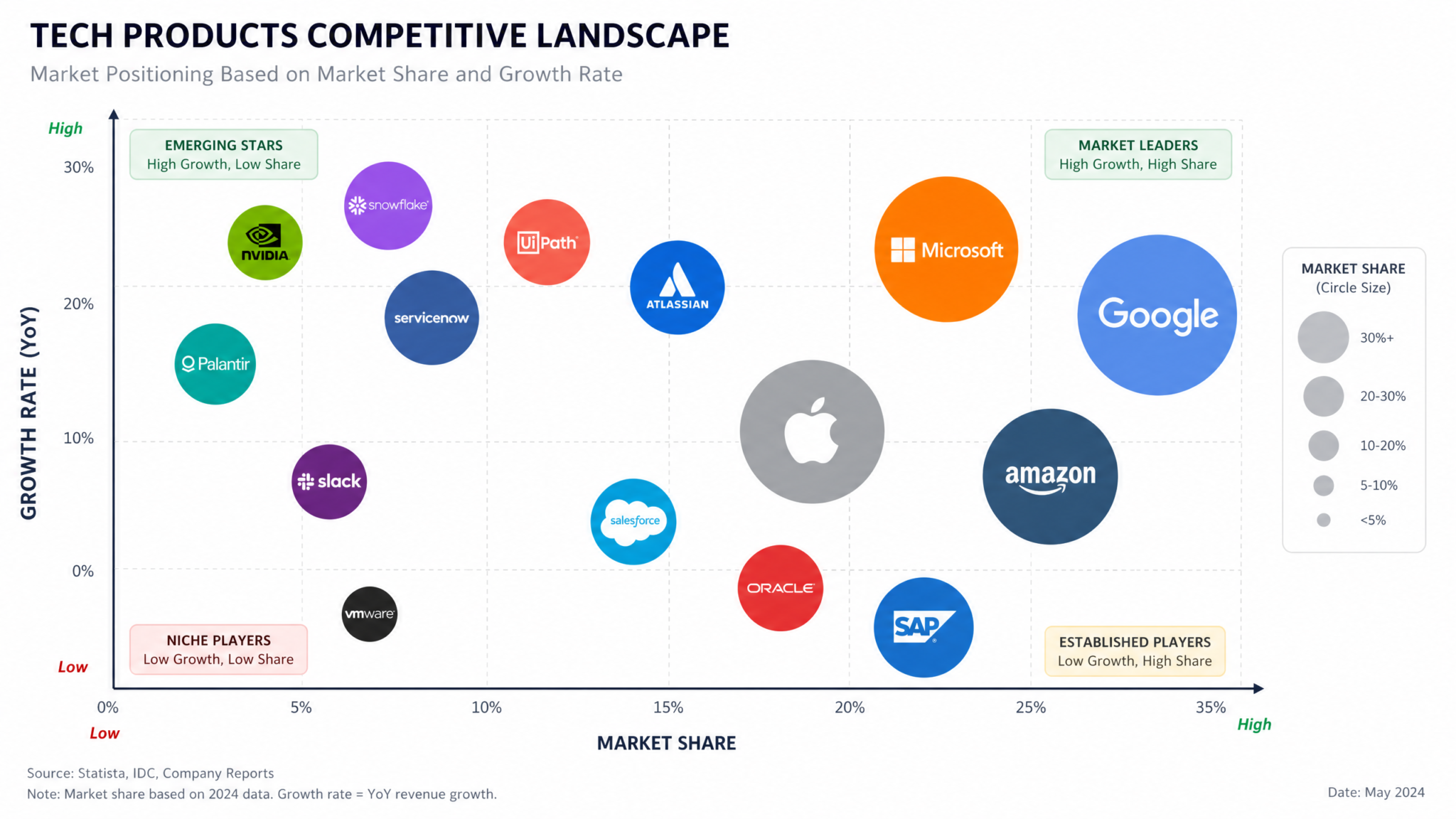
Market analysis prompts help PMs build defensible competitive maps, estimate market size, synthesize personas, track trends, design pricing strategies, plan go-to-market launches, and analyze wins and losses. Each prompt produces deliverables you can include in investor decks, GTM plans, or strategic reviews.
For teams conducting systematic market sizing and competitive research, there is an advanced methodology guide that includes step-by-step approaches for TAM/SAM/SOM, competitor scoring templates, and a reproducible win/loss playbook: The Codex CI/CD Pipeline Playbook
4.1 Competitive Landscape — Produce a competitor matrix and strategic implications
Context: You want a clear competitive landscape for executives and sales enablement. The output should include a matrix comparing features, pricing, strengths, weaknesses, and a short strategy playbook for positioning.
Act as a market strategist. Given: primary competitors list (3–6), your product's current feature set and pricing tiers, and target customers, produce:
1) A competitor matrix with rows = competitors + your product, columns = categories: Core features, Pricing model, Strengths, Weaknesses, Ideal customer profile, Market position.
2) A short-positioning playbook (3 tactics) for sales to win competitive deals against the top two competitors, including objection responses and differentiators.
3) A SWOT summary (1 paragraph) for each competitor and a recommended focus area for us.
Format: Matrix + playbook + SWOTs. Be specific on feature parity and perceived gaps.
Expected output: A tabular competitor matrix, practical sales tactics for the top competitive threats, and concise SWOT analyses with recommended strategic focus.
Pro tip: Provide any recent win/loss calls or customer quotes—these let ChatGPT incorporate real voice-of-customer evidence into objection handlers and positioning language.
4.2 Market Sizing — Generate TAM/SAM/SOM estimates with sources
Context: You need defensible top-down and bottom-up TAM/SAM/SOM calculations for a fundraising memo or executive planning. The output should show assumptions and provide ranges with sensitivity analysis.
Act as a market economics analyst. I will provide: target market definition, geography, industry vertical(s), and any relevant market data points (e.g., number of enterprises, average contract value). Produce:
1) Top-down TAM estimate using available industry metrics and clear source assumptions.
2) Bottom-up SAM and SOM calculation using realistic adoption rates, conversion funnels, and pricing assumptions.
3) Sensitivity analysis with three scenarios (conservative, base, aggressive) and the key drivers for each scenario.
4) A one-paragraph summary for an investor memo stating assumptions and key risks.
Format: Calculations with step-by-step assumptions and scenario summary. Cite types of sources you would use (e.g., IDC, Gartner, Bureau of Labor stats) even if exact numbers are illustrative.
Expected output: A TAM/SAM/SOM calculation with explicit assumptions, scenario ranges, and a compact investor-ready summary describing source types and major sensitivity drivers.
Pro tip: If you lack primary market numbers, use proxy markets (adjacent verticals or public datasets) and explicitly label them as proxies; investors and leadership prefer transparent assumptions.
4.3 Persona Synthesis — Create high-fidelity personas from interview notes
Context: You have 10–20 user interview notes. You need consolidated personas that capture goals, pain points, buying criteria, and how they measure success. Each persona should include a short narrative useful for product and marketing.
Act as a user researcher. I will provide rough interview notes (bulleted highlights per interview). Produce:
1) 3–5 synthesized personas with: name, title, demographics, main goals, top 5 pain points, buying criteria, metrics they care about, and a short 2–3 sentence day-in-the-life narrative.
2) For each persona, propose 2–3 prioritized product features or messaging angles that would most likely move them from awareness to purchase.
3) A recommended research follow-up plan (2–3 methods) to validate assumptions and refine personas.
Format: Persona cards + features/messaging + follow-up plan. Make personas usable for roadmap decisions and marketing campaigns.
Expected output: A set of polished persona cards ready for use in product discovery and marketing, with corresponding feature or messaging recommendations and a prioritized research plan for validation.
Pro tip: Ask ChatGPT to output a one-line “why this persona matters” to help product managers quickly recall priority during planning sessions.
4.4 Trend Analysis — Identify and prioritize relevant market trends
Context: You need to understand which macro and micro trends (technology, regulatory, customer behavior) are most likely to affect your product over the next 12–36 months and recommend strategic responses.
Act as a strategic market analyst. Given: your product category and geography, produce:
1) A prioritized list of 6–10 market trends (technology, regulation, behavior) relevant to your product with expected time horizon (12/24/36 months).
2) For each trend, the likely impact (high/medium/low) on demand, product requirements, and go-to-market.
3) Recommended strategic responses (3 tactics) the product team should consider (e.g., API-first, partnerships, compliance investments), prioritized by feasibility and impact.
Format: Trend list + impact analysis + strategic responses. Provide concise justifications for each trend’s priority.
Expected output: A ranked trends list with time horizons, impact assessments, and prioritized strategic responses that product and leadership can act on during planning cycles.
Pro tip: Ask for signaling indicators (leading metrics) you can monitor monthly to detect acceleration or slowdown of each trend.
4.5 Pricing Strategy — Design a pricing model and test plan
Context: You must propose a pricing architecture for a SaaS product: tier definitions, value metrics, price bands, and an experiment plan for pricing validation. The output should balance growth and monetization objectives.
Act as a pricing strategist. Given: product value props, target segments, competitor pricing ranges, and current ARPU if available, produce:
1) A 3-tier pricing architecture with tier names, value metrics, feature sets per tier, and suggested price points.
2) A rationalized pricing model (per seat, per usage, tiered flat fee, hybrid) explaining why it fits product economics and customer buying behavior.
3) A pricing experiment plan (A/B test or pilot) with hypothesis, sample sizes, primary metrics (conversion, LTV/CAC), and success thresholds.
Format: Tier table + pricing rationale + experiment plan. Show quick sensitivity on revenue for +/-10% price changes on each tier.
Expected output: A clearly defined tier table with recommended prices and feature allocations, a defensible model rationale, and a concrete experiment plan to test pricing assumptions.
Pro tip: When crafting price points, focus on perceived value thresholds (e.g., psychological price breaks) and provide a short note on when to discount (e.g., pilot customers, enterprise negotiations).
4.6 Go-to-Market Planning — Create a launch-ready GTM plan
Context: A product is ready for commercial launch. The GTM plan must include target segments, messaging pillars, channel strategy, sales enablement, launch milestones, and KPIs for the first 90 days.
Act as a head of product marketing. Given: product positioning statement, target segment(s), pricing tiers, and sales model (self-serve, inside sales, enterprise), produce:
1) A GTM plan covering: target personas, top 3 messaging pillars with proof points, channel mix and rationale, key launch milestones (pre-launch, launch, post-launch 90-day calendar), sales enablement checklist, and KPIs to track in first 90 days.
2) A one-page launch brief for cross-functional partners with explicit asks from each function (product, engineering, sales, marketing, CS).
3) A list of 5 quick-win experiments to accelerate early adoption (e.g., targeted free trials, partner discounts).
Format: GTM plan + launch brief + experiments. Prioritize clarity and measurable milestones.
Expected output: A pragmatic GTM plan with specific milestones, role-level asks, and a set of early experiments designed to generate momentum and measurable early indicators of demand.
Pro tip: Integrate sales enablement with measurable outcomes—e.g., include training completion rate and first-quarter deal velocity targets as KPIs to ensure partner readiness.
4.7 Win/Loss Analysis — Build a repeatable win/loss playbook
Context: Your sales organization captures wins and losses but lacks a consistent analysis process. You need a win/loss playbook that structures interviews, captures competitive reasons, and surfaces product and GTM improvements.
Act as a competitive intelligence lead. Given: existing win/loss notes (if any), produce:
1) A repeatable win/loss interview guide (questions for customers, prospects, and internal sellers).
2) A template for encoding results into a database (fields: deal size, decision factors, competitor, demo feedback, pricing sensitivity, timeline, outcome).
3) A synthesis framework to convert raw interviews into strategic actions (e.g., product fixes, messaging changes, pricing adjustments) and an example synthesis for one hypothetical loss.
Format: Interview guide + database template + synthesis framework + example. Make it operational for a sales ops or product ops team to run weekly cadence.
Expected output: A practical interview guide, a structured database schema for capturing standardized win/loss attributes, and an analysis framework that translates insights into prioritized actions for product and GTM teams.
Pro tip: Pair win/loss interviews with customer health and intent signals (usage metrics, demo engagement) to triangulate reasons for decisions and reduce recall bias.
Comparative Reference Tables
Below are two quick reference tables to help you compare common prioritization and communication approaches used in product organizations. Use these as quick aids during planning and stakeholder alignment.
| Prioritization Method | Best for | Produces | Downside |
|---|---|---|---|
| RICE | Data-informed backlog ranking | Numeric score, ranked list | Sensitive to confidence estimates |
| MoSCoW | Release scoping with stakeholders | Category assignments | Coarse categories can be abused |
| Opportunity Scoring | Feature discovery prioritization | Value gap rankings | Needs user research |
| Weighted Scoring | Cross-functional trade-offs | Custom weighted ranks | Requires governance on weights |
| Communication Type | Audience | Ideal Length | Key Elements |
|---|---|---|---|
| Executive Summary | CEO, exec team | 200–300 words | Headline, progress, risks, asks |
| Sprint Review | Engineering, PM, stakeholders | 30–60 minutes | Demos, acceptance, backlog decisions |
| Release Notes | Customers, support, sales | 1–2 pages | Summary, features, breaking changes |
| Incident Status | Internal ops, customers (if public) | Short, frequent updates | Impact, mitigation, ETA, owner |
How to Use These Prompts Effectively
- Pre-fill contextual data: The more concrete inputs you provide (capacity, metrics, exact feature descriptions, customer quotes), the more precise the outputs. Before invoking a prompt, gather a small payload of facts—this improves quality dramatically.
- Iterate with constraints: Use follow-up prompts to tighten outputs—ask for shorter executive versions, more conservative estimates, or alternate scenarios. Treat ChatGPT as a collaborative co-author.
- Validate outputs: Use quick experiments: share generated slides/memos with a small group to sanity-check assumptions, and run a 1:1 with key owners to confirm feasibility.
- Make outputs reproducible: Save prompt + inputs + outputs as a planning artifact to audit decisions later and to accelerate future planning cycles.
Access 40,000+ AI Prompts for ChatGPT, Claude & Codex — Free!
Subscribe to get instant access to our complete Notion Prompt Library — the largest curated collection of prompts for ChatGPT, Claude, OpenAI Codex, and other leading AI models. Optimized for real-world workflows across coding, research, content creation, and business.
Final Notes
These 25 prompts are crafted for ChatGPT‑5.5 to produce operational artifacts that product managers can use immediately in planning, prioritization, stakeholder communications, and market analysis. For best results, pair the prompts with structured input data (CSAT numbers, FTE resources, historical velocity, interview notes) and iterate on generated drafts rather than treating them as one-shot outputs.
If you want, I can convert any of these prompts into a reusable template for your team’s internal prompt library (including slots for variables and sample inputs). Specify which one and I’ll prepare a templated version optimized for automation and integration with your PM tooling.
