
Building Automated Workflows with Claude Managed Agents
In today’s fast-paced digital landscape, automation is no longer a luxury but a necessity. Developers and organizations alike are constantly seeking advanced tools to streamline complex workflows, reduce manual intervention, and enhance operational efficiency. Enter Claude Managed Agents—a groundbreaking solution announced by Anthropic at the “Code with Claude 2026” conference. Designed to empower developers with sophisticated automation capabilities, Claude Managed Agents enable the creation of resilient, intelligent workflows that integrate sandboxed code execution, credential management, and dynamic decision-making strategies.
Automation frameworks have evolved significantly over the past decade, moving from simple script-based scheduling to intelligent agents that adapt and optimize tasks in real time. Claude Managed Agents elevate this paradigm by combining the strengths of Anthropic’s language models and advanced orchestration techniques. At their core, these agents facilitate sandboxed execution environments, ensuring code runs securely and isolated from sensitive resources. This capability is critical for maintaining trust and integrity in automated processes, especially when dealing with privileged credentials and complex system interactions.
As automation systems grow in complexity and scale, the integration of AI-powered decision layers becomes essential for managing dynamic workflows. Claude Managed Agents leverage advanced natural language understanding and context-aware processing to not only execute predefined instructions but also adaptively modify their behavior in response to changing conditions. This marks a significant step beyond traditional rule-based automation, enabling workflows to handle exceptions, optimize task sequences, and interact intelligently with external APIs and services.
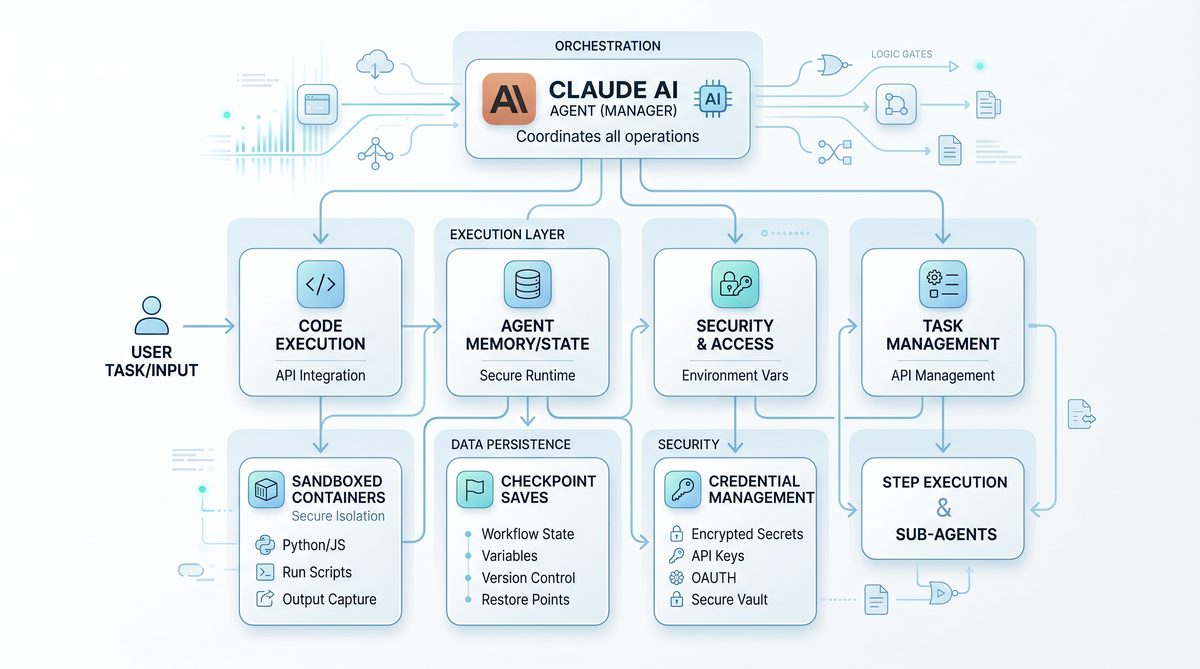
One of the most innovative features of Claude Managed Agents is their built-in checkpointing system, which allows workflows to resume seamlessly after interruptions or failures. This ensures robustness and continuity, essential for mission-critical applications. Additionally, credential scoping within Claude Managed Agents tightly controls access permissions, significantly reducing the attack surface and enhancing security posture.
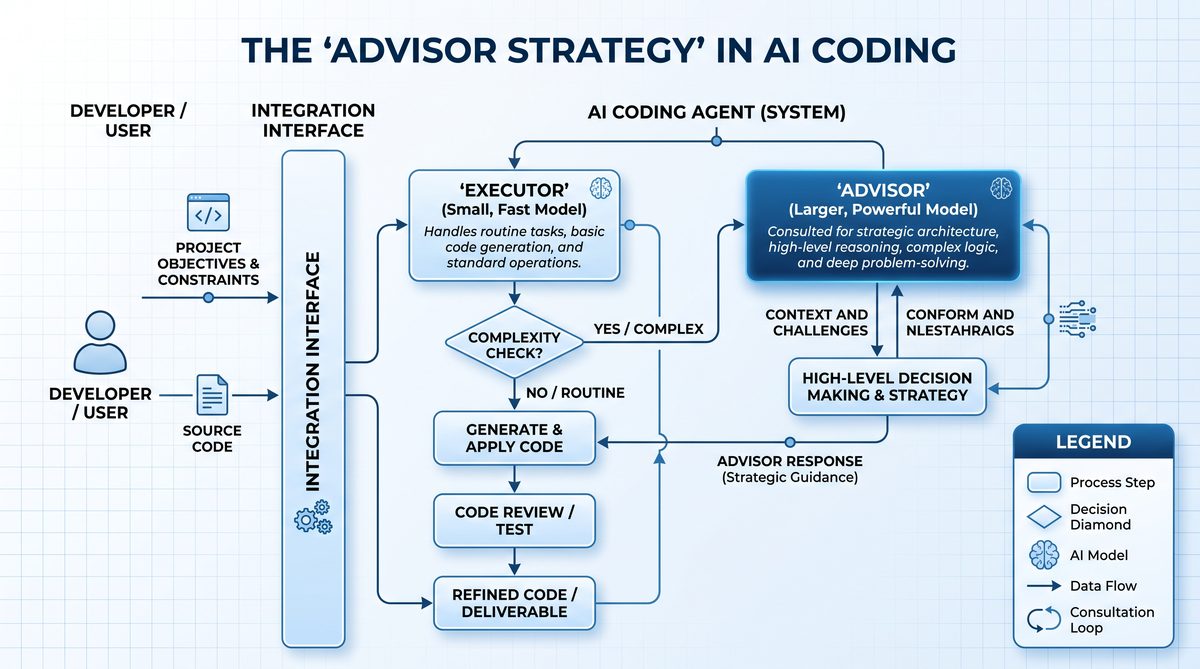
Central to the operational efficiency of Claude Managed Agents is the “advisor strategy,” a hybrid approach that dynamically selects the optimal execution engine based on task complexity. By leveraging Haiku for routine tasks and Opus for handling hard cases, this strategy optimizes resource utilization and task accuracy. Furthermore, the agents can be scheduled to run automatically using cron jobs or triggered by GitHub webhooks, enabling developers to integrate sophisticated automated routines seamlessly into their existing development pipelines.
Anthropic has been pushing the boundaries of agent memory and learning. Their recently announced “Dreaming” feature allows managed agents to consolidate knowledge from previous sessions, creating persistent learning loops. Our analysis of how Claude Managed Agents learn from past sessions through the Dreaming feature explores the technical mechanisms behind this capability and its implications for long-running automation.
Core Technology and Architecture of Claude Managed Agents
Claude Managed Agents represent a significant advancement in automated workflow orchestration, enabling developers to build complex, reliable, and secure task execution pipelines with minimal overhead. Announced at the ‘Code with Claude 2026’ event by Anthropic, these agents combine sandboxed code execution, intelligent checkpointing, and fine-grained credential scoping to deliver a robust environment for automation. At the heart of this system lies a sophisticated architecture designed for extensibility, safety, and seamless integration with existing developer tools and infrastructure.
Sandboxed Code Execution: Ensuring Safe and Predictable Automation
One of the foundational features of Claude Managed Agents is the sandboxed code execution environment. This design choice isolates the agent’s runtime from the host system, preventing unintended side effects or security risks. By running automation scripts and workflows within this controlled sandbox, developers can confidently execute tasks that interact with sensitive data or external services without compromising system integrity.
The sandbox supports multiple programming languages and runtime environments, abstracting away the complexity of environment configuration. It also enforces strict resource limits (CPU, memory, execution time) to prevent runaway processes and ensure predictable performance. This capability is essential for scalable automation, where diverse tasks with varying resource demands are executed concurrently.
For example, a workflow may involve executing Python scripts to process data, invoking shell commands to interact with system utilities, and running JavaScript snippets for web API interactions—all within isolated sandboxes. This multi-language support allows heterogeneous tasks to coexist without conflicts, while resource constraints prevent any single task from degrading overall system responsiveness. Additionally, the sandbox environments can leverage containerization technologies such as lightweight Linux namespaces or microVMs to enhance isolation and security assurances.
Checkpointing: Reliable Progress Tracking and Failure Recovery
Automated workflows often involve multi-step processes that can be interrupted or fail due to transient errors or external dependencies. Claude Managed Agents address this challenge through an advanced checkpointing mechanism that periodically saves the state of a workflow. This allows workflows to resume from the last successful checkpoint rather than starting over, significantly improving resilience and efficiency.
The checkpointing system integrates seamlessly with the sandboxed execution environment, capturing both code state and relevant runtime data. Developers can customize checkpoint intervals and define critical checkpoints manually within their workflows. This flexibility ensures that long-running or complex automation scripts maintain integrity even in the face of unexpected disruptions.
Consider a data processing pipeline that ingests large datasets and applies multiple transformations. Without checkpointing, any failure late in the pipeline would necessitate restarting from scratch, wasting compute resources and time. Claude Managed Agents mitigate this by serializing intermediate states such as partial results, execution variables, and system metadata. Recovery routines then reload these checkpoints to continue processing seamlessly. This approach also supports distributed workflows, where checkpoint states can be synchronized across multiple agents to maintain consistency and enable parallel execution.
Credential Scoping: Secure Access Management for Automated Tasks
Security is paramount when automating workflows that require access to sensitive resources such as APIs, databases, or cloud services. Claude Managed Agents incorporate a credential scoping framework that grants agents the minimum necessary permissions based on the specific tasks they perform. This principle of least privilege minimizes the risk of credential leakage or misuse.
Credentials are scoped dynamically and injected into the sandbox environment only for the duration of the task execution. Post-execution, the credentials are revoked or invalidated automatically, reducing the attack surface. This approach simplifies credential management and ensures compliance with organizational security policies. Additionally, the system supports integration with popular secret management tools, allowing seamless retrieval and rotation of credentials.
For instance, an agent tasked with updating a database record might be granted a scoped API token limited to write-access on a specific table and only valid during the execution window. This token is provisioned just-in-time, reducing exposure. Furthermore, credential usage is logged and monitored, enabling audit trails that meet compliance requirements such as SOC 2 or ISO 27001. Integration with vault solutions like HashiCorp Vault or AWS Secrets Manager streamlines automated credential rotation and revocation, enhancing security hygiene.
The Advisor Strategy: Orchestrating Execution with Haiku and Opus Models
At the core of Claude Managed Agents’ intelligence lies the advisor strategy, a hybrid approach that leverages specialized AI models to handle task execution efficiently. The two primary models involved are Haiku and Opus, each optimized for different types of workload complexity.
- Haiku: This model is designed for the majority of tasks—those that are straightforward and well-defined. Haiku excels at executing routine operations quickly and with high accuracy, making it the default choice for everyday automation.
- Opus: Opus handles the “hard cases,” such as ambiguous tasks, complex decision-making scenarios, or operations requiring nuanced understanding. When Haiku encounters a challenging situation, the advisor strategy escalates the workflow to Opus, ensuring that intricate problems are addressed with the appropriate level of cognitive sophistication.
This advisor strategy enables Claude Managed Agents to balance speed and depth, using computational resources efficiently while maintaining high-quality execution. The seamless switching between Haiku and Opus models abstracts complexity from developers, allowing them to focus on defining workflows rather than managing AI model selection.
In practical terms, this approach reduces latency for common tasks by using the lightweight Haiku model, while still delivering expert-level reasoning where needed through Opus. For example, in a workflow that processes customer support tickets, Haiku might classify and route standard inquiries immediately, while Opus is invoked to interpret complex, multi-faceted issues requiring contextual understanding and policy compliance checks. This division of labor preserves system responsiveness and enhances overall throughput.
Scheduling and Integration: Automating with Cron and GitHub Webhooks
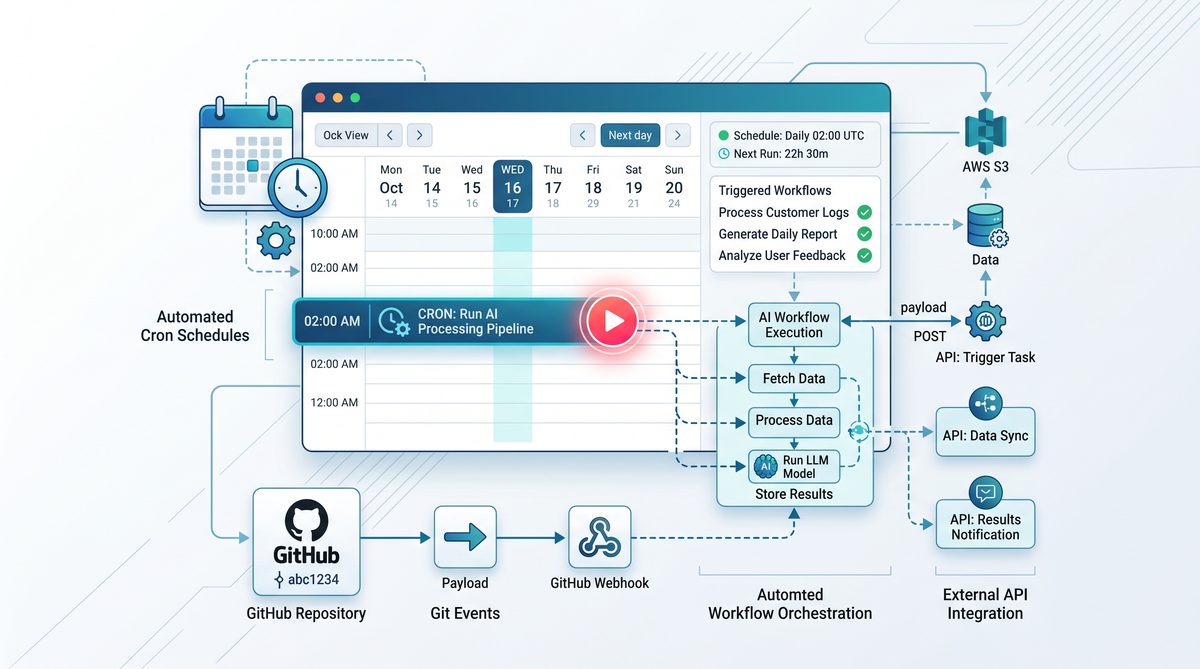
Automation is most effective when it can be triggered naturally within existing development workflows or on a predictable schedule. Claude Managed Agents support flexible scheduling options, enabling developers to set up automated routines using familiar tools such as cron schedules or GitHub webhooks.
Cron scheduling allows tasks to be executed at specific times or intervals, supporting use cases like periodic data processing, system maintenance, or report generation. Alternatively, GitHub webhook integration enables event-driven automation, triggering workflows in response to code pushes, pull requests, or issue events. This capability is particularly valuable for continuous integration and deployment pipelines, where automation must react promptly to changes in the codebase.
By combining robust scheduling with intelligent execution and checkpointing, Claude Managed Agents provide a comprehensive platform for building end-to-end automated workflows that integrate seamlessly with modern software development practices.
Comparison of Key Features in Claude Managed Agents
| Feature | Description | Benefits | Use Cases |
|---|---|---|---|
| Sandboxed Code Execution | Isolated runtime environments with resource limits | Security, stability, predictable resource usage | Running untrusted scripts, multi-language workflows |
| Checkpointing | State saving for workflow progress and recovery | Fault tolerance, efficiency, resuming long tasks | Data pipelines, multi-step automation |
| Credential Scoping | Dynamic and minimal privilege access control | Enhanced security, compliance, reduced attack surface | API integrations, secret management |
| Advisor Strategy (Haiku + Opus) | Hybrid AI model orchestration for task execution | Optimized performance and problem-solving depth | Routine automation, complex decision workflows |
| Scheduling & Integration | Cron-based and webhook-triggered automation | Flexible triggers, seamless CI/CD integration | Periodic jobs, event-driven workflows |
Writing effective instructions for autonomous agents requires a fundamentally different approach than traditional prompt engineering. Our guide on prompting AI agents for Codex, Claude Code, and autonomous systems covers the specific techniques needed to define clear objectives, set appropriate guardrails, and structure multi-step task decomposition for agentic workflows.
Real-World Applications and Enterprise Implications of Claude Managed Agents
Claude Managed Agents represent a transformative advancement in the automation of complex workflows, enabling enterprises to streamline operations, reduce human error, and scale cognitive tasks efficiently. By leveraging sandboxed code execution, checkpointing, and credential scoping, organizations can build robust, secure, and adaptable automation pipelines that integrate seamlessly with existing infrastructure. The advisor strategy, which intelligently delegates tasks between Haiku for routine executions and Opus for more complex scenarios, enhances reliability and decision-making precision. In this section, we explore practical use cases, workflow architectures, and the broader enterprise impact of adopting Claude Managed Agents.
Automating DevOps and Continuous Integration Pipelines
Enterprises increasingly rely on continuous integration and continuous deployment (CI/CD) to maintain rapid development cycles while ensuring code quality and security. Claude Managed Agents can serve as autonomous operators within DevOps pipelines by:
- Automated Code Reviews: Using Claude’s natural language understanding, agents can perform preliminary code reviews, flagging potential bugs and style inconsistencies before human intervention.
- Sandboxed Testing Environments: Through sandboxed code execution, agents safely run test suites in isolated environments, minimizing risks associated with untrusted code.
- Dynamic Rollback Strategies: With checkpointing capabilities, workflows can capture stable states, enabling reliable rollback in case of deployment failures.
- Credential Scoped Access: Agents manage sensitive credentials with scoped permissions, reducing the attack surface for deployment keys and tokens.
By integrating with cron schedules or GitHub webhooks, Claude Managed Agents can trigger these DevOps tasks automatically in response to code commits, pull requests, or scheduled maintenance windows, significantly accelerating release cycles while maintaining rigorous quality control.
Intelligent Customer Support Automation
Customer support teams can leverage Claude Managed Agents to automate routine inquiries and escalate complex issues dynamically. The hybrid advisor strategy—utilizing Haiku for straightforward queries and Opus for nuanced cases—ensures a high-quality customer experience while optimizing resource allocation:
- Routine Query Handling: Haiku-driven agents can quickly resolve common questions such as account status, password resets, or order tracking without human intervention.
- Contextual Escalations: When queries exceed predefined thresholds of complexity or ambiguity, the Opus advisor steps in, using advanced reasoning to provide detailed responses or route the issue to specialized support staff.
- Session Checkpointing: Maintaining conversation state allows agents to pick up interactions midstream, preserving context across multiple touchpoints and channels.
- Credential Scoping for Sensitive Data: Agents access customer data with strictly scoped permissions, safeguarding privacy and compliance with regulations such as GDPR and HIPAA.
Automated workflows can be triggered by external events such as support ticket creation or webhook notifications from CRM systems, ensuring timely and consistent responses with minimal manual effort.
Data Pipeline Orchestration and Monitoring
In data-driven enterprises, managing complex ETL (Extract, Transform, Load) pipelines and ensuring data integrity are critical tasks. Claude Managed Agents offer a programmable, autonomous layer to orchestrate and monitor these pipelines:
- Scheduled Data Processing: Using cron-triggered routines, data ingestion and transformation tasks can be executed on reliable schedules, reducing manual intervention.
- Adaptive Error Handling: Checkpointing enables agents to resume data processing from the last known good state, minimizing data loss and processing overhead in case of failures.
- Credential Scoped Access to Data Sources: Agents connect to databases, APIs, and storage systems with least privilege access, enhancing security and auditability.
- Intelligent Anomaly Detection: By integrating Opus for complex pattern recognition, agents can proactively identify outliers or inconsistencies and trigger alerts or remediation workflows.
These capabilities enable organizations to maintain high data quality, improve operational resilience, and reduce time-to-insight in analytics initiatives.
Enterprise Security and Compliance Automation
Security operations centers (SOCs) and compliance teams face an ongoing challenge to monitor, respond to, and document security events across sprawling IT environments. Claude Managed Agents can automate many facets of this process:
- Automated Threat Detection: Leveraging sandboxed execution, agents analyze suspicious files or code in isolation, preventing potential lateral movement of malware.
- Incident Response Orchestration: Checkpointing enables safe rollback of system configurations or network changes, while credential scoping ensures actions are performed with appropriate authority.
- Regulatory Compliance Auditing: Agents can autonomously parse logs and configuration files, generating compliance reports and identifying deviations from policy.
- Dynamic Playbook Execution: Using the advisor strategy, routine security alerts are handled by Haiku for rapid response, while complex incidents invoke Opus to guide nuanced remediation.
By embedding these automated routines into existing security frameworks, enterprises enhance their security posture and reduce the burden on human analysts.
Enhancing Collaboration and Knowledge Management
Claude Managed Agents can also facilitate enterprise collaboration by automating knowledge curation and dissemination workflows:
- Automated Meeting Summaries: Agents transcribe and summarize meeting notes, then checkpoint progress to enable iterative refinement.
- Contextual Document Retrieval: Using scoped credential access, agents fetch relevant documents from internal repositories or cloud storage.
- Scheduled Knowledge Base Updates: Cron-triggered routines ensure that knowledge bases remain current by automatically integrating new insights or feedback from teams.
- Multi-Advisor Content Generation: The advisor strategy balances routine documentation tasks with in-depth content creation, adapting to varying complexity levels.
Small and medium businesses can leverage these same managed agent capabilities without enterprise-scale infrastructure. Our comprehensive guide to 15 agentic workflows for small businesses using Claude demonstrates practical automation patterns including customer support triage, invoice processing, and content scheduling that can be implemented with minimal technical overhead.
Conclusion: Strategic Enterprise Adoption
Claude Managed Agents offer enterprises a powerful framework for building secure, scalable, and intelligent automated workflows. The combination of sandboxed execution, checkpointing, credential scoping, and the advisor strategy enables organizations to tackle diverse operational challenges with confidence. Whether automating DevOps pipelines, enhancing customer engagement, orchestrating data workflows, or reinforcing security operations, these agents provide a flexible and reliable automation backbone. As enterprises continue to embrace AI-driven process automation, Claude Managed Agents will be instrumental in driving innovation, cost efficiency, and competitive advantage.
Advanced Optimization and Best Practices for Claude Managed Agents
As you progress in building automated workflows with Claude Managed Agents, optimizing performance and ensuring robustness become paramount. This final section delves into advanced strategies for fine-tuning your agent deployments, improving fault tolerance, and maintaining security while leveraging the full potential of Claude’s architecture.
Fine-Tuning the Advisor Strategy
The advisor strategy—leveraging Haiku for routine execution and Opus for complex, edge cases—is a powerful design pattern. To maximize its effectiveness, consider implementing dynamic routing based on real-time workload analysis. By monitoring task complexity and success rates, your system can automatically determine when to escalate to Opus or fallback to Haiku, thus optimizing resource allocation and response times.
- Adaptive Thresholds: Use historical data to set thresholds for when tasks should be handled by Haiku versus Opus, adjusting these thresholds as your workflows evolve.
- Load Balancing: Distribute workloads evenly across multiple instances of Haiku and Opus agents to prevent bottlenecks and ensure high availability.
- Graceful Fallbacks: Implement retry mechanisms and fallback strategies in case one agent type encounters failures or latency issues.
Enhancing Sandboxed Code Execution
Sandboxing remains a critical component for securing code execution within Claude Managed Agents. To enhance this environment:
- Resource Limiting: Enforce CPU, memory, and I/O limits on sandboxed environments to prevent runaway processes and ensure fair resource distribution.
- Immutable Environments: Use containerization or ephemeral environments that reset after execution to avoid persistence of malicious code or unintended side effects.
- Audit Logging: Maintain detailed logs of code execution within sandboxes to facilitate debugging and security audits.
Improving Checkpointing and State Management
Checkpointing enables resilient workflows that can recover gracefully from failures or interruptions. Advanced checkpointing strategies include:
- Incremental Checkpoints: Save only the changes since the last checkpoint to reduce storage overhead and speed up recovery.
- Distributed State Stores: Use distributed databases or cloud storage to persist checkpoints, ensuring availability across multiple agent instances and regional deployments.
- Consistency Guarantees: Implement transactional checkpointing to avoid corrupted states and ensure that rollbacks do not lead to inconsistent workflow outcomes.
Credential Scoping and Security Best Practices
Managing credentials securely is crucial for automated workflows that interact with external services or infrastructure. Best practices include:
- Least Privilege Principle: Scope credentials narrowly, granting only the minimum access necessary for each agent or task.
- Secrets Rotation: Automate the rotation of keys and tokens to reduce the risk of credential leakage.
- Environment Isolation: Separate credentials by environment (development, staging, production) and ensure agents cannot cross boundaries.
- Audit Trails: Track credential usage and access patterns to detect anomalies or unauthorized access.
Scheduling and Event-Driven Automation
Integrating Claude Managed Agents with cron schedules and GitHub webhooks enables powerful event-driven automation. To optimize these integrations:
- Rate Limiting: Handle bursty webhook traffic gracefully by queuing or throttling incoming events.
- Idempotency: Design workflows to be idempotent to avoid unintended side effects from repeated events.
- Monitoring and Alerts: Implement observability tooling to monitor scheduled jobs and webhook-triggered workflows, with alerts for failures or anomalies.
By embracing these advanced techniques, you can build resilient, scalable, and secure automated workflows that fully leverage Claude Managed Agents’ capabilities.
Emerging Trends and Future Directions in AI-Driven Workflow Automation
The field of AI-driven workflow automation is rapidly evolving, and Claude Managed Agents are at the forefront of this transformation. Several emerging trends and future developments are poised to further enhance the capabilities and impact of managed agents in enterprise environments.
Integration of Multi-Modal AI Capabilities
Future iterations of Claude Managed Agents are expected to incorporate multi-modal AI models capable of processing and synthesizing information from diverse data types including text, images, audio, and video. This will enable agents to understand richer contexts and perform more complex tasks such as analyzing visual data streams, interpreting voice commands, or generating multimedia content as part of automated workflows.
For example, in manufacturing quality control, an agent could analyze real-time video feeds of production lines combined with sensor data to detect anomalies and trigger corrective actions automatically. This fusion of modalities will unlock new automation scenarios previously infeasible with text-only processing.
Advanced Autonomous Decision-Making and Explainability
As AI models grow more sophisticated, Claude Managed Agents will increasingly support autonomous decision-making with built-in explainability features. Agents will not only execute complex workflows but also provide detailed rationales for their decisions, enabling human supervisors to understand, audit, and trust automated outcomes.
This advancement is particularly critical in regulated industries such as healthcare, finance, and legal sectors where transparency and accountability are mandatory. By integrating explainable AI (XAI) frameworks, Claude Managed Agents will facilitate compliance and foster human-AI collaboration by allowing users to interrogate the reasoning behind agent actions and intervene when necessary.
Case Study: Autonomous Incident Management in Cloud Infrastructure
Consider a large-scale cloud service provider leveraging Claude Managed Agents to automate incident detection and remediation. Agents continuously monitor infrastructure metrics, logs, and alerts. Upon identifying a potential outage, the advisor strategy routes routine alerts to Haiku for immediate mitigation steps, such as restarting services or clearing caches.
If the issue persists or exhibits complex behavior, the workflow escalates to Opus, which analyzes correlated events across multiple services, predicts root causes using historical incident data, and recommends targeted interventions. The checkpointing system preserves state throughout the incident lifecycle, enabling smooth handoffs between automated agents and human operators if escalation is required.
This autonomous incident management reduces mean time to resolution (MTTR), minimizes downtime, and optimizes operational costs by balancing automation with human expertise. The approach also ensures security by scoping credentials strictly to incident response actions, preventing unauthorized access during remediation.
Claude Managed Agents in Edge Computing and IoT Environments
With the proliferation of Internet of Things (IoT) devices and edge computing architectures, there is a growing need for intelligent, autonomous agents capable of operating in distributed, resource-constrained environments. Claude Managed Agents are uniquely positioned to meet these challenges through lightweight sandboxing, adaptive advisor strategies, and secure credential management.
Deploying Agents on Edge Nodes
Edge nodes often have limited compute and storage capabilities, yet require real-time processing and decision-making close to data sources. Claude Managed Agents’ modular architecture allows deployment of simplified agent instances optimized for edge environments. These edge agents can perform localized data filtering, anomaly detection, and preliminary decision-making using Haiku, while deferring complex analysis to centralized Opus instances when connectivity permits.
This hierarchical execution model reduces latency, conserves bandwidth, and enhances privacy by processing sensitive data locally. For example, in smart cities, edge agents embedded in traffic cameras and sensors can autonomously manage traffic flows, detect incidents, and coordinate with cloud-based systems for broader analytics and planning.
Security and Credential Management at the Edge
Edge deployments introduce additional security considerations, including device tampering and intermittent network connectivity. Claude Managed Agents address these through robust credential scoping tailored for edge scenarios, leveraging hardware security modules (HSMs) or trusted platform modules (TPMs) to securely store and manage keys locally.
Agents dynamically authenticate with cloud services using short-lived, scoped credentials, minimizing exposure. Additionally, checkpointing mechanisms enable agents to persist state locally during offline periods and synchronize with central orchestrators once connectivity is restored, ensuring continuity and consistency across distributed deployments.
Use Case: Industrial IoT Predictive Maintenance
In an industrial setting, Claude Managed Agents deployed on edge gateways collect sensor data from machinery, preprocess it, and detect early signs of wear or failure. The agent’s advisor strategy employs Haiku for routine threshold-based alerts and escalates to Opus for complex pattern recognition and predictive analytics.
Upon detecting a potential fault, the agent can automatically schedule maintenance tasks, order replacement parts via integrated supply chain APIs, and update asset management systems—all while operating securely within sandboxed environments with scoped credentials. This autonomous, edge-centric approach reduces downtime and maintenance costs while improving operational safety.
Conclusion
Claude Managed Agents represent a significant leap forward in automating complex workflows by combining advanced AI-driven execution with robust infrastructure features like sandboxed code execution, checkpointing, and credential scoping. The advisor strategy, using Haiku for common cases and Opus for more challenging tasks, provides a scalable and efficient framework for handling varying workflow demands.
This tutorial has walked you through the foundational elements of setting up Claude Managed Agents, from sandboxing your code securely to implementing checkpointing for fault tolerance, and effectively scoping credentials to maintain security. Additionally, scheduling automation using cron jobs or GitHub webhooks unlocks powerful event-driven capabilities, enabling seamless integration into modern CI/CD pipelines and operational workflows.
As you adopt Claude Managed Agents, focus on continuous improvement by monitoring your workflows, refining your advisor strategy, and applying best practices for security and resource management. These agents not only streamline automation but also provide the flexibility and control needed to handle real-world complexities with confidence.
Ultimately, Claude Managed Agents empower developers and operations teams to build intelligent, autonomous systems that reduce manual overhead, improve reliability, and accelerate innovation. By investing time in mastering these tools and concepts, you position yourself at the forefront of next-generation automation powered by AI.
Useful Links
- Claude Managed Agents Official Documentation – Anthropic
- Haiku Language and Runtime
- Opus AI Platform
- GitHub Actions Documentation
- Kubernetes Pod Security Standards
Access 40,000+ AI Prompts for ChatGPT, Claude & Codex — Free!
Subscribe to get instant access to our complete Notion Prompt Library — the largest curated collection of prompts for ChatGPT, Claude, OpenAI Codex, and other leading AI models. Optimized for real-world workflows across coding, research, content creation, and business.
