
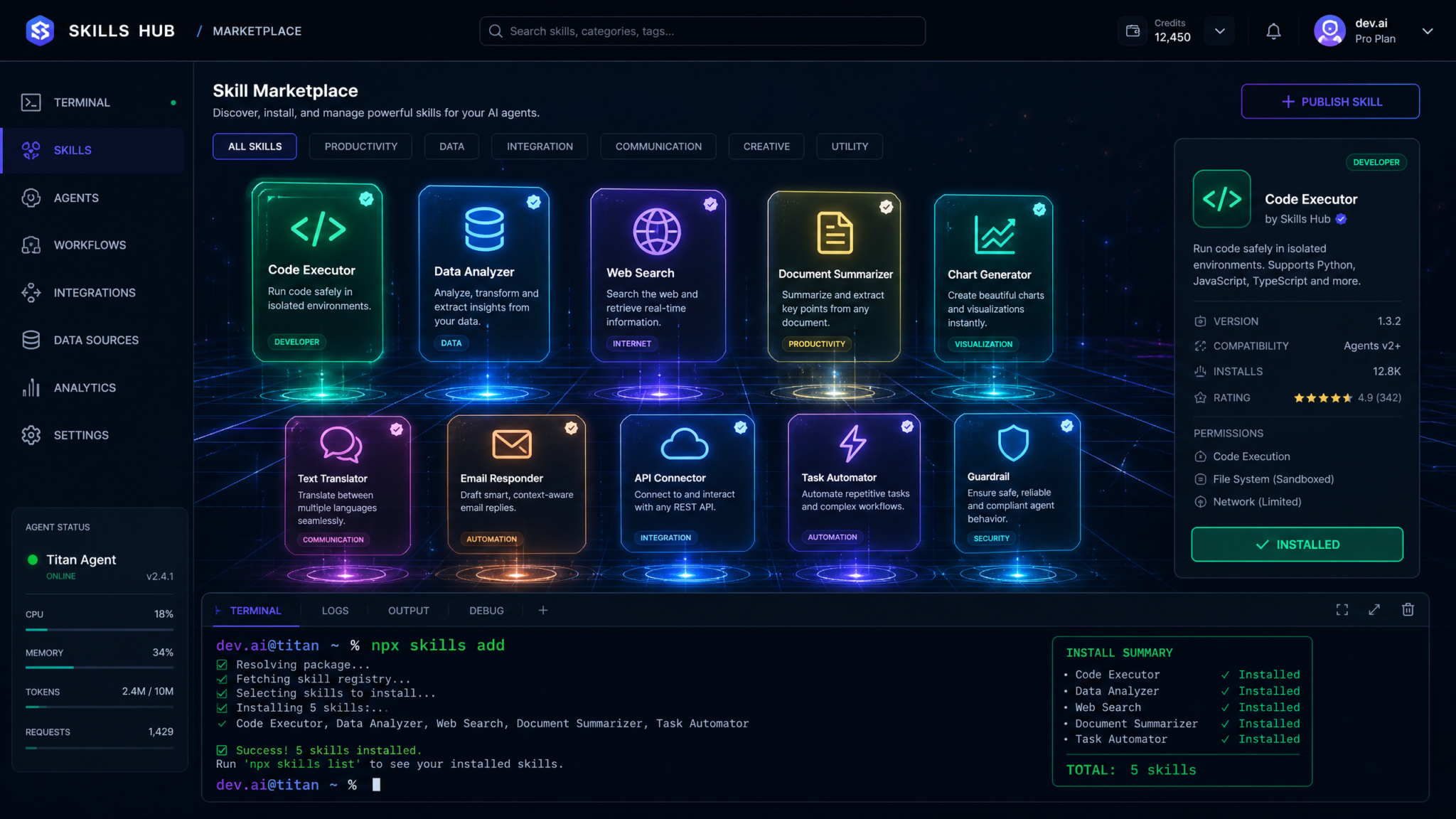
OpenAI Launches Skills.sh — The npm for AI Agent Skills (News)
Editor’s note: As of the publication date, “Skills.sh” and the “Agent Skills standard” described below are a conceptual, forward-looking exploration, not a confirmed or released OpenAI product. This article presents a hypothetical design and industry analysis to help readers reason about what a package manager and open standard for AI agent skills could look like and why it would matter.
Keywords: Skills.sh, Agent Skills standard, AI agents, developer tooling, package registry, npm for AI.
What Is Skills.sh?
Imagine a world where AI agents are as composable as modern web applications: you don’t rewrite a payments processor, you install one; you don’t hand-roll a calendar connector, you add it; you don’t custom-build a data wrangler, you fetch it. That is the core idea behind Skills.sh—an npm-like ecosystem for AI agent capabilities—and a complementary Agent Skills standard that defines a common way to describe, version, test, secure, and run those capabilities across frameworks and vendors.
In this conceptual design, Skills.sh would provide:
- A public and private registry for agent “skills”—reusable, permissioned capabilities packaged with metadata, tests, and contracts. Skills.sh
- A CLI and SDKs to init, build, test, sign, publish, install, and update skills across environments. CLI
- A manifest-driven Agent Skills standard so that any compliant agent runtime can discover and execute a skill, enforce its permissions, and reason about its inputs/outputs. Agent Skills standard
- Security primitives: signing, verification, sandbox policies, runtime resource limits, observability hooks, and organization-level allow/deny controls. Security
- Interoperability with existing agent frameworks and orchestration tools, reducing glue code and bespoke integrations. Interoperability
The analogy to npm is deliberate. Just as npm fueled JavaScript’s explosion by making it trivial to share libraries and services, Skills.sh (conceptually) aims to do the same for AI agents—turning bespoke integrations into standard, discoverable, testable, and composable building blocks that can be reused across agents, assistants, and autonomous workflows.
But unlike npm packages, skills must represent more than code. They must also capture:
- Capabilities and constraints: What the skill can do and under what policies.
- External integrations and scopes: OAuth permissions, API quotas, and data boundaries.
- Safety and compliance features: PII handling, logging, redaction, and audit trails.
- Determinism/variance profiles: How predictable the skill is, given the stochastic nature of LLMs.
By codifying these as standardized metadata, the Agent Skills standard can enable agents from different vendors to install the same skill and reason about how and when to invoke it.
Why an Agent Skills standard Matters
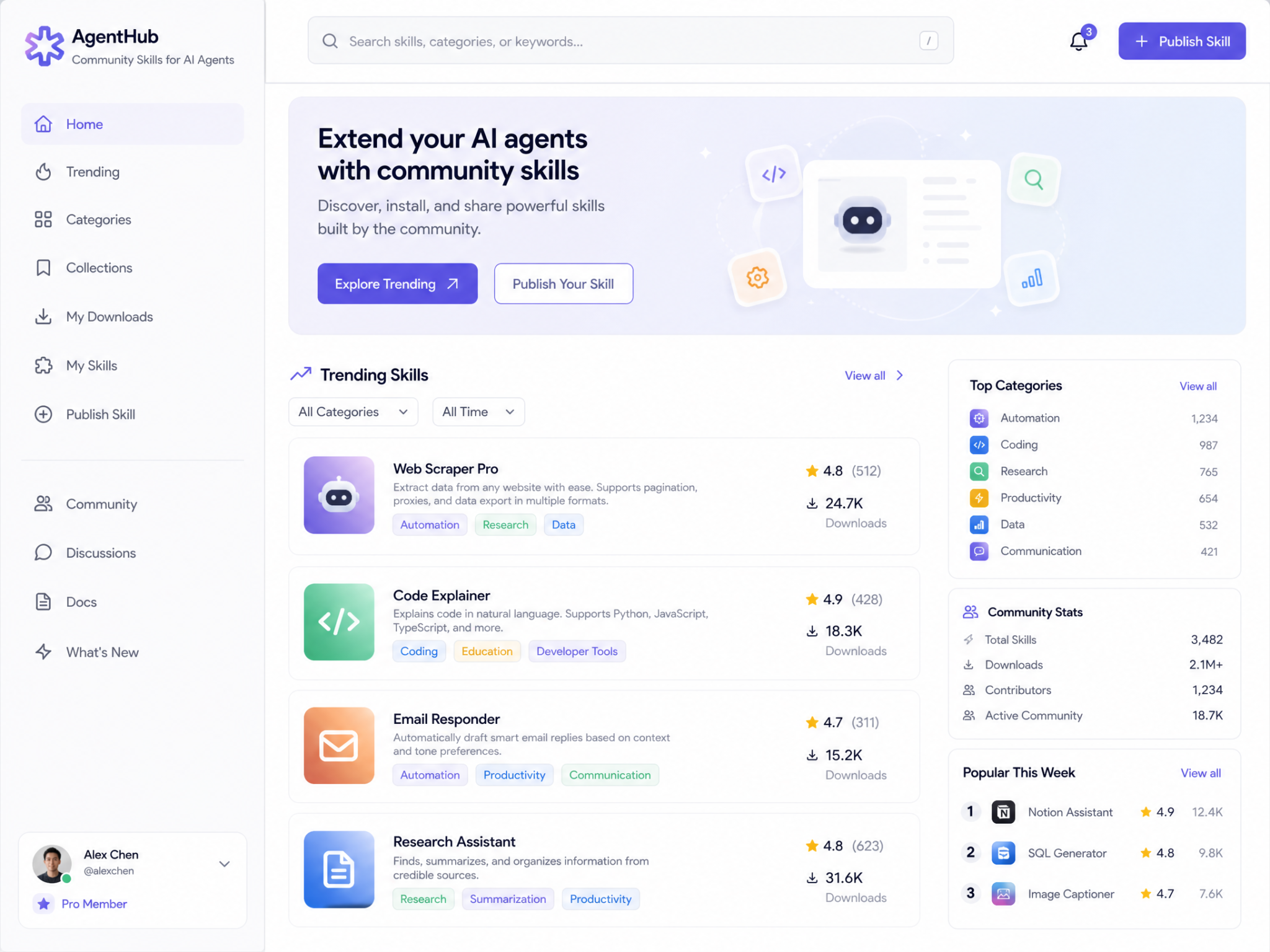
Agent ecosystems today are fractured. Custom tools are tailored to specific frameworks, each with its own definition of a “tool” or “function,” its own approach to permissions, and its own packaging conventions. The result: duplicated effort, fragmented best practices, and brittle integrations. A broadly adopted Agent Skills standard could change that by doing for agents what OpenAPI did for REST APIs: creating a lingua franca for discovery and integration. Agent Skills standard
Key motivations
- Interoperability: Write a skill once, run it anywhere compliant. Interoperability
- Security and compliance: Bake policies and proofs into the package—don’t bolt them on later. Security
- Economics: Enable a marketplace where skill authors monetize usage while enterprises control exposure. Marketplace
- Velocity: Let developers focus on differentiated logic instead of boilerplate connectors and one-off tooling. Developer productivity
- Observability: Standardize metrics and traces for agent-tool interactions so organizations can debug and govern at scale. Observability
In short, standardization would make agent development safer, faster, and more composable—and make it possible for organizations to build policy-aligned, multi-agent systems from a shared ecosystem of vetted parts. That’s the promise behind the concept of Skills.sh.
Anatomy of a Skill: Manifests, Capabilities, Contracts
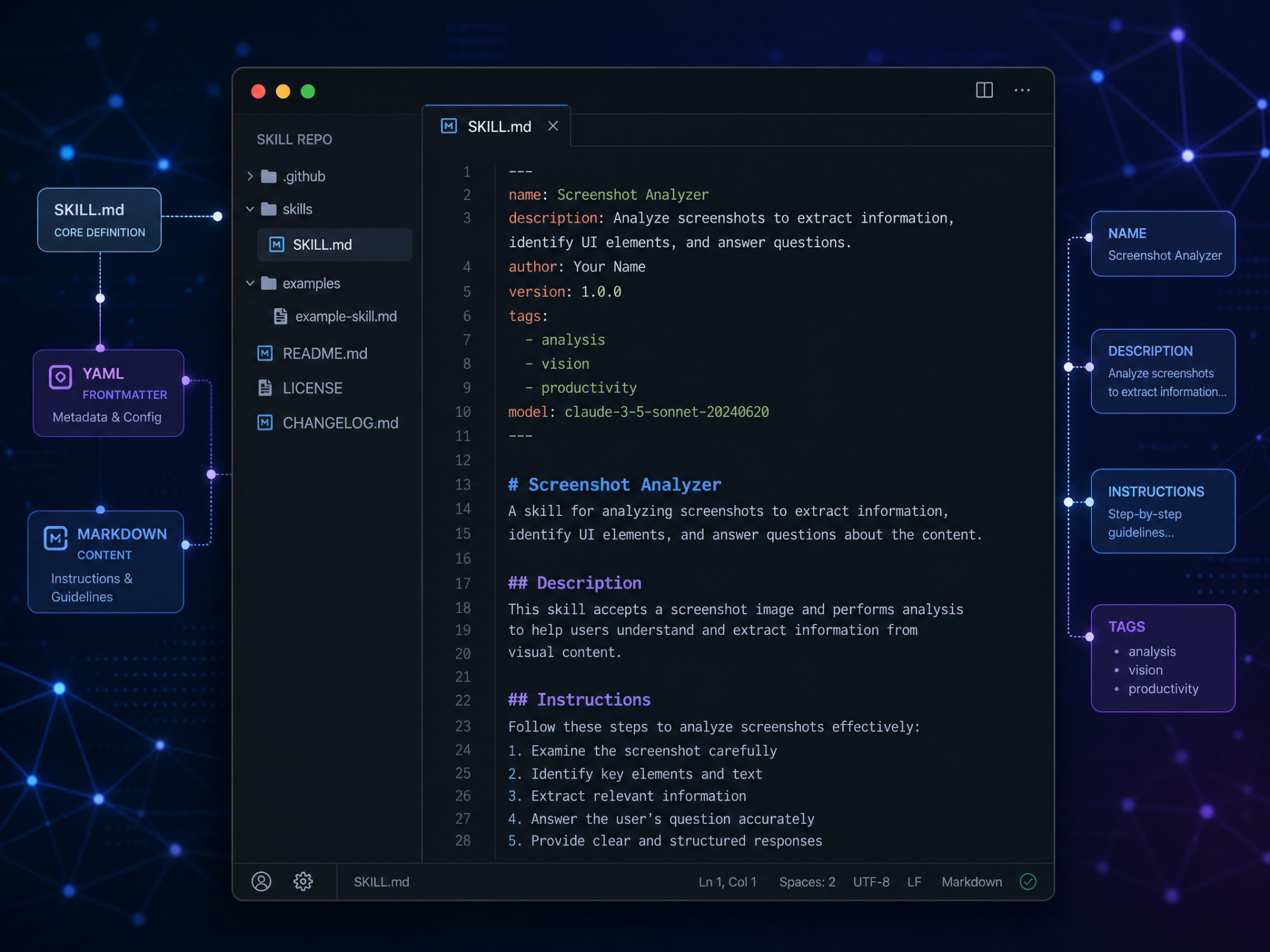
A skill is a package containing code, configuration, and a manifest that declares capabilities, contracts, and policies. Think of it as a self-describing module an agent can call with confidence. At the center lies the Agent Skills standard manifest, which might look like this:
{
  "schemaVersion": "1.0.0",
  "name": "@acme/calendar-sync",
  "version": "2.1.3",
  "description": "Bidirectional calendar sync with conflict resolution and natural-language intents.",
  "license": "Apache-2.0",
  "keywords": ["calendar", "sync", "calendar api", "scheduling", "productivity"],
  "authors": [
    {"name": "Acme AI", "email": "[email protected]", "url": "https://acme.ai"}
  ],
  "entrypoints": {
    "tool": "./dist/index.js",
    "http": "./dist/server.js"
  },
  "interfaces": {
    "functions": [
      {
        "name": "create_event",
        "description": "Create a calendar event with attendees and reminders.",
        "input": {
          "$schema": "https://json-schema.org/draft/2020-12/schema",
          "type": "object",
          "properties": {
            "title": {"type": "string"},
            "start": {"type": "string", "format": "date-time"},
            "end": {"type": "string", "format": "date-time"},
            "attendees": {
              "type": "array",
              "items": {"type": "string", "format": "email"}
            },
            "location": {"type": "string"},
            "reminder_minutes": {"type": "integer", "minimum": 0}
          },
          "required": ["title", "start", "end"],
          "additionalProperties": false
        },
        "output": {
          "type": "object",
          "properties": {
            "event_id": {"type": "string"},
            "status": {"type": "string", "enum": ["created", "updated"]},
            "conflicts": {"type": "array", "items": {"type": "string"}}
          },
          "required": ["event_id", "status"]
        },
        "determinism": "idempotent",
        "retryPolicy": {"max": 2, "backoff": "exponential"},
        "sideEffects": ["external-api", "calendar-write"]
      }
    ]
  },
  "permissions": {
    "oauth": [
      {
        "provider": "google",
        "scopes": ["calendar.events.readonly", "calendar.events"],
        "grantType": "authorization_code"
      }
    ],
    "network": {
      "allow": ["*.googleapis.com", "idp.acme.ai"],
      "deny": ["*"]
    },
    "filesystem": {"read": [], "write": []}
  },
  "policies": {
    "pii": {"collection": "minimal", "retentionDays": 0, "masking": "email"},
    "gdpr": {"dpaRequired": true}
  },
  "runtime": {
    "language": "nodejs18",
    "memoryMB": 512,
    "cpuShares": 1,
    "timeoutSeconds": 15,
    "concurrency": 8
  },
  "testing": {
    "golden": "./tests/golden/*.json",
    "integration": "./tests/integration/*.spec.js"
  },
  "signing": {"sigstore": true},
  "slsa": {"level": "L3"},
  "attestations": [
    {"type": "vuln-scan", "result": "clean", "tool": "osv-scanner", "date": "2026-07-10"}
  ]
}
Several design goals emerge from this style of manifest:
- Self-describing contracts: Strict input/output schemas make a skill predictable for both agents and humans. Skill manifest
- Security-first: Permissions, network policies, and PII handling are declared up front and enforceable at runtime. Security
- Reproducibility: Signatures, SLSA attestations, and vulnerability scans travel with the artifact. Supply chain
- Performance: Runtime limits help agents reason about latency and cost; concurrency hints enable scheduling. Performance
Contract-first development
When implementing these advanced strategies, it is often helpful to reference our deeper analysis on Tool calling, which explores the technical nuances of ChatGPT Work vs Claude Cowork: The Definitive 2026 Comparison for Enterprise Teams in the context of modern AI workflows.
Determinism profiles
Not every skill is deterministic, and that’s okay—what matters is transparency. The Agent Skills standard can classify skills, for example:
- Pure: No side effects; same input yields same output.
- Idempotent: Has side effects, but repeated calls are safe.
- External: Depends on non-deterministic systems (e.g., search results).
- Stochastic: Uses LLM sampling internally; variance is bounded by tests. Deterministic Skills
Agents can then chain pure and idempotent skills more aggressively, retry stochastic ones carefully, and log external ones for audit.
Capabilities taxonomy
When implementing these advanced strategies, it is often helpful to reference our deeper analysis on Discovery, which explores the technical nuances of 40 ChatGPT-5.5 Prompts for UX Designers: User Journey Mapping, Wireframe Descriptions, Usability Testing Scripts, and Design System Documentation in the context of modern AI workflows.
Publishing and Installing: From init to publish
A credible Skills.sh experience lives or dies on developer ergonomics. The CLI should feel instantly familiar to anyone who’s used npm, pip, or cargo, but with supply-chain security as a first-class citizen.
Core CLI workflow
# Initialize a new skill
skills init

# Run local tests (golden + integration)
skills test

# Build a reproducible artifact with lockfiles and SBOM
skills build --sbom --lock --deterministic

# Sign with Sigstore and attach attestations (SLSA, vuln scan)
skills sign --sigstore --attest slsa.json --attest osv.json

# Publish to public or private registry
skills publish --registry registry.skills.sh --visibility public

# Discover and install
skills search "calendar sync"
skills install @acme/calendar-sync@^2

# Verify signatures and policies on install
skills verify @acme/calendar-sync
Private registries and org controls
Enterprises will want private registries with SSO, policy enforcement, and review workflows. For example:
- Scoped namespaces:
@finance/,@ml-platform/ - Policy gates: Only approved scopes and network egress allowlists
- Automated scanning: SBOM ingestion, CVE alerts, transitive dependency audits
- Change management: PR-based promotion from staging to production registries
Versioning and compatibility
When implementing these advanced strategies, it is often helpful to reference our deeper analysis on Semantic versioning, which explores the technical nuances of ChatGPT Work vs Claude Cowork: The Definitive 2026 Comparison for Enterprise Teams in the context of modern AI workflows.
Billing and metering
When implementing these advanced strategies, it is often helpful to reference our deeper analysis on Marketplace, which explores the technical nuances of How to Build a Codex Plugin: From Local Skill to Team Marketplace in 30 Minutes in the context of modern AI workflows.
Security, Trust, and Policy Controls
When implementing these advanced strategies, it is often helpful to reference our deeper analysis on Security, which explores the technical nuances of How AI Coding Agents Are Triggering Enterprise Security Alerts: What IT Teams Need to Know About Claude Code, Codex, and Cursor in the context of modern AI workflows.
Supply chain integrity
- Content-addressable storage: Packages identified by digest; tarballs match SBOM.
- Signing and transparency: Sigstore-style keyless signing with public logs.
- SLSA provenance: Build attestation links source, builder, and artifact.
- Reproducible builds: Deterministic outputs to verify against attestation. Supply chain
Runtime sandboxing
- Fine-grained permissions: Network, filesystem, environment, secrets vaults.
- Resource limits: CPU, memory, timeouts, concurrency, and cost budgets.
- Outbound request mediation: TLS pinning, DNS policies, HTTP verb restrictions.
- PII and compliance: Redaction, tokenization, and data residency controls.
Org-level governance
- Allow/Deny lists by namespace, author, license, and risk score.
- Automated approvals: Policy-as-code gates before install or upgrade. Governance
- Audit trails: Who installed what, where it ran, and what it touched.
Skill trust tiers
Not all skills are equal. A baseline could include:
- Community: Open-source, best-effort support.
- Verified: Identity and supply chain verified; passing security checks.
- Enterprise: SLA-backed, support contracts, additional compliance attestations.
Runtime Integration with Agents and Frameworks
The Agent Skills standard exists to make skills portable across runtimes. That means a compliant adapter can run the same capability in different environments without bespoke code. Interoperability
Adapters and shims
- OpenAI-style assistants: Map function schemas to tool calling automatically.
- LangChain/LlamaIndex/Semantic Kernel: Wrap skills as reusable tools/nodes.
- Autonomous agents: Use determinism profiles to plan retries and rollbacks.
- RPA/Workflow engines: Expose skills as tasks with SLAs and compensation logic.
Local vs. remote execution
When implementing these advanced strategies, it is often helpful to reference our deeper analysis on Execution modes, which explores the technical nuances of ChatGPT Work vs Claude Cowork: The Definitive 2026 Comparison for Enterprise Teams in the context of modern AI workflows.
Composability patterns
- Fan-out/Fan-in: Run multiple skills in parallel and merge results.
- Map/Reduce: Transform datasets through pure skills for reproducibility.
- Orchestration: Higher-order skills that coordinate other skills. Orchestration
How It Compares: npm, pip, Docker, and Model Hubs
Skills.sh borrows from familiar ecosystems but adds agent-specific constraints.
- npm/pip: Developer-first packaging and dependency management; Skills.sh adds permission manifests, attestations, and tool-calling contracts. npm for AI
- Docker/OCI: Image distribution and isolation; Skills.sh may support OCI-backed skills for heavy workloads.
- Model hubs: Distribute models; Skills.sh distributes capabilities that may wrap models, APIs, or both.
The core differentiator is the contract that agents can reason about—schemas, policies, and determinism—plus governance hook points to make safe automation possible at scale.
Use Cases and Business Impact
An ecosystem of reusable, governed capabilities can accelerate dozens of domains:
- Enterprise automation: Finance reconciliation, HR onboarding, compliance checks.
- Sales and marketing: CRM enrichment, outreach sequencing, lead scoring.
- Developer productivity: Issue triage, code refactoring, CI/CD release notes. Developer productivity
- Customer support: Ticket routing, RMA creation, knowledge base updates.
- Healthcare and legal: Document intake, redaction, structured extraction with auditability.
A marketplace layered on top of Skills.sh could enable new business models where specialists publish high-quality skills with SLAs while enterprises curate and govern their own catalogs.
Developer Experience: From Local Dev to CI/CD
For adoption, the DX must be delightful:
- Scaffolding:
skills initgenerates a manifest, tests, and stubs. - Type-safe clients: SDKs generate type-safe callers from JSON Schema.
- Local runner: Execute skills in a sandbox that mirrors production constraints.
- Templates: Opinionated samples for connectors, transforms, and orchestrators.
Testing pyramid
- Unit: Pure functions with 100% determinism.
- Golden: Fixed inputs with pinned model settings and expected outputs. Golden tests
- Integration: External APIs via test doubles or sandboxes.
- Chaos/Load: Stress permissions, timeouts, and retry policies.
CI/CD and policy-as-code
name: skills-ci

on:
  push:
    branches: [ main ]
  pull_request:

jobs:
  build-test-sign:
    runs-on: ubuntu-latest
    steps:
      - uses: actions/checkout@v4
      - uses: actions/setup-node@v4
        with:
          node-version: 18
      - run: npm ci
      - run: skills test --report junit.xml
      - run: skills build --sbom --lock
      - run: osv-scanner -r . > osv.json
      - run: skills sign --sigstore --attest slsa.json --attest osv.json
      - run: skills publish --registry ${{ secrets.SKILLS_REGISTRY }} --visibility private
      - run: skills verify @acme/calendar-sync
Observability and Testing for Deterministic Skills
The standard can define tracing spans for every skill invocation, standard metrics, and structured logs for troubleshooting:
- Traces: Tool selection, argument generation, validation, execution, retries.
- Metrics: P50/P95 latency, success rate, cold starts, token usage, cost.
- Logs: Redacted inputs/outputs, error classes, policy decisions, attestations.
Golden traces
When implementing these advanced strategies, it is often helpful to reference our deeper analysis on Golden tests, which explores the technical nuances of ChatGPT Work vs Claude Cowork: The Definitive 2026 Comparison for Enterprise Teams in the context of modern AI workflows.
Governance, Licensing, and Ecosystem Health
A thriving registry needs clear rules and incentives:
- Licensing: SPDX identifiers; clarity on usage rights for models and datasets.
- Content moderation: Takedown policies, security advisories, and dispute resolution.
- Quality signals: Verified badges, test coverage, maintenance scores, and responsiveness.
- Community processes: RFCs for evolving the Agent Skills standard.
When implementing these advanced strategies, it is often helpful to reference our deeper analysis on Governance, which explores the technical nuances of Inside the Codex Plugin Ecosystem: How 20+ Integrations Are Reshaping Enterprise AI Development in the context of modern AI workflows.
A Possible Roadmap and Open Questions
If an initiative like Skills.sh were to launch, a pragmatic roadmap might look like:
- Developer preview: Small set of official skills, a public registry beta, and a draft Agent Skills standard spec.
- Ecosystem pilots: Partnerships with leading agent frameworks and select enterprises.
- Security hardening: Sigstore integration, SBOM tooling, and private registries.
- Marketplace beta: Usage metering, billing, and SLAs.
- Open governance: Standardization under a multi-stakeholder body.
Open questions
- Portability vs. performance: How to balance a portable interface with framework-specific optimizations?
- Skill composition: How to define policies when one skill invokes others?
- Economics: How to prevent “race to the bottom” while rewarding quality?
- Safety: How to encode and enforce content and action safety reliably across vendors?
- Debuggability: What’s the minimum viable observability spec an agent must expose? Observability
Reminder: This section is speculative and outlines what a plausible roadmap could include for a product like Skills.sh. It is not a statement of fact about any company’s plans.
FAQ
Is Skills.sh a real product?
As of this writing, no. This article explores a conceptual design and its potential impact. It uses the term “launch” as part of a news-style framing but clearly labels the content as hypothetical.
How is this different from just shipping code libraries?
When implementing these advanced strategies, it is often helpful to reference our deeper analysis on Skill manifest, which explores the technical nuances of ChatGPT Work vs Claude Cowork: The Definitive 2026 Comparison for Enterprise Teams in the context of modern AI workflows.
Can existing tools be wrapped as skills?
When implementing these advanced strategies, it is often helpful to reference our deeper analysis on Interoperability, which explores the technical nuances of ChatGPT Work vs Claude Cowork: The Definitive 2026 Comparison for Enterprise Teams in the context of modern AI workflows.
What about privacy and compliance?
When implementing these advanced strategies, it is often helpful to reference our deeper analysis on Security, which explores the technical nuances of How AI Coding Agents Are Triggering Enterprise Security Alerts: What IT Teams Need to Know About Claude Code, Codex, and Cursor in the context of modern AI workflows.
How do agents decide when to call a skill?
When implementing these advanced strategies, it is often helpful to reference our deeper analysis on Tool calling, which explores the technical nuances of ChatGPT Work vs Claude Cowork: The Definitive 2026 Comparison for Enterprise Teams in the context of modern AI workflows.
What if a skill becomes unmaintained?
When implementing these advanced strategies, it is often helpful to reference our deeper analysis on Semantic versioning, which explores the technical nuances of ChatGPT Work vs Claude Cowork: The Definitive 2026 Comparison for Enterprise Teams in the context of modern AI workflows.
Bottom Line
Packaging reusable, permissioned capabilities behind a shared Agent Skills standard—and distributing them via a developer-friendly registry like the conceptual Skills.sh—could be the missing abstraction that propels agent ecosystems from bespoke experiments to dependable, enterprise-ready platforms. While this article is a hypothetical exploration, the needs it addresses—interoperability, security, observability, and velocity—are very real. Whether under this name or another, an npm-for-agents feels less like a question of if and more a question of when and how.
